penalties

World Cup 2026: What’s going on with penalties – is it time to end the ‘stutter’?

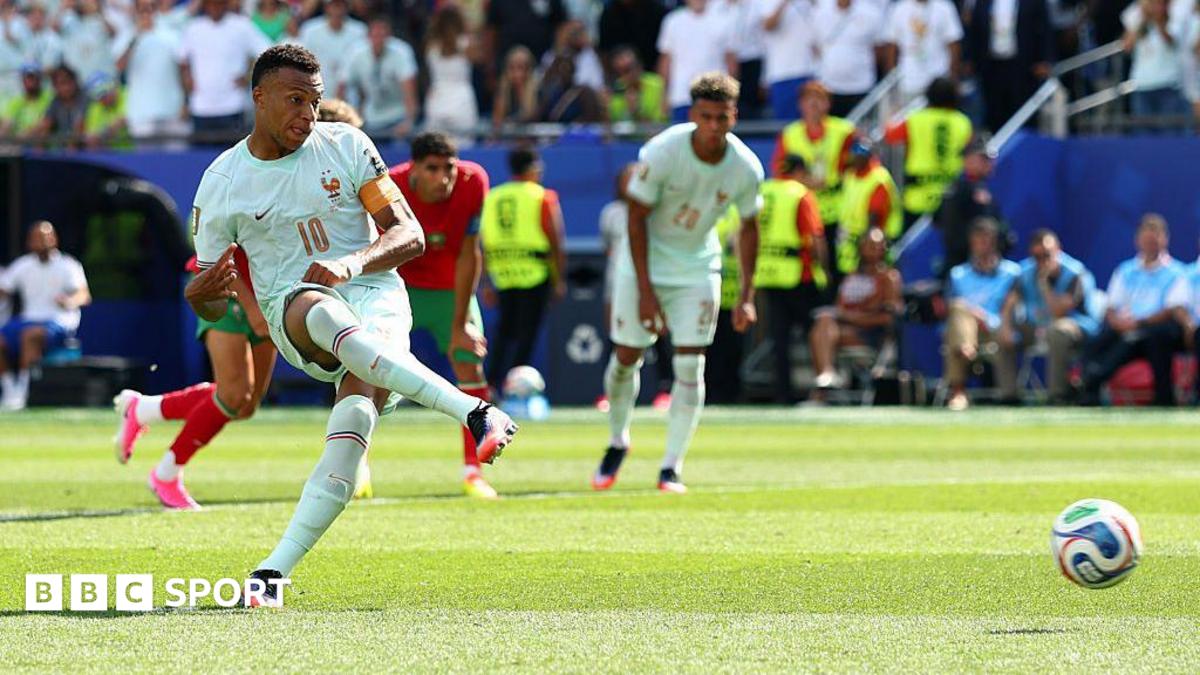
Whether or not France’s World Cup campaign ends with a third world title, few will remember Kylian Mbappe’s penalty miss in their quarter-final victory over Morocco.

The match in Foxborough was goalless when Mbappe was fouled by Noussair Mazraoui. The France captain stuttered in his run up, looked up at goalkeeper Yassine Bounou, and saw his tame penalty easily saved.

Mbappe made amends on the hour mark when his sensational curling effort broke a stubborn Morocco defence, before Ousmane Dembele doubled France’s lead six minutes later to secure a 2-0 win.

But his earlier blunder, uncharacteristic for the joint-top scorer in this tournament, begs the question: Is it time players stopped with the ‘stuttering’ penalty kicks?

In the list of things football traditionalists hate about the modern game, stuttering run ups are high up alongside players wearing gloves with short sleeve shirts, diving, and of course the video assistant referee (VAR).

There is no strict definition of a stutter, but under Fifa rules, a player is allowed to stop or feint during the run-up as long as they don’t do it directly before kicking the ball.

It’s nothing new – John Aldridge, Mexico legend Hugo Sanchez and Pele all used the stutter to gain an advantage – but it can backfire spectacularly if the goalkeeper doesn’t commit to diving early.

Mbappe joins Bruno Guimaraes, Jorgen Strand Larsen, Lionel Messi and Harry Kane (though he was able to retake his penalty against Croatia, which he scored without having a stutter in his approach) in missing penalties after stuttering in the run-up.

Of the 26 ‘stutter’ penalties taken during this World Cup – penalty shootouts included – 11 have not been scored, which leads to a conversion rate of 57%.

“This stuttering penalty seems to be the one. The goalkeepers seem to have got a march on it now,” said Ian Wright on ITV.

Marko Arnautovic, Raul Jimenez, Neymar, Mbappe, Cristiano Ronalo, Yoane Wissa and Kai Havertz have used the technique successfully.

Meanwhile, 24 of the 35 ‘non-stutter’ penalties taken have been scored, a conversion rate of 68%.

In general, this has been a poor World Cup for players looking to convert from 12 yards.

A total of 30% of non-shootout penalties have been missed this summer, the second most of any World Cup since records began in 1966.

When shootout penalties are added to the equation, then the miss rate rises to 35%, the highest of any World Cup since 1966.

“There is an arms race going on. It is definitely harder to score a penalty now. The reason being, the goalkeepers are bigger now, more athletic,” former Scotland winger Pat Nevin said on BBC Radio 5 Live.

“If your keeper goes the right way, you must hit the side netting with pace, even then it still might be saved.

“A very good penalty is no longer a certainty, so you have to re-think it. I need to make sure he goes the wrong way, hence the stutter, you try to send them the wrong way.

“Of course the goalkeepers have the data, they know what everybody does, there is no hiding what you prefer because it shows up. There is a constant running battle to figure out how you get the advantage.

“Mbappe knows what his advantage is: preparation. He has a set up [placing the ball before taking the penalty], he went through it twice today but problem is that he had to go through it three times, and the third time [he missed].”

Source link

After a Minnesota church protest, states are toughening penalties for disrupting services

At least four states have adopted laws this year making it a crime to disrupt worship services, a reaction to a high-profile protest inside a Minnesota church that prompted outrage from faith leaders.

The Republican lawmakers sponsoring most of the legislation say those gathering at sacred sanctuaries deserve protection beyond what existing trespassing laws provide. They also say these new laws will prevent escalating clashes between congregants and protestors as many churches, mosques and synagogues remain on edge over recent mass shootings and acts of violence targeting religious groups.

“People should go to church to be able to sit in peace, worship as they please, without having to worry about people coming in and harassing them,” said Idaho Sen. Mark Harris, a Republican who co-sponsored legislation criminalizing protests inside places of worship. “I think the thing that happened in Minnesota was kind of a shock to some of us, that churches would be used as a place to berate people.”

Critics in both parties have warned that the laws infringe on free speech rights.

Here’s a look at the situation.

The laws make it a crime to interfere with worship

Bills have been signed into law in Republican-dominated Idaho, Louisiana and Oklahoma. In Kansas, a bill is becoming law without the signature of Democratic Gov. Laura Kelly.

Similar bills have been introduced for this year’s legislative sessions in at least seven other states and in Congress. Nassau County, New York, passed a similar measure this year. In 1994, President Bill Clinton signed a law making it a federal crime to intentionally injure or interfere with or intimidate someone entering a place of worship or a reproductive health facility.

The details in the bills differ, but they all make it a crime to interfere with religious assemblies.

Laws against trespassing already apply to disruptions on the grounds of churches or other private property. But legislators say the new laws would boost penalties and bar other protest activity like holding signs near places of worship.

The penalties could be harsher than for trespassing. In some states, people could face up to a year in prison and fines as high as $10,000 for first offenses. The laws also give the states a way to prosecute cases if local authorities decline to do so.

A protest in Minnesota touched off the call for action

Thirty-nine people, including two journalists, were charged in February for roles in a protest during a St. Paul, Minnesota, church service. The protesters had learned that one of the church pastors was also an official at U.S. Immigration and Customs Enforcement who had been overseeing an intensive Minnesota operation.

The U.S. Department of Justice charged the protesters with conspiracy against religious freedom and interfering with the right of religious freedom. The protesters and journalists have pleaded not guilty and the cases are pending in federal court.

Louisiana Rep. Gabe Firment, a Republican, said he was inspired to introduce legislation that allows protestors to be forcibly removed from churches and other places of worship after seeing videos showing the fearful expressions of children at the Minnesota church.

“The first thought that came to my mind was those poor kids,” Firment said. “You certainly have a right to protest, but just like you don’t have the right to come into someone’s home and act like that, you don’t have the right to come into private church property to do that.”

Oklahoma Sen. Todd Gollihare, a Republican, wrote his bill after anti-abortion protestors disrupted his church service last year. His law bars blocking highways within one mile of a service or approaching someone to hand them a flyer within 100 feet of a place of worship.

His Republican colleague, Sen. Kendal Sacchieri, described the law as extreme and said she was afraid of the precedent it would set.

Court challenges could await the laws

The Nassau County ordinance is already facing a court challenge from the New York Civil Liberties Union, which says there’s no history of residents facing intimidation, harassment or violence outside places of worship — and that the statute denies people their constitutionally protected rights of expression in public places.

Kevin Goldberg, vice president at Freedom Forum, which advocates for First Amendment rights, said that if the laws are challenged in courts, governments would have to show there’s a need for them. “You can’t be guessing, you can’t be speculating,” he said. “There has to be some evidence that there’s an actual threat going on — that there’s been a problem there, that you can reasonably forecast there will be a problem.”

In Louisiana, Democrats raised concerns about mandatory jail time for disrupting services and warned that the laws were too arbitrary, suggesting that they could be applied against a congregant for singing out of turn as a pastor delivers a homily.

“If the spirit just hits me and I start singing during the middle of his homily, and it disrupts his homily in a way where he’s got to say ‘Hey, take a seat’, I mean that would materially disrupt his service and now I’m going to jail for 30 days,” Rep. Edmond Jordan said during a March hearing in the Louisiana Legislature.

The law’s proponents said police officers and judges would have discretion about how to apply the law.

Brook and Mulvihill write for the Associated Press. Mulvihill reported from Haddonfield, N.J.

Source link

EU’s New Greenwashing Regulations Bring Sharper Penalties

New EU greenwashing regulations threaten hefty penalties and litigation for financial institutions and corporations that fail to verify their ESG marketing.

Under new EU greenwashing regulations, companies making false or misleading sustainability claims could face hefty penalties as the Empowering Consumers for the Green Transition Directive takes effect on September 27. The most brazen scofflaws should expect fines of up to a 4% of the company’s annual gross income, product recalls, and possible class-action lawsuits, under the directive.

Though the Directive sets a framework, it leaves the precise levels of those penalties to each European Union member state, Mateusz Leźnicki, a senior associate at global law practice Dentons’ Warsaw office, told Global Finance. “That said, the stakes are high — in a number of jurisdictions, penalties for large-scale greenwashing directed at consumers can reach up to 10% of a company’s annual turnover, with personal liability for individual managers on top.”

Related: Sustainable Finance Awards 2026: Environmental Rollbacks Ding Markets

The complete penalty landscape is still evolving as implementing the directive into local commercial regulations is an ongoing process. Germany and Italy already have implemented the enabling legislation, while France, Belgium, and Poland are in advanced stages of transposing the directive into national law.

Historically, France, Germany, the Netherlands, the Nordic countries, and Poland have been the most active enforcers in this space, while the Central and Eastern European markets have been less developed, Leźnicki said.

“The full penalty landscape will only become clear as member states complete their transposition, which remains ongoing in many jurisdictions,” he added. “We are closely monitoring developments across all EU jurisdictions for our clients, as the situation is highly dynamic.”

Prohibited Practices

The Directive’s list of 12 prohibited practices includes the use of “empty” marketing terms associated with sustainability, like “green,” “environmentally friendly,” “energy efficient,” and “biodegradable,” that cannot be demonstrated. It also now requires that any sustainability-related claim made by a company about its product be verified by an independent third party. Other issues addressed by the Directive include planned obsolescence and limitations on aftermarket repairs.

The blacklisted practices hit almost every aspect of a business, including marketing, sales and distribution channels, sales and product teams, product development, supply chains, finance and corporate communications, according to a joint Web posting by My Green Labs, a non-profit that supports sustainable scientific research, and global law firm Eversheds Sutherland.

Impact on Financial Services

Companies outside manufacturing should pay close attention, as the directive covers any commercial communications containing environmental claims, including those made by financial institutions.

“For financial products specifically, the picture is more nuanced: Retail-facing financial products marketed with sustainability or ESG claims may fall within scope where dedicated sector-specific regulation — such as SFDR [the E.U.’s Sustainable Finance Disclosure Regulation] — does not already cover the ground,” said Leźnicki. “The boundaries here are still being tested, and the interaction between the Directive and financial services regulation is exactly the kind of question companies should be seeking specific legal advice on before September 2026.”

Source link