PDVSA

One Hundred Years of British Interference in Venezuela

In October 2001, two years into his presidency, Hugo Chávez made a trip to London to meet with then UK prime minister Tony Blair and other high-level officials.

Official records detail how the Venezuelan president’s proposed Hydrocarbons Law, a major restructuring of Venezuela’s oil industry, was high on the British agenda.

The law aimed to assert sovereignty over Venezuela’s resources by mandating at least 50% state ownership in mixed enterprises and increasing royalties on foreign oil interests.

This was a serious cause for concern for Britain, whose main interests in Venezuela centred on Shell, BP, and BG Group’s investments in the oil and gas industry.

“British companies have over $4bn already invested” in Venezuela, noted one Foreign Office official, with new investments of another $3bn planned for the oil industry.

Blair was thus instructed by advisers to impress on Chávez that the UK government was “following your proposed hydrocarbons legislation very closely”.

In private, Blair’s adviser and future MI6 chief John Sawers wrote that “the only reason for seeing him is to benefit British oil and gas companies”.

Sawers’ note drove at the core issue which had been guiding Britain’s relations with Venezuela for over a century: oil.

Declassified has combed through dozens of files in the National Archives which expose how the UK government has repeatedly sought to thwart the nationalisation of oil in Venezuela since it was first discovered during the early twentieth century.

Working in partnership with Britain’s leading oil corporations, the Foreign Office has resorted to political pressure, propaganda activities, and covert operations to maintain control over Venezuela’s lucrative crude. 

The origins of Britain’s interest in Venezuela’s oil

In 1912, Royal Dutch-Shell began operations in Venezuela and, two years later, the company – alongside US firm General Asphalt – discovered a petroleum field in the small town of Mene Grande.

George Bernard Reynolds, a geologist at Venezuelan Oil Concessions Limited (VOC), a Shell subsidiary, described the supplies as “enough to satisfy the most exacting”.

By 1920, the CIA reported that practically all of Venezuela’s oil production and its most promising concessions were held by Royal Dutch-Shell and two American companies, Jersey Standard (SOCNJ) and Gulf.

Indeed, Venezuelan oil controlled by Royal Dutch-Shell had increased by over 600% from 210,000 barrels in 1917 to 1,584,000 in 1921. 

“Is there any other company more conclusively British than this”, asked Sir Marcus Samuel, chairman of the Shell Transport and Trading Company, in June 1915, “who have proved themselves more willing and able to serve the interests of the Empire?”

But foreign control over oil had serious consequences for Venezuela’s land and people.

In 1936, oil workers in Maracaibo called a general strike in response to low wages, poor living conditions and the association of oil firms with the late dictator, Juan Vicente Gómez. It lasted for 43 days, during which time oil production decreased by 39%.

In response, Venezuelan president General Eleazar López Contreras introduced a series of reforms to improve labour conditions.

This made him unpopular with the British and US oil executives, who were described by US ambassador Meredith Nicholson as belonging to “the old school of ‘imperialists’ who believed that might – in the business sense – was right”.

Venezuela’s oil nonetheless remained central to the British imperial project and, by the outbreak of World War Two, Venezuelan oil “took on particular significance within the British war effort as oil from the Middle East became less accessible following the closure of the Mediterranean in 1940”, according to research by academic Mark Seddon.

Officials therefore became increasingly worried about nationalisation in Latin America, particularly after foreign oil interests – including those of Shell – had been expropriated in Mexico in 1938.

That year, for instance, British diplomat John Balfour wrote: “We should do all we can to show that it is not in the interests of a Latin-American country like Mexico to eliminate British interests from participating in the exploitation of its oil resources”.

A dangerous opponent of capital

Concerns around nationalisation arose once again during the Rómulo Betancourt administration in the 1940s.

He was described by the Foreign Office in 1945 as “by far the most dangerous opponent of capital in Venezuela”, while the oil companies worried about his past support for communism.

These concerns proved overblown as Betancourt developed into a staunch anti-communist. According to a CIA file dated March 1948, Betancourt and his predecessor, Rómulo Gallegos, met to discuss “the proposed outlawing of the Communist Party in Venezuela.”

The first step, according to the document, “was the dismissal from the [oil workers union] Fedepetrol of all Communist Party petroleum syndicate delegates”.

Shell’s directors nonetheless responded positively to the military coup which toppled Betancourt in 1948.

They believed, as UK ambassador John H. Magowan noted in February 1949, that the new administration would “reverse the Betancourt tendency to hostility towards the ‘capitalists’ and ‘colonial’ powers”.

While US-owned SOCNJ had emerged as Venezuela’s main oil producer by this time, Shell remained the second most important player and, by 1950, the company had centralized its operations, building a modernist headquarters in northern Caracas.

The propaganda campaign

During the 1960s, as the shadow of the Cold War cast over Latin America, a propaganda unit within the Foreign Office secretly worked to protect Britain’s oil interests in Venezuela.

That unit, named the Information Research Department (IRD), had been set up in 1948 to collect information about communism and distribute it to contacts worldwide.

The goal was to build resilience against communist and other national liberation movements while cultivating foreign agents of influence such as journalists, politicians, military officers, and businessmen.

By 1961, the IRD viewed Venezuela as the third most important country in Latin America in light of the risk of left-wing “subversion” and Britain’s strategic stake in the country’s oil industry.

That year, the IRD worked with Britain’s intelligence services to promote a boycott of El Nacional, the largest newspaper in Venezuela, with the goal of forcing it “to abandon its campaign in favor of expropriating foreign companies and promoting communist agitation”.

The campaign not only had the backing of powerful conservative and anti-communist groups in Venezuela but also the foreign oil companies, who agreed to suspend their advertising in the newspaper.

By 1962, IRD officer Leslie Boas was able to boast that El Nacional had “changed its tone in a great way”, with the newspaper’s circulation also dropping from 70,000 to 45,000 per day.

Reactionary networks in Venezuela were also being covertly funded by Shell in this period, according to recently declassified files.

In April 1962, Boas wrote to IRD chief Donald Hopson about the Latin American Information Committee (LAIC) which was “now doing quite active work… in Venezuela”.

The first director of LAIC was Enno Hobbing, who divided his work between Time/Life magazine and the CIA and later played a role in Chile’s 1973 coup d’état.

Boas explained that he “had a long talk with Hobbing […] and there do seem to be one or two ways in which we can be of mutual help without either of us burning our fingers”.

A 1962 letter sent from Information Research Department officer Leslie Boas to his boss at the Foreign Office (National Archives)

Such help would include “an unattributable supply of IRD material to contacts” of LAIC in return for LAIC supplying Boas with access to and information about local anti-communist networks.

Remarkably, Boas disclosed that Shell was “contributing financially to” LAIC alongside US retailer Sears Roebuck and other “International Business Machines”.

He added that “none of the local branches of these companies such as Shell de Venezuela are cooperating either financially or overtly in any way, it is being done through their head offices and LAIC who have their own offices in New York”.

It was during this period that Shell and BP were also providing direct, “handsome” subsidies to the IRD to promote their oil interests across Latin America, the Middle East, and Africa.

Nationalisation rekindled

The IRD continued to promote Britain’s oil interests in Venezuela through the 1960s and 1970s, until the unit was closed down in 1977.

In a country assessment sheet for Venezuela, dated 1969, an IRD official noted how “we have considerable investments in the country, particularly those of Shell, whose fixed installations alone have been conservatively valued at £300 million”.

The official continued: “Shell’s operations in Venezuela play an important role in the company’s very substantial contribution in invisibles [earnings through intangible assets] to our balance of payments”, noting that Britain’s key objective was therefore “to protect our investments”.

Two years later, IRD field officer Ian Knight Smith wrote to London with concerns about how “the emotional issue of economic nationalism, always a potent force in a country whose main natural resources are largely in the hands of foreign companies, was [being] rekindled”.

Worse still, the Venezuelan president, Rafael Caldera, had “made his own contribution to the new nationalism – in the shape of a law nationalising all natural gas deposits”.

The IRD consequently prepared briefings “on communist instigation of charges against the international oil companies” to be shared with contacts across Venezuela.

In addition, the propaganda unit “cast around for material with which to brief IRD contacts who are in a position to influence government policy or legislation affecting foreign investments in Venezuela”.

Officials were particularly interested in commissioning a “well-researched paper on the positive aspects of foreign investment in developing countries, helping to counter the growing assumption, carefully fostered by the extreme left, that all foreign investment is basically suspect”.

It was within this context that the Foreign Office privately advised that “we should protect as far as we are able Shell’s continued access to Venezuelan oil”.

Share of the gravy

For all its efforts, the IRD was not able to turn the tide of nationalisation in Venezuela, with plans developed during the 1970s for the early reversion of foreign oil interests to the state.

Venezuelan oil was officially nationalised in 1976, with foreign companies including Shell being replaced by the state-owned Petróleos de Venezuela (PDVSA).

In 1976, President Carlos Andres Pérez and well-wishers celebrate as Venezuela’s oil industry is nationalised (Photo: Alamy)

But this was by no means the end of the road for Britain’s oil interests in Venezuela.

In a background briefing for a visit by Venezuelan president Carlos Andrés Pérez, dated November 1977, the Foreign Office observed that “Shell is still our largest single interest”.

The official added: “It should not be forgotten that despite nationalisation our largest commercial stake in this country is still Shell, and although they no longer, since nationalisation, produce oil here, they earn millions of dollars from their service and marketing contracts with their former company”.

The company also continued “to off-take very large volumes of Venezuelan oil for sale mostly in the US and Canada”.

Another official remarked upon the “furious activity of all European countries, including ourselves, in trying to get our share of Venezuela’s economic gravy”.

By 1978, the New York Times went so far as to say that Shell was “busier in Venezuela than before the oil industry was nationalized”.

Shell has been active

Even still, Britain’s oil firms wished to return to Venezuela’s oilfields.

Those hopes were stoked in the early 1990s by the “Oil Opening” of President Carlos Andrés Péres, whose austerity measures led to an explosion of poverty and street protests, but dashed once again by Chávez’ proposed Hydrocarbons Law in 2001.

In the lead-up to Chávez’ visit that year to London, Britain’s leading oil companies were once again in the prime minister’s ear about the projected impact on their interests.

Blair’s briefing noted unambiguously that UK and US companies were “concerned” about the oil reforms and wanted them watered down.

Days before the visit, Shell’s chairman Philip Watts offered suggestions on how Blair might handle Chávez.

Letter sent in 2001 from Shell chairman Philip Watts to the Foreign Office (National Archives)

“As you may have appreciated, Shell has been active in helping in the preparations for the visit through the Foreign Office”, Watts wrote.

“Considering the importance of the energy sector for both the Venezuelan and UK economies, I thought the PM may appreciate a small briefing on our… plans in Venezuela”, he added.

Those plans involved ameliorating the “uncertain investment climate” and softening the “fiscal and legal framework” in the country.

As part of the charm offensive, Watts also hosted a “farewell” banquet for Chávez, to which foreign secretary Jack Straw and other senior ministers were invited.

BP and BG Group also “registered their interest with No.10 about the visit”, with BP preparing “to put their case… forcefully” in favour of a meeting between the two leaders.

The Americans are concerned

The US government also weighed in on the matter.

On 18 October, an official in the British embassy in Washington wrote to London that “the Americans are concerned about the impact that the Hydrocarbons Law will have on investment in the energy sector”.

They continued: “The major oil companies, including BP, had all made clear that its tax and restrictive joint venture productions would hinder their operations”.

The US state department “thought it would be particularly useful for Chavez to hear these concerns in London, given his tendency to discount messages from the US”.

To this end, the George Bush administration hoped Blair would “talk sense into [Chávez] on the Hydrocarbons Law, where BP are among those who stand to lose”.

Blair hosts Chávez at Downing Street in October 2001 (Photo: Gerry Penny / Alamy)

Further pressure was applied by Gustavo Cisneros, a Venezuelan billionaire and media mogul who was introduced to Blair in 2000 by Daily Telegraph owner Conrad Black.

Sawers, Blair’s adviser, noted that Cisneros’ “sole message” for Blair “was that Chávez was a real danger to stability and free markets (and, of course, rich Venezuelans like himself)”.

A briefing document prepared by Cisneros, for instance, warned that “Chavez will likely react” to oil prices dropping “by lashing out at the private sector”.

Sawers viewed Cisneros with suspicion but broadly agreed that Chávez was objectionable. There was, he wrote, “a chance that the picture [with Chávez] at the front door [of Downing Street] would come back to haunt us”.

He continued: “This is one of the World’s tyrants whose hand I won’t have to shake”.

The coup against Chávez

A coup against Chávez broke out in April 2002, orchestrated by dissident military and political figures with support from Washington.

Pedro Carmona, an economist who was unconstitutionally appointed Venezuela’s president, quickly set about dismantling the country’s democracy and reversing Chávez’s oil reforms.

He happened to be in the offices of Cisneros, the mega mogul who had taken the opportunity to “pour poison” into Blair’s ears about Chávez, when the coup broke out.

The declassified files show how Britain quietly hoped the Carmona regime would be more accommodating to foreign interests while noting the unconstitutional nature of the coup.

“The Cabinet is strong on experience and business” and “hopefully its management capability will be much higher”, wrote the British embassy in Caracas.

The embassy was also informed by UK business leaders in Venezuela that “their operations should be back to normal by 15 April”, while Shell’s “production of oil was unaffected”.

At the same time, however, the Foreign Office was disturbed by the fact that “no one” had “ever elected” the Carmona regime.

“Venezuela may or may not have wanted to get rid of Chavez, but not necessarily to lose the other parts of their democratic system”, one official wrote. “The right-wing businessmen seem to have shot themselves in the foot”.

Notably, the UK government seemed to have some knowledge of Washington’s role in the events.

On 14 April, with Chávez imprisoned in a military barracks, the British embassy in Caracas cabled to London that the US ambassador had been spending “some hours in the Presidential Palace”.

“Please protect [the information]”, they instructed.

The opposition

The coup was short-lived.

Chávez was reinstated within 47 hours following a wave of popular mobilisations across Caracas.

With Chávez back at the helm, the Foreign Office quietly hoped that “the events of the last few days” would be seen as “a serious warning to change his ways”.

But the situation remained tense, with UK foreign secretary Jack Straw noting in July 2002 that Chávez’s position “remain[ed] shaky”.

The political opposition in Venezuela was seen by Whitehall as particularly intransigent, with Straw declaring that Chávez looks “positively resplendent compared with [them]”.

The Venezuelan opposition, Straw continued, “appear to be united, indeed motivated, by sheer indignation that someone like Chávez (not one of them and above all not white) should be in charge and have such a popular power base”.

An official in Britain’s embassy in Caracas similarly noted in 2002 that the Venezuela opposition “looks like a train that tried to breach a wall on one track in April and are now seeking to do the same on a slightly different track and at a slightly different angle”.

They added: “The opposition’s self-delusion is growing worse by the day: they claim alternately they are living in either a fascist or communist dictatorship”.

One of the key opposition figures in this period was María Corina Machado, with whom the UK government is currently in talks amid a renewed regime change campaign in Venezuela.

Source: Declassified UK

Source link

The Road Ahead to Break Venezuela’s Petro-State Curse

The impact the Rodríguez administration could have on the Venezuelan oil industry, even under the new Hydrocarbons Law, would be unsustainable and limited in scope. Structural weakness surrounding the Delcy government and the National Assembly’s lack of legitimacy, commitment to the rule of law, and popular support will restrain the reach of her reforms. Nevertheless, the law will test the willingness of the private sector to run both upstream and downstream operations. These measures could deliver a limited economic boost, that despite American supervision, will be weaponized politically by window-dressing the regime’s legitimacy and stalling further political and economic reforms. It’s precisely this flawed political and legal foundation that undermines the sustainability of the economic gains that the new law could provide.

For Venezuela and PDVSA to reclaim relevance in the international oil market what is required are not incremental improvements but a comprehensive overhaul of the industry, the company, and the constitutional framework that ties them together. The reforms must prioritize transparency, accountability, and insulating the industry and PDVSA from political pressures under strong political coverage that provides long term stability. These measures are something an interim administration, independent of who is in charge, will be unable to provide. Only then would international companies and capitals commit to the long term projects needed.

Once the country finds its political footing under a popularly elected and legitimate government can longlasting and durable reform take place. At this point multiple options may surface. There could be a scenario where we see PDVSA take a back seat while the country creates a competitive fiscal system prioritizing royalty collections while up and downstream operations are run by private enterprises. Remaining PDVSA assets and JV operations would be divested gradually as production capacity is recovered in the hands of private enterprises. However, revitalizing PDVSA as a competitive oil company should remain as a national strategic objective. Venezuelans would greatly benefit from building a company able to compete in and outside of the Venezuelan market.

However, the only way to relaunch PDVSA as a relevant actor in the international market is by allowing it to enter the 21st century oil dynamics and embracing a partial privatization via a minority share offering in international equity markets. Beyond the much needed capital that would be raised in the initial and consequent secondary offerings, plus the potential to tap debt markets along the way, going public will create an additional moat and isolate the company some steps from further political interference. A publicly traded PDVSA would not only need to answer to the government but to energy analysts, independent shareholders, and international compliance and regulatory frameworks alike. It will be the pressure generated by the external scrutiny that will enable PDVSA to be scaled up back into international relevance. Given the precarious financial and operational standing of the holding, a partial privatization is not feasible on day one or two of a political transition and economic recovery phase. But it is a question that will become relevant once the objective becomes long sustainable growth.

PDVSA would need to cut all non-essential personnel and assets, streamlining its operations. Every dollar spent should be evaluated under a return-on-capital framework, making financial discipline central to strategic planning.

The privatization of PDVSA has been a taboo for Venezuelan society despite serious attempts in late 1990s to execute such an operation. However, the devastation that the industry suffered under chavista mismanagement provides a clean slate opportunity to relaunch PDVSA and the oil industry under a modern governance framework. For too long the Venezuelan oil industry has been treated as the cash cow of whoever seats in Miraflores. Historically, this led to the centralization of political and economic power which hindered the development of democratic institutions and left the nation at the will of the administration’s oil revenue distribution policy. Taking control of PDVSA not only meant controlling the oil industry but the state itself. Reforms should aim to break the petro-state monopoly over oil revenue and to make PDVSA part of a dynamic national industry where other participants are allowed to play.

There are multiple precedents to back this move. Lessons from the partial privatizations of Chinese SINOPEC and Norwegian Statoil from the early 2000s could be drawn to prove that these operations are possible under different political systems. A PDVSA offering would be exceptionally complex, but in order to even start considering it there are three basic fundamentals that need to align.

First, the move would need overwhelming support from civil society to sustain the necessary political will. While that looks like a concrete goal in María Corina Machado’s energy proposals, the possibility seems remote under an interim Delcy government that still needs to appease other factions within the ruling coalition. In addition, chavismo’s current leader has not adhered to international transparency standards following her 2020 appointment as acting Minister of Economy and Finance—a role that earned her the title of Venezuela’s economic vice president before taking control of the national oil industry. Her tenure overlapped with the loss of an estimated $21 billion in oil payments, a scandal that ultimately led to the arrest and scapegoating of former Oil Minister Tareck El Aissami.

Second, Petróleos de Venezuela needs a robust rule-of-law framework that can deliver credible guarantees to investors The current interim president is unlikely to provide such assurances, given the deep mistrust surrounding Venezuela’s public institutions—many of which she does not fully control. As Juan Guillermo Blanco points out, her posture may swing from alignment with Washington on this occasion to an anti-imperialist rupture if the circumstances allow it.

Shifting to global best practices

PDVSA cannot move forward without the goodwill of the market. Francisco Monaldi has repeatedly stated that the main risks of Venezuelan oil are above ground. Beyond the politics, sanctions, and the legal framework, PDVSA needs to get its house in order to regain market credibility. For starters, the holding needs to address its debt issue—estimated at $34.5b—through an agreement where debtholders walk away feeling it was a fair deal. Without serious debt restructuring, a share offering roadshow would be impossible.

The company must also cut all non-essential ventures, subsidies, and social project funding from the nucleus. From PDVAL supermarkets to F1 teams, PDVSA bankrolled it all during chavismo. Despite how bizarre the outflows party got, these types of splurges and subsidies have been ingrained in the Venezuelan mindset and will be hard to get rid of. Such measures would represent a comprehensive detachment from century-old beliefs in the magical powers of the Venezuelan petro-state.

Furthermore, PDVSA would need to cut all non-essential personnel and assets, streamlining its operations. Every dollar spent should be evaluated under a return-on-capital framework, making financial discipline central to strategic planning. In addition, investors and banking partners must be able to track every dollar. Auditable records are not only essential for building reliable financial projections but also necessary for protecting stakeholders from anticorruption liability. This underscores the need for a new framework of transparent, efficient contract allocation and fully auditable accounting trails, ensuring that financial statements can withstand market scrutiny and compliance verification.

Making an example out of Petróleos de Venezuela would help generate a spillover effect that could contribute to more transparency, financial discipline, and compliance across the domestic market.

Figures such as the “productive participation contracts” (CPPs) or joint ventures that currently dominate private investments in the industry are compatible with this model as PDVSA should seek alliances in cases where it makes financial sense to do so. However, the secrecy under which these ventures have been working on needs to end.

Finally, PDVSA will need to bring in an independent leadership team and board with enough protection to isolate operational and financial decision-making from politics. Venezuela would be represented in the board as the majority shareholder, but would be restrained from running the day-to-day business operations and resource allocation. Studies that examine initial offerings of National Oil Companies (NOC) suggest that a substantial amount of the efficiency gains are delivered before an IPO is launched, as the company restructures itself to be introduced into the public market. PDVSA has a long way to go before we can consider this scenario. Nevertheless, aiming toward partial privatization would provide a blueprint for rebuilding PDVSA as an operationally, financially, and commercially viable company.

A share offering should consider a dual listing that includes the Caracas Stock Exchange, which is also in need of an extreme makeover (that’s part of a different discussion, however). The overhaul needed is not only about getting barrels out of the ground, but about including the company in the wider economy and making it subject to the highest managerial and corporate governance standards. Making an example out of Petróleos de Venezuela would help generate a spillover effect that could contribute to more transparency, financial discipline, and compliance across the domestic market. Ultimately, this would constrain the government’s ability to overreach into the private sector.

Whichever path is chosen for the future of PDVSA and the Venezuelan oil industry, it should be preceded by an inclusive debate that considers implications beyond the industry itself and sets the country on a sustainable growth path. This debate must happen in public, in conditions of full political and economic freedom, free from coercion by either internal or external powers. It should be the opposite of what occurred prior to the swift approval of the new Hydrocarbons Law, when secrecy prevailed and the legislative body responsible for drafting the statute showed no significant deliberation.

The one-sided vote in the illegitimate 2025 National Assembly should not overshadow the legislature’s failure to comply with its own parliamentary rules during the bill’s passage, as purported opposition lawmakers reportedly received a copy of the draft only hours before the first debate. That episode underscores why the legal and constitutional reforms needed to break the petro-state and refound PDVSA can only follow the renewal of all institutions, including a truly multiparty, independent congress.

The end goal is simple, yet history-changing: to dismantle Miraflores’ total control and discretion over oil-industry revenues.

Source link

Venezuela: Rodríguez Courts European Investment as US Greenlights Diluent Exports

Repsol holds stakes in multiple oil and gas ventures in Venezuela. (Archive)

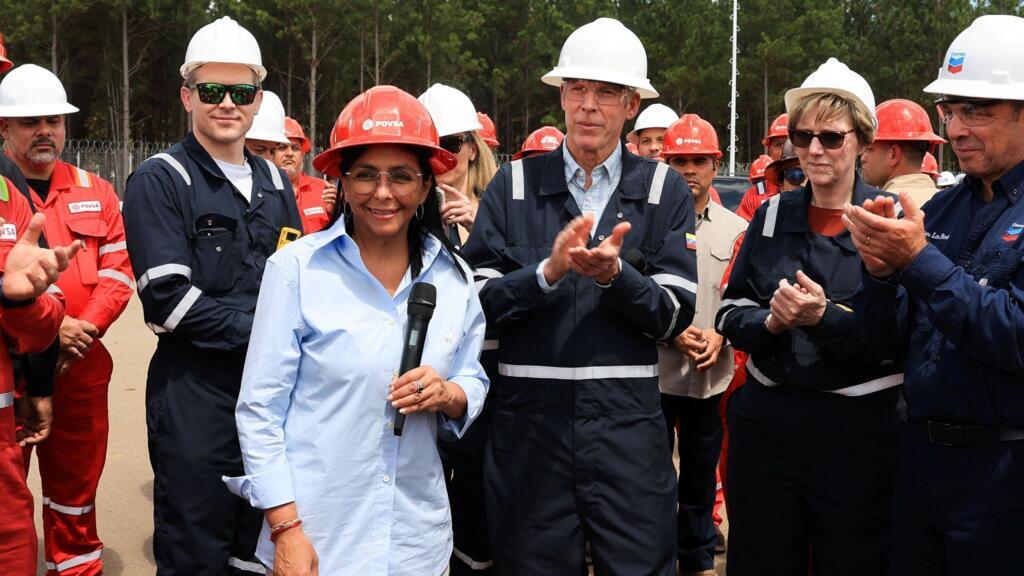
Caracas, February 6, 2026 (venezuelanalysis.com) – Venezuelan Acting President Delcy Rodríguez held meetings with oil executives from Repsol (Spain) and Maurel & Prom (France) on Wednesday as part of ongoing efforts to secure energy investments amid US pressure and unilateral sanctions.

“We discussed the models established in the reformed Hydrocarbon Law to strengthen production and build solid alliances toward economic growth,” Rodríguez wrote on social media.

State oil company PDVSA, represented at the meetings by its president, Héctor Obregón, touted the prospects of establishing “strategic alliances” and “win-win cooperation” with the foreign multinational corporations. 

The Rodríguez administration recently pushed a sweeping reform of Venezuela’s Hydrocarbon Law. Corporations are set to have increased control over crude extraction and exports, while the Venezuelan executive can discretionally reduce taxes and royalties and lease out oil projects in exchange for a cut of production.

Venezuelan leaders have defended the pro-business reform as a step forward to attract investment for a key industry that has been hard hit by US coercive measures, including financial sanctions and an export embargo, since 2017, as part of efforts to strangle the Venezuelan economy and bring about regime change.

Former President Hugo Chávez had overhauled oil legislation in 2001 to reestablish the state’s primacy over the sector with mandatory majority stakes in joint ventures, increased fiscal contributions, and a leading PDVSA operational role. Increased revenues financed the Bolivarian government’s aggressive social programs of the 2000s, which dramatically reduced poverty and expanded access to healthcare, housing, and education for the popular classes. 

Repsol and Maurel & Prom currently hold stakes in several oil and natural gas joint ventures in the South American country. The two firms, as well as Italy’s Eni, have operated in a stop-start fashion in recent years as a result of US sanctions. 

The European companies have consistently lobbied for increased control and benefits in their projects in the molds now established in the reformed energy legislation.

Since launching military attacks and kidnapping Venezuelan President Nicolás Maduro on January 3, the Trump administration has vowed to take control of the Venezuelan oil sector and impose favorable conditions for US corporations. Senior US officials have praised Caracas’ oil reform.

According to reports, the White House has dictated that proceeds from Venezuelan crude sales be deposited in US-run accounts in Qatar, with an initial agreement comprising 30-50 million barrels of oil that had built up in Venezuelan storage as a result of a US naval blockade since December.

On Tuesday, the US Treasury Department issued a license allowing Venezuelan imports of US diluents required to upgrade extra-heavy crude into exportable blends. On January 27, Washington issued a sanctions waiver allowing US companies to purchase and market Venezuelan crude. The exemption requires payments to be made to US-controlled accounts and bars dealings with firms from Russia, Iran, Cuba, and North Korea.

The US Treasury is additionally preparing a license to allow US companies to extract Venezuelan oil, according to Bloomberg.

The White House has urged US corporations to invest in the Venezuelan oil sector and promised favorable conditions. However, executives have expressed reservations over significant new investments. According to Reuters, US refiners have likewise not been able to absorb the sudden surge of Venezuelan heavy crude supplies, while Canadian WCS crude remains a competitive alternative. 

Vitol and Trafigura, two commodities traders picked by the White House to lift Venezuelan oil, have offered cargoes to European and Asian customers as well. India’s Reliance Industries is reportedly set to purchase 2 million barrels. In recent years, the refining giant has looked to Venezuela as a potential crude supplier but seen imports repeatedly curtailed by US threats of secondary sanctions.

US authorities have reportedly delivered US $500 million from an initial sale to Venezuelan private banks, which are offering the foreign currency in auctions that are said to prioritize private sector food and healthcare importers. Nevertheless, Venezuelan and US officials have not disclosed details about the remaining funds in a deal estimated at $1.2-2 billion.

Besides controlling crude sales, the Trump administration has also sought to impose conditions on the Venezuelan government’s spending of oil revenues. On Tuesday, US Treasury Secretary Scott Bessent told House Representatives that the flow of oil funds will be subject to outside audits. 

US Secretary of State Marco Rubio had told a Senate committee last week that US authorities would scrutinize Caracas’ public expenditure and claimed that Venezuelan leaders needed to submit a “budget request” in order to access the country’s oil proceeds.

Washington’s attempted takeover of the Venezuelan oil industry also has an expressed goal of reducing the presence of Russian and Chinese companies. On Thursday, Russian Foreign Minister Sergei Lavrov told media that the country’s enterprises are being “openly forced out” of the Caribbean nation at the behest of the US.

In mid-January, the US’ naval blockade drove away Chinese-flagged tankers on their way to Venezuela. With crude shipments partly used to offset longterm oil-for-loan agreements, Beijing has reportedly sought assurances of the repayment of debts estimated at $10-20 billion. For their part, independent Chinese refiners have moved to replace Venezuelan supplies with Iranian heavy crude.

Source link

Venezuela Approves Pro-Business Oil Reform as Trump Issues New Sanctions Waiver

Venezuelan leaders vowed that the law will lead to a significant growth of the oil industry. (Asamblea Nacional)

Caracas, January 30, 2026 (venezuelanalysis.com) – The Venezuelan National Assembly has approved a sweeping reform of the country’s 2001 Hydrocarbon Law that rolls back the state’s role in the energy sector in favor of private capital.

Legislators unanimously endorsed the bill at its second discussion on Thursday, with only opposition deputy Henrique Capriles abstaining. The legislative overhaul follows years of US sanctions against the Venezuelan oil industry and a naval blockade imposed in December.

National Assembly President Jorge Rodríguez hailed the vote a “historic day” and claimed the new bill will lead oil production to “skyrocket.” 

“The reform will make the oil sector much more competitive for national and foreign corporations to extract crude,” he told reporters. “We are implementing mechanisms that have proven very successful.”

Venezuelan Acting President Delcy Rodríguez signed and enacted the law after the parliamentary session, claiming that the industry will be guided by “the best international practices” and undertake a “historic leap forward.”

Former President Hugo Chávez revamped the country’s oil legislation in 2001 and introduced further reforms in 2006 and 2007 to assert the Venezuelan state’s primacy over the industry. Policies included a mandatory stakeholding majority for state oil company PDVSA in joint ventures, PDVSA control over operations and sales, and increased royalties and income tax to 30 and 50 percent, respectively. Increased oil revenues bankrolled the Venezuelan government’s expanded social programs in the 2000s.

The text approved during Thursday’s legislative session, following meetings between Venezuelan authorities and oil executives, went further than the draft preliminarily endorsed one week earlier.

The final version of the legislation establishes 30 percent as an upper bound for royalties, with the Venezuelan government given the discretionary power to determine the rate for each project. A 33 percent extraction tax in the present law was scrapped in favor of an “integrated hydrocarbon tax” to be set by the executive with a 15 percent limit.

Similarly, the Venezuelan government can reduce income taxes for companies involved in oil activities while also granting several other fiscal exemptions. The bill cites the “need to ensure international competitiveness” as a factor to be considered when decreasing royalty and tax demands for private corporations.

The reform additionally grants operational and sales control to minority partners and private contractors. PDVSA can furthermore lease out oilfields and projects in exchange for a fixed portion of extracted crude. The new legislation likewise allows disputes to be settled by outside arbitration instances.

Thursday’s legislative reform was immediately followed by a US Treasury general license allowing US corporations to re-engage with the Venezuelan oil sector.

General License 46 (GL46) authorizes US firms to purchase and market Venezuelan crude while demanding that contracts be subjected to US jurisdiction so potential disputes are referred to US courts. The license bars transactions with companies from Russia, Iran, North Korea, or Cuba. Concerning China, it only blocks dealings with Venezuelan joint ventures with Chinese involvement.

Economist Francisco Rodríguez pointed out that the sanctions waiver does not explicitly allow for production or investment and that companies would require an additional license before signing contracts with Venezuelan authorities.

GL46 also mandates that payments to blocked agents, including PDVSA, be made to the US Foreign Government Deposit Funds or another account defined by the US Treasury Department.

Following the January 3 military strikes and kidnapping of Venezuelan President Nicolás Maduro, the Trump administration has vowed to take control of the Venezuelan oil industry by administering crude transactions. Proceeds from initial sales have been deposited in US-run bank accounts in Qatar, with a portion rerouted to Caracas for forex injections run by private banks. US Secretary of State Marco Rubio vowed that the resources will begin to be channeled to US Treasury accounts in the near future.

In a press conference on Friday, Trump said his administration is “very happy” with the actions of Venezuelan authorities and would soon invite other countries to get involved in the Caribbean nation’s oil industry. Rubio had previously argued that Caracas “deserved credit” for the oil reform that “eradicates Chávez-era restrictions on private investments.”

Despite the White House’s calls for substantial investment, Western oil corporations have expressed reservations over major projects in the Venezuelan energy sector. Chevron, the largest US company operating in the country, stated that it is looking to fund increased production with revenues from oil sales as opposed to new capital commitments.

Since 2017, Venezuela’s oil industry has been under wide-reaching US unilateral coercive measures, including financial sanctions and an export embargo, in an effort to strangle the country’s most important revenue source. The US Treasury Department has also levied and threatened secondary sanctions against third-country companies to deter involvement in the Venezuelan petroleum sector.

Source link