News Analysis: Toppling Iraq’s Hussein unleashed chaos. Why Iran war poses similar risks
A shock-and-awe campaign laying down a tsunami of bombs. An enemy succumbing rapidly under overwhelming firepower. And a triumphant U.S. president trumpeting a quick and easy campaign.
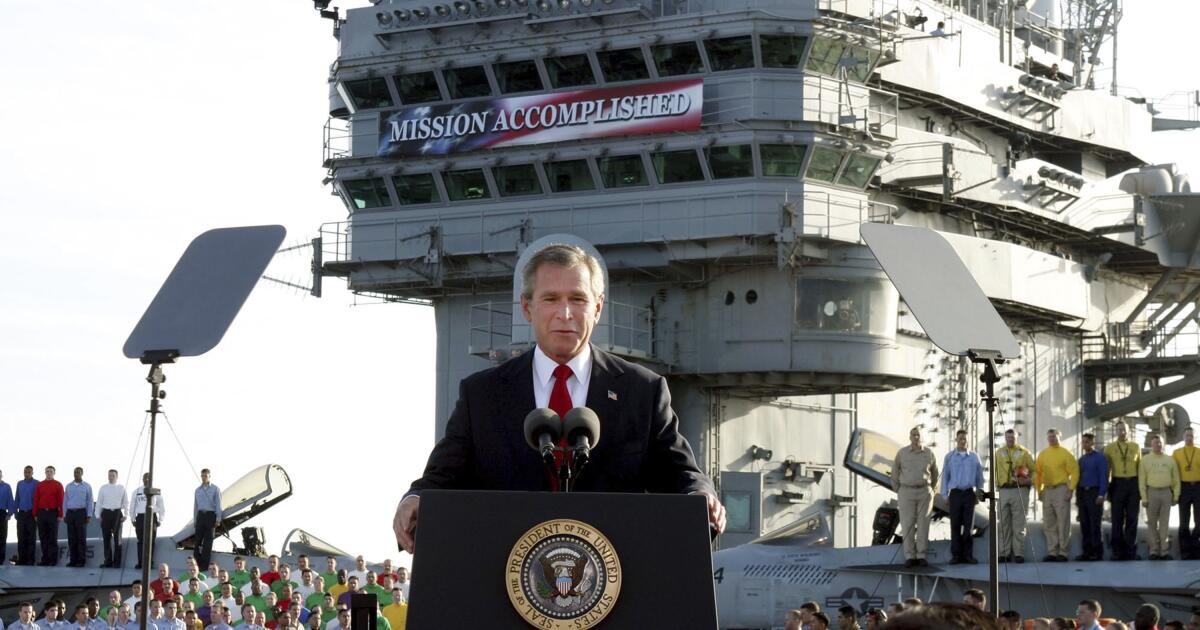
In 2003, President George W. Bush strode confidently on the deck of an aircraft carrier less than five weeks after he ordered the invasion of Iraq and declared the “end of major combat operations” under a banner proclaiming “Mission Accomplished.”
It proved anything but.
The invasion became a meat grinder, leaving thousands of Americans and possibly more than a million Iraqis dead. It unleashed forces whose effects are felt in the region and beyond to this day.
More than two decades later, another U.S. president attacked another Persian Gulf nation, promising rapid success in yet another Middle East adventure that he says will remake the region.
President Trump and his staff have vehemently rejected any comparison between “Operation Epic Fury,” launched Saturday, and “Operation Iraqi Freedom.” On Monday, Defense Secretary Pete Hegseth gave a pugnacious news conference, insisting, “This is not Iraq. This is not endless.”
Yet the assault on Iran — almost four times larger than Iraq with more than double its population — presents no lack of challenges, ones that could spread chaos far beyond Iran’s borders and become a defining feature of Trump’s presidency.
In many ways, analysts say, toppling Iran’s leadership represents a much more complex task than Iraq ever did. Iraq was a state with deep sectarian divisions that was largely dominated by a single dictator: Saddam Hussein.
The Iran that emerged after the 1978-79 Islamic Revolution had a supreme leader, but Iran also developed an elaborate system of governance. That includes a president, a parliament and varying governmental, military and religious hierarchies, noted Paul Salem, senior fellow at the Middle East Institute.
“Unlike Saddam’s Iraq, the Iranian state is multi-institutional and hence much more resilient — and, yes, not as vulnerable,” Salem said. “And hostility to the United States and Israel is at the heart of the Islamic Revolution — baked into the state.”
Here are some of the ways the Iran attacks could develop into the very scenarios Trump once derided in his days as the antiwar candidate:
Boots on the ground
For now, the U.S. and Israel have wielded air power to pound Tehran into submission. In the first minutes of the joint operation, a 200-plane fleet — Israel’s largest — struck more than 500 targets in Iran, according to the Israeli military. One such strike killed Supreme Leader Ayatollah Ali Khamenei.
Iran is still fighting back, lobbing missiles at Israel, Persian Gulf nations, Jordan and other areas with U.S. bases in the region. The U.S. has the qualitative and quantitative edge of materiel to eventually prevail, but Iran’s capabilities will not make it easy, as the losses in service members and planes have demonstrated in the last two days.
And wars have never been won with air power alone. Rather than relying on boots on the ground, Trump expects ordinary Iranians to finish the job for him.
“When we are finished, take over your government. It will be yours to take,” he said in a video address on the first day of the campaign.
During the Arab Spring of 2011, protesters throughout the Middle East took to the streets to demand change. But those efforts mostly did not lead to significant reforms and, in some countries, prompted further repression.
In Iran, it’s true many people would welcome the Islamic Republic’s demise — as many Iraqis rejoiced at Hussein’s fall. But it’s unlikely that mostly unarmed protesters will triumph in a confrontation against enforcers from the Islamic Revolutionary Guard Corps or its volunteer wing, the Basij.
It’s also difficult to gauge how many of Iran’s 93 million people despise the government enough to rise up against it.
Meanwhile, Trump has left the door open for dispatching U.S. troops, but the math of such a deployment raises doubts.
According to the U.S. Army, counterinsurgency doctrine dictates 20 to 25 troops for every 1,000 inhabitants to achieve stability. In the case of Iran that would entail deploying 1.9 million people — almost all the U.S. military’s active duty, reserve and National Guard personnel.
New leadership unclear
At this point, it’s not clear that decapitation of much of Iran’s leadership class will produce any real change in government, much less a successor inclined to bend to U.S. wishes. The top echelons of the Islamic Republic boast a deep bench of mostly hard-liners — not surprising, perhaps, for a nation that has braced for attack for years, if not decades.
Whatever new leadership that does emerge could rally around the “martyrdom” of Khamenei. Not especially popular in life, he appears to have become, in death, a rallying cry for defiance. And martyrs are exalted in Shiite Islam, Iran’s prevalent faith.
“He was the religious leader of the Shiites, so it’s sort of like killing the pope,” Salem said. “And he’s more popular dying as a martyr, than, say, of a heart attack. … He went out in style, no doubt about it.”
When the U.S. occupied Iraq, the expectation was that whatever came next would be a fervent U.S. ally, an idea perhaps best captured in the notion in Washington that a grateful Iraqi populace would shower U.S. troops with flowers. That didn’t happen. And in the Darwin-esque culling of leaders that followed, the ones that emerged victorious had little love for the U.S.
One of them was Nouri Al-Maliki, a Shiite supremacist whose policies were blamed for fueling years of sectarian bloodletting, and whose loyalties often seemed more aligned with Tehran than Washington.
Meanwhile, Tehran, playing on its proximity and deep ties to the new Iraqi ruling class, was able to steer Iraq — a majority Shiite country — deeper into its orbit.
After the Iraqi government — with the help of a U. S.-led coalition — pushed Islamic State out of Iraq in 2017, Iran was able to embed allied militias into Iraq’s armed services. That created the paradoxical situation of Tehran-aligned fighters wielding U.S.-supplied materiel.
Iraq has yet to emerge from Iran’s shadow. After Iraq’s most recent elections, Maliki seems poised to become prime minister once more, prompting Trump to write on Truth Social, “Because of his insane policies and ideologies, if elected, the United States of America will no longer help Iraq.”
A fragmented opposition
Iran’s population is diverse; an estimated two-thirds of Iranians are Persian, while minorities include Kurds, Baloch, Arabs and Azeris.
Those minorities have long-standing grievances against the ruling majority. It’s possible that Trump’s campaign and the resulting disorder could fuel separatist tensions.
Just last month, Iranian Kurdish factions joined together in a coalition that they said would seek the overthrow of the Islamic Republic “to achieve the Kurdish people’s right to self-determination, and to establish a national and democratic entity based on the political will of the Kurdish nation in Iranian Kurdistan.”
An experienced insurgency
Over the decades, the Islamic Republic created a network that at its peak stretched from Pakistan to Lebanon.
It was a fearsome constellation of paramilitary factions and amenable governments that became known as the Axis of Resistance. It included Hezbollah in Lebanon, Hamas in Palestinian lands, Yemen’s Houthis, and militias in Iraq, Afghanistan and Pakistan.
After Hamas’ Oct. 7, 2023, attacks, Israel — and, eventually, the United States — launched offensive campaigns to defang the groups.
Although weakened, the factions still survive, and could form a powerful, transnational and motivated insurgency when the time comes to fight whatever emerges if the Islamic Republic falls.
Bulos reported from Khartoum, Sudan, and McDonnell from Mexico City.