Sunny Ozell, the wife of late actor Patrick Stewart, paid tribute to her husband two weeks after his death on social media.
“[T]he grief continues to come in waves,” the musician wrote Wednesday on Instagram. Ozell’s remembrance included a black-and-white photo of her embracing Stewart from behind. “My heart had to grow to contain my love for Patrick, and he changed me for the better, forever.”
Stewart, best known for his portrayal of Jean-Luc Picard in “Star Trek” series and films and Charles Xavier in the “X-Men” franchise, died Oct. 28 at age 86. The actor had been battling Alzheimer’s disease and Lewy body dementia. He died “in the loving care of his beloved wife Sunny,” according to the Oct. 29 announcement.
Ozell added that she has “also been experiencing such deep, profound gratitude” amid her grief.
“We left nothing unsaid. He knew I loved him, and I know he loved me,” she shared on Instagram. “Patrick and I truly authentically saw one another, and we amplified each other’s best qualities. We shared nearly two decades together, and we filled those years with so much living.”
Stewart and Ozell met in 2008 at a restaurant in Brooklyn where the latter was working as a server at the time. The couple married in 2013 after years of dating. Stewart’s longtime friend and fellow “X-Men” actor Ian McKellan officiated the wedding.
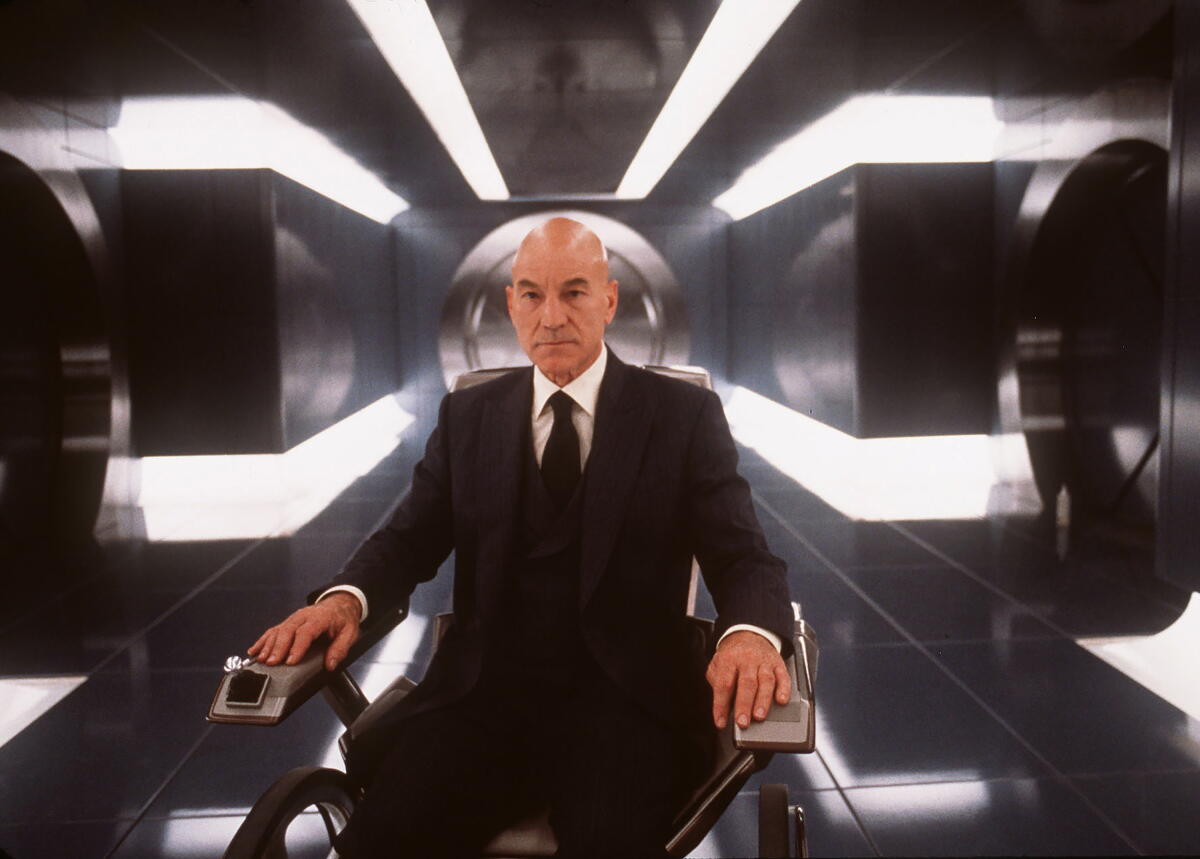
Patrick Stewart played Professor Charles Xavier in “X-Men.”
(Attila Dory / 20th Century Fox)
In her social media statement, Ozell also expressed her appreciation for the sympathy and support from well-wishers.
“I’ve been overwhelmed by the public response to Patrick’s death, and while I’m not at all surprised that he touched so many, I’m sincerely moved by the outpouring of sadness and loss,” she wrote. “Thank you all for your condolences, they mean so, so much to me.”
Stewart’s final appearance as Professor X will be in Marvel’s “Avengers: Doomsday,” to be released Dec. 18.
Unless you’re writing for a major national magazine or shooting video for Architectural Digest, it’s rare for a reporter to be invited into a celebrity subject’s home. More likely, it’ll be some neutral space like a publicist’s office, or coffee shop, or hotel room; even more likely, over the phone or Zoom. But Patrick Stewart, when I interviewed him in 2023 at the end of “Star Trek: Picard,” the “The Next Generation” sequel series in which he starred, asked to meet at his house.
Stewart, who died Wednesday at 86, was 82 then, friendly and dapper and emanating a youthful sense of wonder and readiness. He spoke of wanting to learn to play the piano and speak French — ironic for an actor perhaps best known as Jean-Luc Picard. He had written a memoir, “Make It So,” titled for a Picard catchphrase. And he was excited about the house, located on a leafy, McMansion-free, comparatively modest street in what real estate agents would call Hancock Park, where he’d been living with his wife, Sunny Ozell, since just before the COVID-19 pandemic shutdown.
“We were safe,” Stewart said of the COVID days. “We felt protected here. It was just a walk that way or a walk that way to some shops. I walk to a little post office and my pharmacy is on 3rd Street, and I always take the backstreets. It’s a fabulous neighborhood, it really is. No two houses are the same. I mean, I never thought I’d live in a house that had just got archways everywhere — no doors! Sitting here, you see one, two, three, four, five, six archways.”
From sheer weight of screen time and franchise muscle, “Star Trek: TNG” — which ran for seven seasons (on first-run syndication, a dynamic format that no longer exists), plus four films — and the “X-Men” movies have dominated coverage of Stewart’s death. (Confession: I have possibly seen one “X-Men” movie, though long before there were “X-Men” movies, I read the comics — so I am familiar with Professor Charles Xavier, a part for which Stewart did not need to shave his head, as well as his nemesis Magneto, played by Stewart’s good pal Ian McKellen.) But there’s more to the story.
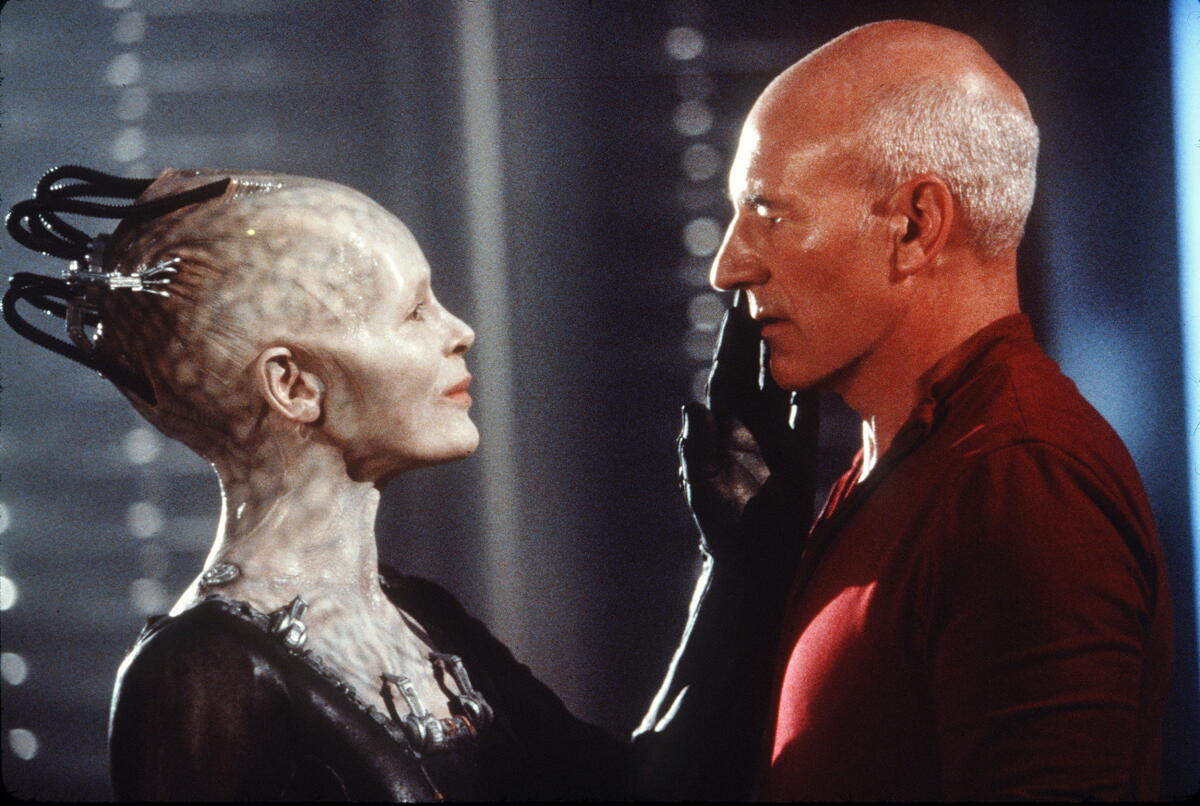
Patrick Stewart’s Picard comes face-to-face with Alice Krige’s Borg Queen in the 1996 film “Star Trek: First Contact.”
(Elliott Marks / Paramount Pictures)
Stewart’s 70-year career does neatly divide into BST and AST — before and after “Star Trek,” which arrived in 1987 at its chronological midpoint. The first half is dominated by theater. He joined the Royal Shakespeare Company in 1968, after a decade on regional stages, and was a core member until 1982. “So that was my daily experience,” he told me. “Shakespeare and his contemporaries and other great 19th century, 20th century playwrights. It was home to me.” In 1982, he took part alongside fellow RSC members, including David Suchet, Ben Kingsley, Judi Dench and McKellen, in director John Barton’s illuminating series “Playing Shakespeare,” demonstrating the relation of text and performance. You can find it all on YouTube from the Shakespeare Network and really should.
American audiences might have gotten a look at him in David Lynch’s “Dune” or PBS-imported British TV productions like “I, Claudius” and “Tinker Tailor Soldier Spy,” or as Claudius opposite Derek Jacobi in BBC’s “Hamlet” — but for many Stewart appeared new and fully formed in September 1987 on the bridge of the USS Enterprise. (This paper, reporting on his casting, apparently called him “an unknown British Shakespearean actor,” a fact you will see printed many times over in the wake of his death, and which Stewart liked to repeat.) With a handsome, sculpted head unencumbered by hair and a rich musical baritone, he exuded compassionate authority. You felt you could trust him, not just because it was in the script. With his classical training, he could make the most mundane line sing as if it were written in iambic pentameter, and do it without sounding hammy. He was a fit 47 when the show premiered. And he rocked his body-hugging Starfleet uniform.
After “Star Trek” made him Hollywood-famous, making way for his “X-Men” role — which he reprised for his final film, “Avengers: Doomsday,” coming in December — other projects followed. As an established personality there were opportunities for self-mockery and oddball choices. In Ricky Gervais’ “Extras,” playing himself, he describes a screenplay he’s writing in which his character has the power to make women’s clothes fall off (“and I’ve seen everything”). In Riz Ahmed’s “Bait,” which premiered earlier this year, he was the hallucinated voice of “Pigtrick,” a decapitated pig’s head that is somehow also Patrick Stewart. He donned a bad wig to portray John Oliver on “The Daily Show” and was a regular voice on “American Dad!” More traditionally, he played Captain Ahab, Ebenezer Scrooge and Captain Nemo.
Patrick Stewart as Macbeth and Kate Fleetwood as Lady Macbeth in “Macbeth,” the film version of Rupert Goold’s production.
(Manuel Harlan / Illuminations TV)
Did success on the screen boost his stage career? Or was it just a different route to the same place? With McKellen he starred in Samuel Beckett’s “Waiting for Godot” and Harold Pinter’s “No Man’s Land” in repertory. He adapted Charles Dickens’ “A Christmas Carol” into a one-man show and played George in “Who’s Afraid of Virginia Woolf?” But it always came back to Shakespeare. Returning to the RSC, he played the Ghost and Claudius to David Tennant’s “Hamlet” and the lead in “Macbeth” (both were filmed and broadcast) as well as Prospero in “The Tempest.” He stayed busy as he aged, if not always as busy as he would have liked — the actor’s lot — and when the pandemic killed regular work, he went onto social media and spoke directly to the people in the language he loved so well, reading and commenting on all of Shakespeare’s 154 sonnets — “A Sonnet a Day” — from March to October 2020 (they’re available on CD).
“We play this game often,” he told me. “I played it when I was a kid: If you could go back in time, where would you go? And I’ve worked on my answer to that question — I want to be in the audience at the very first performance of ‘Hamlet, Prince of Denmark,’ that’s all, because I know Shakespeare would be there.”
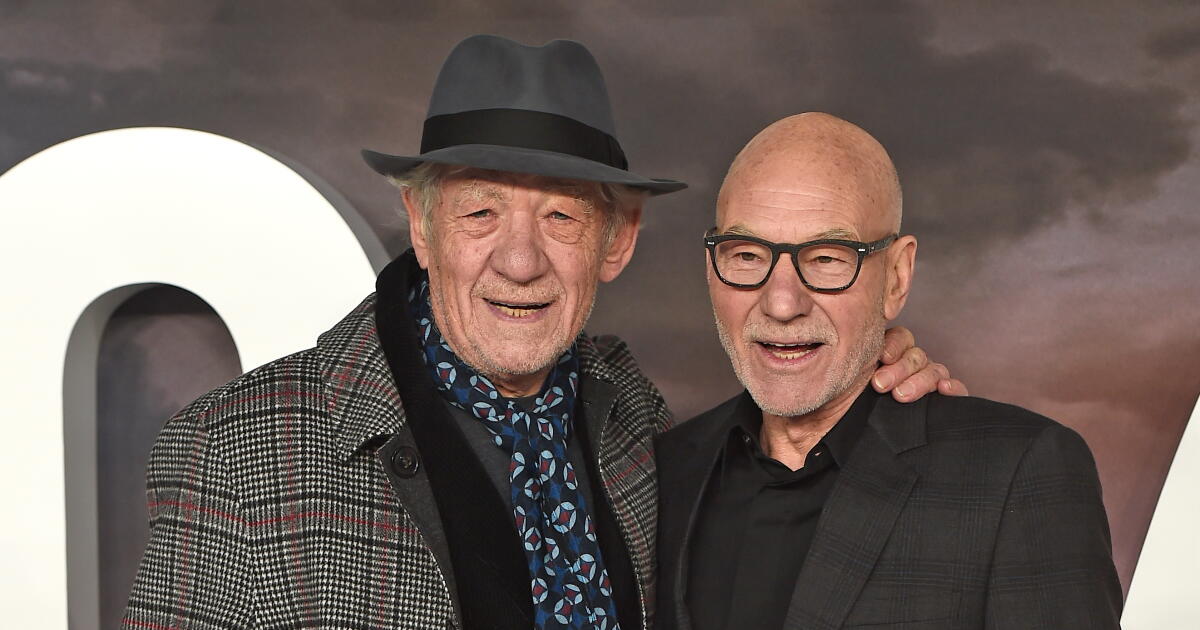
Ian McKellen is saying goodbye to his dear friend Patrick Stewart.
Stewart, the storied actor whose performances spanned comic book films, Shakespearean stage productions and sci-fi TV, died Wednesday at his home in Los Angeles after a battle with Alzheimer’s disease and Lewy body dementia. He was 86. While tributes from former co-stars across the “X-Men” films and “Star Trek” franchise poured in, fans of Stewart were keeping a close eye out for McKellen’s remarks, as the two had a famously close friendship, often on full display with red-carpet smooches and pally interviews.
On Thursday, McKellen posted a tribute to Stewart.
“Before everything else, Patrick was defined by being born and bred in Yorkshire, the proud county in the north of England which he loved to the end,” McKellen’s statement began. “You could hear it in his accented voice and in the stern honesty with which he told you what he thought and felt. Yorkshiremen have no truck with half-truths or avoidance of big issues. He wore his heart on his sleeve, which made him a man to rely on, to admire and in my case, love.”
Although the two had known each other since they were young actors with the Royal Shakespeare Company in the 1970s, Stewart said he initially was too shy to approach McKellen, but was “impressed.” Stewart said the two had “X-Men” to thank for their close bond. On set, the two had trailers that were next door to each other, and with time to kill between filming, they would head next door and chat for hours.
“It was a delight for me to find that the enthusiasms and passions that I’d had all my life were shared by Ian,” the late actor said in a 2014 interview. When asked to write a hashtag that summed up their bromance, Stewart wrote #Aren’twelucky, and McKellen wrote #eternal.
In addition to playing rivals across multiple “X-Men” films, Patrick and McKellen starred together in “Waiting for Godot” and “No Man’s Land” on Broadway and London’s West End.
“We first met as ambitious young actors with the Royal Shakespeare Company half a century ago but we weren’t in the same productions,” McKellen’s tribute continued. “My first strong memory was a few years later, meeting him in the street in central London when he told me about an offer to take over a leading part in ‘Star Trek.’”
McKellen recalled saying, “But Patrick think of your stage career in the UK. Do you really want to risk—getting lost in Hollywood for years and years?”
“Well, he took the risk and thank goodness for us all that he did for not just his devoted Trekkies but film and theatre audiences, who marvelled at his using international celebrity to star in a string of cinema successes (‘X-Men’ of course) and in great classical plays by Shakespeare, Ibsen, Arthur Miller, Peter Shaffer, Pinter and Beckett at Stratford-upon-Avon, in London’s West End and on Broadway.”
In 2014, Stewart admitted to Broadway.com that he was envious of McKellen for both his university education and his hair.
“Ian knows and he thinks I’m foolish to feel this way,” he said. “Ian went to Cambridge and my formal schooling ended when I was 15. I envy that, but I also envy your head of hair. If only because in the two plays you don’t wear a wig and yet you manage to make your hairstyle look completely different … I envy that whereas I have to stick on a wig.”
McKellen responded by telling Stewart that he was gorgeous with and without the wig.
In 2013, Stewart married longtime girlfriend Sunny Ozell in a Lake Tahoe ceremony that McKellen officiated.
“America was his adopted home, where he met his adored Sunny who has cared for him through sickness and health, through thick and thin. But he never forsook his origins: and the proudest achievement of the most respected and beloved actor of his generation on either side of the Atlantic, was his appointment as Chancellor of Huddersfield University in Yorkshire.”
McKellen and Stewart star together again in the forthcoming “Avengers: Doomsday,” which hits theaters Dec. 18.
Patrick Stewart was an imposing figure, on screens big and small, and on stage in the many theatrical productions he starred in over his long career. Depending on the role, his baritone voice could command a legion of Starfleet officers, superhero mutants or a royal court. The actor, who died Wednesday, will be best remembered for the iconic characters he portrayed, particularly in the “Star Trek” and “X-Men” franchises, but over the course of his career, he proved his versatility, playing comedic roles as brilliantly as his dramatic ones. Here, our writers detail some of his most memorable onscreen work.
‘Dune’ (1984)
Even in the wake of Denis Villeneuve’s mega-productions, David Lynch’s dreamy version has found its fandom of acolytes. To watch Stewart commit to the director’s vision is to wish he had more film opportunities outside the shadow of Capt. Picard. He’s playing Gurney Halleck (Josh Brolin does the role in the new movies), a war advisor to young Paul Atreides, and Stewart brings gruff family-friend vibes to his few scenes, which have become legendary in the Lynch pantheon. When Kyle MacLachlan’s Paul says he’s “not in the mood” for combat training, Gurney explodes at him: “Mood’s a thing for cattle and loveplay, not fighting!” Later, you can watch Gurney charging into planetary battle holding — what’s this? — a sweet-looking pug. They must be symbolic to House Atreides. The dogs don’t appear in Frank Herbert’s novel. Lynch just added them. It’s how I choose to remember Stewart. — Joshua Rothkopf
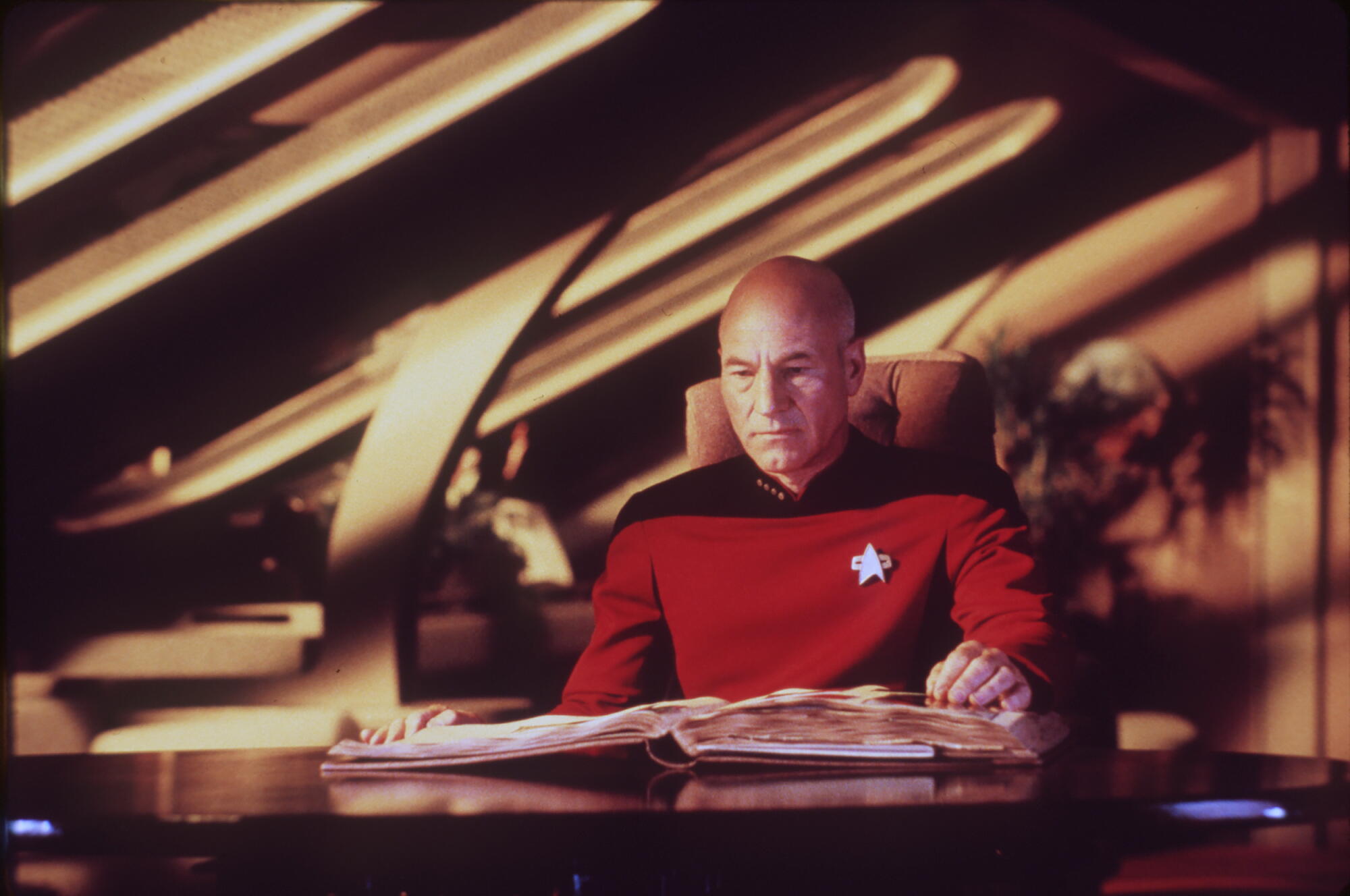
Patrick Stewart as Captain Picard in “Star Trek: The Next Generation.”
(Elliott Marks/Paramount)
‘Star Trek: The Next Generation’ (1987-1994)
Whichever captain in the “Star Trek” franchise you fancy — Janeway, Kirk, Sisko, Pike, etc. — Jean-Luc Picard was always in the conversation. He was serious, stern, smart, curious, with the hint of whimsy that it takes to soar among the stars with theoretical science and a diplomatic flair with alien races. Undoubtedly, Stewart’s Shakespearean training helped him look past the costumes, sets and CGI into the humanity of what the writers and Gene Roddenberry intended. Though “Star Trek” was set hundreds of years into the future, Stewart gave the character a sense of now, with some of the same problems we face today. Indeed, one of his most famous quotes from the show, from the fifth-season episode “The Inner Light,” embodied how he kept Picard in the present: “Seize the time … live now. Make now always the most precious time. Now will never come again.” — Jevon Phillips
‘Robin Hood: Men in Tights’ (1993)
My nascent cinephilia was nurtured by movies on VHS. One tape (and eventually DVD, then Blu-ray) we often found ourselves watching was Mel Brooks’ “Robin Hood: Men in Tights.” The spoof of early Hollywood’s swashbuckling action-adventure movies is one of the comedy titan’s most quotable films, thanks in large part to the timing of the cast. Stewart, in a cameo at the end of the film, plays a regal King Richard who returns from the Crusades to chastise his younger brother Prince John (played by a scene-stealing Richard Lewis). Stewart gets one of the film’s best jokes, delivering one final indignity to Prince John with the panache that only a formally trained actor of his caliber could. — David Viramontes
James Marsden, left, and Patrick Stewart in “X-Men.”
(Attila Dory / 20th Century Fox)
‘X-Men’ (2000)
Casting Stewart as Professor Charles Xavier in Bryan Singer’s “X-Men” must have seemed almost too easy. He looked remarkably like the bald, wheelchair-using Marvel comic-book character and had already spent seven seasons playing a similarly cerebral, principled leader as Capt. Picard on “Star Trek: The Next Generation.” But Stewart brought more to the role than a physical resemblance and a voice that could make a grocery list sound like a royal decree. As the powerful telepath who ran a school for young mutants and believed they could coexist peacefully with humans, his Xavier barely needed to raise an eyebrow to command attention, even when surrounded by characters who could sprout claws, control the weather and shoot beams from their eyes. Playing opposite Ian McKellen as Xavier’s old friend turned rival Magneto, Stewart brought a touch of Shakespearean gravitas to the fledgling franchise, returning to the role for seven more films over the next 22 years. He’ll reprise the role a final time in “Avengers: Doomsday” in December. — Josh Rottenberg
Patrick Stewart and Hugh Jackman in the film “Logan.”
(James Mangold / Marvel / Twentieth Century Fox)
‘Logan’ (2017)
Previous installments of the “X-Men” films are more typical of the superhero genre, with grand CGI battle sequences and a foe or foes that must be defeated. But “Logan,” which centers on the titular character, a.k.a. Wolverine (Hugh Jackman), is different, with a grounded, gritty story set in 2029 in the desert of Northern Mexico near El Paso. Logan is now a limousine driver addicted to prescription painkillers and he’s a caretaker, along with fellow mutant Caliban, for an elderly Charles Xavier. Ten minutes into the film, we see the professor not in his usual dignified manner, dressed in a sharp suit; instead, we see him thin and frail, in a dirty T-shirt, zooming around in circles in his motorized wheelchair repeating the lines of a Taco Bell commercial. Logan attempts to medicate him so that he and Caliban can rest, but Xavier fights him off, falls out of his wheelchair and has a telepathic seizure that begins to affect everyone around him. “What are you doing to me?” he whispers in a scared voice as Logan tries to inject him. It’s a scene that Stewart imbues with terror and sadness as we see the formerly stoic Xavier shrivel in his hospital bed, reminded of his ailments and his mortality. — Maira Garcia