‘Passing Strange’ premieres in L.A. at Pasadena Playhouse
Twenty years after its world premiere in Northern California — and subsequent success on Broadway and in London — “Passing Strange,” the quintessential L.A. coming-of-age musical, is finally arriving in Southern California, staging its long-awaited area premiere at Pasadena Playhouse on Sunday.
Exactly why it has taken so long for this acclaimed, Tony Award-winning show — much of it set in the heart of Los Angeles — to come here is something its creators, the artist and singer-songwriter, Stew, and Heidi Rodewald (along with this writer) have been scrutinizing since 2009, the year after it opened to critical acclaim on Broadway.
“Passing Strange” tells the story of a young, artistic “Youth” (that’s actually his name in the show) who rejects his single mother and the “Black, middle class dream” of 1970s Los Angeles in favor of leaving home to find “The Real,” an elusive state of mind and authenticity he craves.
The reasons “The Real” took so long to land in its hometown began to make sense during a recent group Zoom with the “Passing Strange” brain trust, including Stew, Rodewald and its new director Zhailon Levingston.
“At my age, at this point, I think it is absolute poetry that this gentleman [Levingston] is the one who brings it to our hometown,” said Stew, pointing to a serendipity of timing.

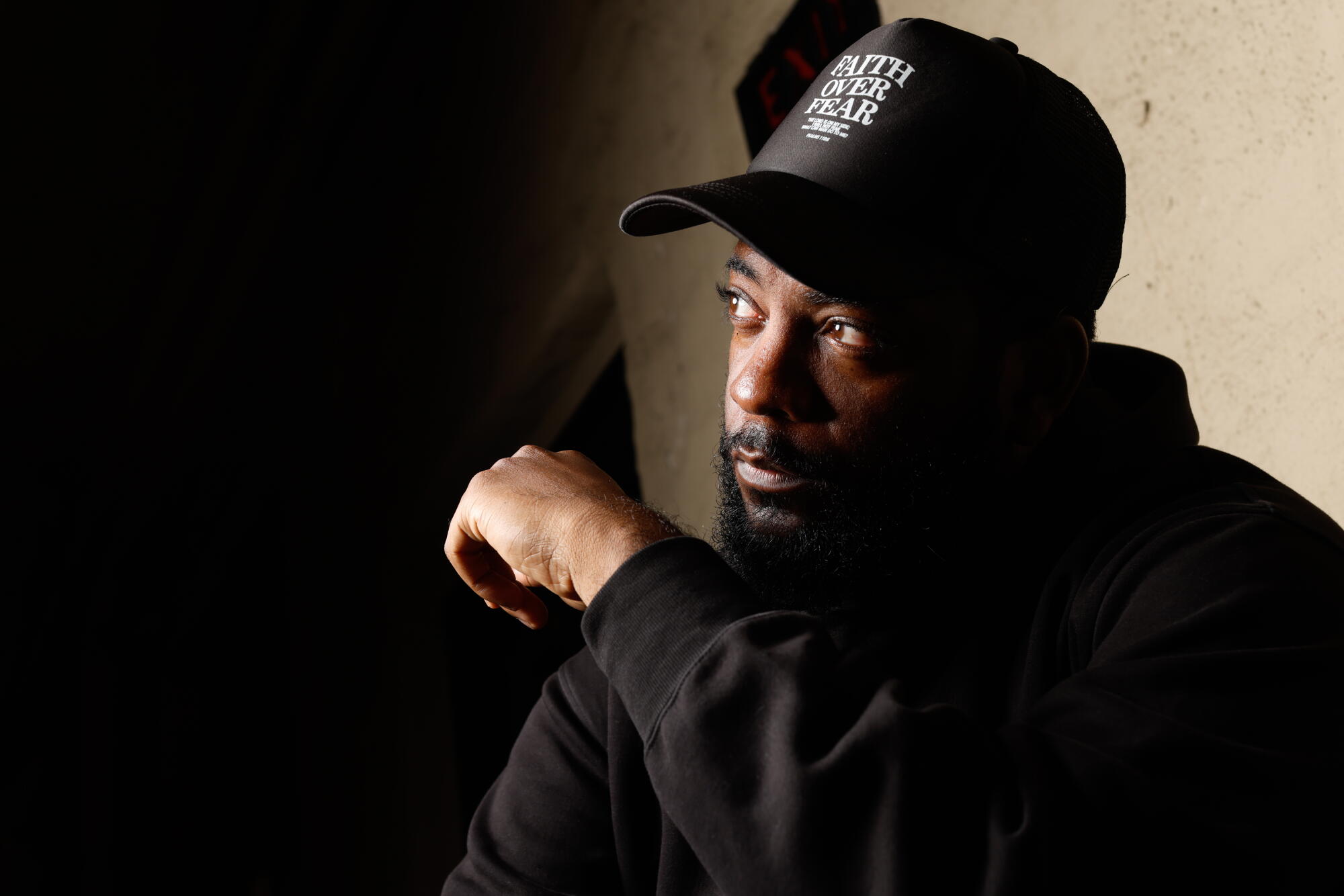
Director Zhailon Levingston sits outside before a rehearsal of “Passing Strange” at the Pasadena Playhouse. Levingston recently won a Tony Award for directing, “Cats: The Jellicle Ball.”
(Carlin Stiehl / For The Times)
Levingston is the 32-year-old theatrical wunderkind who won this year’s Tony Award for best director, for the groundbreaking revival of “Cats” on Broadway by re-imagining the long-running ‘80s smash as a ballroom drag competition.
Getting Levingston to do this revival of “Passing Strange” as his immediate follow-up to “Cats: The Jellicle Ball” is a coup for Pasadena Playhouse’s Artistic Director Danny Feldman. Feldman calls Levingston a rare talent, who’s “generous and fearless.” Or as Stew says more bluntly: “Zhailon’s got the receipts. … it’s the right time because it’s him. We made this play for him — literally, I don’t mean figuratively — because me and Heidi don’t make work necessarily for the contemporary time, we make it for the future.”
One of the main themes of “Passing Strange” is how knowledge is awkwardly handed down from one generation to another. In a key scene, the narrator describes a mentor, Franklin, whose words and wisdom wash over Youth “like a Bach fugue creeping out of a cheap car stereo.” In conversation together, Stew and Levingston (the former is twice the latter’s age) seem entirely in sync, having both clearly absorbed the show’s mantra: “Just ask the song.”

Actors rehearse “Passing Strange,” which is based in downtown L.A. but has never been produced in Southern California until now.
(Carlin Stiehl / For The Times)
Stew says he learned the virtues of “asking the song” while casting the original production at Berkeley Repertory Theatre in 2006. The show would go on to play 165 performances on Broadway, but it wasn’t a traditional book musical — it played more like a cabaret or rock experience. “When we had everybody audition, they had to sing a punk rock song,” Stew recounts. “That was the fast track to figure out if they could do what we needed, or not.”
That original Berkeley cast, including Eisa Davis, Daniel Breaker, Rebecca Naomi Jones and Coleman Domingo, won the 2008 Obie Award for ensemble at New York’s Public Theater before transferring to Broadway. That cast was a big part of the show’s success, so much so that Levingston calls them “the Avengers of Black talent.”
Spike Lee filmed the show’s penultimate night at the Belasco Theater. In 2010, PBS broadcast it as part of “Great Performances,” which is how a then 15-year-old Levingston learned about “The Real.”
“My grandmother’s bedroom had a TV and that was kind of my refuge as a kid. I happened to turn on PBS,” Levingston recalls, “and it just so happens that was the night that they were airing ‘Passing Strange.’ I wasn’t looking for it. I just clicked on the television, and the opening credits were happening. I stayed glued. I didn’t leave. I didn’t pee. I just watched it.”
Levingston was hooked. “It became my favorite show ever,” he says, “I had two birthday parties designated to my friends watching it.”

Composer Heidi Rodewald and writer Stew attend the premiere and panel discussion of “Passing Strange” during the 2009 Tribeca Film Festival at Directors Guild Theater on May 2, 2009, in New York City.
(Amy Sussman / Getty Images)
But more importantly, it made him ask questions. “I then went to school the next day. … I got a dictionary and I looked up every word I didn’t know. I looked up every reference I didn’t know,” Levingston says. “I didn’t know who James Baldwin was. I didn’t know who Josephine Baker was. I didn’t know the significance of the Berlin Wall. I had never been out of the country, let alone Louisiana.”
None of the creators of “Passing Strange” would wince at the musical being described as a “bildungsroman,” or a classic coming-of-age story. Its title is derived from Shakespeare’s “Othello,” and the show earned Joycean comparisons, including to “A Portrait of the Artist as a Young Black Man,” from critics.
“Passing Strange” pokes fun at the pretensions of youth, how a young person can know every indie rock album or French New Wave film and still be clueless about their own emotions and need for family. The truth and timelessness of Stew’s story — about a boy in the 1970s wanting to escape what he sees as L.A.’s “fishbowl of philistines” resonated so much for Levingston that he was inspired to escape his own fishbowl (Louisiana) for a life in Los Angeles, where he enrolled in AMDA College of the Performing Arts in Hollywood.
He lived in L.A. for four years, before making his name in theater back east. He had never dreamed of directing “Passing Strange,” saying, “it felt like too ‘full circle’ to actively pitch myself as the director.” But when he took a meeting with Pasadena’s Feldman: “I mentioned ‘Passing Strange,’ kind of as a secret menu option.”

Britton Smith, left, and Tanerélle in a rehearsal for “Passing Strange” at the Pasadena Playhouse.
(Carlin Stiehl / For The Times)
Feldman loved the idea, and now “Passing Strange” is here. Asked during a recent rehearsal whether he’s deconstructing or re-inventing the show as he did “Cats,” Levingston replied with an emphatic no.
“I didn’t want to put it on the moon … or create some kind of other, concept approach to ‘Passing Strange,’ that would make it too corny. The concept has to be the people,” he said.
Inspired by Stew, Levingston looked for actors with a punk vibe, because he “wanted a company that understood what it meant to lead a band, even if you’re not the Narrator or Stew, I wanted the authenticity of that kind of swagger.”
Ty Taylor plays Stew in the revival, along with a whole new cast. During a recent rehearsal, it was uncanny how these performers look and sound so different — yet still carry the same fiery sense of invention as the actors who created the roles. It was also moving to see that Stew and Rodewald’s Tony Award-winning book still delivers laughs and pathos two decades on. Their show about passing the torch of cultural enlightenment hasn’t lost its edge — even as it is being handed off to another generation.

Actors rehearse “Passing Strange” at the Pasadena Playhouse. The rock musical has played on Broadway and is staging it’s Southern California premiere at the Pasadena Playhouse.
(Carlin Stiehl / For The Times)
During the Zoom interview, Rodewald noted that the show’s original director, Annie Dorsen, gave them the confidence “to not try to please everyone,” to just make something they thought was cool.
“And then we went, and we did it,” Stew adds, “and now it’s perfect that it’s happening here. It’s the right director. It’s the perfect cast.”
In this way, the show has not only come home to Los Angeles, but it has also come full circle.
“I was talking to a cast member the other day, and I was like, ‘I just try to make theater that my friends like.’ But now I feel like I’m trying to make this show as a thank you letter to Heidi and Stew,” Levingston said, as he sat in the house seats at the Playhouse during rehearsal.
Indeed, rather than re-imagining “Passing Strange,” Levingston dug down to the show’s roots, when Stew and Rodewald traveled from gig to gig as musicians. “One of my earliest images thinking about the show,” Levingston says, “is that I wanted it to feel for the audience as if a bus tour of artists from a band backed up here and just dumped everything from the road onto the stage because the tour schedule said we had to be in Pasadena tonight.”
Will L.A. at long last embrace “The Real” or is this revival of “Passing Strange” looking to move to New York or elsewhere?
“Just ask the song,” Levingston says with a smile.
“I did not do this show because I had some long runway vision of how to take it from Pasadena to Broadway or Chicago,” he says, “but obviously, I want everyone in the world to see it.”
Levingston then mentions the number “Arlington Hill,” which is about being torn between where you come from and where you want to be.
Levingston quotes from the scene, “The Narrator looks back and says to Franklin, ‘Thank you, Brother’…’I want to say thank you for giving me this fugue.’ ”
He then gestures to the theater around us, “That’s the intention here.”
‘Passing Strange’
Where: Pasadena Playhouse, 39 S. El Molino Ave., Pasadena
When: 7:30 p.m. Wednesdays and Thursdays; 8 p.m. Fridays; 2 and 8 p.m. Saturdays; 2 p.m. Sundays. Ends Nov. 29.
Tickets: Start at $40
Running time: 2 hour, 30 minutes (with one 15 minute intermission)