Does chemistry surpass talent when it comes to quarterbacks passing to receivers?
Quarterback Ryan Rakowski of Palos Verdes High was rolling right while being chased. Two defensive backs faced a quick decision. Stick with their receiver or come up to confront Rakowski if he decided to run.
Jalen Flowers was being covered, then saw Rakowski motion with his non-throwing hand to keep going. Soon Rakowski was firing the ball to a wide-open Flowers for a 43-yard touchdown as two helpless Mira Costa defenders gave pursuit.

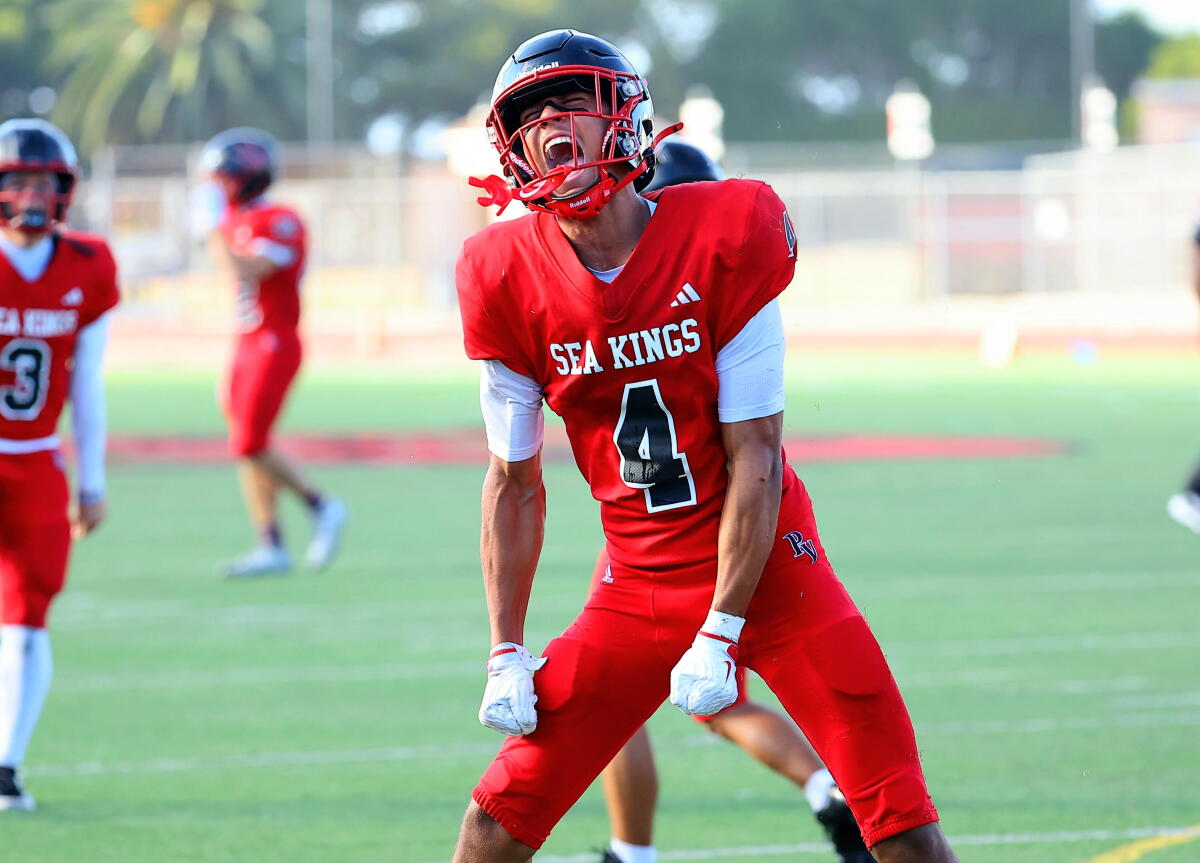
The roar of Palos Verdes’ Jalen Flowers, a receiver and defensive back.
(Nick Koza / For The Times)
It was a perfect example showing the importance of chemistry between quarterback and receiver. Of course, talent helps lead to touchdowns, but chemistry beats talent like rock beats scissors.
“I think it’s kind of easy to have chemistry with him,” Rakowski said. “He understands the game so well, understands what coverages are.”

Jalen Flowers of Palos Verdes shows off his catching skills.
(Nick Koza / For The Times)
When quarterbacks and receivers are thinking alike, magic happens.
“At the end of the day, it boils down to trust,” said Westlake coach Rick Clausen, who played quarterback as did brothers Casey and Jimmy. “Is the receiver going to be where you need him to be? Is he going to make plays for you? It’s such a reliant position. You could be gifted as a thrower, gifted as a receiver, but one without the other is pretty useless.”
The best passing duos look like they have telepathic powers with the ability to anticipate each other’s next move. That’s why quarterbacks throwing to receivers in offseason practices are valuable as each learns about the other.
“When adversity hits and the finger-pointing begins, it’s your chemistry that saves you,” Mission Viejo coach Chad Johnson said.
When St. Bernard coach Dean Herrington was throwing passes to his No. 1 target, Dale Frack, in 1981 at Hart High, the chemistry between the two was legendary.
“You know where the guy is going to be. You’re on the same page,” Herrington said.
Even though the game has evolved, with sometimes four and five receivers going out for passes instead of two, Herrington said, “Chemistry is just as important, if not more so.”
“Chemistry is higher,” Hart coach Jake Goossen said. “If you have talent but it’s not complementary , it’s not going to be fruitful. I want some talent, too, but you have to have the chemistry.”
Here are duos this season showing off talent and chemistry:
Ryan Rakowski and Jalen Flowers, Palos Verdes. Whether praying together before a game or giving high-fives after touchdowns, the Palos Verdes duo keeps producing on short slants or deep posts.
Jaden Jefferson and Quentin Hale, Corona Centennial. This duo grew up together, lived together and played together for years. Jefferson definitely knows what Hale is thinking and vice versa.
Star Thomas III and KJ Woodbury, Orange. They have combined for 16 touchdowns in nine games as juniors.
Jered Smith and Aiden Mejia, Verdugo Hills. Mejia could probably close his eyes and know exactly where Smith would be passing the ball. They have nine touchdowns together.
Grady Long and Landon Armenta, La Serna. Long trusts Armenta like he’s his brother. They’ve combined for 10 touchdowns, with Armenta surpassing 1,000 yards in receiving. They’ve been best friends since kindergarten.
Dane Weber and Chase Bonta, Chaparral. An injury left Weber on the sideline to start the season, but he’s back. Weber and Bonta have known each other since kindergarten.
Brady Edmunds and Dylin Bruce, Huntington Beach. In less than two seasons, they’ve combined for 12 touchdown passes.
Koa Malau’ulu and Kuika Moaalii, St. John Bosco. They are cousins who have been playing together since they were 10. Moaalii has nine touchdown receptions and is having a breakout sophomore season.

Corona Del Mar reciever JJ Haley (1) leaps for a touchdown catch.
(Don Leach/Daily Pilot)
John David Annett and JJ Haley, Corona del Mar. Annett sometimes throws the ball up knowing Haley will find a way to catch it. Both are juniors with complete trust in each other.
Hendrix Tucker and Charles Davis, Westlake. Filling in because of an injury, Tucker, a freshman, has discovered the importance of getting the ball to Davis, who has 11 touchdown receptions.
Jordan Spigarelli and Shane McKibbin, Newport Harbor. They’ve been throwing and catching passes from each other since fifth grade and have connected for eight touchdowns this season.