South Korea youth drawn into crime disguised as part-time work

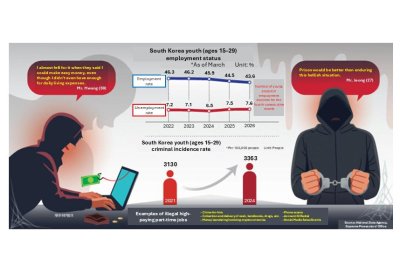
An infographic illustrates declining employment rates and rising crime involvement among South Korean youth, highlighting how economic hardship and online platforms are fueling participation in high-profit illegal activities disguised as part-time jobs. Graphic by Asia Today and translated by UPI
April 23 (Asia Today) — Economic hardship among young people in South Korea is reshaping crime patterns, with more youths turning to high-profit illegal activities disguised as part-time jobs, experts warn.
The shift marks a departure from traditional survival-driven crimes such as theft toward organized fraud, digital financial crime and so-called “crime-for-hire” schemes promising quick cash.
Economists have long noted the link between opportunity and crime. Gary Becker argued that individuals weigh expected criminal gains against legal income opportunities when deciding whether to commit offenses.
Recent data suggest that calculation is changing for young Koreans.
According to government employment data, the youth employment rate for those ages 15 to 29 fell to 43.6% in March, well below the overall rate of 69.7%. Youth employment declined for 41 consecutive months, with 147,000 fewer young workers compared with a year earlier.
In contrast, employment among older age groups increased, deepening what analysts describe as a “K-shaped” divide in the labor market.
At the same time, youth crime is rising. Prosecutors’ data show the number of young offenders per 100,000 people increased from 3,130 in 2021 to 3,363 in 2024. Fraud is particularly prevalent, with people in their 20s accounting for 23.7% of cases – the highest share among all age groups.
Researchers say unemployment and crime are closely linked. A 2023 study found that a 1 percentage point increase in unemployment leads to a 1.5% rise in theft-related crime.
Experts argue the issue is not just an increase in crime, but a structural shift.
“Young people are no longer committing crimes out of necessity alone, but increasingly pursuing one-time, high-reward opportunities,” one analyst said.
The appeal is stark. While unstable jobs may pay about 2 million won (about $1,480) a month, illegal activities can promise hourly earnings exceeding 500,000 won (about $370), widening the perceived gap between legal and illegal income.
Underlying the trend is growing relative poverty – a sense of falling behind others despite overall economic development. Rising real estate and financial asset values have deepened wealth disparities, reinforcing frustration among young people who see limited chances for upward mobility.
Some openly acknowledge the temptation.
“Sometimes it feels better to go to prison than live in this kind of hardship,” a 27-year-old job seeker said. “I know it’s wrong, but it’s hard just to get by.”
Digital platforms are accelerating the problem.
Recruitment for illegal work now spreads through social media and messaging apps, lowering barriers to entry. Schemes such as “yamibaito,” which advertise high-paying short-term jobs, often involve tasks like money transfers, account lending or acting as intermediaries in voice phishing scams.
Many participants are first-time offenders in their early 20s.
Authorities say similar “crime outsourcing” operations are increasingly coordinated through encrypted platforms such as Telegram, making them difficult to trace due to their decentralized structure.
Young people’s familiarity with online tools, cryptocurrencies and non-face-to-face transactions makes them especially suited to the technical roles required in such operations, further concentrating recruitment within the demographic.
Experts caution that the consequences can be lasting.
“Some young people treat these illegal jobs as simple labor and underestimate the risks,” said criminal profiler Bae Sang-hoon. “Even minor involvement can lead to a criminal record that affects the rest of their lives.”
Analysts stress that the problem cannot be addressed through policing alone.
“Poverty is the mother of crime,” said Kim Yoon-tae, a professor of public sociology at Korea University. “We need to examine structural factors such as employment, education and housing, rather than framing this purely as an issue of personal responsibility.”
He added that stable jobs, fair access to education and stronger housing support are essential to reducing the appeal of illegal income opportunities.
Without such changes, experts warn, more young people could be drawn into a cycle where economic hardship leads to crime – and a criminal record further limits future opportunities.
— Reported by Asia Today; translated by UPI
© Asia Today. Unauthorized reproduction or redistribution prohibited.
Original Korean report: https://www.asiatoday.co.kr/kn/view.php?key=20260422010007027