News Analysis: Uncertainty, frustration define messy midterm battles for mayor, governor and Congress
With little more than a week left until primary voters winnow the candidates for Los Angeles mayor, California governor and Congress, there remains a palpable sense of political uncertainty among the electorate — attributable to a lack of clear front-runners, redrawn political maps, messy party infighting and competing voter frustration with both President Trump and the state’s Democratic establishment.
In a state where Democrats hold a substantial advantage among registered voters and Trump lost in 2024 by more than 20 percentage points, MAGA-aligned Republicans are nonetheless competing on a message of ineptitude from longtime liberal leaders to address the state’s most intractable problems. Even some Democrats have railed against the status quo.
With Trump’s grip on the Republican base intact despite abysmal overall approval ratings, many Republican candidates have courted his approval — and been hammered for it by their Democratic opponents.
But those same Democrats have found it harder to explain why their own party should continue to lead the state despite allowing its affordability, housing and homelessness crises to take root and persist — taking little responsibility while swiping at each other for having failed to find solutions sooner.
All that party infighting — present before every primary, but at a fever pitch now — comes against a backdrop of broader voter unease about the war in Iran, volatile oil and gas prices, and the burgeoning threat of AI to the American workforce.
Republican voters are being warned of a blue wave in November giving Democrats control of Congress and grinding Trump’s agenda to a halt. Democratic voters are being warned of Trump administration efforts to undermine local and state elections, and of control of Congress unfairly slipping from reach thanks to further Republican redistricting following a U.S. Supreme Court decision undermining the Voting Rights Act and its protections for majority-Black districts across the South.
Many California voters — some already shaken or burned by former Rep. Eric Swalwell dropping from the gubernatorial race amid sexual assault and rape allegations last month — appear hesitant to cast ballots early, despite warnings that the Trump administration may try to discount those mailed at the last minute.
“Voters don’t want to make a mistake. They’re not absolutely certain,” said Rob Stutzman, a Republican consultant in California. “It’s just not real clear where to land.”
James Adams, a political science professor at UC Davis who studies elections and public opinion, said California Democrats this cycle “have a candidate problem and they have a message problem,” in that they are trying to convince voters to back them “not because they offer exciting ideas or inspiring leadership, but because their Republican opponents are even worse.”
And that message — offered as they gerrymander California in a race to the bottom with Republicans nationally — isn’t cutting it, Adams said.
“People are alienated from our current politics not because Americans are cynical, but because people recognize that they deserve better.”
Outsider shakes up L.A. mayor’s race
Amid entrenched homelessness, affordability concerns and lingering anger over the bungled response to last year’s wildfires, the L.A. mayor’s race was “supposed to be a referendum” on embattled Mayor Karen Bass, Stutzman said.
And yet, Bass remains in the lead, and many voters remain confused about which way to turn away from her — if at all.
Bass has won the endorsement of three council members who are members of the Democratic Socialists of America, despite City Councilmember Nithya Raman, an ally who’d previously endorsed Bass and is a member of the DSA herself, entering the race to her left.
Unable to consolidate support from the city’s progressive flank, Raman is now running neck and neck for a second-place finish and a chance to face Bass in the November runoff with former reality TV personality Spencer Pratt, who has remained in contention in ultra-liberal L.A. despite pushing a MAGA-aligned message to Bass’ right.
Pratt, who did not respond to a request for comment, lost his Pacific Palisades home in the fires and has won over many frustrated city residents with his anti-establishment message and cheeky AI videos — including one casting him as Batman, taking on a corrupt Democratic bourgeoisie.
Pratt, a registered Republican, has tried to dance around politics in the race, calling his campaign a “nonpartisan” one and comparing himself to President Obama politically. But he is backed by many Republicans, has echoed Trump’s rhetoric around restoring “common sense” and a “Golden Age” to L.A., and recently responded to Trump saying that he’d heard Pratt “is a big MAGA person” — and Raman posting the quote to X — with a meme of himself shrugging.
Fernando Guerra, founding director of the Center for the Study of Los Angeles at Loyola Marymount University, said he’s glad city voters have choices this race, because they clearly aren’t happy. He said Angelenos are less optimistic today than ever before and are deeply frustrated with “this same liberal Democratic regime from Bradley to Bass over 50 years” — a reference to former Mayor Tom Bradley, who first took office in 1973.
Voters are clearly tired of that regime, which has succumbed to “policy paralysis” in the name of “inclusion” and trying to please everyone, Guerra said — but not so much that they will consider going MAGA for Pratt.
“People say, ‘Yeah, Democrats have really f—d it up, but there’s no way we’re going to [back] Republicans. Look what they’ve done to the nation.’”
Others aren’t so sure. In its voter guide, the progressive group LA Forward wrote that the “most important thing” in the June 2 primary is to block Pratt — whom it called a “right-wing reality TV buffoon” — from advancing, and the best way to do so is to vote for Raman.
“We would much rather see a Bass/Raman runoff, with no chance of Pratt becoming mayor, than a Pratt/Bass runoff where a Pratt win would be a real possibility — plunging LA into a Trumpian mayoral nightmare,” the group wrote.
An unsettled gubernatorial contest
In the gubernatorial race, none of the many Democratic candidates has been able to consolidate a sizable lead, creating a lingering apprehension that Republicans could somehow eke out a stunning upset in the biggest of blue states.
That’s in part thanks to leading Democratic candidate Xavier Becerra, the former California attorney general and U.S. Health secretary under President Biden, being dogged by insinuations, including from fellow Democrats, that he was somehow complicit in a scheme by underlings to steal from his campaign coffers, despite prosecutors in the case — which resulted in his former chief of staff pleading guilty — never alleging wrongdoing on his part.
It’s also thanks in part to the fact that the leading progressive, Tom Steyer, is a billionaire who has bought his way into contention with nearly $200 million of his own money — in an election cycle in which progressive voters nationwide are decrying billionaires as the clearest symbol of all that is wrong with the nation’s lopsided economy.
“This kind of weird self-loathing rationale of why he’s the right guy to take on billionaires because he is one? You can’t build a Mamdani movement around that,” said Stutzman, referring to New York City Mayor Zohran Mamdani, who shot to power on a democratic socialist platform last year.
The Democrats have also struggled to combat the criticism — leveraged time and again by their Republican competitors — that their party has failed for years to solve California’s most substantial problems, and deserves to be ousted from power.

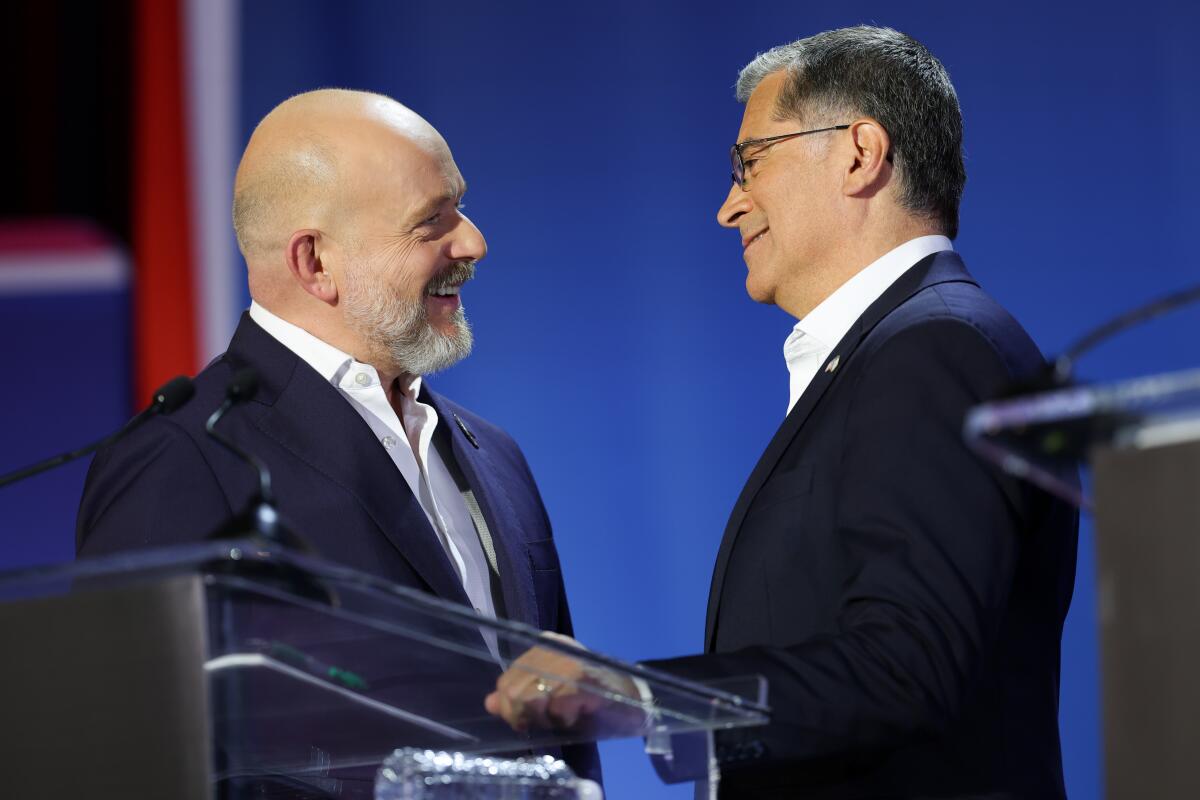
Republican Steve Hilton and Democrat Xavier Becerra speak during a break in the April 28 gubernatorial debate.
(Eric Thayer / Los Angeles Times)
Former Fox News commentator Steve Hilton has hammered that message in ads and on the debate stage, lambasting the Democratic establishment for pushing so much unnecessary regulation that it has chased out business and investment and made everything from gas to housing to groceries more expensive for average residents.
He has blamed Democrats for California’s high rates of poverty and unemployment, its high cost of living and high taxes, its record homelessness and its poor public school results.
In an interview, Hilton said he understands that California voters may not like Trump — who endorsed him — and may have conflicting beliefs about federal and international policy, but that California’s biggest problems have “nothing to do with President Trump.”
“Voters need to decide on what direction they want to take in terms of the policies that affect their daily lives in California,” he said, and those are “devised and enacted within California by our politicians here in Sacramento.”
He also said it’s no surprise that some of his Democratic rivals have also acknowledged that the Democratic establishment has been a failure, because “if you pretend otherwise, you show that you’re just completely out of touch with public opinion.”
Rusty Hicks, chair of the California Democratic Party, said “every campaign is entitled to run the race that they believe matches their story,” even if that means questioning the party’s past performance. But he also said polling hasn’t shown that message to be an effective one, and he’s confident that voters will show their ongoing trust in the party at the polls.
Redistricting, sniping and name-calling
The decision by California voters last November to pass Proposition 50 and allow the state’s Democratic leaders to redraw the state’s congressional maps to favor Democratic candidates in a handful of additional districts — part of a wider redistricting war sparked by Trump — has intensified the primary races in those areas.
As an example, longtime incumbent Reps. Ken Calvert (R-Corona) and Young Kim (R-Anaheim Hills) are now competing to represent the same redrawn swath of Orange, Riverside and San Bernardino counties, and have bitterly attacked one another. Kim has called Calvert a “swampy,” “sleazy” and “corrupt” politician guilty of “sabotaging President Trump’s agenda.” Calvert has called Kim a “RINO,” or Republican In Name Only, and a “Trump-hating liberal.”
Democrats have also sniped at each other, including in the race to replace retiring Rep. Darrell Issa (R-Bonsall) in his redrawn district in San Diego and Riverside counties — where Trump also holds an outsize presence.

Rep. Young Kim and Rep. Ken Calvert are opponents in a heated race in a newly redrawn congressional district.
(Associated Press)
Stutzman said it will be interesting to see how those primaries play out, but also how Democrats there and in other races perform in November — when Democrats are expected to perform well nationally given Trump’s lousy ratings, but Democrats in California could underperform thanks to statewide frustration with affordability, housing and homelessness here.
“People are like, ‘Eh, you know, yeah, Trump — but there’s some problems here,’” Stutzman said.
Hicks said he expects California voters to not only elect another Democratic governor, but to “push back on a Trump administration and congressional Republicans and Republicans around the country that have sought to rig the game in their favor,” including by “ensuring that we fulfill the promise of Proposition 50 by winning congressional seats and retaking the House of Representatives.”
He said the current political moment “can feel like a pressure cooker,” but Californians will “continue to adapt and overcome and be resilient, just as they always have been.”