A historically paralyzed Congress faces its voters
WASHINGTON — Next week’s elections are widely seen as a referendum on President Trump, his team and his party, with most voters telling pollsters they seek a check on his power. But the midterms will also serve as a reckoning for one of the least productive sessions of Congress in a century.
A stunningly low 10% of Americans approve of the job performance of Congress, which has passed fewer bills and conducted less oversight than any of its predecessors in modern history, according to scholars of the legislative branch.
The biggest achievement of unified Republican control has also become one of its biggest liabilities. Deeply unpopular when signed, the One Big Beautiful Bill Act has only grown more controversial, with most Americans still unclear on what’s in it — and those who do know largely disapproving of the law, which cut taxes for businesses and billionaires while adding trillions to the national debt.
A summer Politico poll found that just 8% of Americans believe the law has improved their bottom line. The bill cut billions of dollars for food stamps and over a trillion in health programs and Medicaid.
Two other significant bills passed by this Congress — the Epstein Files Transparency Act and a housing reform package targeting corporate purchases of single-family homes — ultimately became law over Trump’s opposition, leaving Republicans little credit for bipartisan wins.
“It’s not a partisan statement to say that the current Congress will go down in history as one of the most ineffective in history,” said Charles Stewart III, director of the Election Data and Science Lab at MIT. “It may not be the most ineffective, but it’s down there.”
Norman Ornstein, an emeritus scholar at the conservative American Enterprise Institute, said that congressional performance can be measured by several criteria, including the quantity and quality of legislation, its oversight of the executive branch, investigations of government and private-sector failures, and its defense of congressional powers and ethical standards.
By all accounts, he said, “the 119th Congress is an abysmal failure, perhaps the worst I have seen in well over five decades of immersion in the legislative branch.”

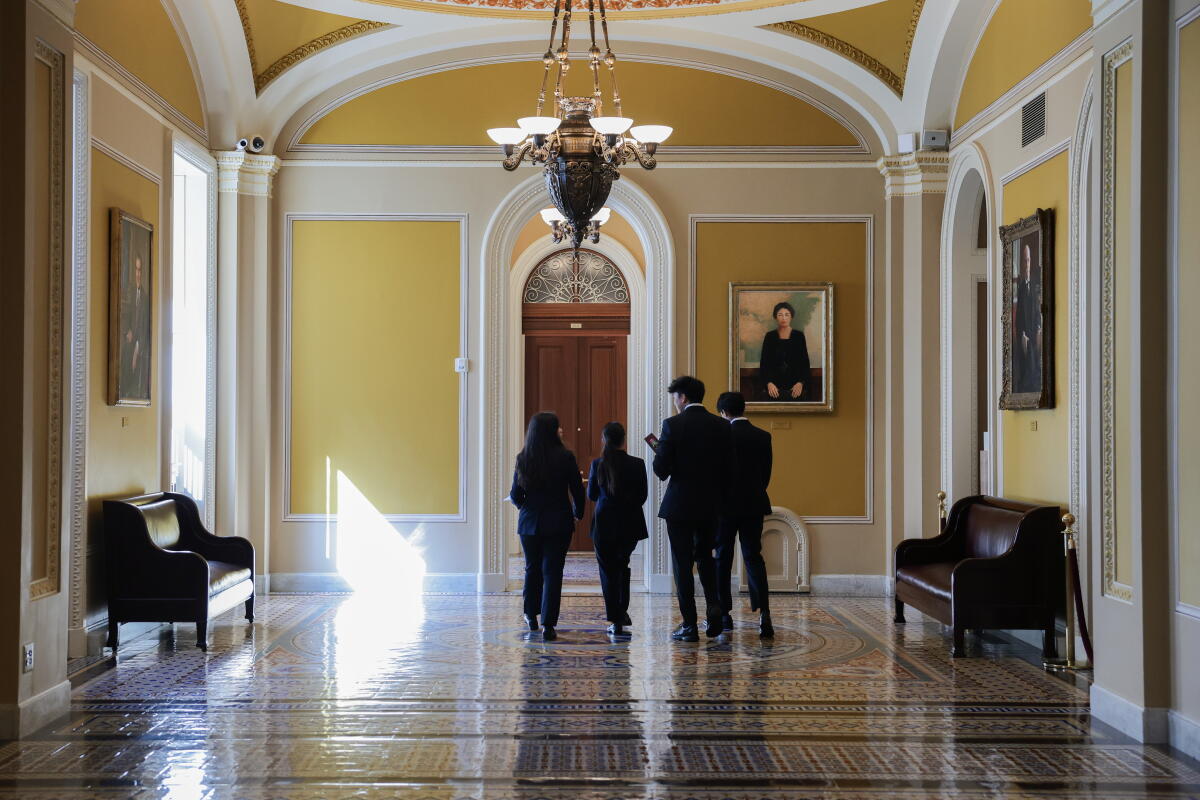
Senate pages walk through the halls outside the Senate chamber in the Capitol on Oct. 1, 2026. The Senate had completed its last votes in the middle of the night before going on recess through Nov. 9.
(Anna Moneymaker / Getty Images)
A recent Fox News poll found that government corruption is voters’ top concern this year, surpassing even the economy. Yet the Republican-controlled Congress has failed to deliver meaningful oversight. The enrichment of Trump, his family, allies and aides has gone uninvestigated, while Senate Republicans continue to block legislation targeting insider trading by members of Congress.
It has been a running theme from Democrats working to unseat Republican incumbents, with Rep. Hakeem Jeffries of New York — slated to become speaker of the House if Democrats win control of the chamber — repeatedly characterizing the current session as a “do-nothing” Congress.

Democratic Senate candidate Mary Peltola speaks at a campaign event Oct. 29, 2026, in Juneau, Alaska.
(Chloe Anderson / Associated Press)
In Alaska, Mary Peltola, the Democratic nominee for Senate, accused her GOP opponent, Sen. Dan Sullivan, of doing nothing to stop Trump’s tariff policies or his war with Iran. Democrat Sherrod Brown in Ohio has attacked the Republican incumbent Jon Husted for his procedural attempts to end debate over legislation on the Epstein files. And Democrat Adam Hamilton has targeted Republican Sen. Roger Marshall of Kansas for voting for the One Big Beautiful Bill Act that jeopardized funding to rural hospitals.
Defending the record of his majority, House Speaker Mike Johnson (R-La.) has highlighted a decline in prescription drug prices, the elimination of “wasteful spending” on various federal programs and bipartisan housing reform. Only so much can be accomplished with a razor-thin majority in the chamber, Johnson has said.

Rep. Derrick Van Orden (R-Wis.) listens as U.S. House Speaker Mike Johnson (R-La.) lends his support at a campaign rally on Oct. 29, 2026, in Platteville, Wis. Van Orden is in a rematch from 2024 with Democrat Rebecca Cooke for the state’s 3rd District seat.
(John Moore / Getty Images)
Trump has vowed on the campaign trail that, if kept in power, a Republican Congress would pass a $5,000 dividend to each American, despite its thin record to date.
Critics of the speaker say Johnson’s deference to Trump — and relinquishing of congressional authority to the executive branch — has unilaterally ceded power, souring voters on unified government.
But Stewart, who also co-directs a voting technology project with Caltech, said Congress’ problems run deeper than its current record.

Sen. Darline Graham (R-S.C.) speaks during a campaign stop at the Palmetto State Armory on Oct. 30, 2026, in Columbia, S.C. Graham is running about even in the polls against her opponent, South Carolina Democratic Senate candidate Annie Andrews.
(Win McNamee / Getty Images)
“Not only is Congress not pushing back against the administration, or even innovating in policy, but its members also don’t seem especially interested in serving their constituents on the small-ball aspects of representation,” Stewart said.
“It’s hard to say members of this Congress are connecting with their constituents as they did in decades past,” he added. “We’ll see if that lack of constituency connection will have an impact on the results.”