Palestine

Palestinian-Israeli conflict critical for BRICS

Long before South African President Cyril Ramaphosa chaired a video summit with BRICS leaders (Brazil, Russia, India and China) with participation of new members on November 21 to discuss the Israel-Hamas conflict, there have been some differences in perceptions and approaches among them, so it was not surprising that the BRICS bloc did not agree on issuing a joint declaration.

Last August when BRICS held its 15th summit, South Africa’s position was entirely different on the International Criminal Court arrest warrant for President Vladimir Putin. But today, South Africa has vehemently called to an arrest warrant to be issued, without further delay, for Prime Minister Benjamin Netanyahu, in the ongoing bombardment and ground invasion of the Gaza Strip.

On November 20, South Africa urged the International Criminal Court (ICC) to issue an arrest warrant for Prime Minister Benjamin Netanyahu by mid-December. Minister in the Presidency Khumbudzo Ntshavheni said failure to do so would signal a “total failure” of global governance.

Some experts think Israel’s approach and strategy should be a lot more targeted and tactical to avoid civilian casualties, South Africa should be critical of their buddy Putin who has been supporting Hamas and facilitating the initial attack. The hypocrisy is suffocating. Having Putin there especially, is hypocrisy in the extreme. They do not want to meet about Ukraine, a sovereign nation that was attacked without cause nor do they want to meet about conflicts in Africa (Sudan, DRC, Somalia, S. Sudan, Nigeria, Ethiopia, et cetera.)

At the end of their lengthy discussions on November 21, leaders of the BRICS bloc, despite their comprehensive analysis of the Palestinian-Israeli conflict that began October 7, were not keen on issuing any joint declaration. It has already been interpreted as a weakness on the part of BRICS. Understandably BRICS is not a political group, as it has often been explained previously during several of its summits. But there must be stern collective decisions from such blocs as BRICS to support United Nations’ efforts toward finding resolution to the conflict has affected millions of civilians, and children in the Gaza Strip.

The virtual talks organized by current BRICS chair South Africa were the first between the group’s leaders since Israel invaded Gaza in retaliation for a deadly raid by militant group Hamas on Israel on October 7. BRICS comprises Brazil, Russia, India, China and South Africa. In August, the grouping agreed to admit Saudi Arabia, Iran, Ethiopia, Egypt, Argentina and the United Arab Emirates from January, in a move aimed at accelerating its push to reshuffle a Western-dominated world order it sees as outdated.

South African President Cyril Ramaphosa has condemned Hamas for its attack on Israeli civilians that sparked the conflict and said both sides were guilty of violating international law. “The collective punishment of Palestinian civilians through the unlawful use of force by Israel is a war crime. The deliberate denial of medicine, fuel, food and water to the residents of Gaza is tantamount to genocide. In its attacks on civilians and by taking hostages, Hamas has also violated international law and must be held accountable for these actions,” Ramaphosa said.

He, however, explained during his discussions that the diplomats did not have sufficient time to draft a declaration. “We’ve called upon all parties to exercise maximum restraint,” Ramaphosa said in his summary of the discussions. “We affirmed … that a just and lasting solution to the Palestinian-Israeli conflict can be achieved by peaceful means.”

Among the BRICS, South Africa has for years compared Israel’s policies in Gaza and the West Bank with its own past apartheid regime of racial segregation. South Africa recalled its ambassador to Israel and withdrew all its diplomatic staff. It has absolutely severed diplomatic ties over the war, taking the lead over Israel who only recalled its Ambassador Eliav Belotserkovsky to South Africa for discussions. Our monitoring shows that apart from South Africa, no other from the BRICS bloc torn down diplomatic relations with Israel.

While South African leader accuses Israel of war crimes, Putin and Xi strike more cautious note at meeting attended by Saudi Arabia, Argentina, Egypt, Ethiopia, Iran and the United Arab Emirates, which are set to join the bloc in January 2024, calling for a cease-fire and the release of civilian hostages but not launching the same level of criticism of either side as Ramaphosa.

Russian President Vladimir Putin blamed the crisis on the failure of U.S. diplomacy in the Middle East. “We call for joint efforts of the international community aimed at de-escalating the situation, a ceasefire and finding a political solution to the Palestinian-Israeli conflict. And the BRICS states… could play a key role in this work,” Putin said, and commended colleagues from the Middle East in the meeting, particularly by holding the Peace Summit in Egypt and the extraordinary Arab-Islamic Summit in Saudi Arabia.

Putin also mentioned there was a “humanitarian catastrophe” unfolding in Gaza and it was “shocking to watch how surgeries are performed on children without anesthesia.” He again blamed the crisis on what he called failed diplomacy by the United States.

“All these events, in fact, are a direct consequence of the U.S. desire to monopolize mediation functions in the Palestinian-Israeli settlement,” Putin said while appearing on teleconference from the Kremlin. He called for a cease-fire in Gaza, the freeing of hostages and the evacuation of civilians from the Gaza Strip.

Putin’s comments were in line with Russia’s careful approach to the Israel-Hamas war, which may present an opportunity for it to advance its role as a global power broker. Putin proposed last month that Moscow could mediate in the conflict due to its relationships with both Israel and the Palestinians. He said that the BRICS bloc could play “a key role” in finding a political settlement.

Different leaders emphasized different points in their remarks. Argentina’s Foreign Minister Santiago Cafiero said his country recognised Israel’s right “to legitimate self-defence while strictly respecting humanitarian international law”, while China’s Xi Jinping appeared to show more sympathy for the Palestinians.

Chinese Jinping called for the release of all civilians detained during the Israel-Hamas war and reiterated his call for an immediate cease-fire. “China believes that the following is urgent and imperative: first, all the parties to the conflict must end hostilities and achieve a cease-fire immediately,” Xi said, addressing leaders from countries including Brazil, Russia, India, South Africa and Iran by video. “All the parties must stop all violence and attacks against civilians, release civilians held captive, and act to prevent loss of more lives and spare people from more miseries.”

“The root cause of the Palestinian-Israeli situation is the fact that the right of the Palestinian people to statehood, their right to existence, and their right of return have long been ignored,” Xi said. China has historically been sympathetic to the Palestinians and supportive of a two-state solution to the Israeli-Palestinian conflict.

In his speech, Xi finally urged the international community to take concrete measures to prevent the escalation of the conflicts and the impact on the stability of the entire Middle East. He also called for a prompt convening of an international peace conference to build consensus for peace and work toward an early comprehensive, just and sustainable solution.

Russia and China are leading voices in BRICS, which has largely cast itself in recent years as standing against the perceived dominance of the West in global affairs. But it has struggled to adopt united policies or positions on many issues because of the differing priorities of the five current members. India, which also wants to be seen as a leader of the developing world, has long walked a tightrope between Israel and the Palestinians and historically has close ties to both.

Many foreign leaders have called on on the International Criminal Court to institute investigations into the military operations of the Israeli Army. The Spokesperson of the Palestinian Government, Ibrahim Milhem, said that the International Criminal Court should take an action on the genocide as it pertains by the international standard.

As confirmed by ICC chief prosecutor Karim Khan, countries such as South Africa, Bangladesh, Bolivia, Comoros, and Djibouti, which are all ICC members. Five nations are calling on the International Criminal Court to launch an investigation into Israel’s indiscriminate war and genocide on Gaza and the situation in the state of Palestine.

Turkey has also filed a case against Netanyahu with the ICC, accusing him of committing genocide against the Palestinians. Turkish President Recep Tayyip Erdogan confirmed to reporters on November 4 that Turkey is no longer considering Netanyahu as its interlocutor, but the head of the Turkish National Intelligence Organization, Ibrahim Kalin, remains in contact with Israel.

In addition, for instance, the President of Algeria called the lawyers of the Arab world and human rights groups to file a claim against Israel in the International Criminal Court for the war crimes in the Gaza Strip. Colombian President Gustavo Petro said Bogota would support Algeria’s case at the International Criminal Court (ICC) over war crimes committed by Israel, led by the Israeli occupation Prime Minister Benjamin Netanyahu, in the ongoing bombardment and ground invasion of the Gaza Strip.

According reports, more than 12,700 Palestinians have been killed in Gaza, according to the Palestinian Health Ministry in the West Bank. Officials there say another 4,000 are missing. Around 1,200 people have been killed on the Israeli side, mainly civilians during the Hamas attack.

The foreign ministers of Saudi Arabia, Jordan, Egypt, Indonesia and Palestine, as well as OIC Secretary General Hissein Brahim Taja, also discussed the situation around Gaza with Russian Foreign Minister Sergey Lavrov on the same day, November 21 and jointly concluded that self-defense is not a justification for what the Israeli military is doing in Gaza. The US and European Union have designated Hamas as a terrorist organization. According to Turkey’s Anadolu news agency, the delegation would also travel to the United Kingdom, France and the United States. 

Source link

Global Sumud Flotilla sets sail from Barcelona for Gaza | Gaza

NewsFeed

Thousands gathered at Barcelona’s port as the largest ever Global Sumud Flotilla prepared to depart for Gaza, aiming to break Israel’s blockade. Al Jazeera’s @Mohammadfff_ reports, as organisers and volunteers insist they will sail to Gaza despite the risks.

Source link

Palestinians appalled as Israel approves settlements in occupied West Bank | Israel-Palestine conflict

NewsFeed

Israel has approved 34 new settlements in the occupied West Bank, illegal under international law, that has Palestinians terrified they will lose their land. At an inauguration event, far-right minister Bezalel Smotrich outlined plans to expand borders across Gaza, Lebanon and Syria.

Source link

Makeshift Gaza university offers chance to resurrect academic studies | Israel-Palestine conflict News

The new academic semester kicked off in Gaza in late March. But the mornings no longer carry the familiar vibrance of students waiting for buses, crossing cities towards universities and colleges.

That feeling has instead been replaced by the hardship of displacement.

Recommended Stories

list of 3 itemsend of list

Israel’s destructive campaign has reduced Gaza’s academic institutions to rubble, many now repurposed as crowded shelters for displaced families. With campuses gone, in-person education has largely disappeared, forcing universities to shift to online learning. But for students living in tents, struggling to secure food, water, electricity, and internet, attending a lecture, even online, has become a privilege.

Amid this chaos, a glimmer of hope has materialised.

In the densely crowded area of al-Mawasi in southern Gaza’s Khan Younis, a new academic initiative is taking shape. Scholars Without Borders, a US nongovernmental organisation, has established what it calls “University City”, a makeshift academic space designed to bring students back into lecture halls.

Built from wood, metal sheets, and whatever materials could be sourced locally, the site stands as a modest reconstruction of what Gaza’s academic life once looked like.

“Despite the hardships, our mission is to bring education closer to students in a better environment,” said Hamza Abu Daqqa, the organisation’s representative in Gaza.

“We designed this space to serve multiple academic institutions and as many students as possible,” he added. “There are six halls here, accommodating up to 600 students a day. It may look simple, but it creates a sense of normal academic life, something students have been deprived of.”

The space includes internet access powered by solar panels, improvised green areas, and even a small business incubator aimed at helping students engage on their own prospects.

According to the organisation, University City operates on a rotating weekly schedule, with each day allocated to a different academic institution. This system allows multiple institutions to share the limited space, ensuring the widest possible access for students.

Given the constraints, universities prioritise courses that require in-person instruction the most, such as practical and discussion-based classes.

Gaza’s prominent universities, such as the Islamic University and Al-Azhar University, have begun using the site, alongside other colleges like the Palestine College of Nursing.

But behind this modest structure lies a far heavier reality.

Dr. Essam Mughari giving a lecture. (Courtesy of the Scholars Without Borders team)
Dr Essam Mughari, a professor at the Palestine College of Nursing, gives a lecture at Gaza’s University City [Courtesy of Scholars Without Borders]

A glimpse of what was lost

Across Gaza, universities have been systematically damaged or destroyed since Israel began its genocidal war in October 2023. In the south, all institutions have been rendered inoperable. A limited number of campuses in northern Gaza have been partially restored, but their capacity remains extremely restricted.

The Palestine College of Nursing, for example, has been surrounded by ruins after falling within the “yellow line” where the Israeli military continues to be based since the October ceasefire, cutting off students from their classrooms entirely.

For a generation of students, university life has simply not existed, as they instead battled to survive.

Each academic year is usually marked by new beginnings, especially for freshmen stepping into a new phase of independence and discovery. But for two consecutive years, thousands of Gaza’s students have been denied that experience.

Now, inside University City, they are encountering it for the first time.

‘It feels like a real university’

Mariam Nasr, 20, a first-year nursing student displaced from Rafah, sat in one of the makeshift halls, reflecting on what the space meant to her.

“Before the genocide, everything we needed to study was available; our homes, electricity, materials, and most importantly, safety,” she said. “But for more than two years, our lives have been completely disrupted.”

Mariam began her final year of high school just as the war started. It took more than a year to complete her exams under difficult conditions before she could finally enrol in the university.

“I always dreamed of studying medicine,” she said. “But the circumstances affected my results. My late grandfather told me that healing people isn’t limited to one path, so I chose nursing.”

Still, her degree requires in-person courses, something she had never experienced until now.

“When I saw this place, I was amazed,” she said. “It was the first time I attended classes in a space that actually feels like a university. We are all excited. It feels different; it feels real.”

For students like Mariam, their first year was spent behind screens, if they were lucky to have one in their tents, disconnected from the academic environment they had hoped for.

Amr Muhammad, 20, another first-year nursing student from al-Magahzi Camp in central Gaza, shared a similar reaction.

“I expected something much simpler, just tents and basic setups,” he said. “But this was different. Being here with other students, discussing and engaging in class makes a huge difference.”

Amr Muhammad, 20. A first-year nursing student. (Courtesy of Scholars Without Borders team)
Amr Muhammad, a 20-year-old first-year nursing student at Gaza’s Palestinian College of Nursing [Courtesy of Scholars Without Borders]

Academia under fire and siege

The experience faced by students in this small space reflects a much larger tragedy.

Israel’s destruction of Gaza’s academic sector has been described by UN experts as scholasticide; the systematic dismantling of education through the targeting of institutions, students, and academic life itself. Universities have been destroyed, professors and students killed, and reconstruction efforts obstructed.

More than 7,000 university students and academics have been killed or injured by Israeli attacks, while more than 60 university buildings were completely demolished by Israeli aerial attacks or ground detonations, according to the Euro-Med Human Rights Monitor and information shared by Palestinian officials.

As a result, hundreds of thousands of students have been cut off from formal education, forced into alternatives that are not able to match their former experiences.

And those alternatives, such as University City, face enormous difficulties in just getting their work started.

“All the materials you see here were sourced from inside the Gaza Strip,” Abu Daqqa said, gesturing around the site. “We had to work within what was available, with rising costs and scarcity of resources. But we were determined to create something that gives students a sense of normalcy.”

Under the October ceasefire, Israel is obliged to allow reconstruction materials to help restore shelter, essential services for Palestinians. But Israel has not adhered to that stipulation and has continued to impose restrictions, while carrying out deadly attacks across Gaza.

And for many students, reaching the University City is itself a challenge.

“I am displaced in al-Mawasi, so I’m supposed to be relatively close, but even getting here is difficult,” Mariam said. “My classes start at 9am, and I wake up at 5 just to find transportation.”

With roads damaged and fuel scarce, options for students are limited to worn-out vehicles and donkey or horse carts.

“Getting cash is frustrating. Taxis and carts only accept coins. My father barely got me eight shekels [$2.64] today, but I couldn’t find a ride,” she said. “So I walked nearly four kilometres[2.5 miles] with my friends.”

For Amr, the journey is even longer.

“I left at 6am and waited for two hours before finding a crowded vehicle,” he said. “It was the only way to get here.”

And once the day ends, the challenges resume.

“This space is only for a few hours,” he added. “The rest of the week, we go back to struggling with electricity, internet, and basic needs. We can’t even print materials or access online lectures properly.”

Students rely on shared or damaged devices, unstable connections, and limited resources, making consistent learning difficult.

“Back in the tent, I rely on my father’s old phone just to follow lectures when I can,” Mariam said. “Most days, there’s no stable internet or power. I try to hold on and keep going, but I often wish for something as simple as a steady power source and a better device like an iPad to study properly and not fall behind.”

Holding on to education

Despite everything, a scene of resilience unfolds as students continue.

Inside the halls, discussions resume, notes are taken, and a sense of academic life slowly returns, even if temporarily.

“For medical education, in-person learning is essential,” said Dr Essam Mughari, a professor at the Palestine College of Nursing. “It’s quite hard for online education to replace practical engagement.”

He described the emotional significance of meeting students again.

“After everything they’ve been through, being able to gather, interact, and learn together, it restores something vital,” he said. “We have a responsibility to support them, despite the circumstances, because tomorrow they will be in our place”

For Mariam, that determination is deeply personal.

“Some people might think it’s impossible to study in these conditions,” she said. “But I want to continue. My cousin was a nurse. An Israeli air strike levelled her family’s three-storey house in Gaza City, killing her and several others. I remember her to remind myself why I hold onto this path to heal others and serve my people.”

The University City now serves hundreds of students each day. But thousands more remain without access to similar spaces.

Scholars Without Borders says the initiative is only the beginning of a mission that is still crippled by the Israeli siege.

“Our work is ongoing,” Abu Daqqa said. “We have established dozens of makeshift schools and established this university city, but the need is far greater. This is what we were able to build under blockade,” he said. “Imagine what could be done if the truly needed resources are allowed.”

Source link

At least seven Palestinians killed in Israeli attacks on Gaza | Israel-Palestine conflict News

An early-morning strike hits a group of civilians in ​​Bureij camp as drones attack a tent in Khan Younis displacement site.

At least seven Palestinians have been killed, and others wounded, in Israeli strikes across the central and southern Gaza Strip.

An Israeli drone fired two missiles close to a police post in Bureij refugee camp in central Gaza, Mahmoud Bassal, a spokesman for Gaza’s civil defence rescue service told the AFP news agency on Saturday.

Recommended Stories

list of 3 itemsend of list

Medical sources confirmed the early morning attack to Al Jazeera, saying the strike hit a group of civilians in the “Block 9” area of Bureij. Several people were killed and seriously wounded, they said.

Ambulance crews faced difficult conditions as they worked to transport the bodies and those injured to nearby hospitals, the sources added.

The al-Aqsa hospital in central Gaza told AFP it had received six bodies and seven wounded people, including four in critical condition. The nearby al-Awda hospital said it received one fatality and two wounded people.

Separately, in the southern Gaza Strip, Nasser Medical Complex said it received three wounded people following an Israeli drone strike against a tent of displaced people in the town of Bani Suheila, located east of Khan Younis.

Al Jazeera’s correspondent on the ground also reported Israeli artillery shelling and heavy tank fire near Bani Suheila and east of Gaza City.

Israel’s genocidal war on Gaza has killed more than 72,300 people since it began in October 2023, according to the Gaza Ministry of Health, including at least 738 since the so-called ceasefire went into effect last October.

The tally includes at least 32 deaths since the start of April alone – among them Al Jazeera journalist Mohammed Wishah, who was killed in an attack west of Gaza City earlier this week.

United Nations human rights chief Volker Turk on Friday condemned Israel’s recent violence in the Gaza Strip, saying that “the unrelenting pattern of killings” reflects Israel’s “sweeping impunity”.

“For the past 10 days, Palestinians are still being killed and injured in what is left of their homes, shelters and tents of displaced families, on the streets, in vehicles, at a medical facility and a classroom,” Turk said.

Israeli settlers stand at a water slide in the Israeli-occupied West Bank village of Ras Ein al-Auja on April on April 9, 2026. Israel vowed more strikes against Hezbollah on April 9, dismissing mounting international demands that the fragile truce between the United States and Iran in the Gulf be expanded to cover the war in Lebanon. (Photo by Ilia YEFIMOVICH / AFP)
Israeli settlers stand at a water slide in the Israeli-occupied West Bank village of Ras Ein al-Auja on April 9, 2026 [Ilia Yefimovich/AFP]

West Bank raids, arrests continue

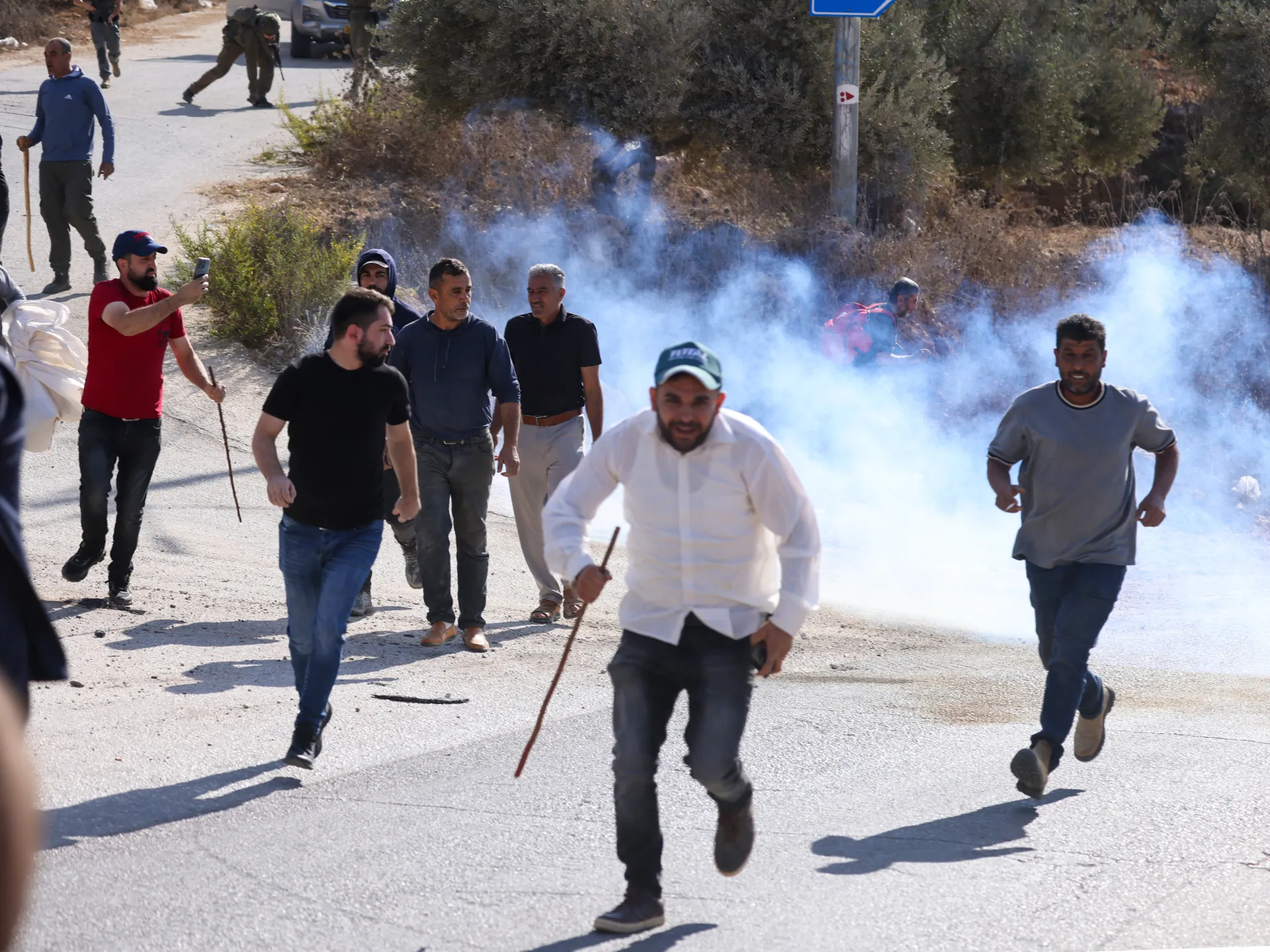
Meanwhile, in the occupied West Bank, Israeli settlers and forces stormed homes and villages throughout the morning, continuing an escalating campaign to expand their illegal settlements.

The Palestinian Wafa news agency reported that Israeli forces arrested seven people east of Qalqilya and separately descended upon Bir al-Basha, near the city of Jenin, where they detained various residents and interrogated them.

In al-Maniya, southeast of Bethlehem, Israeli settlers fanned out across the streets, shone spotlights inside homes and provoked residents.

Another group of settlers set fire to a house in the village of Duma in the Nablus governorate, according to village council head Suleiman Dawabsheh.

Residents managed to control the fire and prevent it from spreading, Dawabsheh said.

Israeli media outlets have reported the recent secret approval of 34 new illegal West Bank settlements, adding to 68 that have been endorsed since Israeli Prime Minister Benjamin Netanyahu’s government rose to power in 2022.

Various foreign governments and organisations, including the European Union, Turkiye, Sweden and the Organisation of Islamic Cooperation, have condemned the move as a flagrant violation of international law.

Source link

Muslims hold first Friday prayers at Al-Aqsa Mosque after reopening | Israel-Palestine conflict

NewsFeed

Thousands of Muslims performed Friday prayers at Al-Aqsa Mosque in occupied East Jerusalem after it reopened to worshippers following a 40-day closure by the Israeli army that barred access to Islam’s third-holiest site after the war on Iran began.

Source link

Palestinian journalist describes losing prosthetic eye in Israeli prison | Israel-Palestine conflict

NewsFeed

Palestinian journalist Muath Amarne said his prosthetic eye fell out after an infection while in Israeli detention, leaving him in urgent need of surgery. Amarne, who lost his left eye in 2019 after being struck by an Israeli rubber bullet, was held in prison for more than seven months.

Source link

Thousands of Palestinians pray at Al-Aqsa Mosque after Israel’s 40-day ban | Occupied East Jerusalem News

Around 3,000 worshippers entered Al-Aqsa for the morning prayer on Thursday, after Israel lifted restrictions.

The Al-Aqsa Mosque compound in occupied East Jerusalem has reopened to Palestinian worshippers after a 40-day closure by Israel.

Video verified by Al Jazeera showed Palestinians streaming through its gates early on Thursday morning. Around 3,000 worshippers attended  morning prayers.

Recommended Stories

list of 4 itemsend of list

Access had been completely prohibited, or restricted to a few dozen faithful at Christian, Jewish and Muslim sites following the outbreak of the US-Israeli war on Iran on February 28. Israel often imposes restrictions, especially on Palestinian worshippers.

The Islamic Waqf Department in occupied Jerusalem confirmed that the doors of Al-Aqsa would be reopened to all worshippers from dawn. The Jordanian-affiliated religious authority responsible for managing the mosque did not provide further details.

Video from earlier showed volunteers and caretakers in courtyards and prayer areas preparing to receive worshippers and holding religious rites.

Israeli authorities announced the opening of the mosque and the Church of the Holy Sepulchre in occupied Jerusalem on Wednesday evening.

Israeli police attributed the opening of holy sites to what it called “updated instructions from the Israeli Home Front Command”.

The statement noted intensive security reinforcements, including hundreds of police officers and border guards in the alleys of the Old City of Jerusalem and roads leading to the holy sites, aimed at “securing visitors”.

Jerusalem and its holy sites have been subjected to strict security measures and frequent closures during the regional war of the past six weeks.

The restrictions subdued Lent, Passover and Ramadan celebrations for many in some of the holiest sites for Christianity, Islam and Judaism.

Authorities also prevented Eid al-Fitr prayers at Al-Aqsa this year – the first such restriction since Israel’s occupation of East Jerusalem in 1967.

But the bans have been lifted just in time for Orthodox Christians, who celebrate Easter on Sunday, a week after Catholic and Protestants.

No let up in raids in occupied West Bank

Israeli raids have continued across the occupied West Bank.

Israeli forces detained a woman and assaulted a man during an early Thursday raid in Nablus, the Palestinian news agency Wafa reported.

The Ramallah-based Palestinian health ministry separately said Israeli forces fatally shot a Palestinian man near the village of Tayasir in the northern West Bank on Wednesday night.

The ministry said 28-year-old Alaa Khaled Mohammed Sbeih “was shot and killed” by Israeli forces, while the Israeli military said an off-duty soldier fired at a stone-thrower.

Wafa said six young men were detained in a raid on the village of Tayasir, while in Ya’bad, south of Jenin, Israeli troops stormed several homes at dawn, destroying the contents of three houses. Forces also raided the villages of Qusra and Awarta, but no arrests were reported there.

Attacks by Israeli forces across Gaza and the occupied West Bank have continued, along with Israel’s wars on Iran and Lebanon.

The UN Office for the Coordination of Humanitarian Affairs (OCHA) says more than 1,100 Palestinians have been killed by Israeli forces and settlers in the occupied West Bank since 2023, with at least 10,000 forcibly displaced.

Source link

Who Speaks for Palestinian Women? Unmasking the Politics of ‘Saving’ in Gaza”

In the midst of the escalation of the Gaza conflict that has been going on since 2023, the world is once again witnessing the heartbreaking reality of women crying among the ruins of their homes and the burning of property, mothers who have lost children, and families separated by military attacks. Global media were quick to point to this event as a symbol of the suffering of civil society. But behind the empathy shown, there is also a question that is rarely asked: how exactly can Palestinian women be represented, and who can shape that narrative?

For decades, women in conflict zones, such as the Middle East, have often been portrayed in the same framework, as passive victims who need to be rescued and protected. In the context of Gaza, this pattern has resurfaced. Global media coverage often only highlights women’s plight without giving enough space for their voices, perspectives, and agency in conflict. This narrative does look humanistic, but it also contains an element of simplification that makes the world unaware of the more complex reality behind it.

This is where postcolonial feminism offers a sharper critique and helps us to look further at this issue as a form of epistemic violence. This perspective emphasizes that in understanding women’s experiences, it cannot be separated from considerations about the history of colonialism and global power relations. In the context of the Gaza conflict, this means that violence is experienced by women. Not only a patriarchal problem but also supported by aspects of colonialism, militarization, and inequality politics (Enloe, 2014).

This phenomenon cannot be separated from the thoughts of Lila Abu-Lughod, who mentioned “politics of saving” in her work entitled Do Muslim Women Need Saving? Abu-Lughod (2013) criticized how the Western world portrays Muslim women as an oppressed group in need of rescue. This narrative is not only a form of simplifying women’s representation but can also be used as a legitimacy for political, cultural, and even military intervention from external actors. Such as the concept of militarization of daily life raised by Enloe (2014), who explains that militarization does not only occur on the battlefield but also enters into the reality of daily life, including in how the media frames conflicts. Where in this context the representation of Palestinian women as passive victims is used to affirm certain narratives about war, security, and the legitimacy of power.

The term “security politics” in the Gaza conflict appears in a more subtle form. Palestinian women are positioned as a universal form of suffering but are rarely seen as political subjects with diverse experiences and aspirations. The suffering they experience in conflict becomes a global consumption, while structural contexts, such as colonialism and power inequality, are often ignored.

An important question then arises: who really has the right to speak on behalf of Palestinian women? This is where Spivak’s (2009) thoughts on the concept of the subaltern become relevant. Spivak himself argues that the subaltern group is a group that is in a marginalized position so that its voice is not heard in the dominant discourse. Even when they are “represented,” their voices are often mediated or even filtered by stronger actors.

In many news narratives about Gaza, Palestinian women rarely appear as the main narrator of their own experiences. Brand awareness is often told by foreign journalists and international organizations. Or humanitarian institutions as “representatives.” As a result, the narrative that is born is not a complete reflection of the reality they face, but rather a form of representation that has been framed according to the logic and direction of global media reporting.

This issue becomes more complex when we look at how the media tends to ignore the agency dimension. Palestinian women not only live in the shadow of conflict but also have active agency in various forms of resistance, both as activists, journalists, medical personnel, and community leaders. They have the capacity to build solidarity and even contribute to political struggles as well as peace. However, aspect II rarely gets the same spotlight as the narrative of suffering.

This disregard of agency can create an imbalance of representation. Palestinian women are only seen as passive victims, which makes them look like they also have no capacity as active actors. This inequality is not only a question of representation but also a question of power regarding who has the right to define reality for a particular purpose.

In the digital era, this is certainly starting to change. Social media provides a space for Palestinian women to be able to speak directly to a global audience. Through various social media platforms, they can share experiences and aspirations that are often not featured in the mainstream media. This ultimately opens up the possibility of a more authentic and diverse counternarrative.

However, the digital space is still full of limitations. Certain narratives can easily go viral, while others sink and disappear without a trace. In other words, while social media can offer opportunities, the space is not completely free from the influence of broader power structures.

Rereading the narrative of Palestinian women in the era of the Gaza conflict is a form of recognition that representation is not neutral. It is always related to interests, ideologies, and power relations. The narrative of “rescue” may seem like a form of concern from the surface, but if you look further, it can also be a form of control over the other party’s representation. Looking at the Gaza conflict through the lens of feminism is to question basic assumptions in global reporting. Do we really see them as individuals? Do we really hear their voices, or just voices about them?

Therefore, it is important to change our perspective. Instead of seeing Palestinian women as victims who need to be saved, we need to recognize them as subjects who have the capacity to speak, form agencies, and share their experiences in the form of real reality. This is not to ignore the real suffering but to place Palestinian women’s experiences in armed conflict in a broader, fairer, and closer context to reality. As Abu-Lughod (2013) reminds us, the more important question that arises is not how to save Muslim women, but how to understand the conditions and realities that shape their life experiences.

Ultimately, the lens of feminism, particularly postcolonial feminism, invites us to not only have empathy but also to be more critical. By looking further at how the narrative is formed, who can benefit, and which voices are ignored.

Perhaps the more relevant question is not whether Palestinian women need protection and rescue, but whether the world is ready to hear and see them as subjects who have the capacity to speak and move. Because what needs to change is not them, but the way we understand them.

Source link

Israeli army fire on WHO vehicle in southern Gaza kills one, medics report | Israel-Palestine conflict News

WHO driver Majdi Aslan was killed and a WHO doctor wounded, along with several other Palestinians, medical sources said.

A member of staff from the World Health Organization (WHO) has been killed in Gaza and several others injured when the Israeli army fired on their vehicle, according to sources, including an Al Jazeera correspondent.

WHO driver Majdi Aslan, 54, was killed on Monday. A doctor from the international organisation and several other Palestinians were also injured in the incident in eastern Khan Younis, according to sources at the enclave’s Nasser and Al-Aqsa hospitals.

Recommended Stories

list of 4 itemsend of list

As the world’s attention remains fixed on the United States-Israel war on Iran, Israel is continuing its attacks on the Gaza Strip, which has seen near-daily Israeli fire and strikes since a fragile ceasefire was reached in October, with more than 700 Palestinians killed since, according to Gaza’s Health Ministry.

Monday’s incident took place in an area close to the so-called yellow line in eastern Khan Younis, reported Al Jazeera’s Hani Mahmoud.

Israeli forces shot “indiscriminately” at people and vehicles moving along the Salah al-Din Street in the southern Gaza Strip, he said.

A commercial vehicle was transporting civilians between southern and central Gaza. It was followed by a car carrying WHO employees, said Mahmoud.

“The driver was shot in the head, and by the time he was transported to the Al-Aqsa Hospital, he was announced dead,” the correspondent reported from Gaza City. Seven or so others suffered injuries, he added.

Translation: Qamar Majdi Mustafa Aslan (54 years old), a resident of Bureij camp, who ascended after being wounded in a shooting targeting a World Health Organization vehicle on Salah al-Din Street east of Khan Younis city.

WHO did not immediately confirm that the man killed was an employee, but said in a statement emailed to Al Jazeera that “this morning, a critical security incident occurred in Gaza that is under review by relevant authorities”.

“As [a] result of this critical security incident, today’s medical evacuation from Gaza via Rafah to Egypt has been put on hold with immediate effect, until further notice,” the statement added.

WHO has been overseeing coordination between Egypt and Israel since the opening of the Rafah crossing, which has allowed small numbers of injured Palestinians desperate for medical aid to leave to seek treatment abroad.

Israel has, however, continued to limit the entry of humanitarian aid into the besieged territory, also shutting the vital crossing in the early days of the US-Israeli war on Iran.

Elsewhere on Monday in the southern part of Khan Younis, a Palestinian man with special needs was killed after being shot by Israeli soldiers.

To the north, a drone attack in Gaza City killed one person, Mahmoud said.

“The target was an electric bike … moving in the area that was struck by drone missiles. It killed … a 36-year-old individual who was moving … around the displacement camps,” he reported.

A child was also injured in the attack and is now in critical condition in hospital, the correspondent added.

Two Palestinians were also killed in Israeli drone strikes on the Yarmouk and Shujayea neighbourhoods, according to a medical source at al-Shifa Hospital.

Sources at Gaza hospitals have reported the deaths of eight Palestinians in Israeli air strikes outside areas under Israeli control since Sunday.

Source link

Israeli air strike hits crowd in Gaza City | Gaza

NewsFeed

Several Palestinians were rushed to hospital with severe injuries after an Israeli air strike hit a crowd near the Al Jazeera Club in central Gaza City. Near-daily Israeli attacks have killed more than 700 people since the so-called “ceasefire” entered into effect in October 2025.

Source link

Hamas armed wing says disarmament demands not acceptable | Israel-Palestine conflict News

Abu Obeida says calling for the group’s disarmament amounts to an attempt to continue Israel’s genocide against the Palestinian people in Gaza.

Hamas spokesman Abu Obeida has said that calling for the group’s disarmament amounted to an attempt to continue Israel’s genocide.

Hamas’s armed wing has rejected calls for the Palestinian group to disarm, saying that discussing the issue before Israel fully implements the first phase of the United States-brokered “ceasefire” in Israel’s war on Gaza amounts to an attempt to continue the genocide against the Palestinian people.

Recommended Stories

list of 4 itemsend of list

In a televised statement on Sunday, Obeida, who is Hamas’s armed wing spokesperson, said that raising the issue of weapons “in a crude manner” would not be accepted.

The issue of Hamas relinquishing its weapons is a major obstacle in talks to implement US President Donald Trump’s 20-point plan for Gaza, aimed at ending Israel’s war on the besieged territory.

Since the US- and Qatar-brokered “ceasefire” took effect in October, more than 705 Palestinians have been killed in Israeli attacks, according to the Palestinian news agency Wafa.

Hamas has told mediators it will not discuss disarmament without guarantees that Israel will completely withdraw from Gaza, three sources told the Reuters news agency last week.

“What the enemy is trying to push through today against the Palestinian resistance, via our brotherly mediators, is extremely dangerous,” Obeida said.

He said the disarmament demands were “nothing but an overt attempt to continue the genocide against our people, something we will not accept under any circumstances”.

It was not immediately clear whether the comments amounted to a formal rejection of the US-backed plan, which includes a demand that Hamas lay down its arms.

Israel’s genocidal war on Gaza, which began after the Hamas-led attacks on southern Israel in October 2023, has killed more than 72,000 Palestinians and injured at least 172,000 others.

Obeida urged mediators to pressure Israel to fulfil its commitments under the first phase of the Trump plan before any discussion of the second phase can take place.

“The enemy is the one who undermines the agreement,” he said.

There was no immediate comment from Israel on his remarks.

Obeida also addressed Israel’s role in the US-Israel war on Iran, condemning it for launching strikes on Iran “in the midst of the deception of negotiations, with full collusion and conspiracy with the United States”.

The US had been involved in talks with Iran over its nuclear programme in the weeks before the US and Israel launched the war on February 28.

In Iran, more than 2,000 people have been killed and at least 26,500 others injured since the war began.

Obeida also condemned Israel’s renewed offensive “against sisterly Lebanon”, which it launched on March 2 after the Lebanese armed group Hezbollah fired rockets into Israel.

Israel’s assault on Lebanon has killed more than 1,400 people and displaced over 1.2 million, according to Lebanese authorities.

Obeida commended Iran, Hezbollah and Yemen’s Houthis for their continued strikes against Israel.

Hamas’s spokesman also condemned the Israeli parliament’s passage of a new death penalty law that only applies to Palestinians, urging people in the West Bank “to seek, by every possible means, to liberate the [Palestinian] prisoners” held in Israeli jails.

Source link

Has the humanitarian crisis in Gaza been ignored? | Israel-Palestine conflict

Conditions in Gaza worsen amid the United States-Israel war on Iran.

Humanitarian conditions in Gaza remain dire, despite the “ceasefire” that came into effect in October.

For months, the Israeli military has violated the agreement – carrying out air strikes and limiting the entry of aid.

But the situation got worse when Israel and the United States launched their war on Iran on February 28.

The Rafah border crossing was closed again. And deliveries of food, fuel and aid were further restricted.

With the Iran war disrupting global supply chains and the United Nations warning of threats to food security, what are the implications for Palestinians in Gaza?

Presenter: Imran Khan

Guests:

Dr Mohammed Tahir – Orthopaedic surgeon who has worked extensively in Gaza

Alex de Waal – Executive director of the World Peace Foundation

Xavier Abu Eid – Political analyst and former communications director for the Palestine Liberation Organization (PLO)

Source link

Israeli measures tighten grip on Hebron’s Ibrahimi Mosque | Israel-Palestine conflict News

Hebron, occupied West Bank – Hebron’s Ibrahimi Mosque is no more than 50 metres from Aref Jaber’s home, in the neighbourhood that bears his surname, reflecting his family’s long history in the Palestinian city.

The 51-year-old has taken advantage of that proximity since his childhood, regularly praying at the mosque, one of the most important Islamic sites, and a Palestinian national symbol.

Recommended Stories

list of 3 itemsend of list

But the Ibrahimi Mosque of Jaber’s childhood is not the one of today. A 1994 massacre of Muslim worshippers by the Israeli settler Baruch Goldstein killed 29 Palestinians. Instead of getting justice, Palestinians faced more restrictions in the aftermath of the attack.

Israeli settlers began establishing an illegal presence in Hebron, part of the occupied West Bank, in 1968, the year after Israel seized control of the Palestinian territory. The settlers have been working to grow their presence ever since, with increased support from the Israeli government.

After 1994, Israel began taking steps to, in effect, control the Ibrahimi Mosque – known to Jews as the Cave of the Patriarchs – by closing off large areas in Hebron’s Old City and the southern area surrounding the mosque, then dividing it between Muslims and a few hundred Jewish settlers, granting the latter the right to pray there.

This was followed by the signing of the Hebron Agreement with the Palestinian Authority in 1997, which stipulated the division of the city into two parts: H1, under Palestinian control, comprising 80 percent of the area, and H2, under Israeli control, comprising 20 percent, but including the Ibrahimi Mosque and the Old City.

Following this series of events, settlement activity intensified in the heart of Hebron. Settlers established illegal outposts within the Old City and began gradually expanding and seizing new homes under the protection of the Israeli army.

Meanwhile, Palestinians were subjected to closures, restrictions and repressive measures aimed at forcing them to leave the Old City, thus facilitating Israeli control over the mosque.

Man stands next to a barrier
Israeli forces have erected metal barriers throughout the neighbourhoods surrounding the Ibrahimi Mosque, restricting access for Palestinians [Mosab Shawer/Al Jazeera]

Neighbours of the Ibrahimi Mosque

Jaber had hoped that his children would pray at the mosque daily and become familiar with it, but Israeli measures prevented this.

He explained that since 1994, the southern gate of the mosque, which residents of his neighbourhood used for access, has been closed. They have instead been forced to take alternative routes, turning a journey of 50 metres into one that now spans almost three kilometres.

Things have gotten worse since the beginning of Israel’s genocidal war on Gaza in October 2023, when Israel also ramped up its attacks in the West Bank.

Israel tightened its grip on the mosque and its surroundings, closing more of the alternative routes.

“The difficulty of reaching the mosque is compounded by the procedures at the iron and electronic gates installed at its entrances and in its vicinity,” Jaber said. “We are subjected to searches, detention, and harassment without any justification, and often young men, boys, and even women are arrested.”

The Israeli government says that the restrictions are necessary for security reasons – to protect Israeli settlers whose presence in the West Bank’s most populous city is illegal under international law.

Jaber explained how the Israeli army closes barriers and gates around the mosque and the neighbourhoods that surround it for extended periods under security pretexts. Palestinian residents are not allowed to leave their homes, even to shop, while settlers are permitted to move freely throughout the Old City.

Israeli authorities also used the justification of the current conflict with Iran to close access to the Ibrahimi Mosque for Palestinians for six days from February 28, allowing it to reopen for a limited number of worshippers on March 6.

Alleyway with Ibrahimi Mosque visible
The Ibrahimi Mosque is an important Islamic holy site and a Palestinian national symbol, also holy to Jews who call it the Cave of the Patriarchs [Mosab Shawer/Al Jazeera]

Increased control

But these measures aren’t only aimed at restricting Palestinians in the vicinity of the mosque, but also seem to be an attempt to establish complete Israeli security control over it, with measures similar to those Israel employs at the Al-Aqsa Mosque in occupied East Jerusalem.

In Al-Aqsa, the third holiest site in Islam, renewable expulsion orders are used to prevent the entry of worshippers deemed troublesome. Searches are also regularly conducted at the gates of Al-Aqsa, as well as detentions, confiscation of identity cards and restrictions on entry to certain parts of the mosque compound.

Israel now regularly conducts similar actions at the Ibrahimi Mosque.

The Israeli army issued orders to remove Moataz Abu Sneineh, the director of the Ibrahimi Mosque, and other employees from the mosque for 15 days in January. The Palestinian Authority said that the orders were part of “an attempt to reduce their role in the administration and supervision of the Ibrahimi Mosque’s religious and administrative affairs”.

Israeli officials have also tried to push through construction work in the mosque without the approval of Palestinian officials.

On February 9, the Israeli cabinet approved the transfer of licensing, building and municipal administration powers in Hebron from the municipality to the Israeli Civil Administration, in addition to establishing a separate settlement municipality within the city.

The change, part of an internationally condemned Israeli push to increase control over the West Bank and make Israeli settlement easier, is seen as illegitimate and dangerous to the existing status quo, threatening freedom of worship and public order, according to a statement issued by the Hebron Municipality in response to the decision.

Abu Sneineh told Al Jazeera that Israel has transformed the mosque into something resembling a “military barracks” due to the stringent measures it imposes, which “aim to reduce the number of worshippers there”.

According to Abu Sneineh, the Israeli government interfered in the authority of the Ministry of Religious Endowments, and the call to prayer was prevented from being performed dozens of times a month. Worshippers were subjected to humiliating treatment at the mosque entrance, including beatings, verbal abuse and expulsion. Abu Sneineh said the measures were part of a systematic Israeli policy aimed at transforming the mosque into a Jewish synagogue.

“Israel is trying to impose a new reality by controlling the mosque and obstructing worshippers’ access to it, whether during Ramadan or at other times. After October 2023, the measures became even more stringent to erase the Islamic identity of the place, as if it were racing against time to seize control of it,” he added.

On February 28, coinciding with the start of Israeli-American strikes on Iran, the Israeli army expelled worshippers and staff from the mosque and informed them of its closure until further notice, just as it had done at Al-Aqsa Mosque in Jerusalem on the same day under the declared state of emergency measures.

The director of the Youth Against Settlements group and a resident of the Old City, Issa Amro, believes that the situation at the Ibrahimi Mosque is more dangerous than at Al-Aqsa Mosque because it has suffered from temporal and spatial division since 1994.

The “arbitrary” barriers, the closure of surrounding markets and main roads leading to it, and recently the closure of checkpoints in the southern area of the city – which includes the Old City and the Ibrahimi Mosque – prevent approximately 50,000 citizens from accessing it, along with the transfer of supervisory authority of parts of the mosque to the Religious Council in the illegal Kiryat Arba settlement, are extremely dangerous steps that threaten the Palestinian identity of the site, Amro said.

“The Jewish area [of the mosque] has been expanded, and recently, residents around the mosque have been living a difficult life due to soldier violence, settler terrorism, the constant closure of barriers, and restrictions on leaving their homes. They live as prisoners in their own homes in fear of settlers and soldiers, and disturbed by the constant gatherings held by settlers in the mosque,” he added.

According to the Applied Research Institute – Jerusalem (ARIJ) – a Palestinian research institute – approximately 40,000 Palestinians live in the H2 area, alongside about 800 Israeli settlers residing in 14 small illegal settlement outposts. These outposts are under heavy protection from thousands of Israeli soldiers deployed around the perimeter of the area and in the streets of the Old City, preventing Palestinians from leading normal lives.

The outposts are managed by the Hebron Settlements Council, which is linked to the parent settlement, Kiryat Arba, located east of the city.

A research study published by the institute in November 2025 revealed a significant increase in the forced displacement of Palestinians from the H2 area over the past two decades.

The Israeli human rights group B’Tselem said in a 2019 report that about 35,000 Palestinians lived in Hebron’s H2 area when the Hebron Agreement was signed in 1997. Today, only around 7,000 remain. Roughly 1,000 of them live in a particularly restricted zone around the Tel Rumeida neighbourhood and Shuhada Street – formerly Hebron’s main shopping street, which is now closed to Palestinians, due to the presence of several illegal Israeli settlements.

Palestinian families in the Old City and the vicinity of the Ibrahimi Mosque are subjected to various forms of pressure, including demolition orders under the pretext of unlicensed construction, frequent arrests, settler attacks on residents and students travelling to and from school, economic restrictions, shop closures, and movement restrictions, particularly regarding access to places of worship and hospitals.

According to the United Nations Office for the Coordination of Humanitarian Affairs, the area contains 97 various military checkpoints and barriers.

These are often closed for hours or even days at a time without prior notice, paralysing movement within the Old City and the residential areas adjacent to the mosque.

Towards full annexation

Observers see these measures in Hebron as a prelude to establishing a fait accompli in the West Bank as a whole, which has been subjected for more than two years to accelerated policies aimed at controlling the largest possible area of land and expanding settlements.

Settlement affairs researcher Mahmoud al-Saifi told Al Jazeera that Israel has sought over the past two years to solidify the annexation of the West Bank, particularly Area C, which constitutes more than 61 percent of the total area of the West Bank.

Israeli authorities have approved 54 new official settlements and 86 smaller outposts in 2025 alone, according to data from Peace Now, which monitors settlement activity.

Planning was approved or advanced for some 51,370 settlement units in the West Bank from late 2022 to the end of 2025, a figure also announced by Israeli government agencies based on data from the Higher Planning Council.

In addition, 222 kilometres of secondary and bypass roads were constructed in the two years preceding January 2025, aimed at connecting outposts to main settlements.

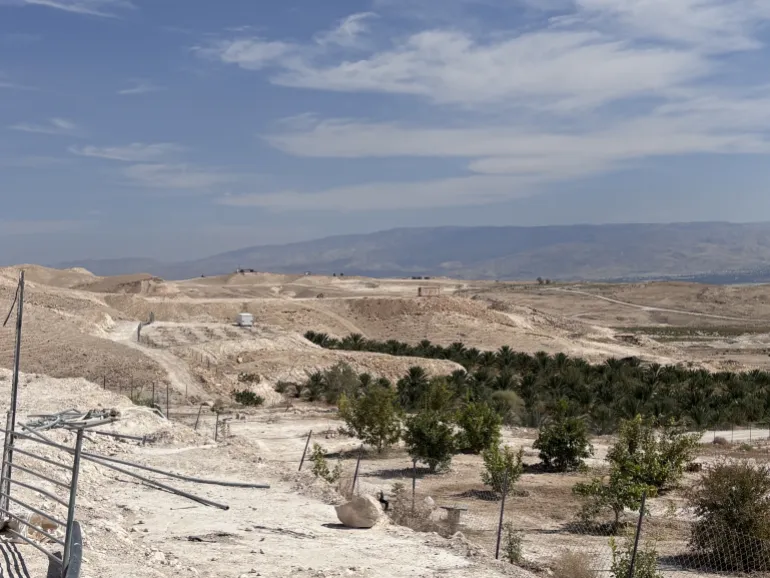
As a result of these policies, the Palestinian presence has dwindled in many areas, particularly the Jordan Valley, where their number has decreased to no more than 65,000.

“Israel is implementing a policy of encirclement and strangulation of small villages in the West Bank by confiscating land and preventing Palestinian construction, in contrast to the frenzied settlement wave that Smotrich called a ‘settlement revolution,’ and the accompanying bitter reality for Palestinians,” al-Saifi said.

There are now thousands of armed settlers spread throughout the West Bank, al-Saifi noted. Skilfully trained and often called settlement guards, they are essentially a rear guard force for the Israeli army, used to attack and intimidate Palestinians and seize their land.

“All Bedouin communities are located in Area C, and 47 of them have been forcibly displaced since October 2023, meaning more than 4,000 Palestinians have been displaced in just two and a half years,” al-Saifi said. “This is part of ethnic cleansing and de facto annexation on the ground.”

Source link

Vehicle engulfed in flames after Israeli drone strike in central Gaza | Gaza

NewsFeed

Videos show Palestinians in Gaza scrambling to extinguish a vehicle engulfed in flames in az-Zawayda after it was targeted by an Israeli drone. Israel has killed more than 700 people since the October 10 “ceasefire,” according to local officials.

Source link

Palestine 36: A film about a revolt that nearly changed history | News

Director Annemarie Jacir on how Palestine 36 traces today’s crisis back to British colonial rule.

Before Israeli occupation, there was British colonialism. We speak to director Annemarie Jacir about Palestine 36, her epic film about the 1936 Palestinian revolt that almost succeeded, the often-forgotten roots of today’s crisis, and why this history still feels painfully present.

In this episode: 

Episode credits:

This episode was produced by David Enders, Sonia Bhagat, and Sarí el-Khalili with Spencer Cline, Chloe K. Li, Catherine Nouhan, Tuleen Barakat and our host, Malika Bilal. It was edited by Tamara Khandaker. 

Our sound designer is Alex Roldan. Our video editors are Hisham Abu Salah and Mohannad al-Melhem. Alexandra Locke is The Take’s executive producer. 

Connect with us:

@AJEPodcasts on X, Instagram, Facebook, and YouTube


Source link