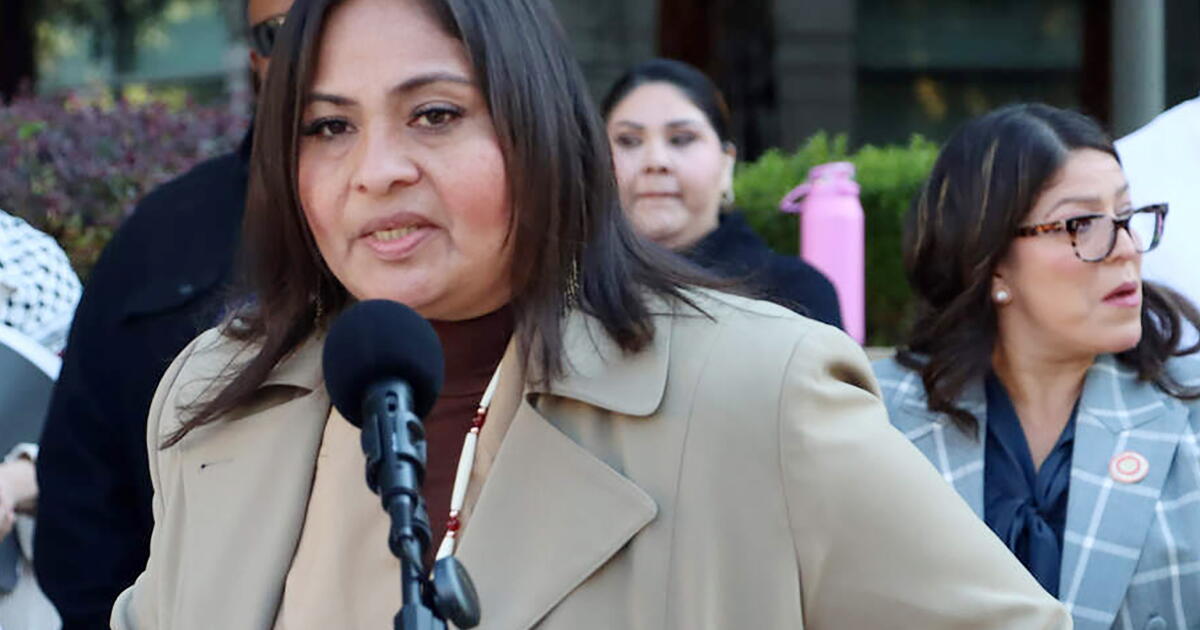
California mayor accused of stalking a hairdresser she thought was an ICE agent
The mayor of the small Central Valley farm town of Kerman pulled up to a bakery, her cellphone camera recording, and confronted federal immigration agents conducting an early-morning operation in which multiple people were detained.
“You’re not welcome in my city,” Maria Pacheco told the masked agents, identifying herself as the mayor. “You’ve taken enough people yesterday. We don’t want you here. You need to leave.”
As the men wearing U.S. Immigration and Customs Enforcement vests drove away, she shouted: “How can you make a living kidnapping people? How can you sleep at night doing what you’re doing? … You are a sorry piece of sh—!”
Pacheco, who is running for a seat on the Fresno County Board of Supervisors, posted video of the Oct. 8 confrontation in Kerman — a mostly Latino city of 17,000 west of Fresno — on social media, labeling it: “Mayor Maria Pacheco Stands Up to ICE.”
The footage went viral. TikTok commentators praised her bravery. Comedian and actor George Lopez posted about it on Facebook — writing, “We need more politicians like Maria Pacheco!” — and she shared her campaign fundraising link in the comments.
A few days later, Pacheco allegedly drove through Fresno, closely following a vehicle driven by a man she assumed was an ICE agent.
Except, he wasn’t one.
Eric Bridges, a Fresno hairdresser, has accused Pacheco of closely trailing him in an orange Nissan Altima for more than 20 minutes on Oct. 14 and taking photos of his vehicles as she followed him to his sister’s house.
“I’m looking for ICE, and you look like ICE,” Pacheco told him, according to a signed statement submitted to the Fresno County District Attorney’s Office this week in which Bridges wrote that he wanted “to press charges to the fullest extent of the law.”
Bridges’ attorney, Roger Bonakdar, told The Times that Pacheco used his client “as a political trampoline so she could create social media clickbait” to benefit her political campaign.
“There are real concerns as to whether or not she is acting as some sort of vigilante law enforcement person, that she’s wrongfully abusing her position as an elected official,” Bonakdar said.
Bonakdar added that he filed complaints about the incident with the Fresno Police Department and county prosecutor.
Taylor Long, a spokesperson for the district attorney’s office, said in an email that the information provided by Bonakdar had been referred to its Public Integrity Unit, which investigates public officials for potential crimes related to their office, but that “the receipt and review of information” does not mean a crime had occurred or that charges were warranted.
No charges had been filed by the district attorney’s office in connection with the incident as of Wednesday, Long wrote.
In an email to The Times, Pacheco wrote: “Regarding recent allegations, my only comment is this: If he wants to go to court, we will go to court.”
“Meanwhile, the Kerman Food Bank and other local organizations are experiencing food shortages as families face fear and uncertainty caused by recent immigration enforcement actions,” Pacheco wrote. “Parents are afraid to go to work or leave home, even to buy groceries, leaving more families struggling to put food on the table. … That is where our attention belongs, and where my time, energy and heart will remain.”
The encounter comes at a tense time in the Central Valley, where a surge this month in federal immigration operations and detentions has rattled agricultural communities, causing workers to stop showing up to farm fields and construction sites and families to keep their children home from school.
The Department of Homeland Security did not immediately respond to requests for information about the Oct. 8 operation outside La Princesa Real Bakery in Kerman, where Pacheco filmed her interaction with agents. Pacheco told the Fresno Bee that four of the bakery’s customers had been detained and that one was eventually released because he had lawful immigration status.
In his signed statement, Bridges wrote that he was driving near Kearney Park just west of Fresno on the afternoon of Oct. 14 when he noticed an orange car “pull behind me quickly and follow me into the park.” Bridges said he stopped his vehicle and was on the phone with his sister, telling her that he was being followed and that the driver was taking photos of him.
As he sat in the parking lot, he wrote, the car circled him for five minutes, and he could overhear the driver on the phone through her vehicle’s speaker system.
He then drove to his sister’s neighborhood, where the car tailed him into a cul-de-sac and stopped beside his white Mercedes sport utility vehicle — an encounter recorded by a home security camera.
When the female driver rolled down her car window, Bridges wrote, she asked who he was and he did the same. According to Bridges’ statement, the driver told him he was “in [her] ‘hood driving an unmarked car.”
Bridges wrote that he had a California Department of Motor Vehicles print-out affixed to the back of his vehicle and asked if she was a police officer or DMV employee.
She replied, “Don’t worry about who I am; I’m someone important” then accused him of being an ICE agent, Bridges wrote. Outraged, he began filming her.
In the home security footage, Bridges can be heard from a distance saying, “I didn’t know you owned the neighborhood,” and shouting in apparent surprise: “I look like I’m ICE?” after the woman speaks to him.
A close-up video that Bridges recorded shows a woman in sunglasses smiling as she drives away, with him saying, “Don’t you ever in your … life follow me, you weird-ass b—.”
Bridges wrote that she flipped him off as she left and that he learned she was the mayor of Kerman after reviewing the video footage.
Bonakdar, his attorney, said Bridges is a grandfather and hair stylist who has never worked for ICE or the Department of Homeland Security. When the driver of the orange vehicle saw him, Bonakdar said, Bridges was not wearing a face covering, as immigration agents often do, or a badge or tactical vest.
Pacheco “claims to be an advocate for minority groups, or to somehow have an interest in helping those people,” Bonakdar said. “I mean, she just victimized somebody who is a member of two minority groups. [Bridges] is a thin-framed, middle-aged Black gay man.”
Bonakdar said Bridges had received threats from people accusing him of being an undercover ICE agent and that some had told him he was not welcome in certain places.
On Oct. 15, the day after the alleged encounter with Bridges, Pacheco wrote a Facebook post about a street corner near agricultural fields just west of Fresno city limits: “I have spotted ICE on Shaw and Dickenson. White SUV. No plates. Driver is masked and hooded.”
Two days later, she took to Facebook again, writing: “I never imagined we’d live in a time when communities would fear masked men in unmarked vehicles. It’s exhausting living on constant high alert, watching for out-of-state or missing license plates, never knowing who’s next.”