owe

As post-Kawhi Leonard era begins, Clippers owe more to their fans

Starting over has to start somewhere, and so the Clippers got on with it Wednesday.

While Kawhi Leonard got an NBA Finals hero’s welcome back up north in Toronto, the Clippers did what they could to entice fans back to Intuit Dome.

Not with superstars or championship aspirations. But with the promise of free parking, a jersey trade-in and a basketball team that is, at least, better than the Sacramento Kings, who they beat 121-96 in both teams’ season opener. Coach Tyronn Lue dedicated the win to suspended team owner Steve Ballmer: “Just want to say thank you for everything. We’re still fighting for him.”

Yeah, but the Clippers should focus on fighting for their fans, not the billionaire whose apparent salary cap circumvention has the organization in hot water.

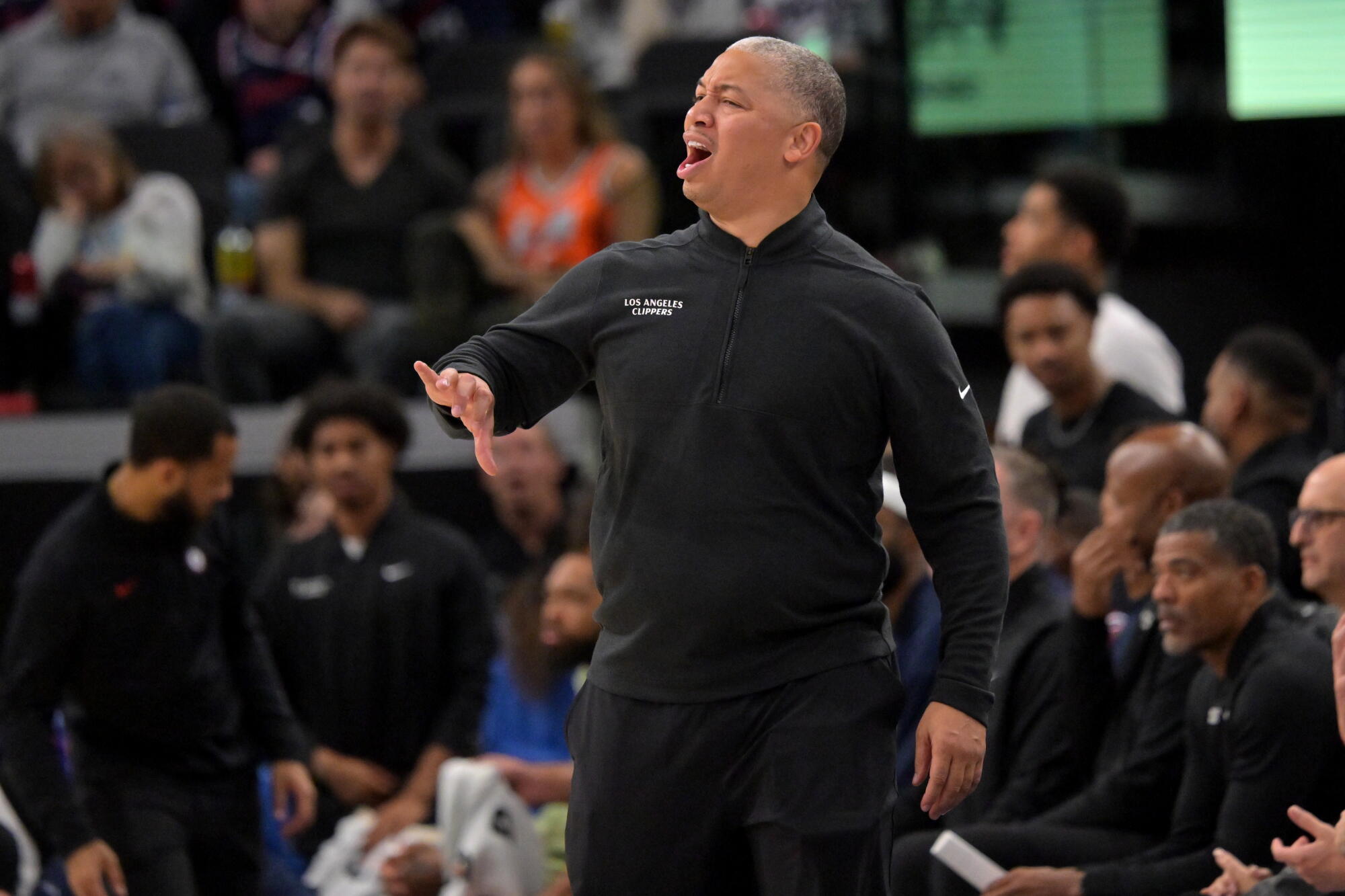
Clippers coach  Tyronn Lue directs his players during a win over the Sacramento Kings Wednesday at Intuit Dome.

Clippers coach Tyronn Lue directs his players during a win over the Sacramento Kings Wednesday at Intuit Dome.

(Jayne Kamin-Oncea / Associated Press)

Wednesday’s fan appreciation stuff was a swell gesture, as a start. But it wasn’t nearly far-reaching enough.

Not for embattled Clippers supporters who have stuck with the team through thick and thin, sickness and health, in spite of Donald Sterling, the former cheap, racist owner and now Ballmer, the wealthy, over-invested one whose salary cap circumvention cost his team its first-round picks in the 2029, 2030, 2031, 2032, and 2033 NBA drafts.

To fans, that was the most consequential part of the historic punishment dealt by the NBA, which commissioned a year-long investigation that determined the Clippers committed audacious levels of salary cap circumvention.

The league also fined the team $30 million, suspended team owner Ballmer and president of business operations Gillian Zucker for a year and president of basketball operations Lawrence Frank for six months.

And Leonard? He got a $700,000 slap on the wrist and got traded back to Toronto, where he signed a two-year, $115 million contract extension and on Wednesday, had Raptors coach Darko Rajaković saying he was “super excited for the chance to bring a Hall of Famer back home.”

“That’s one of the most insulting parts of it all, the way [Leonard] was able to walk away scot-free and the fans are left sort of holding the bag,” said Torrance’s Justin Ratterree, while he tried to dodge raindrops as he waited in line, four hours before tipoff, to trade in his No. 2 Leonard jersey.

Young Clippers fans watch the team play the the Sacramento Kings Wednesday at the Intuit Dome.

Young Clippers fans watch the team play the the Sacramento Kings Wednesday at the Intuit Dome.

(Jayne Kamin-Oncea / Associated Press)

“It’s rough right now. Defending the team this past couple months has been really rough … and I’ve kind of just given up defending. How can you defend it?”

Even Ballmer stopped doing that, releasing a statement on Sept. 13 that read, in part: “This has been a very difficult time for everybody associated with the Clippers, and for that, I have sincere regrets.

“I want to apologize to our fans, employees, and my fellow NBA team owners for the distraction and distress this matter has caused, for which I accept responsibility as principal owner.

“We are,” he added, “committing to put this chapter behind us.”

Yes, let them try to scrub the memory of Leonard, the intensely skilled and private player who demanded so much of the Clippers when he signed with them as a free agent in 2019. Who made no efforts to popularize the team, missed almost as much time as he worked, and who failed to lead the Clippers to their first championship or anywhere close to it in his seven seasons.

After his trade to Toronto went through on Sept. 23, the Clippers resisted posting the “Thank You, Kawhi” graphic that pro sports teams do when they part ways with a player.

Let them also forget to play a tribute video when Leonard’s Raptors visit Intuit Dome for the only time this season on Nov. 2.

And let the Clippers expand the jersey swap beyond the first 4,000 paying customers at Game 1; there was no official figure available Wednesday night for exactly how many jerseys were traded and how many of them belonged to he-who-must-not-be-named.

The Clippers should keep it going, offer the option all season. Set it up at the Intuit Dome’s Lost and Found — invite fans to exchange the No. 2 jersey of the player whom they lost all respect for a guy they’ve found themselves newly enamored with, likely rookie Keaton Wagler if Wednesday’s exchange was any indication.

Clippers fans also deserve more than having their parking picked up until an hour before gametime, on one rainy workday, on late notice.

They should have their parking at games covered all season — or at least substantially reduced from the typical $70 price that’s already too steep. (The Dodgers didn’t start charging $65 until the National League Division Series!)

They should do more if they want to continue to draw a crowd to watch a team whose best player is now Darius Garland, whose future is compromised, whose current best-cast scenario — the play-in! — only Clippers fans could love.

Clippers forward Rui Hachimura drives past Kings guard De'andre Hunter and center Domantas Sabonis Wednesday.

Clippers forward Rui Hachimura drives past Kings guard De’andre Hunter and center Domantas Sabonis Wednesday at the Intuit Dome.

(Jayne Kamin-Oncea / Associated Press)

Several fans Wednesday also said they would appreciate improved transparency, including in terms of player injury and availability news.

It’s the least the team can do for these patient people, who will have the type of team that they usually fall hard for, actually — a group of gamers, devoid of divas, punching above their weight.

“All this stuff that’s going on,” Lue said, “you can’t take that out on our players … that’s not their fault, you know?”

It’s not fans’ fault, either. Let’s see the Clippers go above and beyond for them.
Source link

Why do Iran’s oil ‘intermediaries’ owe the government billions? | US-Israel war on Iran News

As the United States maintains a naval blockade of Iran’s ports and imposes more sanctions on its oil exports, Tehran is confronting another problem: billions of dollars in revenue from previous oil sales that it says have gone missing.

A spokesperson for Iran’s judiciary said in September that a network of oil intermediaries known as “trustees” owed the Iranian government between 10 billion euros ($11bn) and 11 billion euros ($12bn). That figure was equivalent to half of the total oil revenue projected in Iran’s government budget for the current fiscal year.

Recommended Stories

list of 3 itemsend of list

US officials, including Treasury Secretary Scott Bessent, have tied Iran’s struggles to access oil revenues as evidence that its economic pressure campaign is having an effect. In August, Bessent said that “Iran’s shadow banking system was buckling” under pressure from the US campaign against the country, which has been ramped up as Washington seeks a way to force Tehran to capitulate in the war between the two countries, launched by the US and Israel in late February.

So who are the oil intermediaries, why does Iran depend on them, and what has happened to the billions of dollars they owe? Let’s take a closer look.

The debt, and the crisis it has created for the Iranian government, both stem from an oil-sales arrangement Tehran adopted in 2012 in response to US sanctions targeting Iranian oil exports.

American and European sanctions targeting Iranian oil sales and revenue collection began in 2012. The stated rationale behind both sets of measures was that revenue from oil sales helped finance Iran’s nuclear programme and that restricting Iranian oil exports could prevent the programme from advancing.

In response, the Iranian government devised a way to circumvent international sanctions on its oil sales. Unable to sell oil through the Oil Ministry and receive the proceeds through the Central Bank, it began selling oil to domestic buyers or using it to settle outstanding obligations to institutions and organisations owed money by the state.

This arrangement gave rise to a network of oil intermediaries often referred to in Iran as the “trustee network”. Rather than selling all its oil through official government channels, the state entrusted crude oil to institutions, individuals and companies to sell on its behalf. The proceeds were supposed to be transferred to the government’s treasury, with the sellers or recipient institutions subsequently recovering their agreed costs and outstanding claims. Some institutions sold the oil themselves, while others contracted private trading companies to handle the sales.

The Oil Industry Pension Fund, established for retired Oil Ministry employees familiar with the oil-sales process, was among the first institutions to receive crude oil for sale. Other recipients included Khatam al-Anbiya Construction Base, a major hub for large-scale infrastructure projects. Even the municipal police received payments owed to them by the government in the form of crude oil.

Effect of the nuclear deal

Even in those early experiments, discrepancies emerged between the revenue expected from oil sales and the amounts sellers actually deposited into the government’s treasury. These discrepancies eventually gave rise to some of Iran’s largest economic corruption cases.

The accounting discrepancies and the government’s inability to recover money from private sellers entrusted with Iranian oil persisted until 2016, when the Joint Comprehensive Plan of Action (JCPOA) nuclear deal was signed and when sanctions on Iranian oil sales were lifted. The government was subsequently able to regain control over oil sales.

Individuals who had sold Iranian oil but failed to return the proceeds were imprisoned. With the ability to sell oil again through legal and transparent channels, the government was able, for a time, to manage its oil revenues and spending with greater control.

How did money from oil sales go unreturned?

After US President Donald Trump withdrew the United States from the JCPOA in 2018 during his first presidential term, the Iranian government once again had to rely on private oil traders to sell its oil. But the problems associated with selling oil through intermediaries rather than official state channels, including delays in returning revenues, accounting discrepancies, debts owed by oil sellers to the government, and the occasional seizure of Iranian oil shipments at sea, once again constrained the government’s ability to manage its oil revenues.

Moreover, the US expanded its sanctions beyond Iranian government institutions and interests, adding bank accounts involved in transactions with the Iranian government, currency-exchange offices, companies, and individuals to its sanctions lists. As a result, the time between individuals participating in Iran’s oil-trading network and being sanctioned themselves, along with their assets and companies, and having their accounts blocked or frozen grew progressively shorter.

This contributed to an accumulation of debts owed by sanctioned oil traders – no longer able to access their accounts – to the government. It also left Iran with little choice but to expand its private oil-sales network. That meant increasing the number of people involved in trading Iranian oil, reducing the volume of oil allocated to each individual or company and, ultimately, increasing the risk that the proceeds would not be returned.

Iranian officials have also accused trustees of exploiting the sanctions workarounds to enrich themselves.

The billions of dollars owed by private oil sellers to the Iranian government are a combination of outstanding payments, disputed financial obligations and allegations of corruption. Iran’s judiciary chief recently addressed the issue, warning that oil sellers who refuse to return the proceeds from oil sales will face legal action. But such warnings do not change the sanctions environment or remove the obstacles that prevent some oil sellers from returning the money.

Source link