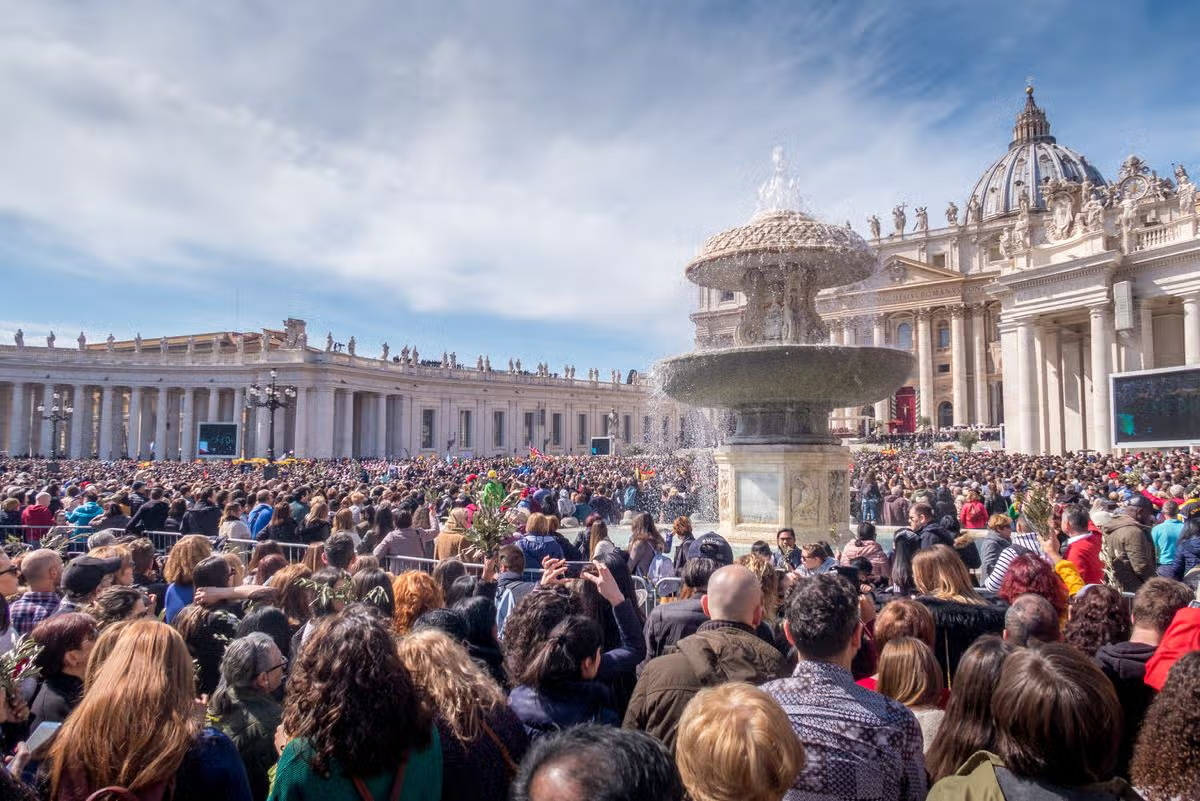
The Spanish destination has banned all new holiday rental properties — including houses and villas — as local authorities move to protect struggling residents from being pushed out of their own neighbourhoods
Local politicians are moving ahead with plans to limit Airbnb supply (Image: Jam Press/Helen Dalling)
A beloved holiday destination popular with British tourists is cracking down on new holiday rental properties, after they were found to be forcing local residents out of their own communities.
Local politicians in Palma de Majorca are poised to bring in the measure to boost housing availability for hard-pressed residents. New licensed apartment holiday lets have already been prohibited there for several years, and now local politicians are moving forward with a ban on houses and villas.
Local councillor Óscar Fidalgo insisted the move was one that simply had to be made. He described it as proportionate and fair, adding that it should have been implemented sooner in order to protect those living on the island from spiking property prices.
He was openly critical of holiday rentals growing ‘like never before’, and warned that they were causing integration issues between tourists and locals.
According to Majorca Daily Bulletin, Fidalgo said: “The expansion of tourist accommodation reduces the available residential supply and makes it harder to access housing. The current model presents problems of legal certainty and complicates inspections, which allows for fraud. More inspection capacity is needed.
“There are also urban sustainability reasons. It affects neighbourhood coexistence. We must protect neighbourhoods and prevent the displacement of residents.”
A town hall technical report concluded that the Spanish holiday hotspot is unsuitable for the opening of new holiday rental properties.
In April this year, more than 8,000 illegal Airbnb listings in Majorca were removed from the website, totaling a withdrawal of more than 40,000 illegal tourist beds.
The move was part of a coordinated effort between Airbnb and the Spanish authorities to reduce the number of active rental properties.
The fines for running an unlicensed holiday let in Palma de Majorca are steep. Landlords face fines of up to €40,000 (£34,700) and the government has employed a group of inspectors to ensure compliance. There is also an online reporting system for the public to report suspected rule-breakers to the authorities.
Nearly a third of tourists visiting Spain opt to stay in short-term rentals. The number of homes listed for holiday rentals in May dropped 6% from the previous summer to 1.43 million, after regulations were tightened to ease the housing crisis, data from the National Statistics Institute showed.
According to campaign group Affordable Majorca, since 2013, rents in Palma have increased by a whopping 40%.
Approximately 2.3 to 3.6 million British tourists visit Mallorca each year. The UK consistently ranks as the second-largest source of international visitors to the island, making up about 20% to 26% of all tourist traffic, trailing just behind Germany, according to Road Genius.
The decision in Palma de Majorca comes as another holiday island has also cracked down on beach regulations, banning nearly 700 loungers. Authorities imposed the ban on Formentera in the Balearics, effective immediately until 2029. A further 339 parasols have also been ordered to be removed from beaches.
GREECE has slapped a sunbed ban on 251 of its beaches meaning tourists will have to ditch the loungers for a simple towel.
The rule aims to limit overtourism on the beaches as well as tourist developments, such as hotels and sunbeds for hire, to keep the beaches in their natural state.
Sign up for the Travel newsletter
Thank you!
Umbrellas and sunbeds are not allowed to be hired on 251 of Greece’s beachesCredit: AlamyThese include Elafonissi Beach, which is well-known for its pink sandCredit: Getty
So for tourists heading to the 251 beaches on the list, they’ll need to stick to either a towel or just sitting on the sand.
And some spots have even stricter rules – on beaches that are part of the Natura 2000 programme, you won’t see hotels cordoning off areas as a ‘private beach’ section, instead they will be open to everyone.
There will also be no changes to how the beach looks, so no concrete piers, sea walls or paved paths.
Essentially, anything that messes with the natural state of the beach, is not allowed.
So, if you want a beach bar and to rent an umbrella, you’ll need to head elsewhere.
A release from the Greek Environment Ministry stated that the ban “seeks to effectively protect beaches that have particular aesthetic, geomorphological or ecological value, as well as to preserve the types of habitats and the species of flora and fauna found on these beaches”.
The Ministry added: “In particular, the number of shorelines and beaches within areas included in the National List of Areas of the European Ecological Network Natura 2000 is increasing and in which the granting of simple use, as well as any other action that may endanger their morphology and their integrity in terms of their ecological functions, is now prohibited.”
The ban follows Greek authorities dealing with a number of incidents in recent months on the protected beaches.
According to local reports, riot police recently took down a number of shacks on the island of Gavdos, just south of Crete.
One of the beaches included on the list is Elafonissi Beach found on the southwest coast of Greece as it is a protected Natura 2000 nature reserve.
Its not the easiest to get to – visitors must head across a shallow lagoon.
It was named the second best beach in the world by TripAdvisor‘s Travellers‘ Choice Awards Best of the Best 2026 and also 15th best in Europe in the World’s Best Beaches 2025 awards.
Or favourite Greece holidays
*If you click on a link in this box, we will earn affiliate revenue.
Blue Bay Beach Resort, Rhodes
The four-star Blue Bay Beach Resort sits a stone’s throw away from this beach, and has its own pools, splash park and water slides. Here you’re only a 15-minute drive away from Rhodes Old Town, where UNESCO-listed medieval streets wind through castle-like architecture. Make sure to check out the Street of the Knights, one of the best-preserved medieval streets in Europe.
Gouves Bay Hotel keeps things simple on a sunny Greek island location right by the sea. This hotel has a relaxed, family-friendly feel with two pools, a kids’ club and easy all-inclusive dining. And if you fancy a change of atmosphere, Gouves’ bars and tavernas are just a short walk away for your choice of evening drinks with a view.
The picturesque hotel is perched up high and surrounded by lush greenery in the historic harbour town of Kos. Here you’ll find a huge swimming pool and a waterpark, as well as activities like darts, tennis, football and more. There’s evening entertainment six days a week, and an on-site spa with a hot tub and sauna to unwind.
This mega resort with six pools and its own waterpark is rated five stars by TUI. In the main restaurant, you’ll see show cooking displays as you take your pick from an extensive international buffet. Plus, Kalives beach is on the doorstep of this hotel, with its strikingly blue water and soft golden sands.
The beach is known for its pink sand, which gets its colour from crushed seashells – though removing any of the shells or sand is forbidden.
One recent visitor said: “One of the most beautiful natural paradises in the world.”
Other beaches include Kalamaki Beach near Athens, Tobruk Beach near Heraklion and several beaches on the island of Samos.
If you are heading to Greece and are not sure what beaches the ban applies to, download the Gov.gr MyCoast app, where you can see a map of all the 251 beaches.
If you are thinking of going on holiday to Greece, there’s one city that’s better in spring with funiculars, sunset rooftops and wine tastings.
First, it was Barcelona, Venice and Dubrovnik. Now, Florence has joined the most overtouristed destinations in the world: its 365,000 inhabitants shared their city last year with 4.6 million visitors. The director of the city’s Accademia gallery – home to Michelangelo’s David – talked in 2024 about “hit and run” tourism, describing visitors “on a quick in-and-out mission to take selfies … trampling the city without contributing anything”. Local author Margherita Calderoni describes Via Camillo Cavour, a street leading to the Duomo, as a “rancid soup” of chain restaurants and “shops selling plastic trinkets from who knows where”.
Although steps are being taken – the city council has introduced a ban on new short-term lets and is promoting sights in lesser-known neighbourhoods – tackling overtourism is a challenge. And other Tuscan cities, such as Siena and San Gimignano, are suffering too. But beyond these honeypots, Italy’s fifth-largest region is full of glories, with not a takeaway chain or selfie stick in sight. Here are six of my favourites.
For architecture: Monteriggioni
To hit Monteriggioni during its medieval festival in July is to be transported to the middle ages: the whole town becomes a stage on which local re-enactors recreate 13th-century life, with artisans, entertainers, soldiers and musicians in the streets, and inns serving ancient recipes. Festival apart, this tiny town is remarkable for its intact architecture. It was built by the Republic of Siena around 1213 to ward off Florentine aggression, and it is still possible to walk around its 570 metres of wall, with two gates and 14 watchtowers. Inside there is a church, a museum and gardens once used to grow food in case of a siege. All cobbled streets and panoramic views, it feels intimate but rarely crowded. On the square, Il Tagliere Medievale is the place to people-watch over cured meats and cheese and a carafe of chianti. Stay at Il Piccolo Castello, doubles from €115 B&B
For idealists: Pienza
The hilltop town of Pienza. Photograph: Fani Kurti/Getty Images
Is there such a thing as an “ideal city”? In 1459, Pope Pius II rebuilt his birthplace, Corsignano, according to the scientific and humanist criteria architects and planners believed cities should fulfil, with harmoniously proportioned streets, buildings and fortifications. Naturally, he then renamed the town after himself. Pienza is tiny – about 2,000 inhabitants – and best explored on foot. The main square, Piazza Pio II, is a small space shared by the cathedral and the honey-coloured Piccolomini Palace, Pius’s summer residence. The three colonnaded loggias (covered walkways) facing the Piccolomini’s garden suggest the harmony architect Bernardo Rossellino was aiming for.Human harmony is evoked by street names Via dell’Amore and Via del Bacio (kiss): both lead to a walkway with panoramic views over the Val d’Orcia. Foodwise, Pienza is known for its pecorino cheese: try it atLa Terrazza del Chiostro, run by young chef Massimiliano Ingino. Stay at Agriturismo Casalpiano, doubles from €135 B&B
For Renaissance art: Arezzo
The Piazza del Duomo in Arezzo. Photograph: PK Photos/Getty Images
On a hill where eastern Tuscany rises to the Apennines, Arezzo is rich in history and art, but sees a fraction of Florence’s visitors. Many come for the monthly antiques fair on Piazza Grande, the sloping main square. The city’s treasure is the 15th-century artist Piero della Francesca’s Legend of the True Cross frescoes in San Francesco basilica, but I also love his serene Mary Magdalene in the cathedral up the road. From there, it’s a short walk across Passaggio del Prato park to the fortress built by the Medici family in 1540. Its ramparts offer great views over red roofs and rolling countryside. In pedestrianised Via Cavour, three friends recently took over a former corset shop and turned it into a deli selling filled focaccia, wine, chocolates and olive oil. Stay at La Corte del Re, doubles from €79 room-only
For history: Volterra
A Roman amphitheatre in Volterra. Photograph: Robert Harding/Alamy
Volterra was founded about 3,000 years ago as part of the Etruscan league of 12 cities. Its Guarnacci museum features hundreds of fantastically decorated funerary urns, but they’re outshone for me by an elongated male nude in bronze called Shadow of the Evening which, though believed to have been made in the third century BC, wouldn’t look out of place in a modern sculpture show and is said to have inspired Giacometti. A short walk away, the Porta all’Arco is an Etruscan gate still standing after 2,300 years. More recent monuments include a Roman amphitheatre and a Medici fortress now used as a prison. The town is also known for alabaster carving: check it out at the Ecomuseum, or buy at local cooperative Artieri Alabastro. In a picturesque alley, La Sosta del Priore (Prior’s Pitstop) offers sandwiches with fillings such as wild boar, melted pecorino and lampredotto (tripe). Stay at Villa Nencini, doubles from €65 B&B
For port city vibes: Livorno
The Quartiere Venezia in Livorno. Photograph: Roberto Nencini/Alamy
Tuscany has so many sights that its ancient port is often overlooked. Originally fortified by the Pisans, Livorno was ruled by Florence’s Medicis from the 1500s, and today’s multicultural vibe is thanks in part to that dynasty. Under Medici law, newcomers of any nationality or faith were encouraged to settle here, and a diverse population – Greeks, Armenians, Jews fleeing the Inquisition – helped Livorno thrive. Today, this politically leftish and greenish city is home to populations from Senegal and Morocco as well as eastern Europe.
Get a lungful of sea air at the checkerboard seaside promenade Terrazza Mascagni, then walk up to the Quartiere Venezia, Livorno’s Little Venice, with bridges, coloured houses and two Medici fortresses, Nuova and Vecchia. Other sights include San Francesco Cathedral and one of Italy’s biggest covered markets, the Parisian-style Vettovaglie. Livorno is known for its chickpea pancakes (torte di ceci), and Torteria Gagarin by the market sells them hot from a wood-fired oven to eat in a roll as a cinque e cinque sandwich. Stay at Dogana d’Acqua Rooms & Art, doubles from €75 room-only
For coastal charm: Porto Ercole
The harbour at Porto Ercole. Photograph: Stevan ZZ/Getty Images
A port since Roman times, this village on a promontory in the south of Tuscany was fought over in 1555 in a proxy war between Spain (supporting Florence) and France (Siena). Spain won and built the forts that still guard all approaches. Climb up to Forte Stella for views over the picturesque harbour and north to one of three causeways linking the promontory to the mainland. The walk into town passes the botanical garden. Farther north is the unassuming cemetery that is home to Caravaggio’s simple tomb, an odd finale to a life of brawls, murders, arrests and exile. Mystery surrounds the painter’s death, but he was said to be heading for Rome in the hope of papal forgiveness when he succumbed to “fever” – probably infection from a sword fight in Naples.
For a beach day, head out on the SP66 and take the signposted footpath just before the crossroads leading to Forte Stella. Sandy Spiaggia Lunga is mostly undeveloped, but in high summer there’s a bar with sunbeds to hire. Right on the harbour back in Porto Ercole, Grano offers top-quality sourdough pizzas by the slice. Stay at Alba sul Mare, doubles from €91 room-only
Tourists visiting this holiday hotspot may find it harder to book a hotel room in the future as local authorities are seeking to freeze new hotel licences in a bid to tackle tourist numbers
The city could start clamping down on new hotels(Image: Getty)
A European tourist hotspot that’s popular with Brits is eyeing plans to tackle overtourism, including potentially putting a freeze on the opening of new hotels.
The mayor of Athens, Haris Doukas, is desperate for his city not to become too overcrowded and overwhelmed by tourists. Haris previously oversaw a ban on new permits for short-term rentals such as Airbnbs in three neighbourhoods in central Athens.
Now, he has told Euronews that he wants to avoid the city becoming like other crowded spots. He said: “We really need to see if and how many more hotels we need and where. We need to see and think about how much extra tourist load we can lift and where.
“We must not become Barcelona. We have to understand that there are saturated areas that cannot afford new beds: whether short-term rentals or not. Talking at events around the globe, we see that capping is not only being put on short-term rentals but also on hotels; in specific, ‘saturated’ areas.”
Across the Attica region, where Athens is located, there are 68,934 rental apartments, nearly half of which are found in the city center. Across Greece, tourist demand has seen a huge increase in the amount of accommodation available, with 450 new four- and five-star hotels opening between 2019 and 2024.
Should Athens enact the ban, it would join cities including Barcelona and Amsterdam, which already have similar initiatives to tackle the issue of overtourism.
Evgenios Vassilikos, President of the Athens – Attica & Argosaronic Hotel Association – spoke at the same event. He argued that there needed to be a careful planning process when it comes to expanding the number of hotel beds and short-term rentals.
He said: “There are practices abroad which have been implemented. We don’t need to reinvent the wheel. The example I gave is that in Barcelona they have completely banned short-term rentals from 2028 and from 2017 onwards no new hotel licences are being issued. So there are, therefore, these restrictions abroad. We will possibly have to see in Athens what we want in terms of where we want to be in 10 to 15 years. “
He added: “We will definitely need hotel beds there. How many will these be? How many will be five-star, how many four-star, etc. There has to be a specific plan. And of course that drags in all kinds of beds, meaning non-primary tourist accommodation and short-term rentals.”
Athens has become the most popular tourist destination in Greece with about 12 million international arrivals in 2025. This included around 4.5 million British tourists, up from 3.5 million in 2019. The Acropolis alone receives millions of visitors a year, and at peak times can see over 17,000 visitors a day.
Have a story you want to share? Email us at webtravel@reachplc.com