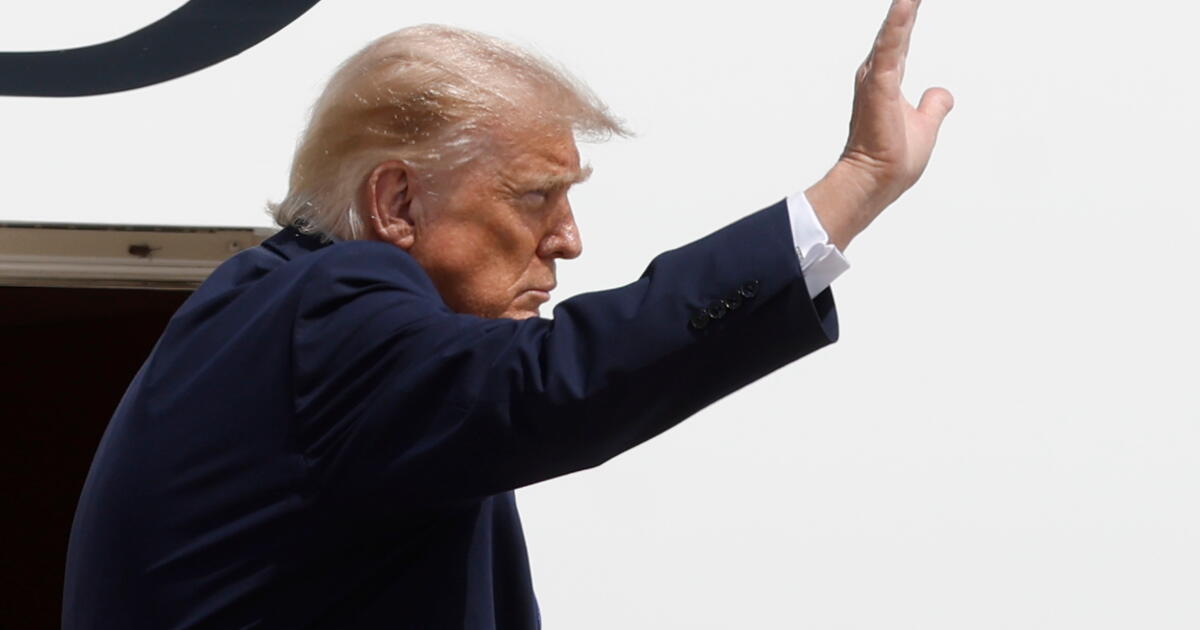
April 18 (UPI) — President Donald Trump signed an executive order Saturday to accelerate research for some psychedelic drugs to treat mental health disorders.
Surrounded by podcaster Joe Rogan and veterans, the president signed the order that could lead to use of the psychedelics in controlled, therapeutic settings.
“We’re taking this decision, this decisive step, to confront one of the most urgent public health challenges facing our nation, the mental health crisis,” Trump said Saturday in the Oval Office.
“Today’s order will ensure that people suffering from debilitating symptoms might finally have a chance to reclaim their lives and lead a happier life,” Trump said.
The order directs the Food and Drug Administration to speed its review of new treatments. Trump said the order applies to certain drugs that are already in the “advanced stages of clinical trials.”
Rogan said he sent the president “some information” about the drugs after he heard about them on his podcast, The Hill reported.
“I sent him that information. The text message that came back: ‘Sounds great. Do you want FDA approval? Let’s do it.’ Literally that quick,” Rogan said.
Trump mentioned ibogaine, which has been used to treat post-traumatic stress disorder in other countries. He said the administration would be “opening the pathway” for the drug to be included in the Right to Try Act, which allows terminally ill patients to participate in clinical trials for treatments still under FDA review, The Hill reported. Trump signed that act into law in 2018.
“Under this new program in this administration, drugs can get approved in weeks, not a year or year plus, but in weeks, if they are in line with our national priorities,” FDA Commissioner Martin Makary said at the signing.
“This is an unmet public health need, and there are potentially promising treatments,” Makary said. “That’s why there’s a sense of urgency around this. That’s why we’re doing it now.”
In 2024, 471 U.S. service members died by suicide, and there were 1,515 attempts reported, according to the Pentagon’s Annual Report on Suicide in the Military.
Some of the drugs included are ibogaine; LSD; psilocybin; known as magic mushrooms; and MDMA, known as ecstasy. Trump added that the government had just committed $50 million in additional funding for ibogaine research, The Post reported.
“Federal prohibition of psychedelic medicine in America is over,” said W. Bryan Hubbard, an advocate for access to ibogaine, The Washington Post reported.
Kevin Sabet, who was a White House drug policy adviser over three presidential administrations, disagreed. He said the order will “send the wrong message” and encourages hasty, potentially dangerous research.
“People need to realize there is little to no evidence for most of these drugs and most of the conditions they claim to alleviate,” Sabet, president of Smart Approaches to Marijuana, wrote in a text message to The Post.
Health and Human Services Secretary Robert F. Kennedy Jr. has championed the idea of using psychedelics to help with mental health conditions. On Saturday, he said officials owed it to veterans “to turn over every stone.”
“It’s disturbing to me and to the president that hundreds, in fact, thousands of veterans are having to travel to Mexico or other countries to experiment with interventions that hold great promise,” Kennedy said.
WASHINGTON — Former Vice President Kamala Harris said Friday she was considering running for president in 2028, offering the clearest signal yet that she could seek to lead Democrats back to the White House.
“I might, I might,” she told an audience in New York. “I’m thinking about it.”
Harris was asked about her plans by the Rev. Al Sharpton during a conversation at a convening of his civil rights organization National Action Network, where several other likely Democratic hopefuls also were appearing this week. Some in Harris’ audience chanted “Run again!” before Sharpton asked whether she might do so.
“I served for four years being a heartbeat away from the presidency of the United States,” Harris said. “I know what the job is and I know what it requires.”
Harris’ loss to President Trump in 2024 was gutting for Democrats, who have faced persistent questions about the party’s direction and what type of candidate would be best positioned to retake the presidency.
Democrats have notched some wins against Republicans in recent state-level races as Trump’s popularity has declined and have set their sights on gains in this year’s midterm elections. Even if the party’s popularity rises, however, the 2028 race likely will be a tooth-and-nail fight as the country determines who will succeed Trump.
“Democrats can win in the midterm through protest votes against [Trump’s] direction of the country, but they’ll clearly need a vision for 2028 and beyond to win the presidency,” said Thad Kousser, a political science professor at UC San Diego.
The number of Democrats vying to put forth that vision is set to be high. Other potential 2028 candidates, including Gov. JB Pritzker of Illinois, Gov. Josh Shapiro of Pennsylvania, Sen. Mark Kelly of Arizona and former Transportation Secretary Pete Buttigieg, also spoke or were scheduled to speak with Sharpton before the conference ends Saturday.
California Gov. Gavin Newsom, who is considering a presidential run, was not on the convention schedule. A recent poll found that Newsom would have a wide lead over Harris among Democratic voters in California for the party’s next nominee.
Whether Harris would seek the nation’s highest office again after a fast, truncated 2024 campaign following former President Biden’s withdrawal from the race has been the subject of speculation for months.
She announced in July that she would not run for California governor — leaving the door open for a presidential run or something else — then published a book in September rehashing her campaign.
Voters’ familiarity with Harris gives her both a strength and a liability — her name recognition and experience have helped put her at the top of recent national polls, Kousser said, but voters often turn to fresher faces by the time primary elections come around. Her loss to Trump also could cause voters to balk ahead of an election that will be largely a referendum on his leadership.
At a time when Democrats are in particular need of a bold vision, that ultimately could give Harris a challenge, Democratic strategist Joe Caiazzo said.
“Elections are about the future, and I think it’s really tough for people who are part of our past to make that case. There’s a yearning for something fresh, new, exciting,” he said.
On Friday, Harris said she was considering who could do the best job for the American people.
WASHINGTON — President Trump has once again mocked Gov. Gavin Newsom’s dyslexia as “disqualifying” for leadership, marking at least the fourth time in a week that the president has targeted the California Democrat for being open about his diagnosis.
In remarks Monday in the Oval Office, Trump said Newsom was “dumb” and should never be allowed to be president because he has “admitted that he has learning disabilities, dyslexia.”
“That’s how crazy it’s gotten with a low-IQ person,” Trump said. “Honestly, I’m all for people with learning disabilities but not for my president. … And I know it’s highly controversial to say such a horrible thing.”
But in the course of his needling, Trump mistakenly elevated his political rival to the rank of commander in chief — repeatedly referring to Newsom as “the president of the United States.” Newsom took the opportunity to turn the tables on the president.
“I, GAVIN C. NEWSOM, AM OFFICIALLY PRESIDENT OF THE UNITED STATES (THANK YOU DONALD!)” he wrote on X Monday.
The clash is the latest in a storied contest of chest-beating between Trump and Newsom, who have made sport of bad-mouthing one another across campaign rallies, interviews and social media.
A model stealth bomber sits in front of President Trump during an executive order signing in the Oval Office Monday.
(Aaron Schwartz / Bloomberg via Getty Images)
The president has frequently cast Newsom as a symbol of the liberal governance he opposes, while the governor has leaned into the confrontations, often using them to elevate his national profile and position himself as a leading Democratic counterweight. His sparring with the president appears to be part of an aggressive strategy to amplify his own messaging as he weighs a potential run for president in 2028. This time, Newsom used the spotlight to support young people with dyslexia.
“To every kid with a learning disability: don’t let anyone — not even the President of the United States — bully you,” Newsom wrote on X. “Dyslexia isn’t a weakness. It’s your strength.”
The insults first materialized when a video went viral of Newsom speaking at a book tour appearance with Atlanta Mayor Andre Dickens during which he discussed his lifelong struggle with the learning disability. Since then, the president has repeatedly poked at the vulnerability.
Trump has brought up the governor’s dyslexia at least four times in the last week. He mentioned it at a political rally in Kentucky last week, where he equated dyslexia with a “mental lack of ability,” and again during a Fox News Radio interview on Friday, in which he reiterated that “presidents can’t have a learning disability.” In a post on Truth Social, Trump labeled Newsom’s admission a “politically suicidal act,” calling him “dumb” and “A Cognitive Mess!”
After the Kentucky rally, Newsom responded to Trump.
“I spoke about my dyslexia, I know that’s hard for a brain-dead moron who bombs children and protects pedophiles to understand,” he said.
Dyslexia affects as much as 20% of the population, according to the Yale Center for Dyslexia and Creativity. Despite affecting a such a wide portion of the population, the condition is widely misunderstood, according to dyslexia researcher Dr. Helen Taylor of the University of Cambridge.
“In some ways, Trump’s awful comments are just a cruder version of assumptions that already run through our culture,” she said. “If anything, [it’s] the opposite. There is evidence of an overrepresentation of people with dyslexia in business leadership roles.”
According to Taylor, there is a link between dyslexia and “enhanced abilities” in areas such as discovery, invention and creativity.
“The same cognitive trade-offs that can make routine tasks like reading more difficult support strengths in navigating complexity and guiding groups toward better future outcomes,” she said.
Newsom often describes his early experiences with dyslexia as a source of insecurity when he was growing up. In his memoir, the governor writes about his mother, Tessa Newsom, attempting to help him with homework. The lessons ended with him “running out of the room screaming that I didn’t know what was wrong with my brain.”
Back when Newsom was a boy in the 1970s, dyslexia was recognized but still not fully understood. He recalls a day when his mother grew so concerned that she took a deep breath and told him, “It’s OK to be average, Gavin.”
“I understood even back then that this, too, came from her deep reservoir of love for me,” Newsom writes in his book “Young Man in a Hurry.” “But I don’t recall crueler words ever said about me.”
The challenges from his learning disorder persist in his work at the state Capitol. Newsom finds reading off a teleprompter challenging. His aides describe days of painstaking preparation before major addresses to live audiences. Late edits to a speech, and the resulting changes to the words on the screen, threaten to throw off his delivery.
All memos in the governor’s office are written in 12 point Century Gothic font with specific spacing between lines, formatting that his aides say helps him with his disability.
The governor reads his daily briefings a few times in the morning, underlines sentences and writes down notes to retain the information on yellow cards he keeps in his suit pockets.
The ritual, he has said, helps him compensate for his dyslexia and feel confident communicating. But it also adds to the public perception of Newsom as a smooth-talking, and at times rehearsed, politician. His excessive preparation has become a trait he considers a “super power.”
His effort to thoroughly absorb reading material and desire to understand issues before he speaks about them means he’s often well-prepared. In his perception, the learning disorder has brought out his grit and resilience, and helped him hone other skills, such as quickly reading a crowd.
Without missing a beat, Newsom directed the journalist to the exact page in his 246-page budget that touched on the issue.
“While people with dyslexia are slow readers, they often, paradoxically, are very fast and creative thinkers with strong reasoning abilities,” according to the Yale Center for Dyslexia and Creativity.
The governor’s wife, Jennifer Siebel Newsom, discussed the president’s attacks Tuesday in a video on X in which she emphasized that “learning differences do not determine someone’s potential.” She listed a number of qualities she considered disqualifying for the presidency, including being a convicted felon, bankrupting businesses, having numerous associations with convicted sex offender Jeffrey Epstein, and sending “masked extremists to terrorize Black and brown communities and rip kids away from their families.”
“Everything that Donald Trump represents is frankly beyond disqualifying,” she said. “Day in and day out, Trump says things that make him unfit for office. He degrades our vulnerable communities, our institutions, even the Constitution itself.”
Two of the Newsoms’ four children have also been diagnosed with dyslexia.
Quinton reported from Washington, D.C., and Luna from Sacramento.