orders

USAF Orders Both General Atomics’ FQ-42 And Anduril’s FQ-44 Into Production

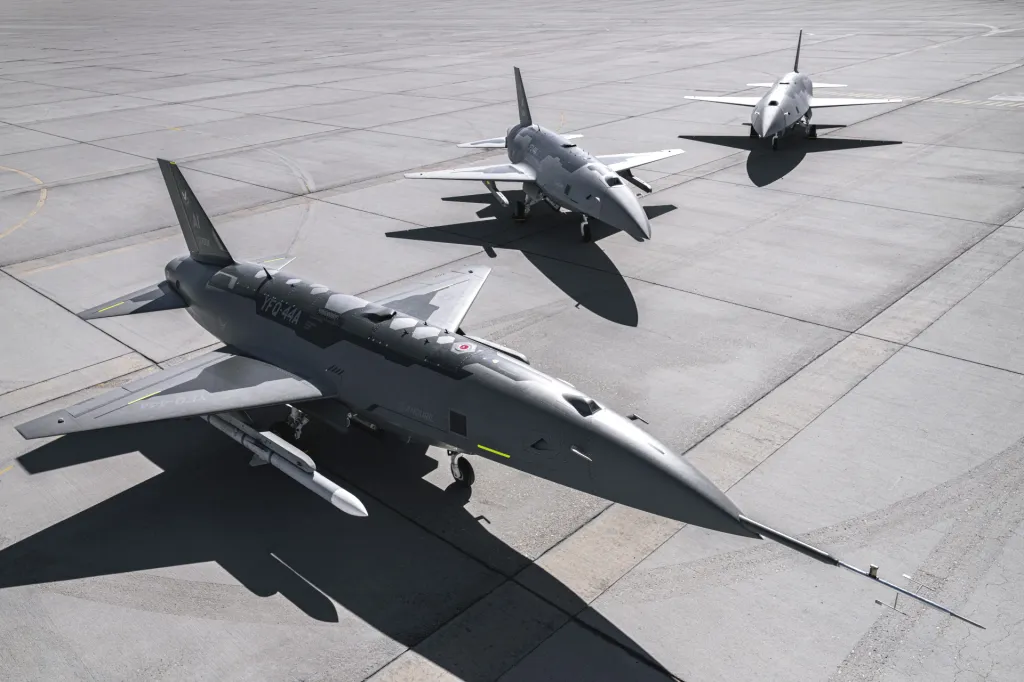
The U.S. Air Force has awarded contracts for the production of General Atomics FQ-42A Dark Merlin and Anduril FQ-44A Fury drones. This sets the service up to operate a split initial fleet of Collaborative Combat Aircraft (CCA), something TWZ has highlighted as being a distinct possibility from the start.

The Air Force down-selected the designs from General Atomics and Anduril to move ahead as part of the first incremental development cycle of its CCA program, or Increment 1, back in 2024. What were originally designated the YFQ-42A and YFQ-44A first flew in August and October 2025, respectively, and have been undergoing further testing since then. Dark Merlin testing was paused earlier this year after one of the drones crashed, but has resumed.

A trio of YFQ-44A drones. Anduril
Three YFQ-42As in a row. GA-ASI

“By moving fast from competitive selection into full-scale manufacturing, we position ourselves to field highly credible and combat-ready semi-autonomous systems to stay ahead of the pacing challenge,” Secretary of the Air Force Troy Meink said in a statement today. “These contracts reaffirm our confidence in the strategic path forward for the program to procure over 150 combat capable CCA by the end of the decade.”

The Air Force says these contracts were awarded four months ahead of schedule, reflecting “that the FQ-42 and FQ-44 meet rigorous mission requirements and are ready for full-scale manufacturing.” At the time of writing, the service does not appear to have provided an update on the expected delivery timeline of the first production CCAs, but it has said in the past that it is hoping to have the first examples in operational service toward the end of the decade. Air Force has asked for nearly $1 billion in its 2027 Fiscal Year budget request to begin procurement of these drones.

“Under the contract, Anduril will deliver an initial set of production FQ-44 semi-autonomous fighter aircraft to support continued testing, validation, and, ultimately, operational fielding,” Mark Shushnar, Anduril’s Vice President for Autonomous Airpower, also wrote in a blog post today. “The contract also establishes a structure for the Air Force to buy additional lots of production FQ-44 aircraft across the next several years, providing a clear path for the Air Force to rapidly and affordably expand fighter capacity.”

A Fury drone carrying an inert AIM-120 air-to-air missile during a flight test. USAF

“This is an exciting day for our company and the nation,” David Alexander, President of General Atomics’ Aeronautical Systems, Inc. division (GA-ASI), said in his own statement. “Moving to production on FQ-42A is the result of an extraordinary partnership and many years of investments between General Atomics and the U.S. Air Force. We’ve been preparing for this order, and manufacturing is already well underway.”

A YFQ-42A in flight. General Atomics

A split-buy of Dark Merlin and Fury drones will help drive down risk. The designs are also very different, which opens the door to more operational possibilities for the Air Force right from the start. General Atomics and Anduril can also then focus on refining the respective strengths of their uncrewed aircraft. As noted, TWZ has pointed out on several occasions that a mixture of uncrewed platforms with different attributes would be needed to truly do justice to the CCA concept.

Furthermore, the Air Force making this decision still deep in the developmental phase also underscores how critical the service sees CCAs, and its desire to push ahead with getting at least an early iteration of the capability into service.

“Collaborative Combat Aircraft change how we project power and generate mass in highly contested environments,” Air Force Chief of Staff Gen. Ken Wilsbach said in a statement today. “Delivering this capability to our warfighters faster ensures our forces maintain the tactical edge required to deter and, if necessary, defeat any adversary.”

The Air Force has also further split the CCA effort into hardware and software segments, with airframe development falling into the former category.

“These distinct efforts validate acquisition transformation principles to secure a critical operational advantage: decoupling hardware from software,” according to an Air Force press release today. “By treating mission autonomy as ‘software sold separately,’ the Air Force ensures that the warfighter receives state-of-the-art physical platforms alongside agile, easily updatable software, effectively breaking traditional procurement molds.”

Anduril and General Atomics, as well as Lockheed Martin, Northrop Grumman, RTX Collins Aerospace, and Shield AI form the current vendor pool for the software side of the CCA program. The Air Force announced today that it had awarded additional mission autonomy contracts to Anduril, Collins, and Shield AI. Anduril is notably the only company currently with CCA contracts on the hardware and software sides.

Collaborative Mission Autonomy thumbnail

Collaborative Mission Autonomy


“This targeted award, based on the vendors’ ability to meet aggressive schedule and affordability requirements, will fund the first of two six-month competitive phases designed to speed the fielding of operational software to the warfighter,” according to an Air Force release. “While the baseline contract establishes a continuous competitive arena, the competitive awards are designed to deliver capability faster. Following the initial six-month period, the Air Force will evaluate the vendors’ progress and execute a second competitive award period. This performance-based competition will culminate in the selection of a primary mission autonomy provider for CCA Increment 1, with award planned for selection by summer 2027.”

“Furthermore, this software contract leverages a first-of-its-kind award fee exposure strategy, which enables operator feedback and combat performance to determine what the Air Force pays for mission autonomy. The Air Force will only pay the entire licensing fee if a vendor provides a combat capability aligned with warfighter needs and feedback,” the release adds. “The licensing approach also allows the Air Force to award software licenses to any of the six vendors within the pool at any point over the next six years. This approach ensures the Air Force can procure the best-performing and most affordable solutions as technology evolves.”

More government ownership of key intellectual property, and software in particular, has become a central guiding principle for the U.S. military contracting, in general, in recent years. When it comes to autonomy software packages, there is also now a core government-owned Autonomy Government Reference Architecture (A-GRA) that goes beyond the Air Force’s CCA program.

“Today, Lattice for Mission Autonomy is fully A-GRA compliant, ensuring that it can be integrated not only with all Increment 1 CCA, but with the full spectrum of current and future A-GRA compliant aircraft,” Anduril’s Shushnar highlighted in his blog post. “Through the A-GRA, the CCA program has established the foundation that will drive the development of a larger ecosystem of autonomous aircraft.”

Lattice for Mission Autonomy: An Unfair Advantage for Unrivaled Deterrence thumbnail

Lattice for Mission Autonomy: An Unfair Advantage for Unrivaled Deterrence


Shield AI’s Hivemind software is also already flying on a number of different drones.  Just last month, the Pentagon announced that it would be using this autonomy package to introduce swarming capabilities to its Low-Cost Uncrewed Combat Attack System (LUCAS) kamikaze drones.  

Shield AI flies Hivemind AI Pilot on 6th Aircraft thumbnail

Shield AI flies Hivemind AI Pilot on 6th Aircraft


“Mission autonomy is the cornerstone of the CCA concept, and leveraging a competitive, multi-vendor environment ensures we capture the latest technology,” Secretary Meink also said today in another statement. “This approach guarantees our Airmen are equipped with state-of-the-art capabilities today but keeps the door open for the breakthroughs necessary to maintain air superiority.”

In general, greater government control over intellectual property rights also helps avoid the potential to be locked into a single vendor. Establishing vendor pools to compete for follow-on contracts also creates opportunities to lower costs and to diversify supply chains, especially when it comes to hardware. That diversification, in turn, can be beneficial when it comes time to scale up production of both key subcomponents and complete systems.

As far as we know, the Air Force is still planning for at least one more incremental CCA development cycle, or Increment 2, firm requirements for which have yet to be publicly released. This could lead to further diversification of the service’s future CCA fleets. The Air Force has notably already given the YFQ-48A designation to Northrop Grumman’s Talon Blue drone design, which first broke cover in December 2025. Boeing’s MQ-28 Ghost Bat, originally developed for Australia, now has a greater presence in the United States.

The U.S. Marine Corps and the U.S. Navy are also pursuing their own CCA fleets in very close coordination with the Air Force. The Air Force is very much in the lead in fielding drones in this category, which could factor into future Marine and Navy decisions. The Marines are currently planning for their first tranche of MQ-58 Valkyrie CCA drones from Kratos to arrive in 2029. The Navy’s program is still very much in its infancy.

The Air Force’s CCA program has now taken another major step forward toward an initial fleet of drones that will include both General Atomics Dark Merlin and Anduril’s Fury.

Contact the author: joe@twz.com

Joseph is TWZ’s Deputy Editor, helping to oversee the site’s highly experienced and dedicated team, while also writing informative and impactful defense and national security content. He lives right in the thick of it in the Washington, D.C. area.


Source link

US orders Anthropic to disable AI models for all foreign nationals | Technology News

The company said it received ⁠an export control directive to suspend access to Fable 5 and Mythos 5 for foreign nationals.

The AI firm Anthropic has blocked access to its newly released cutting-edge software, following an order by the United States government.

In a blog post published Friday, the company behind the Claude chatbot said government agencies had instructed it to prevent all foreign nationals from accessing the AI models Fable 5 and Mythos 5, citing national security concerns.

Recommended Stories

list of 4 itemsend of list

Anthropic said it received the order at 5:21pm (21:21 GMT) on Friday and that the letter did not explain the government’s specific security concern in detail.

The ban also affects foreigners currently in the US – including those working at Anthropic.

As a result of the order, the company had to cut off access for everyone at short notice, it said.

The artificial intelligence behind Anthropic’s Mythos AI model is particularly adept at detecting software vulnerabilities, some of which have remained undiscovered for decades.

This capability has been used by US authorities and selected companies to plug security gaps.

However, a concern from the outset has been that such AI could become a dangerous cyberweapon in the wrong hands.

The Fable 5 model, released just this week, is based on Mythos technology, but its cybersecurity and biotechnology capabilities are blocked.

Mythos 5 is the non-public full version, which should continue to be used only by government agencies and selected corporate partners to harden their systems.

Anthropic emphasised that it had so far received only partial information from the government.

The company said it had reviewed a report which, in its assessment, was likely to have triggered the order.

Anthropic’s experts concluded that this referred to a limited capability to use the AI to review specific programme code and correct errors.

Models from other providers, such as GPT-5.5 from rival OpenAI, also possess this capability, the company stressed.

Anthropic said it disagreed that software used by hundreds of millions of users should be blocked for this reason, and that the safety measures in Fable 5 have been extensively tested.

Earlier this month, Anthropic proposed that the world’s top artificial intelligence companies coordinate to pause development of advanced AI systems, warning that the technology is improving so quickly that there is a risk humans would lose control.

The company said in a blog post in early June that, as cutting-edge AI gets increasingly faster at carrying out tasks, “it would be good for the world to have the option to slow or temporarily pause” its development.

Source link

One killed as Israel hits south Lebanon, issues forced displacement orders | Israel attacks Lebanon News

The Israeli military has ordered residents of 20 Lebanese towns and villages to leave their homes immediately.

Israeli air raids across southern Lebanon have killed one person as attacks continue despite a United States-brokered “ceasefire”.

Lebanon’s National News Agency (NNA) reported that the person was killed in an Israeli air raid in the municipality of Maarakeh, in the Tyre district of southern Lebanon.

Recommended Stories

list of 4 itemsend of list

Al Jazeera’s Heidi Pett, reporting from Beirut, said that over the course of Friday and into the evening, there were continued Israeli air attacks on towns and villages that are well north of what the Israelis call the “Yellow Line” – the part of southern Lebanon that they have been seeking to control and to occupy.

The attacks come after an announcement by Pakistani Prime Minister Shehbaz Sharif on Friday that the United States and Iran have agreed on the wording of an agreement aimed at ending their war, and that mediators were working with both sides to finalise a deal.

Iranian media report the initial agreement would declare an end to the war “on all fronts, including Lebanon”.

This has led to fears that Israel’s actions in Lebanon could scupper a deal, since Israel is not a party to the negotiations between the US and Iran, and its leaders have said they do not plan to withdraw from Lebanon.

The attacks also come amid a supposed ceasefire, agreed between Israeli and Lebanese officials earlier this month, that would require a “complete cessation” of fire by Hezbollah, yet the fighting continues.

The next round of talks between the two countries is expected on June 22, with a view towards reaching a comprehensive agreement.

Israel issues forced displacement orders, demolishes homes

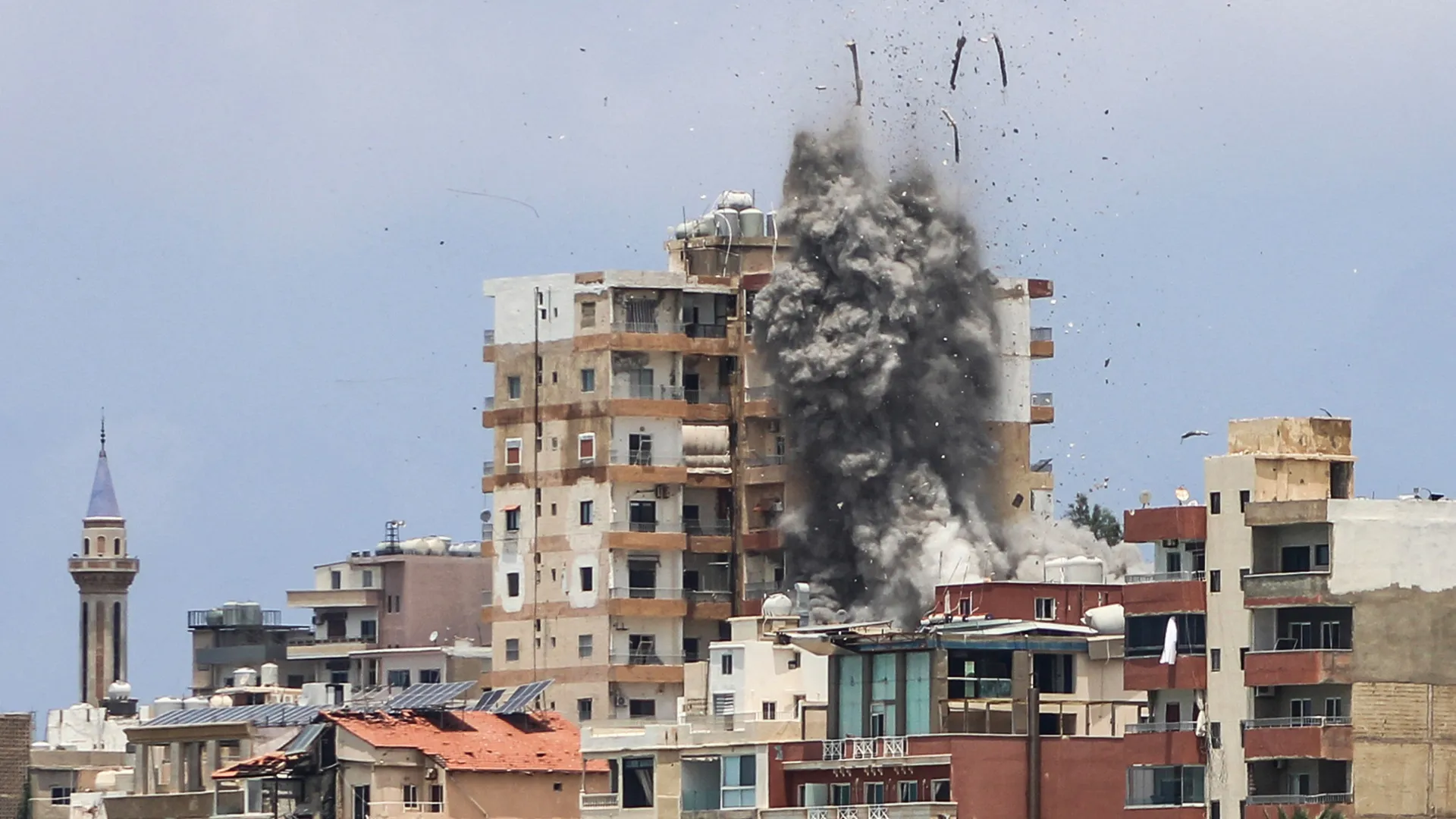
Israeli attacks at dawn have demolished homes and government buildings in southern Lebanon’s Bint Jbeil, the country’s NNA reports.

The Israeli military also ordered residents of 20 Lebanese towns and villages to leave their homes immediately and move “north of the Zahrani River”.

The forced displacement orders apply to Deir al-Zahrani, al-Namirieh, al-Sharquieh, al-Dewayr, Harouf, Habboush, Kfarjoz, Zibdine (Nabatieh), Nabatieh al-Tahta, Nabatieh al-Fawqa, Kfar Rouman, Al-Mahmoudieh, Sajed (Jezzine), Reihan, Aaramta, Kfarchouba, Mlki, Al-Lawiza (Jezzine), Jarjouh and Arab Salim.

On Saturday, the Israeli military said an air raid alert had been activated in the northern town of Metula due to the “infiltration of a hostile aircraft” from Lebanon, but did not name the armed group Hezbollah.

Source link

Israel orders Lebanese city of Tyre to evacuate, ignores Iran warning

The aftermath of an earlier Israeli airstrike on the southern Lebanese port of Tyre in May. On Tuesday, the Israel Defense Forces ordered residents, including for the first time those in Christian neighborhoods, to evacuate well to the north of the city for their safety as it prepared to target Hezbollah “elements, facilities and combat means.” File photo by Stringer/EPA

June 9 (UPI) — The Israel Defense Forces ordered residents of the Lebanese city of Tyre, including the Christian quarter and more than 10 refugee camps, to evacuate Tuesday, pending Israeli military action against targets of Iran-proxy Hezbollah.

IDF spokesman Avichay Adraee wrote on X that “out of concern for your safety,” residents should leave their homes immediately and move some 20 miles north beyond the Zahrani River and warned that anyone remaining south of the river was putting their life at risk.

“Your presence near Hezbollah elements or their facilities or combat means endangers your lives. As we warned in the past days, following Hezbollah elements’ actions inside the Christian Quarter in the city, the Israel Defense Forces will be compelled to act against their terrorist activities in the quarter in the near term,” said Adraee.

“Any building used by Hezbollah for military purposes may be subject to targeting. To ensure your safety — evacuate your homes immediately and move north beyond the Zahrani River. Attention — any movement south of the Zahrani River may endanger your lives,” he added.

The development came a day after Israel and Iran backed away from direct confrontation that flared up at the weekend over an Israeli strike on the southern suburbs of Beirut that prompted Tehran to fire as many as 30 missiles at Israel with Israel striking back against military targets in central and western Iran.

In standing down its military, Tehran warned that in the event Israel continued its attacks in Lebanon, including in the south, “much more severe and crushing measures will be on the way.”

Israeli Prime Minister Benjamin Netanyahu said in a post on X Monday evening that Israel had only halted hostilities because “after we struck the terror regime in Tehran, it ceased attacking us” and threatened to “respond with overwhelming force” if Iran made the mistake of attacking Israel again.

Netanyahu said that by firing into Israel over the past day, Iran and Hezbollah had attempted “to impose a new equation upon” where they believed they could fire at Israel from Lebanese territory and from Iran and Israel would not react.

“That did not happen, and it will not happen. Not on my watch! It is an equation I find intolerable and unacceptable,” wrote Netanyahu.

The sides halted their respective military strikes at the request of U.S. President Donald Trump who urged them to “stop shooting” because a deal ending the 100-day-long U.S.-Iran conflict was imminent.

Speaking on the tarmac at JFK Airport in New York on Monday night, Trump said the United States and Iran were very close to “a very good deal that will not allow in any way, shape, or form nuclear weapons.”

“And the [Hormuz] Strait will open up right away — they’ll open up immediately upon signing, which could be in two or three days,” said Trump.

He said he didn’t believe there were any sticking points.

Trump said the alternative was to return to bombing Iran but that would be counterproductive because it would mean the Strait of Hormuz remaining closed for many months and the needless deaths of many more people.

“Who wants to do that? I don’t. And we’ll have a signed document that’s actually stronger than doing the bombing,” he said.

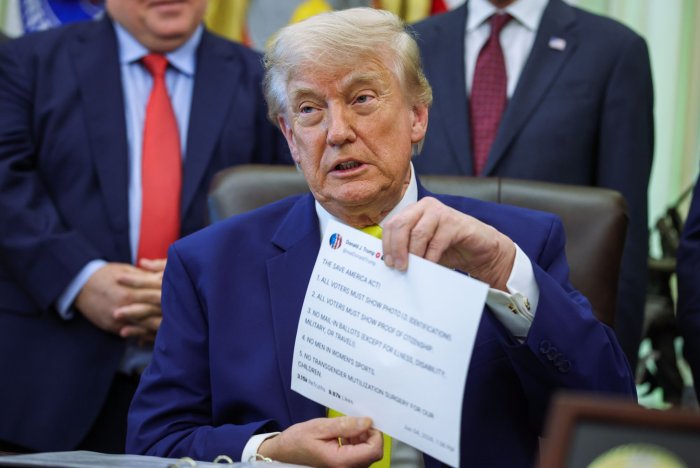
President Donald Trump discusses renovations to the Lincoln Reflecting Pool and makes an announcement on coal in the Oval Office at the White House on Thursday. Photo by Samuel Corum/UPI | License Photo

Source link

South Korean president orders probe into election agency

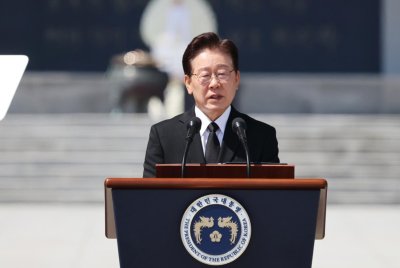
South Korean President Lee Jae-myung delivers his speech during a ceremony marking the country’s 71st Memorial Day to commemorate veterans and independence activists at the National Cemetery in Seoul, South Korea, 06 June 2026. Photo by KIM HONG-JI / EPA

June 7 (Asia Today) — President Lee Jae-myung sharply criticized the National Election Commission on Sunday over allegations that voting rights were violated during South Korea’s June 3 local elections.

Lee called on the National Assembly to conduct a parliamentary inquiry and ordered the administration to create a joint investigation team involving prosecutors and police.

“The National Election Commission caused serious disruption to the people’s exercise of voting rights during the June 3 local elections,” Lee wrote on Facebook. “The incident itself is difficult to understand, but its response afterward and explanation to the public were also insufficient.”

Lee said the right to vote is a constitutional right that must not be restricted or infringed upon for any reason.

“This is a grave matter that damaged the foundation of popular sovereignty,” he said. “As one citizen and as the president responsible for the government, I express deep regret.”

Lee asked lawmakers to quickly pursue a parliamentary inquiry to determine the facts and prepare measures to prevent a recurrence.

He also called for discussions on fundamental institutional reforms of the election commission.

“The government will also consider every possible measure at the administrative level, given the seriousness of the matter,” Lee said. “I have instructed the creation of a joint investigation team involving prosecutors and police to clarify responsibility and thoroughly determine the full circumstances of the case.”

Lee noted that the commission is an independent institution and said its independence comes with major responsibilities.

“The chairperson of the National Election Commission is regarded as one of the five highest constitutional officeholders because the commission is an independent institution with corresponding authority, duties and responsibility, just like the executive, legislative and judicial branches,” Lee said.

“The more independent an institution is, the more important public trust becomes,” he said. “An independent institution that has lost public trust has no reason to exist.”

Lee urged the commission to conduct a fundamental review of its organization and election management system. He said the commission should take the incident seriously and show a strong commitment to reform at a level the public can trust.

— Reported by Asia Today; translated by UPI

© Asia Today. Unauthorized reproduction or redistribution prohibited.

Original Korean report: https://www.asiatoday.co.kr/kn/view.php?key=20260607010002243

Source link

Judge orders pretrial detention for ex-CIA official accused of stashing $40 million in gold bars at home

A former senior CIA official accused of stashing more than $40 million worth of gold bars from the federal government at his Virginia home was ordered to remain jailed until his trial after a hearing Friday where a defense attorney accused prosecutors of smearing the official with “sensational,” irrelevant allegations.

The defendant, David J. Rush, has both the means and motive to flee while the case against him is pending, U.S. Magistrate Judge William Fitzpatrick ruled, citing Rush’s professional experience.

“He’s in a different position than most people to flee and avoid detection by law enforcement,” Fitzpatrick said.

Rush is charged with fraudulently claiming tens of thousands of dollars in compensation for military leave after he was honorably discharged from the U.S. Navy in 2015. He was arrested last month after investigators searched his home and seized more than 300 gold bars, roughly $2 million in U.S. currency and about 35 luxury watches, according to an FBI agent’s affidavit.

Rush’s attorney, Jessica Carmichael, noted that Rush isn’t charged with any crimes related to the discovery of the gold bars, which she referred to as “basically a non-issue” and “nothing more than a sensational tidbit.” She said Rush properly obtained the gold bars and kept them locked in a safe in his basement.

“Mr. Rush never claimed they were his,” she said.

Between last November and March, Rush requested and received a “significant quantity” of foreign currency and tens of millions of dollars in gold bars for “work-related expenses,” according to the FBI affidavit. Justice Department prosecutor Gavin Tisdale said Rush wasn’t supposed to have the gold bars at his home.

“That’s the issue — his skirting of rules and regulations,” he said.

Tisdale briefly summarized the case against Rush in open court after a portion of the hearing was sealed from the public. The evidence against Rush “grows stronger by the day,” Tisdale told the magistrate judge.

“Mr. Rush simply cannot be trusted to abide by this court’s conditions,” he said.

Rush enlisted in the Navy in 1997 and was honorably discharged from the U.S. Navy Reserves as a lieutenant in 2015, according to the affidavit.

Authorities claim Rush lied about his education and military background on job applications, falsely claiming to be a former Navy pilot who graduated with a bachelor’s degree from Clemson University in South Carolina and a master’s degree from Rensselaer Polytechnic Institute in New York.

Investigators determined that he didn’t serve as a Navy pilot and didn’t attend either school.

Kunzelman writes for the Associated Press.

Source link

Venezuelan Gov’t Orders Airlines, Shipping Companies to Deposit Fuel Payments in US Treasury Account

Airlines and shipping companies must send payment receipts to PDVSA to access fuel. (Archive)

Caracas, June 3, 2026 (venezuelanalysis.com) – The Venezuelan government headed by Acting President Delcy Rodríguez has instructed airlines and shipping companies to direct fuel payments to a US Treasury account.

Spanish newspaper El Diario published a May 28 letter from state oil company PDVSA addressed to “aviation and maritime customers” that laid out the “banking coordinates” for foreign currency payments concerning JET A1, MGO, and IFO 380 purchases.

JET A1 is a kerosene-based fuel widely used by commercial airplanes, while Maritime Gas Oil (MGO) and Intermediate Fuel Oil (IFO) 380 are standard for ship engines.

“We urge our customers to take the necessary precautions and forward the payment receipt to PDVSA sales representatives so that the payment is cleared and fuel supply is assured,” the letter read.

An attached US Treasury information sheet contains details for Fedwire payments to a “Venezuela custody account” and requires information about “source of funds, e.g., oil, gold, minerals, etc.”

The leaked letter is the first publicly available document from a Venezuelan state institution directing foreign currency payments to an account run by the US Treasury Department as opposed to the country’s Central Bank (BCV) or some alternative state-run mechanism.

Since the January 3 military strikes and kidnapping of Venezuelan President Nicolás Maduro, the Trump administration has seized control of the country’s export revenues. The White House has likewise extracted concessions in the form of pro-business reforms, preferential access for Western corporations to natural resources, and external audits of the Venezuelan Central Bank.

US Treasury general licenses allowing select Western corporations to engage in oil and gas activities mandate that all Venezuela-owed payments for royalties, taxes, and dividends be deposited in US Treasury accounts. Additional sanctions waivers imposed similar constraints on mining sector services and exports.

Neither US nor Venezuelan authorities have disclosed information about the funds, the timings of their disbursements back to Caracas, and the percentage kept by the Trump administration. The US president stated in a May interview that Washington has “made a fortune” from Venezuelan oil sales.

Both Washington and Caracas have acknowledged the use of Treasury-held Venezuelan revenues for the purchase of medicines and medical equipment from US manufacturers. In January, Secretary of State Marco Rubio said in a Senate hearing in January that Venezuela would need to submit a “budget request” to access its own funds.

According to reports, Washington is mandating that the Venezuelan Central Bank distribute the returned foreign currency to private sector importers via exchange table auctions run by public and private banks. The BCV has reportedly allocated more than US $5 billion thus far in 2026.

The Rodríguez acting government’s diplomatic rapprochement with the Trump White House, coupled with reforms to attract Western investment, has led to a growing number of international airlines reestablishing flights to the Caribbean nation. American Airlines currently runs two daily direct Caracas-Miami flights, while United Airlines will launch a Caracas-Houston connection in August. Jetblue, for its part, is set to initiate its first-ever Venezuela route later in the year.

Venezuelan authorities have likewise recorded increased shipping activity at the country’s ports.

Source link