orders

Netanyahu orders deeper Israeli invasion into Lebanon | US-Israel war on Iran

NewsFeed

Israeli Prime Minister Benjamin Netanyahu has ordered the military to expand its invasion in southern Lebanon, pushing deeper to extend what he calls a ‘buffer zone’. As Israeli forces advance towards the Litani River, an explosion at a UN position in southern Lebanon killed a peacekeeper.

Source link

Trump orders pay to TSA workers as Congress hits standstill

March 27 (UPI) — The U.S. Department of Homeland Security announced Friday that Transportation Security Administration employees will begin receiving paychecks as the department’s shutdown continues.

There was movement on Capitol Hill toward ending the shutdown and partially funding DHS on Friday. After the Senate unanimously voted to pass a bill that would fund the department, aside from Immigrations and Customs Enforcement, the U.S. House rejected the bill outright.

House Speaker Mike Johnson, R-La., said the House will pursue its own bill that would fully fund the department for 60 days. Johnson said the Senate’s bill would not move forward because it did not include funding for ICE.

President Donald Trump was also critical of the Senate-passed bill, saying it “wasn’t appropriate.” He signed an executive order to direct payment toward the more than 60,000 TSA employees.

“Today, at the direction of President Trump and the Secretary of Homeland Security Markwayne Mullin, TSA has immediately begun the process of paying its workforce,” a DHS spokesperson said in a statement to UPI. “TSA officers should begin seeing paychecks as early as Monday, March 30.”

Alan Fyall, associate dean of the University of Central Florida’s Rosen College of Hospitality Management, told UPI that news of TSA receiving pay is welcome, though for some it may be too late.

“If they’re going to get paid, that’s excellent,” Fyall said. “I’m sure there are quite a few who have left and probably won’t return.”

As of Friday, TSA agents were on their second pay period without receiving a paycheck.

On Wednesday, Ha Nguyen McNeill, deputy administrator of the TSA, told the House Homeland Security Committee that more than 480 workers have resigned and workers have missed $1 billion in pay.

“Most people in lower to middle salaries, if you miss two paychecks, that’s a problem,” Fyall said. “That’s not unique to TSA agents. As they would say, ‘do the math.'”

This is the second time the government has at least partially shut down, affecting the pay of TSA workers, in the past six months. The TSA has been shut down for more than 85 days this fiscal year.

“Many of our workforce have missed bill payments, received eviction notices, had their cars repossessed and utilities shut off,” McNeill told the House committee. “Some are sleeping in their cars, selling their blood and plasma and taking on second jobs to make ends meet.”

When the shutdown ends, Diego Bufquin, professor of practice at the Freeman School of Business at Tulane, told UPI he expects relief to come to TSA workers and travelers quickly, though the end of spring break adds to the long lines.

“We’re not going to have this resolved by this weekend,” Bufquin said. “Lines are going to be very long this weekend. There will be lots of complaints from passengers for sure.

“The thing is that the job market right now is not looking fantastic either,” Bufquin said. “I don’t think those TSA agents who are now considering switching jobs are in a good spot to easily find jobs in other sectors, given the current job market.”

Fyall said that the air travel industry as a whole is “resilient,” though the repeated government shutdowns will cause some travelers to change their habits, opting for direct flights when possible.

“If it’s a one-off, everybody complains but life gets back to normal pretty quickly,” Fyall said. “One of the things about the long queues is you might be waiting 3 or 4 hours, but that tells you that they’re doing their job properly. You want to get on your plane and be secure.”

President Donald Trump stands with U.S. Secretary of Agriculture Brooke Rollins during an event celebrating farmers on the South Lawn of the White House on Friday. Photo by Aaron Schwartz/UPI | License Photo

Source link

Federal judge orders return of California DACA recipient deported to Mexico

A federal judge on Monday ordered the government to return to the U.S. a California DACA recipient who was deported last month to Mexico.

U.S. District Judge Dena Coggins in Sacramento gave the government seven days to return Maria de Jesus Estrada Juarez, 42, and restore her protections under the Obama-era program Deferred Action for Childhood Arrivals, “as if her Feb. 19, 2026 removal never occurred.”

A lawyer for Estrada Juarez argued that she was unlawfully deported within a day of appearing at a scheduled immigration appointment in Sacramento.

Lawyers for the government, meanwhile, argued that the court lacked jurisdiction over Estrada Juarez’s case because her petition was filed after she was deported and because her removal was a discretionary decision the government is entitled to.

Coggins said she found the government’s argument “unavailing,” writing in her ruling that Estrada Juarez “was removed in flagrant violation of the regulatory protections afforded to her under DACA, and in violation of the Constitutional protections afforded to her under the Due Process Clause of the Fifth Amendment to the U.S. Constitution.”

In a statement, Estrada Juarez said she was “overwhelmed with relief and hope” after learning the court’s decision.

The Department of Homeland Security said it had reinstated an expedited removal order for Estrada Juarez from 1998, when she was 15. But her lawyer, Stacy Tolchin, said the record showed that the order lacked supervisory approval and was never finalized, so there was no valid removal order to reinstate.

Homeland Security previously told The Times that an immigration judge had ordered Estrada Juarez’s deportation in 1998 “and she was removed from the United States shortly after.” Tolchin said Estrada Juarez never saw an immigration judge.

Estrada Juarez, who worked as a regional manager for Motel 6, has had protection from deportation under DACA since 2013. She applied for legal permanent residency, or a green card, through her daughter, Damaris Bello, 22, who is a U.S. citizen.

Her deportation after the green card interview garnered public attention and outrage from members of Congress, including Sen. Alex Padilla (D-Calif.).

Tolchin filed the lawsuit seeking her return on March 10.

DACA was created to protect undocumented people who were brought to the U.S. as children.

As of June 2025, there were more than 515,000 DACA recipients, known as “Dreamers,” in the U.S. California has 144,000 DACA recipients, the most of any state, according to federal data.

Source link

Court rules for N.Y. Times, orders Pentagon credentials restored

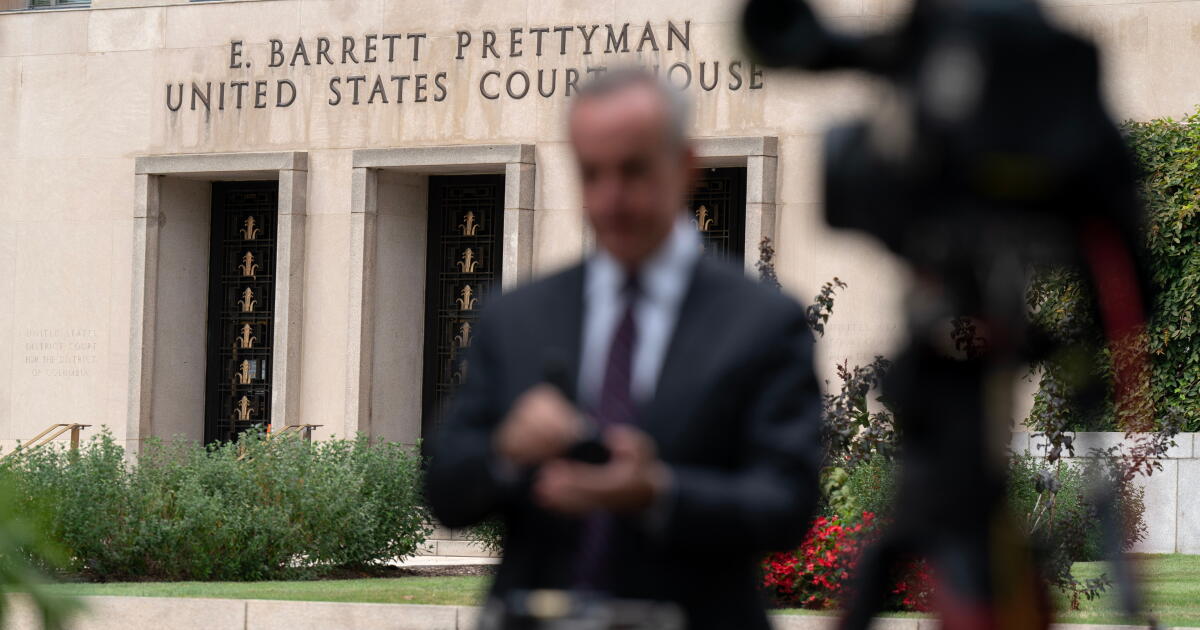
March 21 (UPI) — A federal judge struck down the Department of Defense’s policy that led to the ouster of most journalists from the Pentagon last fall and replaced them with those who agreed to the department’s new rules.

Judge Paul Friedman of the U.S. District Court for the District of Columbia ruled in favor of The New York Times, which sued the Department of Defense over the policy. Friedman ruled that the policy is unconstitutional and ordered the department to give back the credentials of the seven Times journalists who cover the Pentagon.

Though he didn’t order the restoration of other reporters’ credentials, he voided the policy that they refused to sign, allowing them to get credentialed again.

Pentagon spokesperson Sean Parnell wrote on X: “We disagree with the decision and are pursuing an immediate appeal.”

In October, the Defense Department required that all credentialed journalists sign the policy. Signing it gave the Pentagon the ability to label the journalists “security risks” and revoke their credentials if the department decided they had endangered national security. They had to pledge to only publish approved information.

Most news outlets refused to sign, losing their press passes and desks inside the Pentagon. They were replaced with news outlets and people friendly to the administration. The Times then sued the department over its First Amendment rights.

“A primary purpose of the First Amendment is to enable the press to publish what it will and the public to read what it chooses, free of any official proscription,” Friedman wrote in his opinion.

“Those who drafted the First Amendment believed that the nation’s security requires a free press and an informed people and that such security is endangered by governmental suppression of political speech,” Friedman added. “That principle has preserved the nation’s security for almost 250 years. It must not be abandoned now.”

First Amendment attorney Theodore Boutrous, who is representing The Times in the suit, told CNN: “The district court’s decision is a powerful rejection of the Pentagon’s effort to impede freedom of the press and the reporting of vital information to the American people during a time of war.”

“The district court’s opinion is not just a win for The Times, [Times reporter] Mr. [Julian E.] Barnes, and other journalists, but most importantly, for the American people who benefit from their coverage of the Pentagon,” Boutrous said.

Friedman also agreed with the Times that the policy violated its due process rights because it was vague and could be accidentally violated by reporters. Part of the policy prevented reporters from asking certain questions.

“A primary way in which journalists obtain information is by asking questions,” he wrote. “Under the policy’s terms, then, essential journalistic practices that the plaintiffs and others engage in every day — such as asking questions of department employees — could trigger a determination by the department that a journalist poses a security or safety risk.”

First Amendment advocates said they support the decision.

“The court affirmed that our security and liberty rely on the press’s freedom to publish and the public’s ability to access news about government affairs free from state control,” said Gabe Rottman, vice president of policy at the Reporters Committee for Freedom of the Press, in a statement.

Seth Stern, chief of advocacy at Freedom of the Press Foundation, said the ruling is especially important right now.

“It’s unfortunate that it took this long for the Pentagon’s ridiculous policy to be thrown in the trash. Especially now that we are spending money and blood on yet another war based on constantly shifting pretexts, journalists should double down on their commitment to finding out what the Pentagon does not want the public to know rather than parroting ‘authorized’ narratives,” Stern said in a statement.

Source link

Pentagon orders 2,500 troops, 3 warships from California to the Middle East

The Pentagon is reportedly sending three California-based warships and roughly 2,500 Marines to the Middle East, the second significant deployment in a week.

The three warships are part of the San Diego-based USS Boxer amphibious ready group. The Marines are from the 11th Marine Expeditionary Unit, based at Camp Pendleton. The deployments were reported Friday by the Associated Press, citing Pentagon sources.

A 2,500-strong Marine unit accompanied by the USS Tripoli warship launched from Japan on Saturday.

The major reinforcement comes as the war’s economic shock waves are felt throughout the globe, as Washington seeks to secure vital shipping lanes and deter further attacks on energy infrastructure around the Persian Gulf.

Secretary of Defense Pete Hegseth and Chairman of the Joint Chiefs of Staff General Dan Caine arrive for a news conference

Secretary of Defense Pete Hegseth, front, and Chairman of the Joint Chiefs of Staff General Dan Caine arrive for a news conference at the Pentagon in Washington on Thursday.

(Mandel Ngan / AFP via Getty Images)

President Trump has continued pressing allies to join his proposed coalition to patrol the Iranian-controlled Strait of Hormuz, a vital shipping lane through which about 20% of the world’s oil supply passes. So far, Europe, Japan, China and Australia have refused to heed the call.

Trump on Thursday said Iran “is close to demolished,” but that securing the Strait of Hormuz remained a struggle. He suggested the U.S. was working to secure the strait not for its own oil needs, but “just to be nice” to other countries that rely on oil from the region to a much larger degree than the U.S.

Marines perform a demonstration with helicopters and the amphibious assault ship USS Boxer

Marines perform a demonstration with helicopters and the amphibious assault ship USS Boxer Oct. 18, 2025, on Marine Corps Base Camp Pendleton.

(Gregory Bull / Associated Press)

“They complain about the high oil prices they are forced to pay, but don’t want to help open the Strait of Hormuz, a simple military maneuver that is the single reason for the high oil prices. So easy for them to do, with so little risk. COWARDS, and we will REMEMBER!” Trump wrote Friday on Truth Social.

Iran continued sweeping attacks on Mideast energy facilities, a retaliation to Israeli strikes on its Iran’s South Pars field, the world’s largest natural gas field Wednesday. The fallout has dragged the gulf states into the war amid the largest energy supply disruption in history.

Iranian Shahed drones hammered Kuwait’s largest oil refinery Friday. Similar attacks triggered fires at Ras Laffan Industrial City in Qatar, bringing energy product screaming to a halt at the largest natural gas hub in the globe. Repairs are expected to take years.

Meanwhile, United Arab Emirates’ air defense systems were countering Iranian missiles overnight, and Saudi Arabia said it might respond with force if Iran continues to attack facilities in the kingdom.

An Israeli self-propelled howitzer artillery gun fires rounds

An Israeli self-propelled howitzer artillery gun fires rounds toward southern Lebanon from a position in the upper Galilee in northern Israel near the border on Friday.

(Jalaa Marey / AFP via Getty Images)

Israel said Friday it had killed Esmail Ahmadi, a senior intelligence official in Iran’s Basij and deputy to its commander, in an airstrike. Officials described Ahmadi as “one of the most important pillars” of the Basij volunteer paramilitary force.

Even as Israel carries out daily decapitation airstrikes in Tehran and the U.S. deploys renewed forces to its front door, the Islamic Republic has not faltered.

Abolfazl Shekarchi, a senior spokesperson for Iran’s armed forces, said American and Israeli officials could be targeted worldwide.

“From now on, based on the information we have, even recreational and tourist locations around the world will not be safe for you,” Shekarchi said.

Oil prices have surged past $100 a barrel and found a volatile new floor amid the chaos.

Financial markets have reacted with sustained losses. Wall Street has now posted its fourth consecutive week of declines, with investors increasingly pricing in the risk that higher energy costs could slow economic growth while reigniting inflation. Analysts warn that persistently elevated crude prices are likely to squeeze corporate margins and weigh on consumer spending in the United States and beyond.

The International Monetary Fund has cautioned that the conflict could push inflation higher, too. The Federal Reserve is now facing renewed uncertainty as they weigh whether to hold interest rates higher for longer in response to rising energy costs.

At a White House event on Friday, Trump maintained that the United States’ military operation is “going extremely well in Iran.”

“The difference between them and us is they had a navy two weeks ago and they have no navy anymore. It’s all at the bottom of the sea,” Trump said. “Fifty-eight ships were knocked down in two days and we have the greatest navy in the world. It is not even close.”

The president did not take questions from reporters in the room. But in unprompted remarks, he said the United States and Iran are not engaging in talks because their leaders “are all gone,” adding to the uncertainty about the war’s exit strategy.

“We are having a hard time, we want to talk to them and there is nobody to talk to,” he said. “We have nobody to talk to and you know what? We like it that way.”

Source link