opened

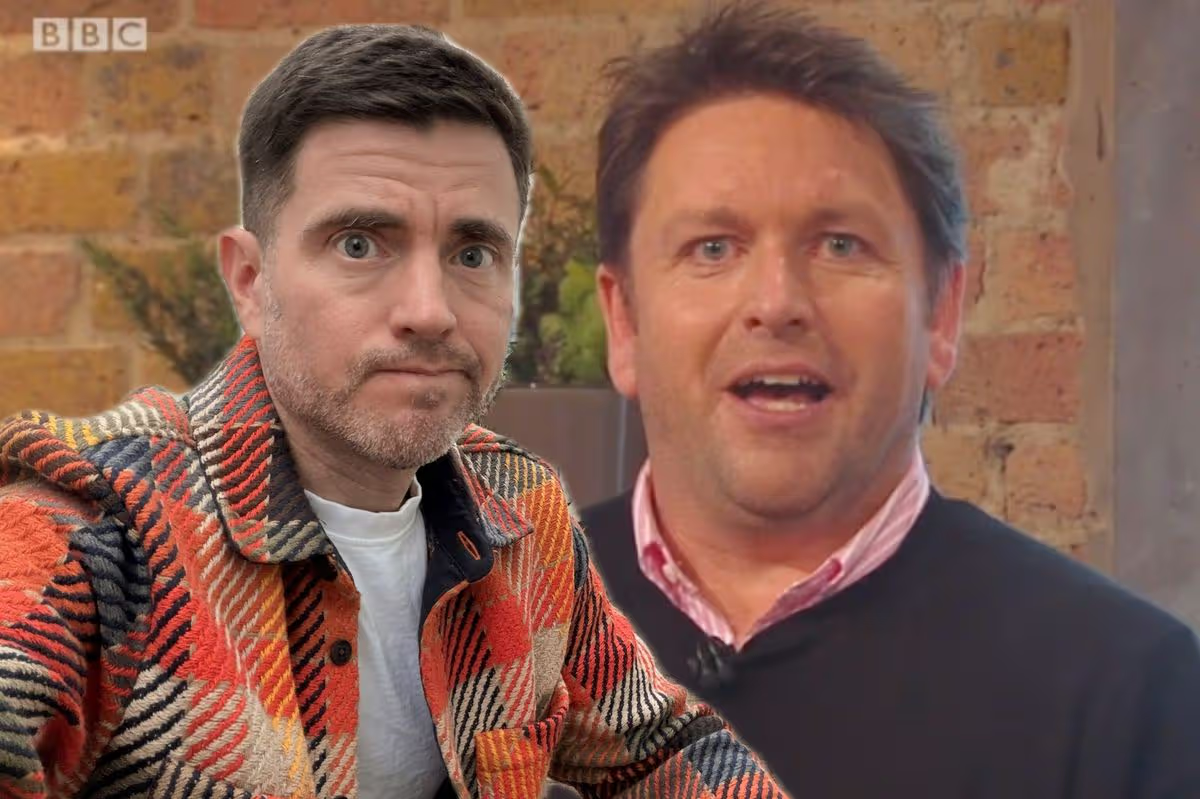
I was on Saturday Kitchen — celebrity guest showed true colours when I opened my mouth

I’ve rarely been more embarrassed.

Saturday Kitchen has been a regular part of the weekend for millions of people over the years. In the days before I had children, I enjoyed nothing more than starting off the weekend slowly with some relaxing, wholesome TV over brunch and a cup of coffee.

I adored not only the live studio cooking fronted first by the legendary James Martin then the equally watchable Matt Tebbutt, but also the segments from the likes of Rick Stein, Mary Berry or the great Keith Floyd slurping his wine while cooking up his rustic, no-nonsense meals somewhere in the south of France.

In fact, I loved it so much that I actually appeared on the show. Remember those days when two random members of the public would be studio guests and would sit at the table off to the side of the set while the guest chefs and celebrities wondered who they were and what they were doing there? Yep, I was one of those.

This was obviously quite a while ago — Saturday Kitchen stopped having members of the public as guests back in 2012, with James Martin saying afterwards: “That wasn’t my decision. I liked having the studio guests. It was the BBC’s decision. Budget cuts — and don’t look at me, I didn’t get a pay rise.”

James wasn’t the only one who was disappointed, with viewers taking to forums to ask why the show had got rid of its non-celebrity guests. One said: “Every Saturday without fail I watched Saturday Kitchen. Now it is just another cookery programme with, nine times out of ten, a boring guest. Bring back the viewer guests, get rid of the celeb.”

Not everyone agreed, though, with one saying: “Er, the viewer guests did nothing, they were hardly ever interviewed, they added little to the programme. So how can that be a loss?”

Viewers also speculated whether their sudden absence was down to the cost to the BBC of paying the guests’ hotel and transport costs. However, having been a Saturday Kitchen guest, I can confirm that the BBC didn’t pay for either of these things. Rightly so, of course.

This is how it worked. There were always two guests, usually a couple (or two friends if someone’s other half was too embarrassed to go on with them). You had to submit an application, including a picture, and then hope for the best.

Not long after we submitted our application, my partner and I got a phone call from a show producer telling us they would like us to be guests on the show. She said something like “As soon as we saw your picture we knew we had to have you on the show.” Which, if you had seen the picture, or any picture of me really, you would find hard to believe. Still, the flattery worked and we were booked on.

The only instruction I can remember being given about our appearance was not to wear black. I forgot this instruction and wore a black shirt, meaning I had to scrabble around on the day to find something to wear over it — which ended up being a beige-coloured tank top. Lovely.

Next we had to get ourselves to the Saturday Kitchen studio, which at that time was in the Kennington area of London, not far from the Oval cricket ground. We were asked to arrive at a stupidly early time in the morning (the show starts at 10am) and were shown into the green room to wait. We were even there before James Martin because I remember him arriving in the car park outside in what my partner described as “one of his funny little sports cars”.

We got to watch from the wings as James and the guest chefs practised their dishes and then it came time for the live show to start. I don’t remember being told not to speak unless spoken to but I didn’t say a word during the entire live broadcast. My partner was interviewed, though, and described having recently cooked a lobster when we’d been guests in a Michelin-starred kitchen.

Her description had the celebrity guest, Eve Myles, laughing out loud and James abruptly moved the conversation on! I still remember the warm way Eve laughed, she seemed genuinely tickled.

But after the show came a moment I still cringe about. I happened to leave the studio at the same time as Eve, who has just starred in one of the best TV crime dramas I’ve seen in a long time. As we both lived in roughly the same area of the UK at the time, I offered her a lift for the 150-mile journey home. Obviously, as any sensible person (let alone a well-known TV star) would, she politely declined this offer of a long lift home to Wales in a battered old Fiesta from a stranger. A less kind celebrity may well have been more blunt in her refusal. But Eve did her best to be polite despite my idiocy, which I’ve always remembered.

Incredibly, this wasn’t my only cringeworthy moment from that day. I’ve also worried ever since that I offended the hugely successful TV chef Jason Atherton, when I asked him at the chef’s table during a break in live filming why he didn’t have a recipe book out. He replied: “I do.” This was way back in 2008 but I’ve still not fully got over the embarrassment.

So, if Eve or Jason happen to read this, please accept my very late apologies. Thankfully, I don’t think I embarrassed myself in front of James Martin or the show’s other guest chef, Bryn Williams (they must have had a Welsh theme that day) and I’ll always remember being on the show. It’s a shame no one gets to any longer. Bring back the guests, BBC!
Source link

‘Atomic Dragons’ opened at Pitzer College, then the U.S. bombed Iran

The anti-nuclear artists collective whose work is on display at Pitzer College in Claremont never predicted a nuclear proliferation crisis would break out in the Middle East during their exhibit, or how grimly topical their work would quickly become as a result.

“Atomic Dragons,” wrapping April 4 with a closing-day symposium of nuclear experts, is the work of SWANS, which stands for Slow War Against the Nuclear State. The group is made up of artists, activists and academics with ties to the nuclear industry, including children and spouses of nuclear industrial complex workers — putting a new spin on the “nuclear family.”

The show examines the environmental and human cost of the atomic era through an artistic lens, tracing present day nuclear risk back to its Cold War roots.

The SWANS’ warning call has always been clear, but ”Atomic Dragons” took on a whole new meaning when the United States and Israel launched a joint assault on Iran over its illicit stockpile of nuclear materials Feb. 28, three weeks after the show opened.

“We’re at the start of what will be an exceedingly dangerous period in terms of the Iranian nuclear program,” nuclear policy expert Scott Sagan, who co-directs Stanford’s Center for International Security and Cooperation, said. “We’re likely to have a major, major conflict over this.”

In a time of acute nuclear anxiety, SWANS is an outlet through which the artists process the fear and gravity of our atomic reality.

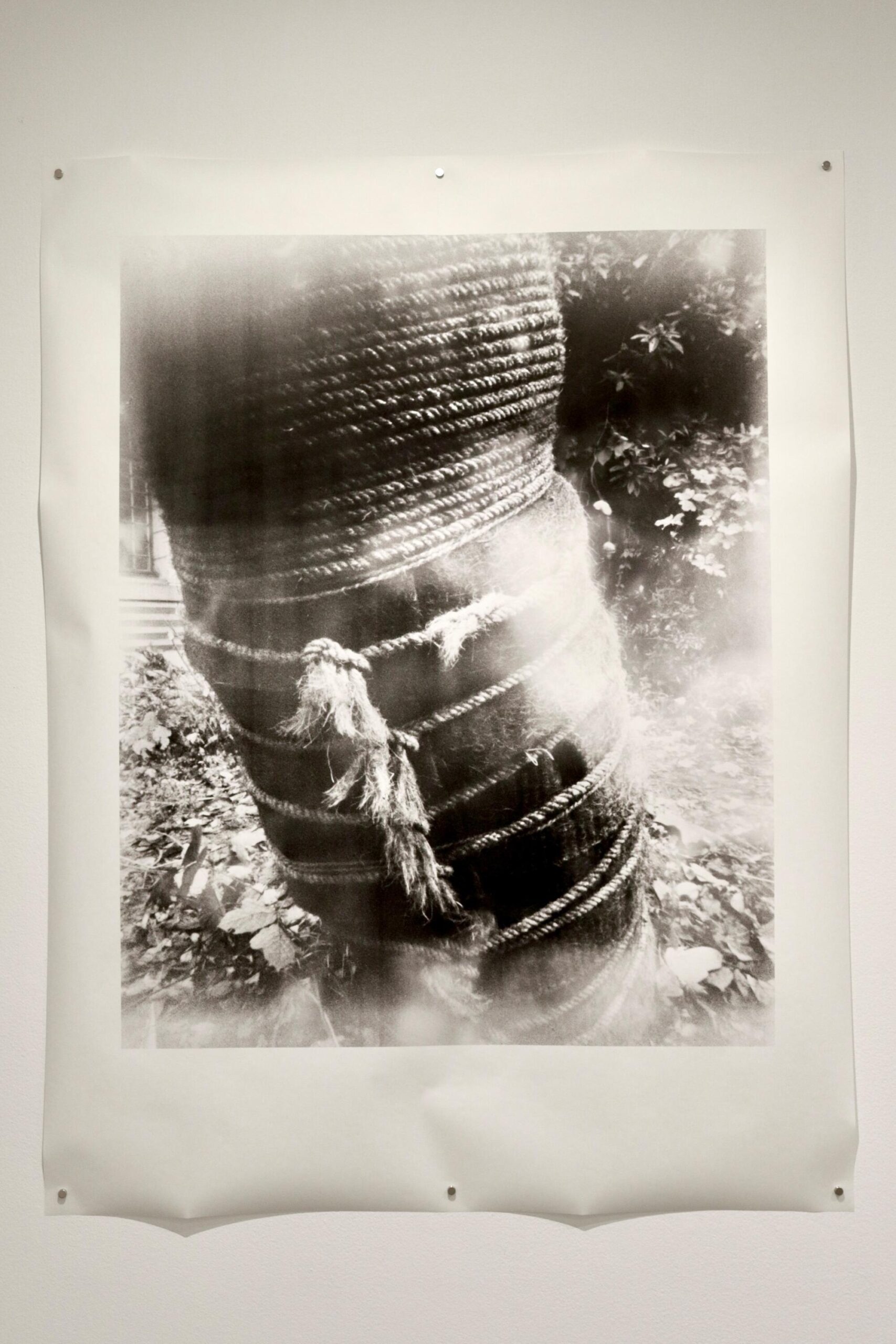
A black and white photo of a cherry tree."

Fiona Amundsen, “Yoshino Cherry Tree, Sanyo Buntokuden, Hiroshima (lovingly held),” 2025, from the series, “The Trees are Leaking Light,” 2024-25, 4 x 5 inch negative processed using seaweed, gathered from the ocean current of the Fukushima wastewater release, inkjet washi photograph.

(Chloe Shrager)

“My maybe-naive hope is that the artworks help to provide an avenue into that understanding of the severity of what it means to play with the nuclear,” said Fiona Amundsen, whose arresting film photography of three trees in Hiroshima that survived the 1945 nuclear bomb was developed using contaminated seaweed growing in the Fukushima wastewater release line.

The resulting images are dotted with delicate white flares: trace amounts of radioactive tritium that transferred to the film from the nuclear effluent during the chemical processing, bearing physical witness to the usually invisible effects of radiation.

Amundsen’s work is in keeping with the rest of the show, which fills two halls at the liberal arts school with visual and multimedia works that probe the persistence of radioactive materials. Artifacts from the birth of the nuclear age are also featured, including items recovered from postwar Hiroshima and a letter from the father of the nuclear bomb, Robert J. Oppenheimer.

The artworks are as likely to unsettle as they are to move.

Elin o’Hara slavick labored over an expansive series of photochemical drawings of every above-ground nuclear test — 528 in total, a selection of which are featured in the exhibit— on salvaged darkroom paper from Caltech, the institution that played a role in developing the detonators for the U.S. nuclear bombs dropped on Japan under the top secret Project Camel.

A photo-chemical drawing.

elin o’Hara slavick, selection from “There Have Been 528 Atmospheric Nuclear Tests to Date,” 2022, photo-chemical drawings on outdated and fogged silver gelatin paper.

(Chloe Shrager)

Slavick said she found the abandoned silver-gelatin paper, which was fogged despite being stored in closed boxes, in the basement of the university near a door labeled “Radiation Science,” which led her to believe radiation exposure from Caltech’s Manhattan Project past distorted the photographic paper.

SWANS seems to double as a support group for families impacted by the nuclear industry. Many members believe they’ve lost loved ones to radiation, or were themselves likely impacted by early-life exposure as children of Manhattan Project engineers. The tension between the anti-nuclear artwork and its artists’ familial ties to the production of the very technology they reject is an enticing dance of its own.

A photo of two milk bottles.

Judith Dancoff, “The Milk Pathway (still),” 2023, video, briefcase, antique milk bottles, and tempera.

(Chloe Shrager)

Writer Judith Dancoff links her hyperthyroidism and long-term reproductive issues from a pituitary gland tumor to childhood radiation exposure during a summer spent at the Oak Ridge uranium enrichment site in Tennessee where her father worked as a student of Oppenheimer. Her father died young of cancer, and the story is woven into her featured SWANS work.

One of the largest pieces on display at “Atomic Dragons” is Nancy Buchanan’s interactive full-wall exhibit of documents her father brought home from his government work as a Manhattan Project physicist, alongside material from the FBI file on his mysterious death, on display for viewers to read under looming red letters spelling out “SECURITY.”

An art installation on a white wall.

Nancy Buchanan, “Security,” 1987, installation with file folders, photos, map pins, and documents.

(Chloe Shrager)

The current crisis in Iran has sent memories bubbling to the surface for the collective, and chills down the spines of viewers.

Many have expressed fears of an Orwellian-style forever war, or worse, the use of the atomic weapon invented “to end all wars” in a twisted attempt to do so, poisoning the region as a byproduct. But nuclear policy expert Sagan said the likelihood of the conflict escalating to involve nuclear weapons is “exceedingly low,” even if Iran has the capability to build them.

Iran possesses enough 60% highly-enriched uranium to build about 10 nuclear weapons if further enriched to 90% weapons grade, he said. This could take a matter of weeks to complete depending on the state of Iran’s enrichment centrifuges, which Trump claimed to have “obliterated” during air strikes in June.

Iran could also craft a primitive nuclear device out of minimally enriched materials for an offensive attack (“60% could actually create an explosion, it just wouldn’t be a very efficient one,” according to Sagan), but George Perkovich, senior fellow for the Carnegie Endowment for International Peace’s Nuclear Policy Program and author of “How to Assess Nuclear Threats in the 21st Century,” points out that “you have to build more than one for it to be useful,” especially under the wrath of a nuclear-armed West’s expected response.

What is more likely, and probably more dangerous, experts say, is the now-heightened long-term risk of global proliferation. “This war is going to suggest to some countries that if they want to secure their sovereignty, they need nuclear weapons,” Sagan said.

A photo-chemical drawing.

elin o’Hara slavick, selection from “There Have Been 528 Atmospheric Nuclear Tests to Date,” 2022, photo-chemical drawings on outdated and fogged silver gelatin paper.

(Chloe Shrager)

Since 1968, the world nuclear order has rested on the delicate architecture of the Nuclear Non-Proliferation Treaty, enforcing the international norm that countries without nuclear weapons won’t try to get them, and countries with nuclear weapons won’t help arm their allies. Now, experts say the rulebook has been thrown out.

“What this does is it breaks the old system that was based on the non-proliferation treaty,” said Perkovich, who has worked on nuclear issues for 44 years. “It’s now ‘might makes right,’ everybody’s on their own, friends versus enemies. I think the terms now change, and we’re not bargaining.”

Though the timing of the military operation in Iran with the “Atomic Dragons” exhibit could not be described as kismet as much as brutally ironic, slavick said the “sick and sad thing” is that “it’s always topical when you’re an American.”

“We do this. We wage wars. We are the leading nuclear country,” she said, speaking to the heart of the SWANS message: In a world where nuclear materials exist, it is not a matter of if humans will be harmed, but when.

There is a historic relationship between visual art and nuclear war, said Jim Walsh, a senior research associate at the MIT Security Studies Program on nuclear weapons risk issues in Iran and North Korea, who is also a speaker at the exhibit’s closing symposium. As the world enters a “more disruptive period” after the post-Cold War cooling of nuclear tensions, he expects to soon see “a flowering of artistic projects,” as nuclear risk reaches a local peak. “It’s a super powerful thing involving life and death, the planet, the entire environment, love and hate,” he said.

“Atomic Dragons,” which also features work created decades ago, highlights questions that are as relevant today as they were at the dawn of the nuclear era: Can we make the world safe enough so we can once again dream? Is the strength of a country found in its military rather than its culture? Is fear our gross national product?

Symposium: Art, Science, and the Nuclear Legacy

A talk by nuclear expert panelists Jim Walsh and David Richardson, as well as a viewing of the “Atomic Dragons” art exhibit and a conversation with the artists. Coffee and a light lunch will be served.

When: Saturday, April 4, 11 a.m. – 4 p.m.
Where: George C. S. Benson Auditorium, Pitzer College
Tickets: Free RSVP
Info: Details on event website

Source link

The huge new free-to-visit playground that’s just opened in famous Victorian park as part of £52million upgrade

A HUGE new playground has just opened in the UK as part of a huge multi-million revamp.

Forget it’s football team and towering transmitting station – Crystal Palace Park in London has opened a new playground right by the famous dinosaur sculptures.

A new play area has opened at Crystal Palace Park and it is free to visitCredit: kiddoadventures / Facebook
The park features a number of slides, swings and climbing framesCredit: kiddoadventures / Facebook
Many of the different elements of the playground are also accessibleCredit: HTA Design

The park features “hands-on play” with a “world shaped by scales, skeletons and stories from deep time”.

‍There are a number of pathways to explore with dinosaur-details as well as a few different shaped slides on the embankment.

A huge dinosaur-like skeleton also offers kids the chance to climb and hide, with the curving tail forming a play trail.

In the sandpit, which is shaped like a dinosaur’s footprint, young children can also dig and discover fossils.

Read more on travel inspo

BUNNY WELL SPENT

Cheapest Easter days out whatever the weather & FREE kids activities


CHEAP BREAKS

UK’s best 100 cheap stays – our pick of the top hotels, holiday parks and pubs

There’s also jumping discs, a log scramble and swings.

And a lot of features in the park are accessible including a wheelchair accessible roundabout, accessible swing and tactile games.

For parents wanting to rest and watch whilst their children play, there is a picnic area too.

The Dinosaur Playground is close to the main park toilets, as well as the cafe.

The new playground replaces an old one that had become rundown over the years.

After enjoying the new play park, make sure to head on the dinosaur trail to see around 30 Grade-I listed statues scattered across the park.

These are the world’s first life-sized prehistoric animal sculptures which were all inspired by fossils found by Victorian palaeontologists over 170 years ago.

Many of the dinosaurs look rather different to how we imagine dinosaurs now and that is because the statues were created from the scientific information Victorians had at the time.

It is free to visit the park as well as the sculptures, which can be found across islands and lakes in the park.

And by this summer, there will be a new £17.75million Visitor Centre.

There’s even a climbing frame and trail that looks like a dinosaur skeletonCredit: kiddoadventures / Facebook
Across Crystal Palace Park you can also see 30 Grade-I listed dinosaur sculpturesCredit: Alamy

It will be a single-storey and will have an ‘Interpretation and Activity Room’ which will showcase the park’s history and future through a number of displays, objects and information panels.

The park’s Grand Centre Walk is also being restored to create more space for events, with the path becoming wider and a new entrance being built at Penge Gate.

In total, the park’s revamp is expected to cost around £52million.

For more free attractions in the UK, these are the 20 most-visited attractions in England that are completely free to enter.

Plus, one of London’s most popular free attractions to get massive £231million upgrade.

In the future, the park will also have a new visitor centreCredit: kiddoadventures / Facebook

Source link