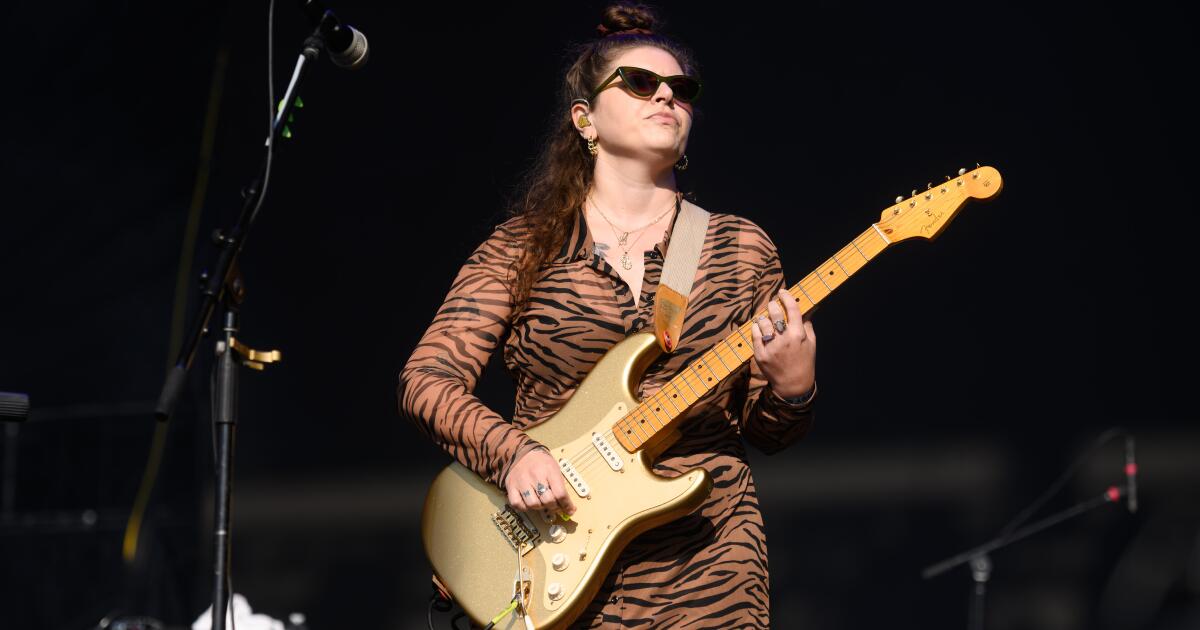
Bethany Cosentino, the solo artist and co-founder of the rock band Best Coast, posted an open letter castigating her booking agency Wasserman Music over its founder’s connections to Jeffrey Epstein and relationship with convicted child sex trafficker Ghislaine Maxwell.
Agency founder Casey Wasserman — also the head of the 2028 Los Angeles Olympics organizing committee — was included in a recently released tranche of federal documents related to the Jeffrey Epstein investigation. While Wasserman was long known to have have flown with his then-wife Laura on Epstein’s plane with the disgraced financier, these new documents included sexually suggestive messages between Wasserman and Maxwell, Epstein’s consigliere who is serving a lengthy sentence in federal prison for child sex trafficking.
In a statement to the Hollywod Reporter, Wasserman said, “I deeply regret my correspondence with Ghislaine Maxwell which took place over two decades ago, long before her horrific crimes came to light. I never had a personal or business relationship with Jeffrey Epstein. As is well documented, I went on a humanitarian trip as part of a delegation with the Clinton Foundation in 2002 on the Epstein plane. I am terribly sorry for having any association with either of them.”
Meanwhile, Cosentino, a Wasserman client since 2021, wrote in a letter posted to social media that her agency head’s response to the backlash was “not enough… Regret without accountability is just damage control.”
“We are tired of learning, over and over, that men who control access, resources, money and so-called safety in our industry are given endless grace,” Cosentino wrote. “We are tired of being asked to treat proximity to something horrific as an unfortunate situation we should simply move past — especially when the person involved still holds all the power.”
“This letter is my public refusal to accept that this is ‘just how things are,’” she continued.
Cosentino specified that she is “In the Sam Hunt business,” referring to her longtime agent. “I am not in the Wasserman business. I have asked to remove my name and the band’s name from the company site. The position Casey Wasserman has put his agents in is inexcusable. This is a call for him to step down and a change of business name be imminent.”
In the messages between Wasserman and Maxwell, Maxwell said she “thought of [Wasserman] at inappropriate moments,” to which Wasserman answered “I think of you all the time… So what do I have to do to see you in a tight leather outfit? I am in NY tonight, youre not, what am I to do? Xoxo cw”
Later, Wasserman wrote “I thought we would start at that place that you know of, and then continue the massage concept into your bed…and then again in the morning…not sure if or when we would stop.” She responded: “Umm – all that rubbing – are you sure you can take it? The thought frankly is leaving me a little breathless. There are a few spots that apparently drive a man wild -I suppose I could practise them on you and you could let me know if they work or not?”
Wasserman Music is a leading talent agency, representing top acts like Chappell Roan and Kendrick Lamar. Previously, Billie Eilish left Wasserman after reports surfaced of separate incidents of alleged sexual misconduct from Wasserman.
Local politicians have called for Wasserman to back away from the Olympics committee. “I think Casey Wasserman needs to step down,” said L.A. County Supervisor Janice Hahn. “Having him represent us on the world stage distracts focus from our athletes and the enormous effort needed to prepare for 2028.”
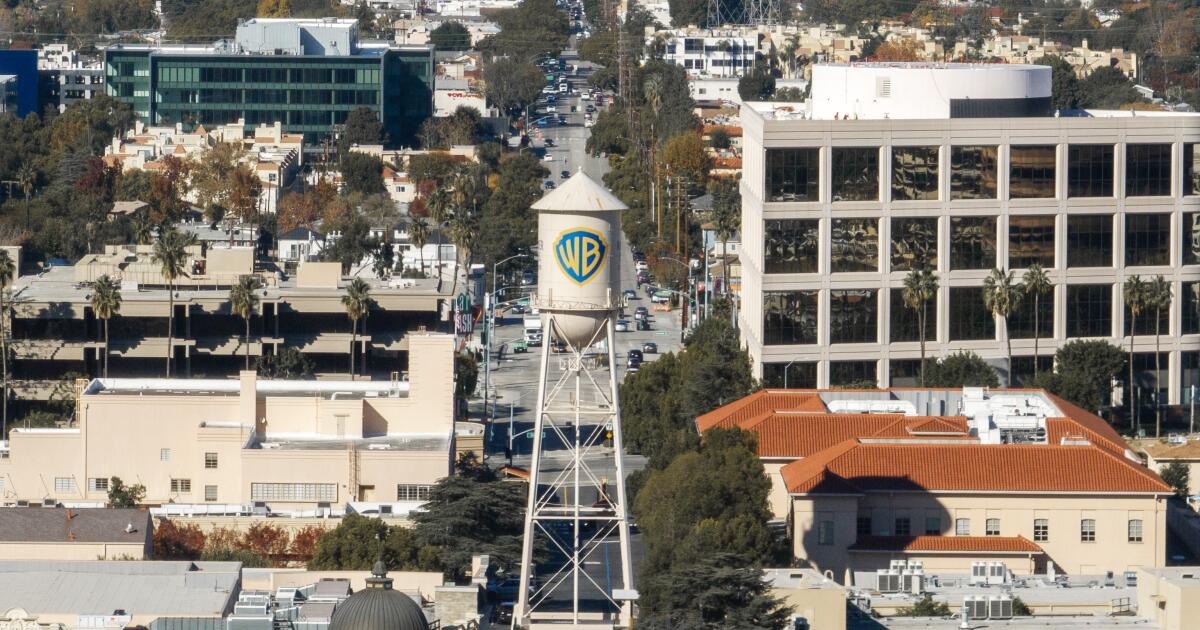
California lawmakers are expressing concern about how the future of Warner Bros. Discovery could affect Hollywood’s workforce.
In an open letter addressed to Netflix Chief Executives Ted Sarandos and Greg Peters and Paramount Skydance Corporation CEO David Ellison, U.S. Sen. Adam Schiff (D-Calif.) and Rep. Laura Friedman (D-Glendale) call for the industry giants to make “concrete commitments to Californian and American workers.”
With all of these moving pieces, there’s a bipartisan fear among the nation’s lawmakers about how the acquisition could affect jobs in the U.S. entertainment industry . As stated in the letter, the industry “supports more than 680,000 jobs and contributes over $115 billion annually to the regional economy.”
Given the slowdown the industry has seen post-COVID and the growing number of international productions, Los Angeles film activity was down 13.2% from July through September 2025 when compared with the same period last year. This downward trend continues to build on the loss of 42,000 jobs in L.A. between 2022 and 2024.
Ellison and Sarandos have made arguments for why they believe their respective companies are best positioned to take over Warner Bros.
But each deal comes with major cuts. Paramount is projected to slash $6 billion in expenses over three years, and Netflix is projecting to cut $2 billion to $3 billion. Some analysts believe these cuts will have a significant effect on the workforce.
Previously, Ellison said, “We believe that what we are offering is better for Hollywood. It’s better for the customers and it’s pro-competitive.”
Sarandos is also quoted in the letter saying: “We think it’s great for consumers. We think it’s a great way to create and protect jobs in the entertainment industry.”
Earlier this week during a Senate subcommittee hearing, Sarandos said Netflix plans to increase its film and television production spending to $26 billion this year, with a majority of that happening in the U.S.
The lawmakers’ letter raises a series of questions surrounding the livelihood of creators, the use of AI and “concrete steps” about preserving jobs in L.A. Schiff and Friedman also offer the CEOs an opportunity to meet with them to discuss their answers.
In an effort to ensure “America continues to lead the world in the creative economy,” the letter said that Congress is currently working on bipartisan legislation that would establish a federal film tax incentive. It will be modeled after state programs in California, Louisiana and Georgia.
“We view this as a tool to not just protect but encourage more domestic filming and sustainable job creation on American soil,” wrote the lawmakers.
Eva Longoria, John Leguizamo and Xochitl Gomez are among the 100-plus Latino actors, artists and creatives who have signed an open letter calling for accountability in Hollywood — citing longtime discrimination in casting and storytelling.
The public statement follows the controversy surrounding Odessa A’zion, who dropped her role as a Latina character in Sean Durkin’s “Deep Cuts,” following online backlash over the actor herself not being Latina.
“Recent casting decisions around the character Zoe Gutierrez in A24’s ‘Deep Cuts’ have exposed a troubling pattern,” the letter states. “We acknowledge and commend Odessa A’zion for listening, reflecting and deciding to exit the project and become an ally. Yet how did this happen?”
Earlier this week, the Wrap revealed that the “I Love L.A.” and “Marty Supreme” breakout star was cast as Zoe Gutierrez in the A24 film adaptation of Holly Brickley’s music-filled coming-of-age novel. The character’s identity plays an important role in the book, as she is written as a half-Mexican and half-Jewish lesbian.
Though the 25-year-old announced Wednesday night that she had dropped the role — admitting through her Instagram stories that she had not yet read the book, nor learned of all the character’s traits — the incident has unearthed questions about Latino representation in Hollywood.
“This isn’t about Odessa,” said Xochitl Gomez to The Times on Friday. “It’s about the executives, the producers and the whole system at the top. They thought it was OK to not even audition Latinas for the role in the first place. Latinas were pitched, including me, but we were told that there was an actress with an exclusive offer. This role never showed up on the casting grid because it was already gone.”
Xochitl Gomez attends “REBBECA” LA Premiere on November 30, 2025 in Los Angeles, California. (Photo by JC Olivera/Getty Images for State of the Art)
(JC Olivera / Getty Images for State of the Art)
According to UCLA’s 2025 Hollywood Diversity Report, Latinos were cast in only 1% of the leading roles in the top 104 English-language films released theatrically in 2024, despite constituting roughly 20% of the total U.S. population.
In TV, representation is just as stark. Latinos are cast in only 6% of all roles across the top U.S. broadcast series, as per a recent study by ¡Pa’lante! — a Latino representation initiative from the USC Norman Lear Center — which also found that 1 in 4 Latino characters are depicted as career criminals.
“The absence of Latina audition opportunities, and the choice to replace a clearly Latina character with a non-Latina actress, signals a broader, ongoing erasure of our community from the stories that define our culture,” the letter continues. “This is not about any one actor or project. It is about a system that repeatedly overlooks qualified Latino talent even as our identities, histories, and experiences fuel the most enduring stories.”
The signatories request that Latino actors be hired for a diverse range of roles, including non-stereotypical leads. There is also a demand for more Latino executives to be involved in green-lighting projects and the inclusion of Latino consultants, writers and producers from the earliest stages of development. Finally, there is a call on Hollywood to create mentorship, scholarships and opportunities that expand access on all levels of the ecosystem.
This plea by marginalized creatives is not the first pushback — nor likely the last — against a stagnant Hollywood machine.
As early as the 1920s, the portrayal of Latinos was so negative that the Mexican government, and even Woodrow Wilson reportedly told Hollywood producers to “please be a little kinder to the Mexicans.”
In 1999, the National Hispanic Media Coalition (NHMC) and the National Assn. for the Advancement of Colored People (NAACP) called for the boycott of broadcast networks’ 26 new fall series because they did not feature a non-white lead, sparking dialogue over the diversity of Hollywood at the time.
Comedian Chris Rock blasted the industry in a 2014 essay for its omission of Mexicans in Los Angeles, where nearly half of the population is Latino: “You’re in L.A., you’ve got to try not to hire Mexicans.”
Rep. Joaquin Castro (D-Texas) — who in recent years has nominated several Latino-focused films to the Library of Congress National Film Registry — also penned a 2020 column in Variety, underscoring the dearth representation of Latinos in entertainment and the consequences of omission. “Prejudice has existed in the United States for generations, but the image of our community created by film and television has done little to counter bigoted views, and too often has amplified them.”
Another letter published in October 2020 with over 270 showrunners, creators, television and film writers signatures — including Lin-Manuel Miranda and “One Day at a Time” co-creator Gloria Calderón Kellett — called for systemic change in the industry. “We are tired,” they wrote.
The pushback continued in 2022, when actor Leguizamo penned an open letter in The Times about the history of Latino representation and the co-option of Latino stories — including that of Mexican revolutionary Emiliano Zapata, who was portrayed by a brownface Marlon Brando in the 1952 film “Viva Zapata!,” and Al Pacino, who played the fictional Cuban character Tony Montana in the 1983 film “Scarface.”
Wrote Leguizamo, “There’s a fix for this: Cast more Latinos!”
Read the full open letter below.
Dear Casting Directors, Creative Executives, Writers, Producers, and Hollywood Leaders,
We write to you with urgency, because storytelling is humanity’s compass and Hollywood wields all the power. The stories you choose to tell, and how you tell them, shape public perception, cultural understanding, and who gets to see themselves reflected on screen. In these challenging moments that power comes with real responsibility.
Recent casting decisions around the character Zoe Gutierrez in A 24’s Deep Cuts have exposed a troubling pattern. We acknowledge and commend Odessa A’zion for listening, reflecting and deciding to exit the project and become an ally. Yet how did this happen? The absence of Latina audition opportunities, and the choice to replace a clearly Latina character with a non-Latina actress, signals a broader, ongoing erasure of our community from the stories that define our culture. This is not about any one actor or project. It is about a system that repeatedly overlooks qualified Latino talent even as our identities, histories, and experiences fuel the most enduring stories.
Latino communities are already underrepresented and misrepresented in ways that distort reality and harm real people. Casting decisions carry real weight: they influence who is seen as worthy of authentic storytelling and who gets to tell those stories with care, nuance, and authority.
We are calling for accountability, intentionality, and equity in casting and storytelling. Authentic representation means more than casting a performer who looks like the character; it means involving the communities being portrayed not just in front of the camera, but in the decisions that shape these stories from their inception. Our stories deserve to be shaped with the input, guidance, and leadership of Latino creators, consultants, writers, and performers at every stage.
We implore you to join us in concrete action:
Audition and hire more Latino actors for a diverse range of roles, including non-stereotypical leads
Hire Latino executives in your greenlighting rooms
Include Latino voices as consultants, writers, and producers from the earliest stages of development
Create and support pipelines: mentoring, scholarships, and opportunities that expand access all levels of the ecosystem