On Holiday

Parents handed airport boost but there is a catch

Families should be aware of some important rules before they travel

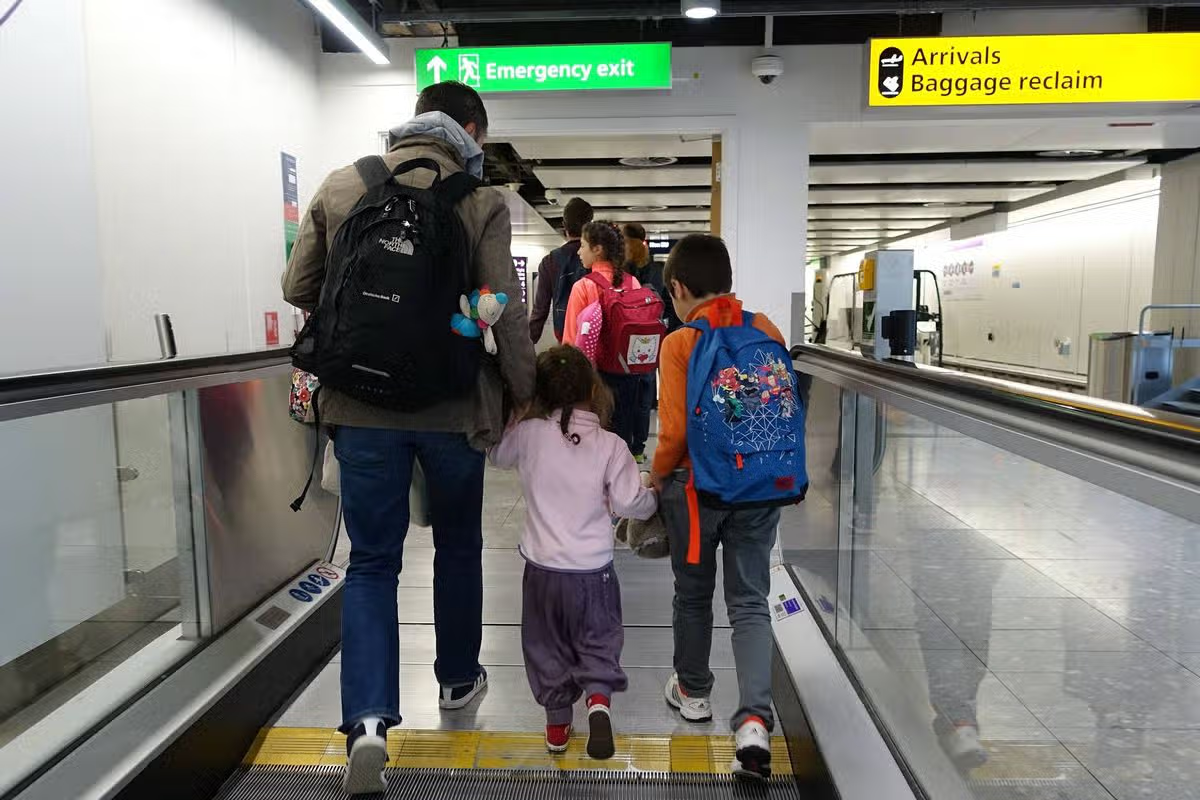
Heathrow has issued a summer travel update telling families they can now benefit from a major change to Britain’s airport border controls.

The airport said: “Get ready for easier arrivals for families. Children aged 8 and 9 will now be able to use the eGates. They will need to have an eligible passport and be travelling with an adult”. The change could prove a welcome boost for parents returning to Britain from their summer holidays – potentially cutting the time they spend queuing at passport control.

Children aged eight and nine can use UK eGates, bringing them into line with older children who are already eligible to use the automated border gates.

But there is an important catch. The youngsters must have an eligible passport, be travelling with an adult and, under the Government’s rules, be at least 120cm (3ft 11in) tall.

The change came into force on July 8, just as the summer holiday travel season was getting into full swing. And the Government estimates that up to 1.5 million more children could become eligible to use eGates over the next year.

For parents facing the prospect of tired youngsters after a long flight, the prospect of avoiding a lengthy passport-control queue could be particularly welcome. Heathrow has urged passengers travelling with younger children to check airport signage or speak to staff if they are unsure which lane they should use.

What parents need to know

The expanded eGate access applies to eight and nine-year-olds who meet the requirements.

They must:

  • Be aged eight or nine
  • Be at least 120cm tall
  • Have an eligible passport
  • Be travelling with an adult

The Government says the change covers more than 290 eGates across the UK and at so-called juxtaposed ports, where British border checks are carried out in Europe. Millions of passengers already use eGates each year.

The Government says using one typically takes only a few minutes – and increasing the number of people who can use them should also help reduce queues for passengers who still need to go through staffed passport control.

Content cannot be displayed without consent

Major change for families

The move was announced by the Home Office in May as part of a wider programme to transform the UK’s border system. Migration and Citizenship Minister Mike Tapp said: “Travel with young children can be stressful for parents.”

He said expanding eGate access would allow more families to have a “swifter and smoother journey home” while keeping Britain’s borders secure.

Border Force Director General Phil Douglas said eGates were an “essential part” of keeping the border secure.

He said the expansion would deliver safe and smooth journeys while freeing officers to concentrate on intercepting people who pose a threat to the UK.

Karen Dee, chief executive of AirportsUK, welcomed the change, saying it would give more families the opportunity to use the technology and could reduce waiting times.

Part of wider border overhaul

The change comes alongside the Government’s wider push to modernise Britain’s borders. The Electronic Travel Authorisation scheme has also been introduced for eligible travellers, with almost 25 million ETAs issued, according to Government figures.

The longer-term ambition is for a more “contactless” border, with facial comparison technology being used to verify travellers’ identities.
Source link

Everything you’re entitled to if airline loses your luggage

Holidaymakers may be entitled to claim compensation when an airline loses, damages or delays their luggage

Holidaymakers facing the misery of lost, damaged or delayed luggage could be entitled to compensation from their airline – but they need to act quickly.

Passengers arriving at their destination only to discover their suitcase has failed to make the journey with them have legal rights that can help them recover some of the costs. Citizens Advice says travellers have the right to claim compensation from an airline when checked-in luggage is delayed, lost or damaged. But there are important deadlines – and passengers should report a problem as soon as possible.

The consumer advice charity warns that the rules for cabin baggage are different. You can generally only claim for a problem with hand luggage where the airline was at fault.

Don’t leave it too late

Citizens Advice says holidaymakers should report missing or damaged luggage to the airline straight away. At the airport, this will normally involve completing a Property Irregularity Report (PIR) at the baggage claims area.

Passengers should keep a copy of the PIR, or obtain written confirmation from the airline if they report the problem later. Making a report does not necessarily mean a compensation claim has been made. Passengers will normally still need to submit a separate claim unless the airline agrees to pay certain expenses upfront.

There are strict deadlines

One of the biggest traps is assuming there is plenty of time to make a claim.

Citizens Advice says the usual deadlines are:

  • Damaged luggage: claim within seven days of receiving it.
  • Missing or damaged contents: claim within seven days of receiving the luggage.
  • Delayed or missing luggage: claim within 21 days of the flight.
  • Luggage not returned within 21 days: it is officially treated as lost, meaning passengers should make a claim as soon as possible.

A suitcase that eventually turns up after several days does not necessarily mean a passenger has lost their right to compensation. Citizens Advice says it is still possible to claim for delayed luggage if it is returned within the 21-day period.

What can you claim for?

The compensation available from an airline is generally limited. For delayed luggage, this can include the cost of essential items needed while waiting for the suitcase, such as toiletries and underwear.

Passengers may also be able to claim some of the cost of repairing or replacing luggage and its contents if they are lost or damaged. If a traveller has to collect delayed luggage themselves, says they may also be able to recover reasonable transport costs.

But holidaymakers should not assume they will receive the full replacement value of everything inside a suitcase. Airlines will often ask for receipts and proof of purchase, while Citizens Advice warns that they will not normally pay ‘new for old’ replacement costs.

There can also be restrictions around valuable, fragile or perishable items packed in checked luggage. Total compensation is generally limited to around £1,000 and is often considerably less.

Passengers cannot normally claim for stress or inconvenience caused by the luggage problem, or for knock-on problems such as missing a connection.

Keep every scrap of evidence

Anyone making a claim should keep hold of their paperwork.

Citizens Advice says airlines will usually expect passengers to provide documents such as:

  • their boarding pass;
  • luggage tags showing the identification number;
  • the PIR or written confirmation that the problem was reported;
  • receipts for emergency purchases made because of delayed luggage;
  • proof of purchase for lost or damaged belongings;
  • photographs showing damage; and
  • estimates for the cost of repairs where relevant.

Travellers should keep copies of their claim and the original documents.

How to make the claim

Passengers should check with their airline to find out how it wants compensation claims submitted. If there is no specific claim form, Citizens Advice says travellers may need to write to the airline’s customer service department.

The charity advises making clear that the claim is being made under the Montreal Convention. The claim should include details of the flight, including the date, flight number, departure point and destination.

Travellers should explain what happened, set out the amount being claimed and provide a detailed list of the luggage or contents that were lost or damaged. Any essential items bought because of the delay should also be listed, with copies of supporting receipts and other evidence.

What if several airlines were involved?

Passengers travelling on connecting flights operated by different airlines may be able to claim against any of them. However, Citizens Advice says most airlines expect the claim to be made against the last airline boarded.

An airline cannot simply refuse to deal with a claim because another carrier was involved. If a passenger gets nowhere they can seek advice from the Civil Aviation Authority (CAA).

What if the airline rejects your claim?

Holidaymakers who are unhappy with an airline’s response can take the matter further. Citizens Advice recommends first trying to resolve the complaint through the appropriate process.

The CAA can take up complaints against airlines or airports in certain circumstances, although its role depends on whether the airline or airport belongs to an approved alternative dispute resolution scheme. As a last resort, passengers can consider taking a case to the small claims court.

A luggage claim can generally be taken to court within two years of the flight, although court action can be costly and time-consuming.

Check your insurance too

There is another option that could prove easier and more generous. Citizens Advice says that if luggage is covered by travel insurance or a home contents policy, making an insurance claim may be preferable.

This is because insurance can potentially provide more money and may be easier to claim through than pursuing the airline.

Passengers needing further help can contact the Citizens Advice consumer helpline on 0808 223 1133 or use its online service.

The charity also advises checking the specific rules applying to the airline, as individual procedures and deadlines can vary. More information here.

Source link