Oil prices

Martin Lewis shares ISA tip to ‘smooth out’ Iran war economic impact

He was asked if now is a good time to open an ISA or not

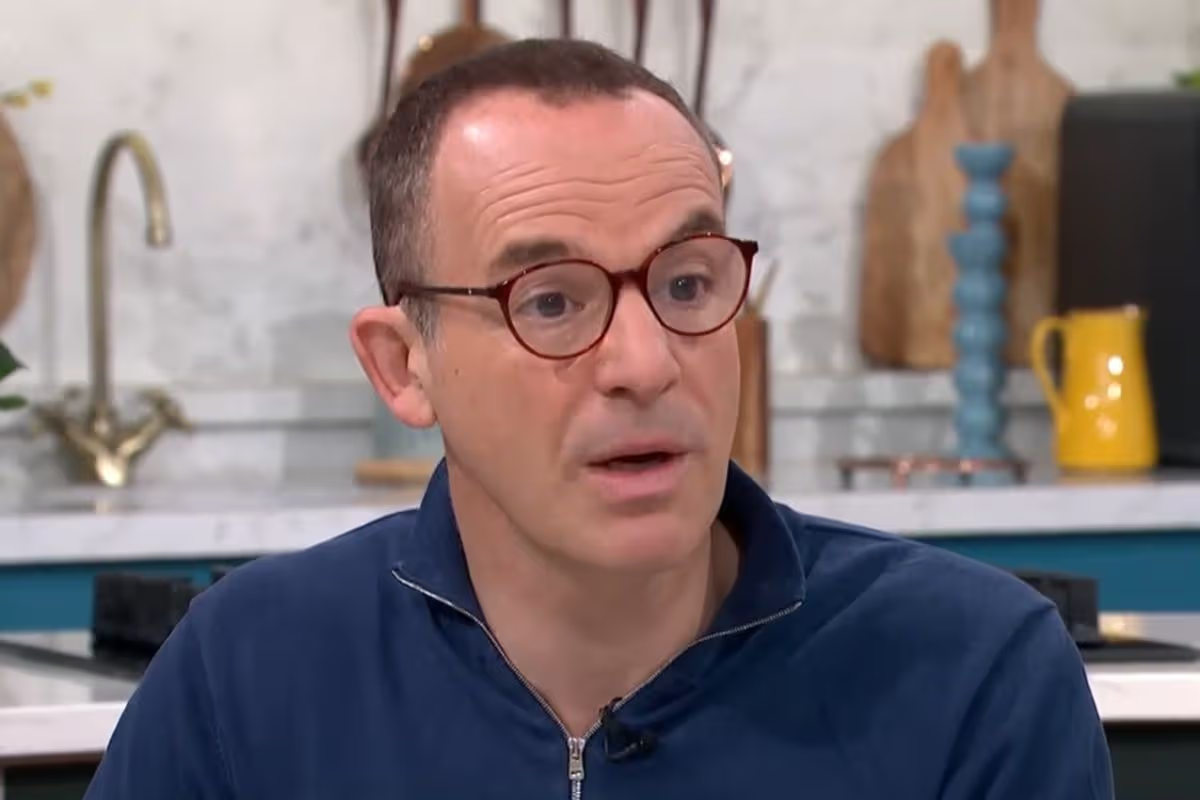
Martin Lewis has offered some advice on how you could organise your savings. He explained the practical tip amid the current uncertainty surrounding the economic impact of the Iran conflict.

The major war has already triggered a surge in oil prices, with fears of long-term consequences for food production and global economic growth.

Mr Lewis was questioned on his BBC podcast about whether now is an opportune moment to open a stocks and shares ISA, given that markets are struggling. When share prices fall, it can present a prime opportunity to invest, as your funds could increase in value when the market bounces back. But if prices decline further, the worth of your holdings could also drop. In response, Mr Lewis outlined the general principle to bear in mind.

He said: “If you’re talking about investing for a long term money that you don’t need for five years and you’re going to do that in a nice spread of investments, like a global tracker fund or an S&P tracker or FTSE tracker, then you just have to accept that you will never know when the perfect time to put money in is.”

£1,000 savings tactic

Nevertheless, he did reveal one strategy you could use to reduce the risk posed by market volatility. Mr Lewis said: “Let’s just imagine you’re putting £10,000 in a stocks and shares ISA, and you’re putting it away for a long time.

“You could put £10,000 in now but you could arrange with the provider that it sits in its cash part. You can hold it in cash, within a stocks and shares ISA, for the moment.

“You could say I’ve got £10,000, over the next 10 months, I’d like you to buy £1,000 a month of that tracker fund that I’m putting my investment into. It’s called pound-cost averaging.

“Because you’re drip feeding the money in, that helps smooth out the short-term volatility of buying at the right moment. So if you’re worried about that volatility, you might want to adopt that tactic.”

Mr Lewis continued in saying that in reality nobody can predict the optimal time to invest. He said: “They are unknowable in the short term, but in a broad spread of investment over the long term, on the balance of probabilities, investing will outperform saving.

“So don’t let the volatility put you off, but you might want to spread the time that you’re putting the money in.”

Major changes to ISA allowances

Savers may also want to note that major changes to ISA allowances are on the horizon. Currently, you can deposit up to £20,000 each tax year, which can be divided as you wish between cash ISAs and stocks and shares ISAs.

From April 2027, you will only be permitted to save up to £12,000 as you choose. The remaining £8,000 will only be available for deposits into investment-based accounts.

Savers aged 65 and over will be exempt from the new regulations, retaining the existing £20,000 allowance. ISAs are entirely tax-free, with no tax liability on any interest earnings or investment gains within these accounts.

Source link

Oil prices fall as renewed hopes for peace talks feed a stock market rally

European stocks were mostly steady on Wednesday as investors weighed signals from Washington that a diplomatic breakthrough in the Iran war could be imminent.


ADVERTISEMENT


ADVERTISEMENT

The pan-European Stoxx 600 had ticked down 0.1%, Germany’s Dax edged 0.11% higher and the FTSE 100 climbed 0.11%. The CAC 40 in France fell by a slightly greater margin, at 0.65%.

US President Donald Trump said fresh talks between Washington and Tehran “could be happening over the next two days” in Islamabad, signalling a possible diplomatic breakthrough, and added that the war was “very close to over” — despite continued uncertainty over key sticking points in negotiations.

Asian markets were broadly higher.

Japan’s Nikkei 225 gained 0.5%, South Korea’s Kospi jumped 3.0% and Hong Kong’s Hang Seng edged up 0.7%.

The Shanghai Composite added 0.2%, while Australia’s S&P/ASX 200 was little changed, up less than 0.1%.

On Wall Street, the S&P 500 added 1.2% to its gains from the previous day, and the index at the heart of many 401(k) accounts is now just 0.2% below its record set in January.

The Dow Jones Industrial Average rose 317 points, or 0.7%, while the Nasdaq Composite climbed 2%.

On Wednesday, benchmark US crude inched up by 1 cent to $91.29 a barrel.

Brent crude added 48 cents to $95.27, or less than 1%, after falling 4.6% the previous day. While that is still above its roughly $70 level from before the war began in late February, it remains well below the peak of $119.

Lower oil prices help reduce costs for businesses across the economy. However, some analysts noted that the war is still ongoing, warning that the optimism may prove unfounded.

“The counterintuitive decline in crude appears driven by growing hopes that a second round of peace talks between Washington and Tehran could soon materialise, after the first attempt fizzled out,” said Tim Waterer, chief market analyst at KCM Trade.

“Traders are clearly choosing to price in the possibility of de-escalation rather than the immediate reality of restricted flows,” he added.

Asian nations depend on access to the Strait of Hormuz, a narrow waterway that is the main route for crude oil produced in the Persian Gulf to reach customers worldwide. Disruptions there have kept oil off the global market, driving up prices.

Global inflation this year is expected to accelerate to 4.4% from 4.1% in 2025, according to the International Monetary Fund, which had previously forecast a slowdown to 3.8%.

The IMF also downgraded its forecast for global economic growth to 3.1% this year, from 3.3% projected in January.

Overall, the S&P 500 rose 81.14 points to 6,967.38. The Dow Jones Industrial Average gained 317.74 points to 48,535.99, while the Nasdaq Composite climbed 455.35 points to 23,639.08.

In the bond market, Treasury yields eased as falling oil prices reduced inflationary pressure. The yield on the 10-year Treasury fell to 4.25% from 4.30% late Monday.

In currency trading, the US dollar edged up to 159.03 Japanese yen from 158.79 yen. The euro stood at $1.1780, down from $1.1797.

US stocks climbed to the brink of a record high on Tuesday, while oil prices eased as hopes grew that Washington and Tehran may resume talks to end their war.

The S&P 500 rose 1.2%, leaving it just 0.2% below its January peak. The Dow Jones Industrial Average gained 0.7%, while the Nasdaq Composite jumped 2%, tracking broader global market gains.

Investors are betting that renewed diplomacy could prevent a prolonged surge in oil prices and inflation, allowing focus to return to corporate earnings.

Brent crude for June delivery fell 4.6% to $94.79, down from recent highs, though still above pre-war levels.

However, volatility remains high, with markets sensitive to developments around the Strait of Hormuz, a key route for global oil supply.

Source link