officer

Florida congressman assaulted at party during Sundance Film Festival

Utah police arrested a man accused of assaulting a Florida congressman this weekend at a Sundance Film Festival after the man allegedly hurled racist comments to several patrons of a Creative Artists Agency party.

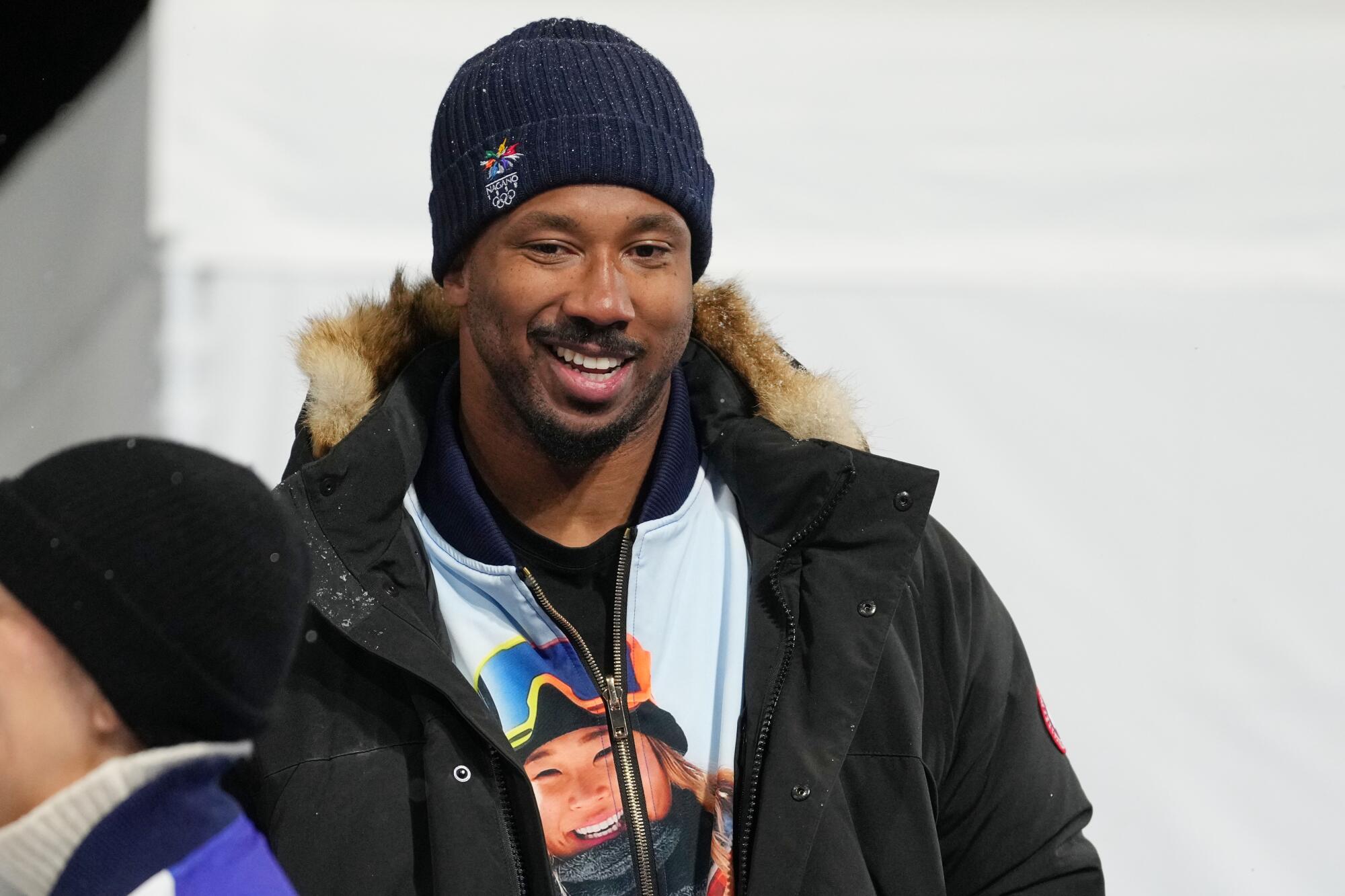
Rep. Maxwell Alejandro Frost (D-Florida) posted on X that he was “okay” after being slugged by the man, identified by police as 28-year-old Christian Young.

“I was assaulted by a man at Sundance Festival who told me that Trump was going to deport me before he punched me in the face,” Frost wrote Saturday in an X post. “He was heard screaming racist remarks as he drunkenly ran off. The individual was arrested.”

Frost, 29, has the distinction of being the first member of Gen Z elected to U.S. Congress. Born in Orlando, Frost is in his second term representing a Central Florida district. He is Afro-Latino.

On his website, Frost noted his “diverse heritage with roots in Puerto Rican, Lebanese, and Haitian ancestry.” He was adopted at birth “by a Kansas-born musician-producer and … a special education teacher who immigrated to the US from Cuba as a child in the 1960s.”

A person who was at the party told The Times that the suspect crashed the party and said “offensive things” to several partygoers, including in the men’s restroom, before allegedly assaulting the congressman.

Security personnel removed the suspect from the venue, the source said. Police quickly arrived.

Park City Police Lt. Danielle Snelson said that officers responded to a report of an assault just after midnight at the High West Saloon on Park Avenue — the location of the Friday night party hosted by CAA.

“Upon arrival, officers conducted an investigation and determined that Christian Young unlawfully entered a private party after previously being turned away for not having an invitation,” Snelson wrote in an email. “Once inside the saloon, Young assaulted Florida Congressman Maxwell Frost and a female who was attending the private event.”

Frost’s companion was not identified.

After the incident, the congressman was seen speaking with Park City police officers outside the restaurant. In his X post, Frost wrote: “Thank you to the venue security and Park City PD for assistance on this incident.”

The suspect was arrested and booked into Utah’s Summit County Jail on charges of aggravated burglary and two counts of simple assault.

Axios reported that County Judge Richard Mrazik ordered Young to be held without bail because of “convincing evidence” that he may flee the area and “would constitute a substantial danger” to the community.

“I am horrified by the attack on Congressman Maxwell Frost. Grateful that he is okay, but appalled that this terrifying assault took place,” Democratic House Leader Hakeem Jeffries wrote on X. “The perpetrator must be aggressively prosecuted. Hate and political violence has no place in our country.”

The altercation occurred several hours before the deadly shooting of an ICU nurse in Minneapolis by a federal agent with Immigration and Customs Enforcement. The Saturday shooting has sparked widespread outrage. It was the third shooting in Minneapolis by ICE officers in the last three weeks, Minneapolis Police Chief Brian O’Hara told CBS News.

On Sunday, a small group of about a dozen anti-ICE protesters walked up Park City’s Main Street, urging festival attendees to join them.

Staff writer Samantha Masunaga contributed to this report.

Source link

Protesters demand immigration agents leave Minneapolis after fatal shooting

Democrats demanded federal immigration officers leave Minnesota after a U.S. Border Patrol agent fatally shot a man in Minneapolis and set off clashes with protesters who poured into the frigid streets in a city already shaken by another shooting death weeks earlier.

The latest shooting also sparked a legal fight over control of the investigation and renewed calls by state and city officials for an end to the immigration surge that has swept across Minneapolis and surrounding cities.

Federal officials say agents fired defensively Saturday morning when Alex Pretti, a 37-year-old intensive care unit nurse, stepped into a confrontation between an immigration officer and a woman on the street. Officials say Pretti was armed, but no bystander videos appear to show him holding a weapon; he appears to be holding a phone. The Minneapolis police chief said Pretti had a permit to carry a gun.

Pretti’s family said they were “heartbroken but also very angry” at authorities, saying in a statement that Pretti awas kindhearted soul who wanted to make a difference in the world.

A federal judge has already issued an order blocking the Trump administration from “destroying or altering evidence” related to the shooting, after state and county officials sued.

Minnesota Atty. Gen. Keith Ellison said the lawsuit filed Saturday is meant to preserve evidence collected by federal officials that state authorities have not yet been able to inspect. A court hearing is scheduled for Monday in federal court in St. Paul.

“A full, impartial, and transparent investigation into his fatal shooting at the hands of DHS agents is nonnegotiable,” Ellison said in a statement.

Spokespersons for the Justice Department and the Department of Homeland Security, which are named in the lawsuit, did not immediately respond to an email seeking comment Sunday.

Another federal judge previously ruled that officers participating in the federal immigration enforcement surge in Minnesota cannot detain or tear-gas peaceful protesters who are not obstructing authorities, though an appeals court temporarily suspended that ruling days before Saturday’s shooting.

The Minnesota National Guard was assisting local police at the direction of Gov. Tim Walz, officials said, with troops sent to both the shooting site and a federal building where officers have squared off daily with demonstrators.

Homeland Security Secretary Kristi Noem said during a news conference Saturday that Pretti showed up to “impede a law enforcement operation.” She questioned why he was armed but did not offer details about whether Pretti drew the weapon or brandished it at officers.

Gun rights groups have noted it’s legal to carry firearms during protests.

“Every peaceable Minnesotan has the right to keep and bear arms — including while attending protests, acting as observers, or exercising their First Amendment rights,” the Minnesota Gun Owners Caucus said in a statement. “These rights do not disappear when someone is lawfully armed.”

Trump blames Democrats

The Republican president weighed in on social media Saturday by lashing out at Walz and Minneapolis Mayor Jacob Frey.

He shared images of the gun that immigration officials said was recovered and said: “What is that all about? Where are the local Police? Why weren’t they allowed to protect ICE Officers?”

Trump said the Democratic governor and mayor “are inciting Insurrection, with their pompous, dangerous, and arrogant rhetoric.”

Rep. Alexandria Ocasio-Cortez of New York was among several Democratic lawmakers demanding that federal immigration authorities leave Minnesota. She also urged Democrats to refuse to vote to fund U.S. Immigration and Customs Enforcement, saying via social media: “We have a responsibility to protect Americans from tyranny.”

Senate Democratic leader Chuck Schumer of New York later said that Democrats will not vote for a spending package that includes money for DHS, which oversees ICE. Schumer’s statement increases the possibility that the government could partially shut down Jan. 30 when funding runs out.

Pretti was shot just over a mile from where an ICE officer killed 37-year-old Renee Nicole Good on Jan. 7, sparking widespread protests.

Pretti’s family was furious at federal officials’ description of the shooting.

“The sickening lies told about our son by the administration are reprehensible and disgusting. Alex is clearly not holding a gun when attacked by Trump’s murdering and cowardly ICE thugs. He has his phone in his right hand and his empty left hand is raised above his head while trying to protect the woman ICE just pushed down all while being pepper sprayed,” the family statement said. “Please get the truth out about our son. He was a good man.”

Video shows officers, man who was shot

When the Saturday confrontation began, bystander video shows protesters blowing whistles and shouting profanities at federal officers on a commercial street in south Minneapolis.

The videos show Pretti stepping in after an immigration officer shoves a woman. Pretti appears to be holding his phone toward the officer, but there’s no sign he’s holding a weapon.

The officer shoves Pretti in his chest, and pepper-sprays him and the woman.

Soon, at least seven officers are forcing Pretti to the ground. Several officers try to bring the man’s arms behind his back as he struggles against them. An officer holding a tear-gas canister strikes him on or near his head several times.

A shot is heard, but with officers surrounding the man, it’s not clear where it came from. Multiple officers back off. More shots are heard. Officers back away, and the man lies motionless on the street.

Gregory Bovino, the Border Patrol commander leading Trump’s crackdown, was repeatedly pressed on CNN’s Sunday “State of the Union” for evidence that Pretti did anything illegal or assaulted law enforcement, as officials have claimed.

Bovino said it was “very evident” that Pretti was not following the officers’ orders.

“It’s too bad the consequences had to be paid because he injected himself into that crime scene,” he said. “He made the decision.”

Walz said Saturday that he had no confidence in federal officials and that the state would lead the investigation into the shooting.

Drew Evans, superintendent of the Minnesota Bureau of Criminal Apprehension, said during a news conference Saturday that federal officers blocked his agency from the scene even after it obtained a signed judicial warrant.

Protests continue

Demonstrations broke out in several cities across the country, including New York, Washington and Los Angeles.

In Minneapolis, protesters converged at the scene of the shooting Saturday despite dangerously cold weather, with temperatures around minus-6 degrees.

An angry crowd gathered after the shooting and screamed profanities at federal officers, calling them “cowards” and telling them to go home. Protesters dragged garbage bins from alleyways to block streets, and people chanted “ICE out now” and “Observing ICE is not a crime.”

As darkness fell, hundreds of people mourned quietly by a growing memorial at the site of the shooting. A doughnut shop and a clothing store nearby stayed open, offering protesters a warm place as well as water, coffee and snacks.

Caleb Spike said he came from a nearby suburb to show his support and his frustration. “It feels like every day something crazier happens,” he said. “What’s happening in our community is wrong, it’s sickening, it’s disgusting.”

Raza, Brook and Karnowski write for the Associated Press. AP writers Giovanna Dell’Orto and Tim Sullivan in Minnesota, Rebecca Santanta in Washington and Jim Mustian in New York contributed this report.

Source link

Political schism seen in reaction to videos showing deadly Minneapolis shooting

Videos quickly emerged Saturday showing the fatal shooting of a Minneapolis protester by federal immigration agents, with Democratic leaders in Minnesota saying the footage showed the deadly encounter was the result of untrained federal officers overreacting and the Trump administration saying the man provoked the violence.

It was the second fatal shooting in Minneapolis by federal immigration authorities this month. The killing of Renee Nicole Good on Jan. 7 also was captured on videos and produced a similar schism among political leaders.

At around 9 a.m. on Saturday, federal agents patrolling Minneapolis killed 37-year-old Alex Pretti after a roughly 30-second scuffle. The Trump administration said shots were fired “defensively” against Pretti, who federal authorities said had a semiautomatic handgun and was “violently” resisting officers.

Minneapolis Mayor Jacob Frey, who said he watched one of several videos, said he saw “more than six masked agents pummeling one of our constituents, shooting him to death.” Frey has said Minneapolis and St. Paul are being “invaded” by the administration’s largest immigration crackdown, dubbed Operation Metro Surge.

Homeland Security Secretary Kristi Noem said Pretti attacked officers, and Customs and Border Patrol Cmdr. Gregory Bovino said Pretti wanted to do “maximum damage and massacre law enforcement.” In posts on X, President Trump’s Deputy Chief of Staff Stephen Miller called Pretti “a would-be assassin.”

The shooting Saturday occurred as officers were pursuing a man in the country illegally wanted for domestic assault, Bovino said. Protesters routinely try to disrupt such operations, and they sounded their high-pitched whistles, honked horns and yelled out at the officers.

Among them was Pretti. At one point, in a video obtained by the Associated Press, Pretti is standing in the street and holding up his phone. He is face-to-face with an officer in a tactical vest, who places his hand on Pretti and pushes him toward the sidewalk.

Pretti is talking to the officer, though it is not clear what he is saying.

The video shows protesters wandering in and out of the street as officers persist in trying to talk them back. One protester is put in handcuffs. Some officers are carrying pepper spray canisters.

Pretti is seen again when the video shows an officer wearing tactical gear shoving a protester. The protester, who is wearing a skirt over black tights and holding a water bottle, reaches out for Pretti.

The same officer shoves Pretti in his chest, leading Pretti and the other protester to stumble backward.

A different video then shows Pretti moving toward another protester, who falls over after being shoved by the same officer. Pretti moves between the protester and the officer, reaching his arms out toward the officer. The officer deploys pepper spray, and Pretti raises his hand and turns his face. The officer grabs Pretti’s hand to bring it behind his back, and deploys the pepper spray canister again and then pushes Pretti away.

Seconds later, at least half a dozen federal officers surround Pretti, who is wrestled to the ground and hit several times. Several agents try to bring Pretti’s arms behind his back, and he struggles.

Videos show an officer, who is hovering over the scuffle with his right hand on Pretti’s back, back away from the group with what appears to be a gun in his right hand just before the first shot is heard.

Someone shouts, “Gun, gun.” It is not clear whether that’s a reference to the weapon authorities say Pretti had.

And then the first shot is heard.

Videos do not clearly show who fired the first shot. In one video, seconds before that shot, one officer reaches for his belt and appears to draw his gun. The same officer is seen with a gun to Pretti’s back as three more shots ring out. Pretti slumps to the ground. Videos show the officers backing away, some with guns drawn. More shots are fired.

The Department of Homeland Security said Pretti was shot after he “approached” Border Patrol officers with a 9-millimeter semiautomatic handgun. Officials did not say whether Pretti, who is licensed to carry a concealed weapon, brandished the gun or kept it hidden.

An agency statement said officers fired “defensive shots” after Pretti “violently resisted” officers trying to disarm him.

Minnesota Gov. Tim Walz expressed dismay at the characterization.

“I’ve seen the videos, from several angles, and it’s sickening,” he said.

Trump weighed in on social media by lashing out at Walz and Frey. He shared images of the gun that immigration officials said was recovered from Pretti and said “What is that all about? Where are the local Police? Why weren’t they allowed to protect ICE Officers?”

Fingerhut writes for the Associated Press.

Source link

Immigration officers assert sweeping power to enter homes without a judge’s warrant, memo says

Federal immigration officers are asserting sweeping power to forcibly enter people’s homes without a judge’s warrant, according to an internal Immigration and Customs Enforcement memo obtained by the Associated Press, marking a sharp reversal of longstanding guidance meant to respect constitutional limits on government searches.

The memo authorizes ICE officers to use force to enter a residence based solely on a more narrow administrative warrant to arrest someone with a final order of removal, a move that advocates say collides with 4th Amendment protections and upends years of advice given to immigrant communities.

The shift comes as the Trump administration dramatically expands immigration arrests nationwide, deploying thousands of officers under a mass deportation campaign that is already reshaping enforcement tactics in cities such as Minneapolis.

For years, immigrant advocates, legal aid groups and local governments have urged people not to open their doors to immigration agents unless they are shown a warrant signed by a judge. That guidance is rooted in Supreme Court rulings that generally prohibit law enforcement from entering a home without judicial approval. The ICE directive directly undercuts that advice at a time when arrests are accelerating under the administration’s immigration crackdown.

The memo itself has not been widely shared within the agency, according to a whistleblower complaint, but its contents have been used to train new ICE officers who are being deployed into cities and towns to implement the president’s immigration crackdown. New ICE hires and those still in training are being told to follow the memo’s guidance instead of written training materials that actually contradict the memo, according to the whistleblower disclosure.

It is unclear how broadly the directive has been applied in immigration enforcement operations. The Associated Press witnessed ICE officers ramming through the front door of the home of a Liberian man, Garrison Gibson, with a deportation order from 2023 in Minneapolis on Jan. 11, wearing heavy tactical gear and with their rifles drawn.

Documents reviewed by the AP revealed that the agents only had an administrative warrant — meaning there was no judge who authorized the raid on private property.

The change is almost certain to meet legal challenges and stiff criticism from advocacy groups and immigrant-friendly state and local governments that have spent years successfully urging people not to open their doors unless ICE shows them a warrant signed by a judge.

The Associated Press obtained the memo and whistleblower complaint from an official in Congress, who shared it on condition of anonymity to discuss sensitive documents. The AP verified the authenticity of the accounts in the complaint.

The memo, signed by the acting director of ICE, Todd Lyons, and dated May 12, 2025, says: “Although the U.S. Department of Homeland Security (DHS) has not historically relied on administrative warrants alone to arrest aliens subject to final orders of removal in their place of residence, the DHS Office of the General Counsel has recently determined that the U.S. Constitution, the Immigration and Nationality Act, and the immigration regulations do not prohibit relying on administrative warrants for this purpose.”

The memo does not detail how that determination was made nor what its legal repercussions might be.

Homeland Security spokeswoman Tricia McLaughlin said in an emailed statement to the AP that everyone the department serves with an administrative warrant has already had “full due process and a final order of removal.”

She said the officers issuing those warrants have also found probable cause for the person’s arrest. She said the Supreme Court and Congress have “recognized the propriety of administrative warrants in cases of immigration enforcement,” without elaborating. McLaughlin did not respond to questions about whether ICE officers entered a person’s home since the memo was issued, relying solely on an administrative warrant and if so, how often.

Recent arrests shine a light on tactics

Whistleblower Aid, a nonprofit legal organization that assists workers exposing wrongdoings, said in the whistleblower complaint obtained by the Associated Press that it represents two anonymous U.S. government officials “disclosing a secretive — and seemingly unconstitutional — policy directive.”

A wave of recent high-profile arrests, many unfolding at private homes and businesses and captured on video, has placed a spotlight on immigration arrest tactics, including officers’ use of proper warrants.

Most immigration arrests are carried out under administrative warrants, internal documents issued by immigration authorities that authorize the arrest of a specific individual but do not permit officers to forcibly enter private homes or other non-public spaces without consent. Only warrants signed by judges carry that authority.

All law enforcement operations — including those conducted by ICE and Customs and Border Protection — are governed by the 4th Amendment of the Constitution, which protects all people in the country from unreasonable searches and seizures.

People can legally refuse federal immigration agents entry into private property if the agents only have an administrative warrant, with some limited exceptions.

Memo shown to ‘select’ officials

The memo says ICE officers can forcibly enter homes and arrest immigrants using just a signed administrative warrant known as an I-205 if they have a final order of removal issued by an immigration judge, the Board of Immigration Appeals or a district judge or magistrate judge.

The memo says officers must first knock on the door and share who they are and why they’re at the residence. They’re limited in the hours they can go into the home — after 6 a.m. and before 10 p.m. The people inside must be given a “reasonable chance to act lawfully.” But if that doesn’t work, the memo says, they can use force to go in.

“Should the alien refuse admittance, ICE officers and agents should use only a necessary and reasonable amount of force to enter the alien’s residence, following proper notification of the officer or agent’s authority and intent to enter,” the memo reads.

The memo is addressed to all ICE personnel. But it has been shown only to “select DHS officials” who then shared it with some employees who were told to read it and return it, Whistleblower Aid wrote in the disclosure.

One of the two whistleblowers was allowed to view the memo only in the presence of a supervisor and then had to give it back. That person was not allowed to take notes. A whistleblower was able to access the document and lawfully disclose it to Congress, Whistleblower Aid said.

Although the memo was issued in May, David Kligerman, senior vice president and special counsel at Whistleblower Aid, said it took time for its clients to find a “safe and legal path to disclose it to lawmakers and the American people.”

Santana writes for the Associated Press.

Source link

Austria’s biggest spy trial for decades puts ex-intelligence officer in the dock

Bethany BellVienna correspondent

Reuters A man with a black jacket and tie and dark hair and glasses stares at a cameraReuters

Egisto Ott is accused of collecting large amounts of data and handing information to Russian intelligence

Former intelligence official Egisto Ott goes on trial in Vienna on Thursday, accused of spying for Russia in what is being dubbed Austria’s biggest spy trial in years.

Egisto Ott, 63, is charged with having handed over information to Russian intelligence officers and to Jan Marsalek, the fugitive executive of collapsed German payments firm Wirecard.

Ott denies the charges.

Jan Marsalek, who is also an Austrian citizen, is wanted by German police for alleged fraud and is currently believed to be in Moscow, having fled via Austria in 2020.

The subject of an Interpol Red Notice, he is alleged to be an intelligence asset for the FSB, Russia’s secretive security service.

The spy scandal has revived fears that Austria remains a hotbed of Russian espionage activity and observers will also be watching closely for details that could emerge about Marsalek.

Prosecutors in Vienna say Egisto Ott “abused his authority” as an Austrian intelligence official by collecting large amounts of personal data, such as locations, vehicle registration numbers, or travel movements.

They say he did this between 2015 and 2020 without authorisation, often using national and international police databases.

Prosecutors also charge him with supporting “a secret intelligence service of the Russian Federation to the detriment of the Republic of Austria” by collecting secret facts and a large amount of personal data from police databases between 2017 and 2021.

They say Egisto Ott gave this information to Jan Marsalek and unknown representatives of the Russian intelligence service, and received payment in return.

In 2022, prosecutors say, Jan Marsalek commissioned him to obtain a laptop containing secret electronic security hardware used by EU states for secure electronic communication. The laptop, they say, was handed over to the Russian intelligence service.

He is also suspected, reports say, of having passed phone data from senior Austrian interior ministry officials to Russia.

Austria’s Standard newspaper says Egisto Ott apparently obtained the work phones after they accidentally fell into the River Danube on an interior ministry boating trip.

He is alleged to have copied their contents and passed them on to Jan Marsalek, and Moscow.

Egisto Ott is charged with abuse of authority and corruption and espionage against Austria and faces up to five years in prison, if he is found guilty.

When he was arrested in 2024, Austria’s then Chancellor, Karl Nehammer, described the case as “a threat to democracy and our country’s national security”.

Munich Police Munich police wanted poster for Jan MarsalekMunich Police

Jan Marsalek, former executive at Wirecard, is believed to have escaped to Moscow

In a separate development, prosecutors in the Austrian town of Wiener Neustadt have told the BBC that a former MP, Thomas Schellenbacher, has been charged with helping Marsalek to escape following the collapse of the Wirecard company in 2020, when it emerged that €1.9bn was missing from its accounts.

Schellenbacher is alleged to have helped Jan Marsalek fly to Belarus, from Bad Vöslau in Austria, in June 2020.

Schellenbacher was an MP for the far-right Freedom Party (FPÖ), which has been accused by Austria’s Green Party, now in opposition, of enabling Russian espionage, of acting as “an extension of Russia’s arm” in Austria.

The FPÖ and its leader Herbert Kickl have denied the allegations – and have not faced any legal action in connection with any of them.

Marsalek, who was the Wirecard’s Chief Operating Officer, has since been charged with fraud and embezzlement, suspected of having inflated company’s balance sheet total and sales volume.

He is also believed to have been the controller of a group of Bulgarians who were convicted in London in 2025, of spying for Russia.

Messages from that trial reveal Marsalek has had plastic surgery to alter his appearance as well as details of his life as a fugitive.

“I’m off to bed. Had another cosmetic surgery, trying to look differently, and I am dead tired and my head hurts,” he wrote to one of the Bulgarians, Roussev, on Telegram in February 2022.

In another, dated 11 May 2021, Roussev congratulated Marsalek for learning Russian.

“Well I am trying to improve my skills on a few fronts. Languages is one of them,” the Austrian responded.

“In my new role as an international fugitive I must outperform James Bond.”

Source link

Jury finds ex-police officer not guilty of endangering students in Uvalde school shooting

Jan. 21 (UPI) — A Texas jury on Wednesday found former school police officer Adrian Gonzales not guilty of felony charges accusing him of endangering children during the 2022 mass shooting at Uvalde’s Robb Elementary School that killed 19 students and two teachers.

Following seven hours of deliberations that capped off a two-week trial, the jury returned to the courtroom in Corpus Christi, Texas, Wednesday evening, when presiding Judge Sid Harle read its unanimous verdict that Gonzales was found not guilty on all charges.

Gonzales, 52, was facing 29 felony charges, one for each of the 19 fourth-grade students killed and 10 students wounded in the May 24, 2022, shooting.

Wearing a blue suit, Gonzales received the verdict while standing between two members of his defense counsel, one of whom placed a hand on the right shoulder of Gonzales, who bowed his head upon receiving the judge’s words.

Some members of the victims’ families who were in the courtroom cried, wiping eyes and noses with tissues, but remained silent on hearing the verdict.

On the morning of May 24, 2022, 18-year-old Salvador Rolando Ramos entered his former Robb Elementary School with an AR-15-style rifle and opened fire.

Ramos was in the school for 77 minutes before the nearly 400 officers who responded engaged Ramos, who was shot dead at the scene.

The prosecution during the trial argued that Gonzales failed to protect the students and failed to confront the gunman despite a witness having alerted him to Ramos’ location before he entered two connected classrooms.

The defense, however, successfully countered that Gonzales did what he could under the circumstances and with the information he had, arguing that he had rushed into the building after arriving on the scene, but retreated with other officers once the bullets rang out.

Nico LaHood, the primary defense attorney for Gonzales, told reporters following the verdict that the jury found gaps in the prosecution’s evidence.

“We felt Adrian was innocent from the beginning when we analyzed the situation,” he said. “We knew it was going to be a challenging case because of the emotions, the sheer emotions behind it and those precious babies being taken from those families.”

During closing arguments, special prosecutor Bill Turner told the jury that Gonzales did not follow his training, failing to engage Ramos until after children were being shot.

“If you have a duty to act, you can’t stand by while the child is in imminent danger,” he said. “If you have a duty to protect the child, you can’t stand by and allow it to happen.”

He then compared Gonzales to teachers who tried to protect students, saying they put the children first and students who tried to protect one another.

“Adrian Gonzales had a duty to put the kids first,” he said.

LaHood, in his closing arguments, told jurors that Gonzales “drove into danger” and did more than other Uvalde police officers to protect the children.

Convicting Gonzales, he argued, would inform police officers whether and ho to react to future similar situations.

“What you tell police officers is, ‘Don’t go in. Don’t react. Don’t respond,'” he said.

Gonzales is one of two former Uvalde police officers facing charges in connection to the mass shooting.

Pete Arredondo, the former Uvalde School District police chief, is facing 10 counts of child endangerment. His trial has yet to be scheduled.

Mourners gather at a memorial of flowers at Robb Elementary School in Uvalde, Texas, on May 30, 2022. A mass shooting days before left 19 children and two adults dead at the elementary school. Photo by Jon Farina/UPI | License Photo

Source link

Doctors in Minnesota decry fear and chaos amid Trump administration’s immigration crackdown

There was the pregnant woman who missed her medical checkup, afraid to visit a clinic during the Trump administration’s sweeping Minnesotaimmigration crackdown. A nurse found her at home, already in labor and just about to give birth.

There was the patient with kidney cancer who vanished without his medicine in immigration detention facilities. It took legal intervention for his medicine to be sent to him, though doctors are unsure if he’s been able to take it.

There was the diabetic afraid to pick up insulin, the patient with a treatable wound that festered and required a trip to the intensive care unit, and the hospital staffers — from Latin America, Somalia, Myanmar and elsewhere — too scared to come to work.

“Our places of healing are under siege,” Dr. Roli Dwivedi, past president of the Minnesota Academy of Family Physicians, said Tuesday at a state Capitol news conference in St. Paul, where doctor after doctor told of patients suffering amid the clampdown.

For years, hospitals, schools and churches had been off-limits for immigration enforcement.

But a year ago, the Trump administration announced that federal immigration agencies could now make arrests in those facilities, ending a policy that had been in effect since 2011.

“I have been a practicing physician for more than 19 years here in Minnesota, and I have never seen this level of chaos and fear,” including at the height of the COVID-19 crisis, Dwivedi said.

The crackdown, which began late last year, surged to unprecedented levels in January when the Department of Homeland Security said it would send 2,000 federal agents and officers to the Minneapolis area in what it called the largest-ever immigration enforcement operation.

More than 3,000 people in the country illegally had been arrested during what it dubbed Operation Metro Surge, the government said in a Monday court filing.

“Our patients are missing,” with pregnant women missing out on key prenatal care, said Dr. Erin Stevens, legislative chair for the Minnesota section of the American College of Obstetricians and Gynecologists. Requests for home births have also increased significantly, “even among patients who have never previously considered this or for whom, it is not a safe option,” Stevens said.

The surge in the deeply liberal Twin Cities has set off clashes between activists and immigration officers, pitted city and state officials against the federal government, and left a mother of three dead, shot by an Immigration and Customs Enforcement officer in what federal officials said was an act of self-defense but that local officials described as reckless and unnecessary.

The Trump administration and Minnesota officials have traded blame for the heightened tensions.

The latest flare-up came Sunday, when protesters disrupted a service at a St. Paul church because one of its pastors leads the local ICE field office. Some walked right up to the pulpit at the Cities Church, with others loudly chanting “ICE out.”

The U.S. Department of Justice said it has opened a civil rights investigation into the church protest.

Sullivan writes for the Associated Press.

Source link

Kerry’s Lionizing Shift From Officer to Activist

The week he became an American household name, John F. Kerry carried his credentials pinned to his shirt pocket.

For five days in late April 1971, Kerry wore his battle ribbons on old combat fatigues as he led 1,000 disillusioned Vietnam veterans massed in Washington for a protest against the war they fought.

“Mr. Kerry, please move your microphone,” Sen. Stuart Symington (D-Mo.) prodded the 27-year-old former Navy lieutenant during a climactic appearance before the Senate Foreign Relations Committee. “You have a Silver Star, have you not?”

Solemn, gangling, hunched over a witness table, Kerry obliged, showing the cloth bars that stood for his Silver Star, Bronze Star and three Purple Hearts. Kerry’s pained plea — “How do you ask a man to be the last man to die for a mistake?” — stiffened congressional opposition to the war and made him a peace movement icon for giving voice to veterans weary of death without victory.

The embittered grunts called themselves “Winter Soldiers,” conjuring up Thomas Paine’s vision of a Colonial army of patriots. They dubbed their protest “Dewey Canyon III,” a play on the Nixon administration’s code for secret incursions into Laos. They flashed their decorations everywhere they went that week. Then, in a bitter farewell that still shadows Kerry’s career, he and his peace platoons tossed away honors.

Antiwar Turning Point

A signal moment in the slow fade of American support for the war, the 1971 protest by the Vietnam Veterans Against the War was Kerry’s entry point into public life. No other presidential aspirant of his generation won such early prominence or endured such microscopic scrutiny.

“I did what I thought was the right thing to save the lives of American soldiers,” Kerry said in a recent interview. “It wasn’t easy. I mean, I knew people would be critical, that there would be people who wouldn’t like it.”

Kerry’s two-year transformation — from disaffected patrol boat skipper home from Vietnam to an antiwar leader coming into his own at the Washington protest — sheds insight into the nuances of his character. His determined entry into the upper echelon of the peace movement was a daring high-wire act for a Yale graduate with no constituency beyond his own conscience and ambition.

Poised beyond his years, Kerry spoke out with wounded eloquence as the nation roiled over widening war and mounting American deaths. He faced risks in coming forward, singled out as a threat by no less than President Nixon and targeted by government and military spies in a covert surveillance campaign still coming to light today.

“The powers that be wanted to know what these guys were up to,” recalled John J. O’Connor, a D.C. policeman assigned to infiltrate the VVAW leadership. “They had their hotheads. Not Kerry. He was cool as 12-year-old Scotch.”

Kerry pressed his antiwar troops to work within the system, a moderate course he says is a lifelong inclination. But critics and admirers say his centrism reflected a striver’s calculation. Fellow protesters mocked his prudence and pressed khakis. Even then, they say, Kerry kept one eye cocked on his future, hedging his bets in careful maneuvering that became the hallmark of his political rise.

On the campaign trail, Kerry plays up his exploits as a patrol boat skipper to show his resolve. Yet he revisits his antiwar days warily, aware his old words and actions remain poisoned symbols. Vietnam veterans still rage over Kerry’s Senate speech, reviling him for his incendiary antiwar criticism and for citing unproven atrocities allegedly committed by U.S. troops.

“Going up to testify without confirmation was a slander on the Vietnam veteran,” said W. Hays Parks, a former Marine colonel who served as an infantry officer and military prosecutor in Vietnam.

Even as Dewey Canyon III ended with an admiring burst of media coverage, Kerry’s success was fissured with doubts. Fearing public recriminations, he urged the antiwar veterans to return their decorations in a muted ceremony. But they ignored him, instead flinging their honors away in an angry symbolic rejection of the war.

Massing in parade formation, 700 veterans wept, cheered and swore as they lobbed their decorations like grenades. When Kerry’s turn came, he muttered sorrowfully into a brace of microphones, then lofted his own ribbons.

“I knew I was going to throw them back, but I didn’t know how,” Kerry recalls. After the crowd dispersed, Kerry says, he discreetly tossed away two medals given to him by veterans who could not attend the event. The flinched denouement fed suspicions that Kerry had pretended the medals were his own — even as the renounced honors lay unclaimed for years, hidden away in a police storeroom.

Dewey Canyon III ended for Kerry as catharsis, “like throwing the war over the fence.” But his path to antiwar activism remains an exposed fault line for his generation, a progression Kerry has always insisted was seamless and unavoidable.

“I had to speak out,” he says. “I was compelled.”

Kerry had it relatively easy when he came home from the war in April 1969. He was an admiral’s aide in Brooklyn and had an apartment with his fiancee on Manhattan’s elegant upper East Side.

But Vietnam still gouged his world, erasing old friends. Two weeks after his return, Kerry learned of the ambush death of Don Droz, a fellow patrol boat commander who shared his doubts about the war. Droz’s death left him numb.

“That’s when I decided I really needed to kick into gear,” Kerry recalls.

He vented on paper, intent on composing “a letter to America.” At a Greenwich Village pub, Kerry raised the idea with columnist Pete Hamill, a friend of his sister’s. The letter sat unsent. “He felt he had something to give. It’s the sort of noblesse oblige that doesn’t resonate too much these days,” said close friend George Butler.

Kerry found an outlet piloting Adam Walinsky, a former speechwriter for Robert F. Kennedy, to upstate New York colleges for a lecture series against the war. Aloft in a bucking prop plane, the two men talked about Vietnam, politics and the Kennedys. For Kerry, the talk “crystallized in me that this was something we all needed to do.”

By January 1970, Kerry had left the Navy to run as an antiwar congressional candidate in Boston. Outflanked by the sudden entry of peace activist the Rev. Robert Drinan, Kerry pulled out, canny enough to know his aspirations for office needed a base.

The war kept drawing him back. Newly married and on honeymoon in France, Kerry detoured from his vacation to meet with South and North Vietnamese delegates to the Paris peace talks. How a 26-year-old private citizen without a political track record connected with the negotiators is unclear.

Through an aide, Kerry said he does not recall the details of the session — though he told the Senate in 1971 that negotiators for the communist North assured him that if the U.S. “set a date for withdrawal” from Vietnam, its “prisoners of war would be returned.”

A Veteran Voice

Speaking out against the war at college campuses and fundraisers, Kerry found his voice as an activist. His reputation reached leaders of the Vietnam Veterans Against the War, a group of dissident ex-GIs in New York. “He was just what we needed, the kind of guy who could stand in a room of angry vets and convince them to do something,” said Jan Barry, who founded the group in 1967.

Kerry found his chance in late January 1971. As VVAW members massed in a Detroit motel, Kerry asked to organize a march on Washington. By lobbying Congress and marching in front of cameras, Kerry felt, veterans might turn the tide against the war.

His reception was stormy. Many VVAW leaders, working-class grunts from the heartland, teed off on Kerry, suspicious of his officer’s rank and patrician aloofness. Radicals resented his blunt push for leadership. They finally gave their assent, but added a symbolic tweak of guerrilla theater — a mass return of their combat honors.

“We used each other,” explains Jack Mallory, a former Army captain from Virginia. “He was our front man. We were his stepping-stone to publicity.”

The veterans also were there to amass proof of U.S. war crimes in Vietnam. The “Winter Soldier” hearings were sparked by the 1968 My Lai massacre of 347 Vietnamese civilians.

Prodded by Kerry and other moderators, more than 150 vets filed into the dimly lighted motel hall, spilling horror tales. Bill Crandell, an Ohio infantry officer who led the hearings, described civilians gunned down in “free fire zones” — combat areas where soldiers killed at will. Former Marine Scott Camil detailed a torrent of murders and disembowelings — a grisly account he later gave under oath to the Navy.

Government’s Scrutiny

Media interest was fitful. But hidden among observers were undercover military agents. In 1973, Army investigators detailed the clandestine intelligence operation to Hays Parks, who taught war crimes law at the Army’s Judge Advocate General’s School.

The Army’s Criminal Investigation Division agents told Parks they confirmed some atrocity allegations, but also found that several VVAW members were impostors. The Army never released its findings, Parks said, but “there were enough questions to put the hearings in doubt.”

Unaware of the discrepancies, Kerry cited the “Winter Soldier” findings as fact to the Senate in 1971, comparing the alleged U.S. atrocities with the “ravage” of Mongol conqueror Genghis Khan.

Kerry’s testimony infuriated military lawyers, chief among them William Eckhardt, an Army colonel coordinating the My Lai prosecutions. Eckhardt, now a University of Missouri law professor, says Kerry’s reliance on unproven “show trial” allegations “besmirched those of us who did it right.”

Kerry concedes he “wouldn’t be surprised” if some “Winter Soldier” accounts were phony. But he stands by the bulk of the claims. “Free-fire zones, women getting blown away, children getting blown away, ears being cut off, rapes — people know this,” Kerry said. “These are a matter of record in our history.”

After Detroit, Kerry plunged into protest logistics. He hit the antiwar fundraising circuit, toting chocolate milk and entertaining VVAW members with broken-French imitations of Inspector Clouseau from “Pink Panther” films. In Washington, he laid plans with dissident congressmen and negotiated with federal officials for rally permits.

At battle stations after two years of war protests, Nixon and his aides were uncertain how to respond to angry soldiers. “Kerry was considered a threat,” said John Dean, White House counsel until he turned against Nixon during Watergate.

Nixon wanted the protest scuttled until Dean and speechwriter Patrick Buchanan warned that police violence against the veterans could backfire. Nixon relented, but pressed Charles Colson, his acerbic Special Counselor, for dirt on Kerry and other VVAW leaders. In an undated memo, “Plan to Counteract Vietnam Veterans,” Colson demanded their records scoured.

The FBI was already compiling dossiers. An FBI memo dated Feb. 22, 1971, later obtained by Camil, cited intelligence gathering on “Winter Soldier” participants from New York to Florida. And an FBI memo dated Jan. 25, 1971, found by Gerald Nicosia, a historian of the VVAW movement, reveals the bureau was sharing copies of surveillance reports with Army, Navy and Air Force intelligence before the Detroit meeting.

Kerry was under scrutiny even earlier. His name was forwarded to FBI headquarters in September 1970, Nicosia said. The FBI kept watch until August 1972, when the bureau concluded Kerry had no ties to “any violent-prone group” and closed his file.

Complaining recently that FBI spying was “an offense to the Constitution,” Kerry grimaced when he learned he was also monitored by Washington, D.C. police. O’Connor, the undercover agent who fit in so well with VVAW members that he rose to office manager, told his superiors that Kerry “was one of the top guys, a little elitist, but knows what he’s doing.”

Chartered buses filled with VVAW protesters rumbled toward Washington on Sunday, April 18, 1971. Massing in ragged ranks, more than 1,000 Vietnam veterans filed out the next morning to march across the Lincoln Memorial Bridge toward Arlington National Cemetery.

Fresh from an appearance on NBC’s “Meet the Press,” Kerry stood out among the rumpled, bearded veterans, marked by his shaggy hair and neatly pressed fatigues. At the cemetery, officials barred the gate. As the troops turned back, sullenly waving toy guns, someone raised a U.S. flag inverted in the “distress” position.

They pitched camp on the National Mall near the Capitol. Grimy from the bus trip, veterans grabbed showers at the YMCA and slept in bedrolls. Some grumbled that Kerry was not around at night. Settled in at the Georgetown townhouse of Butler’s mother-in-law, he told doubters he needed a place to field phone calls from congressmen and lawyers.

It was there that Kerry heard from an aide to Arkansas Sen. J. William Fulbright. Impressed by a talk he heard Kerry give at a cocktail party, Fulbright wanted him to appear before the Foreign Relations Committee.

‘Letter to America’

After a long day butting heads with VVAW radicals, Kerry bent over his old “letter to America.” Refined over months of fundraisers, it needed final touches. He phoned Walinsky for Kennedyesque pointers, then “sat up all night in the most uncomfortable chair in the house,” recalled Butler. When dawn broke, Kerry was still scribbling away in longhand.

Hurrying to the hearing room on the morning of April 22, Kerry passed scores of veterans pressing from the back of the hall and peeping from doorways. He launched into a grim catalog of the “winter soldier” atrocities, describing a deathscape of decapitations, torture and razed villages.

The U.S. had “created a monster,” Kerry warned — soldiers “given the chance to die for the biggest nothing in history.” He told of their anger, sense of betrayal and their hope that the nation might look back on Vietnam as a turning point “where soldiers like us helped it in the turning.”

“He had the guts to say wrong is wrong,” said Chris Gregory, a former Army medic who watched, mesmerized, wedged against a far wall. “It was brave. There was a price to be paid for talking like that.”

Kerry is still paying. For three decades, Vietnam veterans who supported the war have recoiled at his words. Robert Turner, an Army officer interrogating Vietcong defectors at the time in the war zone, recalls pulsing with rage as he read accounts of the speech. “He made us all look like monsters,” Turner says.

Kerry admits he “can wince sometimes” at “the language of an angry young man.” But he stands by his indictment of the war policy and its architects: “It was honest at the time and it’s honest today.” Conceding he is “sensitive” to the fury his old words evoke, Kerry says he tried even then to “distinguish the war from the warrior.”

But that day, Kerry left the Senate chamber an instant celebrity. Film clips played on the nightly news. They were impressed, too, at the White House. An Oval Office tape machine caught Chief of Staff H.R. Haldeman admitting that Kerry “did a hell of a great job.” Nixon seconded: “He was extremely effective.”

But Kerry still faced trouble over how to handle the protest’s parting gesture. Nervous about how the nation might perceive a mass turn-in of decorations, he urged VVAW leaders to lay their honors down with dignity on a table shrouded in white cloth. He was outvoted. The vets chose to heave their medals in protest, then turning them over to the sergeant-at-arms at the Capitol.

Kerry’s objections left VVAW officers convinced “he was out,” said Jack Smith, a former Marine who ran the event. At the White House, Colson dashed off a memo to Haldeman: “John Kerry is not participating — would be a total loss of all he has accomplished this week.”

He was swaying “between patriotism and protest,” recalls Kerry’s brother-in-law, David Thorne. But when protesters mustered for their last day of protest on the morning of April 23 — 33 years ago today — Kerry was still with them.

Overnight, police had erected a high wire fence around the Capitol, preventing the veterans from turning in their combat honors. Enraged, they decided to leave them behind.

For nearly two hours, the antiwar troops heaved medals, ribbons, berets, dog tags, and snapshots of dead comrades at a sign marked, “Trash.” Maimed vets threw their canes. One discarded an artificial leg. Some let loose with the medals of veterans who could not attend. And several now admit tossing medals offered by strangers.

As former Marine aviator Rusty Sachs prepared to throw his own decorations, someone handed him a Silver Star and a Distinguished Flying Cross. “What do I do with these things?” he recalls wondering. He thought of dead comrades, then pitched the medals away after a tear-strewn speech that many VVAW members describe as the event’s emotional highlight.

At the end of the long line, Kerry unfastened the ribbons he wore for a week. Nearing “dozens of cameras, countless people watching,” Kerry “took out the ribbon plate, pulled them off, said something — I do this sadly, or I do this with regret — and threw them over the fence.”

He waited until “after everybody and all the cameras dispersed.” Then, he took out two medals from his fatigue pocket and “threw the other things away.” Emotionally spent, weeping, he embraced his wife.

“He looked fractured,” recalls Chris Gregory.

The medals Kerry threw were not his own. One, he says, was offered from a patient in a Brooklyn VA hospital. The other was a Bronze Star handed over by a World War II veteran at a Massachusetts fundraiser — an incident also recalled by Gregory. Kerry never asked their names.

Myths of the Medals

Kerry says he never claimed to have thrown the medals as his own. But as his reputation grew as a shrewd political operator after his 1984 senate election, Kerry was dogged by a troubling political myth.

He was accused of discarding his ribbons and the medals of others in 1971 to appear as an antiwar hero, while keeping his own medals for use as political props years later — a charge echoing this election year.

“It’s so damn hypocritical to get these awards, throw them in the dirt and then suddenly value them again,” said B.G. Burkett, a Vietnam veteran and author who critiques Kerry’s antiwar stance.

“I never ever implied that I did it,” Kerry says wearily, adding: “You know what? Medals and ribbons, there’s almost no difference in distinction, fundamentally. They’re symbols of the same thing. They are what they are.”

The war honors abandoned by the “Winter Soldiers” sat for years in boxes shelved in the Capitol Police Department’s property room. The honors lay ignored for two decades, long after Kerry’s exit from the VVAW in late 1971 and his immersion into politics.

They remained hidden as the years passed, unclaimed by the protesters who bitterly flung them away, forgotten, too, by the war supporters who cherish them as symbols of valor.

Finally, police ran out of space. “Last thing I wanted to do was throw them away again,” said former Deputy Chief James Trollinger. But when aides approached him “sometime in the early 1990s,” asking for permission to remove the decorations, Trollinger reluctantly agreed.

Three boxes bulging with medals and ribbons were hauled away to a local forge, destined to be melted down as scrap.

Times Researcher John Beckham contributed to this report.

*

(BEGIN TEXT OF INFOBOX)

From military officer to antiwar activist

1966-1969: John F. Kerry enlists in the Navy in 1966, undergoes officer training and volunteers for duty in Vietnam. He serves there from November 1968 to April 1969, including 4 1/2 months as a swift-boat commander in the rivers of the Mekong Delta. After being wounded for third time, he is sent stateside.

April 11, 1969: Returning from the Vietnam War, Lt. j.g. Kerry is assigned as an admiral’s aide in Brooklyn.

Jan. 3, 1970: Kerry takes an honorable discharge from the Navy to run as a Democrat for a Massachusetts congressional seat, then withdraws from the race in February after the entry of the eventual winner, the Rev. Robert Drinan.

May 1970: On his honeymoon in France after marriage to Julia Thorne, Kerry meets as a private citizen with South and North Vietnamese delegates to the Paris Peace Talks.

September 1970: Kerry’s name is forwarded to FBI headquarters after speaking to Vietnam Veterans Against the War rally near Philadelphia. Agents covertly monitor Kerry’s activities until August 1972.

Jan. 31, 1971: Kerry attends VVAW’s “Winter Solider” meeting in Detroit, winning approval to organize an antiwar rally in Washington and participating as a moderator in hearings that raise claims of widespread American war crimes in Vietnam.

April 18, 1971: Kerry arrives in Washington to lead VVAW members in the “Dewey Canyon III” antiwar demonstration.

April 22, 1971: Kerry testifies before the Senate Foreign Relations Committee, criticizing the Nixon administration’s war policy and citing “Winter Soldier” war crimes claims.

April 23, 1971: As 700 VVAW protesters angrily throw away their war honors to condemn the war, Kerry joins in by discarding his combat ribbons and the medals given to him by others, but retains his Silver Star, Bronze Star and other medals awarded for Vietnam service.

Source: Times research

Los Angeles Times

Source link

In Twin Cities, immigration crackdown has made chaos the new normal

Work starts around sunrise for many federal officers carrying out the immigration crackdown in and around the Twin Cities, with hundreds of people in tactical gear emerging from a bland office building near the main airport.

Within minutes, hulking SUVs, pickup trucks and minivans begin leaving, forming the unmarked convoys that quickly have become feared and common sights in the streets of Minneapolis, St. Paul and their suburbs.

Protesters also arrive early, braving the cold to stand across the street from the fenced-in federal compound, which houses an immigration court and government offices. “Go home!” they shout as convoys roar past. “ICE out!”

Things often turn uglier after nightfall, when the convoys return and the protesters sometimes grow angrier, shaking fences and occasionally smacking passing cars. Eventually the federal officers march toward them, firing tear gas and flash grenades before hauling away at least a few people.

“We’re not going anywhere!” a woman shouted on a recent morning. “We’re here until you leave.”

This is the daily rhythm of Operation Metro Surge, the Trump administration’s latest and biggest crackdown yet, with more than 2,000 officers taking part. The surge has pitted city and state officials against the federal government, sparked daily clashes between activists and immigration officers in the deeply liberal cities, and left a mother of three dead.

The crackdown is barely noticeable in some areas, particularly in whiter, wealthier neighborhoods and suburbs, where convoys and tear gas are rare. And even in neighborhoods where masked immigration officers are common, they often move with ghost-like quickness, making arrests and disappearing before protesters can gather in force.

Still, the surge can be felt across broad swaths of the Twin Cities area, which is home to more than 3 million people.

“We don’t use the word ‘invasion’ lightly,” Minneapolis Mayor Jacob Frey, a Democrat, told reporters this week, noting that his police force has just 600 officers. “What we are seeing is thousands — plural, thousands — of federal agents coming into our city.”

Those agents have an outsize presence in a small city.

It can take hours to drive across Los Angeles or Chicago, both targets of Trump administration crackdowns. It can take 15 minutes to cross Minneapolis.

So as worry ripples through the region, children are skipping school or learning remotely, families are avoiding religious services, and many businesses, especially in immigrant neighborhoods, have closed temporarily.

Drive down Lake Street, an immigrant hub since the days when newcomers came to Minneapolis from Norway and Sweden, and the sidewalks seem crowded only with activists standing watch, ready to blow warning whistles at the first sign of a convoy.

At La Michoacana Purepecha, where customers can order ice cream, chocolate-covered bananas and pork rinds, the door is locked and staff lets in people one at a time. Nearby, at Taqueria Los Ocampo, a sign in English and Spanish says the restaurant is temporarily closed because of “current conditions.”

A dozen blocks away at the Karmel Mall, where the city’s large Somali community goes for everything from food and coffee to tax preparation, signs on the doors warn, “No ICE enter without court order.”

The shadow of George Floyd

It’s been nearly six years since George Floyd was murdered by a Minneapolis police officer, but the scars from that killing remain raw.

Floyd was killed just blocks from where an Immigration and Customs Enforcement officer shot and killed Renee Nicole Good, a 37-year-old American citizen, during a Jan. 7 confrontation after she stopped to help neighbors during an enforcement operation. Federal officials say the officer fired in self-defense after Good “weaponized” her vehicle. City and state officials dismiss those explanations and point to bystander videos of the confrontation, which show the officer shot her through her driver’s side window.

For Twin Cities residents, the crackdown can feel overwhelming.

“Enough is enough,” said Johan Baumeister, who came to the scene of Good’s death soon after the shooting to lay flowers.

He said he didn’t want to see the violent protests that shook Minneapolis after Floyd’s death, causing billions of dollars in damage. But this city has a long history of activism and protests, and he had no doubt there would be more.

“I think they’ll see Minneapolis show our rage again,” he predicted.

He was right. In the days since there have been repeated confrontations between activists and immigration officers. Most amounted to little more than shouted insults and taunting, with destruction mostly limited to broken windows, graffiti and some badly damaged federal vehicles.

But angry clashes flare regularly across the Twin Cities. Some protesters clearly want to provoke the federal officers, throwing snowballs at them or screaming obscenities through bullhorns from just a couple of feet away. The serious force, though, comes from immigration officers, who have broken car windows, pepper-sprayed protesters and warned observers not to follow them through the streets. Immigrants and citizens have been yanked from cars and homes and detained, sometimes for days. And most clashes end in tear gas.

Drivers in Minneapolis or St. Paul stumble across intersections blocked by men in body armor and gas masks, with helicopters clattering overhead and the air filled with the shriek of protesters’ whistles.

Shovel your neighbor’s walk

In a state that prides itself on decency, there’s something particularly Minnesotan about the protests.

Soon after Good was shot, Gov. Tim Walz, a Democrat and regular Trump target, repeatedly said he was angry but also urged people to find ways to help their communities.

“It might be shoveling your neighbor’s walk,” he said. “It might mean being at a food bank. It might be pausing to talk to someone you haven’t talked to before.”

He and other leaders pleaded with protesters to remain peaceful, warning that the White House was looking for a chance to crack down harder. And when protests become clashes, residents often spill from their homes, handing out bottled water so people can flush tear gas from their eyes.

Residents stand watch at schools to warn immigrant parents if convoys approach while they’re picking up their children. People take care packages to those too afraid to go out,and arrange rides for them to work and doctor visits.

On Thursday in the basement of a Lutheran church in St. Paul, the group Open Market MN assembled food packs for more than a hundred families staying home. Colin Anderson, the group’s outreach director, said the group has had a surge in requests.

Sometimes people don’t even understand what has happened to them.

Like Christian Molina from suburban Coon Rapids, who was driving through a Minneapolis neighborhood on a recent day, taking his car to a mechanic, when immigration officers began following him. He wonders if it’s because he looks Latino.

They turned on their siren, but Molina kept driving, unsure who they were.

Eventually the officers sped up, hit his rear bumper and both cars stopped. Two officers emerged and asked Molina for his papers. He refused, saying he’d wait for the police. Crowds began to gather, and a clash soon broke out, ending with tear gas.

So the officers left. They left behind an angry, worried man who suddenly owned a sedan with a mangled rear fender.

Long after the officers were gone, he had one final question.

“Who’s going to pay for my car?”

Sullivan writes for the Associated Press. AP writers Rebecca Santana and Giovanna Dell’Orto in Minneapolis and Hallie Golden in Seattle contributed to this report.

Source link

Trump threatens to use the Insurrection Act to end protests in Minneapolis

President Trump on Thursday threatened to invoke the Insurrection Act and deploy troops to quell persistent protests against the federal officers sent to Minneapolis to enforce his administration’s massive immigration crackdown.

The president’s threat comes a day after a federal immigration officer shot and wounded a Minneapolis man who had attacked the officer with a shovel and broom handle. That shooting further heightened the fear and anger radiating across the Minnesota city since an Immigration and Customs Enforcement agent fatally shot a Renee Good in the head.

Trump has repeatedly threatened to invoke the rarely used federal law to deploy the U.S. military or federalize the National Guard for domestic law enforcement, over the objections of state governors.

“If the corrupt politicians of Minnesota don’t obey the law and stop the professional agitators and insurrectionists from attacking the Patriots of I.C.E., who are only trying to do their job, I will institute the INSURRECTION ACT, which many Presidents have done before me, and quickly put an end to the travesty that is taking place in that once great State,” Trump said in social media post.

The Associated Press has reached out to the offices of Gov. Tim Walz and Minneapolis Mayor Jacob Frey for comment.

The Department of Homeland Security says it has made more than 2,000 arrests in the state since early December and is vowing to not back down. ICE is a DHS agency.

Protests, tear gas and another shooting

In Minneapolis, smoke filled the streets Wednesday night near the site of the latest shooting as federal officers wearing gas masks and helmets fired tear gas into a small crowd. Protesters responded by throwing rocks and shooting fireworks.

Police Chief Brian O’Hara said during a news conference that the gathering was an unlawful assembly and “people need to leave.”

Things later quietened down and by early Thursday only a few demonstrators and law enforcement officers remained at the scene.

Demonstrations have become common on the streets of Minneapolis since the ICE agent fatally shot 37-year-old Good on Jan. 7. Agents have yanked people from their cars and homes, and have been confronted by angry bystanders demanding that the officers pack up and leave.

“This is an impossible situation that our city is presently being put in and at the same time we are trying to find a way forward to keep people safe, to protect our neighbors, to maintain order,” Frey, the mayor, said.

Frey said the federal force — five times the size of the city’s 600-officer police force — has “invaded” Minneapolis, scaring and angering residents.

Shooting followed a chase

In a statement describing the events that led to Wednesday’s shooting, Homeland Security said federal law enforcement officers stopped a driver from Venezuela who is in the U.S. illegally. The person drove away and crashed into a parked car before taking off on foot, DHS said.

After officers reached the person, two other people arrived from a nearby apartment and all three started attacking the officer, according to DHS.

“Fearing for his life and safety as he was being ambushed by three individuals, the officer fired a defensive shot to defend his life,” DHS said.

The two people who came out of the apartment are in custody, it said.

O’Hara said the man shot was in the hospital with a non-life-threatening injury.

The shooting took place about 4.5 miles ( north of where Good was killed. O’Hara’s account of what happened largely echoed that of Homeland Security.

During a speech before the latest shooting, Walz described Minnesota as being in chaos, saying what’s happening in the state “defies belief.”

“Let’s be very, very clear, this long ago stopped being a matter of immigration enforcement,” he said. “Instead, it’s a campaign of organized brutality against the people of Minnesota by our own federal government.”

An official says the agent who killed Good was injured

Jonathan Ross, the Immigration and Customs Enforcement officer who killed Good, suffered internal bleeding to his torso during the encounter, a Homeland Security official told The Associated Press.

The official spoke to AP on condition of anonymity in order to discuss Ross’ medical condition. The official did not provide details about the severity of the injuries, and the agency did not respond to questions about the extent of the bleeding, exactly how he suffered the injury, when it was diagnosed or his medical treatment.

Good was killed after three ICE officers surrounded her SUV on a snowy street a few blocks from her home.

Bystander video shows one officer ordering Good to open the door and grabbing the handle. As the vehicle begins to move forward, Ross, standing in front, raises his weapon and fires at least three shots at close range. He steps back as the SUV advances and turns.

Homeland Security Secretary Kristi Noem has said Ross was struck by the vehicle and that Good was using her SUV as a weapon — a self-defense claim that has been criticized by Minnesota officials.

Chris Madel, an attorney for Ross, declined to comment.

Good’s family has hired the same law firm that represented George Floyd’s family in a $27 million settlement with Minneapolis. Floyd, who was Black, died after a white police officer pinned his neck to the ground in the street in May 2020.

Karnowski, Richer, Golden and Madhani write for the Associated Press. Madhani reported from Washington. AP reporters Bill Barrow in Atlanta; Julie Watson in San Diego; Rebecca Santana in Washington; Ed White in Detroit and Giovanna Dell’Orto in Minneapolis contributed to this report.

Source link

Trump Class Battleships Could Get Megawatt Lasers: Navy’s Top Officer

The U.S. Navy’s top officer wants directed energy weapons to become the go-to choice for the crews of American warships when faced with close-in threats. He also said that more powerful megawatt-class lasers should not be seen as “beyond” the capabilities that could be found on the future Trump class warships. The Navy has been a leader within the U.S. military in fielding laser weapons and is actively pursuing systems that employ high-power microwaves, but there continue to be significant hurdles to these efforts.

Chief of Naval Operations Adm. Daryl Caudle talked with TWZ and other outlets about his service’s directed energy weapon plans at a roundtable at the Surface Navy Association’s (SNA) annual symposium earlier today. Caudle has long been an outspoken proponent of directed energy capabilities.

Chief of Naval Operations Adm. Daryl Caudle, seen here speaking at an event in 2025. USN

“My thesis research at [the] Naval Post Graduate School was on directed energy and nuclear weapons,” Caudle said. “This is my goal, if it’s in line of sight of a ship, that the first solution that we’re using is directed energy.”

In particular, “point defense needs to shift to directed energy,” the admiral added. “It has an infinite magazine.”

When it comes to point defense for its ships, the Navy currently relies heavily on Mk 15 Phalanx Close-In Weapon Systems armed with six-barrel 20mm M61 Vulcan rotary cannons and launchers for RIM-116 Rolling Airframe Missiles (RAM). Each Phalanx has enough ammunition to fire for a total of around 30 seconds, at most at the lower of two rate-of-fire settings, before needing to be reloaded. RAM launchers available today can hold either 11 or 21 missiles at a time, and the latest versions of those missiles cost around $1 million each. Many ships across the Navy also have 5-inch or 57mm main guns, and/or 30mm automatic cannons, which can also be used against close-in threats.

Phalanx CIWS Close-in Weapon System In Action – US Navy’s Deadly Autocannon


USS Porter Conducts SeaRAM Test Fire


Recent Navy experience during operations in and around the Red Sea has underscored the value of magazine depth and concerns about expenditure rates of traditional munitions.

“What that does for me is it improves my loadout optimization, so that my loadout, my payload volume is optimized for offensive weapons,” Caudle said of adding new directed energy weapons, and lasers in particular. Furthermore, “as you increase power, the actual ability to actually engage and keep power on target, and the effectiveness of a laser just goes up.”

To date, the plurality of the Navy’s available shipboard directed energy weapon capabilities are split between two systems: the Optical Dazzling Interdictor (ODIN) and the High-Energy Laser with Integrated Optical Dazzler and Surveillance (HELIOS). ODIN and HELIOS systems are currently installed on a number of Arleigh Burke class destroyers.

HELIOS is a 60-kilowatt class design, which is powerful enough to destroy or at least damage certain targets, such as drones or small boats. Its beam can also be used as a ‘dazzler’ to blind optical sensors and seekers. Those same optics could be damaged or destroyed in the process, as well. Manufacturer Lockheed Martin has talked in the past about the possibility of scaling HELIOS’ power up to 150 kilowatts.

The Arleigh Burke class destroyer USS Preble seen testing its HELIOS system. US Military

The exact power-rating for ODIN is unclear, but it is understood to be lower than that of HELIOS. ODIN can only be employed as a ‘dazzler,’ though the system also has a secondary surveillance capability.

An ODIN system, seen here on the Arleigh Burke class destroyer USS Stockdale. USN

The Navy has tested more experimental laser directed energy weapons on other warships in the past. The most recent known example of this was the integration of a 150-kilowatt design called the Laser Weapon System Demonstrator (LWSD) Mk 2 Mod 0 onto the San Antonio class amphibious warfare ship USS Portland in 2019. The LWSD Mk 2 Mod 0 has since been removed from that ship. The Navy just released a picture yesterday showing it at the Naval Surface Warfare Center, Port Hueneme Division’s (NSWC PHD) Directed Energy Systems Integration Laboratory (DESIL) at Naval Base Ventura County at Point Mugu in California.

USS Portland (LPD 27) tests LWSD laser system


A picture of the LWSD Mk 2 Mod 0 at the Naval Surface Warfare Center, Port Hueneme Division’s (NSWC PHD) Directed Energy Systems Integration Laboratory (DESIL). This picture was released yesterday, but was taken in 2025. USN

Higher-powered laser directed energy weapons in the 300 to 600 kilowatt classes are also in the Navy’s publicly stated plans, with a focus on improving shipboard defense against incoming cruise missiles. The service has said that each one of the future Trump class large surface combatants could be armed with two 300-kilowatt lasers, as well as a pair of 600-kilowatt types, along with four ODINs. It’s also worth noting here that the Navy has not ruled out using nuclear propulsion on these ships, which could help meet power generation requirements. You can read more about what is known about the design of those ships here.

Details the Navy has previously released regarding the expected capabilities of the Trump class warships. USN via USNI News

“You know, we have continuous electron beam, free electron lasers today that can scale to megawatt-plus, gigawatt-plus” power-ratings, Caudle noted today. “I’m telling you that I don’t think a one-megawatt laser is beyond what should be on that battery [on the Trump class].”

A megawatt is 1,000 kilowatts, meaning a weapon in that category would be exponentially more powerful than HELIOS. A gigawatt is 1,000 megawatts. Megawatt-class laser weapon developments have historically focused in large part on the ballistic missile defense mission set.

“We were heavy into this with the Strategic Defense Initiative,” Caudle said, referring to the abortive Cold War-era missile defense program, also nicknamed “Star Wars,” which began under President Ronald Reagan. “We were really into high powered lasers, and we just basically – there was no business case for people to be out there working [on it] … so I don’t think we devoted the actual industrial might and the brain power across academia and think tanks and other places that generate this type of outcome toward directed energy in an effective way, so that we have taken it seriously. So now’s the time.”

Artwork depicting a space-based directed energy capability as part of the Strategic Defense Initiative. US Military

“We’ve got to have different lasers, I think, going forward on the battleship to make them effective,” the Navy’s top officer added. “Laser power is not the issue. It’s the form factor. It’s the engineering of the power to get the density of that in a shipboard design. That’s the challenge.”

Caudle did highlight other ongoing hurdles facing laser directed energy weapon developments at the roundtable today.

“The targeting is always a challenge when you’re in a high-moisture environment, because the optics are critical to lasers,” he noted. Lasers are sensitive to various environmental factors that can break up a beam and reduce its effectiveness.

The beam’s power also drops as it gets further away from the source, just as a result of propagating through the atmosphere. More power is then required to generate effects at greater distances. Just ensuring the reliability of laser directed energy weapons with their sensitive optics is a challenge that is further magnified in a shipboard context by saltwater exposure and rough sea states. All of this, combined with the thermal cooling and power demands, have challenged the U.S. military’s ability to field directed energy weapons at greater scale at sea, as well as on land and in the air.

As Caudle highlighted today, the capabilities that laser weapon systems promise to offer are in high demand for ships amid ever-growing drone and missile threats. Advanced warships, particularly large ones like the Trump class, may be heavily protected, but are also high-value targets. As such, having added layers of defense with largely unconstrained magazine depth – as long as there is sufficient power and cooling in the case of direct energy weapons – would be advantageous.

A model of the Trump class warship design on display at the Surface Navy Association’s (SNA) 2026 annual symposium, Eric Tegler

“These things are based on renewable energy, so I can recharge the system … I don’t have to worry about payload [or] volume with directed energy,” Caudle, then commander of U.S. Fleet Forces Command, said at last year’s SNA conference. “All those things are appealing to a navy, [but] we just haven’t really matriculated that into a place … that’s ready for prime time.”

He added then that the Navy should have been “embarrassed” about the progress it had made by that point, or the lack thereof, in fielding directed energy capabilities.

As mentioned, the development of high-powered microwave directed energy weapons is another area where the Navy has been making major investments. The main focus of those projects is again on expanding shipboard defense against incoming cruise missiles, as well as drones. In line with Caudle’s comments today, the Navy has previously said its pursuit of microwave-based systems is directly tied to loadout optimization, though in terms of defensive rather than offensive capabilities. The service sees these directed energy weapons as critical to helping warships keep higher-end surface-to-air missiles in reserve for use against threats they might be better optimized for, especially anti-ship ballistic missiles. Of course, directed energy weapons, whether they are laser or microwave-based, could also allow for further remixing of missile loadouts and other changes that would give current and future ships more offensive magazine depth.

Other armed forces globally, including China’s People’s Liberation Army (PLA), are coming to similar conclusions, and are also actively pursuing directed energy weapon capabilities for shipboard use, as well as for land-based and aerial applications.

A screen capture from a 2019 Chinese state television report showing a laser weapon said to be under development for the People’s Liberation Army Navy. CCTV-7 capture via Jane’s

“I’ll take what I can get, and then, like anything else, we can evolve that,” the Chief of Naval Operations said today of ongoing work on directed energy weapons.

Whether a megawatt-class laser weapon is added to the arsenal of the future Trump class remains to be seen. The Navy’s top officer has issued a new and clear call to action to put directed energy capabilities front and center when it comes to defending ships against close-in threats like missiles and drones. At the same time, Navy officials have made similar pushes in the past, and there have been persistent challenges in turning that vision into a reality.

Contact the author: joe@twz.com

Joseph has been a member of The War Zone team since early 2017. Prior to that, he was an Associate Editor at War Is Boring, and his byline has appeared in other publications, including Small Arms Review, Small Arms Defense Journal, Reuters, We Are the Mighty, and Task & Purpose.


Source link

ICE officer shoots Venezuelan immigrant in Minneapolis: What we know | Civil Rights News

A federal officer in the United States has shot a Venezuelan man in the leg in Minneapolis, Minnesota. Officials say officers had tried to stop a car to arrest the man and opened fire after two people attacked one of them with a “snow shovel and broom handle”.

Protests broke out in the city after the incident.

Recommended Stories

list of 4 itemsend of list

Wednesday’s shooting comes exactly a week after a US Immigration and Customs Enforcement (ICE) officer shot and killed local resident Renee Nicole Good in her car in Minneapolis during an immigration raid.

What happened?

In an X post on Wednesday, the US Department of Homeland Security (DHS) wrote that at 6:50pm (00:50 GMT on Thursday), federal law enforcement officers were stopping “an illegal alien from Venezuela who was released into the country by [former President] Joe Biden in 2022”.

The DHS added that the man had tried to evade the officers, crashing his car into another parked car and then fleeing on foot. It said one of the officers caught up with the immigrant on foot “when the subject began to resist and violently assault the officer”.

The department’s post said that while the immigrant and the officer were struggling on the ground, two people came out of a nearby apartment and began to strike the officer with a snow shovel and a broomstick. It further said, “The original subject got loose and began striking the officer with a shovel or broom stick.”

“Fearing for his life and safety as he was being ambushed by three individuals, the officer fired a defensive shot to defend his life. The initial subject was hit in the leg,” the DHS wrote.

It added that the immigrant and the two people who had come out of the apartment ran back inside the apartment and barricaded themselves in.

The immigrant and officer who was attacked were taken to hospital, and the other two people who attacked the officer are in custody, DHS wrote.

Who was Renee Nicole Good and what happened to her last week?

On the morning of January 7, Jonathan Ross, an ICE officer, fatally shot Good while she was in her car in Minneapolis.

Local officials said Good, 37, was acting as a legal observer during protests against US President Donald Trump’s immigration crackdown.

Legal observers are usually volunteers who attend protests to watch police-demonstrator interactions and record any confrontations or possible legal violations.

Good’s killing sparked outrage and protests in Minnesota and nationwide.

In a joint statement released after she was shot dead, Minneapolis City Council President Elliot Payne and council members wrote: “Renee was a resident of our city who was out caring for her neighbors this morning and her life was taken today at the hands of the federal government. Anyone who kills someone in our city deserves to be arrested, investigated, and prosecuted to the fullest extent of the law.”

After Good was shot, the Republican Trump administration clashed with local authorities, including Democratic Governor Tim Walz and Minneapolis Mayor Jacob Frey.

Trump and administration officials claimed that Good had deliberately hit the ICE officer with her SUV and he had shot her in self-defence.

US Homeland Security Secretary Kristi Noem described Good’s actions as “domestic terrorism”.

She said Good had refused to obey orders to get out of her car, “weaponise[d] her vehicle” and “attempted to run” over the officer. Minnesota officials disputed Noem’s account, citing videos showing Good trying to drive away.

Footage from the incident shows Good’s car slowly reversing and then trying to move forwards. As the car moves forwards, an agent is seen walking around in front of it. He opens fire while standing in front of the driver’s side of the SUV.

Speaking about the shooting on Wednesday, Trump told the Reuters news agency: “I don’t get into right or wrong. I know that it was a tough situation to be in. There was very little respect shown to the police, in this case, the ICE officers.”

What have local authorities said about the latest shooting?

Walz wrote in an X post on Wednesday that state investigators have been to the scene of the shooting.

“I know you’re angry. I’m angry. What Donald Trump wants is violence in the streets,” Walz wrote.

“But Minnesota will remain an island of decency, of justice, of community, and of peace. Don’t give him what he wants.”

In a series of posts on X on Wednesday, Frey wrote: “No matter what led up to this incident, the situation we are seeing in our city is not sustainable.”

He added that there are 600 local police officers working in Minneapolis, and the Trump administration has sent in 3,000 federal officers.

“I have seen conduct from ICE that is intolerable. And for anyone taking the bait tonight, stop. It is not helpful. We cannot respond to Donald Trump’s chaos with our own chaos.”

What is ICE doing in Minnesota?

The DHS launched Operation Metro Surge, which includes Minneapolis, in December. The Trump administration said the operation aims to root out and arrest criminals and undocumented immigrants.

The Trump administration escalated its immigration operation in Minneapolis on January 6. In an X post, ICE announced it planned to deploy 2,000 additional agents to the northern Midwestern city.

“A 100% chance of ICE in the Twin Cities – our largest operation to date,” the post said, referring to Minneapolis and the adjacent city of St Paul.

Todd Lyons, the acting director of ICE, told local news media that ICE is “surging to Minneapolis to root out fraud, arrest perpetrators and remove criminal illegal aliens”.

On Monday, the state of Minnesota filed a lawsuit against the Trump administration, arguing that the operation is an unconstitutional “federal invasion”.

The population of Minnesota is more than 5 million people, and according to numbers from the Migration Policy Institute from 2023, the number of undocumented immigrants in the state is 100,000.

Republicans have made disparaging remarks particularly targeting the state’s Somali population.

Noem said on Tuesday that Trump intends to end temporary deportation protections and work permits for some Somali nationals in the US.

“Country conditions in Somalia have improved to the point that it no longer meets the law’s requirement for Temporary Protected Status,” Noem said in a statement. “Further, allowing Somali nationals to remain temporarily in the United States is contrary to our national interests. We are putting Americans first.”

In December, ICE launched a raid in Columbus, Ohio, which also has a large Somali population. In late November, ICE agents were deployed in New Orleans, Louisiana. Similar raids were launched in Charlotte, North Carolina, the same month.

How many Venezuelan immigrants are in the US?

As of 2023, there were about 770,000 Venezuelan immigrants in the United States, making up just under 2 percent of the country’s 47.8 million foreign-born population, according to the Migration Policy Institute.

The institute estimated that in 2023, 486,000 Venezuelan immigrants were not authorised to be in the US, accounting for 4 percent of a total of 13.7 million unauthorised immigrants.

Since 2014, about 7.7 million Venezuelans, comprising 20 percent of the population, have left the country, mostly to seek better opportunities abroad as the economy has faltered and the government has cracked down on the political opposition. While the vast majority have moved to neighbouring countries, some have gone to the US.

On January 3, US forces abducted Venezuelan President Nicolas Maduro, whom the Trump administration describes as a “narcoterrorist”. He currently faces charges related to weapons and drug trafficking in New York.

During a national address on January 3, Trump stated: “Maduro sent savage and murderous gangs, including the bloodthirsty prison gang, Tren de Aragua, to terrorise American communities nationwide.”

However, several US intelligence agencies have rejected the claim that Trump has repeatedly made that Maduro controls Tren de Aragua. In an April memo, the agencies said Maduro’s government “probably does not” cooperate with the gang or direct it to carry out operations in the US.

Source link

Judge skeptical on masked ICE agents after Minnesota shooting

A top Trump administration lawyer pressed a federal judge Wednesday to block a newly enacted California law that bans most law enforcement officers in the state from wearing masks, including U.S. Immigration and Customs Enforcement agents.

Tiberius Davis, representing the U.S. Department of Justice, argued at a hearing in Los Angeles that the first-of-its-kind ban on police face coverings could unleash chaos across the country, and potentially land many ICE agents on the wrong side of the law it were allowed to take effect.

“Why couldn’t California say every immigration officer needs to wear pink, so it’s super obvious who they are?” Davis told U.S. District Judge Christina A. Snyder. “The idea that all 50 states can regulate the conduct and uniforms of officers … flips the Constitution on its head.”

The judge appeared skeptical.

“Why can’t they perform their duties without a mask? They did that until 2025, did they not?” Snyder said. “How in the world do those who don’t mask manage to operate?”

The administration first sued to block the new rules in November, after Gov. Gavin Newsom signed the No Secret Police Act and its companion provision, the No Vigilantes Act, into law. Together, The laws bar law enforcement officers from wearing masks and compel them to display identification “while conducting law enforcement operations in the Golden State.” Both offenses would be misdemeanors.

Federal officials have vowed to defy the new rules, saying they are unconstitutional and put agents in danger. They have also decried an exception in the law for California state peace officers, arguing the carve out is discriminatory. The California Highway Patrol is among those exempted, while city and county agencies, including the Los Angeles Police Department, must comply.

“These were clearly and purposefully targeted at the federal government,” Davis told the court Wednesday. “Federal officers face prosecution if they do not comply with California law, but California officers do not.”

The hearing comes at a moment of acute public anger at the agency following the fatal shooting of American protester Renee Good by ICE agent Jonathan Ross in Minneapolis — rage that has latched on to masks as a symbol of perceived lawlessness and impunity.

“It’s obvious why these laws are in the public interest,” California Department of Justice lawyer Cameron Bell told the court Wednesday. “The state has had to bear the cost of the federal government’s actions. These are very real consequences.”

She pointed to declarations from U.S. citizens who believed they were being abducted by criminals when confronted by masked immigration agents, including incidents where local police were called to respond.

“I later learned that my mother and sister witnessed the incident and reported to the Los Angeles Police Department that I was kidnapped,” Angeleno Andrea Velez said in one such declaration. “Because of my mother’s call, LAPD showed up to the raid.”

The administration argues the anti-mask law would put ICE agents and other federal immigration enforcement officers at risk of doxing and chill the “zealous enforcement of the law.”

“The laws would recklessly endanger the lives of federal agents and their family members and compromise the operational effectiveness of federal law enforcement activities,” the government said in court filings.

a man wearing a hat, sunglases, and an American flag as a face mask

A U.S. Border Patrol agent on duty Aug. 14 outside the Japanese American National Museum, where Gov. Gavin Newsom was holding a news conference in downtown Los Angeles.

(Carlin Stiehl / Los Angeles Times)

Davis also told the court that ICE‘s current tactics were necessary in part because of laws across California and in much of the U.S. that limit police cooperation with ICE and bar immigration enforcement in sensitive locations, such as schools and courts.

California contends its provisions are “modest” and aligned with past practice, and that the government’s evidence showing immigration enforcement would be harmed is thin.

Bell challenged Department of Homeland Security statistics purporting to show an 8,000% increase in death threats against ICE agents and a 1,000% increase in assaults, saying the government has recently changed what qualifies as a “threat” and that agency claims have faced “significant credibility issues” in federal court.

“Blowing a whistle to alert the community, that’s hardly something that increases threats,” Bell said.

On the identification rule, Snyder appeared to agree.

“One might argue that there’s serious harm to the government if agents’ anonymity is preserved,” she said.

The fate of the mask law may hinge on the peace officer exemption.

“Would your discrimination argument go away if the state changed legislation to apply to all officers?” Snyder asked.

“I believe so,” Davis said.

The ban was slated to come into force on Jan. 1, but is on hold while the case makes its way through the courts. If allowed to take effect, California would become the first state in the nation to block ICE agents and other federal law enforcement officers from concealing their identities while on duty.

A ruling is expected as soon as this week.

Source link

Disney names Asad Ayaz as chief marketing and brand officer

Asad Ayaz, the Disney marketing chief behind creative campaigns for Disneyland Resort’s 70th anniversary and films like “Zootopia 2” and the live-action adaptation of “Lilo & Stitch,” has been named chief marketing and brand officer for Walt Disney Co., the entertainment giant said Wednesday.

The 21-year veteran most recently served dual roles as the company’s first chief brand officer as well as president of marketing for Walt Disney Studios.

Ayaz will now lead a new marketing and brand organization within the Burbank media and entertainment company. He reports to Disney Chief Executive Bob Iger, as well as the heads of Disney’s film and TV studios, theme parks segment and ESPN for those sectors’ respective marketing efforts.

“As our businesses have evolved, it’s clear that we need a company-wide role that ensures brand consistency and allows consumers today to seamlessly interact with our wonderful products and experiences,” Iger said in a statement Wednesday. “The Chief Marketing and Brand Officer role is critical for this moment, and Asad is the perfect fit.”

In his new role, Ayaz will lead the company’s global marketing efforts, including social and digital strategy, overseeing corporate partnerships and franchise priorities, Disney said.

Ayaz previously worked on brand campaigns commemorating Disney’s 100th anniversary, global expansion of Disney’s D23 fan club and led marketing for Disney+, including shows such as “The Mandalorian,” Marvel Studios’ “WandaVision” and the launch of Taylor Swift’s “The End of an Era” on the streaming platform.

Source link

Anti-ICE protesters gather across U.S. after shootings in Minneapolis and Portland

Minnesota leaders urged protesters to remain peaceful Saturday as people gathered nationwide to decry the fatal shooting of a woman by a federal immigration officer in Minneapolis and the shooting of two protesters in Portland, Ore.

On Friday night, a protest outside a Minneapolis hotel that attracted about 1,000 people escalated as demonstrators threw ice, snow and rocks at officers, Minneapolis Police Chief Brian O’Hara said during a news conference Saturday. One officer suffered minor injuries after being struck with a piece of ice, O’Hara said. Twenty-nine people were cited and released, he said.

Minneapolis Mayor Jacob Frey stressed that while most protests have been peaceful, those who cause damage to property or put others in danger will be arrested. He faulted “agitators that are trying to rile up large crowds.”

“This is what Donald Trump wants,” Frey said. “He wants us to take the bait.”

Minnesota Gov. Tim Walz echoed the call for peaceful demonstrations.

“Trump sent thousands of armed federal officers into our state, and it took just one day for them to kill someone,” Walz posted on social media. “Now he wants nothing more than to see chaos distract from that horrific action. Don’t give him what he wants.”

The demonstrations in cities and towns across the country come as the Department of Homeland Security pushes forward in the Twin Cities with what it calls its largest immigration enforcement operation yet. Trump’s administration has said both shootings were acts of self-defense against drivers who “weaponized” their vehicles to attack officers. Video of the Minneapolis shooting appeared to contradict the administration’s assertions.

Steven Eubanks, 51, said he felt compelled to get out of his comfort zone and attend a protest in Durham, N.C., on Saturday because of what he called the “horrifying” killing of Renee Nicole Good in Minneapolis.

“We can’t allow it,” Eubanks said. “We have to stand up.”

Indivisible, a social movement organization that formed to resist the Trump administration, said hundreds of protests were scheduled in Texas, Kansas, New Mexico, Ohio, Florida and other states. Many were dubbed “ICE Out for Good,” using the acronym for Immigration and Customs Enforcement. Indivisible and its local chapters organized protests in all 50 states last year.

In Minneapolis, a coalition of migrant rights groups called for a demonstration at Powderhorn Park, a large green space about half a mile from the residential neighborhood where the 37-year-old Good was shot Wednesday. They said the rally and march would celebrate her life and call for an “end to deadly terror on our streets.”

Protests held in the neighborhood have been largely peaceful, in contrast to the violence that hit Minneapolis in the aftermath of the murder of George Floyd by police in 2020. Near the airport, some confrontations erupted Thursday and Friday between smaller groups of protesters and officers guarding the federal building used as a base for the Twin Cities crackdown.

O’Hara said city police officers have responded to calls about cars abandoned because their drivers have been apprehended by immigration enforcement. In one case, a dog was left in the vehicle.

He said that immigration enforcement activities are happening “all over the city” and that 911 callers have been alerting authorities to ICE activity, arrests and abandoned vehicles.

Three congresswomen from Minnesota who attempted to tour the ICE facility in the Minneapolis federal building on Saturday morning were initially allowed to enter but then told they had to leave about 10 minutes later.

Democratic Reps. Ilhan Omar, Kelly Morrison and Angie Craig accused ICE agents of obstructing members of Congress from fulfilling their duty to oversee operations there.

“They do not care that they are violating federal law,” Craig said after being turned away.

A federal judge last month temporarily blocked the Trump administration from enforcing policies that limit congressional visits to immigration facilities. The ruling stems from a lawsuit filed by 12 members of Congress who sued in Washington, D.C., to challenge ICE’s amended visitor policies after they were denied entry to detention facilities.

The Trump administration has deployed thousands of federal officers to Minnesota under a sweeping new crackdown tied in part to allegations of fraud involving Somali residents. More than 2,000 officers were taking part.

Some officers moved in after abruptly pulling out of Louisiana, where they were part of an operation in and around New Orleans that started last month and was expected to last until February.

Santana writes for the Associated Press. AP writers Allen Breed in Durham, N.C., and Scott Bauer in Madison, Wis., contributed to this report.

Source link

Contributor: Don’t let the mobs rule

In Springfield, Ill., in 1838, a young Abraham Lincoln delivered a powerful speech decrying the “ravages of mob law” throughout the land. Lincoln warned, in eerily prescient fashion, that the spread of a then-ascendant “mobocratic spirit” threatened to sever the “attachment of the People” to their fellow countrymen and their nation. Lincoln’s opposition to anarchy of any kind was absolute and clarion: “There is no grievance that is a fit object of redress by mob law.”

Unfortunately, it seems that every few years, Americans must be reminded anew of Lincoln’s wisdom. This week’s lethal Immigration and Customs Enforcement standoff in the Twin Cities is but the latest instance of a years-long baleful trend.

On Wednesday, a 37-year-old stay-at-home mom, Renee Nicole Good, was fatally shot by an ICE agent in Minneapolis. Her ex-husband said she and her partner encountered ICE agents after dropping off Good’s 6-year-old at school. The federal government has called Good’s encounter “an act of domestic terrorism” and said the agent shot in self-defense.

Suffice it to say Minnesota’s Democratic establishment does not see it this way.

Minneapolis Mayor Jacob Frey responded to the deployment of 2,000 immigration agents in the area and the deadly encounter by telling ICE to “get the f— out” of Minnesota, while Gov. Tim Walz called the shooting “totally predictable” and “totally avoidable.” Frey, who was also mayor during the mayhem after George Floyd’s murder by city police in 2020, has lent succor to the anti-ICE provocateurs, seemingly encouraging them to make Good a Floyd-like martyr. As for Walz, he’s right that this tragedy was eminently “avoidable” — but not only for the reasons he thinks. If the Biden-Harris administration hadn’t allowed unvetted immigrants to remain in the country without legal status and if Walz’s administration hadn’t moved too slowly in its investigations of hundreds of Minnesotans — of mixed immigration status — defrauding taxpayers to the tune of billions of dollars, ICE never would have embarked on this particular operation.

National Democrats took the rage even further. Following the fateful shooting, the Democratic Party’s official X feed promptly tweeted, without any morsel of nuance, that “ICE shot and killed a woman on camera.” This sort of irresponsible fear-mongering already may have prompted a crazed activist to shoot three detainees at an ICE facility in Dallas last September while targeting officers; similar dehumanizing rhetoric about the National Guard perhaps also played a role in November’s lethal shooting of a soldier in Washington, D.C.

Liberals and open-border activists play with fire when they so casually compare ICE, as Walz previously has, to a “modern-day Gestapo.” The fact is, ICE is not the Gestapo, Donald Trump is not Hitler, and Charlie Kirk was not a goose-stepping brownshirt. To pretend otherwise is to deprive words of meaning and to live in the theater of the absurd.

But as dangerous as this rhetoric is for officers and agents, it is the moral blackmail and “mobocratic spirit” of it all that is even more harmful to the rule of law.

The implicit threat of all “sanctuary” jurisdictions, whose resistance to aiding federal law enforcement smacks of John C. Calhoun-style antebellum “nullification,” is to tell the feds not to operate and enforce federal law in a certain area — or else. The result is crass lawlessness, Mafia-esque shakedown artistry and a fetid neo-confederate stench combined in one dystopian package.

The truth is that swaths of the activist left now engage in these sorts of threats as a matter of course. In 2020, the left’s months-long rioting following the death of Floyd led to upward of $2 billion in insurance claims. In 2021, they threatened the same rioting unless Derek Chauvin, the officer who infamously kneeled on Floyd’s neck, was found guilty of murder (which he was, twice). In 2022, following the unprecedented (and still unsolved) leak of the draft majority opinion in the Dobbs vs. Jackson Women’s Health Organization Supreme Court case, abortion-rights activists protested outside many of the right-leaning justices’ homes, perhaps hoping to induce them to change their minds and flip their votes. And now, ICE agents throughout the country face threats of violence — egged on by local Democratic leaders — simply for enforcing federal law.

In “The Godfather,” Luca Brasi referred to this sort of thuggery as making someone an offer that he can’t refuse. We might also think of it as Lincoln’s dreaded “ravages of mob law.”

Regardless, a free republic cannot long endure like this. The rule of law cannot be held hostage to the histrionic temper tantrums of a radical ideological flank. The law must be enforced solemnly, without fear or favor. There can be no overarching blackmail lurking in the background — no Sword of Damocles hovering over the heads of a free people, ready to crash down on us all if a certain select few do not get their way.

The proper recourse for changing immigration law — or any federal law — is to lobby Congress to do so, or to make a case in federal court. The ginned-up martyrdom complex that leads some to take matters into their own hands is a recipe for personal and national ruination. There is nothing good down that road — only death, despair and mobocracy.

Josh Hammer’s latest book is “Israel and Civilization: The Fate of the Jewish Nation and the Destiny of the West.” This article was produced in collaboration with Creators Syndicate. X: @josh_hammer

Insights

L.A. Times Insights delivers AI-generated analysis on Voices content to offer all points of view. Insights does not appear on any news articles.

Viewpoint
This article generally aligns with a Right point of view. Learn more about this AI-generated analysis
Perspectives

The following AI-generated content is powered by Perplexity. The Los Angeles Times editorial staff does not create or edit the content.

Ideas expressed in the piece

  • Democrats and activist left are perpetuating a dangerous “mobocratic spirit” similar to the mob law that Lincoln warned against in 1838, which threatens the rule of law and national unity[1]
  • The federal government’s characterization of the incident as self-defense by an ICE agent is appropriate, while local Democratic leaders are irresponsibly encouraging anti-ICE protesters to view Good as a martyr figure like George Floyd[1]
  • Dehumanizing rhetoric comparing ICE to the Gestapo is reckless fear-mongering that has inspired actual violence, including a shooting at an ICE facility in Dallas and the fatal shooting of a National Guard soldier[1]
  • The shooting was “avoidable” not because of ICE’s presence, but because the Biden-Harris administration allowed undocumented immigrants to remain in the country without legal status and state authorities moved too slowly investigating immigrant fraud[1]
  • Sanctuary jurisdictions that resist federal law enforcement represent neo-confederate “nullification” and constitute crass lawlessness and Mafia-style extortion, effectively telling federal agents they cannot enforce the law or face consequences[1]
  • The activist left employs threats of violence as systematic blackmail, evidenced by 2020 riots following Floyd’s death, threats surrounding the Chauvin trial, protests at justices’ homes during the abortion debate, and now threats against ICE agents[1]
  • Changing immigration policy must occur through Congress or federal courts, not through mob rule and “ginned-up martyrdom complexes” that lead to personal and national ruination[1]

Different views on the topic

  • Community members who knew Good rejected characterizations of her as a domestic terrorist, with her mother describing her as “one of the kindest people I’ve ever known,” “extremely compassionate,” and someone “who has taken care of people all her life”[1]
  • Vigil speakers and attendees portrayed Good as peacefully present to watch the situation and protect her neighbors, with an organizer stating “She was peaceful; she did the right thing” and “She died because she loved her neighbors”[1]
  • A speaker identified only as Noah explicitly rejected the federal government’s domestic terrorism characterization, saying Good was present “to watch the terrorists,” not participate in terrorism[1]
  • Neighbors described Good as a loving mother and warm family member who was an award-winning poet and positive community presence, suggesting her presence during the incident reflected civic concern rather than radicalism[1]

Source link

Minneapolis protesters vent their outrage after an ICE officer kills a woman

Minneapolis was on edge Thursday following the fatal shooting of a woman by an Immigration and Customs Enforcement officer taking part in the Trump administration’s latest immigration crackdown, with protesters venting their outrage, the governor urging restraint and schools canceling classes as a precaution.

State and local officials demanded ICE leave Minnesota after the unidentified ICE officer shot 37-year-old Renee Nicole Macklin Good in the head Wednesday morning. But Homeland Security Secretary Kristi Noem said agents won’t be going anywhere.

The Department of Homeland Security has deployed more than 2,000 officers to the area in what it says is its largest immigration enforcement operation ever. Noem said more than 1,500 people have already been arrested.

Dozens of protesters gathered early Thursday outside of a federal building on the edge of Minneapolis that is serving as a major base for the immigration crackdown. They shouted “No More ICE,” “Go Home Nazis,” “Quit Your Job,” and “Justice Now!” as Border Patrol officers pushed them back from the gate and fired smoke grenades.

“We should be horrified,” protester Shanta Hejmadi said. “We should be saddened that our government is waging war on our citizens. We should get out and say no. What else can we do?”

Bystanders captured video of Macklin Good’s killing in a residential neighborhood south of downtown, and hundreds of people turned up for a Wednesday night vigil to mourn her and urge the public to resist the immigration crackdown. Some then chanted as they marched through the city, but there was no violence.

“I would love for ICE to leave our city and for more community members to come to see it happens,” said Sander Kolodziej, a painter who came to the vigil to support the community.

The videos of the shooting show an officer approaching an SUV stopped across the middle of the road, demanding the driver open the door and grabbing the handle. The Honda Pilot begins to pull forward, and a different ICE officer standing in front of it pulls his weapon and immediately fires at least two shots at close range, jumping back as the vehicle moves toward him.

It is not clear from the videos if the vehicle makes contact with the officer, and there is no indication of whether the woman had interactions with ICE agents earlier. After the shooting the SUV speeds into two cars parked on a curb before crashing to a stop.

In another recording made afterward, a woman who identifies Macklin Good as her spouse is seen crying near the vehicle. The woman, who is not identified, says the couple recently arrived in Minnesota and that they had a child.

Noem called the incident an “act of domestic terrorism” against ICE officers, saying the driver “attempted to run them over and rammed them with her vehicle. An officer of ours acted quickly and defensively, shot, to protect himself and the people around him.”

President Trump made similar accusations on social media and defended ICE’s work.

Noem alleged that the woman was part of a “mob of agitators” and said the officer followed his training. She said the FBI would investigate.

But Minneapolis Mayor Jacob Frey called Noem’s version of events “garbage.”

“They are already trying to spin this as an action of self-defense,” Frey said. “Having seen the video myself, I wanna tell everybody directly, that is bullshit.”

He also criticized the federal deployment and said the agents should leave.

The shooting marked a dramatic escalation of the latest in a series of immigration enforcement operations in major cities under the Trump administration. Wednesday’s is at least the fifth death linked to the crackdowns.

The Twin Cities have been on edge since DHS announced the operation’s launch Tuesday, at least partly tied to allegations of fraud involving Somali residents.

A crowd of protesters gathered at the scene after the shooting to vent their anger at local and federal officers.

In a scene that hearkened back to crackdowns in Los Angeles and Chicago, people chanted “ICE out of Minnesota” and blew whistles that have become ubiquitous during the operations.

Gov. Tim Walz said he was prepared to deploy the National Guard if necessary. He expressed outrage over the shooting but called on people to keep protests peaceful.

“They want a show,” Walz said. “We can’t give it to them.”

There were calls on social media to prosecute the officer who shot Macklin Good.

Commissioner Bob Jacobson of the Minnesota Department of Public Safety said state authorities would investigate the shooting with federal authorities.

Sullivan and Dell’Orto write for the Associated Press. AP reporters Steve Karnowski, Ed White in Detroit, Valerie Gonzalez in Brownsville, Texas, Mark Vancleave in Las Vegas, Michael Biesecker In Washington, Jim Mustian in New York and Hallie Golden in Seattle contributed to this report.

Source link

US immigration officer fatally shoots woman in Minneapolis

Watch: Police chief describes how Minneapolis shooting unfolded

A US immigration agent has fatally shot a 37-year-old woman in the city of Minneapolis, sparking a war of words as local officials rejected the Trump administration’s account that it was self-defence.

The Department of Homeland Security said the woman, Renee Nicole Good, was a “violent rioter” who tried to run over Immigration and Customs Enforcement (ICE) agents.

But Minneapolis Mayor Jacob Frey said, “This was an agent recklessly using power that resulted in somebody dying”, telling ICE officials in expletive-laced remarks to leave the city.

Hundreds of ICE agents have been deployed to Minneapolis, in the state of Minnesota, as part of the White House’s crackdown on illegal immigration.

Videos posted to social media by onlookers appear to show the moment of the shooting, which occurred around 10:25 local time on Wednesday morning.

From various vantage points, a maroon SUV can be seen blocking a residential street in Minneapolis.

A crowd of people, who appear to be protesting, are lining the pavement.

Law enforcement vehicles appear nearby. Immigration agents pull up to the vehicle parked in the street, emerge from the truck and tell the woman behind the wheel to get out of the SUV. One of the agents tugs at the driver’s side door handle.

Another agent is positioned near the front of the vehicle.

It’s not clear exactly how close the agent is standing or whether he was struck by the vehicle based on the videos reviewed immediately by the BBC.

That agent opens fire as the maroon SUV attempts to drive off.

Three pops are heard, and the vehicle can be seen losing control and crashing into a car parked nearby along the street.

In a post on Truth Social, Trump said an ICE officer was “viciously” run over. “It is hard to believe he is alive, but is now recovering in the hospital,” he wrote.

The Republican president also blamed the “Radical Left” for “threatening, assaulting, and targeting our Law Enforcement Officers and ICE Agents on a daily basis”.

Minneapolis police chief Brian O’Hara said the driver was in her vehicle and was blocking the roadway on Portland Avenue. She was then approached on foot by a federal law enforcement officer, “and she began to drive off”.

Getty Images Police tape is shown blocking off a snow-covered residential street. Two sheriff cars are in the foreground with officers standing in front of them. Getty Images

Law enforcement surrounds the area where an ICE agent fatally shot a woman in Minneapolis

US Homeland Security Secretary Kristi Noem said the woman was “stalking and impeding” officers throughout the day and tried to “weaponise her vehicle” in an attempt to run over the officer in an act of “domestic terrorism”.

The federal agent fired “defensive shots” and was himself injured, Noem said, before he was treated and discharged from a local hospital.

The Minneapolis City Council, however, said in a statement that Good was simply “caring for her neighbours” when she was shot and killed.

The same agent was also hit by a car in the line of duty in June, Noem said.

She added that ICE operations in the city would continue, and the FBI would investigate Wednesday’s incident.

Emily Heller told CNN she was at home when she saw the ICE agents arguing with protesters outside. She said she heard agents shouting at a woman driving an SUV, then one agent tried to open her car door, and the driver went into reverse and began pulling away.

“An ICE agent stepped in front of her vehicle and said, ‘Stop!’ and then – I mean, she was already moving – and then, point blank, shot her through her windshield in the face,” Heller told the US network.

Minnesota State Governor Tim Walz also pushed back on federal accounts of the incident.

“Don’t believe this propaganda machine,” Walz wrote in response to a Department of Homeland Security post about the shooting.

“The state will ensure there is a full, fair, and expeditious investigation to ensure accountability and justice.”

Top Democrats, including former Vice-President Kamala Harris and House minority leader Hakeem Jeffries, also released statements. Harris called the Trump administration’s version of events “gaslighting”.

Protests and marches took place in several parts of the city as some outraged Minneapolis residents condemned the shooting and called for ICE to leave.

REUTERS/Tim Evans In the dark, a photo taken from above shows a vast group of peopel wearing heavy coats and carrying signs. REUTERS/Tim Evans

People gather during a vigil for Good in Minneapolis

The scene of the shooting is about one mile from where George Floyd was murdered in 2020 by a city police officer, sparking worldwide anti-racism protests.

Protests were being organised in other US cities, including New Orleans, Miami, Seattle and New York City.

Minneapolis Public Schools announced that classes were cancelled for the rest of the week, “due to safety concerns”. It comes after federal agents reportedly made arrests outside a high school on Wednesday.

Why is ICE in Minneapolis?

The Trump administration deployed an additional 2,000 federal agents to the Minneapolis area in recent weeks in response to allegations of welfare fraud in the state.

The mayor said in the Wednesday press conference that ICE was not making the city safer. “They’re ripping families apart, they’re sowing chaos in our streets,” he said.

The deployment, which began on Sunday, is one of the largest concentrations of Department of Homeland Security personnel in a US city in recent years.

It follows an immigration enforcement campaign launched by ICE late last year to target individuals in Minneapolis who were issued deportation orders, including members of the city’s Somali community.

That community has been criticised frequently by Trump, who has called them “garbage”.

“I don’t want them in our country. I’ll be honest with you,” the president has said. “Their country’s no good for a reason. Their country stinks.”

Trump later doubled-down on his remarks after a YouTube video by a conservative online content creator accused daycare centres run by Somali immigrants of mass fraud.

In response, Trump has withheld federal childcare funds from the state of Minnesota.

The Trump administration has sent ICE agents to other cities across the US, where they have made thousands of arrests as part of what the administration says is a crackdown on crime and immigrants who illegally entered the country.

Map showing location of shooting in Minnesota

Source link

This Jan. 6 plaque was made to honor law enforcement. It’s nowhere to be found at the Capitol

Approaching the fifth anniversary of the Jan. 6, 2021, attack on the Capitol, the official plaque honoring the police who defended democracy that day is nowhere to be found.

It’s not on display at the Capitol, as is required by law. Its whereabouts aren’t publicly known, though it’s believed to be in storage.

House Speaker Mike Johnson, a Louisiana Republican, has yet to formally unveil the plaque. And the Trump administration’s Department of Justice is seeking to dismiss a police officers’ lawsuit asking that it be displayed as intended. The Architect of the Capitol, which was responsible for obtaining and displaying the plaque, said in light of the federal litigation, it cannot comment.

Determined to preserve the nation’s history, some 100 members of Congress, mostly Democrats, have taken it upon themselves to memorialize the moment. For months, they’ve mounted poster board-style replicas of the Jan. 6 plaque outside their office doors, resulting in a Capitol complex awash with makeshift remembrances.

“On behalf of a grateful Congress, this plaque honors the extraordinary individuals who bravely protected and defended this symbol of democracy on Jan. 6, 2021,” reads the faux bronze stand-in for the real thing. “Their heroism will never be forgotten.”

Jan. 6 void in the Capitol

In Washington, a capital city lined with monuments to the nation’s history, the plaque was intended to become a simple but permanent marker, situated near the Capitol’s west front, where some of the most violent fighting took place as rioters breached the building.

But in its absence, the missing plaque makes way for something else entirely — a culture of forgetting.

Visitors can pass through the Capitol without any formal reminder of what happened that day, when a mob of President Trump’s supporters stormed the building trying to overturn the Republican’s 2020 reelection defeat to Democrat Joe Biden. With memory left unchecked, it allows new narratives to swirl and revised histories to take hold.

Five years ago, the jarring scene watched the world over was declared an “insurrection” by the then-GOP leader of the Senate, while the House GOP leader at the time called it his “saddest day” in Congress. But those condemnations have faded.

Trump calls it a “day of love.” And Johnson, who was among those lawmakers challenging the 2020 election results, is now the House speaker.

“The question of January 6 remains – democracy was on the guillotine — how important is that event in the overall sweep of 21st century U.S. history,” said Douglas Brinkley, a professor of history at Rice University and noted scholar.

“Will January 6 be seen as the seminal moment when democracy was in peril?” he asked. Or will it be remembered as “kind of a weird one-off?”

“There’s not as much consensus on that as one would have thought on the fifth anniversary,” he said.

Memories shift, but violent legacy lingers

At least five people died in the riot and its aftermath, including Trump supporter Ashli Babbitt, who was fatally shot by police while trying to climb through a window toward the House chamber. More than 140 law enforcement officers were wounded, some gravely, and several died later, some by suicide.

All told, some 1,500 people were charged in the Capitol attack, among the largest federal prosecutions in the nation’s history. When Trump returned to power in January 2025, he pardoned all of them within hours of taking office.

Unlike the twin light beams that commemorated the Sept. 11, 2001, attack or the stand-alone chairs at the Oklahoma City bombing site memorial, the failure to recognize Jan. 6 has left a gap not only in memory but in helping to stitch the country back together.

“That’s why you put up a plaque,” said Rep. Mary Gay Scanlon, D-Pa. “You respect the memory and the service of the people involved.”

Police sue over Jan. 6 plaque, DOJ seeks to dismiss

The speaker’s office over the years has suggested it was working on installing the plaque, but it declined to respond to a request for further comment.

Lawmakers approved the plaque in March 2022 as part of a broader government funding package. The resolution said the U.S. “owes its deepest gratitude to those officers,” and it set out instructions for an honorific plaque listing the names of officers “who responded to the violence that occurred.” It gave a one-year deadline for installation at the Capitol.

This summer, two officers who fought the mob that day sued over the delay.

“By refusing to follow the law and honor officers as it is required to do, Congress encourages this rewriting of history,” said the claim by officers Harry Dunn and Daniel Hodges. “It suggests that the officers are not worthy of being recognized, because Congress refuses to recognize them.”

The Justice Department is seeking to have the case dismissed. U.S. Attorney Jeanine Pirro and others argued Congress “already has publicly recognized the service of law enforcement personnel” by approving the plaque and displaying it wouldn’t alleviate the problems they claim to face from their work.

“It is implausible,” the Justice Department attorneys wrote, to suggest installation of the plaque “would stop the alleged death threats they claim to have been receiving.”

The department also said the plaque is required to include the names of “all law enforcement officers” involved in the response that day — some 3,600 people.

Makeshift memorials emerge

Lawmakers who’ve installed replicas of the plaque outside their offices said it’s important for the public to know what happened.

“There are new generations of people who are just growing up now who don’t understand how close we came to losing our democracy on Jan 6, 2021,” said Rep. Jamie Raskin, D-Md., a member of the Jan. 6 committee, which was opposed by GOP leadership but nevertheless issued a nearly 1,000-page report investigating the run-up to the attack and the attempt to overturn the 2020 election.

Raskin envisions the Capitol one day holding tours around what happened. “People need to study that as an essential part of American history,” he said.

“Think about the dates in American history that we know only by the dates: There’s the 4th of July. There’s December 7th. There’s 9/11. And there’s January 6th,” said Rep. Zoe Lofgren, D-calif., who also served on the committee and has a plaque outside her office.

“They really saved my life, and they saved the democracy and they deserve to be thanked for it,” she said.

But as time passes, there are no longer bipartisan memorial services for Jan. 6. On Tuesday, the Democrats will reconvene members from the Jan. 6 committee for a hearing to “examine ongoing threats to free and fair elections,” House Democratic Leader Hakeem Jeffries of New York announced. It’s unlikely Republicans will participate.

The Republicans under Johnson have tapped Rep. Barry Loudermilk of Georgia to stand up their own special committee to uncover what the speaker calls the “full truth” of what happened. They’re planning a hearing this month.

“We should stop this silliness of trying to whitewash history — it’s not going to happen,” said Rep. Joe Morelle, D-N.Y., who helped lead the effort to display the replica plaques.

“I was here that day so I’ll never forget,” he said. “I think that Americans will not forget what happened.”

The number of makeshift plaques that fill the halls is a testimony to that remembrance, he said.

Instead of one plaque, he said, they’ve “now got 100.”

Mascaro writes for the Associated Press.

Source link

Trial begins for Uvalde officer over failure to respond to school shooting

1 of 2 | Mourners gather at a memorial of flowers at Robb Elementary School in Uvalde, Texas, on May 30. A mass shooting days before left 19 children and two adults dead at the elementary school. File Photo by Jon Farina/UPI | License Photo

Jan. 5 (UPI) — The trial of former Uvalde school police officer Adrian Gonzales is underway Monday, four years after 19 students and two teachers were killed in a shooting at a Texas elementary school.

The jury selection process will begin the trial proceedings for Gonzales in Corpus Christi, Texas. He faces 29 felony charges, one for each of the 19 fourth-grade victims and 10 surviving students of the shooting on May 24, 2022.

Gonzales is accused of putting the children at Robb Elementary School in Uvalde, Texas, in “imminent danger” when he failed to respond to an active shooting. He was one of the first officers on the scene, the prosecution says.

It took the nearly 400 officers who responded in various capacities 77 minutes to engage the shooter, 18-year-old Salvador Rolando Ramos. Ramos was armed with an AR-15-style rifle.

State and federal investigators reviewed bodycam footage, 911 calls and eyewitness accounts before determining that a series of failures in the law enforcement response contributed to the incident.

The jury is expected to view bodycam footage and hear from investigators and survivors during Gonzales’ trial.

The site of the trial was moved by a judge in October after his attorneys argued it would be unlikely to fill an impartial jury in Uvalde.

Gonzales is one of two law enforcement officers facing criminal charges related to their response to the shooting. Pedro Arredondo, former police chief of the Uvalde Consolidated Independent School District Police Department, faces 10 counts of abandoning and endangering children.

Source link

Leicestershire officer committed gross misconduct over mushroom foraging report

Will JeffordEast Midlands

Louise Gather Mrs Gather with bright orange hair holding a large white mushroomLouise Gather

Louise Gather said she had not foraged any mushrooms on the day that she was reported

A police officer involved in a controversy sparked by efforts to sanction a woman for mushroom foraging has been found to have committed gross misconduct.

In November 2024, Louise Gather travelled from her home in Derby to Bradgate Park, Leicestershire, in search of magpie inkcaps – a rare kind of fungus.

The 39-year-old told the BBC she did not pick any mushrooms, but despite this, former PC Christopher Vickers later attended her property and issued a community resolution order.

However, the misconduct panel found he had issued the paperwork to her husband and then lied when updating an official police database – claiming to have spoken directly to Mrs Gather.

Louise Gather Magpie inkcaps a back mushroom with white spots and white stems Louise Gather

Mrs Gather had travelled to Bradgate Park in search of magpie inkcaps – a rare kind of fungus

The misconduct panel said he would have been sacked over the incident if he had not already left the force.

It was found Mr Vickers’s actions had been dishonest, deliberate, and had the potential to damage police confidence.

A report issued by Leicestershire Police following the hearing said the case could have caused Mrs Gather “significant” harm.

“She ultimately could have lost her job had the CR [community resolution] remained on her enhanced DBS checks,” the report added.

Community resolution orders are an informal agreement between a complainant and an alleged offender.

For one to be valid, the alleged offender should be spoken to directly, accept responsibility and sign the relevant paperwork.

The report concluded Mr Vickers did not follow this policy when issuing the resolution.

Mrs Gather previously said the order had included agreeing not to take items from the park in the future, and looking into Bradgate Park’s status as a designated site of special scientific interest (SSSI).

Picking mushrooms is illegal in sites of special scientific interest, which are protected areas of land or water.

At the time of the incident, Mrs Gather had said she felt the actions of Leicestershire Police had been “a bit excessive” – although this was not assessed by the misconduct panel.

The hearing, which took place on 29 October 2025, was told the force received a call from Bradgate Park Trust about a woman who was picking mushrooms at their park in Leicester on 8 November 2024.

On 25 November, Mr Vickers went to her home address and advised her husband that he would issue a community resolution, an informal agreement between a complainant and an alleged offender.

Her husband signed the relevant paperwork before the officer left.

PA Media Two male deer with large antlers on a grassy areaPA Media

Bradgate Park is protected as a site of special scientific interest (SSSI)

Following the visit, Mr Vickers put an entry on a police system stating that he had spoken to Mrs Gather, that she had admitted to the offence and that she had received the community resolution.

In response to the allegation, the former officer accepted his actions, but said he was intending to call Mrs Gather but had forgotten.

Concluding the report, the misconduct committee said Mr Vickers knew his actions did not align with police policy and were done “for his own convenience” and to avoid what he “perceived to be unnecessary work”.

Following the misconduct hearing, Mrs Gather told the BBC: “I did not personally instigate or pursue a complaint against the officer.

“The professional standards department asked for my version of events after the story was picked up by the press, when they realised that the officer had recorded a crime on my record without evidence or ever speaking to me.

“Leicestershire Police had already apologised, and the charge was removed from my record.

“I had no idea that records had been falsified or that the officer’s actions constituted gross misconduct.”

Source link