The UK is getting colder, but elsewhere in Europe the October sun is still shining and a warm weather holiday is not out of the question.
This beach is known for it’s gorgeous clear waters(Image: Getty)
The UK may be getting chillier, but across Europe the sun is still blazing and a beach getaway remains firmly on the cards. If you’re not quite ready to bid farewell to sun and sand, there’s one destination just four and a half hours from the UK where temperatures are still hitting a pleasant 23C.
Better still, it won’t cost you a fortune. That destination is Cyprus, the Mediterranean island paradise. According to research by airport transfer firm hoppa, this gem ranks as the ultimate choice for an autumn escape in the sunshine.
The warmest location is Nissi Beach, nestled on the south-eastern coastline in the resort town of Ayia Napa.
While it’s renowned as a lively party hotspot, there’s far more to discover beyond the buzzing nightlife.
The beach is celebrated for its dazzling turquoise waters and its small offshore island, which visitors can reach by simply wading through the shallow sea.
That island is Nissi itself, the namesake of the beach, and those who venture to its summit are rewarded with spectacular sweeping views across the entire bay.
The beach proudly holds Blue Flag status, with ample sun loungers and parasols available to rent, alongside opportunities to hire jet skis or pedalos for those seeking a dose of adventure.
One holidaymaker took to TripAdvisor to share their thoughts, writing: “Probably one of the most popular beaches in Cyprus-and for good reason.
“Crystal-clear water, beautiful soft sand, and that creamy, turquoise texture that makes you feel like you’re in paradise. Add the amazing atmosphere and beautiful people, and you have the perfect beach experience.”
A second visitor added: “Nissi Beach easily has the most amazing water I have ever swum in!
“Despite being extremely busy, its natural beauty makes it an absolute must-visit.”
While the beach can get extremely crowded during peak summer, visiting during the shoulder season means far fewer tourists to contend with, allowing you to soak up the stunning surroundings in relative peace.
What’s more, according to hoppa, the average nightly rate for a three-star hotel in Ayia Napa comes in at just £79, making it a brilliantly affordable choice for a late burst of October sunshine.
What happened to that docile small-town bunch that was once embarrassingly soft? What happened to the team with great stats but none of the swagger, a team that the Dodgers swept last October in a playoff series that wasn’t that close?
The Dodgers entered the National League Championship Series at Milwaukee’s American Family Field on Sunday knowing the Brewers had the best record in baseball, the best batting average in baseball, the best bullpen in baseball, and still…
They had to be convinced this wasn’t the same Brewer team that had famously rolled over one short year ago.
Well, um… duck!
In a first round that portended a lengthy and bloody fight, the Dodgers clutched to a 1-0 lead after three innings with ace Tarik Skubal on the mound and Brewers ace Jacob Misiorowski headed for the showers.
Then they lost it.
They lost to a rare Brewer home run. They lost to a trademark Brewer bunt. They lost to four stifling Brewer relievers.
In the end, they lost the series opener 2-1 to a relentless Brewer effort filled with all the muscle and hustle of their football-toting neighbors up in Green Bay.
This time, when they were knocked down, the Brewers didn’t stay down.
This time, the Brewers swung back and swung harder and eventually landed a stunning blow deep into the Dodgers’ psyche.
This time, it’s clearly going to be different.
This time they tied the game in the fourth inning on a Brice Turang home run, then took the lead an inning later on a perfect example of the manufactured attack that is pure Brewerball.
Garrett Mitchell walked, rookie Cooper Pratt laid down a sacrifice bunt and light-hitting Luis Lara banged the next pitch up the middle to score Mitchell from second for the 2-1 lead.
From there, the league’s best bullpen held the Dodgers to two singles in the last four innings, with the Dodgers stranding two runners on base in two of them. On a night they ended three innings with double plays and have still not focused their postseason hitting efforts, the final inning epitomized the frustration.
With two outs against closer Trevor Megill, Kyle Tucker drew a seven-pitch walk and kid pinch-hitter Josue De Paula drew a walk, and the sort of heroics the Dodgers have displayed for the previous two postseasons were all set up for Mookie Betts.
And he promptly lofted the second pitch to center fielder Mitchell, who made the catch and screamed and flexed with the sort of hearty celebration that usually comes from the Dodgers.
A different day indeed.
Last season in the NLCS, the Dodgers won the opener by this exact same score and the series was never really close. Don’t expect the Brewers to follow the same path, but also don’t expect this to be easy.
Milwaukee’s Brice Turang celebrates with third base coach Matt Erickson after hitting a solo home run in the fourth inning against the Dodgers in Game 1 of the NLCS on Sunday.
(Robert Gauthier / Los Angeles Times)
The Dodgers should get the equalizer in this best-of-seven series Monday afternoon with October superstar Yoshinobu Yamamoto facing relatively untested Logan Henderson.
But who knows? If the Brewers are going to act like this for a week, the Dodgers could be in big trouble.
The two-time defending champs aren’t panicking. But they’re not happy either. And if you listen closely, perhaps you can pick up a scent of worry.
“Yeah, you can’t go into a long series against a team that has the best record in baseball and expect to just win four,” Dodgers manager Dave Roberts said. “It’s going to be a long series. We knew it coming in. We had our chances, but they made plays, pitches when they needed to.”
And the Dodgers, particularly one man in the middle of their order and behind the plate, failed to do the same.
Will Smith grounded into a double play and went hitless in three at-bats and is now one for 19 in the postseason.
“Yeah, he’s not swinging the bat well,” said Roberts, who remains hopeful. “He just has that knack to get a hit, a big hit.”
More of a lost cause is Shohei Ohtani, who banged out a single in three at-bats and is three for 16 in the postseason.
The Brewers seem better able to handle slumps from their stars because they’re all about the business of creating runs from what unselfish soul finds himself in the spotlight.
When asked about the key to this culture, Turang said, “I think the buy-in factor with everyone buying into what we’re trying to accomplish and kind of our style of play. Then not only that, like guys are getting more experience, they’re learning the game — even for me, still learning, getting experience. That’s a big factor in this.”
Milwaukee Brewers pitcher Jacob Misiorowski celebrates after striking out Kyle Tucker in the fourth inning Sunday in Game 1 of the NLCS.
(Robert Gauthier / Los Angeles Times)
Spoken like a guy who believes his team is on the verge of taking the next step. Turang said the key is what happens when they are faced with adversity — like Sunday night.
“Then not giving up when we are behind in the game and knowing that we can do it, we can make up runs,” he said. “This group is really, really good with that.”
As for the Dodgers, they know they’re really, really good at just about everything. But they know that time could be quickly running out on their chance to once again show it.
“We’ve just got to reset,” Roberts said. “We’ve got our guy going tomorrow, who we trust undoubtedly, and we’ve got to win a baseball game.”
This October, against this newly rumpled and roughneck version of the Milwaukee Brewers, that’s apparently going to be easier said than done.
From this month the new rule will start coming in at all UK airports with it fulling in force by early 2027
Passengers arriving in the UK will be able to pass through e-gates without showing their passports(Image: Getty Images)
Anyone with a passport has been warned of a major change for all travellers – coming in early 2027. People who may hve been hit by delays getting back into the UK and tryin to use an eGate has been told of the rule change.
From early 2027, passengers arriving in the UK will be able to pass through the gates without showing their passports, according to the Home Office. East Midlands Airport became the first to offer the new system this week, which uses facial technology to scan passengers on approach.
After taking a photo, the system checks the passenger against verified immigration, travel and passport information. The gate then opens automatically once the checks are complete, meaning passengers do not need to place their passport on the e-gate reader.
If further checks are needed, travellers will need to put their passport on the reader or may be directed to a Border Force officer. After opening at the Leicestershire hub, the Home Office said all UK airports will have contactless e-gates by early 2027. Passengers must still carry their passports, though.
Here’s how it works:
passengers approach an eGate and have their photo taken
the system checks this live image against verified immigration, travel and passport information
the eGate opens automatically once these checks are complete
The system uses state-of-the-art facial technology to verify a passenger’s identity before the UK’s robust border security checks are carried out in full. Legitimate travellers can then simply walk through, without needing to place their passport on the eGate reader.
If further checks are needed, passengers will need to place their passport on the reader or may be directed to a Border Force officer, as happens today. Border Force officers will continue to monitor all eGates offering assistance, and passengers should keep their passport with them at all times.
Testing shows the new contactless system is up to 25% faster than using a passport on an eGate.
The phased rollout starts at East Midlands Airport, initially for British citizens, before expanding to more airports and other nationalities already eligible for eGates over the coming months.
Phil Douglas, Director General of Border Force, said: “This is a win for travellers coming to our brilliant country. By using state-of-the-art technology, we are making journeys smoother and faster, all while fully maintaining the UK’s robust border security.
“Our digital transformation also builds on our work this summer to extend eGates to children aged eight and above, making life a little easier for families.
Karen Dee, chief executive of AirportsUK, the trade body for UK airports, said: “This will be excellent news for the passenger and demonstrates how UK airports continue to be at the forefront of new technologies to keep our borders safe, while improving the travelling experience.
“It is vital that we have the fast, efficient borders that arrivals into the UK now expect, and we will work closely with our members and government officials to ensure a smooth rollout.”
Chris Wilson, Head of Terminal & Capacity Planning at Birmingham Airport, said: “We’re pleased to be one of the first airports in the UK to introduce UK Border Force’s contactless eGates.
“Working closely with our industry partners and government agencies, we have actively supported the rollout of the new UK Border Force system here at Birmingham Airport.”
Customers arriving into the UK will benefit from this new speedier and smoother arrival through the border. Millions of people already use eGates every year – the fastest way for legitimate travellers to enter the UK. This marks the latest step in the government’s efforts to modernise the UK border, delivering on the Immigration White Paper.
Earlier this year to e-gates at UK airports were expanded to include younger children allowing, children aged eight and nine returning to the UK to use e-gates.
The gates use facial recognition technology to check passengers’ identities against the photo in their passport, which is generally quicker than manual inspections. Children must be at least 120cm tall so they can be seen by biometric scanners, and accompanied by an adult.
Under previous rules, only passengers aged 10 and above were allowed to use the gates, forcing families with younger children to queue for passport booths.
In addition to the 13 UK airports with e-gates, children aged eight and nine are also now permitted to use them at ports in Brussels and Paris, where juxtaposed checks take place.
OCTOBER half-term is fast approaching, and keeping the kids entertained without spending loads can feel scarier than Halloween itself.
Luckily, you don’t need to spend a small fortune to keep the half term action-packed, with brilliant cheap and free events popping up across the UK.
Meet a whole host of strange and wonderful characters at Playful Park of Peculiar in LondonCredit: High Street Kensington
From giant inflatable monster takeovers, to ‘Wizard Schools’ and Hey Duggee-themed trails, there are options for families of all ages.
Here’s our pick of the best free and cheap family days out for October half-term.
Free
Spooky Season at the National Railway Museum, York
Visit the National Railway Museum between 24 October – 1 November follow a spooky storytelling trail through spectacular vintage trains.
Drop into free daily storytelling sessions, creepy craft workshops and more, while getting to see everything from steam locomotives to the Japanese shinkansen.
For even more hands-on action, grab tickets to the Wonderlab gallery, where the interactive science exhibits have been given a thrilling seasonal twist.
Tickets are free, just make sure to book online in advance.
The Playful Park of Peculiar & Halloween Trail, London
Head to High Street Kensington for a family-friendly Halloween trail that will lead you in and out of shops along one of London’s prettiest streets.
The free trail takes place from October 23 – 31, but if you visit on Halloween, you’ll also get to visit Big Kensington Vintage Flea market which will be specially stocked with Gothic furniture and florals.
Plus, from 4:30pm – 7.30pm that night, Holland Park transform into the Playful Park of Peculiar.
This is a free trail complete with decorations, illuminations and even live characters and performances to meet along the way.
Pendle Hill, Lancashire
For a proper scare this Halloween, head to Lancashire’s Pendle Hill, which is widely known as one of the UK’s most haunted spots.
The area is famous for hosting witch trials in 1612, and there are plenty of ghostly and historical walking tours that delve deep into its past.
Brave a guided ghost walk for £10pp and explore the very villages where the accused witches once lived.
After working up a fright in the dark, you can calm your nerves and warm up with a well-earned pint by a roaring fire in one of the area’s cosy local pubs.
Halloween trails, murder mystery and more on the English Riviera
Brave the hair-raising ‘Abbey After Dark’ scare trail at Torre Abbey, hunt for mini monsters at the illuminated Babbacombe Model Village, or explore ancient underground caves on a creepy ghost walk at Kents Cavern.
If you need a break from the scares, take a brisk walk along the stunning South West Coast path before warming up with a cosy pub lunch.
Derry Halloween Festival
Derry is home to the largest Halloween Festival in EuropeCredit: AlamyVisit Lightpool Festival in Blackpool to see impressive illumination displays for freeCredit: Alamy
Visit the home of Halloween this October half-term, as Derry celebrates the 40th anniversary of Europe’s largest Halloween festival.
Families can tackle the ‘Awakening the Walled City’ trail, where the streets come alive with giant illuminated statues, creepy roaming characters, and thrilling fire shows.
Down in the city centre, the streets are packed with free entertainment and live shows to keep the kids entertained, with acrobatics, circus performers and spooky street theatre.
The fun wraps up on Halloween night with a costume carnival parade through the city and a dazzling fireworks finale over the River Foyle.
Halloween in the City, Manchester
From October 24 – 31, Manchester city centre will be taken over by giant inflatable ghosts and aliens as the popular MCR Monsters return to the city to celebrate their 10th birthday.
Families can join in the completely free monster birthday bash, featuring a Rave Yard disco, live storytelling and a brilliantly bizarre Monster Bake-Off.
Kids are also encouraged to don their best fancy dress alongside creepy creatures in the Walk the Plank monster procession.
To top it all off, little trick-or-treaters can tackle the Kids’ Halloween Hunt on New Cathedral Street to bag themselves a party bag stuffed with free sweets.
Lightpool Festival, Blackpool
Blackpool‘s Lightpool Festival is back with a bang this October half-term, celebrating its 10th anniversary with another completely free program of illuminated entertainment.
Running from October 21 – 31, the seaside town‘s landmarks will be transformed by mesmerising 3D projection shows and interactive artworks including neon jellyfish and giant glowing sculptures.
Make sure to visit the famous Tower Ballroom to catch the ‘Carnival Magic’ show, an explosive performance packed with puppets, fire-breathers, and dancers.
With zero cost to explore all the indoor and outdoor displays, it’s the perfect family evening out to brighten up the dark autumn nights.
£5 and under
Dressing up is encouraged for the Creepy Circus trail and Zombie Apocalypse Party in WeymouthCredit: GettyGlide through Scarecastle Tunnel in StaffordshireCredit: Canal & River Trust
The Creepy Circus, Zombie Apocalypse party & more, Weymouth – £2.75pp
Head on a haunted trail through Weymouth this October, and meet the cast of theCreepy Circus (made up of live actors) along the way…
Beginning in the city centre, you will explore the seaside town as a team, stopping to collect clues from witches and mystery circus characters.
The trail takes place from October 25 – November 1, from 10am – 6pm daily and costs £2.75pp.
Plus if you’re in Weymouth on Halloween night, there’s a Zombie Apocalypse party at The Donkey Social with totally free entry. Fancy dress is encouraged, and there’s prizes up for grabs, too.
Wizard School & more in Southampton – from £4
There’s plenty of spooky happenings in Southampton this October, with options for families of all ages.
Tudor House will offer free admission on October 30 on a Halloween-themed open day. The site is Southampton’s oldest museum, and was built in the late 15th century.
There will also be additional themed crafts, face painting and more from £4.
Families visiting on October 26 or 27 can take part in ‘Wizard School’ sessions, and even create their own wand to take home (£8 per child).
Scarecastle, Staffordshire- £5
Brave the dark depths of a two-mile long underground canal tunnel on a spooky ‘Scarecastle’ boat trip this October.
The tunnel opened in 1777, and helped to connect the Midlands canal network to Stoke-on-Trent and beyond.
Running daily from October 25 to 31, this historic tunnel is transformed into a floating Halloween tour packed with surprises.
Tickets cost £5 each. Pre-book your spot in advance online.
£10 and under
Take on the Enchanted Forest and Woodland Witches trail at Stockeld ParkCredit: Alamy
Southampton Ghost Tour – £10pp
The Southampton Ghost tour winds through underground medieval vaults and includes visits to haunted historic buildings such as the Merchants Hall, Tudor House and The Red Lion pub (which boasts an impressive 21 ghosts)
It starts at 6pm on Halloween night, but if you can’t make this one there are more options with various dates hosted by the likes of Dark Encounters and Get Your Guide.
Halloween at Stockeld Park, Yorkshire – from £9pp
At Yorkshire’s Stockeld Park, families can explore an Enchanted Forest on a Woodland Witches trail, tackle interactive challenges and even take on a giant Mummy Maze.
Beyond the witchy fun, there are tractor rides to pumpkin patches and even a Zombie Laser Tag arena.
For a special after-dark treat, you can grab tickets to the brand new Pumpkin Nights to watch spectacular fire-eating shows under the stars.
The events run every weekend throughout October, with event tickets priced individually. The cheapest event costs £9pp.
£15 and under
Explore the autumn colorus of the great outdoors this October with walking trailsCredit: AlamyCastle Howard Arboretum has 120 acres of woodland and rare red squirrels to seeCredit: PA
Illuminated Halloween trail, Moors Valley Country Park and Forest, Dorset – £14 per adult, £8 per child
As darkness falls, Moors Valley begins to glow with a spectacular illuminated Halloween trail packed with eerie encounters.
Wander beneath towering giant skeletons, dodge creepy characters like manic barbers, and tip-toe through a creepy carnivorous garden.
The route also features a brilliant food village where you can stop to sip a hot chocolate or toast some marshmallows.
The event takes place from October 23 – November 1. Pre-book timed entry tickets online, costing £15.75 for adults and £13 for children.
Kew Gardens is teaming up with Hey Duggee for an autumnal outdoor adventure trail for little ones this October half-term.
Kids can grab a map and explore the famous gardens while taking on interactive challenges, stopping to collect Squirrel Club badge stamps along the way.
After earning their final badge and grabbing a quick photo with a Duggee sculpture, there’s plenty more to explore such as the Children’s Garden.
Running daily from October 17 – November 1, the trail is completely free with standard garden entry. You can bag £10 entry tickets if you visit on a Tuesday throughout autumn.
Castle Howard Arboretum, North Yorkshire – from £12.75 per adult, £8.50 per child
Visit Castle Howard Arboretum this October half-term for a spectacular display of autumn colours across 120 acres of beautiful woodland.
After exploring hidden glades and tranquil lakes, you can sit down for a family meal in the cosy on-site cafe.
Make sure to look out for the resident red squirrels, named David Attenborough and Cinnamon.
Enjoy getting out in the fresh air this half term, with adult tickets from £12.75 and kids from £8.50.
Welsh School of Witchcraft and Wizardry, Carmarthenshire – £10pp
Pack your broomsticks, as the British Bird of Prey Centre is transforming into the Welsh School of Witchcraft and Wizardry this October half term.
Trainee wizards can get stuck into a timetable of spooky activities, including crafting their own wands and brewing potions.
You can also upgrade for £10 to a masterclass where you’ll learn how to fly an owl and more.
The event runs from October 26 – November 1, with all standard classes and bird shows included in your regular centre admission ticket (£14 per adult, £8.50 per child).
New York City’s Mayor Zohran Mamdani was met by crowds calling him a ‘traitor’ for attending a vigil organised by Israelis for Peace on the third anniversary of the October 7 attacks. Mamdani was also criticised by pro-Israel groups over a statement he released on the same day.
In the past three years, following the October 7 attacks and the start of Israel’s genocidal war on Gaza, the wider region has been marked by conflict, economic turmoil, and a shattering of the balance of power.
The network of alliances maintained by Iran, long central to its regional power, has been hit hard and severely weakened. Yemen’s Houthi rebels remain one notable exception.
Recommended Stories
list of 4 itemsend of list
Israel has made gains. Many of the leaders of the Lebanese group Hezbollah and the Palestinian group Hamas have been killed, while Iranian Supreme Leader Ayatollah Ali Khamenei was also assassinated in February. Israel occupies most of Gaza, where it has also killed more than 74,000 Palestinians and reduced much of the enclave to rubble.
Its military aggression has come at a cost, isolating it from its traditional allies and making it globally unpopular, including in the United States. The potential for more normalisation deals with Arab countries seems unlikely, at least in the short term.
Instead, Israel continues to launch attacks across the region, crossing previously held red lines – such as the 2025 attack on Doha, Qatar – and making many governments around the world view it as the primary source of unrest in the Middle East.
US not a protector
“Before October 7, the US’s entire policy in the Middle East rested on normalising Israel’s presence in the region through its so-called Abraham Accords,” HA Hellyer of the Royal United Services Institute said, referring to the normalisation deals with several Arab states, including the United Arab Emirates. “Israel’s response to the October 7 attack ended that.”
Instead, rather than a stable Middle East with Israel at its centre, the US entered into a war with Iran this year, and has since looked on as Tehran targeted US allies across the Gulf, shattering the perceived security of the US security umbrella.
Drones and missiles hit Qatar’s Ras Laffan gas hub and started fires near Dubai airport and at Fujairah’s oil zone. In September, the Houthis surged down Yemen’s Red Sea coast, taking the port of Mocha and nearby islands. Their gains tightened their grip on the Bab al-Mandeb strait, threatening a key route for global trade and energy supplies that had become even more important amid disruption in the Strait of Hormuz.
“There’s been a loss of faith in the US as a singularly sufficient security guarantor,” Hellyer continued.
“This is why you’re seeing many in the region talk to other external actors, in addition to continuing, and in some cases deepening their US ties, as well as initiatives such as the Mecca security pact as states in the region look elsewhere for ways to safeguard their security,” he said, referring to the defence agreement between Saudi Arabia, Turkiye and Pakistan, signed in August, agreeing that an attack on one was to be regarded as an attack on all.
Iranians walk near an anti-Trump billboard in Tehran, Iran, August 19, 2026 [Abedin Taherkenareh/EPA]
Alliances
Alongside the loss of confidence in the US as a security guarantor has come a dramatic reordering of alliances and rivalries. Much of Iran’s network – most notably Hezbollah, whose reputation had long served as a deterrent against Israeli attack – appeared to buckle under Israeli pressure.
“The Middle East has always been multi-aligned. However, now it’s even more so,” Sanam Vakil, the director of the Middle East and North Africa Programme at Chatham House, said of the increased leverage given to external actors, such as Turkiye in Syria and China’s involvement in negotiations over the end to war on Iran, as Beijing finds its own energy supplies under threat.
“It’s ironic, since October 7, it’s Israel that has emerged as the revisionist power and Iran almost as the status quo power,” she said of the apparent reversal in status of the two belligerents, with Tehran seemingly more focused on regaining the ground it has lost in the last three years rather than advancing beyond them.
However, none of this was to overstate Israeli influence, or liken it to a regional superpower, Vakil cautioned. “Israel may currently be the preponderant military power in the Middle East, but real power is typically classed as being able to project stability, which Israel hasn’t shown itself able or willing to do,” she said.
Clogged arteries
While Israel and the US hoped February’s attacks would swiftly topple Iran’s government, they have instead opened a new front. Tehran now wields economic leverage over Israel, the US and their partners through the Strait of Hormuz, which borders Iran and typically carries about a fifth of the world’s oil and gas, and through Bab al-Mandeb, which is now threatened by its Houthi allies.
Whatever Tehran’s intentions, the economic pain has been uneven. The West, cushioned by emergency reserves, record US oil production and supplies from countries such as Norway, has so far avoided the turmoil of the 1970s oil shocks, when US drivers queued for petrol, even though the current disruption is on a greater scale. In April, the International Monetary Fund trimmed its 2026 global growth forecast only slightly, to 3.1 percent from 3.3 percent.
Gulf exporters, in contrast, have fared far worse. The same assessment cut its forecast for Saudi Arabia from 4.5 to 3.1 percent, and turned Qatar’s from growth of 6.1 percent into a contraction of 8.6 percent.
“It’s curious, in many ways the West’s reduced need for Gulf oil has increased the degree to which Israel has become a liability for the US,” Israeli political economist Shir Hever told Al Jazeera, referring to a diplomatic alliance between the two states long underpinned by Israel’s strategic position in an oil-rich region central to US interests.
“There’s a train of thought in Israel that the current crises may push the Gulf states into allying with it,” he said, while noting the irony that Israel had been the main aggressor in the conflicts that followed October 7. “Though that seems fairly unlikely.”
When Huda Helassa, 20, left her home in Tal al-Hawa, southern Gaza city, in the first hours of the war, she took a signed T-shirt from the Access Microscholarship Program, a United States-funded programme that provides English-language and cultural education to young people.
Her classmates had signed the shirt on September 15, 2023, during their final class, two years before she graduated on September 27.
“When we left our home on the first day of the war, the T-shirt was one of the first things that came to my mind,” Huda says.
She put it in her bag almost instinctively, wanting to hold on to something from a part of her life that had ended just days earlier.
[Abdelhakim Abu Riash/Al Jazeera]
Huda and her family first moved to her grandmother’s house in Gaza City, then were displaced south, walking part of the way, and eventually reached Rafah in the south of the Palestinian territory.
In May 2024, they were displaced again, this time to Khan Younis. When they returned to Gaza in January 2025, they found their home completely burned.
“There was nothing left of the life we had there,” she says. “No belongings, no photographs, no memories we could hold onto, just the blackened walls.”
They were displaced again in April 2025, moving to Remal and then Tal al-Hawa, before moving to az-Zawayda in September and returning to Gaza in October. They are currently in Tal al-Hawa.
For Huda, the T-shirt remains a link to the life she had before the war, a period of learning, friendships and experiences that shaped her.
Aircraft carrier USS George H.W. Busharrived in Phuket, Thailand, on Sunday for a scheduled port call after 188 days at sea, leaving just one carrier strike group, led by USS George Washington, in the Middle East for the first time in months. Across the Pacific, USS Abraham Lincoln, which Washington relieved in August, is holding off the west coast of California to disembark her air wing and offload ammunition ahead of a well-deserved homecoming this week. With severaloutlets now confirming that USS Theodore Roosevelt will deploy to the Middle East, there very well may be three flattops in the region again, but any overlap will be temporary given normal rotation schedules.
Here’s TWZ’s weekly carrier tracker monitoring America’s flattop fleet, including deployed Carrier Strike Groups (CSG) and Amphibious Ready Groups (ARG), using publicly available open-source information. Check out last week’s report here.
George H.W. Bush Drops Anchor Off Phuket For Liberty Port Call
USS George H.W. Bush arrived in Thailand on October 4 for a scheduled port visit, U.S. 7th Fleet announced. Guided-missile destroyer USS Delbert D. Black escorted the flattop from her previous station in the Arabian Sea and joined the call. Bush deployed from the continental U.S. on March 31 and took the long way to the Middle East, rounding the Cape of Good Hope to limit exposure to the treacherous Red Sea and Bab Al Mandeb Strait.
USS George H.W. Bush (CVN 77) arrived in Phuket, Thailand, on October 4, 2026. U.S. Navy photo
On October 3, Bush switched her Automatic Identification System (AIS) transponder on about 15 nautical miles southwest of Thailand, broadcasting her position publicly for the first time since April, based on data available via MarineTraffic. The carrier dropped anchor approximately two nautical miles off the coast of Phuket the following day.
USS George H.W. Bush’s transit into Phuket, Thailand, on October 3. Source: MarineTraffic/KPLER (Reprinted with permission)
Bush had been operating in the U.S. Central Command (CENTCOM) area of responsibility (AOR) since April, when the U.S. briefly had three carriers on station, in support of operations against Iran. “For the last six months, the strike group supported Operation Epic Fury and the U.S. naval blockade in the U.S. Central Command area of responsibility to secure maritime security and stability in the Middle East,” according to the 7th Fleet statement. That force posture was short-lived, however, as the USS Gerald R. Fordtransited the Suez Canal northbound on May 1 and began her journey home not long after Bush arrived. Bush chopped into the U.S. Pacific Command (PACOM) AOR sometime over the past week while en route to Phuket, leaving a single CSG in CENTCOM.
The current composition of CSG-10 is USS Mason, USS Ross, and USS Donald Cook, but none of the destroyers joined the flagship in Thailand. Why Black escorted the carrier instead is unclear. Blackdeparted Mayport, Florida, on January 3, 2026, for an independent deployment and is long overdue for a liberty call after nine months. Mason transited the Malacca Strait southbound on September 29, according to public AIS data, and is currently in Singapore; the purpose of the stop is unknown. Ross and Cook have not broadcast their positions in months, but were last operating in the Arabian Sea.
The Navy confirmed this was the first port visit for Bush since deploying, marking 188 consecutive days at sea (including the end date), which falls just short of the 200-plus days that USS Abraham Lincoln recently logged.
Flight ops aboard CVN 77. U.S. Navy photo USS Mason in CENTCOM. U.S. Navy photo USS Delbert D. Black underway. U.S. Navy photo USS Donald Cook sails while an MH-60S Seahawk flies alongside USS George H.W. Bush in U.S. 5th Fleet. U.S. Navy photo
Abraham Lincoln Homecoming Imminent
The USS Abraham Lincoln reappeared on AIS on October 3, roughly 200 nautical miles southwest of her homeport at Naval Air Station (NAS) North Island in San Diego, after steaming east across the vast Pacific Ocean. However, instead of returning home, Lincoln is holding off the coast of California, disembarking Carrier Air Wing (CVW) 9 and offloading ammunition alongside Lewis and Clark class dry cargo ship USNS Washington Chambers.
USS Abraham Lincoln’s transit off the coast of California. Source: MarineTraffic/KPLER (Reprinted with permission)
Lincoln is expected to return home on Wednesday or Thursday. The carrier departed San Diego on November 21, 2025, and an arrival this week would close out a total deployment of 321 to 322 days, by our count. That’s just shy of the 326-day record USS Gerald R. Ford set in May, representing the second-longest deployment in the modern carrier era.
The marathon deployment drew scrutiny over the grueling conditions Sailors and Marines experienced aboard. In August, crew families described supply shortages and difficult living arrangements, as TWZreported at the time. The accounts led to widespread media coverage, which Acting Secretary of the Navy Hung Cao called dishonest while also acknowledging that “a small number of mental health cases were treated with no loss of life, meal plans were adjusted when fresh resupply was unavailable, without a single meal being missed, calls home were limited when the operational threat was too high.” At least eight personnel across the strike group attempted suicide during the cruise, Cao wrote in a letter sent to Sen. Kirsten Gillibrand that was obtained by CNN.
Friends and family welcomed members of Helicopter Maritime Strike Squadron (HSM) 71 back to NAS North Island on Friday, according to a release from DVIDS, the military’s content-sharing portal. A Growler squadron from CVW 9 also recently returned to NAS Whidbey Island in Washington State.
Family and friends welcome HSM 71 home. U.S. Navy photo An MH-60R with HSM 71 on USS Abraham Lincoln. U.S. Navy photo
Ronald Reagan Moves From Washington State To San Diego
The latest carrier to rejoin the fleet after completing an extended maintenance availability, USS Ronald Reagan, pulled into San Diego on Monday after departing Bremerton, Washington, on September 30, according to public AIS data. Reagan is currently berthed at Kilo Pier on Naval Air Station North Island, a spot now available after USS Theodore Rooseveltvacated it on September 27.
USS Ronald Reagan arrives at Naval Air Station North Island in California on October 5, 2026. U.S. Navy photo
Imagery released by the Navy showed the flattop underway conducting routine operations in the U.S. 3rd Fleet area of operations on Sunday, October 4. Reagan reentered the fleet recently after completing a four-day sea trial and shakedown cruise that capped an extended 17-month Drydocking Planned Incremental Availability.
While docked at Puget Sound Naval Shipyard, she received several upgrades and enhancements, including an Unmanned Air Warfare Center (UAWC) to command and control the MQ-25 tanker drone. The MQ-25 will eventually take on the role of refueling carrier-based aircraft, held today by Super Hornets. The new UAWC makes her the second carrier to receive such an upgrade, following USS Theodore Roosevelt. The crew aboard Reagan has conducted pierside and at-sea testing of the new command center.
USS Ronald Reagan conducts routine ops in the Pacific. U.S. Navy photo USS Ronald Reagan departs Bremerton. U.S. Navy photo
Dwight D. Eisenhower Returns To Homeport After Growler Mishap
Following an incident off the east coast that resulted in the loss of an EA-18G Growler electronic attack jet, the USS Dwight D. Eisenhower returned to Naval Station Norfolk on October 5 after an eight-day underway.
Prior to her return, the Navy told us the following, published in full: “The Nimitz-class aircraft carrier USS Dwight D. Eisenhower (CVN 69) will return to Naval Station Norfolk to allow for a comprehensive assessment of the ship’s aircraft launch and recovery equipment following the Sept. 28 aviation mishap. The decision reflects the Navy’s deliberate approach to flight safety and readiness. While the cause of the mishap remains under investigation, Navy technical experts will conduct a thorough assessment of the affected systems and complete any necessary maintenance before flight operations resume. USS Dwight D. Eisenhower remains capable of safely navigating and conducting shipboard operations.”
USS Dwight D. Eisenhower’s recent transit off the east coast. Source: MarineTraffic/KPLER (Reprinted with permission)
Eight Sailors were ultimately evaluated by medical personnel aboard the ship. The mishap was reportedly due to a failure of the arresting gear, which catches and stops the forward momentum of aircraft after landing, and the Growler was lost overboard. Both crew members safely ejected and were rescued by MH-60 Seahawk helicopters.
Harry S. Truman Moves Dead Stick For Mid-Life Nuclear Refueling Overhaul
USS Harry S. Trumanleft Naval Station Norfolk on September 30 and moved “dead stick” into Dry Dock 11 at Huntington Ingalls Industries’ (HII) Newport News Shipbuilding (NNS) facility the same day. The carrier will begin the lengthy process of a mid-life Refueling and Complex Overhaul (RCOH).
USS Harry S. Truman transits the Elizabeth River after departing Naval Station Norfolk to begin the shipyard phase of her RCOH. U.S. Navy photo
Truman is the eighth Nimitz class carrier to conduct an RCOH at NNS, according to HII, which won a $5.1 billion contract to complete the work. The overhaul accounts for about one-third of the maintenance and modernization work that a carrier will undergo over a 50-year service life and involves defueling and refueling her nuclear reactors, in addition to upgrades made to the ship’s propulsion plant and combat systems.
“Our team has been diligently working to get ahead on this critical engineering and construction project that will prepare USS Harry S. Truman for the second half of her service life,” Bryan Caccavale, the NNS vice president of program management, said in a statement. “When the ship arrives at NNS, we’ll apply that same diligence to working with our suppliers and Navy partners to ensure a successful recapitalization of CVN 75,” he added.
USS John C. Stennis is also currently completing RCOH at NNS, but there has been no announcement of a return to service, as of publication. Stennis began the overhaul in 2021, and budget documents point to an October 2026 redelivery date, but it’s unclear whether that timeline will hold.
Newest Ford Class Carrier, John F. Kennedy, Transits To Norfolk After Preliminary Acceptance
The Navy took “preliminary acceptance” of the future USS John F. Kennedy from NNS on September 29. The nation’s newest and second Ford class carrier completed acceptance trials in August.
“Achieving preliminary acceptance marks a new phase for the ship and her crew, allowing them to get more water under the keel as they test and train underway,” the Navy’s Program Manager for Gerald R. Ford-Class New Construction, Capt. Mark Johnson, said. “This milestone is a testament to the shared commitment of our sailors and our combined Navy-industry team, who remain laser-focused on completing the final stages of construction and test with precision and efficiency to deliver combat-ready lethality to the fleet.”
The future USS John F. Kennedy departs Newport News Shipbuilding. Photo: HII-NNS
Kennedy is 99% finished, according to the Navy, with formal delivery planned for spring 2027. “All major systems are complete. The shipbuilder is currently completing final ship systems testing, including testing of the remaining four Advanced Weapons Elevators,” the release noted. On the same day as the announcement, September 29, the carrier departed the shipyard, and arrived at her new homeport of Naval Station Norfolk, moored at Pier 11N, on October 2.
Big Deck Fleet At A Glance
Overall, four U.S. carriers are deployed (with one returning home this week), three are working up in various states of readiness, three are in maintenance, one is being used primarily for training before deactivation next year, and another will be delivered in 2027. Two amphibious ready groups are deployed, one is forward-deployed, three are working up or in port, and three are in maintenance.
Note: Positions are general approximations.Non-deployed LHA/LHD amphibious warships are not shown.
Major League Baseball wrapped a postseason advertisement around the front page of The Times this week. “OCTOBER STARTS TODAY,” the headline screamed.
Beneath those enormous letters, Shohei Ohtani smiled. Who else?
And so dozens of reporters crammed into a cramped room within Dodger Stadium on Friday afternoon, on the eve of the National League Division Series between the Dodgers and the Atlanta Braves, waiting for Ohtani to answer a few versions of “How are you?”
It’s not just about attracting casual fans to watch the icon whose face adorns everything from airplanes to skin care products. For the Dodgers and their fans, it’s about whether their most famous player can be a game-changer in October.
The Dodgers could have shut him down as a pitcher rather than let him continue to try to pitch through knee and biceps injuries. They didn’t, and that backfired.
The Dodgers could have shut him down as a hitter, not for the season but for a stint on the injured list. They didn’t. They gave him just a few days off, and that backfired.
Then the Dodgers did put him on the injured list, but activated him for the final five games of the regular season rather than give him extended rest for the playoffs, limiting his activity to controlled workouts.
That might backfire, or it might not, and the repercussions of the former could represent a significant hurdle in their quest for a third consecutive World Series championship. Giving Ohtani time off during the regular season would have carried no penalty; the Dodgers would have won the NL West with or without him.
If the Dodgers decide Ohtani needs a few days off now, they would face this unpleasant dilemma: play one man short, or put him on the injured list. Under MLB rules, a player put on the injured list during a postseason series must sit out the next series. So, if Ohtani starts wincing at the end of his swings during the NLDS, a stint on the injured list would mean he could not play again until the World Series — if the Dodgers get there.
Shohei Ohtani speaks during a news conference at Dodger Stadium on Friday.
(Mark J. Terrill / Associated Press)
Ohtani has not hit a home run since Aug. 18. Since then, he is batting .157, and he has struck out in 41% of his at-bats. In those final five games, he hit the ball hard in the first two, then hit ground balls in the final three. In the on-deck circle, he did not always take a swing.
In batting practice Friday, he hit lots of home runs.
The general sense of how Ohtani is feeling now: good enough.
Ohtani said he feels “really good” as compared to before he went on the injured list, but acknowledged he isn’t sure what he might need to do to address the injuries over the winter.
“As of now, it’s something I’m just going to have to manage,” he said through interpreter Will Ireton.
Dodgers manager Dave Roberts offered this medical update: “Shohei’s not 100%, but he’s going to be in the lineup.”
Same for Freddie Freeman, who has not homered in a month. The difference, Roberts said, is how encouraged the manager was by Freeman’s workouts this week.
“With Shohei, I’m not so sure,” Roberts said. “I know that once the lights turn on, the postseason starts, the focus will be heightened. I expect good things. I really do. We just haven’t seen it enough to really — for me to forecast it.”
Ohtani plays when he says he can. After he tore up his left shoulder in Game 2 of the 2024 World Series, he had trainers tape the shoulder in place and took 11 at-bats over the final three games of the series. He had one hit, a single.
“I do pride myself on playing every day,” Ohtani said. “I do see it as an obligation as a professional to be on the field every single day.”
Andrew Friedman, the Dodgers’ president of baseball operations, acknowledged recently that communication with Ohtani has been “awesome” but “fully sharing exactly how he’s feeling, maybe not as awesome.”
Said Friedman: “He’s not always the best reporter of how he feels. Freddie’s the same way. Clayton Kershaw. I’ve been around a lot of these guys that feel like their job is to be out there to help the team however they can, and sometimes will downplay some things that are bothering them. But again, it’s because he wants to help the team win.”
The Dodgers are talented enough that Ohtani not hitting well would not damage their chances as much as, say, Sale not pitching well for the Braves. In the NLDS and the first three games of the NLCS last October, Ohtani hit .103 with no home runs and struck out in 48% of his at-bats.
In the NLCS clincher, he hit three home runs (and struck out 10 batters). The Dodgers could trade a few bad days from Ohtani for that one really good day.
In that MLB advertisement, the one that featured Ohtani, the league acknowledged that its screaming headline was not exactly accurate. The explanation also fits the Dodgers’ hopes of Ohtani starring in October.
The ad, after all, appeared on Sept. 29.
October starts today?
“Logic and reason would tell you otherwise,” the ad read. “But October isn’t about being reasonable.
BY October, the hot summer weather starts to dwindle out, as autumn begins to creep in.
But if you’re looking to relive those dizzy sunshine highs, there are some fantastic short-haul holiday deals we’ve found that will cost you as little as £135 each.
October is the perfect time for some European heat to escape the chillier UKCredit: On The Beach HolidaysFrom heated pools to nearby beaches – some of these deals are from £135ppCredit: On The Beach Holidays
Temperatures in these spots still hit the mid-twenties, meaning eating al fresco is a completely normal decision rather than a cold survival test.
But a dirt-cheap package is only half the story – once you land, you still want to afford lunch or a crisp, cold beer without breaking the bank.
So, I’ve factored in local resort prices too, so your spending money goes miles further.
Hot weather, cheap booze, and a break from chilly UK – what more could you want?
1. Carvoeiro, Portugal – from £135pp
Taking the top spot on our board for the absolute cheapest October escape is Carvoeiro.
It’s the Algarve at its finest: gorgeous views over the sea, white-walled village streets, and long, lazy outdoor lunches that take up the entire afternoon.
October serves up temperatures in the mid-twenties, and local cafés serve up cold Super Bock beers for just over £2.50.
And here, you get a full spacious apartment rather than a standard hotel room.
But my favourite feature, by far, is its heated indoor pool – so if you get a rogue, overcast hour in late October, you can retreat for a warm swim without missing a beat.
Colina Village is the most affordable deal we found for a five night holidayCredit: On The Beach Holidays
2. Sunny Beach, Bulgaria – £145pp
Sunny Beach pairs a huge beach with some of the lowest local prices in Europe – local beach venues serve up large glasses of wine for just over £3, meaning you can stay out for dinner without keeping a nervous eye on your bank balance.
The early-October forecast shows reliable 24C highs, which sounds a whole lot better than putting the central heating on at home.
The kitchenette layout in these apartments is ideal for grabbing quick poolside breakfasts before heading down to the sea. Lovely jubbly.
A stay at Aparthotel Cote Da Zure is the perfect base to explore BulgariaCredit: On The Beach Holidays
3. Acharavi, Corfu – £150pp
Acharavi sits on Corfu’s scenic northern coast, serving up a gorgeous beach and a slow, authentic Greek pace. Perfect for an October wind-down.
October temperatures hover right around 23C here, and you can grab five nights room-only at Tzilios Studios for £150pp, flying direct from London Gatwick on October 13, 2026.
And I should say, room-only is the smart play here as it means you can explore the Greek tavernas for breakfast rather than sticking to a hotel clock, and evening beers with a view cost around £5.
The hotel also sits barely 400 metres from the sand and features its own quiet garden pool area surrounded by olive trees. A proper bit of me.
Have a swim in the pool before heading to a Greek taverna for an affordable dinnerCredit: On The Beach Holidays
4. Zaton, Croatia – £155pp
Zaton combines crystal-clear water with direct access to the historic streets of Zadar, where you combine beach time paired with proper local sightseeing, and October highs here regularly touch 26C.
Waterfront restaurants down by the harbour sell local draught beers for around four quid.
But back at the hotel, you get access to nine pools, a massive beach area, authentic Croatian food and top-shelf cocktails, so I wouldn’t blame you if you never left…
26C and a beer by the pool – how better to spend a holiday in Croatia?Credit: On The Beach Holidays
5. Icmeler, Turkey – £155pp
Icmeler wraps around a green, mountain-backed bay that delivers a far more relaxed atmosphere than neighbouring Marmaris – and October highs of 26C.
Local beachfront bodegas offer glasses of regional Spanish wine for around £3, with the hotel set up right by the beach and literally steps directly out onto the sand.
Playas de Guardamar is right by the beach (and some wine-selling bodegas)Credit: On The Beach Holidays
7. Manilva, Spain – £160pp
Manilva is a peaceful Costa del Sol spot built for quiet beach stops and finding low-key seafood spots that don’t charge tourist-trap prices.
Along with 26C highs in October, local tapas bars near the hotel serve up cold draught beer for under £3 a pint.
This is another hotel where you’re bagging yourself a brilliant apartment as your room, and each has a wide, covered terrace with an outdoor dining table, giving you a brilliant private space for alfresco drinks overlooking the coast.
Try Pierre & Vacances Terrazas Costa del Sol on the Costa del Sol for a quieter, less touristy resortCredit: On The Beach Holidays
8. El Arenal, Majorca – £170pp
Majorca typically holds onto 23C weather well into October, making it ideal for a low-cost break where the agenda consists purely of warm weather, a few drinks and good food.
Early this October, I tracked down five nights at Ahoi! Urban Beach for £170pp, flying direct from London Stansted on a bed-and-breakfast basis.
This deal even takes care of breakfast upfront so you can get straight out each day and local beach bars serve up pints for less than four quid.
This hotel has recently received a modern, boutique refurbishment, and it feels far sleeker than standard budget options – I love that it sits just two streets back from the main beach strip. Ideal.
Majorca doesn’t have to be expensive, and Ahoi! Urban Beach even throws in breakfastCredit: On The Beach Holidays
9. Tholos, Rhodes – £170pp
Rhodes is one of my absolute favourite spots for wringing every last drop of summer out of the year, with October temperatures comfortably averaging 24C and Tholos (also known as Theologos) on the west coast is far quieter than Faliraki, making it an ideal base for exploring the island.
You can grab five nights at Sunlight Studios for £170pp, flying direct from London Stansted on October 15, 2026 on a self-catering basis.
Local tavernas line the village in Tholos, where a large glass of local Greek wine costs around the £4 mark.
But the standout feature at Sunlight Studios is the layout: every room comes with a private balcony looking out towards the sea, allowing you to catch the famous west-coast Mediterranean sunsets right from your room.
Swap Faliraki for Tholos on Rhodes – it’s one of my favourite spotsCredit: On The Beach Holidays
10. Agadir, Morocco – £175pp
If guaranteed heat is your non-negotiable, Agadir is where I’d send you first in Autumn.
October here serves up consistent 26C sunshine alongside a massive, golden beach and a flat seafront promenade that’s ideal for evening walks.
Local prices here are remarkably cheap too – head down to the traditional fishing port and you can grab a plate of freshly grilled local fish for around 60 dirhams, which is roughly £4.80.
The hotel itself sits a short ten-minute stroll from the main beach, but the real insider win is its massive, quiet garden pool terrace.
And because it stays sheltered from Atlantic breezes, the pool gives you a perfect suntrap to tan, dip, dry and repeat all week.
Agadir has a fantastic beach to explore, and hotels are very affordableCredit: TripAdvisor
As Israel prepares to mark three years since the October 7 attacks and with less than a month to go to parliamentary elections, one topic is dominating the electoral agenda.
Media reports that Prime Minister Benjamin Netanyahu was warned by the United Arab Emirates before the attacks have put his alleged responsibility back in the spotlight.
“Did he know?” is the question on everyone’s lips.
Listening to the accusatory choir, one might think that Israeli society finally is acknowledging the real meaning of October 7. Yet the opposite is true.
Instead of giving a platform to a reckoning, the elections function to scapegoat Netanyahu for his alleged role in facilitating Hamas’s attack while absolving Israeli society and the Zionist movement of its collective responsibility for the preceding violence and ensuing genocidal aggression.
For example, it does not insist on investigating whether the “Hannibal Directive” was deployed as part of the Israeli military response on October 7 and whether it killed Israeli citizens and how many.
It does not scrutinise subsequent Israeli military operations or whether they put the Israeli hostages in danger or how many were killed by Israeli bombs.
There is no questioning of why key Palestinian negotiators were attacked during ceasefire and hostage negotiations, including Ismail Haniyeh, Hamas’s chief negotiator, in July 2024 in Tehran and Hamas’s negotiating delegation in September 2025 in Doha.
There is no debate about why the Israeli government repeatedly rejected ceasefire proposals that could have brought the hostages back much earlier.
There is little attention paid to the fact that Netanyahu and former Defence Minister Yoav Gallant face arrest warrants from the International Criminal Court for crimes against humanity.
None of these made the cut. Why?
The answer lies in the psychological state of Israeli society. For many Israelis, October 7 became a psychological rupture, making it difficult to reconcile their sense of humanity with their complicity in the criminal reality that followed.
The problem, then, is not that Israelis are in denial or misinformed. It is that a large portion of the society is complicit in criminality and actively avoids reckoning with it.
The absence of Gaza and Palestinians more broadly from Israeli political discourse is because of their complete dehumanisation by Israeli society.
How else could one explain the absence from the election rhetoric of questions about, and subsequent accountability for, actions against the Palestinian people?
Why has the Israeli military killed at least 74,000 Palestinians, the vast majority of them civilians? Why has it carried out mass and arbitrary detentions, torture and enforced disappearances of Palestinians?
Why has the sadistic and often sexually deviant celebration of destruction, subjugation, ethnic cleansing and death by Israeli soldiers been allowed?
What’s more, there is also little interrogation of the consequences of bombing and invading Lebanon, killing nearly 9,000 people since October 2023. Or bombing Syria and Yemen.
These are not isolated abuses. They are symptoms of a system of theft and domination driven by greed and sustained through psychological conditioning, segregation, fear and rewards for aggression. In line with the “Wired to Steal” model, dehumanisation helps produce consent for aggression while escalation following acts of resistance leads to normalisation of further expansion and robbery.
Thus, this election is not about a reckoning with October 7 or its horrifying aftermath. It is a lens onto a fascistic settler society engaged in denial and dehumanisation of an Indigenous “other” as a means of evading and normalising its own ongoing genocidal actions. Although Netanyahu may become the scapegoat, replacing him does not address the underlying machinery of domination and may instead serve to entrench it further.
That machinery remains firmly in place. The continuity between the violence unleashed since October 7 and the longer history of Zionist colonial expansionism is striking, with no lessons learned other than how to improve and grease the machinations of genocide. Fear, victimhood and the construction of a permanently besieged “us” against a dehumanised “them” continue to produce consent for further aggression and expansion.
October 7, therefore, has become not an occasion for genuine reckoning but another means of avoiding one. Netanyahu seeks to focus responsibility for the attacks on questions of what he knew and when while leaving the much broader record of what Israel has done since largely outside the electoral debate. His opponents, meanwhile, have their own complicity and ambitions to answer for. Thus, there is little political interest in a genuine reckoning with October 7. The fixation on Netanyahu allows the wider political establishment and Israeli society to avoid confronting the system of domination in which they remain invested.
The views expressed in this article are the author’s own and do not necessarily reflect Al Jazeera’s editorial stance.
Of all the heroes in the Dodgers’ 5-3 victory over the Atlanta Braves in their National League Division Series opener Saturday at Dodger Stadium, none was more stunning than the shrugging, somnolent, underachieving right fielder whom Dodger fans have treated like an overpaid outcast.
Just listen to them now.
Booo…Yayyyyy!
Locked in a one-run game on a scorching 100-degree afternoon, Tucker drove an AJ Smith-Shawver fastball 408 feet over the right-field fence in the sixth inning for a two-run homer that essentially ended the Braves’ afternoon and set up the Dodgers for what appears to be a certain series sweep.
Yes, the Dodgers only lead one game to none in this best-of-five deal, but the Braves are clearly out of breath and out of pitching after enduring last week’s wild-card series against the Philadelphia Phillies.
The Braves dug deep in their bullpen for all eight innings Saturday. They may have to dig even deeper in Game 2 on Sunday or desperately start ace Chris Sale on short rest.
Their offense looks wasted, their bullpen is taxed, and they spent most of Saturday in one sweaty mess.
Of course, the Dodger bullpen almost handed the game back to them when Ozzie Albies hit a two-run homer off Tanner Scott in the ninth to close what seemed to be an insurmountable gap. But Scott was mercifully lifted for Evan Phillips, who recorded the final out of the game to save the Dodgers from disgrace.
And to etch Tucker into the rare role of hero.
“Obviously for us it’s about winning a championship,” said manager Dave Roberts when asked about Tucker afterward. “Our fans, they really remember what you do in the postseason. So this is certainly a way to change the story for a season in 2026.”
Indeed, except for the back end of the bullpen, Dodgers old and new rose to the championship occasion.
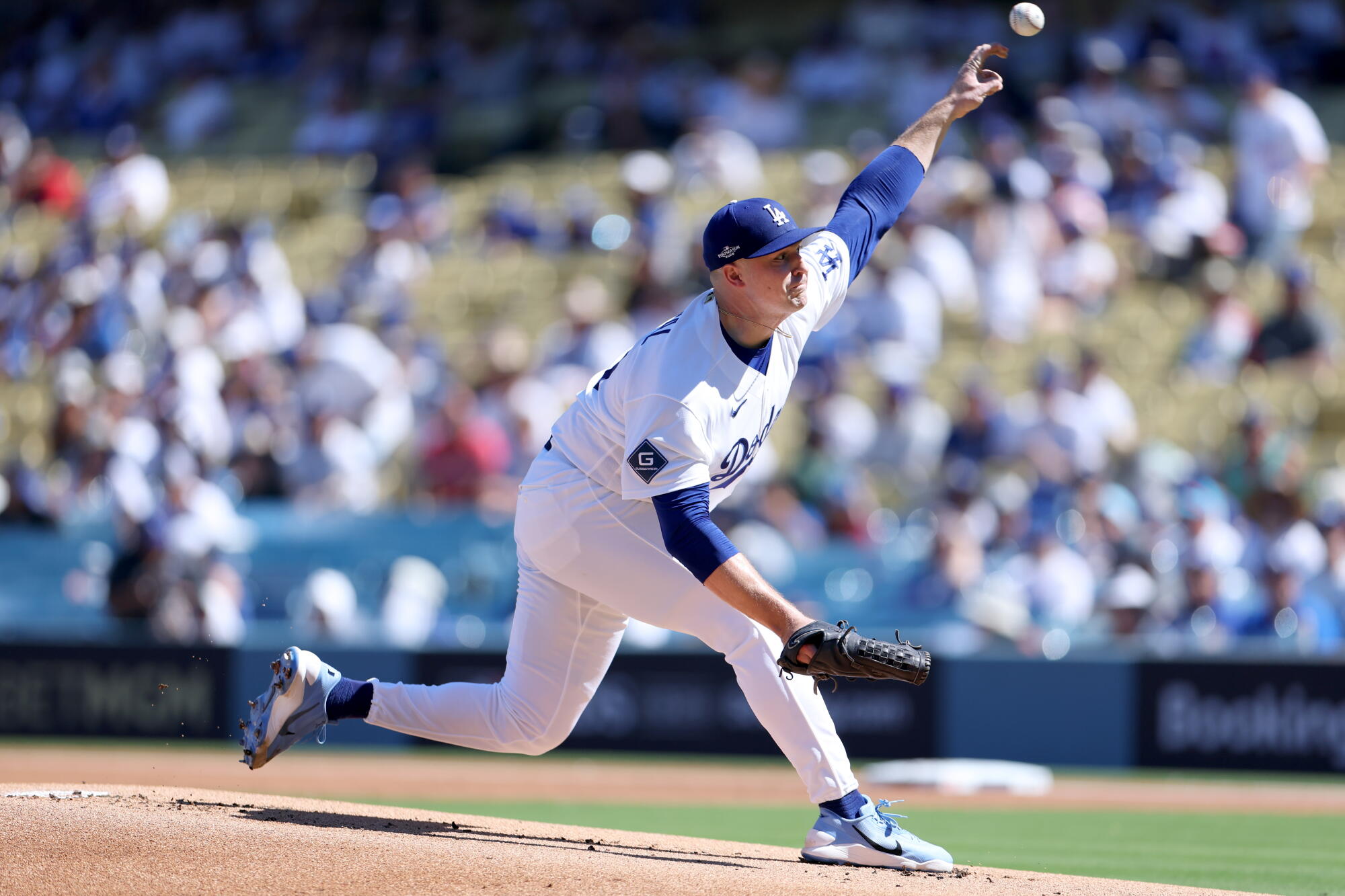
Skubal in his first Dodger postseason start after being traded here from Detroit on Aug. 2? Six innings of brilliance, 15 batters in a row retired at one point, only one three-ball count in the first five innings, two allowed hits, seven strikeouts, two walks and only nicked by a Sean Murphy homer.
Dodgers pitcher Tarik Skubal delivers during the first inning Saturday against the Braves.
(Eric Thayer / Los Angeles Times)
Teoscar Hernández, almost benched during a rocky regular season? Same old Teo, the guy who leads the Dodgers with 27 RBIs over the last three postseasons, this time opening the scoring with a two-run homer in the fourth.
Max Muncy, the forgotten stalwart who always seems to show up huge in October? Same old Max, blasting a ball over the right-field fence in the sixth to give the Dodgers a 5-1 lead.
But Kyle Tucker? This was not the same old Tucker. Nobody saw this coming. Certainly, he finished the regular season strong with a .969 OPS in September with six homers and 13 RBIs, but he was awful for most of the previous five months after joining the team this winter with baseball’s highest annual salary of $60 million.
Tucker batted .196 at home. He seemingly jogged after fly balls, wildly swung and missed at fastballs, and who would have thought he would take control with one out in the sixth and the Dodgers leading 2-1?
There was one out. This was a big moment. Skubal was out of the game and the Dodgers had lost all their early momentum when Hernández popped a single to center, bringing up Tucker.
On Smith-Shawver’s second pitch, he connected, and after Tucker trotted across home plate, the most amazing thing happened.
He smiled.
“I think that we all know — it’s been well talked about — the struggles he had this year,” said Roberts. “I give him a lot of credit for grinding through it, not running from it, always posting and kind of getting to the other side of it.”
It was an otherwise ordinary Dodger playoff win that began with a rare bit of Dodger second-guessing.
Many questioned the Dodgers choosing to pitch Skubal in Saturday’s opener while slotting Blake Snell into Sunday’s spot and leaving last season’s playoff hero Yoshinobu Yamamoto on the bench until Game 3.
The reasoning was that Skubal could get two starts in this series on full rest while Yamamoto, who requires an extra day’s rest, was only getting one start in the series regardless. Furthermore, by holding him back in this series, the Dodgers ensured that Yamamoto would get two starts in the National League Championship Series.
Still, you have to wonder, how do you take a guy with a 7-0 postseason record with a 2.25 ERA and put him third in the rotation?
Turns out, the Dodgers knew what they were doing, and before the game, even Andrew Friedman acknowledged this was their best pitching staff of this era.
“I feel like this is the best and deepest pitching staff we’ve ever had going into October,” said the Dodgers president of baseball operations. “I think we had some tough conversations in leaving some guys off the roster. That would have never happened before.”
There were also pregame question marks surrounding the health of Shohei Ohtani and Freddie Freeman.
Those questions remain, as the two future Hall of Famers went two-for-seven with two singles and not much power.
Ohtani, fighting arm and leg injuries, entered the game batting .157 since Aug. 18 with zero home runs during that time.
“As of now, it’s something I’m just going to have to manage,” he said through interpreter Will Ireton.
Ohtani and Freeman are going to have to manage better than this for the Dodgers to three-peat.
Maybe they should take some advice from the Dodgers’ latest candidate to be christened Mr. October.
Last year chef Debbie Lee debuted her long-awaited pocha in Highland Park: Yi Cha, one of L.A.’s best new bars, where Lee serves modern Korean bites that pair with artful cocktails and imported soju. Now she’s opened Mokja, a tandem cafe and market for Korean-leaning coffees, sandwiches, pastries and pantry goods. Enter Mokja through Yi Cha’s back alley and find sweet corn iced lattes, coffees topped with misugaru cold foam, and banana matcha lattes served alongside oxtail hand pies, Seoul-style breakfast plates, gochujang short rib onigiri, tomato-muchim pork belly BLTs, and a DIY ramyun station. In a hurry? Grab Lee’s premade bibimbap, mayak eggs, mandu, japchae and more from the refrigerators. If you’re shopping for your home, find coffee, mochi mixes, ice cream, hot sauce, black sesame spreads and other goods from local makers, plus imported Korean Oreos and chips, on the shelves around the cafe.
The Dodgers did not need Tarik Skubal to win the National League West. They traded for him to help them win a third consecutive World Series.
Their legacy is at stake. So is his.
That could be hyperbole. Skubal turns 30 next month, already the winner of two Cy Young awards, one of them unanimously. He could sign the largest contract of any pitcher in major league history this fall. His career might be only at its halfway point, and already we can say he’ll be remembered as a star.
So I asked him if his career would feel somehow empty if he did not win a World Series. No one in Anaheim thinks any less of Mike Trout, and no one in San Diego thinks any less of Tony Gwynn, because neither Hall of Famer won a World Series.
Skubal thought about it. Yes, he said, his career would feel diminished without a championship.
“I think winning is the most important thing, so I think that’s fair to say,” Skubal told me.
“If I retire and I don’t have one, that will definitely be something that I don’t know when I will live it down.”
The Dodgers imported him for five or six starts in October, the first of them this weekend. I wasn’t sure of the right noun to use to capture his feelings: Excitement? Pressure? Responsibility?
“I think all of those things,” he said.
How so?
“I’ve grown to appreciate expectations from teammates, from fans, from organizations,” he said. “I’ve come to appreciate pressure. Early on in my career, there wasn’t much of that. It was more just kind of finding my footing, which I’m grateful for. It helped me learn a lot about myself.
“Having the expectation of being a team that is going to win the World Series, and me being a part of that, is something that I’ve come to really appreciate. I’ve come to appreciate all that stuff. As much as they can be looked at as negative things, or stress-inducing things, I’ve come to really appreciate those things, because I haven’t had that for my entire career.”
As soon as the Dodgers traded for Skubal two months ago, he was delighted to receive a text message from a pitcher who wore the weight of expectations throughout his career.
“Honestly,” Skubal said, “I wanted to get a jersey from him.”
The Dodgers’ Tarik Skubal pitched seven scoreless innings in his final start of the regular season last week against the San Francisco Giants.
(Thearon W. Henderson / Getty Images)
They talked pitching too, of course, and stayed in touch. When the Dodgers landed Skubal, Kershaw’s welcome text led to him sharing advice not just about the team itself but about navigating the notorious L.A. roads to Dodger Stadium, and various neighborhoods that Skubal, his wife and two young boys might enjoy.
For Kershaw, the postseason was a widely publicized menace throughout the previous decade. In 2019, after he inherited a two-run lead in the deciding game of the division series, Kewshaw gave up home runs to Anthony Rendon and Juan Soto.
After the game, Kershaw said, “Everything people say is true right now about the postseason.”
In 2024, the Tigers were five innings from the American League Championship Series, leading 1-0 in the deciding game of the division series, with Skubal on the mound. Three singles, a hit batter and a grand slam later, the Tigers trailed for good.
“I felt pretty responsible for the season ending,” Skubal said.
Kershaw earned his redemption in 2020, winning both of his World Series starts as the Dodgers won their first championship since 1988. That title lifted the postseason burden off Kershaw, and I wondered whether Skubal might feel the same way if he leads these Dodgers to a parade.
Skubal rejected the premise.
“I don’t really buy into that narrative with Kersh, the postseason struggles,” Skubal said.
Kershaw’s 41 postseason appearances include four starts on short rest and nine relief outings. In 2013, he pitched a combined 259 innings between the regular season and playoffs. In 2015, that number was 246 innings.
“It takes a superhuman to be held to the standard he was being held to, in the biggest of moments,” Skubal said. “I think he was great. He did everything he could for his team. He wore it out there sometimes. Chasing box scores and stuff is kind of unfair to judge guys on, because I’m sure he was pitching through some stuff and grinding through some stuff.
“But he had to do it, because he was Clayton Kershaw.”
Kershaw’s postseason earned-run average: 4.62. For Skubal, in six postseason appearances, all of them starts: 2.04. In that one five-run inning, he gave up more runs than he has in the other 38-2/3 innings of his postseason career.
After he gave up those five runs, he returned for one more inning and retired the side in order.
“That moment solidified who I thought I am, in terms of how I responded to that failure, how I responded to that adversity,” he said. “It’s weird to say and it’s probably weird to portray, and I don’t know how many people it’s going to resonate with, but that’s what I feel.”
Right time, right place: If Skubal wants to win a World Series, where else would he rather be?
“For him?” pitcher Blake Snell said. “There’s no better time for anybody than right now.”
The Dodgers acquired infielder Tommy Edman from the St. Louis Cardinals at the 2024 trade deadline. For Edman, that’s two Octobers and two parades.
“In St. Louis, I think we were hovering around .500,” Edman said. “I found myself traded here and I was like, ‘OK, all of a sudden I’m on the team with the best record in baseball right now, going for a ring just about every single year.’
“That’s the expectation we have here. There’s definitely a level of excitement.”
“There’s also a difference between being on a team like the Tigers — and nothing against that organization — where the goal really isn’t to win the World Series. It’s the hope,” Roberts said. “But being here and seeing the standard that we have and it’s like: ‘I’m here to win the World Series. This team has the best chance to win the World Series, and I get to be a part of it.’
“So I fully see him, now that he is completely immersed into our culture, where the first month was trying to feel his way: ‘Where do I fit in? I’m this hired gun.’ And now it’s like he’s one of the guys.”
Skubal insists that he has not really thought about his free agency, that his focus is on the here and now, and on each start as it comes. That means this month could be his last in Dodger blue, and that means this really might be his best chance to win a World Series.
“I don’t really know if I like the verbiage of that, thinking I must win this year,” he said. “I don’t think that’s fair.”
The travel expert highlighted one spot as a stunning and affordable autumn city break destination
Simon called the European spot a “very exciting” destination to visit(Image: kolderal via Getty Images)
For many people mapping out an autumn escape, short-haul European city breaks promising late-season sunshine tend to top the wishlist. But as one of Britain’s most respected travel journalists, Simon Calder, suggests a more affordable and “very exciting” destination.
During an appearance on Holly Rubenstein’s podcast ‘The Travel Diaries,’ Simon shone a spotlight on everything from ancient cities in Algeria to Cape Verde and the Azores. Another unexpected destination on his radar was Tbilisi, the capital of Georgia. Tbilisi, the capital of Georgia, is becoming an increasingly popular choice for a city break, offering a mix of historic sights, delicious food, traditional wine, famous thermal baths and relatively affordable prices.
Why visit Tbilisi?
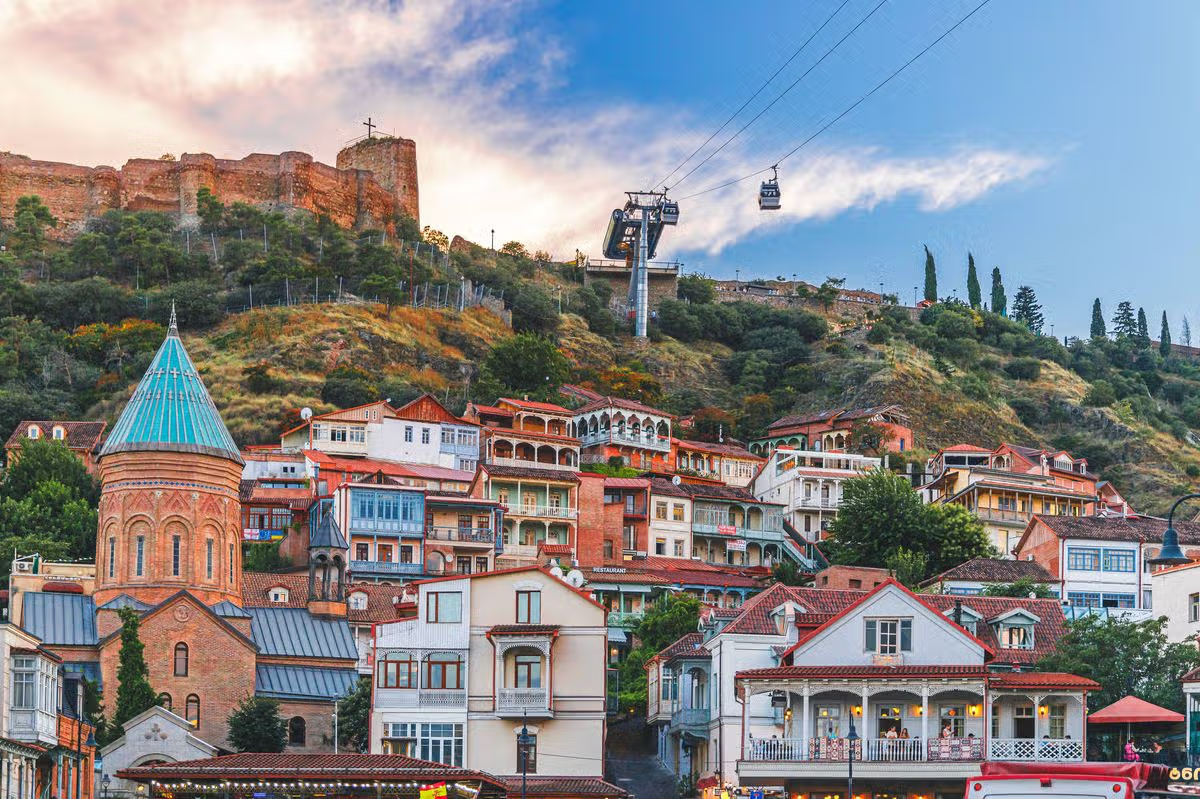
Tbilisi’s historic centre is packed with colourful wooden balconies, winding streets and beautiful churches, alongside architecture reflecting Georgian, Persian, Russian and European influences.
The city takes its name from its natural hot springs, and the Abanotubani district is home to traditional bathhouses where visitors can enjoy the famous sulphur-rich waters.
One of the must-visits in the city is a ride on the cable car towards Narikala Fortress offers impressive views across Tbilisi and the Mtkvari River. From the fortress, you can also glimpse the iconic “Mother of Georgia” statue.
Simon said: “It used to be the case that you couldn’t fly from Tbilisi in Georgia from the UK. And suddenly, within a couple of days, British Airways and easyJet launched flights to Tbilisi.”
The travel guru continued: “And that’s a very exciting part of the world. Central Asia, Uzbekistan, is very much getting back to being more mainstream as well. So much exciting stuff to do,” reports the Express.
What’s Tbilisi like in autumn?
Autumn can be an attractive time to visit Tbilisi. September is typically warm, while October brings cooler temperatures but can still offer pleasant days for exploring the city. Early autumn can also feel considerably warmer than the UK, making it an appealing option for travellers looking for a break from cooler weather.
Tbilisi comes into its own during autumn for a whole host of reasons. While temperatures back home in the UK begin to plummet, Georgia’s capital basks in a pleasant climate, with average highs of 19.5C in October.
This mild, sunny weather is perfectly suited to exploring on foot, and with very little rainfall to contend with, you can safely leave the waterproofs behind. Tbilisi has earned a reputation as a remarkably budget-friendly travel destination, especially for visitors from the UK and Western Europe.
While prices have risen slightly in recent years owing to increasing popularity, the city still offers exceptional value for money.
In the Georgian capital, a pint of local beer in a bar or pub will set you back around £1.75, while meals out typically cost between £8 and £15.
Tbilisi’s charm lies in its fusion of old and new. The city’s ancient heritage is prominently displayed in the delightful Old Town (Dzveli Tbilisi), where a maze of cobbled streets winds past traditional houses with characteristic wooden balconies.
You can explore this historic quarter and uncover the domed roofs of the renowned Sulfur Baths in the Abanotubani district.
For a modern architectural wonder, walk across the Bridge of Peace, a contemporary pedestrian crossing that illuminates with thousands of LED lights after nightfall.
Georgian cuisine is a standout feature of any visit, and Tbilisi is the ideal spot to sample it. From the warming comfort of khinkali (spiced meat or cheese dumplings) to the cheesy delight of khachapuri (bread with cheese), the local food is a hearty and flavoursome experience.
Wash it all down with a glass of locally produced wine from one of the oldest winemaking regions on the planet.
Travel Local reveals that Georgia is widely regarded as the birthplace of wine. Archaeological findings of winemaking activity stretch back more than 8,000 years, making it the oldest continuous winemaking tradition in the world.
Remarkably, the very word “wine” is thought to have originated from the Georgian term for it, ‘ghvino’.
Tbilisi boasts a fantastic selection of wine bars and tasting rooms throughout the city, but the most celebrated vineyards and wineries can be found in the Kakheti wine region, considered the heart of Georgian winemaking.
It’s a well-loved and straightforward day trip from Tbilisi, typically requiring around a 1.5 to two-hour drive to reach the region’s principal towns such as Sighnaghi or Telavi.
October is also a particularly vibrant time to visit the city, as it plays host to the Tbilisoba festival, a grand celebration of the city’s rich history and harvest season. The streets burst into life with music, folk dancing and food stalls, offering an unforgettable insight into Georgian culture.
The bodies of 105 Palestinians have been recovered from the rubble of a residential block destroyed by Israel in the early part of its genocide on Gaza. The victims are being prepared for burial almost three years since the war began.
RAILWAY workers are set to stage two 24-hour strikes this October in a row over doors.
The staff are making a stand against plans for driver-only operation on new services.
Staff at Chiltern Railways will walk out for two days this OctoberCredit: PA
Members of the Rail, Maritime and Transport union (RMT) at Chiltern Railways will walk out on October 10 and October 17.
The union said its members voted overwhelmingly in favour of industrial action over plans to introduce driver-only operation (DOO) on East West Rail services.
Sign up for the Travel newsletter
Thank you!
The dispute centres on the first stage of the new railway, which will run between Oxford and Milton Keynes.
RMT general secretary Eddie Dempsey said the proposed operation represented a “significant risk” to safety and to existing train manager roles.
He said: “RMT will not accept the watering down of safety on the rail network.”
But Chiltern Railways has rejected the suggestion that the new services will compromise passenger safety.
Interim managing director Tony Baxter said: “We have run most of our trains with the driver in control of the doors for decades, safely and as approved by the independent rail regulator.
“It also means over 100 new permanent jobs at Chiltern, and no changes to the roles of existing colleagues.”
He added that the operator expected to run the “vast majority” of its services on both days, with the timetables for the strike dates confirmed shortly.
The operator also stressed that every East West Rail service will have two people on board.
This will include the driver and another member of staff responsible for looking after passengers, checking tickets and helping people who need assistance.
The company said it remains committed to working with the RMT to resolve the dispute.
Brits looking for cheap Spain holidays where it’s still warm and sunny into late October may want to check out one particularly charming destination
This article contains affiliate links, we will receive a commission on any sales we generate from it. Learn more
(Image: LightRocket via Getty Images)
Summer may officially be over, but there’s good news for those not quite ready to accept this fact, as Europe still offers a host of holiday options with hot and sunny weather.
In fact, there’s one Spanish destination that’s been tipped as one of the best holiday hotspots for October, thanks to its balmy temperatures, beautiful beaches and cheap flights.
Lanzarote, in the Canary Islands, still boasts daytime temperatures of 25-27C, with sea waters still warm enough for swimming if you fancy a beach day and a dip. (Just pack some light layers for the evenings when temperatures drop to about 18-19C). Temperatures stay warm well into the winter months – it’s why the Canaries are such popular destinations year-round.
As for Lanzarote, it offers a wide array of different stays from luxury resorts ideal for a romantic getaway, to family-friendly all-inclusive breaks with kids’ clubs, poolside entertainment and family-friendly rooms.
Playa de Papagayo is the highest-rated beach according to TripAdvisor, with holidaymakers praising the golden sands and turquoise waters, although be warned that you’ll need to face a slightly dusty and bumpy road to reach the beach, and cross over some sand dunes. In terms of popularity, Papagayo is closely followed by Playa Blanca, another shoreline made up of soft sands and azure waters with a nearby port and marina if you fancy a waterfront lunch.
As for getting there, when we took a look on Skyscanner, there were plenty of flight options from 12 UK airports with fares from under £30 each way, based on two adults travelling outside of the half term dates. For example we found one-way fares from £17 from Liverpool, £19 from London, £21 from Bristol and £24 from Manchester. (For a family of four travelling during half term, the cheapest flights appeared to be from Bristol with prices from £148pp each way).
Given the weather, cheap flight options and array of accommodation, it’s therefore no surprise that Lanzarote has been named one of Europe’s top 10 best holidays for October, in a recent study from the travel experts at Solmar Villas. The team ranked 105 holiday destinations looking at factors including weather and affordable flights, with Lanzarote coming out sixth in the overall rankings.
Cyprus was the top destination taking four spots in the top ten, while Greece had three destinations on the list and Spain two, followed by Malta – you can check out the full top 10 list below.
When Dodgers rookie Josue De Paula debuted a little over two weeks ago, he was the youngest player in the lineup by four years. And when veteran infielder Miguel Rojas pinch-hit for Alex Freeland in the eighth inning, the 21-year-old De Paula and 29-year-old Kyle Tucker were the only Dodgers under 30 remaining in the batting order.
“You’ve got to have both,” veteran shortstop Mookie Betts, who turns 34 next month, said in a recent conversation with the Times. “You need experience, but you also do need youth. I don’t know what the balance is, to be honest.”
The age of the Dodgers’ stars is the most persistent knock on a group that just finished a 100-win regular season and has the second-best odds to win the World Series (16.7%), according to Baseball Prospectus.
It’s the threat looming beyond every new accomplishment. Yes, the Dodgers are in the midst of a historic run. Only one other organization has strung together so many consecutive postseason berths, and that Braves team of the 1990s and early 2000s won only one World Series.
The Dodgers are aiming to become the first National League team to claim three straight championships.
But how long can this last?
The Dodgers’ lineup is the oldest in the majors, according to Baseball Reference, with an average age of 30.9 years old when weighted by at-bats and games played. Their star corner infielders, Freddie Freeman and Max Muncy, are the oldest of the everyday starters, at 37 and 36, respectively. Even two-way phenom Shohei Ohtani turned 32 in July.
“That’s a fact, we’re an older team,” manager Dave Roberts said. “With age, there’s experience. I know we’re not going to fall off a cliff, our team.”
Plenty of young players in the Dodgers’ system have been blocked by older stars over the years. But in addition to a sky-high payroll, the Dodgers are known for their player development.
Even after the trade deadline — when the Dodgers sent two MLB Top-100 prospects, outfielder Zyhir Hope (No. 25) and right-hander River Ryan (No. 68), to the Tigers as part of the trade package for left-hander Tarik Skubal — the organization’s farm system ranked No. 1 on MLB Pipeline’s rankings.
Serving as a reminder of that strength, when the Dodgers called up De Paula straight from double A, he immediately showed his bat belonged in the big-leagues.
At the same time, injuries stoked the flames of the age discussion. De Paula got his shot because Ohtani finally went on the injured list, after managing problems with his left knee and right biceps for much of the season.
Freeman pushed through knee tendinitis in September. Teoscar Hernández (left hamstring strain) and Betts (right oblique strain) both had monthlong IL stints earlier in the season but have helped carry the offense lately.
“As I’ve gotten older, I’m definitely taking a lot more care of my body,” Betts said. “I know I had an oblique [injury] earlier, but as far as just showing up every day and whatnot, I feel like we do a good job in taking care of our bodies and staying healthy for the most part.
“But I mean, people are talking like we’re the only ones in the league that’s getting hurt. You look everywhere around the league, somebody’s hurt.”
That’s true. And it also isn’t just the guys in their mid-to-late 30’s sustaining soft-tissue injuries. Dodgers catcher Dalton Rushing, 25, served back-to-back IL stints for a flexor strain in his forearm down the stretch.
The Dodgers’ roster has proven deep enough to withstand injuries, as the team posted the second-best regular-season record in the majors this year.
“We’re not going to win games the same way that Milwaukee or Tampa Bay or these younger teams are winning games,” said Rojas, 37. “We’re going to win games a different way. We’re going to win games with a lot of talent, with experience, and winning moments.”
Over the years, the Dodgers have brought in players with postseason experience. But roster continuity also has meant that 17 players on this year’s projected postseason roster also contributed to both of the Dodgers’ last two World Series-winning seasons.
So, after playing more games than any other team the past couple years, the Dodgers may be a little hobbled going into their first-round bye. Regardless, they just completed their first 100-win season since 2023.
“The experience, how smart these guys are on the field, I think those things help win moments and win battles on the edges in October,” president of baseball operations Andrew Friedman said when the Dodgers clinched the NL West title earlier this month. “It’s not as easy to navigate through a 162-game season with an older roster. But I do think that experience in those moments will definitely help and we’ll see it shine through at different points in October.”
Those Yankees had a Hall of Fame closer. In 1998, Mariano Rivera got the final four outs of the clincher. In 1999, he got the final four outs. In 2000, he got the final three outs.
These Dodgers? Their closer? Your guess is as good as theirs.
“I do not know,” said Andrew Friedman, the Dodgers’ president of baseball operations.
This might be a good time to know, no? The regular season is over. The postseason is upon us.
“I feel very confident that we’re going to be going into October with arguably the deepest and best pitching staff that we’ve had,” he said. “Exactly what their roles will be and how things will be ordered, I don’t know right now.”
Perhaps the Dodgers are overthinking this. They have done that before.
Tanner Scott converted 25 of 29 save opportunities this season, including saves Friday and Saturday.
But the strongest hitters on the Dodgers’ possible division series opponents are left-handed — Matt Olson, Drake Baldwin and Michael Harris II on the Atlanta Braves; Bryce Harper and Kyle Schwarber on the Philadelphia Phillies — and the Dodgers may not hesitate to use the left-handed Scott against those guys in the seventh or eighth inning.
In theory, these Dodgers have three candidates as closer: Scott, their marquee closer signing for 2025 and actual closer for most of 2026; Edwin Díaz, their marquee closer signing for 2026; and Roki Sasaki, their accidental closer last October.
Yet Friedman said he could envision scenarios where Evan Phillips could close, or even Brock Stewart, or perhaps Alex Vesia against a run of left-handed hitters. The Dodgers hope to activate Edgardo Henriquez for the playoffs. The starters could close, too, especially a well-rested Tyler Glasnow early in the first round.
“We’ve got a number of guys that we really trust,” Friedman said. “Depending on who we’re playing, how deep our starter goes, there are a lot of factors that would go into it. But, more than who will be that pitcher on the mound, is the fact that we have so many candidates we feel really good about.”
That the Dodgers have improvised an October relief corps, transformed a rookie starter into a postseason closer and run bullpen games in elimination games might lead you to conclude Friedman does not really believe in the concept of a designated closer. In a world where “high leverage” is the trendy jargon, maybe a closer is more of an anachronism than a necessity.
That the Dodgers invested $72 million in Scott and $69 million in Díaz in consecutive winters would lead you to conclude Friedman does indeed believe in the concept of a designated closer. In fact, he does.
“I think it’s extremely helpful,” he said.
The Dodgers do not hold splashy news conferences to introduce closer candidates. When the Dodgers introduced Díaz last December, Friedman proudly introduced the three-time All-Star as the closer.
“For us, we have a high bar,” Friedman said then. “To name someone the closer, you have to be one of the best. You have to be elite and dominant at what you do.”
Díaz’s season went awry, limited to 18⅔ innings after elbow surgery and then a neck injury. But in five September appearances since his activation from the injured list, he gave up no runs and one hit in five innings, striking out nine of the 17 batters he faced. (In the same span, Scott has given up no runs and two hits in five innings, striking out nine of the 19 batters he faced.)
Dodgers reliever Edwin Díaz high-fives teammates in the dugout after pitching against the San Diego Padres on Sept. 22.
(Gina Ferazzi / Los Angeles Times)
“What we’ve seen out of Díaz recently has been really encouraging,” Dodgers manager Dave Roberts said. “What that ultimately means, we don’t know yet.
“Of course, if you have a reliever who is really hot in October, that can be extremely valuable. It doesn’t mean you use him exclusively in the ninth. But, by and large, that’s how you would use him.”
Roberts saluted Díaz for working hard to get back to an uncertain assignment.
“I’m really proud of Edwin, given the deal he signed, to work it out, to go to the minors, to come back and pitch in whatever role we ask of him, that shows a lot of character,” Roberts said.
“He could have mailed this year in. That’s something that has not gone unnoticed. And we’ll see how October plays out.”
The Dodgers could be forgiven for believing it will all work out in the end. Their final pitcher in each of the World Series clinchers under Friedman, all starters: Julio Urías in 2020, Walker Buehler in 2024, Yoshinobu Yamamoto in 2025.
The pitchers to record a postseason save in those championship seasons: Kenley Jansen, Joe Kelly, Brusdar Graterol, Blake Treinen and Urias in 2020; Alex Vesia, Treinen and Buehler in 2024; Glasnow, Sasaki and Treinen in 2025.
The organizational flexibility can lead to some uncomfortable discussions within the clubhouse, as Roberts and coaches keep the relievers updated on the latest plan for how they might be used.
“It is tricky,” Roberts said. “These are constant conversations. They are ever-evolving. They are ongoing.”
If all goes right for the Dodgers, those conversations will be ongoing for another month.