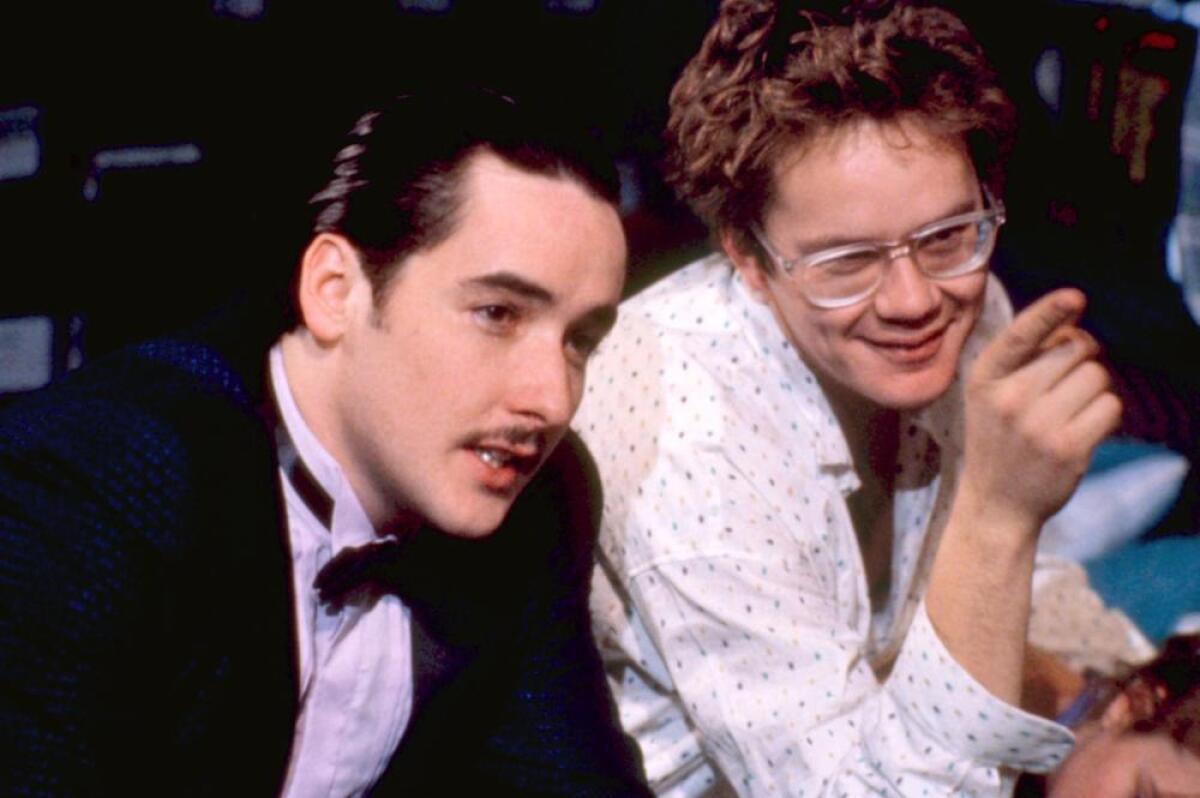
Return to 1988’s ‘Tapeheads,’ shot in a now-gone Los Angeles
The ongoing explosion of revival screenings in Los Angeles is an opportunity not just to revisit accepted classics, but also to give a spotlight to undersung oddball picks deserving of broader attention.
Take for example 1988’s “Tapeheads.” An offbeat comedy about two friends trying to break into the then-emergent world of music videos, the film stars John Cusack and Tim Robbins just as their careers were starting to take off. A snapshot of a specific moment in Los Angeles — some shots of downtown’s skyline at sundown have an unexpected beauty — the film has never been lost exactly, but it is deserving of renewed interest.
The movie will show on Monday as part of the American Cinematheque’s Cinematic Void program at Los Feliz Theatre, screening from a rare 35mm print provided by the UCLA Film & Television Archive. Director and co-writer Bill Fishman will be there along with producer and co-writer Peter McCarthy, producer Eric Barrett and production designer (later turned director) Catherine Hardwicke.
Cusack and Robbins star as Ivan and Josh, friends since childhood now working as nighttime security guards until they figure out their future. Cusack’s Ivan has ambition and drive while Robbins’ Josh is sensitive and creative. Together they launch a music video business and take it upon themselves to revive the careers of their favorite soul singers, the fictional Swanky Modes (played by real-life soul legends Sam Moore and Junior Walker). Josh and Ivan soon find themselves accidentally wrapped up in a blackmail scheme involving a sex tape and a conservative politician, complicating everything.
“It was a hustler and an artist and the merging of the two, trying to get some sort of balance with your creative side and what you needed to do to make a living,” explains Fishman, now 68, during a recent video interview from Venice, Calif. “We came up with the credo ‘You do what you gotta till you can do what you wanna.’ And that was really where it came from.”
Before making his feature debut with “Tapeheads,” the native New Yorker had already found success in his 20s as a music video director himself, creating clips for songs such as Suicidal Tendencies’ “Institutionalized” and the Georgia Satellites’ No. 2 hit “Keep Your Hands to Yourself.” Straddling the music scene and Hollywood, Fishman found that a satire of conservative politics came to him naturally.
“Music videos seemed to be an easy thing for me to do because I knew that world,” he says. “Even though the story was what we thought would be completely ludicrous, it ended up being much more realistic than we believed.”

John Cusack, left, and Tim Robbins in the movie “Tapeheads.”
(American Cinematheque)
James Branscome, who programs the Cinematic Void series for the American Cinematheque, calls the rare chance to show the film a bucket-list experience.
“It was a weird movie that felt lost, especially when it stars John Cusack and Tim Robbins being zany in a way they don’t often get to be,” he says by phone. “It felt like this very organic, perfect movie, like: This checks so many boxes for me.”
Among the producers on the film is Michael Nesmith, a former member of the Monkees, and through him the project fell under the production umbrella of NBC. Fishman remembers being invited to the home of Brandon Tartikoff, president of NBC Entertainment and a green-lighter of titles including “Miami Vice” and “Seinfeld.” What he thought was going to be a relatively brief meeting was instead hours of Tartikoff patiently going through the script page by page.
“I did not know anything,” remembers Fishman, whose most recent credit is the 2024 film “Waltzing With Brando,” starring Billy Zane. “I thought Hollywood was always going to be like this. But I didn’t realize that my best experience was my first and then we were going to have to fight and claw for the rest of it.”
It was young casting director Victoria Thomas (lately of “Once Upon a Time … in Hollywood” and “Michael”) who brought in Cusack and Robbins. Cusack, a Chicagoan, was in Los Angeles to appear onstage with Robbins’ theater group the Actors’ Gang and the two of them came in to audition together.
“They had really prepared,” says Fishman. “And after an hour or more of the interview, which went great, I said, ‘I want you guys to switch roles.’ And that freaked them out. They were like, ‘We can’t do that. We rehearsed. We can’t just throw this together for you.’ I said, ‘I really think you should.’ And they said, ‘OK, give us 15 minutes.’ And they walked out onto the street in Venice and they came back in as the other characters, redid the audition and that’s how they were cast.”

Mary Crosby and John Cusack in the movie “Tapeheads.”
(American Cinematheque)
Fishman made sure to show Cusack the 1957 film “Sweet Smell of Success,” with Tony Curtis’ smarmy press agent an influence on his character. Fishman also says Cusack’s greased-back hair and pencil mustache were partly inspired by Eric Roberts in “Star 80.”
“Tapeheads” captures a specific moment in Los Angeles history, sure to be nostalgic for some, from a desolate downtown to a percolating music scene. Legendary local party band Fishbone provided music for the score and appears briefly as a country-and-western bar combo. Devo rerecorded a version of their song “Baby Doll” in Swedish to stand in for an international boy band’s hit. The film is also full of cameo appearances by real-life music figures, including “Soul Train” host Don Cornelius, MTV’s Martha Quinn, comedian Bobcat Goldthwait, rapper Doug E. Fresh and musicians “Weird Al” Yankovic, Ted Nugent and Stiv Bators. (A then-largely unknown Courtney Love has an uncredited appearance as a dominatrix on a sex tape.)
“The soundtrack and the people we used in the film were reflective of the wide spectrum of what was unifying, I thought, for the counterculture in specifically L.A.,” says Fishman. “It wasn’t a film about punk rock, it wasn’t a film about rhythm and blues or hip-hop. It was a film about young people expressing themselves.
“When you would go out in Los Angeles at that time, you would go to nightclubs and all these bands would be playing in the same club,” he says. “If you were part of the counterculture you could play anything or dress any way and you were sort of accepted. It was a creative scene and that’s what the film was about.”
One highlight of the movie is a commercial Ivan and Josh make for local L.A. eatery Roscoe’s House of Chicken ‘N Waffles (still going strong), featuring a memorable rap by blues singer King Cotton and done with a bold yellow and black look.
“I grew up in New York City and chicken and waffles was not a thing,” says Fishman. “People here would go get it late night in Hollywood and when I was looking for some business that they could do a video for, it just struck me as an absurd combination, which was all about what the film was about: absurd combinations. And it happens to be delicious.”
“That Roscoe’s Chicken and Waffle commercial is incredible,” says programmer Branscome. “Which is the most California thing because outside of L.A. no one knows what a Roscoe’s is unless you’ve been here. It’s full of very niche stuff that is elevated. It works on one level, but if you know exactly what it is, it gives it a different dynamic.”

Tim Robbins in the movie “Tapeheads.”
(American Cinematheque)
When “Tapeheads” was released in October 1988 (after a berth at the film festival that would be later renamed Sundance), it struggled to find theaters. Moore and Walker performed on “Late Night With David Letterman” as the Swanky Modes. According to Fishman, Cusack and Robbins were both reluctant to do press for the film at the time “because they thought it was uncool.”
It was not until it hit the VHS market that the movie truly began to find its audience. That said, it has never been on Blu-ray and is available to stream from only a few scattered sites. Perhaps this sold-out L.A. screening, with the support of some of the key behind-scenes-team, will help spur the film toward a broader renaissance. It deserves to be seen as more than just a cult curio.
“As soon as people saw the film, they said, ‘Oh, this is a cult film’ and I always hated that,” says Fishman. “I was like, ‘No, it’s not a cult film — it’s a pop movie.’ We wrote it to play to everybody.”