novels

Before governor’s race, Xavier Becerra was depicted in kids novels

For years, Kitty Felde was a familiar voice on public radio in Southern California. Reporting from Capitol Hill, it was her job, she felt, to explain government to the grown-ups living thousands of miles away.

It could be frustrating, given how little many listeners seemed to know or understand about even the basics of Washington and how the place works. (Or, at least, how it’s supposed to work.)

“They don’t remember this stuff from fifth grade,” Felde said.

Worse, a lot of people didn’t seem to care.

So Felde wondered: What if her insights and expertise were aimed at a younger audience?

You’re reading the L.A. Times Politics newsletter

George Skelton and other political analysts cover the insights, legislation, players and politics you need to know. In your inbox Monday and Thursday mornings.

With her career in radio winding down, Felde set off in a new direction, writing a novel for young adults that combined sleuthing with civics; a blend of “Nancy Drew” and “The West Wing,” as Felde’s website described the result.

Set in Washington, the book’s main character was Fina Mendoza, a 10-year-old girl modeled after someone whom Felde, a Southern California native, mentored years ago while living and reporting in Los Angeles.

“She was fierce, smart, quiet, driven, even persuading her non-English-speaking mother to help her transfer to a better high school where she graduated with honors,” Felde told an interviewer when the book was published in 2019. In creating Fina Mendoza, “I imagined what [Felde’s mentee] must have been like when she was younger.”

For Mendoza’s father, or “Papa,” Felde envisioned someone she had gotten to know over the years covering California’s congressional delegation. Someone genial and soft-spoken who, lately, has been in the news quite a bit.

Xavier Becerra.

“He’s a widower,” Felde said of the fictional Arturo Mendoza, a Democratic congressman representing Los Angeles, as Becerra did for nearly a quarter of a century. “Xavier, obviously, is not. But I met his daughters, I met his wife. And so that image … I could see him being the father.”

She did not, Felde confessed, see Becerra as a California governor-in-waiting.

When she conceived Arturo Mendoza, Felde said, “nobody knew who [Becerra] was” — which is only a slight exaggeration. Even now, many Californians are just becoming familiar with the Democrat, who is heavily favored to beat Republican Steve Hilton in November, given the state’s strong Democratic tilt.

A five-part series

That first novel about Fina and her exploits on Capitol Hill has expanded into a multi-volume series, published in English and Spanish, featuring the young detective and her roman à clef Papa. The fourth installment comes out next month. Felde is currently working on the fifth and, she expects, final volume.

Collectively, the works do not purport to offer “The Xavier Becerra Story.” Rather, each centers on a mystery — a bird that poops on the president during his State of the Union speech; a culprit placing snakes in the gym bags of lawmakers; a series of break-ins, fires and vandalism in the Montecito Heights neighborhood of Los Angeles, where Fina is home for the summer. The protagonist unravels each knot and, along the way, delivers readers a goodly dose of Government 101.

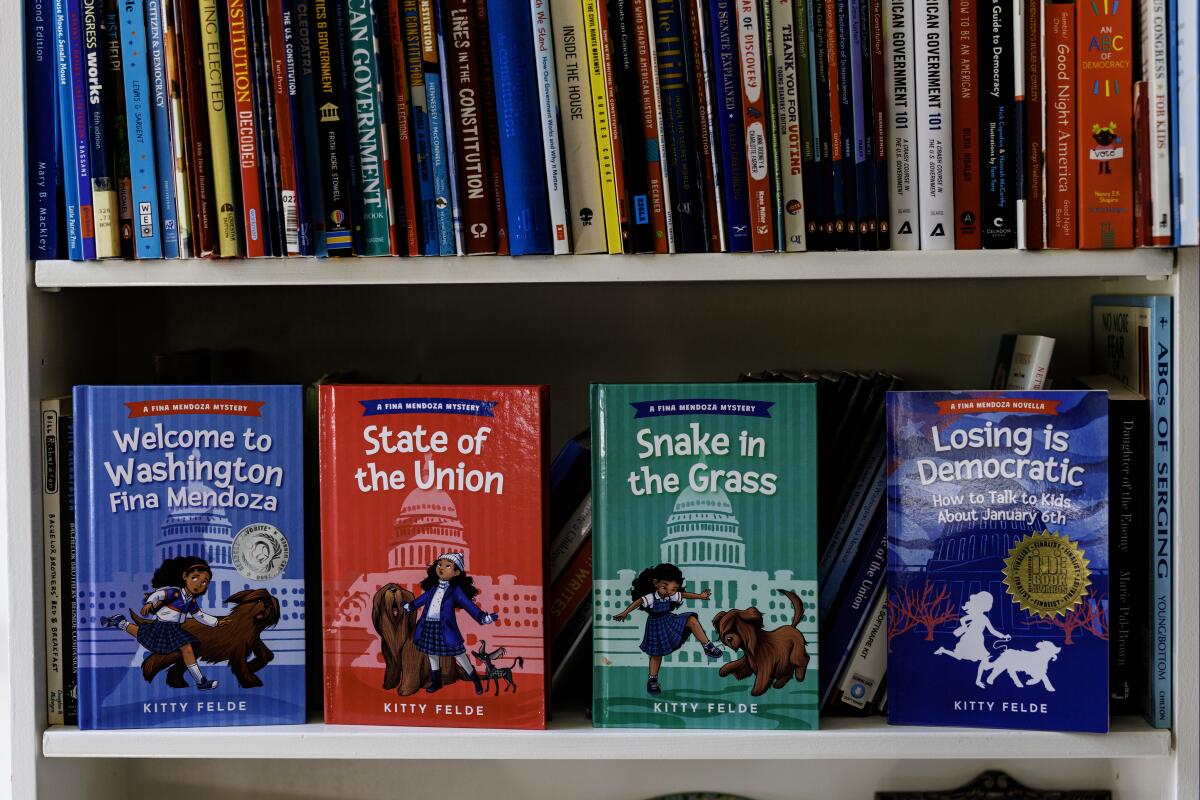
A shelf-load of books written by Kitty Felde

Felde has written four books in the Fina Mendoza Mystery Series and is working on the fifth and, she believes, final volume.

(Gina Ferazzi/Los Angeles Times)

Unlike Becerra, Papa continues serving in the House. His real-life model left Congress in January 2017 after Gov. Jerry Brown appointed him California attorney general, replacing Kamala Harris upon her departure for the U.S. Senate. Becerra was elected to the job the following year, served in the Biden administration as Health and Human Services secretary and finished atop the field in California’s crowded June 2 gubernatorial primary.

Speaking via Zoom from her home office in Baldwin Hills, Felde ventured a few thoughts on how Becerra would do as governor. (Which, of course, is also a mystery; at this point one can only guess.)

“We’re a big state with a lot of problems,” Felde said with a small shake of her head. “I think he’ll have a good time fighting the current administration. And I think, because he does have contacts both in Sacramento and in Washington … that can help because that’s where money’s coming from.”

The great divide

Returning to Fina Mendoza, Felde said part of her intent in writing the series was closing the yawning physical and psychic gaps that exists between California and Washington.

“We think we are the center of the universe because we are isolated in a lot of ways from the rest of the country,” Felde said of her fellow Californians. In Washington, “they think the same thing, but they’re the ones with the money and the power…. There is a dependency there.”

For that reason alone, she suggested, people should pay closer attention to what’s happening back East, notwithstanding the distance and the sometimes confounding, oftentimes arcane ways and means of the nation’s capital.

“It’s our government,” she said. “If you want to change the world, it’s not just City Hall. It’s not just whoever is making the HOA rules. It’s on Capitol Hill. It’s the White House. It’s the Supreme Court.”

Apart from the Fina Mendoza novels, Felde has written several other books and plays related to government and history, set in and around Washington. She also hosts several podcasts, including a book club for kids.

What does Becerra think of his artistic rendering?

Felde’s husband caught up with the gubernatorial hopeful a few months ago outside a candidates forum in Santa Monica. He presented Becerra with a copy of the first book in the series, “Welcome to Washington Fina Mendoza.” Becerra’s eyes brightened at the mention of Felde and he sent his warm regards.

Otherwise, she has yet to hear back.

What else you should be reading:

The must-read: Politician behind ‘top two’ primary has second thoughts
The deep dive: ‘I got crushed’: AI giants are funding ad wars in races across the country
The L.A. Times Special: Federal probe of Newsom creates lots of smoke. Is there any fire?

Until next time,
-mzb

Was this newsletter forwarded to you? Sign up here to get it in your inbox.

Source link

L.A. Times Book Prize winners talk AI, book bans, diverse novels

Some of our finest contemporary writers got their laurels Friday night at the 46th Los Angeles Times Book Prizes ceremony at USC’s Bovard Auditorium.

At the awards ceremony, which opens the annual L.A. Times Festival of Books weekend, Oakland-born writer Amy Tan and literary nonprofit We Need Diverse Books received achievement honors, and finalists in 13 other categories became prize winners.

The presenters and awardees who took the stage balanced a spirit of playfulness — Times senior editor Sophia Kercher called the weekend’s festival “my personal Coachella” and Times columnist LZ Granderson saluted his fellow “booktroverts” — and one of reverence as they celebrated writing as an instrument for advocacy, imagination and history-keeping.

As Bench Ansfield virtually accepted his award in the history category for “Born in Flames: The Business of Arson and the Remaking of the American City,” which exposes a pattern of landlords setting residential fires to collect insurance payouts, he said, “It’s a scary time to be a historian in the United States.”

“Our field, like so many other fields, is under attack,” Ansfield said. “To understand the crises in front of us, we have to understand our history.”

Among the crises highlighted was AI encroachment, the subject of science and technology category winner Karen Hao’s “Empire of AI: Dreams and Nightmares in Sam Altman’s OpenAI.” The AI expert and investigative journalist’s book is a critical investigation into the rise of OpenAI and its impact on society.

In Hao’s acceptance speech, read by presenter Jia-Rui Cook in her absence, the author said she “can’t help but be disturbed by how the themes of this book have grown more relevant by the day.”

“That said, I have never been more hopeful of our chance to advance a different future,” the author said, adding that L.A.’s history of resistance movements — including the recent Hollywood strikes — made it an apt place to accept her award.

“Gatherings like this are one of many radical acts of resistance against the imperial project that seeks to strip us of our meaning and our humanity,” Hao said. “Let us continue to resist defiantly together and let us remember lessons in history: When people rise, empires always fall.”

Tan echoed Hao’s sentiments as she accepted the Robert Kirsch Award, which celebrates literature with regional and thematic connections to the Western United States, for her acclaimed portfolio of writing exploring identity and cultural inheritance — often through the lens of the immigrant experience.

In her speech, “The Joy Luck Club” writer said that while she never particularly considered herself a “political writer,” her stance on that has changed as government actions have made her think critically about her own identities.

“My birthright and that of millions of others is now being argued before the Supreme Court, and no matter what the outcome is, it’s been a kick in the gut to know that those in the highest echelons of government and those who support them believe that we don’t belong.”

As an author, Tan said, “I imagine the lives of the people I write about,” and that act of compassion, for writers, inherently “reflects our politics and our beliefs. And so yes, I am a political writer.”

Later, Caroline Richmond, executive director of We Need Diverse Books, celebrated the work of her nonprofit — the recipient of this year’s Innovator’s Award — which has made it so her daughter “has never really had to look that far to find herself on the page.”

Still, she said ongoing book bans are threatening those strides toward a more diverse literary marketplace.

“The work is very much far from over,” Richmond said, “but I have to remind myself that the people banning books are never the good guys in history, and it’s up to us in this room and beyond — as readers, as book lovers — to fight back because diverse books, we really need them now more than ever.”

As the ceremony wore on, the room was as charged with celebration as it was with resistance.

When writer-editor and former child actor Adam Ross accepted the Christopher Isherwood Prize for “Playworld,” a semi-autobiographical novel about a teen growing up in 1980s New York, he gleamed with joy about his second novel being out in the world and finding readers.

“When it became clear to me that I was writing something that was going to be a lot bigger and take a lot longer than I planned, I promised myself I would use all of my ability to capture my experience of a particular era in an enduringly magical city, and to hopefully express it in such a way that any reader willing to embark on a journey with me, but upon finishing close the book and say, ‘Yes, I know exactly what that was like,’” Ross said in his acceptance speech.

“Winning this award makes me feel like I succeeded in that endeavor,” the author said.

Other winners included Ekow Eshun, who topped the biography category for “The Strangers: Five Extraordinary Black Men and the Worlds That Made Them,” which parses Black masculinity as embodied by various civil rights activists, philosophers and other visionaries, and Bryan Washington, who accepted the fiction award for “Palaver,” which details the tense reunion of a Jamaican-born mother and her queer son, who are navigating years of estrangement in Tokyo.

The 31st annual L.A. Times Festival of Books will host 500-plus authors and celebrities and 300-plus exhibitors across more than 200 events including panels, book signings and cooking demonstrations. Top-billed guests include musician-memoirist Lionel Richie, veteran actor and recent Golden Globe Carol Burnett Award honoree Sarah Jessica Parker, and the mastermind behind “Curb Your Enthusiasm,” Larry David.

The schedule for the Saturday-Sunday event can be found here.

Here’s the full list of finalists and winners for the Book Prizes.

Robert Kirsch Award

Amy Tan

Innovator’s Award

We Need Diverse Books

The Christopher Isherwood Prize for Autobiographical Prose

Adam Ross, “Playworld: A Novel”

The Art Seidenbaum Award for First Fiction

Andy Anderegg, “Plum”

Krystelle Bamford, “Idle Grounds: A Novel”

Addie E. Citchens, “Dominion: A Novel”

Justin Haynes, “Ibis: A Novel” | WINNER

Saou Ichikawa translated by Polly Barton, “Hunchback: A Novel”

Achievement in Audiobook Production, presented by Audible

Molly Jong-Fast (narrator), Matie Argiropoulos (producer); “How to Lose Your Mother”

Jason Mott, Ronald Peet, and JD Jackson (narrators), Diane McKiernan (producer); “People Like Us: A Novel”

James Aaron Oh (narrator), Linda Korn (producer); “The Emperor of Gladness: A Novel”

Imani Perry (narrator), Suzanne Mitchell (producer); “Black in Blues”

Maggi-Meg Reed, Jane Oppenheimer, Carly Robins, Jeff Ebner, David Pittu, Chris Andrew Ciulla, Mark Bramhall, Petrea Burchard, Robert Petkoff, Kimberly Farr, Cerris Morgan-Moyer, Peter Ganim, Jade Wheeler, Steve West, and Jim Seybert (narrators), Kelly Gildea (producer); “The Correspondent: A Novel” | WINNER

Biography

Joe Dunthorne, “Children of Radium: A Buried Inheritance”

Ekow Eshun, “The Strangers: Five Extraordinary Black Men and the Worlds That Made Them” | WINNER

Ruth Franklin, “The Many Lives of Anne Frank”

Beth Macy, “Paper Girl: A Memoir of Home and Family in a Fractured America”

Amanda Vaill, “Pride and Pleasure: The Schuyler Sisters in an Age of Revolution”

Current Interest

Jeanne Carstensen, “A Greek Tragedy: One Day, a Deadly Shipwreck, and the Human Cost of the Refugee Crisis”

Stefan Fatsis, “Unabridged: The Thrill of (and Threat to) the Modern Dictionary”

Brian Goldstone, “There Is No Place for Us: Working and Homeless in America” | WINNER

Gardiner Harris, “No More Tears: The Dark Secrets of Johnson & Johnson”

Jordan Thomas, “When It All Burns: Fighting Fire in a Transformed World”

Fiction

Tod Goldberg, “Only Way Out: A Novel”

Stephen Graham Jones, “The Buffalo Hunter Hunter”

Mia McKenzie, “These Heathens: A Novel”

Andrés Felipe Solano translated by Will Vanderhyden, “Gloria: A Novel”

Bryan Washington, “Palaver: A Novel” | WINNER

Graphic Novel/Comics

Eagle Valiant Brosi, “Black Cohosh”

Jaime Hernandez, “Life Drawing: A Love and Rockets Collection” | WINNER

Michael D. Kennedy, “Milk White Steed”

Lee Lai, “Cannon”

Carol Tyler, “The Ephemerata: Shaping the Exquisite Nature of Grief”

History

Char Adams, “Black-Owned: The Revolutionary Life of the Black Bookstore”

Bench Ansfield, “Born in Flames: The Business of Arson and the Remaking of the American City” | WINNER

Jennifer Clapp, “Titans of Industrial Agriculture: How a Few Giant Corporations Came to Dominate the Farm Sector and Why It Matters”

Eli Erlick, “Before Gender: Lost Stories from Trans History, 1850-1950”

Aaron G. Fountain Jr., “High School Students Unite!: Teen Activism, Education Reform, and FBI Surveillance in Postwar America”

Mystery/Thriller

Megan Abbott, “El Dorado Drive” | WINNER

Ace Atkins, “Everybody Wants to Rule the World: A Novel”

Lou Berney, “Crooks: A Novel About Crime and Family”

Michael Connelly, “The Proving Ground: A Lincoln Lawyer Novel”

S.A. Cosby, “King of Ashes: A Novel”

Poetry

Gabrielle Calvocoressi, “The New Economy”

Chet’la Sebree, “Blue Opening: Poems”

Richard Siken, “I Do Know Some Things”

Devon Walker-Figueroa, “Lazarus Species: Poems”

Allison Benis White, “A Magnificent Loneliness” | WINNER

Science Fiction, Fantasy & Speculative Fiction

Stephen Graham Jones, “The Buffalo Hunter Hunter”

Jordan Kurella, “The Death of Mountains”

Nnedi Okorafor, “Death of the Author: A Novel”

Adam Oyebanji, “Esperance”

Silvia Park, “Luminous: A Novel” | WINNER

Science & Technology

Mariah Blake, “They Poisoned the World: Life and Death in the Age of Forever Chemicals”

Peter Brannen, “The Story of CO2 Is the Story of Everything: How Carbon Dioxide Made Our World”

Karen Hao, “Empire of AI: Dreams and Nightmares in Sam Altman’s OpenAI” | WINNER

Laura Poppick, “Strata: Stories from Deep Time”

Jordan Thomas, “When It All Burns: Fighting Fire in a Transformed World”

Young Adult Literature

K. Ancrum, “The Corruption of Hollis Brown”

Idris Goodwin, “King of the Neuro Verse”

Jamie Jo Hoang, “My Mother, the Mermaid Chaser”

Trung Le Nguyen, “Angelica and the Bear Prince” | WINNER

Hannah V. Sawyerr, “Truth Is: A Novel in Verse”

Source link