Jared Huffman is one of few nonreligious members of Congress
SAN RAFAEL, Calif. — Jared Huffman was unstinting and unbowed as he raised an arm heavenward. Not for fear of a thunderbolt hurtling through the blue sky and, punitively, creasing his skull. Rather, he was illustrating a point.
“I believe in a lot of things,” he said over a tuna melt at a small Marin County cafe. “I just don’t believe in magic and a sky god that looks like an old bearded man sitting just beyond the clouds.”
Huffman is the rare American — one of only about 10% or so — who flatly state they do not believe in God, or any higher power for that matter. What makes him rarer still is his place in Congress. Huffman, who represents a sprawling slice of Northern California, reaching from the Bay Area to the Oregon border, is one of just four members (out of more than 500) who are openly agnostic or religiously unaffiliated.
He is, by far, the most outspoken.
Huffman, who publicly revealed his nonreligious status in 2017, helped form the Congressional Freethought Caucus, which consists of about three dozen members of various religious stripe, each dedicated to the proposition that church and state should be distinct. He’s written a book, due out next month, raising an alarm and summoning Americans to fight the rising tide of Christian nationalism roiling our divided land.
An overwhelming favorite to win an eighth congressional term in November, Huffman, a Democrat, calls himself a humanist and described it this way:
“To me, it means good without God. It means you don’t need the inducement or fear of an afterlife to have a moral framework and to know your place in the universe. You’re sort of at peace with the reality that, as far as we know, this is it. You get one time around.

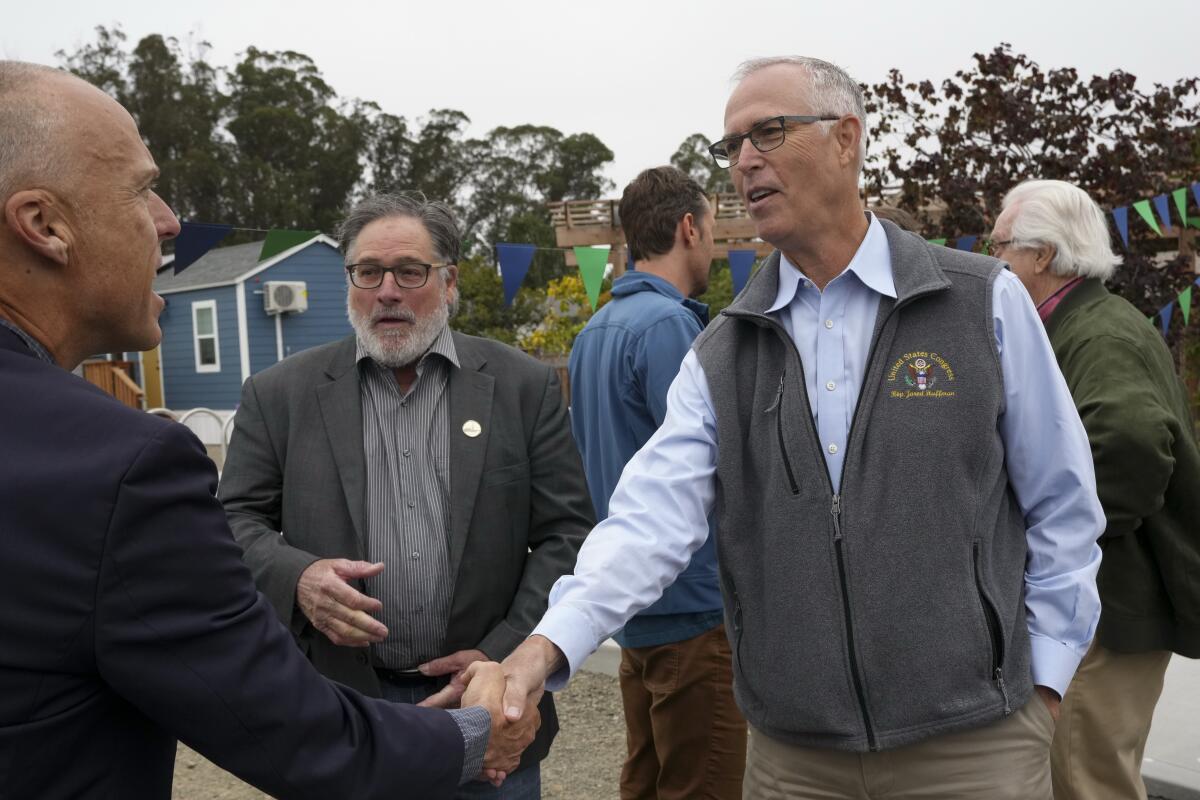
Rep. Jared Huffman, right, greets Marin County Executive Derek Johnson during the opening of a housing community in Point Reyes Station, Calif., on Wednesday.
(Godofredo A. Vasquez / For The Times)
“There are people of faith who sometimes think, well, that must be sad, that must be incomplete,” Huffman went on. “I find it’s just the opposite. It makes this world and our opportunity to be part of it more sacred.”
Growing up in the Mormon faith
Huffman, 62, grew up in a religious household in Independence, Mo. His family practiced an offshoot of the Mormon faith; as a youth, Huffman served in the priesthood.
He began to question the church and its teachings when his father died of lung cancer at age 56. Huffman was 19 and enrolled at UC Santa Barbara on a full-ride volleyball scholarship. (A lean 6-foot-3, Huffman was a three-time NCAA All-American and is a member of the school’s athletic hall of fame.)
“I think in hindsight ignorant faith kept me from coming to terms with the fact that he was dying, and it made it way more traumatic than it should have been,” Huffman said of his father’s passing. “I didn’t really own up to the reality of what was happening, because I was this person of faith who thought rotten things would never happen to me and my father.”

-
Share via
Shaken, Huffman spent years in a period of reflection and deep study — of various religions, spirituality, the Bible, which he can cite chapter and verse — before landing in his place of humanism and nonconformity.
After earning a law degree at Boston College, Huffman moved to the Bay Area and served as a senior attorney for the Natural Resources Defense Council, the environmental group. His political career began in 1994 with his election to the Marin Municipal Water District. Huffman served for 12 years, until his election to the state Assembly. He won his congressional seat in 2012.
Huffman’s secularism never came up, he said, until his arrival in Washington, where religiosity, God-fearing and worship of a higher power are taken as articles of faith.
“All of a sudden, religion is all around you and everyone wants to know your religion,” Huffman said. “I knew that I was a nonbeliever. I knew that I was a humanist. But that was a very private thing and I had kind of intended to keep it that way.”
Losing his religion
Two things changed.
First, Huffman’s mother died at age 87. She was fervently religious, Huffman said, and “I didn’t really want to break her heart and tell her how deep my nonbelief actually was.” (In his book, Huffman recounts an awkward scene where he takes the congressional oath of office for the first time on a hastily borrowed Bible, to please his proud mom.)
The second factor was the ascent of Trump, riding a wave of ardent evangelical support.
Huffman was put off by the hypocrisy of such a blasphemous president surrounding himself with extremists using the language and symbols of religious faith to enact what he perceived, and perceives, as a distinctly antidemocratic, un-American agenda.
“I was always uncomfortable with the way I saw religion encroaching into government in Washington,” Huffman said. “My previous concerns were heightened by an order of magnitude because of what he did.”
Ignoring the counsel of family, friends and political advisors who, to a person, warned against it, Huffman revealed his religious disbelief in a series of statements and interviews in November 2017. At the time, the only member of Congress to ever publicly come out as an atheist was Rep. Pete Stark, who announced his sentiments in 2007; though the Fremont Democrat was reelected twice, he was eventually defeated by a Democratic rival who turned his lack of faith against him.
That rival was Eric Swalwell; make of it what you will.
Huffman braced for political blowback. There was none, though he’s gotten death threats and plenty of admonishments he’s bound for Hell.
(Meantime, the congressional ranks of the religiously unaffiliated have grown to include Democratic Reps. Yassamin Ansari of Arizona and Emily Randall of Washington and Republican Rep. Abraham Hamadeh of Arizona.)
In the first election after his announcement, Huffman was returned to Washington with 77% of the vote. He’s won reelection three times since, with never less than 72% support. “It turns out [constituents] don’t much care what my religion is if I’m doing good work,” Huffman said, “and that’s pretty great in my opinion.”
He underscored the sentiment with a hearty bite of his tuna melt.
The book Huffman has coming out next month — with chapters that include “Breaking Faith,” “Christian Privilege” and “Christian Zionism” — is a work that explains his personal evolution and expresses a dire fear the country is headed, if unchecked, toward a system of authoritarian theocracy.
He describes the Christian nationalism that informed the attempted coup on Jan. 6, 2021, and explains the biblical prophecies behind the messianic support among some Trumpian true-believers.
“The book is not so much about humanism,” Huffman said. “It is about the fight to protect our secular democracy, which, I think, is the bedrock of America as we know it.”
The dedication reads, “For everyone who refuses to bow.”
What else you should be reading
The must-read: 14 propositions that could remake California taxes, housing, healthcare and elections
The deep dive: Even without birthright citizenship, Supreme Court co-signs much of Trump’s immigration agenda
The L.A. Times Special: The right and left need to control the radicals in their own parties
Until next time,
mzb
—
Was this newsletter forwarded to you? Sign up here to get it in your inbox.