nominee

Trump flouts lower court rulings in unprecedented display of executive power

When a federal judge shot down a Trump administration policy of holding immigrants without bond last December, it seemed like a serious blow to the president’s mass deportation effort.

Instead, a top Justice Department official insisted the ruling wasn’t binding, and the administration continued denying detainees around the country a chance for release.

By February, the district court judge, Sunshine Sykes, was fed up. Sykes, a nominee of President Biden, accused Trump officials in a ruling that month of seeking “to erode any semblance of separation of powers,” adding that they could “only do so in a world where the Constitution does not exist.”

Hardly isolated, the case illustrates a broader pattern of defiance of lower court decisions in President Trump’s second term.

The failure of Trump officials to follow court orders has been highlighted most notably in individual immigration cases. But a review of hundreds of pages of court records by the Associated Press also shows an extraordinary record of violations in lawsuits over policy changes and other moves.

In the administration’s first 15 months in office, district court judges ruled it was violating an order in at least 31 lawsuits over a wide range of issues, including mass layoffs, deportations, spending cuts and immigration practices, the AP’s review of court records found. That’s about 1 out of every 8 lawsuits in which courts have at least temporarily blocked the administration’s actions.

The Trump administration’s power struggle with federal courts — which is testing basic tenets of U.S. democracy — reflects an expansive view of executive authority that has also challenged the independence of federal agencies, a president’s ethical obligations and the U.S. role in the international order.

Widespread noncompliance found

The Trump administration violations in the 31 lawsuits are in addition to more than 250 instances of noncompliance that judges have recently highlighted in individual immigration petitions — including failing to return property and keeping immigrants locked up past court-ordered release dates.

Legal scholars and former federal judges said they could recall at most a few violations of court rulings over the full four-year terms of other recent presidential administrations, including Trump’s first time in office. They also noted previous administrations were generally apologetic when confronted by judges; the Trump administration’s Justice Department has been combative in some cases.

“What the court system is experiencing in the last year and a half is just qualitatively completely different from anything that’s preceded it,” said Ryan Goodman, a law professor at New York University who studies federal courts and is tracking litigation against the Trump administration.

Though Trump officials eventually backed down in about a third of the 31 lawsuits, legal experts say their treatment of court orders poses serious dangers.

“The federal government should be the institution most devoted to the rule of law in this country,” said David Super, a constitutional law scholar at Georgetown University. “When it ceases to feel itself bound, respect for the rule of law is likely to break down across the country.”

The White House’s aggressive policy moves have prompted a barrage of lawsuits — more than 700 and counting.

Higher courts boost Trump efforts

The AP’s review also found that higher courts, including the Supreme Court, overruled the district courts and sided with the White House in nearly half of the 31 cases. Critics say those decisions are emboldening the administration to ignore judges’ orders.

White House spokesperson Abigail Jackson said the higher courts had overturned “unlawful district court rulings.” The administration will “continue to comply with lawful court rulings,” she added in a written statement.

“President Trump’s entire Administration is lawfully implementing the America First agenda he was elected to enact,” the statement said.

Among other instances of noncompliance, judges found the White House defied rulings when it deported scores of accused gang members to a notorious prison in El Salvador, withheld billions of dollars in foreign aid and failed to restore programming at the Voice of America. The three cases date to the first few months of the new administration, but judges have continued to find violations since then, including in two cases in April.

“The danger is that this gets normalized,” said JoAnna Suriani, counsel at the nonpartisan group Protect Democracy, which is tracking noncompliance cases. The group is also involved in litigation against the administration.

‘Ham-handed,’ ‘hallucinating’

In October, U.S. District Judge William Smith took little time to conclude Homeland Security officials were flouting one of his orders. Smith, a nominee of President George W. Bush, had blocked them from making billions of dollars in disaster relief funding to states contingent on cooperation with the president’s immigration priorities.

The Department of Homeland Security responded by keeping the immigration requirement on some grants, but making it contingent on a higher court overriding Smith’s injunction. The judge called the move “ham-handed” and said the agency was trying to “bully the states.”

In a case over the suspension of refugee admissions, U.S. District Judge Jamal Whitehead, a Biden nominee, accused the Justice Department last May of “hallucinating new text” in an appellate court order and “rewriting” it to achieve the government’s preferred outcome.

In four additional cases the AP reviewed, judges stopped short of a clear written finding of noncompliance but still criticized the administration’s response to their orders.

Of the judges who have confirmed violations, 22 were appointed by Democratic presidents and seven by Republican presidents.

Former federal judges Jeremy Fogel and Liam O’Grady said jurists are losing trust in the integrity of the Department of Justice.

That’s making them “more aggressive in accusing the government of bad faith,” said O’Grady, who along with Fogel is part of the nonpartisan democracy group Keep Our Republic.

Fogel said judges are also getting frustrated.

“They make orders and the orders don’t get complied with, and then they have to inquire why the orders are not being complied with, and that’s where it gets very mushy and very political,” he said.

Education case raises alarms

In Eureka, Calif., school administrator Lisa Claussen is worried about the impact on her students’ mental health if a judge does not find the Education Department in violation of a court order on federal grants.

Grant money allowed the school district in the poor coastal community in Northern California to hire more than a dozen psychologists and social workers to help students struggling with drug use and suicidal thoughts.

Education officials in the Trump administration told schools in California and other states last year that it was discontinuing the grants; the administration opposed diversity considerations in the grant process.

U.S. District Judge Kymberly Evanson blocked the move permanently in December, but California and 15 other states now say the administration is making an end run around her injunction by imposing new rules, including an initial limit of six months of funding.

Attorneys for the Education Department said they wanted to see whether schools were making progress on performance goals before releasing additional funds. The judge’s order did not block the six-month limit, they added in a court filing.

Evanson, a Biden nominee, has yet to rule.

In the absence of a one-year funding guarantee, Eureka City Schools and other districts say they have already issued layoff notices to mental health providers or eliminated positions.

“We have many kids who don’t trust adults for very good reason, and to be able to just swipe this grant like they’re doing … ,” Claussen said in a phone interview, her voice trailing off. “We didn’t do anything wrong.”

Justice Department response

In court filings, Justice Department attorneys have generally disputed accusations that the government was not complying. They have argued over the meaning of words, cited favorable appellate court rulings and said they were acting outside the scope of the court’s order, among other legal maneuvering.

Outside of court, Trump and White House officials have railed against federal judges. Vice President JD Vance has even suggested the president could ignore court orders.

Will Chamberlain, senior counsel with the conservative legal advocacy group the Article III Project, said many of the judges who have found violations are ignoring laws that clearly prohibit their rulings.

Trump officials are “generally complying, appealing and winning,” he said. “If they were defying orders left and right, they’d be losing them.”

A justice’s rebuke

In March, a federal appeals court ruled Sykes, the judge in California, had probably exceeded her authority in requiring bond hearings nationwide and blocked her February decision.

The outcome was not unusual.

In 15 of the 31 lawsuits the AP reviewed, an appellate court or the Supreme Court either allowed the administration’s underlying policy, limited the district court’s efforts to correct or punish the noncompliance, or both.

Supreme Court Justice Sonia Sotomayor criticized her fellow justices after one such ruling.

“This is not the first time the Court closes its eyes to noncompliance, nor, I fear, will it be the last,” she wrote in June in a dissent joined by the court’s two other liberal justices. “Yet each time this Court rewards noncompliance with discretionary relief, it further erodes respect for courts and for the rule of law.”

Thanawala writes for the Associated Press. AP writer Michael Casey in Boston contributed to this report.

Source link

Trump pulls nomination for stalled surgeon general nominee Means and says he’ll put forth Saphier

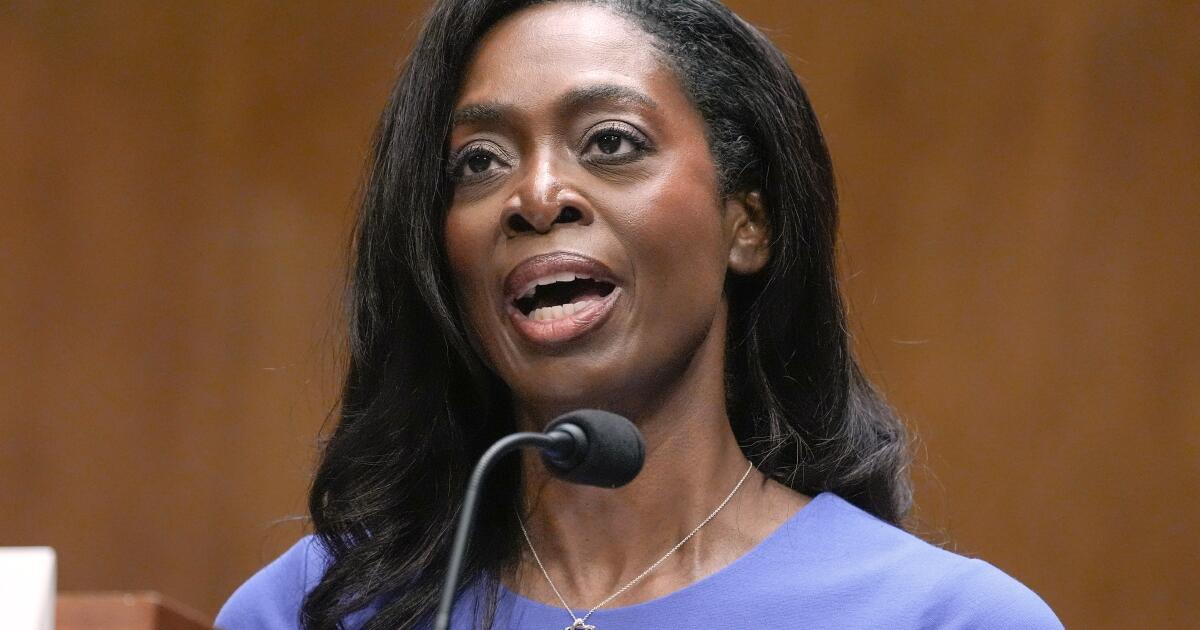
President Trump says he’s nominating Fox News Channel contributor Nicole Saphier for surgeon general after Casey Means’ path forward stalled in the Senate over questions about her experience and her stance on vaccines.

In a social media post Thursday, the Republican president said Saphier is “a STAR physician who has spent her career guiding women facing breast cancer through their diagnosis and treatment.”

Senators of both major political parties grilled Means on her vaccine stance and other health topics during a tense confirmation hearing, deepening doubts about her ability to secure the votes she needs for the role.

Earlier Thursday, Trump on social media commended Means as “a strong MAHA Warrior,” also criticizing the “intransigence and political games” from GOP Sen. Bill Cassidy of Louisiana, who interrogated Means about vaccines during the hearing.

The withdrawal of Means’ nomination to be the next U.S. surgeon general is a blow to Health Secretary Robert F. Kennedy Jr. and his movement, which championed Means for the role as the country’s top doctor despite her nontraditional path in medicine and some controversial past remarks on vaccines and other health topics.

The withdrawal comes after tense exchanges between Means and lawmakers of both parties threw into question whether she could secure enough votes to advance out of the Senate health committee. Her nomination had languished since her confirmation hearing in late February, even as activists from Kennedy’s Make America Healthy Again movement orchestrated a push to support her bid by surging phone calls to Republican senators Lisa Murkowski of Alaska and Susan Collins of Maine, who had both indicated reservations with the pick.

In nominating Means last May, Trump sought to hire a close ally of Kennedy as the nation’s doctor. Means, a Stanford-education physician whose disillusionment with the healthcare system led to her career as an author and entrepreneur, promotes ideas popular with the MAHA movement, including that Americans are overmedicalized and that diet and lifestyle changes should be at the center of efforts to end widespread chronic disease.

Source link

Here’s who (we think) won the chaotic California gubernatorial debate

Eight candidates for California governor shared a stage for 90 minutes Tuesday night, their second of three scheduled debates before the June 2 primary.

My colleagues Gustavo Arellano and Mark Z. Barabak joined me to decide who the winner was, or if there was a winner at all.

Arellano: The real MVP in this debate? State Supt. Tony Thurmond.

He brought up his family story — child of a Panamanian immigrant who lost his parents young, someone familiar with “government cheese” as sustenance growing up — in a way that didn’t sound forced or pedantic.

He usually stayed within the time limits that were barely enforced by moderators. And he kept knocking down Chad Bianco again and again, drawing applause when he brought up the Riverside County sheriff’s takeover of hundreds of thousands of ballots.

Thurmond is the only gubernatorial candidate currently holding a statewide position, a former Richmond City Council member and Assembly member. “Elect someone with a lived experience,” he told the audience in his closing statement.

So why has Thurmond polled so low again and again to the point that he keeps not getting invited to debates and therefore not getting in front of California voters?

California has never elected a Black governor — in fact, the state is notorious for not voting in Tom Bradley in 1982 even though polls showed him leading George Deukmejian all the way to Election Day (the phenomenon of voters telling pollsters what they think they want to hear instead of what they actually feel is now known as the Bradley Effect).

As California’s Black population keeps shrinking, it would’ve been wonderful to see Thurmond do better than he has.

Chabria: Gustavo is spot on with his take on Thurmond. He came across as polished, capable and knowledgeable. But also, he’s just too far down in the polls for any kind of comeback.

In my mind, though, Xavier Becerra was the clear winner. No, he didn’t blow the other candidates away.

But he landed more than one punch that will almost certainly be on social media feeds for weeks to come, especially when he went at Republican Steve Hilton. Early on, he called President Trump “Hilton’s daddy.” Later, he quipped at Hilton, “We don’t need a talking head for Fox News to tell us how the government works.”

The debate was chaotic in more than one moment, but Becerra managed to get more than his share of airtime and use it wisely. Tom Steyer, the other Democratic front-runner, mired himself in wonk-talk. He wanted to get deep into policy, and got lost in complicated issues such as oil refineries.

Steyer didn’t have a single memorable line, though his closing statement did redeem him somewhat. He called himself the “change maker,” and promised, “if you want change, there is only one person on this stage they are afraid of” — they being tech titans, oil companies and other gods of industry.

It was the same for Katie Porter and Matt Mahan, who didn’t do anything wrong, but also, didn’t break out.

But those back-and-forths of Becerra and Hilton are priceless because they’re quick and shareable. I won’t be surprised to see voters drift Becerra’s way, even if only a bit.

Barabak: No runs, no hits, no errors. Seven men — and one woman — left standing.

I didn’t see, or hear, anything that seems very likely to drastically shake up or dramatically reorder the governor’s race. No breakout performance that will launch any of the candidates into clear-cut front-runner status. No major gaffes to leave any of the contestants sprawled on the killing floor.

So to that extent, I would score Becerra as the evening’s (modest) winner. He’s clearly having a moment, surging from political near-death to the top tier in polls. (Though, let’s be clear, it’s still a muddle, with several candidates bunched in the 15%-20% support range.)

There have been suggestions Becerra needs to show a bit more fight and he did so Tuesday, in particular taking on Hilton. Some of his jabs seemed a bit forced and stagy. (That line about Trump as “Hilton’s daddy.”)

Better, as Anita noted, was the jab from the former congressman, state attorney general and Biden cabinet secretary about a Fox “talking head” explaining how government works.

I found Porter to be crisp and authoritative on policy; Steyer to be repetitive (I’m the only change agent on this stage, look how much money is being spent to stop me — though it’s a small fraction of the sum he’s sunk into his vanity-cruise campaign); Mahan and Antonio Villaraigosa to be largely afterthoughts, and Bianco to have all the warmth and appeal of the grouchy old man telling kids in the neighborhood to get off his damn lawn!

The Riverside County sheriff seemed not to be running for governor of California, but rather mayor of MAGA-ville, a strategy apparently intended to nab one of two spots in the June primary, allowing him to go on to crushing defeat in November.

I agree that perhaps the night’s most surprising performance came from Thurmond. The state schools superintendent is mired in bare single digits in polls and only just made the debate stage after being left out of last week’s meetup in San Francisco.

His chances of being California’s next governor are somewhere between zero and nil, which is why he escaped serious scrutiny. That said, he made the most of the 90 minutes on stage, laying out his compelling up-from-poverty life story and seeming to relish taking on Bianco in particular.

Too little, too late. But Thurmond certainly acquitted himself well.

What else you should be reading
The must-read: ‘This is like the Russian mafia’: L.A. judge elections see unusual drama
The deep dive: Gavin Newsom wants to break up with Elon Musk. Tesla is making that difficult.
The L.A. Times Special: John Seymour, Anaheim mayor and U.S. senator, dies at 88

Stay Golden,

Anita Chabria

Was this newsletter forwarded to you? Sign up here to get it in your inbox.

Source link

White House withdraws hospitality executive as nominee to lead the National Park Service

President Trump is withdrawing his nomination of a hospitality company executive to lead the National Park Service, the White House announced Monday.

The withdrawal of nominee Scott Socha comes as the park service has been shaken by widespread firings as part of the Trump administration’s pledge to sharply reduce its size.

Socha said in a statement that he was dropping out of consideration for the post for personal reasons.

The park service is currently overseen by an acting director, agency comptroller Jessica Bowron. It did not have a Senate-confirmed director during Trump’s first term, when it was led by a series of acting directors.

Socha is president for parks and resorts at Buffalo, N.Y.-based Delaware North, which has service contracts with numerous parks and describes itself as one of the world’s largest privately owned entertainment and hospitality companies. A White House spokesperson had said when he was nominated in February that Socha was “totally qualified” to execute Trump’s plans for the park system.

But some conservation groups had questioned whether Socha’s private sector work provided the experience he would need to oversee hundreds of national parks and monuments that range from the Statue of Liberty and other cultural sites to remote sites in the Utah desert.

The Associated Press sent email messages to the White House and the Interior Department seeking comment on Socha’s withdrawal.

Thousands of employees have been fired or otherwise left the park service since Trump took office.

Emily Douce with the National Parks Conservation Assn., an advocacy group, said Monday that the next director for the service needs to “undo the damage.”

“It’s very unfortunate that our parks have gone more than a year without a permanent director at a time when they need strong, steady leadership the most,” Douce said.

The Republican administration’s proposed budget for next year would reduce staffing to 9,200 employees. That’s down almost 30% compared to 2025 levels.

The park service’s operating budget would be cut by more than $1 billion, to $2.2 billion, for the 2027 fiscal year that starts in October.

Similar cuts proposed for 2026 were blocked by lawmakers in Congress after park supporters and former employees warned the administration’s proposal would have effectively gutted the agency.

The administration also has faced blowback for the removal or planned removal of national park exhibits about slavery, climate change and the destruction of Native American culture. In February, a federal judge said an exhibit about nine people enslaved by George Washington must be restored at Washington’s former home in Philadelphia after the Trump administration had taken it down.

Administration officials have said they are removing “disparaging” messages under an order last year from Trump. Critics accuse it of trying to whitewash the nation’s history.

Under Trump’s interior secretary, Doug Burgum, the park service has started charging millions of international tourists who visit U.S. parks each year $100 each to visit sites including Yellowstone and Grand Canyon. The service also has put Trump’s image onto its annual passes for U.S. citizens, drawing a lawsuit from environmentalists who said the move was illegal.

Brown writes for the Associated Press.

Source link

Column: After Swalwell scandal, a ‘safe choice’ for Democrats emerges

Xavier Becerra seems like the type of steady, trustworthy fellow you’d like your daughter to marry. But she’s attracted to a charming party animal.

Then the flashy dude does something really stupid and repulsive. Daughter is jarred into her senses and decides to size up the unexciting but reliable guy.

That’s how I’m seeing the suddenly captivating contest to succeed termed-out Gov. Gavin Newsom.

OK, it’s not a perfect analogy. Becerra is 68, been happily married for 37 years and the couple have three grown children. But the principle’s the same: He’s the safe choice. The hot other character merely fooled lots of people for a while.

You’re reading the L.A. Times Politics newsletter

George Skelton and Michael Wilner cover the insights, legislation, players and politics you need to know. In your inbox Monday and Thursday mornings.

Becerra is suddenly getting a hard look because the fast-stepping, front-running Democrat Eric Swalwell revealed himself to be totally unworthy of public office.

Five women accused the married Bay Area congressman of sexual misconduct, including rape. He denied the allegations but apologized to his wife for past “mistakes in judgment.” Donors, endorsers, staffers and voters immediately fled his campaign. And he quickly slunk away.

And Becerra surged.

Why?

“People are looking for something stable,” Becerra answered when I asked. “Everybody likes pizzazz and glitter. Then all of a sudden their hero falls from grace. And they look for who they can trust.”

Dan Schnur, who teaches political communications at USC, UC Berkeley and Pepperdine, says: “Democrats had a near-death experience with Swalwell. They don’t seem to be in the mood to take more risks.”

Schnur calls Becerra “this year’s version of Joe Biden’s 2020 campaign.” He’s the safe choice. “Sometimes being ‘none of the above’ is good enough.”

Since Swalwell’s collapse, the once-floundering Becerra has had a meteoric rise in the polls.

A survey conducted for the state Democratic Party showed Becerra rising by 10 points from single digits to tying Tom Steyer, a billionaire hedge fund founder turned climate warrior. Close behind was former Orange County Rep. Katie Porter.

Those three are now the leading Democratic competitors for a slot on the November ballot. The top two vote-getters in the June 2 primary, regardless of party, will advance to the general election.

Republican former Fox News host Steve Hilton was leading the entire field in the poll, followed closely by Riverside County Sheriff Chad Bianco.

Steyer and Porter are both liberals in their ideology and personalities. Neither are flamethrowers, but they‘re fiery. In contrast, Becerra also is an ideological liberal, but with a low-key demeanor that might cause one to mistake him for a political moderate.

San José Mayor Matt Mahan is clearly a Democratic centrist. But in this era of intense polarization, moderation may be a hard sale. At least, it has been so far for Mahan.

Among those six Democratic and Republican candidates, Becerra boasts by far the most outstanding political resume.

He was U.S. secretary of Health and Human Services under President Biden. Before that as state attorney general, California’s mild-mannered “top cop” showed his aggressiveness by suing the first Trump administration 123 times and winning the vast majority of cases. He also served 12 terms in Congress from Los Angeles and became part of the Democratic leadership. And he served one term in the state Assembly.

That’s an impressive list. But Schnur says Becerra was “the least impressive” candidate in a 90-minute televised debate last week.

“He talked in very vague generalities,” the former political operative says, but adds: “In the middle of the other candidates’ drama and emotional outbursts, he seemed very calm and safe.”

Some pundits and pols have been calling on Becerra to show more fire. But that’s not him. He’s guarded and understated. It’s how he’s wired. If he attempted a personality change, it probably wouldn’t work. There’s a risk of it seeming contrived and phony.

But Becerra should be more specific on issues. Exactly how would he make life better for Californians?

His basic answer when asked how he’d solve a given problem pestering California is essentially: Trust me. I’ll meet with all sides and figure it out.

That’s not just a cop-out. It’s his pragmatic modus operandi.

That reserved style prompted this shot during the debate from Porter, who tends toward specificity:

“Mr. Becerra, you have all these lovely plans. But there are never any numbers, any revenue plan, any details. … The how, the why and how much, it’s all missing.”

Becerra responded with some rare emotion: “That’s very rich to hear from someone who’s never had to actually run a government.” The former Cabinet secretary said he’d balanced four federal HHS budgets that were larger than the California state budget.

I asked Becerra about some issues last week. Here’s partly what he said:

Housing costs: Expedite building by streamlining more regulations. “We’ll continue to have rules, but let’s make them smart rules.”

Gas prices: Keep more refineries from closing. “Let them know they can operate and produce and not lose money. That’s an easy one.”

High-speed rail: ”We’re going to build the bullet train, but not this bullet train. It’s too expensive. Sit everybody down and come out with a position.”

Banning new gas cars by 2035: Is Newsom’s goal realistic? “Seeing what I see, no. We can’t make it by ‘35, but we can make it.”

But let’s be honest. Elections usually turn more on likability than policy positions.

“Decency may be a quality that goes a long way” in the governor’s race, says longtime Democratic strategist Darry Sragow. “In part that’s because of the Swalwell revelations and also because of Trump, who’s not decent. Decency may be what people are looking for.”

But Democrats are riled up by Trump and they’re also demanding backbone and fight.

Many are eyeing Becerra as someone perhaps worth partnering up with. A bit more passion from him could help sustain their interest.

What else you should be reading

The must-read: The congressional landmine stirring fears about the midterm election — and a Trump power grab
Brace yourself: Voter ID controversy headed for California with initiative on November ballot
The L.A. Times Special: How a Trump-endorsed Republican could become California’s next governor

Until next week,
George Skelton


Was this newsletter forwarded to you? Sign up here to get it in your inbox.

Source link

Sen. Thom Tillis will vote to confirm Trump nominee for Fed chair

Sen. Thom Tillis, R-N.C., said on Sunday that he will vote to confirm President Donald Trump’s nominee for Federal Reserve chairman after the Department of Justice assured him it has ended its investigation into current chair Jerome Powell. Photo by Bonnie Cash/UPI | License Photo

April 26 (UPI) — U.S. Sen. Thom Tillis, R-N.C., said on Sunday that he will end his blockade of Kevin Warsh’s confirmation as Federal Reserve chair after the Department of Justice ended its investigation into current chair Jerome Powell.

U.S. Attorney Jeanine Pirro on Friday said the Justice Department was ending its investigation into Powell over the Fed’s budget for renovations to its headquarters and has threatened him with criminal charges over testimony he gave about the costs.

Tillis made the announcement during an interview on NBC News’ “Meet The Press,” because the department assured him that it has “completely and fully ended” the investigation.

He had previously said he would block all Trump nominees until the probe was dropped.

“We worked a lot over the weekend to make sure that we were very clear that we have assurances from the Department of Justice that I needed to feel like they were not using the department as a weapon to threaten the independence of the Fed,” Tillis told NBC News.

The Justice Department launched a criminal investigation into Powell in January after President Donald Trump questioned the Fed being over budget on renovations to its headquarters in Washington, D.C.

The investigation was condemned by several members of Congress as improper, including Tillis, because it was seen as politically motivated punishment from Trump for not setting interest rates at levels he preferred.

Pirro said Friday that she has asked the Federal Reserve’s inspector general to investigate the renovation costs, which she said is “billions of dollars” over budget, and that she expects a “comprehensive report” on the matter.

She noted, however, that she “will not hesitate to restart a criminal investigation should the facts warrant doing so.”

President Donald Trump and first lady Melania Trump participate in the 2026 White House Correspondents’ Association Dinner in Washington on April 25, 2026. Photo by Yuri Gripas/UPI | License Photo

Source link

Vance, eyeing 2028, navigates a diplomatic minefield with Iran

Reporters assigned to travel aboard Air Force Two were told to prepare for an early morning departure on Tuesday for Islamabad until an unexplained delay — followed by a detour by Vice President JD Vance to the White House — revealed clues that something was wrong.

Iranian diplomats had not yet responded to U.S. proposals intended to form the basis of a new round of talks. Some were questioning whether they would attend at all. Had he departed as planned, Vance risked a humiliation, spending hours flying to Pakistan only to be stood up on arrival.

A crisis meeting at the White House led President Trump to announce an indefinite extension to a ceasefire deadline that had been set as a pressure tactic. Now, unable to bring the Iranians to heel, that pressure was suddenly off.

It was an early lesson for Vance in the many ways high-stakes diplomacy can veer off-course.

“There are obvious risks for Vance,” said Chester Crocker, who served as an assistant secretary of State in the Reagan administration, “being associated with failure or with a dubious deal.”

Trump’s aides are clear on the stakes in negotiations with Iran over its nuclear program and an end to the war. Control of the Strait of Hormuz could determine global oil prices for years. Any final deal will shape whether Americans ultimately conclude the fight was worth it — and could sway the outcome of the midterm elections.

But for America’s lead negotiator, the stakes are also personal.

Vance, a diplomatic novice, has found himself at the helm of an effort rife with political risk that has stymied seasoned diplomats ahead of an anticipated run for president.

You’re reading the L.A. Times Politics newsletter

George Skelton and Michael Wilner cover the insights, legislation, players and politics you need to know. In your inbox Monday and Thursday mornings.

The potential payoff is substantial, placing Vance at the center of an international stage with the power to end a historically unpopular war.

But he also may be forced to attach his name to a nuclear deal that provides Tehran access to billions of dollars in sanctions relief, in exchange for limits on its nuclear work that will ultimately expire over time, under conditional monitoring access for international inspectors — an agreement with striking echoes to a 2015 nuclear deal negotiated by a Democratic administration that was disparaged by his party for over a decade.

Vance is negotiating not on his own terms, but on behalf of a mercurial president whose decisions will ultimately determine whether an agreement can be reached. And the Iranians know that Trump’s days in office are numbered, with Vance, a war skeptic, possibly in line to succeed him.

One U.S. official familiar with the negotiations said the vice president is “a pragmatist,” realistic about the prospects of a deal.

“What he has to gain is an image that he can operate effectively on the world stage on a fraught issue. Even if he will give credit to the president, he will be seen as capable of resolving really hard, security-related problems,” said Dennis Ross, a veteran diplomat on the Israeli-Palestinian conflict who served in the George H.W. Bush, Clinton and Obama administrations. “What he has to lose is that he was given the role and did not succeed.”

Failure could raise doubts about his statecraft. But even success at the negotiating table could result in an agreement that turns off Republican voters he may need in a 2028 presidential bid.

“Vance is put in an impossible position,” said Arne Westad, a professor of history at Yale.

“Any deal with the current Iranian regime will be seen as problematic by many Republicans,” Westad said. “If he fails to secure a deal, he will be attacked by those who want an end to the U.S. war — and be seen as ineffective by the president.”

Reputation ‘on the line’

Trump has publicly acknowledged that Vance, a Marine Corps veteran who has consistently opposed U.S. military engagements in the Middle East, had reservations over launching the Iran war in the first place. “He was, I would say, philosophically a little bit different than me,” the president told reporters in March. “I think he was maybe less enthusiastic.”

For that reason, according to Iranian state media reports, Vance was seen by Tehran as their preferred interlocutor in negotiations. Iranian officials expressed gratitude when, during fevered talks ahead of the initial announcement of a ceasefire, they learned that Steve Witkoff, the president’s roving negotiator, had recommended that the vice president be included in the delegation — an exceptional gesture that marked Washington’s highest-level engagement with the Islamic Republic in history.

Republican strategists said Vance’s participation is a demonstration that Trump trusts him, an essential trait for any future Republican presidential nominee and aspiring heir to the MAGA movement.

“It’s rare that a vice president has been put in the position of directly negotiating with a foreign adversary,” said Terry Nelson, a longtime Republican media strategist. “We are engaging a very senior political leader in negotiations with a country that has killed U.S. soldiers and sown chaos in the region. I do think it’s an indication of our resolution and seriousness.”

Whit Ayres, a veteran Republican pollster who has consulted Republican senators and governors for more than three decades, said the vice president’s appointment as lead negotiator “elevates Vance as Trump’s heir-apparent even more than before.”

“Whether that becomes a plus or a minus depends on the outcome of the negotiations,” Ayres added, “and Trump’s ultimate standing with the Republican electorate, both of which are unknowns.”

Talks are currently deadlocked over long-standing demands from Tehran that its leadership has held since the early 2000s, when previously undisclosed nuclear activities first triggered international alarm over Iran’s expanding program.

Iran has periodically accepted temporary limits on its nuclear work — pausing uranium enrichment during talks and, under the 2015 deal, committing to a prolonged cap on enrichment at levels beyond any clear civilian need. But it has always insisted on a “right to enrich” on its own soil, rejecting U.S. attempts to permanently end the program as a foreign attempt to thwart Iran’s scientific progress.

Returning from the first round of ceasefire negotiations, Vance dismissed that position, articulated to him in Islamabad by the speaker of Iran’s Parliament.

“He said, ‘We refuse to give up the right to enrichment,’” Vance said. “And I thought to myself, you know what, my wife has the right to skydive, but she doesn’t jump out of an airplane, because she and I have an agreement that she’s not going to do that, because I don’t want my wife jumping out of an airplane.”

Echoes of a broken deal

The 2015 deal known as the Joint Comprehensive Plan of Action — negotiated by veteran, nonpolitical U.S. diplomats and nuclear scientists over two years of near-constant negotiations — removed roughly 98% of Iran’s nuclear stockpile from the country, while keeping the country’s nuclear infrastructure largely in place, save for the decommissioning of a heavy-water plutonium reactor that could have provided Tehran with a second path to a nuclear bomb.

Under the agreement, Iran consented to limit its use of advanced centrifuges for 10 years, and to restrict uranium enrichment to below weapons-grade levels for 15 years. Inspectors from the U.N.’s International Atomic Energy Agency were granted unprecedented access to monitor the program, though some of these enhanced inspection measures were set to expire after roughly two decades.

In exchange, Iran regained access to tens of billions of dollars of its frozen assets, and settled a long-standing legal dispute with Washington that led the Obama administration to transfer $400 million in cash to Tehran. The episode prompted scandal on the political right, which accused Democrats of fueling terrorism through the funding of Iran’s proxy militias.

Now, after just two weeks of negotiations, the Trump administration is already acknowledging that a final deal with Iran would rely on a familiar formula: temporary caps on Iran’s nuclear work in exchange for substantial sanctions relief. Trump withdrew from the JCPOA in 2018.

Iran comes to the talks with added leverage today, able and willing to disrupt the flow of 20% of the world’s energy through the Strait of Hormuz. And the United States is negotiating alone, without its former partners in the “P5+1” — Russia, China, France, the United Kingdom and Germany — at its side.

Anna Kelly, principal deputy press secretary at the White House, told The Times that “after Democrats like Joe Biden and Barack Hussein Obama weakened our country on the world stage, President Trump has effectively restored American strength with the help of Vice President Vance, who is doing a great job leading the United States in negotiations with Iran.”

“The president and his entire national security team have an incredible track record in making good deals for our country, and the American people can rest assured that the United States will not enter any agreement that does not put our national security interests first,” Kelly said.

Matt Gorman, a longtime Republican strategist and chief communications officer at Targeted Victory, said the JCPOA was viewed particularly critically because it “was negotiated in peacetime.”

“Vance would essentially be ending a war, if successful, and that allows him to make a very different argument,” Gorman said.

The vice president is currently polling as the front-runner for the 2028 Republican presidential nomination, ahead of Marco Rubio, who — despite serving as Trump’s secretary of State and national security advisor — is not directly involved in the Iran talks.

Vance’s role at the negotiating table could help position him as a peacemaker, Crocker noted, distinguishing him from advocates of the war entering the presidential primaries.

But Vance “has been tasked by a president incapable of staying on message, with limited stores of credibility with adversaries as well as allies and a disregard for the complexities of the issues,” said Barbara Bodine, former U.S. ambassador to Yemen. “His task? A credible end to the war without clear objectives.”

“At best, this will be a faux-gilded JCPOA 2.0. Victory will be declared to no applause. On the line is not just Vance’s own reputation, but a demerit in his run for the 2028 presidency,” Bodine added. “The Iran portfolio was no gift.”

What else you should be reading

The must-read: How a Trump-endorsed Republican could become California’s next governor
The deep dive: Palisades reservoir that was empty during fire is dry again. Residents aren’t happy about it
The L.A. Times Special: The Flores twins built a drug empire with El Chapo — then betrayed him

More to come,
Michael Wilner

Was this newsletter forwarded to you? Sign up here to get it in your inbox.

Source link

Fed chair nominee Warsh rejects ‘Trump sock puppet’ label at Senate hearing

Kevin Warsh, the man nominated to lead the Federal Reserve, the world’s most important financial institution, told the US Senate Banking Committee on Tuesday that he had made no secret agreements with the White House over interest rate policy, defending his professional integrity.


ADVERTISEMENT


ADVERTISEMENT

He said he would act independently if confirmed to succeed Jerome Powell, despite continued public pressure from US President Donald Trump for lower borrowing costs.

The question of that independence was put sharply to him during the hearing, when Republican Senator John Kennedy asked whether he would be Trump’s “human sock puppet”. Warsh replied: “Absolutely not.”

His comments came amid broader concerns on Capitol Hill about the future direction of the central bank, with lawmakers divided over his past record and approach to monetary policy.

Warsh insisted that the President had never asked him to commit to any specific interest rate path and said he would not have agreed to such a request.

The hearing highlighted the significant pressure facing the Federal Reserve as it maintains its independence while addressing inflation, which remains at 3.3%.

Just hours before the session began, US President Donald Trump stated in a CNBC interview that he would be disappointed if Warsh did not immediately implement rate cuts.

This current friction suggests that the White House may struggle to secure the necessary votes to confirm Warsh before Powell’s term as Fed Chair expires on 15 May.

Democratic opposition and Republican dissent

Democratic senators were particularly vocal in their scepticism, accusing Warsh of shifting his economic stance to suit the political climate.

US Senator Elizabeth Warren labelled the nominee a “sock puppet”, suggesting his installation would facilitate an “illegal takeover” of the institution.

Critics also pointed to his historical record, alleging that he favoured higher rates during Democratic administrations but has become more dovish under Republican leadership.

US Senator Ruben Gallego cited reporting from the Wall Street Journal (WSJ), which claimed the President had previously urged Warsh to reduce borrowing costs. Warsh responded by stating that such reports were based on inaccurate sources and reiterated that the independence of the Fed is “essential” for economic stability.

Despite Trump’s backing, the nomination also faces a critical roadblock within the Republican Party.

US Senator Thom Tillis, a Republican from North Carolina, reiterated his refusal to support Warsh as long as a Department of Justice investigation into Jerome Powell continues.

The probe, led by Assistant US Attorney Jeannine Pirro, is examining whether Powell committed perjury during testimony last year regarding the budget of a Federal Reserve building renovation project.

Tillis and other Republican colleagues have expressed their support for Powell, arguing that the investigation is meritless. According to Tillis, he will not vote for a successor until the “investigation is dropped,” a stance that effectively freezes the nomination in a closely divided committee.

Federal prosecutors have reportedly continued their efforts to access Fed records as recently as last week, even after a judge previously found no evidence to support the charges.

Legal and ethical hurdles

The proceedings also delved into Warsh’s personal financial interests and the logistical challenges of a potential leadership transition.

US Senator Elizabeth Warren raised questions about the nominee’s investments in private entities, including SpaceX and Polymarket, noting that the specific size of these holdings had not been fully disclosed to the public.

Warsh defended his position by stating that the Office of Government Ethics has already approved his plan to divest all assets within 90 days of his confirmation.

Compounding the uncertainty is the unique situation involving Jerome Powell.

Unlike most departing Chairs, Powell has indicated he intends to remain on the Federal Reserve’s governing board until his separate term ends in 2028, or until the perjury investigation is concluded.

This could create an awkward power dynamic where the former Chair sits alongside his successor, a scenario not seen in Washington since the late 1940s.

While US President Donald Trump has threatened to remove Powell from the board entirely, legal experts suggest such a move would be difficult, particularly given recent US Supreme Court precedents relating to the protection of Fed governors from political dismissal.

Source link

Trump’s US Fed nominee Warsh vows independence, says he’s no ‘sock puppet’ | Banks News

Kevin Warsh, United States President Donald Trump’s pick to lead the Federal Reserve, has addressed concerns about his independence pending his appointment to the bank amid fears that Trump could sway his decisions on monetary policy.

On Tuesday, Warsh — who served on the central bank’s Board of Governors from 2006 to 2011 — faced waves of criticism during a confirmation hearing of the Senate Banking Committee where Democrats voiced concerns about the Fed’s independence should he be appointed to lead the organisation.

Recommended Stories

list of 4 itemsend of list

Senator Elizabeth Warren of Massachusetts, the ranking Democrat on the committee, questioned Warsh’s independence, alleging that he would be a “sock puppet” for Trump, concerns he pushed back against and addressed in his opening testimony.

“I do not believe the operational independence of monetary policy is particularly threatened when elected officials — presidents, senators, or members of the House — state their views on interest rates,” Warsh said.

“Monetary policy independence is essential. Monetary policymakers must act in the nation’s interest . . . their decisions the product of analytic rigour, meaningful deliberation, and unclouded decision-making.”

Warsh, 56, also called for “regime change” at the US central bank, including a new approach for controlling inflation and a communications overhaul that may discourage his colleagues from saying too much about the direction of monetary policy.

Warsh blamed the central bank for an inflation surge after it slashed interest rates to nearly zero in the wake of the COVID-19 pandemic, a move that continues to hurt US households.

Concerned by the implications of artificial intelligence for jobs – expected to increase productivity – and prices, he said he would move quickly to see if new data tools could provide better insight on inflation, and would also discourage policymakers from saying too much about where interest rates might be heading.

“What the Fed needs are reforms to its frameworks and reforms to its communications,” the former Fed governor said. “Too many Fed officials opine about where interest rates should be … That is quite unhelpful.”

Warsh has also long been an advocate for shrinking the Fed’s $6.7 trillion balance sheet. In the Tuesday hearing, he said any such plans would take time and must be publicly discussed well in advance.

Jai Kedia, a research fellow at the Center for Monetary and Financial Alternatives at the libertarian Cato Institute, told Al Jazeera that there were many “encouraging” signs in Warsh’s candidacy.

“Warsh is presenting himself as a regime change candidate at a time when the Fed needs serious reform,” Kedia noted. “Particularly encouraging was his understanding of the negative effects of QE and his focus on reducing the balance sheet. He also correctly criticised mission creep and acknowledged that the Fed did better when it kept its focus on the dual mandate [of keeping inflation at 2 percent and increasing employment].”

Quantitative easing or QE is an unconventional monetary policy under which a central bank lowers interest rates, among other measures, to boost the economy, a step taken by central banks in several developed countries during the pandemic.

Warsh’s private investments, at well over $100m, are also under scrutiny. Among them are two holdings in the Juggernaut Fund LP, apparently part of his work advising for the Duquesne Family Office, the private investment firm of Stanley Druckenmiller.

Warsh’s nearly 70-page financial disclosure also showed that his other holdings include investments in Elon Musk’s SpaceX and the prediction trading platform Polymarket.

“I agreed to divest virtually all of my financial assets, the large majority of which will be divested” before taking office, Warsh said without giving any details.


Warsh noted that selling his holdings comes with challenges. He said that when that process is completed, he would have “virtually no financial assets” and “we’ll be sitting in something like cash”.

Warren, however, questioned him about the divestment plan. “Do we have any way to verify that, in fact, these sales will occur if we have no idea what’s in them?” she asked.

Political hurdles

The hearing quickly turned contentious, and the pace of Warsh’s confirmation process through the Senate remained in doubt.

He would not directly say that Trump lost the 2020 election – a statement of fact that Senator Warren said was a litmus test of Warsh’s independence from the Republican president who nominated him for the top Fed job.

Yet even amidst the focus on independence, Warsh needs 13 votes to clear the 24-member Senate Banking Committee.

North Carolina Senator Thom Tillis said he would vote against Trump’s nominee and join Democrats, which would create a 12–12 split. The committee has 13 Republican members and 11 Democrats.

Tillis said he would not vote for any Trump nominee until an investigation into current Fed Governor Jerome Powell, whose term ends May 15, is either concluded or called off. Last month, federal prosecutors said they found no evidence of wrongdoing. But Jeanine Pirro, the US Attorney for the District of Columbia, has not indicated that the investigation will be dropped.

Tillis said on Tuesday that he would support Warsh’s nomination once the probe into Powell is dropped.

“Today’s confirmation hearing underscored that Warsh is aiming for independence with guardrails,” noted Selma Hepp, chief Economist of Cotality, a market analytics company. “He rejected being a political ‘sock puppet’ and argued the Fed protects its autonomy by ‘staying in its lane.’ He offered no pre-commitment on rates, while emphasising inflation discipline, a large balance sheet, and a desire for clearer Fed communication.”

Noel Dixon, senior macro strategist at State Street, said that with Warsh, the US would have a “dovish-leaning Fed”.

“When a senator asked him if he would lower rates to 1 percent – I guess Trump had indicated that he would like to have rates below 2 percent – Warsh didn’t really say no to that,” Dixon noted. “He didn’t say that it would increase prices. He kind of leaned on it and said there would be a lagged effect, and he was just very noncommittal to that. So it’s almost like – just reading between the lines – he’s giving himself space to maintain possible justification for rate cuts by the end of the year.”

Trump has continued to pressure the central bank.

On Tuesday, he said he would be “disappointed” if the Fed did not lower interest rates.

Tuesday’s remarks follow comments in December, when the US president said he would not appoint anyone to lead the central bank unless they agreed with him.

“The public needs to know whether Mr. Warsh will have the courage of his convictions or if he’s willing to compromise his independence and accommodate more Wall Street deregulation,” Graham Steele, an academic fellow at the Rock Center for Corporate Governance at Stanford University, told Al Jazeera in an email.

Warsh has praised the administration for its push for increased bank deregulation. In a November 2025 op-ed for the Wall Street Journal, Warsh claimed that Trump’s “deregulatory agenda” is “the most significant since President Ronald Reagan’s”.

Source link

Column: Swalwell scandal exposed flaws in top-two primary

California Democrats caught a huge break with Eric Swalwell’s sexual assault scandal. It surfaced in early spring rather than midsummer.

Just think of the Democratic debacle that could have occurred.

What if the accusations of sexual misconduct, including alleged rape, had come to light after the gubernatorial candidate had triumphed in the June 2 primary and qualified for the November ballot?

Under California law, it would have been impossible to remove him from the ballot and insert a Democratic replacement.

“It would have been pretty devastating,” notes Assemblywoman Gail Pellerin (D-Santa Cruz), who heads the Assembly Elections Committee.

“It has given us a lot to think about.”

There’s a glaring flaw in California’s election system that should be fixed for the future. But exactly how is trickier than it might seem.

Here’s what I’m talking about:

Prior to April 10 — doomsday for Swalwell — the then-congressman from the East San Francisco Bay was leading the large field of Democratic candidates for governor. Just barely. But he was starting to pull away, based on polling and endorsements.

A survey conducted by the independent Public Policy Institute of California just before Swalwell’s accusers went public showed him leading all candidates — Democrats and Republicans — with 18% support among likely voters.

He was closely trailed by Republican Steve Hilton, a former Fox News host, with 17%. Another Republican and a Democrat — Riverside County Sheriff Chad Bianco and billionaire climate activist Tom Steyer respectively — were tied for third at 14% each. Democratic former Orange County Rep. Katie Porter followed at 10%.

You can now toss all those numbers in the trash. But the point is that Swalwell was headed for victory in the primary. His next stop was the governor’s mansion because no Republican has won a statewide race in California in two decades.

The Democratic front-runner was raking in endorsements from interest groups and democratic politicians. He was considered the safest bet in a generally unimpressive field, a regular middle-class guy — and a white male, the only ethnicity and gender that has ever been elected governor in California.

Former state Controller Betty Yee, a Democratic darkhorse candidate for governor, was pretty much on target when she observed after Swalwell’s campaign collapsed:

“The obsession with who looks the part [of governor] almost got us an alleged sexual predator in Sacramento — ignoring the reality we need to actually fix our fraught state.”

But what if the victims of Swalwell’s alleged sexual improprieties — five women at last count — had waited a few more months to go public? And that’s conceivable. After all, they had remained silent for years. Apparently the nightmare of their alleged assailant becoming governor inspired them to talk now.

Although Swalwell quickly dropped out of the race, there’s no way to erase his name from the primary ballot. But at least voters can choose among seven other “major” Democratic contenders.

If he had already won in the top-two primary, however, and a Republican had also qualified for the November ballot, Democratic voters would have been left high and dry.

Presumably no sane person, no matter how partisan, would vote to elect an alleged rapist as governor. But the only other choice would have been a Republican lackey of President Trump. He’d undoubtedly win by default in a landslide.

“If Democrats had been stupid enough to nominate Swalwell, they’d have been stuck with him,” says Tony Quinn, a Republican elections analyst.

“Even dying doesn’t get you off the ballot. You don’t want to be the party nominee? So what, you are.”

No write-in candidacies are allowed in California’s general elections, although they are in the primary. That’s an inexplicable flaw.

“I’ve thought for years there should be a write-in option to deal with such a problem,” says UCLA law professor Rick Hasen, an expert on elections law.

Also, he points out, California’s top-two primary system — which advances only the top two vote-getters regardless of party — “cuts out minor parties from being relevant. You ought to be able to write in a minor party candidate.”

One reason a candidate can’t be removed from the ballot, election officials claim, is that tens of millions ballots have to be printed early enough to mail to every registered voter one month before election day.

Nonsense. In this era of rapidly expanding technology, you’d think that dilemma could be resolved even within snail-paced government bureaucracies. If nothing else, mail out a supplemental ballot just for the governor’s race.

But a bigger question is exactly who would choose the replacement for a departed candidate.

In a presidential election, the party hierarchy — a convention or national committee — would choose another nominee.

But there are no party nominees in California’s top-two open primary system. Parties don’t choose candidates for the November election. Voters regardless of their party do. So, in Swalwell’s case, the Democratic Party alone wouldn’t be entitled to select his substitute — unless the law were changed.

Or, perhaps the No. 3 vote-getter in the primary could automatically be elevated to the general election. We then could wind up with two candidates from the same party. But at least there’d be a better choice than an alleged sexual predator.

“I kind of miss those days” when parties nominated, says Pellerin, who was Santa Cruz County’s chief elections official for 27 years. “It’s something I’ve been thinking about — whether this is the best primary system.”

As I recently wrote, my vote would be to junk the top-two system and return to pre-”reform” party-nominating primaries.

Advocates of the top two primary — including myself — thought it would produce more centrist officeholders. It really hasn’t. It has just caused additional problems — like occasionally sending two candidates of the same party to the November runoff.

Meanwhile, all California voters should be grateful that Swalwell’s accusers courageously went public in April, not August.

You’re reading the L.A. Times Politics newsletter

George Skelton and Michael Wilner cover the insights, legislation, players and politics you need to know. In your inbox Monday and Thursday mornings.

What else you should be reading

The must-read: Swalwell supporters scramble after he drops out of governor’s race. Who will benefit?
California love: Californians are pouring money into Democrats’ Senate races in other states
The L.A. Times Special: There’s a wide gap between rumor and fact. That’s where Eric Swalwell lurked

Until next week,
George Skelton


Was this newsletter forwarded to you? Sign up here to get it in your inbox.

Source link

Jackie Speier would like her former congressional colleagues to zip up and shape up

It seems like a simple ask that male politicians don’t sexually harass or even rape women, but also, it seems like an open secret in Congress that sexual misconduct is too common.

Take Eric Swalwell, whose epic political immolation has captivated this week’s national political news, including a TMZ-obtained video of the then-congressman bleary-eyed in a bathrobe on a yacht that was literally the least-worst revelation.

For years “there were swirling rumors about Eric,” former Rep. Jackie Speier told me. Speier in 2018 thought she’d put in place tough new rules to stop sexual misconduct among her former colleagues, and the type of backroom shrugs that allowed men to prowl unchecked.

But despite her efforts, Speier, who represented a part of the Bay Area near Swalwell’s district until 2023, said the problem remains Congress itself, and the “crippling” power that elected officials have over their staffs. Don’t get her started on how that power imbalance is even worse for young lobbyists.

“I’ve always said that Congress is Hollywood for ugly people,” she said. “It’s a whole environment that becomes, I think, toxic.”

But also one that, she added, isn’t inevitable.

The 2018 change

In 2017, the #MeToo movement had swept into the public consciousness and ignited calls for change.

Armed with that outrage and the roiling fire of public opinion, Speier set out to change archaic rules that governed how sexual misconduct was handled in Congress.

“I’ll just run through what it was like,” she told me. “If you wanted to file a complaint, you had to be prepared to go through some period of counseling; to have a cooling off period; to participate in mandatory mediation; and sign an NDA, and then the taxpayers picked up the tab if there was a settlement. It was kind of jaw dropping to think that that was the policy.”

It wasn’t just policy, it was culture. Speier herself had been the victim of an assault when she was a young staffer — a senior staffer pushing her against a wall and forcibly kissing her. And like so many women, she put the episode aside and went on with her career because speaking out would have likely brought her more grief than justice.

But by 2017, she realized the public was at a “tipping point,” and, as she said then, “Congress has been a breeding ground for a hostile work environment for far too long.”

With Rep. Bradley Byrne, a Republican from Alabama, they passed the Congressional Accountability Act of 1995 Reform Act.

It did away with the weird and coercive requirement for counseling and a cooling off period and most significantly, forced sexual harassers to pay for their own settlements instead of pinning the cost on taxpayers.

But even with the new rules, some colleagues didn’t seem to get it. Speier recalled one man who, informed of possibility he would have to pay sexual harassment settlements out of his own pocket, asked if he could purchase insurance to cover those costs.

“How about you keep your zipper up?” Speier wondered.

The bigger problem

Still, Speier said she thought the law made a difference not just in how claims of misconduct were handled, but in the culture of Capitol Hill.

But, “over time it just was relaxed,” she said.

When Speier left office in 2023, Rep. George Santos (R-N.Y.) was under investigation for sexual harassment — a claim Congress deemed unfounded, but bounced Santos from its ranks for a bunch of other misconduct.

Let’s be real — Congress has never been without scandal.

But Speier said that doesn’t mean sexual abuse can’t be stopped. She just thinks the rules she put in place need to be even tougher: A zero-tolerance approach similar to what corporate America often enforces.

“I’m thinking now that the way to fix this may be something more direct and straightforward and simple, much like they do in the private sector,” she said.

“When the CEO is having an affair with a subordinate and it becomes known, he’s history. He’s relieved of his duties, and if we made it clear that if you sexually harass a staff member, or you have an affair with a staff member, you will be expelled, or you will be subject to expulsion of Congress, that will change their behavior.”

I love her enthusiasm and I support tossing out miscreant members, but I’m not sure even that will keep the zippers up. But there is always hope.

And something has to be done.

“These cases underscore the fact that these women do not feel comfortable coming forward,” she pointed out. “So we’ve got to figure out why and close that hole.

“Is it because they’re fearful that they’ll be retaliated against or that they’ll be ostracized or blackballed? I don’t know the answer, but I’m really urging my colleagues on both sides of the aisle to fix this, and part of fixing it is talking to these women who were, in fact, sexually harassed and assaulted and find out why they didn’t feel comfortable coming forward.”

That’s the real issue, and the real demand we should be making. From the Oval Office to district offices, too many elected leaders have proven they’ll use their power to obtain sex — by coercion or even force.

And too many women remain afraid to speak out because they still suffer both career and social consequences — a realistic fear that coming forward could end their own ambitions, or at least leave them battling to not be defined by the abuse.

Yes, Swalwell and others have been shamed into resigning.

But it’s past time to make sexual abuse a one-strike-you’re-out offense — for the perpetrator, not the survivor.

You’re reading the L.A. Times Politics newsletter

George Skelton and Michael Wilner cover the insights, legislation, players and politics you need to know. In your inbox Monday and Thursday mornings.

What else you should be reading

The must-read: Swalwell supporters scramble after he drops out of governor’s race. Who will benefit?
The deep dive:Rebuilding After Fires, L.A. Neighbors Join Forces and Innovate
The L.A. Times Special: In L.A. County, many homeless people enter shelters, only to end up back on the streets

Stay Golden,
Anita Chabria

Was this newsletter forwarded to you? Sign up here to get it in your inbox.

Source link