nithya raman

What Nithya Raman’s effort to learn Spanish says about her vision for L.A.

Nithya Raman slowly recited the start of her handwritten message to Angelenos.

Llegué de la India con mi madre a los seis años. Sé lo que cuesta empezar de nuevo.

I came from India with my mother when I was 6. I know what it takes to start over.

The mayoral hopeful was in the green room of Univision’s Westchester studios on Thursday, waiting for an interview with anchor Guad Venegas. He would ask each question in both English and Spanish, and Raman could respond in English.

But she hoped to do better than that.

Since the start of her campaign, Raman has sprinkled Spanglish into her speeches and sometimes offered whole sentences in softly accented, lightly stilted Spanish. It’s part of an effort to win over Latinos, nearly half the city’s population and a crucial swing vote , with less than a week to go before election day.

“Can you say the whole thing for me?” Raman asked Lauren Perez-Rangel, her Latino outreach senior director, who read the full message in effortless Spanish. Raman repeated it word for word, accent for accent, with no flubs or pauses.

“You got it!” Perez-Rangel told her boss.

“I hope,” Raman replied.

It was showtime.

Raman, who serves on the L.A. City Council, grinned when someone said “me vale madre” — I don’t give a damn — on the walk to the studio. She cracked in English, “I doubt that’s true!” when I told an Univision producer in Spanish that no one likes my work.

A cameraman proclaimed “¡Muy bien!” when Raman rattled off an “uno, dos, tres” mic check. Venegas responded in English, “It’s always like that” to Raman’s comment in Spanish that her pronunciation is better than her comprehension.

During the interview, Raman raised her eyebrows when Venegas talked about streets filled with “basura,” the word for “trash” that became an insulting pun on Bass’ name hurled by then-candidate Spencer Pratt during the primary. Raman answered questions in English even when Venegas only asked them in Spanish, fully understanding what he said. And she kept saying “sí” to acknowledge Venegas’ points, as a native speaker would.

She never got a chance to read her Spanish-language statement, but that was OK. I saw enough to know that while she isn’t going to write the next “Don Quixote,” she isn’t limited to ordering at Casa Vega.

Supporters have praised her efforts en español. Critics dismiss them as pandering. I see something more interesting at work.

Raman spoke Tamil and Malayalam in India before moving to the U.S. as a child. If she wins, she would be the first immigrant mayor since Canadian-born Frank Shaw in the 1930s. She’d also be the first mayor whose native tongue wasn’t English since Bernard Cohn, who grew up speaking German in Prussia and served as mayor for two weeks in 1878.

Having a non-native English speaker in charge of a world capital such as L.A. — and one who wants to express herself in the city’s second tongue — wouldn’t just be symbolic. A person who’s earnest about learning a language is forever trying to decipher something new, failing far more often than succeeding in the early going — yet always working to master the task.

Isn’t that what we want from any politician, especially in a city where 56% of residents live in a household that speaks a language other than English?

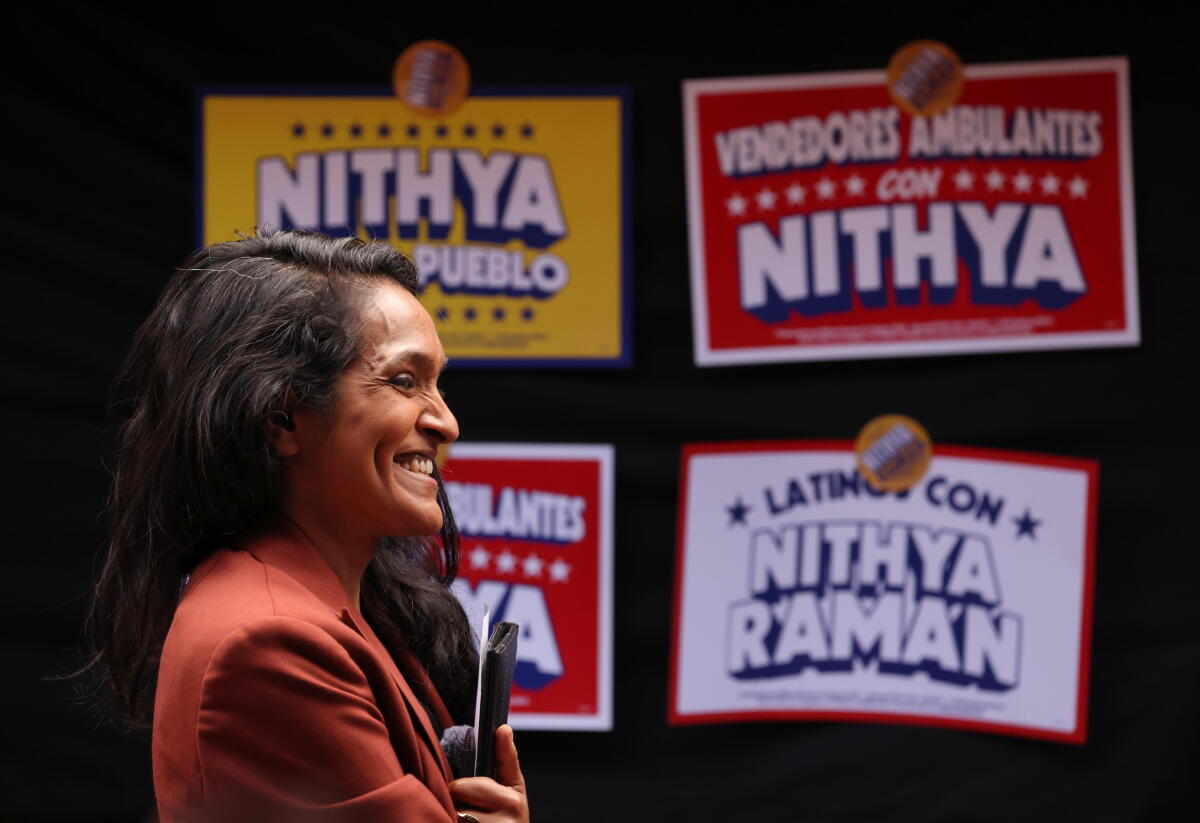
Los Angeles mayoral candidate and city council member Nithya Raman

Los Angeles mayoral candidate and city councilmember Nithya Raman prepares to speak at a “Latinos Con Raman” rally at La Cita Bar in downtown Los Angeles on Sept. 18.

(Genaro Molina/Los Angeles Times)

Familiarity with Spanish has become a prerequisite for L.A. mayors. Antonio Villaraigosa famously took classes to improve his assimilated Spanish. Eric Garcetti described his fluency as “good community meeting Spanish” and often delivered remarks in Spanish. Bass, who was married to a Chicano and treats her ex-husband’s children as her own, isn’t fluent but has a robust Spanish-language outreach for her campaign, complete with ads, mailers and websites.

For Raman, though, learning Spanish isn’t just a way to reach out to constituents. It’s a reminder of “what it means to grapple with a bureaucracy that wasn’t intended for you.”

We spoke outside Univision’s studios after her interview. I asked to speak about her experience with Spanish as a way to show a private side of her to Angelenos. (I had asked Bass to sit down with me and talk about food. The interview was initially scheduled, then campaign spokesperson Alex Stack said it was canceled so Bass could attend a news conference assailing Raman for saying that former LAPD Police Chief Daryl Gates was a “gold standard” in protecting immigrants. Bass’ campaign didn’t reschedule the interview and didn’t provide comment on her Spanish skills in time for publication.)

In 2022, Raman co-authored a motion that introduced live Spanish translation services at city council committee meetings. She wants the city to research whether it can provide the information that’s being lost as the Trump administration increasingly deletes Spanish-language versions of federal websites.

“You have to show them that you’re trying,” Raman told me. “And even if you go out there, and you speak broken Spanish, and you mess it up, and you don’t conjugate it properly, and you get all the endings wrong — ‘a’ versus ‘o’ — the fact that you show up and you say it, and you try it in Spanish, means something to the people that I’ve been talking to.”

Her Spanish journey began with four years of classes at a suburban Boston high school. She chose Spanish instead of French because she felt it “would be more useful for me in the world.”

Raman forgot most of it while attending Harvard and MIT but started practicing with her brother, a Spanish major at UCLA, when she moved to L.A. 13 years ago. She read bilingual books for beginners and streamed shows such asNetflix’s dark comedy “La Casa de las Flores” (“The House of Flowers”) and podcasts such as “Chill Spanish.”

Those lessons have happened “pretty regularly” since she joined the city council in 2020, Raman said, although she scaled back once the mayoral campaign intensified.

I wondered what languages are spoken in her household. Her husband, whose Tamil-speaking parents are immigrants from India, only speaks English. Her twin 10-year-olds “can kind of follow along” when she speaks to her parents in Tamil, but she is no longer fluent in Malayalam.

“I have friends like who speak a different language, and they’re, like, religious about speaking it to their children,” Raman said. While she would love for her children to learn other languages, “life is too stressful trying to make every moment of your time with your family into almost a chore.”

I asked about the pandering charge. Throwing out Spanish phrases in an effort to appeal to Latinos is a political cliché as weak salsa as eating tacos in East L.A. or cruising in a lowrider.

Raman shook her head.

“To try and communicate to people in the language that they speak doesn’t feel like pandering. It feels like what the city should do,” she said. “Why shouldn’t elected representatives here also speak Spanish, or do their best to communicate to people in their language?

“If there was a lot of Tamil speakers here,” Raman continued, “I would appreciate that for me and for my family and for my grandparents.”

Los Angeles Mayor Karen Bass

Mayor Karen Bass speaks during the “Latinos Con Bass” campaign at Ernest E. Debs Regional Park on Sunday, Sept. 20, 2026 in Los Angeles.

(Kayla Bartkowski/Los Angeles Times)

Then I tested her Spanish.

Had she heard of one of my favorite words: convenenciero? Someone who goes with what will help them and doesn’t stand for anything but themselves. Haters have never outright called Raman a convenenciera, I said, but that’s what they’re insinuating in almost every other sentence.

In fairness, most politicians have a bit of convenenciero in them.

“People say, ‘She doesn’t stand for anything,’ but people also criticize me for being ideological, so which is it?” Raman calmly responded. “I try and learn. And I don’t come and say, ‘I know what you want.’ I say, ‘I’m trying to learn what you want, and I want to make the city work for you. How can I make it work?’”

So you’re not a convenenciera?

“I don’t feel that,” Raman said, repeating the phrase two more times.

I told her I’d ask three questions in Spanish. First: how was she doing?

“Bien. Un poco nervioso.”

“Poca nerviosa,” I corrected. A bit nervous. She thanked me for correcting her and said, “Sí, sí, nerviosa.”

What was she doing to try and relax during this campaign?

“Yo quiero estar con mi familia. Mis hijos …” I want to be with my family. My children …

She thought about the right phrase.

“… son mi vida.” Are my life.

What’s a word she loves in Spanish?

Perez-Rangel suggested chisme — gossip.

“I do like chisme!” Raman said with a laugh. But that wasn’t it.

“I like the word tomar [to take] and how many different meanings it has,” she said in English, then rattled off definitions and tenses in Spanish. Tomar bebidas. Tomar su tiempo.

“Tomar City Hall?” I asked.

She laughed again and said something that needs no translation: “Yes.”

Source link

DSA’s national leaders postpone decision on rescinding Raman’s endorsement for mayor

A national panel of the Democratic Socialists of America decided Monday to once again delay voting on whether to uphold or rescind the Los Angeles chapter’s endorsement of Nithya Raman in the L.A. mayor’s race over concerns that Raman hadn’t taken a sufficiently tough stance against Israel.

The left-wing group’s National Political Committee had begun a review of the DSA-L.A.’s endorsement of Raman after some members pointed out that Raman hadn’t been asked for her position on “R22,” a DSA resolution that requires local chapters to inquire about a candidate’s support for the Boycott, Divestment and Sanctions movement against Israel before they are endorsed.

The committee met last week and again Monday, when it voted to work with DSA-LA to organize an Oct. 31 meeting with Raman to assess her position on BDS and other issues related to the Gaza conflict.

If she fails to “provide clear and unequivocal commitments” to their questions, the national committee will vote on whether to rescind DSA-LA’s endorsement, a spokesperson confirmed.

If Raman wins the Nov. 3 election, the group also wants a commitment by her to oppose weapons being shipped to Israel out of Los Angeles International Airport.

If Raman has not “expressed support for BDS and condemned weapon shipments out of LAX” by Jan.1, the National Political Committee will “compile the documentation of fair and ample opportunity for education about the Palestinian struggle for liberation necessary to begin a disciplinary process under R22 and thereafter schedule a vote on expelling Nithya Raman on those grounds,” according to a resolution approved by the committee.

The Raman campaign sent a statement to DSA on Monday during the national committee meeting that outlined her stance on BDS.

“I believe the best way for working Angelenos to stand in solidarity with Gaza is through non-violent protest, legislative action, and diplomatic pressure, including BDS,” Raman said in the statement.

The Raman campaign declined to say whether the council member personally supports BDS, and pointed The Times back to the statement she sent to the DSA and other statements she has made in the past. Raman has said she does not plan to make BDS part of her mayoral platform.

Some Angelenos in DSA were frustrated with the move to rescind the endorsement.

“I feel that this is unnecessary, but that I am encouraged that Nithya has actually expressed support for Palestine and our priorities and that she is compliant with R22,” said Clayton Ryles, a member of DSA-LA who also serves on the 27-person national committee, after the meeting. “Not everybody agrees on that.”

Ryles — one of a few DSA-LA members on the committee — plans to vote against rescinding the endorsement. He also supported Raman’s endorsement as a member of DSA-LA.

Revoking DSA-LA’s endorsement of Raman would have represented a major incursion by the national organization into the local chapter’s politics, invalidating a democratic vote to endorse Raman that passed 937 to 484 in September.

The co-chairs of DSA-LA acknowledged that they had failed to include a question about BDS on their candidate questionnaire, though they said they had inquired about Palestine both on the questionnaire and during a candidate interview.

“This was an oversight,” Leslie Chang and Sean Wakasa, the co-chairs of DSA-LA, wrote in an email to members.

“Nithya had strong answers on Palestine in her DSA-LA questionnaire, in public forums … and in her response to the NPC today,” Chang said in a statement to The Times on Monday. “We are disappointed that the members of the NPC passed their resolutions without reading the materials we sent them, which clearly answer the many questions that are posed to us in the two resolutions.”

“In these last few days of the election, we would like to focus on electing our entire slate and continuing to fight for working Angelenos,” Chang said.

Source link

Bass and Raman skirmish over treatment of small business. The Valley is a battleground

The landmark Casa Vega Mexican restaurant in Sherman Oaks was honored in May with a sign proclaiming its corner of Ventura Boulevard as “Casa Vega Square.”

Mayor Karen Bass was there, and so was City Councilmember Monica Rodriguez, whose district is on the other side of the San Fernando Valley. The event was perhaps more notable for who wasn’t there: Nithya Raman, the mayoral candidate whose City Council district includes Casa Vega.

To Raman’s critics, the episode represents what they say is one of her biggest flaws as an elected official: not tending to the parochial needs of her district. Bass has sounded that theme repeatedly during the mayoral election campaign, including calling Raman “contemptuous of her constituents” during their televised debate on NBC4 and Telemundo 52 Oct. 13.

Raman called that “a lie.” Some of Raman’s constituents beg to differ, saying her office has seemed unwilling to help with a broad array of city services, including fixing broken sidewalks and removing homeless encampments.

“She’s just been MIA,” said Jessica Lewis, who owns Dragonfly Cycle and Train, a fitness studio in Sherman Oaks. “I would send photos of what I was experiencing, like human feces at my front door, encampments at the back door … all those emails just fell on deaf ears.”

Raman spokesperson Stella Stahl disputed that contention, saying the council office has “a proactive constituent service team.”

“Our approach is to listen to those who live and work in a neighborhood, then use every tool the city has to fix what they’ve told us is broken,” Stahl said.

LA Mayor Karen Bass and challenger councilwoman Nithya Raman.

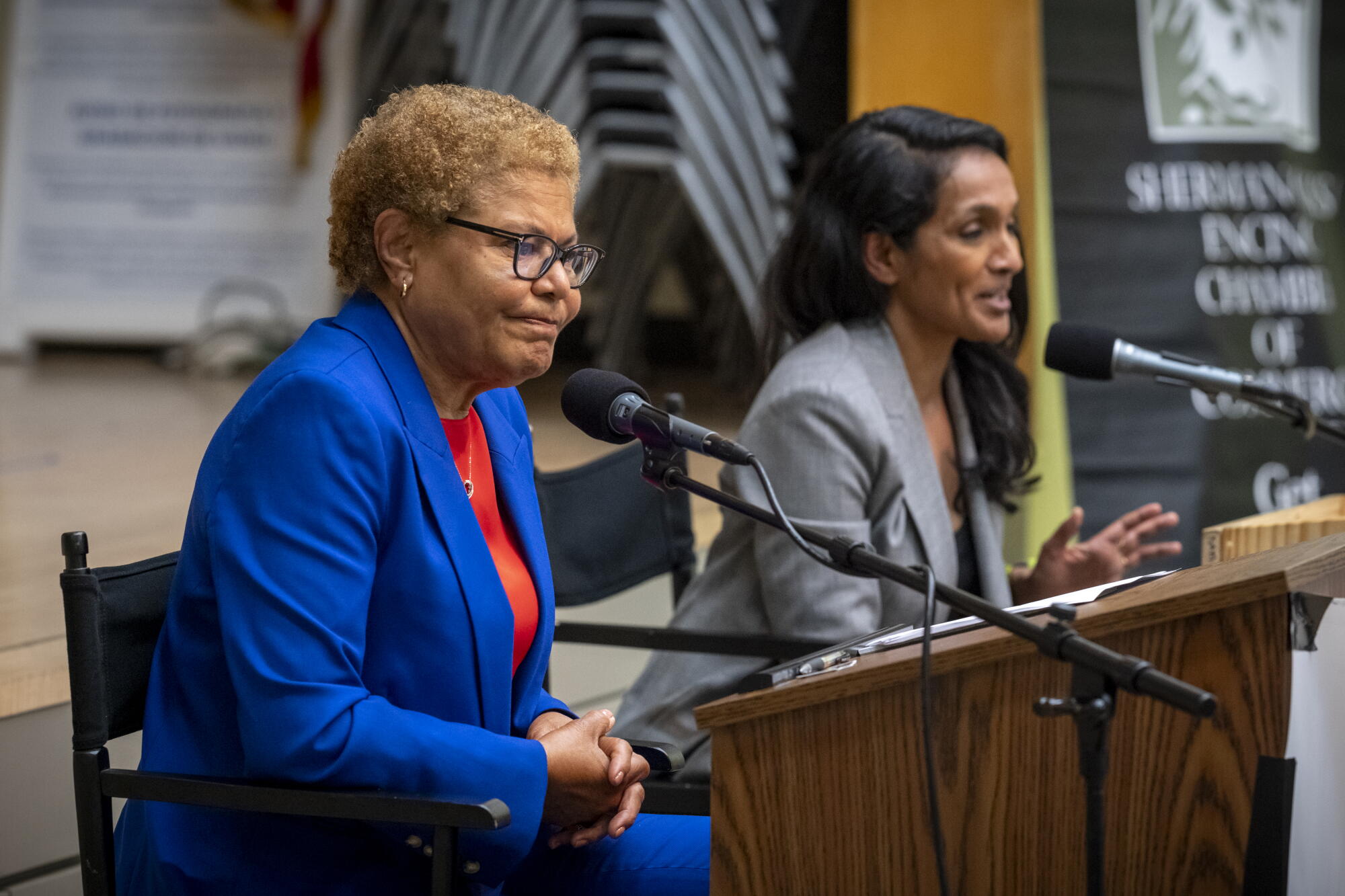
L.A. Mayor Karen Bass, left, and challenger Nithya Raman during their debate before the Sherman Oaks Homeowners Assn.

(David Butow / For The Times)

Raman co-presented the motion to designate Vega Square, along with Councilmember Rodriguez, according to documents filed in March. Raman was unable to attend the ceremony because of scheduling conflicts, Stahl said, but other Raman staffers were present.

Councilmember Rodriguez said her staff spearheaded the designation, part of her broader work to “enshrining the many positive contributions that Latino families have made throughout our city.”

To be sure, Raman has constituents who are big fans. Marissa Rodriguez said she wasn’t aware of the web of licenses and city permits she would have to obtain before she could open her wine shop in Studio City, Dia Natural Wine. The process felt monumental, she said, and nearly impossible to complete on her own.

She reached out to Raman’s team, and said the council office’s help was integral to Dia Natural Wine making its debut in 2022.

“I thought I could do this myself, and at a certain point, I hit a ton of roadblocks at the city,” Marissa Rodriguez said. “They were extremely helpful in just sort of helping me navigate who I needed to talk to.”

Tyler Simmons, who owns a coffee wine bar, Reunion & Co., on Hyperion Avenue in the Franklin Hills neighborhood of Los Feliz, said Raman and her team have always been receptive to his community’s needs.

In response to complaints of speeding, he said, Raman’s office helped get four speed tables — a flatter, wider version of speed bumps — installed in the intersection near his business last year.

“She’s done her best,” Simmons said. “I think there’s larger systemic issues at play within the city … it’s bigger than a councilperson, unfortunately. I’m hoping, if she wins, she’ll help change all that.”

idewalks in disrepair along the 1300 block of Ventura Blvd.

Sidewalks in disrepair along the 1300 block of Ventura Blvd on Friday, Oct. 16, 2026, in Sherman Oaks, California. Christy Vega, owner of Casa Vega, claims that Nithya Raman, Councilmember, Fourth District, has been unhelpful and ignored her requests to get certain city services, including street sidewalk repairs and addressing homelessness in her parking lot. (Gary Coronado/For The Times)

A street in disrepair along the 1300 block of Ventura Blvd.

A street in disrepair along the 1300 block of Ventura Blvd on Friday, Oct. 16, 2026, in Sherman Oaks, California. Christy Vega, owner of Casa Vega, claims that Nithya Raman, Councilmember, Fourth District, has been unhelpful and ignored her requests to get certain city services, including street sidewalk repairs and addressing homelessness in her parking lot. (Gary Coronado/For The Times)

On the other hand, Casa Vega owner Christy Vega rattles off a long list of complaints when discussing Raman and her office. She said she’s spent years seeking help from Raman’s staff, including to make repairs on sidewalks and pavement outside the restaurant, and to remove a homeless encampment that sprang up during the COVID-19 pandemic.

“With Raman’s office, they viewed me as a nuisance rather than someone who’s trying to keep her employees safe,” Vega said.

Vega is supporting Bass in the Nov. 3 election, and she sits on on the board of Thrive LA, an advocacy group backed by business and community leaders that is running ads against Raman in the mayoral race and also ran anti-Raman ads during her 2024 City Council reelection campaign.

Vega says she’s not supporting Raman because of her experience seeking help from Raman’s council office for problems her business encountered, including cars being broken into in the restaurant’s parking lot and muggings on the street out front. One employee was stabbed at a nearby bus stop, and another fell because of the potholes in the alley behind her restaurant, she said.

At one point, Vega said, she called Raman’s office to ask for help in fixing the curb near her restaurant that was damaged during a street racing incident.

Vega said she was told by Raman’s office that she would need to fix the curb herself, meaning she’d have to pull permits, hire a contractor and pay out of pocket for the repairs Vega said she pushed back, and a staff member suggested she move to another district.

Raman’s office didn’t comment on that assertion, but Stahl said that the Bureau of Street Services isn’t funded to repair damaged sidewalks, and the responsibility falls to the adjacent property owners.

“Every constituent who contacts our office deserves a response, and we take Ms. Vega’s concerns seriously. People often reach out to us on their hardest days,” Stahl said. “Unfortunately, we weren’t able to accommodate it at that time. Telling constituents no to basic service requests is frustrating for residents and for us, and it’s part of why the council member ran for office.”

Councilmember Rodriguez, who represents the northeast San Fernando Valley, said she’s stepped in to help business owners in Raman’s district over the years. Most recently, she helped Vega with permitting issues on the restaurant’s outdoor patio.

A sign for Nithya Raman, Councilmember, Fourth District, along the 1300 block of Ventura Blvd.

A sign for L.A. Councilmember Nithya Raman’s district office on Ventura Boulevard in the San Fernando Valley.

(Gary Coronado / For The Times)

“I’ve heard some of the same frustrations and stories from many people. … It reflects a pattern,” said Rodriguez, who is backing Bass for mayor. “If this is your audition [for mayor] based on your performance in your own district, I think it’s an example of the responsiveness of what people can expect.”

Sophia Brodetsky, who owns the Valley Inn restaurant with her husband in Sherman Oaks, isn’t happy with either mayoral candidate, but said Bass’ office has been more receptive to her needs.

Brodetsky has endured robberies, property damage and homeless encampments that have disrupted her restaurant that dates back to 1947, she said.

“They’re running for office right now. They promise you an arm and a leg, but they don’t deliver,” Brodetsky said.

According to Vega and Lewis, owner of the Dragonfly gym, a number of Sherman Oaks business owners reached out to Bass after she was elected mayor in 2022 to voice their concerns about Raman’s stewardship of the district.

The mayor met with a group of business owners in the area in 2023 and she convened weekly safety meetings between business owners, district leaders and local law enforcement to address their concerns, Vega said.

Vega said it was Bass and Rodriguez who helped her navigate the permit process when she sought to open an outdoor patio for her restaurant last year.

“I wasn’t a supporter of hers. I wasn’t someone that she owed any favors to,” Vega said of Bass. “She answered the phone immediately, and she heard the panic of my voice and my tears, and she said, ‘I’m on it.’”

Lewis, however, said she and others felt betrayed by Bass when she endorsed Raman for reelection in 2024.

“That just felt like a huge slap in the face,” Lewis said.

Lewis said she plans to vote for Bass, but reluctantly. Keeping her business afloat has felt nearly impossible at times, she said, but getting help from both the council and the mayor’s office has been an even tougher hurdle.

“The council office would blame the mayor’s office. The mayor’s office would blame the county,” Lewis said. “It was like everyone was just pointing fingers at someone else, and no one was actually doing anything about it.”


Source link