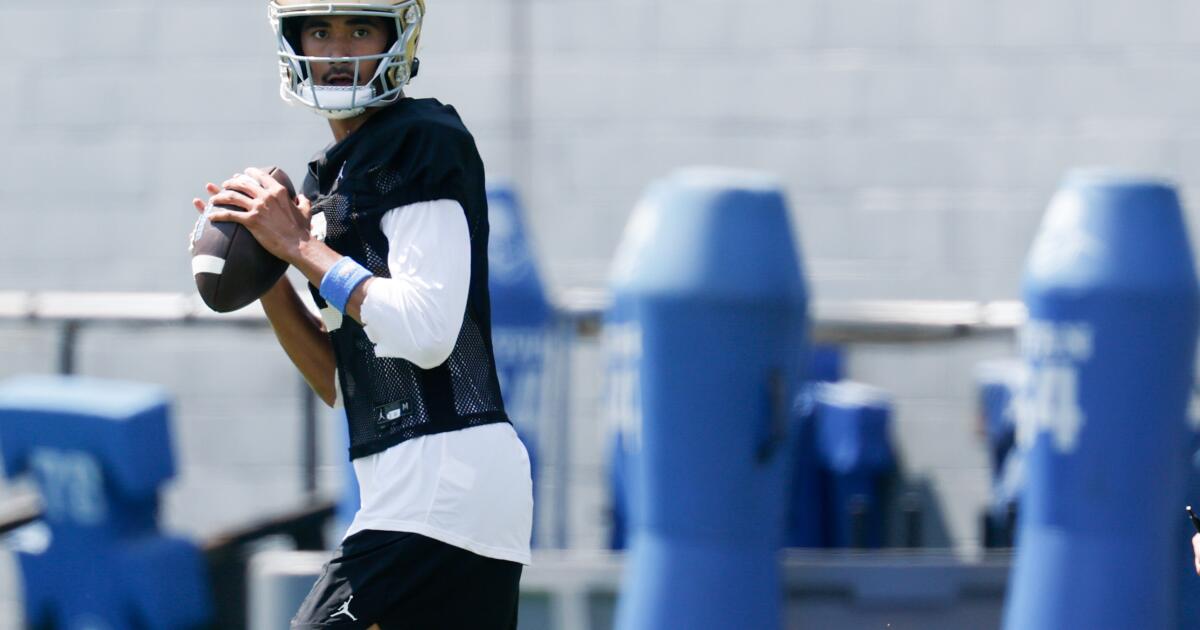
nico iamaleava

UCLA QB Nico Iamaleava learns, and builds, on his experiences

Nico Iamaleava became a household name among college football fans.

Not because of his five-star, blue-chip status, leaving Warren High as the second-ranked prospect in the 2023 class and top-ranked recruit out of California.

Not for leading Tennessee to its first-ever College Football Playoff appearance and a 10-3 record — tying for the Volunteers’ second-best finish since 2001.

Instead, Iamaleava is remembered for his tumultuous exit from Knoxville, a parting characterized by head coach Josh Heupel that the program would move on without its starting signal-caller, leading the Long Beach product to UCLA.

More than one year removed after his departure, Iamaleava reflected at preseason media day on his time with the Volunteers, the effect last season had on his mental health and his mindset heading into 2026.

“In Tennessee, I was in a rough mental state as far as being far from home, but that’s what came with me growing and maturing,” Iamaleava said Wednesday. “So coming back home has been a great transition, and I can’t wait to play this year.”

While returning to Southern California brought the Bruins’ starting quarterback closer to his roots and family, the social media ridicule chased him cross-country, targeting not just him, but his parents too.

To combat the animosity centered on his family, Iamaleava focused on his support system, leaning on those around him and strengthening relationships with the people that he loved.

“Mental health is huge, and having a great support system with you definitely helps. I’ve had that with my parents, going to them whenever I need something,” Iamaleava said. “I have brothers that I can go and rely on, and coming back home to my family has been easy. I don’t really focus on the outside noise.”

While the majority of Iamaleava’s criticism stemmed from his departure from Knoxville, it reignited after UCLA started out the season 0-4 and finished the 2025 campaign 3-9 — a program worst since 2018.

Iamaleava could have allowed the disparagement to compound, but the starting signal-caller is using it as fuel for a 2026 season where many have the Bruins painted as a potential dark horse.

“Everybody counted us out. Last year wasn’t a great year for us, so we’re not on anybody’s radar,” Iamaleava said. “That fuels us, and really playing for each other is going to be the main thing.”

Being one of the few returning starters, Iamaleava has embraced a “vet” role, and has subsequently taken the mantle and burden of being the team’s leader.

And despite all of the negative sentiment surrounding Iamaleava and his time at Tennessee, it was with the Volunteers when he learned how to effectively lead and cultivate camaraderie.

“I learned a lot of that in Tennessee. I had a great vet in Joe Milton. He was a great quarterback,” Iamaleava said. “He’s at the Cowboys now, so learning under him, and then my whole O-line from Tennessee, I love them boys, and they helped me a lot too.”

Iamaleava is building on everything — the good and the bad — he learned from his time in Knoxville and his first year in Westwood entering the new season.

And as he enters his senior season with professional football aspirations on the horizon, Iamaleava has learned to not let external voices interfere with his internal confidence.

“I like to let people assume. Not a lot of people know me on a personal level, so it’s kind of hard to really focus on what they have to say,” Iamaleava said. “Those who know me in this locker room, those who know me in the building, those are the people I care about.”
Source link

Bob Chesney, UCLA top players share their belief Bruins will win

In the nearly nine months since he was hired as head coach at UCLA, Bob Chesney has won over a lot of hearts and minds with his unwavering sense of belief.

First, he won over his star quarterback, Nico Iamaleava, who opted to stick with the Bruins after a 3-9 season a year ago. He won over 45 new transfers, who came to UCLA as part of the portal’s 11th-ranked class and seems to be winning over recruits, too, with UCLA currently ranked in the top 10 among 2027 classes. He even won over once-dormant Bruin donors, who, according to the school’s athletic department, have now poured over $41 million in private support into UCLA athletics over the past fiscal year, an increase of 80% from the previous year.

“It’s his energy, man,” Iamaleava said. “He brings a different type of energy.”

At this point, the only thing it seems Chesney hasn’t won yet at UCLA is an actual football game.

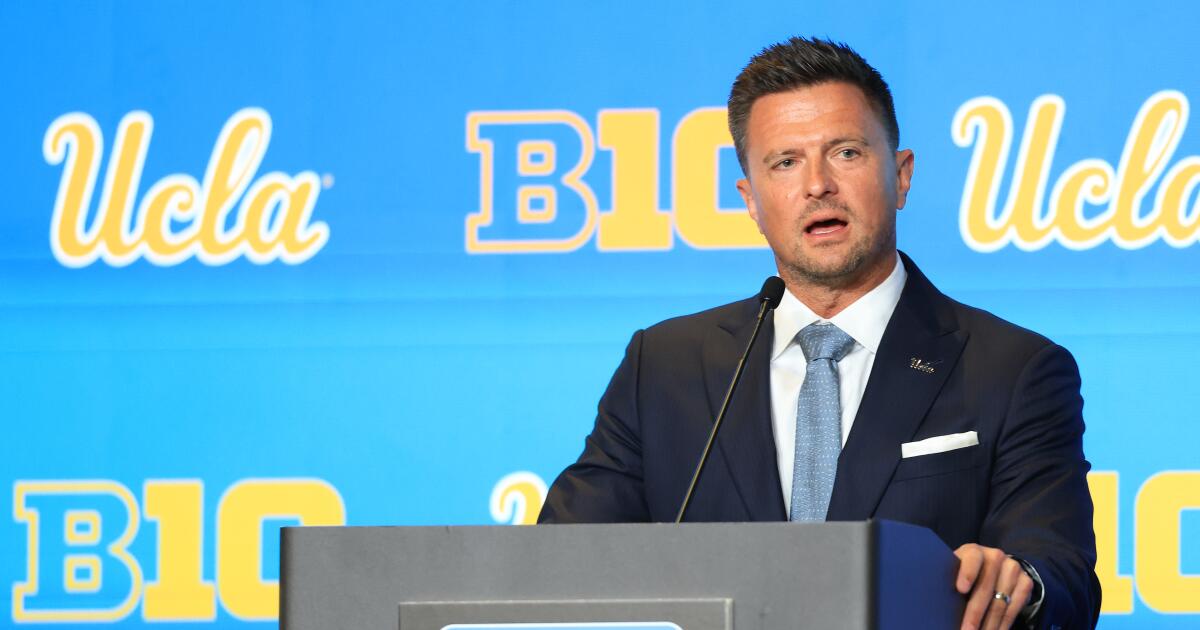
He couldn’t do anything about that Wednesday from the podium at Big Ten media days. Though, as far as first impressions go in this conference, Chesney certainly had a leg up on his predecessor, who stumbled through his own opening address two years ago.

But as the season draws nearer and a new era of Bruin football begins, all the enthusiasm does beg the question: What does a successful debut actually look like for Chesney at UCLA?

Chesney said Wednesday he had no interest in setting those expectations or “in putting artificial limits on ourselves.”

“Outcomes have to be earned,” he said. “And I think in the end, potential is a gift, right? The work is becoming. That’s the work.”

Considering UCLA’s recent history, you can understand why Chesney wouldn’t want to wade too far into setting expectations. Hope, after all, may be his most valuable resource at the moment.

The Bruins are coming off a season in which they won just three games, their fewest in more than 54 years. They’ve reached the nine-win mark once in the past decade. And just two UCLA coaches in a half-century — Jim Mora and Terry Donahue — have clocked a winning campaign in their debut seasons with the Bruins.

“There’s no better place I’d rather be at this moment in time,” Chesney said. “I strongly believe in the power of what UCLA is.”

The collective Big Ten media seems less convinced, having voted the Bruins to finish 13th in their preseason conference poll. That’s exactly where they finished last season.

But there are some things working in Chesney’s favor. For one, a schedule that includes just four opponents picked to finish in the top half of the Big Ten.

It doesn’t hurt, either, that his quarterback got a full spring and summer under his belt as a Bruin. Iamaleava didn’t join the program until late in the process last season after his transfer portal drama dragged out through the spring and summer. Then once he started to find his bearings, UCLA’s coach was fired.

There was no such uncertainty this offseason, as Chesney moved to quickly retain Iamaleava.

“It was a matter of making sure he understood we had a plan,” Chesney said. “That was the most important thing we could do to make sure he stuck around and he did.”

Not only was Iamaleava impressed with his plans to prepare him for the NFL, but he found himself right away swept up in the coach’s personality.

“When you first talk to him,” Iamaleava said, “it kind of sounds like you’re talking to a poet or something, the way the words roll off.”

Chesney is counting on Iamaleava to make things move smoothly for UCLA’s offense this season. But the most marked difference for the Bruins on that side of the ball should be the ground game.

The Bruins boasted one of the least dynamic rushing attacks in the Big Ten a season ago, as Iamaleava led the team with just 505 rushing yards. Their lead running back, Jalen Berger, rushed for a meager 364 yards over the course of the season.

Meanwhile, at James Madison, Chesney had three running backs with as many yards last season. The Dukes rushed for the fifth-most yards (3,381) of any Football Bowl Subdivision team.

Their lead rusher, Wayne Knight, followed Chesney to UCLA and should step in as one of the best backs the Bruins have had in years. Of the 30 backs in college football with over 200 carries, Knight averaged the most yards per carry last season (6.63).

“There’ll be a commitment to playing that style of football,” Chesney said.

The rest is mostly just a projection, a fact that Chesney openly acknowledges.

“Everything here is ultimately conceptual,” he says.

But one change has already taken hold, if you ask Iamaleava. One that might appear unrecognizable from recent history at UCLA.

“He’s definitely changed the mindset in there, just how you feel. I don’t know how to explain it,” Iamaleava said.

“When Ches walks into a room, he just brings that winning mentality.”

Source link