A federal judge has declined to halt President Trump’s executive order creating a federal voter list and limiting mail voting, clearing the way for potential sweeping changes in how American elections are run shortly before this year’s midterm elections.
U.S. District Judge Carl Nichols, a Trump appointee in Washington, late Wednesday rejected the request by Democrats and civil rights groups that had argued Trump’s order would likely be found unconstitutional because the states and Congress, not the president, have the power to set election rules. Nichols agreed with the Republican Trump administration’s contention that it was too early to block the order because it has yet to be implemented.
Nichols’ ruling leaves the door open for further challenges when the Trump administration moves to implement the president’s directive. A separate lawsuit seeking to block the executive order is underway in Boston. No matter how rapidly the administration acts, no voting changes are expected during primary elections, which continue into next month.
“The Court recognizes that the Postal Service may ultimately issue a final rule that directly affects Plaintiffs or their members, or that the Government may develop State Citizenship Lists that omit specific individuals due to particularized flaws,” Nichols wrote. “Plaintiffs may, of course, renew their motions if and when those future actions occur. Until then, however, Plaintiffs cannot show that preliminary injunctive relief is warranted.”
The Trump administration has yet to formally issue lists of eligible voters, and those who filed the initial request for a temporary halt said they’d be back if the administration moves in that direction.
“We are ready to resume the fight if and when the administration takes those next steps,” said Juan Proaño, chief executive officer of the League of United Latin American Citizens, one of the organizations that sought the stay from Nichols.
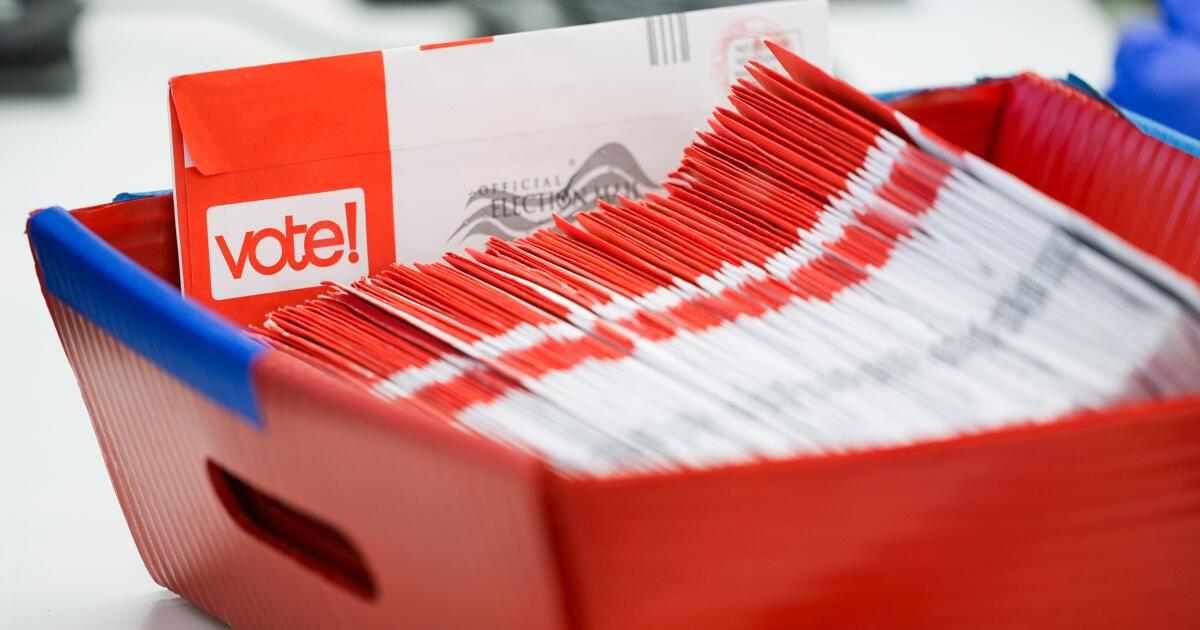
Trump issued the order in March after a bill he supported to overhaul voting stalled in Congress. The order would have had the federal government create a list of eligible voters and then directed the U.S. Postal Service to deliver mail ballots only to those on the list. Election officials argued it was ripe for abuse and could cause chaos, and the postal union has objected to the idea of mail carriers policing ballots.
Since his 2020 presidential election loss to Democrat Joe Biden, Trump has groundlessly claimed mail voting is rife with fraud and has launched a federal investigation into that year’s vote, even though repeated audits and investigations, including ones run by Republicans, found it was free of widespread fraud. Trump also has said he wants to “take over” election administration in Democratic areas.
Democrats and civil rights groups argued it was urgent that Nichols issue a restraining order in the midst of primary season and with states already gearing up for the fall midterm elections.
This was Trump’s second executive order seeking to overhaul elections and voting. His initial election executive order, issued just months after he took office in his second term, has been blocked by multiplefederal judges. That order sought to require documentary proof of citizenship to register to vote, among other changes.
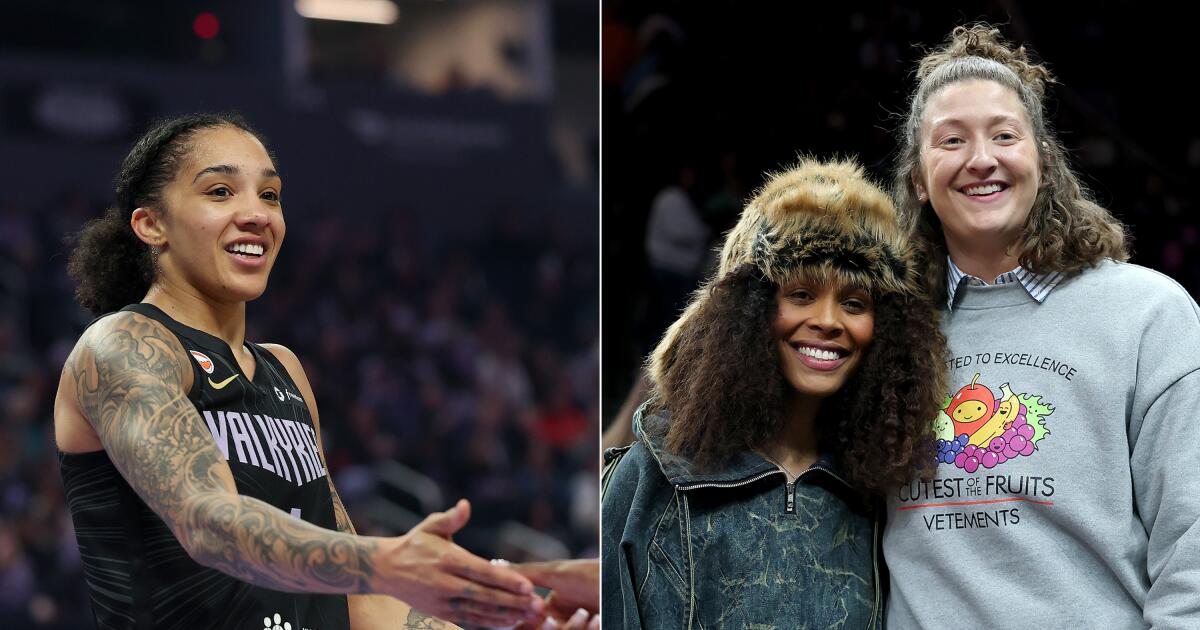
Media company Run-A-Muck has announced that it is developing “Courtside,” a sports romantic comedy set in the world of professional basketball. WNBA All-Star Gabby Williams, two-time WNBA champion Sydney Colson and 2022 WNBA champion Theresa Plaisance are among those set to appear in the movie, according to Deadline.
“If you like ‘Love & Basketball’ and ‘Bend It Like Beckham’ and ‘Bring It On’ but you found yourself wondering, ‘Could this maybe be a little bit gayer?’ We have great news for you,” Colson said in a Thursday Instagram post. “The answer is yeah, you could always make it gayer.”
Colson, a Texas A&M standout who was drafted to the WNBA in 2011, is also one of the executive producers on “Courtside.”
Written by “Abbott Elementary” writer-producer Brittani Nichols and directed by Carly Usdin, the movie will follow an injury-plagued women’s basketball superstar with championship ambitions who is thrown for a loop when she falls for a teammate.
“Making a movie like this is super exciting to me because I grew up playing basketball,” Colson added. “I would have loved as a young person to see my story depicted … on screen so to see a team of people who want to ensure that others can see characters and storylines that feel personal and familiar to them. I’m so excited about it.”
Colsen and Plaisance, who won a championship together as teammates on the Las Vegas Aces in 2022, share a podcast and also starred in the unscripted buddy comedy “The Syd + TP Show” together. Williams, who plays for France in international competition, currently plays on the Golden State Valkyries.
“It feels like I’ve been waiting my whole life for this kind of excitement to surround women’s basketball, and I’m excited to blend my love of sports, lesbian tension, and comedy into one project,” Nichols told Deadline. According to the outlet, Run-A-Muck co-founder and “The L Word” star Jennifer Beals is also slated to appear in the project.
When the heads of three Los Angeles Unified School District unions stood side by side at City Hall to announce their new contracts after nearly going on strike hours earlier, one of them looked out of place.
Max Arias was decked out in a purple letterman’s cardigan emblazoned with “99,” for Service Employees International Union Local 99. United Teachers Los Angeles President Cecily Myart-Cruz wore a tie-dyed T-shirt that read “Solidarity LA.”
And then there was Maria Nichols, who looked like the school principal she once was.
Shiny black shoes. Black slacks. Light makeup. Tight smile. The only flash of color was her green V-neck union T-shirt, the logo peeking out of a black blazer.
Arias and Myart-Cruz gave impassioned speeches hailing the last-minute deals, which still need to be approved by union members and the school board. Nichols, who leads the Associated Administrators of Los Angeles/Teamsters Local 2010, started with a joke about her mere year and 10 months as a union leader.
“I’m the new kid on the block,” the 60-year-old said. “But we made a commitment. It’s not about equality, it’s about equity. … We are all better today for our collective work.”
AALA’s tentative contract calls for raises of more than 11% for the LAUSD’s 3,000 principals, assistant principals and middle managers — a lower percentage increase than SEIU’s 24% and UTLA’s 14%. But the contract also secured a 40-hour week with flex time off for extra hours, addressing long-standing complaints about grueling schedules.
On top of all that, Nichols has led her members into a new era.
“For a long time, principals have been perceived” as a class apart from other school employees, Arias said at the City Hall news conference Tuesday.
Not only are they many workers’ bosses, but with median salaries of $160,139 for elementary schools and $174,628 for higher grades, they make a lot more money. When UTLA went on strike in 2019, AALA stayed on the job.
This time, AALA and the other two unions vowed to all go on strike together if any one of them failed to get a contract.
“So them coming in,” Arias continued, “really shows our members that it is important to start figuring out how we work in solidarity.”
Nichols “called us and said, ‘I know that you guys have already been rolling, but I want to join in,’” Myart-Cruz added. “Having the leadership to be able to articulate that message to her administrators is a great thing. Solidarity is a great thing, but we now have unity.”
“I may be the new kid on the block,” Nichols told me afterward with a grin, “but I’ve been fighting for better schools for 42 years.”
We met a few days later at AALA’s Echo Park office.
“Excuse the mess,” Nichols cracked as we walked to her corner suite. She now wore a bright red pantsuit, union pins on her lapel. Hundreds of signs reading “Enough is Enough” leaned upside down against desks and cabinets. Chips, water and other snacks were piled inside collapsible carts.
“This was all going to be used for the strike,” she said. “You know what they say — expect the best but prepare for the worst.”
AALA /Teamsters 2010 President Maria Nichols hugs UTLA President Cecily Myart-Cruz during a news conference announcing a tentative agreement between LAUSD and the unions representing teachers, principals and workers at City Hall in Los Angeles on April 14, 2026. Above them is SEIU Local 99 President Max Arias.
(Robert Gauthier / Los Angeles Times)
A breakfast of blueberries and yogurt sat untouched as Nichols recounted her life story. She moved to Los Angeles at age 5 from her native Peru to join parents who left after a military coup. A star volleyball setter at Fairfax High, she gave up a University of Arizona scholarship her freshman year after breaking her wrist and finding it “too hard to watch the games and not be involved.”
Back home, she joined LAUSD as a bilingual teacher’s assistant while pursuing a degree in physical therapy at Cal State Northridge. Thanks to a succession of bosses she called “angels,” she stayed in public education. She worked in San Fernando Valley elementary schools as an assistant, a teacher and an assistant principal before a decade-long run as principal at Vena Avenue Elementary in Arleta, which was designated a California Distinguished School during her tenure.
That led to a promotion as a regional director for Valley schools, a job she loved despite the difficulties of shrinking budgets and enrollment. Nichols credited then-LAUSD Superintendent Austin Beutner with granting autonomy to principals in the district.
“We were all administrators from the field that had served time in this district and gone up the ranks,” she said. “That disappeared with [current Supt. Alberto] Carvalho. Gone. Gone.”
She pointed to a flow chart on the wall, titled “Ready for the World,” that Carvalho’s team distributed after he arrived in 2022. He brought in his own people instead of empowering existing administrators, she said.
“It’s a great plan,” Nichols said with no sarcasm while reading its goals aloud. “Because that is what we want. But we don’t invest in staff because we have a shortage. … We can’t have joy and wellness if your people are drying on the vine because they’re exhausted.”
Friction between principals and teachers over budgets and educational strategies increased. Frustrated, Nichols attended her first AALA meeting about two years ago.
“There were like 20 people there. And I thought, ‘This is it? This is where we are?’” she recalled.
Some principals urged her to run against the union’s incumbent president. One of them was Kathie Galan-Jaramillo, whom Nichols had hired to lead Sylmar Leadership Academy.
“Our union was very small, and it was very difficult for us to stand for what we believe in,” Galan-Jaramillo said. “But Maria knew all of the things and hurdles that we [administrators] had to do and go through, and the expectations.”
To prepare for negotiating a new contract, Nichols studied the existing one.
“It was so weak. The language was so antiquated,” she remembered thinking, especially when it came to making sure members weren’t being overworked. “And then I looked at UTLA’s contract and I said, ‘Holy crap. No wonder they get everything.’”
At the end of 2024, 85% of AALA members approved a Nichols-backed merger with Teamsters 2010, which represents higher education workers in California, to shore up their resources and try a different, tougher mindset.
“She has what’s lacking among many leaders — she has the judgment and humility to say, ‘I have things to learn and I’m up to it,’” said Teamsters 2010 Secretary-Treasurer Jason Rabinowitz, who sat with Nichols in contract negotiations. “And she’s a learner and quick study. That’s not always easy to do, because labor leaders have ego.”
After contract talks hit an impasse in February, Nichols reached out to Arias and Myart-Cruz to share research and strategy. They sold her on a united front. But initially, not all AALA members embraced the move, with some questioning why the union would still strike after getting a new contract.
“I was getting a lot of push back from members — ‘But if we get a TA [temporary agreement], why would we strike?” Nichols said. “But it wasn’t about the TA anymore. It was about the coalition. It was about sticking together. It was about power and unity. … My folks were not used to that.”
Nichols expects that AALA members will ratify the agreement.
“We’ll be done, and in May, we [Arias and Myart-Cruz] will go out and have some dinner, and, you know, adult beverages,” she said with a loud laugh.
Maria Nichols, head of the LAUSD principals union, AALA/Teamsters 2010, at her AALA office in Echo Park.
(Robert Gauthier / Los Angeles Times)
Then comes what she describes as the new alliance’s “heavy lies the crown” moment.
LAUSD plans to bankroll the contracts with money from Sacramento that may or may not come through, even as it plans to cut more than 600 jobs and school enrollment keeps dropping. SEIU’s new contract includes extra hours for members — who include custodians, bus drivers and cafeteria workers — so they can qualify for health benefits, Nichols pointed out.
“They deserve it,” she said, citing her respect for them because her father was a dishwasher and her mother cleaned houses. “But that impact of health benefits, it’s going to be directed at school budgets. OK, great. We got all of these wins, but how is that going to impact our budget at schools? Where’s the money going to come from?”
But these were issues for another day.
The conference room table was now covered in stacks of the same green T-shirt Nichols had worn at City Hall.
“We were going to give them out during the strike,” she said as her staff busied for a flurry of meetings. “But we’ll still give them out. We’ve got a job to do.”