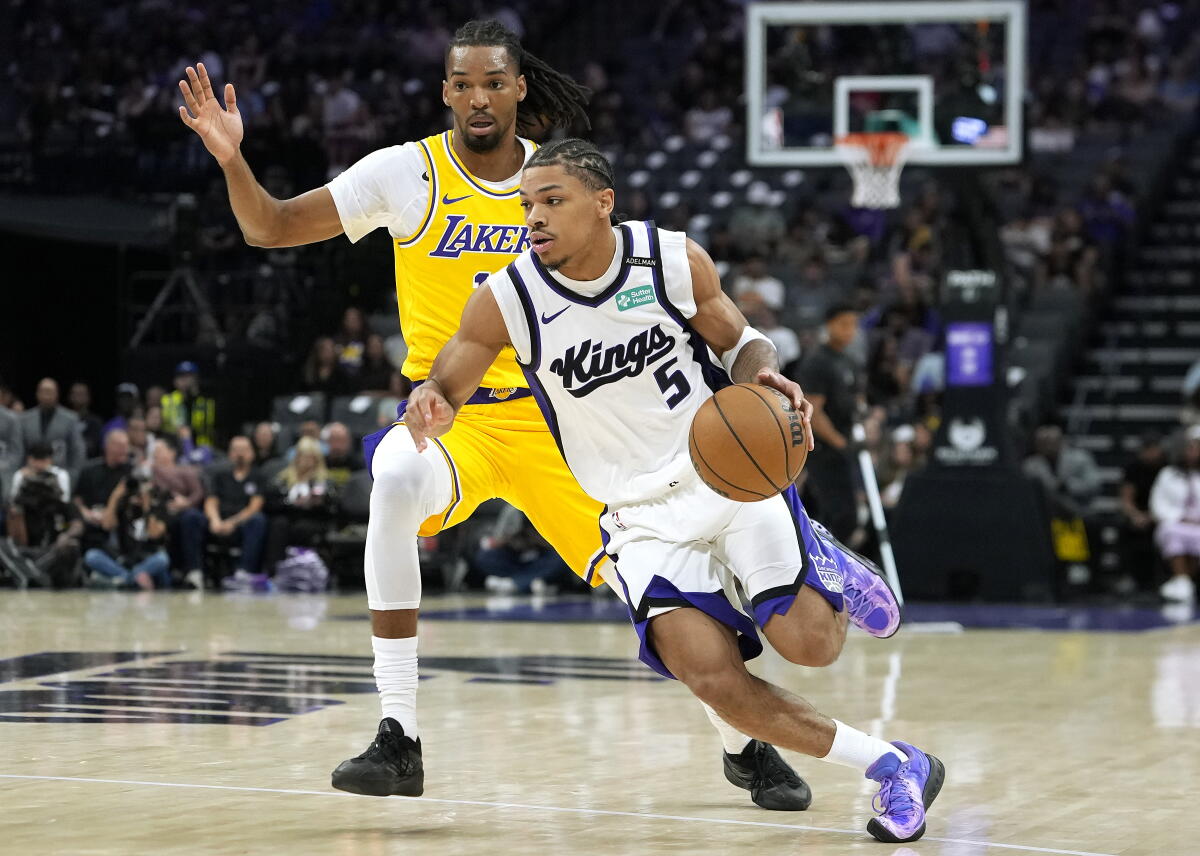
NEW YORK — The NHL docked the Vegas Golden Knights a second-round pick in next month’s draft and fined coach John Tortorella $100,000 on Friday for violating media access rules after their series-clinching Game 6 victory over the Ducks on Thursday night.
Tortorella refused to speak to reporters after Vegas routed the Ducks 5-1 to move on to face Colorado in the Western Conference final. The Golden Knights also did not open their locker room in accordance with league and NHL Players’ Assn.-negotiated regulations.
The NHL in a statement announcing the punishment said the penalties for these “flagrant violations” come after previous warnings were issued to the Golden Knights. The team has been offered the opportunity to appeal to Commissioner Gary Bettman’s office in person at the league’s New York headquarters next week.
“The Golden Knights are aware of today’s announcement from the NHL regarding the postgame media availability following Game 6 in Anaheim,” the team said in a statement posted to social media. “The organization will have no further comment.”
Welcome back to the Lakers newsletter, where, against all odds, we’re still kicking.
The Lakers defied expectations by winning their first-round series against the Houston Rockets. Most didn’t give them any chance. It felt dicey after a deflating Game 5 loss at home. But the Lakers pulled it off with a headlining performance from their 22-time All-Star and award-worthy supporting performances from the ensemble cast.
Against the league-leading Oklahoma City Thunder, even fewer people are giving the Lakers a chance for an encore performance. But as Kevin Garnett once said: “Anything is possible!”
All things Lakers, all the time.
Get all the Lakers news you need in Thuc Nhi Nguyen’s weekly newsletter.
By continuing, you agree to our Terms of Service, which include arbitration and a class action waiver. You agree that we and our third-party vendors may collect and use your information, including through cookies, pixels and similar technologies, for the purposes set forth in our Privacy Policy such as personalizing your experience and ads.
Set the tone
Marcus Smart rotated over to the baseline. He came face to face with Houston’s Tari Eason as the 6-foot-8 Rockets forward leapt toward the basket. The 6-3 guard jumped right along with him.
Smart is used to taking on big challenges.
The Lakers brought Smart in for this moment. It’s not just the defensive tenacity to block a forward five inches taller and eight years younger than him, but when the postseason inevitably challenged the Lakers in unforeseen ways, they needed Smart’s leadership. He proves it every time he steps up to take a charge, gets a deflection or just pulls a teammate aside for a quick word.
“Marcus is a true leader,” center Deandre Ayton said. “Besides [Le]Bron [James], Luka [Doncic] and AR [Austin Reaves], Marcus is the other guy with the grit where [if you feel] discombobulated, he tries to be that guy that puts his arm around you and some of the younger guys. Whether it’s coming down to his competitiveness, keeping that same, consistent edge, Marcus tries to keep that level of intensity pretty high and it’s contagious, too.”
With Doncic (hamstring) still sidelined to begin the Western Conference semifinals against the top-seeded Thunder, the Lakers are counting on their supporting players for major performances. Smart’s role will be one of the most taxing; he’ll be the top defender for a team trying to slow down the NBA’s reigning most valuable player.
On his long list of elite matchups, Smart ranked Shai Gilgeous-Alexander at the top.
“I think we all know that, right?” the former defensive player of the year said. “He does a really good job of getting to the free-throw line. He’s mastered it. … It’s tough, but it can be done, it’s just going to take a lot of effort from everybody and we gotta stay together.”
Gilgeous-Alexander is a front-runner for his second consecutive most valuable player and led the Thunder to a sweep over the Phoenix Suns in the first round. The Thunder easily carved up Phoenix’s ninth-ranked defense, scoring 126.9 points per 100 possessions. Their offensive efficiency was five points better than the next best team in the first round.
The Lakers are coming off their own defensive masterpiece against Houston, holding the Rockets to less than 100 points in four of the six first-round games. Their 78 points allowed in the series-clinching Game 6 were the fewest in a playoff game by a Lakers opponent since May 16, 2012.
The anchors of the defensive performance are two major offseason additions acquired to help the Lakers bounce back from their disappointing first-round series loss to Minnesota last year. Smart and Ayton are quietly starring this postseason.
Ayton’s 11 points per game didn’t accurately reflect the influence he made against the Rockets. His 10.8 rebounds per game, including four games in which he had 10 or more rebounds despite being ejected in the third quarter of Game 4, were even more impressive against a team that dominated the rebounding battle at a historic rate.
A strong performance from Ayton lifts the ceiling on the team more than anyone else, Lakers coach JJ Redick said. An underrated and unexpected part of Smart’s value is his ability to unlock the team’s most important piece.
“I’m just somebody who he respects,” Smart said. “He sees [me] go out there and not only preaching, I’m actually doing what I’m preaching.”
Smart and Ayton barely knew each other before this season. But their paths are parallel: Former postseason mainstays who, in Ayton’s words, “disappeared.” The center who helped Phoenix to the NBA Finals trudged through Portland for two seasons; Smart, the former Boston Celtics stalwart, bounced between Memphis and Washington.
They’re now soaking up the spotlight in L.A.
“We’re both here, we’re both trying to get our names back into the good graces of the basketball gods,” Smart said, “and just show what we still can do.”
Priority No. 1
The Lakers had two keys for their first-round series against the Rockets: boxing out and taking care of the ball.
Now against what Redick estimated was “one of the greatest teams ever in NBA history,” that list has narrowed to one big thing.
Turnovers.
The Lakers, who got swept in the four-game regular-season series by an average of 29.3 points per game, averaged 17.5 turnovers per game against the Thunder during the regular season, three more than their regular-season average. Turnovers nearly undid the Lakers’ first-round series: they averaged 17.7 against the Rockets and gave up 19 points off turnovers per game.
The Thunder are an especially dangerous matchup for a team that can’t take care of the ball; Oklahoma City led the league in points off turnovers with 22 per game during the regular season.
“Whatever moments we felt Houston pressuring, like the maximum amount of pressure they put on us, that’s OKC’s baseline,” Redick said.
The Thunder, even playing without star two-way wing Jalen Williams for much of the season, were the NBA’s most disruptive defense. They’re league-leading defensive rating came with the third-most steals (9.7), sixth-most blocks (5.5) and the second-most turnovers forced (16.7) per game.
“They somehow do all of that without fouling,” Redick said with a hint of sarcasm in his voice, “which is one of the most remarkable things, I think, in NBA history.”
The Lakers, who attempted the second-most free throws in the league behind Doncic’s top-ranked 10.1 attempts, committed fewer fouls than the Thunder this season: 18.5 fouls per game compared to Oklahoma City’s 19.
On tap
Tuesday at Oklahoma City, 5:30 p.m. PDT (Game 1)
Two of the Lakers’ worst losses of the year were in Oklahoma City. If November’s 29-point loss wasn’t painful enough, the injury-plagued disaster on April 2 could be enough for the Lakers to want to sage the whole arena.
Thursday at Oklahoma City, 6:30 p.m. PDT (Game 2)
The Thunder have had the league’s best home record for each of the last two seasons, including a 34-7 mark this season, but still had two home playoff losses last year. Oklahoma City dropped Game 1 of the Western Conference semifinals and the NBA Finals last year, needing to win both series in seven games en route to the championship.
Saturday vs. Oklahoma City, 5:30 p.m. (Game 3)
The Thunder lost Game 3 in three of their four playoff series last year. The only exception was their first-round sweep over Memphis.
Monday vs. Oklahoma City, 7:30 p.m. (Game 4)
Could this be the final Lakers game of the year?
Status report
Luka Doncic (left hamstring)
After missing the first round, the Lakers’ superstar guard is still sidelined with a Grade 2 hamstring strain. He is not expected to return for the start of the series and has yet to progress to live on-court workouts.
Jalen Williams (left hamstring)
The Thunder’s All-NBA wing will miss at least Game 1 after he suffered a Grade 1 left hamstring strain on April 22, which kept him out of the Thunder’s last two games. After last year’s breakout season, Williams was plagued by injuries to his wrist and right hamstring that limited him to just 33 regular-season games.
(Second) favorite thing I ate this week
Because I did not take a picture of it, the only evidence I have from my No. 1 meal from Houston is a lingering sweet and spicy tang on my tongue from Rodeo Goat’s Billy F Gibbons burger. It was delicious: candied bacon, caramelized onions, gouda, mango pico, cream cheese and habanero sauce.
Street taco plate from Luchi & Joey’s in Houston.
(Thuc Nhi Nguyen / Los Angeles Times)
A close second was the street taco plate from Luchi & Joey’s, a food stall in downtown Houston’s underground tunnels. The five-taco spread hit the spot while I was hiding from the heavy storm moving through Houston on the day of Game 6. The six-mile tunnel system is lined with restaurants and shops that came in handy during torrential rain. I was safe from the elements while I hunted for lunch then only had to make a one-block scramble through the rain back to my hotel.
Welcome to this week’s Lakers newsletter, where the brooms are going back in the closet.
The Lakers squandered their first playoff sweep since 2010, but are still one win away from their first playoff series win of the JJ Redick era.
Three weeks ago, even this moral victory of a 3-1 lead seemed out of reach. Now actually grabbing a spot in the conference semifinals could take more than one super-human performance.
All things Lakers, all the time.
Get all the Lakers news you need in Thuc Nhi Nguyen’s weekly newsletter.
By continuing, you agree to our Terms of Service, which include arbitration and a class action waiver. You agree that we and our third-party vendors may collect and use your information, including through cookies, pixels and similar technologies, for the purposes set forth in our Privacy Policy such as personalizing your experience and ads.
Help needed
The forceful drives turned into desperation jumpers. The dominant dunks became limp layups that dribbled off the rim.
LeBron James carried the Lakers to a historically insurmountable 3-0 lead in the best-of-seven first-round series against the Houston Rockets. But with a chance to clinch the series Sunday, he showed just how much the Lakers need someone else to help carry the team across the finish line.
James had his worst shooting game of the season, settling for 10 points on two-of-nine shooting. The nine field-goal attempts he took were tied for the fewest he’s taken in a playoff game. He didn’t extend his streak of consecutive playoff games with double-digit scoring to 144 until the fourth quarter.
Just after accepting a third-option role behind Luka Doncic and Austin Reaves, James was thrust back into the top spot when the star guards were injured April 2. The NBA’s all-time leading scorer had no problem putting on his Superman cape again. He started taking — and making — more shots than he had in months. His usage rate spiked.
But with the ball back in his hands more, James had eight turnovers in each of the last two games. The turnovers, 24 total by the Lakers on Sunday, were their “kryptonite,” James said.
The Lakers’ lack of guard play is becoming a glaring weakness.
“That’s the biggest challenge we have is just the ballhandling and downhill drivers, not having those guys,” Redick said.
Doncic and Reaves are progressing in their returns. Just three weeks after his oblique injury, Reaves was questionable for Games 3 and 4. He even warmed up before the games. But his timeline for return is still indefinite.
Considering the Lakers’ 3-0 start to the series, it might be safe to think the team would just wait until the conference semifinals for Reaves’ return. Redick said it’s fair to consider all factors when deciding when to bring Reaves back. But after a long conversation with the guard Saturday, Redick said the most important variable is the player’s confidence.
“That’s always the final hurdle coming back from an injury,” Redick said, “is the psychological component of it.”
Doncic, hampered by a balky hamstring, is ramping up, but is still not as close as Reaves.
The hope of getting their two most important players back was “a carrot” for the Lakers to keep extending their season, Redick said. A two-day break between games could be just as significant of a lifeline.
The one day of rest between Games 3 and 4 was the shortest of the series so far. The Lakers, led by 41-year-old James and 32-year-old Marcus Smart, looked especially desperate for the extra downtime.
Smart was wearing inflatable compression boots on both legs in the locker room before the game. Lakers were dropping passes like they were loose coffee plans with someone who lives across town.
Meanwhile the 23-year-old Alperen Sengun was doing spin moves in transition, finishing through contact and flexing toward the crowd in the third quarter with the Rockets up by more than 20.
Smart insisted the mistakes were mental. They looked like physical fatigue manifesting as mental blunders.
“It’s something we gotta clean up,” said Smart, who had four turnovers Sunday. “We know it, we understand it.”
The Lakers have time to fix it. The two-day break between Games 4 and 5 will be the last such break of this series if the Lakers let this stretch on.
Games in mirror are closer than they appear
This series is 30 inexplicable seconds away from being 2-2.
NBA teams that have a 3-0 lead in a best-of-seven playoff series are 159-0. Since 1984 – when the NBA expanded its playoffs to 16 teams – teams with home-court advantage in the current series format are 125-42. Had that comeback never materialized, the Lakers would still have the upper hand in this series but they surely wouldn’t be invincible.
In a tighter-than-it-appears series, the Lakers have their 3-1 lead thanks to a run of hot shooting.
They were already the NBA’s most efficient shooting team, but the early part of the playoff success came from a sudden uptick in three-point shooting. The Lakers’ 40.8% three-point shooting through the first four games was 5.1 percentage points better than their regular-season mark. On the other hand, the Rockets are shooting 5.1 percentage points worse than their regular-season rate.
The Lakers identified turnovers and limiting offensive rebounds as the two most important items against the Rockets. They’ve struggled on both. The Lakers averaged 20 turnovers per game in the first four games and gave up 16.8 offensive rebounds. The Rockets’ 39% offensive rebounding rate is almost identical to their league-leading 38.8% from the regular season.
The Lakers have turned the ball over on 20.9% of their possessions, the highest turnover rate in the playoffs.
The Rockets have scored 21.5 points per game off the Lakers’ turnovers, the second-most of any team in the playoffs. Only Oklahoma City — the team that’s waiting for the winner of this series — has scored more points off turnovers in the playoffs.
On tap
Wednesday vs. Rockets, 7 p.m.
The Lakers can clinch the series at home and earn extra rest days before facing the Oklahoma City Thunder in the conference semifinals. The Thunder finished a sweep of the No. 8 seeded Phoenix Suns in the first round Monday.
Friday at Rockets, 6:30 p.m. (if necessary)
If this game is necessary, it will be especially difficult to win for the Lakers. Both teams will have to travel from L.A. to Houston and we just watched what happens when the shorthanded Lakers play on one day of rest in the playoffs.
Sunday vs. Rockets, TBD (Game 7, if necessary)
The Rockets are trying to become the fifth team in NBA history to force a Game 7 after trailing 3-0 in a best-of-seven series. The 2023 Celtics were the last team to even a series after a three-game deficit. Smart’s Celtics lost Game 7 of the Eastern Conference finals to the Miami Heat.
Status report
Luka Doncic (left hamstring strain)
Approaching the four-week mark, Doncic is ramping up his on-court work. On Sunday, he progressed to more movement instead of standstill shooting. He is still out indefinitely.
Austin Reaves (left oblique muscle strain)
Reaves’ return has been faster than many expected. He was questionable for Games 3 and 4, a quick three-week turnaround from his initial injury on April 2.
Kevin Durant (left ankle sprain)
After missing Game 1 with a knee bruise, Durant sprained his ankle in the fourth quarter of Game 2 and missed the next two games. Rockets coach Ime Udoka said Sunday pain and limited range of motion because of a bone bruise in Durant’s ankle are keeping him sidelined, but there’s a chance he returns this series.
Favorite thing I ate this week
Seafood boil with the Combo No. 4 (crawfish, snowcrab, shrimp, corn and potato) at Crawfish Cafe in Houston.
(Thuc Nhi Nguyen / Los Angeles Times)
This was a culinary bucket list item for me: Viet cajun food in Houston.
At Crawfish Cafe, you choose your seafood combination for a delicious, and slightly messy, seafood boil. I went for a combination of crawfish, shrimp and snow crab tossed in a mix of Viet cajun and Thai basil sauces. But there are more than a half-dozen sauce choices, so with that many options left to explore, maybe I wouldn’t be mad if this series returns to Houston.
At the peak of the crackdown, carloads of masked immigration officers were a common sight in the streets of Minneapolis, while thousands of people were being arrested every week in Texas, Florida and California.
“Turn and burn,” top Border Patrol commander Gregory Bovino called the strategy, with relentless displays of force and teams of agents descending on restaurant kitchens, bus stops and Home Depot parking lots.
In December, arrests by Immigration and Customs Enforcement agents peaked at nearly 40,000 nationwide and were nearly as high the next month, according to data provided to UC Berkeley’s Deportation Data Project and analyzed by the Associated Press.
In late January, the killings in Minneapolis of two American citizens by immigration officers and growing concerns over the government’s heavy-handed tactics led to a shake-up of top immigration officials. In the weeks that followed, ICE arrests across the country dropped on average by nearly 12%.
Polling has found the public felt the immigration enforcement operation in Minnesota went too far, a factor that may have contributed to the abrupt firing of Homeland Security Secretary Kristi Noem in early March.
The numbers don’t follow the same pattern everywhere
Bovino, who swaggered through raid scenes in tactical gear and was the public face of the Trump administration crackdown, was pushed aside following the killings in Minneapolis of Renee Good and Alex Pretti. Border advisor Tom Homan was then sent to the Twin Cities to chart a new course for immigration enforcement, and he announced the drawdown of immigration agents in the state on Feb. 4.
An AP analysis of ICE arrest records show the department averaged 7,369 weekly arrests nationwide in the five weeks after Homan’s drawdown announcement, , the most recent period for which data is available, down from 8,347 per week in the previous five weeks. Those arrest numbers were still higher on average than during much of the first year of President Trump’s second term, and were dramatically higher than during the Biden administration.
The numbers were not, however, uniform across the country.
ICE arrests rose significantly in Kentucky, Indiana, North Carolina and Florida during those five weeks, in some cases hitting their highest weekly count since the start of Trump’s second term.. In Kentucky alone, weekly arrests more than doubled, reaching 86 by early March.
Those increases were offset by steep drops in a handful of large states, including Minnesota and Texas.
Many arrested were not Trump’s ‘worst of the worst’
The Trump administration insists it is targeting the most vicious criminals living illegally in the U.S., and the president has referred to them as “ the worst of the worst.”
In some cases the description is accurate, but the reality is complicated.
Many of the toughest criminals taken into ICE custody were already in prison, but many others who were arrested have no criminal history.
Nationally, some 46% of the people ICE arrested in the five weeks before Feb. 4 had no criminal charges or convictions, dropping to 41% in the five weeks that followed.
Yet that’s still above the 35% weekly average for the time since Trump returned to office. And in a number of states, even after Feb. 4, the share of noncriminals being arrested went up, not down.
Has there been a change in approach?
Across the country, thousands of federal court filings offer an imperfect window into how the Trump administration’s deportation tactics remain in high gear, even if activity has waned.
Like the 21-year-old Honduran man with no criminal record who has filed a petition for release after being arrested Feb. 22 in a suburban San Diego traffic stop. The father of three U.S. citizen children — ages 5, 3 and 10 months — had been under ICE surveillance, the petition says, before officers in tactical gear pulled him over.
Or the 33-year-old Venezuelan woman, a well-known south Texas doctor who worked in a region designated as medically underserved, who was arrested earlier this month with her 5-year-old daughter, a U.S. citizen, on her way to her husband’s asylum hearing.
She was arrested, officials said, for overstaying her visa.
Aaron Reichlin-Melnick, a senior fellow with the research and advocacy group the American Immigration Council, says he sees signs of change in lower arrest and detention numbers but warns it’s too early to know if those shifts are permanent.
“The Trump administration says: ‘We’re not slowing down,’ ‘Nothing has changed,’” in immigration enforcement, he said. “But it’s very clear that they have pulled back from some of the tactics of Operation Metro Surge,” the crackdown that swept Minneapolis.
Kessler and Sullivan write for the Associated Press. Kessler reported from Washington and Sullivan from Minneapolis. AP reporters Elliot Spagat in San Diego and Gisela Salomon in Miami contributed to this report.
WASHINGTON — President Trump was preparing to take the stage at the White House Correspondents’ Assn. dinner Saturday night, eager — by his own account — to “let it rip” before a room of Washington’s elite and reporters he has spent years calling the enemy of the people.
Then shots were heard. Secret Service agents rushed him off the stage. And within hours, the president was at the White House calling for unity, offering overtures to a press corps that he had long clashed with.
“I just want to say you did a fantastic job, what a beautiful evening and we are going to reschedule,” Trump told Weijia Jiang, the president of the White House Correspondents’ Assn., at a news briefing after the shooting at the dinner.
His magnanimity did not last long. On Sunday night, sitting down for an interview with Norah O’Donnell of CBS’ “60 Minutes,” Trump reacted with fury to her reading of the suspected shooter’s manifesto, calling her a “disgrace.”
The manifesto characterized his targets as rapists and pedophiles.
“You’re horrible people. Horrible people,” Trump said. “He did write that. I’m not a rapist. I didn’t rape anybody.
“I’m not a pedophile. You read that crap from some sick person? I got associated with all — stuff that has nothing to do with me,” he added. “You should be ashamed of yourself reading that because I’m not any of those things.”
It marked a return to the familiar dynamic between the president and the press after a night of shared crisis and purpose — raising doubts about how long the goodwill would last.
Just hours before, at the briefing, Trump expressed dismay at the violent outburst at the Washington Hilton, where the black-tie event has been held for more than 50 years.
“I will tell you, I fought like hell to stay, but it was protocol,” the president said. On Sunday he repeated his desire to reschedule the event, telling Fox News that he is committed to attending it in the near future, even proposing to do it within 30 days.
Trump appeared to be enjoying himself moments before Cole Tomas Allen, a 31-year-old tutor from Torrance, allegedly ran past a security checkpoint at the hotel and fired off two shots. Oz Pearlman, a mentalist and the entertainer for the night, seemed to be doing a trick for the president and the first lady when the shots were fired, videos show.
Trump was preparing to deliver remarks at the end of the night. His team was excited about it, and the president had been making tweaks to his speech on Air Force One up until Saturday morning.
“It will be funny. It will be entertaining,” White House Press Secretary Karoline Leavitt said at a red carpet event ahead of the dinner.
The speech was going to mark Trump’s first at the White House correspondents’ dinner. He told Fox News on Sunday that he was “really going to let it rip,” and that he had considered the moment an “important event” until it came to a halt.
Trump said he would like to reschedule the event within the next month, adding that he will make an “entirely different speech” — one that he said will be focused on “love.”
It is unclear how long Trump’s media-friendly tone will last, but some Republicans continued to blame reporters for the violent act. Kari Lake, the senior advisor to the U.S. Agency for Global Media, said some reporters attending the event “have spent a decade spreading absolute lies” about Trump.
Trump, for his part, used the security breach at the event to make the case for his White House ballroom project, claiming that the Washington Hilton is “not a particularly secure building” and is a prime example of why legal challenges holding up its construction need to be dismissed.
“We need the ballroom,” Trump told reporters. “Today, we need levels of security that probably nobody’s ever seen before.”
However, the annual dinner’s venue is picked not by the White House, but by the White House Correspondents’ Assn., an independent organization of journalists who cover the president.
Trump has vowed to return to the event in the near future, and has called for it to take place within the next month to show that “bad people” cannot “change the course of the country.” But the ballroom project could not be ready that quickly.
It remains under construction and “ahead of schedule,” Trump has said. Earlier this month, a federal appeals court allowed construction on the project to continue through early June, as legal challenges remain ongoing.
The construction of the $400-million ballroom on the White House grounds has come under searing scrutiny. The National Trust for Historic Preservation, which sued last year to stop the project, has argued that Trump lacked authority to make architectural changes to the White House grounds.
Carol Quillen, president and chief executive of the National Trust for Historic Preservation, has argued the White House is “the most evocative building in our country” and any changes should go through a review process, including a public comment period. Trump on Sunday described the lawsuit as one brought by a “woman walking a dog.”
The attempted attack, which marks the third time in less than two years that Trump has faced the threat of a gunman, has reignited questions about the tense political environment besetting the United States.
Trump, for his part, called his job a “dangerous profession” and said he believed he has become the target of attacks because of his presidency’s own consequence.
“The people that do the most, the people that make the biggest impact, they are the people that they go after,” Trump told reporters at the White House after being rushed out of the hotel.
In an interview with Fox News on Sunday, he added: “If you’re a consequential president, you’re in much more danger than if you’re not a consequential president.”
As an example, Trump pointed to his war in Iran, a conflict that recent polling shows has contributed to his approval rating falling to around 40%. The president said the war “should’ve been done by previous presidents … but nobody did anything about it.”
At Saturday night’s dinner, people infiltrated the hotel to protest the Iran war and Defense Secretary Pete Hegseth.
Two demonstrators, wearing suits, crashed a red carpet photo shoot in the hotel lobby and called for Hegseth to be arrested for war crimes, underscoring how the foreign conflict is fueling the political rhetoric at home.
In the hours after the shooting, Trump remained defiant. In an interview, he said he was determined to show a unified front and not let “one nut” derail his agenda or events.
“I hate it when a sick, bad person,” he told Fox News on Sunday. “I hate someone like that changing the course of our country.”
Bill Cassidy’s roles as a lawmaker, a doctor and a political candidate will collide on Wednesday as he questions Health Secretary Robert F. Kennedy Jr. in two high-stakes Senate hearings.
The Louisiana Republican chairs one of the Senate committees that oversees Kennedy’s department and sits on another, giving him two chances to interrogate the secretary about his plans for an agency responsible for public health programs and research. As a doctor, Cassidy has clashed with Kennedy’s anti-vaccine ideas even though he provided crucial support for the health secretary’s nomination last year.
At the same time, Cassidy is fighting for his political future in next month’s primary in Louisiana, where President Trump has endorsed one of his opponents in an unusual attempt to oust a sitting senator from his own party.
How Cassidy handles the hearings could affect his chances at a pivotal moment of his reelection campaign and set the tone for how Congress oversees the nation’s health agenda at a time of rampant distrust and misinformation.
Cassidy hasn’t faced Kennedy in public since September. In the subsequent months, Kennedy has attempted a dramatic rollback of vaccine recommendations that, if not blocked by an ongoing lawsuit, could undermine protections against diseases like flu, hepatitis B and RSV.
After a backlash, Kennedy has also pivoted to spending more time talking about less controversial topics like healthy eating — albeit with his own spin, including sharing exaggerated claims that various ailments can be cured by diet alone.
Cassidy will have to decide on Wednesday whether to grill Kennedy on vaccines, an issue deeply important to him, or put their differences aside and prioritize loyalty to the Trump administration.
“He’s taken a risk showing any sort of resistance to RFK,” said Claire Leavitt, an assistant professor at Smith College who studies congressional oversight. “He may pay an electoral price for that.”
Cassidy has long advocated for vaccines
Cassidy has spent years walking a political tightrope. He’s one of the few Republican senators who voted to convict Trump during an impeachment trial after the Jan. 6, 2021, attack on the U.S. Capitol.
As a liver doctor, he advocated for babies to receive hepatitis B vaccines shortly after birth, a step that could have prevented the disease in his patients. But when Trump nominated Kennedy, a longtime anti-vaccine activist, Cassidy supported him. He did so after securing various commitments, including that Kennedy would work within the current vaccine approval and safety monitoring system and support the childhood vaccine schedule.
The vote for Kennedy did not appear to mollify Trump. The president endorsed U.S. Rep. Julia Letlow, one of Cassidy’s two primary opponents.
Cassidy also faces opposition from Kennedy’s allies in the “Make America Healthy Again” movement, a group that includes both anti-vaccine activists and a wide variety of other crusaders for health and the environment. The MAHA PAC, aligned with Kennedy, has pledged $1 million to Letlow’s campaign. While the organization hasn’t publicly said so, some have questioned whether the support is partly in retaliation against Cassidy for criticizing Kennedy’s vaccine policy agenda.
“I’m not really sure what MAHA’s beef is,” Cassidy told reporters earlier this month. “Let me point out that I am the reason that Robert F. Kennedy is now the secretary of HHS. He would not have gotten there otherwise.”
Cassidy argues that he has “strongly supported” the MAHA agenda, especially when it comes to the fight against ultraprocessed foods. However, the physician-turned-senator acknowledged that he and MAHA have “disagreed on vaccines.”
“We’ve seen, frankly, that I am right,” Cassidy added, pointing to recent measles-related deaths of children who were not vaccinated.
At a hearing in September, he slammed Kennedy’s decision to slash funding for mRNA vaccine development. He interrogated Kennedy over his attempt to replace members of a vaccine committee, suggesting the new members could have conflicts of interest. He also raised concerns that Kennedy’s vaccine policy decisions could be making it harder for Americans to get COVID-19 shots.
Later that month, Cassidy convened a hearing featuring former U.S. Centers for Disease Control and Prevention Director Susan Monarez, who was ousted by Kennedy less than a month into her tenure after they clashed over vaccine policy, and former CDC Chief Medical Officer Debra Houry, who resigned in August citing an erosion of science at the agency.
“I want to work with the president to fulfill his campaign promise to reform the CDC and Make America Healthy Again. The president says radical transparency is the way to do that,” Cassidy said at the time.
Experts say Cassidy’s vaccine stance might not hurt him
Political consultants said they expect Cassidy’s primary opponents, Letlow and Louisiana Treasurer John Fleming, to seize on any sound bites from Wednesday’s hearings that can make Cassidy seem at odds with the Trump administration.
But Dorit Reiss, a vaccine law expert at UC Law San Francisco, said the political risk of advocating for vaccines may not be as strong among Republicans as some people assume.
“He’s probably not alienating voters by focusing on the issue and calling it out,” she said.
Louisiana political consultant Mary-Patricia Wray said she thinks most diehard MAHA voters already know who they are voting for, and it’s probably not Cassidy.
Instead, she said, he may still be able to appeal to Democrats who switch their party registration to vote in the primary, as well as a wide swath of still-undecided Republican voters who care about the same health care affordability issues he advocates for every day in Congress.
“If I was advising Bill Cassidy, I would tell him your goal here is not to get out unscathed,” Wray said. “Your goal is to prove that your consistency on issues regarding public health is an asset in your campaign, not a detriment.”
Election outcome will shape future oversight of HHS
Also at stake if Cassidy doesn’t make it to November’s general election is what will happen to his responsibility to oversee the massive U.S. Department of Health and Human Services as the chair of the Senate Health, Education, Labor and Pensions committee.
Leavitt, the Smith College professor, said seniority typically plays the most important role in who chairs Senate committees. She said another Republican in today’s increasingly hyperpartisan Congress may not be as willing as Cassidy to check Kennedy’s power.
Reiss, the vaccine law expert, said she wishes Cassidy had done more hearings or introduced legislation to rein in Kennedy. And she said the senator bears the blame for allowing Kennedy to bring unfounded vaccine fears into the government in the first place.
“His original sin, of course, was voting for Kennedy at all,” Reiss said.
Swenson writes for the Associated Press. AP writer Sara Cline contributed to this report.
Welcome to this week’s Lakers newsletter, where we’re playing chess, not checkers.
The intensity has picked up now that the playoffs have started. The Lakers won Game 1 against the Houston Rockets and now the fun begins. Coaches tinker with their game plans trying to capitalize on every perceived advantage. Players are locked in intense multi-game matchups. For a self-proclaimed basketball sicko such as JJ Redick, it’s almost basketball nirvana.
“Every day I wake up, I’m excited to go to work,” Redick said. “Every day feels exciting.”
All things Lakers, all the time.
Get all the Lakers news you need in Thuc Nhi Nguyen’s weekly newsletter.
By continuing, you agree to our Terms of Service, which include arbitration and a class action waiver. You agree that we and our third-party vendors may collect and use your information, including through cookies, pixels and similar technologies, for the purposes set forth in our Privacy Policy such as personalizing your experience and ads.
Playoff DA
Days before the game, on the day of the game and the day after the Lakers’ playoff opener, Redick fielded different versions of the same question.
How influential will Deandre Ayton be in these playoffs?
“The ceiling for our team is maximized when he’s playing at a high level,” Redick said Monday, one day after Ayton’s 19-point, 11-rebound double-double highlighted the Lakers’ Game 1 win. “I remember saying that three times already in the last week. I don’t know how else to answer that.”
Facing consistent scrutiny as the Lakers’ biggest X factor, Ayton now needs to deliver consistent performances in the playoffs. Just one impressive performance won’t be enough to silence critics.
Ayton sent a solid statement in Game 1. In addition to shooting 80% from the field, Ayton helped hold Rockets All-Star center Alperen Sengun to 19 points on six-of-19 shooting. The Lakers’ defense, anchored by Ayton on the back line, smothered Houston. Playing without Kevin Durant, who was a late scratch with a right knee contusion, the Rockets shot just 37.6% from the field.
“I really tried my best to show [Redick] that I’m here and I’m ready throughout those practices just being super and extremely consistent,” Ayton said after the Lakers’ playoff opening win Saturday. “I couldn’t wait to just beat up on somebody else in the first game.”
In front of a buzzing Crypto.com Arena crowd, Ayton made his presence felt early. He scored the Lakers’ first points with a turnaround floater in the lane. He caught two two lobs for dunks. The Lakers’ crowd erupted each time.
Ayton, after two lost years in Portland, hadn’t experienced that thrill in too long.
“It got my blood boiling a little bit,” Ayton said of not playing in the postseason since 2023.
Ayton’s career was fading in Portland. He became known more for inconsistent play and lagging energy than his soft shooting touch or defensive prowess. He looked at the two-year, $16.6-million contract with a player option from the Lakers as a lifeline. It felt like the last chance for him to prove he could still be that player who started for the Phoenix Suns in the NBA Finals.
Ayton averaged 14.7 points, 12 rebounds and 1.5 blocks on 53.1% shooting in the 2021 Finals series against the Milwuakee Bucks. When speaking of Lakers players with playoff experience, LeBron James always leads the conversation, but Redick, conscious of Ayton’s importance to this team, never leaves out Ayton’s playoff past.
There is still a reason why Ayton was the No. 1 overall pick in 2018, center Jaxson Hayes said.
“When it comes to this serious time of year, like playoffs, he already knows,” Hayes said. “He’s been there, and so he knows what to do. He just came locked in. And I loved it. It was awesome.”
The Lakers were 22-3 in the regular season when Ayton took 10 or more shot attempts and 15-1 in games when he had 11 or rebounds. The trend continued in the playoffs when Ayton made eight of 10 shots in Game 1. He grabbed his 11th rebound in the final seconds.
Ayton’s dominance allowed Hayes to “take a chill day,” the backup center joked. But both big men aren’t resting on one successful game.
“We’re not gonna sit here and take this for granted,” Ayton said. “We have to take care of home court, and that’s our job.”
Gang’s all here
Luka Doncic, left, and Austin Reaves chat as they sit on the bench during Game 1 against Houston.
(Mark J. Terrill / Associated Press)
Each seat in Crypto.com Arena for Game 1 was carefully decorated with a yellow T-shirt featuring every Lakers player and Redick. Each photo, a little black-and-white headshot, was the same size arranged in a grid, symbolizing unity from everyone on the Lakers’ bench. On the free T-shirt and in real life, the Lakers brought the entire band together just in time for the playoffs as Luka Doncic reunited with the team Saturday.
The superstar guard is still out indefinitely while rehabbing a Grade 2 hamstring strain, but his presence on the bench at least offered a timely morale boost.
“I think people don’t know how much impact Luka has, not only on the court, but off the court,” forward Rui Hachimura said. “He’s a guy that always wants to be around with us. We love him just being around, just hanging out, talking. So, yeah, we’re happy that he’s back finally and he’s doing funny things always.”
While continuing treatment for his injury, Doncic’s role at practice was limited to rebounding and passing the ball in shooting drills. He and Reaves helped distract teammates during free-throw shooting drills at the end of practice Monday and engaged in a quick game of rock-paper-scissors while Jarred Vanderbilt was at the free-throw line. After their shared agent Bill Duffy helped Hayes get a Slovenian passport to potentially play internationally together, Doncic has been calling the 7-foot center from Cincinnati “my Slovenian brother.”
Doncic adds his joyful energy to a typically tense time. Maintaining that balance of lightness and focus has been key for the Lakers all season. Like how Redick often describes when Doncic is at his best, the Lakers look their best when they’re having fun too.
In the final seconds of Saturday’s Game 1, when the Lakers were dribbling out the clock, Hachimura was standing dutifully in the corner in front of the Lakers’ bench with his hands up ready for a pass. Doncic playfully smacked his teammate on the head several times.
Hachimura had no recollection of the moment. That’s just life with Doncic.
“I’m used to it,” Hachimura said.
On tap
Tuesday vs. Rockets, 7:30 p.m.
The Lakers have a chance to go up 2-0 in a playoff series for the first time since the 2020 NBA Finals.
Friday at Rockets, 5 p.m. PDT
The Lakers have lost nine consecutive road playoff games. The last postseason win on the road came in Game 1 of the second round in 2023 against Golden State. The Lakers won that series in six and advanced to the Western Conference finals.
Sunday at Rockets, 6:30 p.m. PDT
Maybe the Lakers are going for the sweep Sunday. If not, they will at least get two days’ rest before Game 5 back in L.A.
Status report
Luka Doncic (left hamstring strain)
Doncic is still out indefinitely but at least reunited with the team Saturday after returning from Spain. Redick said Doncic is in good spirits to be back with his teammates, and he sat on the bench for Saturday’s Game 1.
Austin Reaves (left oblique strain)
Reaves is working diligently with hopes of returning this postseason. Like Doncic, he had an initial four- to six-week recovery timeline, which would make April 30 the roughly four-week mark.
Kevin Durant (right knee contusion)
The Rockets superstar missed Game 1 after banging his knee in practice last week. He was a game-time decision Saturday and remains questionable for Tuesday’s Game 2.
Favorite thing I ate this week
Duck tsukune meatballs and wagyu beef tongue skewers from RVR in Venice.
(Thuc Nhi Nguyen / Los Angeles Times)
My friends heard conflicting opinions about RVR — a new izakaya on Abbot Kinney — so, naturally, we had to investigate.
Our verdict is all the thumbs up.
The menu rotates so often that between sitting down and ordering, our server handed us new menus because the kitchen got a different batch of produce from the farmers market that morning.
There were waves of small shareable plates and we started with the duck tsukune meatballs and wagyu beef tongue skewers (pictured). The meatballs are among the most popular dishes on the menu, our server told us. The beef tongue wasn’t popular at all, he said, but they were his favorite. We’re on his side. He said the beef tongue is brined for days in dashi, and the care shows in the beautifully tender pieces; we cut one of the cubes with the skewer that it came on.
We had a seasonal blood orange and fennel salad, pan fried pork rib gyoza that came with a unique yozu kosho sauce, and wagyu beef keema curry. The miso-orange glaze-soaked mochi beignets were the ideal sweet treat.