Newsoms

Analysis: As California’s most powerful politician, Gov. Newsom’s choices to wield that influence seem boundless

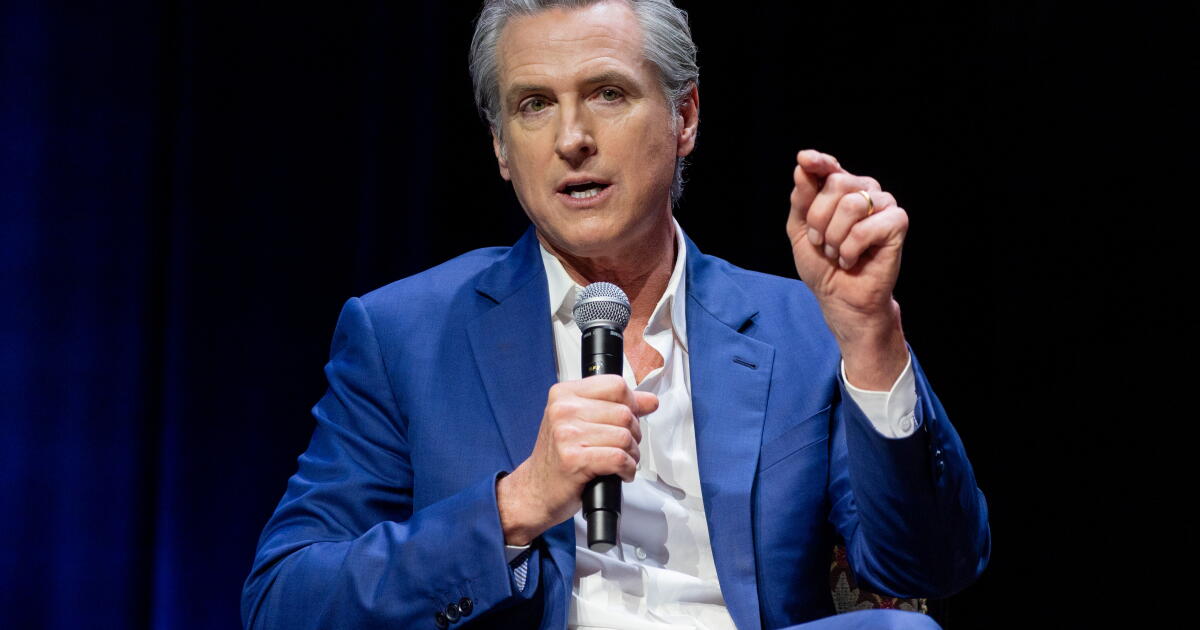
Gov. Gavin Newsom’s ascent to the top of California’s political pyramid did not happen overnight. It’s been 23 years since he entered public life as a San Francisco parking and traffic commissioner and more than a decade since first saying he wanted to be governor.

But through an alchemy of hard work, lucky breaks and larger demographic and electoral shifts, Newsom has hit his stride at a unique moment in California. And it is hard to argue with the observation that he is now the most powerful person in California politics.

How long the moment lasts depends on what happens next. Newsom must choose which battles to fight, and which causes to champion. The size of his list seems equal to his enthusiasm.

“The world is waiting on us,” he said after taking the oath, pausing briefly for maximum impact. “The future depends on us. And we will seize this moment.”

That Newsom managed to win the job as the presumptive favorite from wire to wire of the 2018 campaign was, in part, due to his own decision to seize the opportunity four years ago this week. It was then, in the wake of a surprise announcement by Sen. Barbara Boxer that she would not seek reelection, that several prominent Democrats wrestled with whether to jump at the chance that appeared.

For Newsom, that day in 2015 was serendipitous. He had been on a collision course to the gubernatorial election for three years with another political heavyweight, then-state Atty. Gen. Kamala Harris. It wasn’t clear he would win such a showdown. And so four days after Boxer stepped aside, Newsom stepped forward to decline a Senate race and — in effect — announce his intentions to run for governor.

Read Gov. Gavin Newsom’s inaugural address »

The next day, Harris did just the opposite. Newsom simultaneously encouraged his most powerful rival to switch gears and launched his 2018 campaign — all with a speed that meant his political machine would be fully operational months and years before others decided if they wanted to run.

The move also allowed Newsom to take the job of lieutenant governor and expand it from a nothing-to-do way station into a legitimate role of California governor-in-waiting. In 2015, he dug into the policy debate over legalizing marijuana, helping craft the following year’s successful ballot measure, Proposition 64. He challenged the National Rifle Assn. to fight against Proposition 63 and its requirement of new background checks before buying ammunition for guns — even though it crossed paths with a similar effort by his fellow Democrats in the Legislature.

More recently, Newsom used his de facto role as California’s political heir apparent to ramp up his criticisms of President Trump. And he expanded his base of friends in politics, campaigning last fall for the party’s challengers in battleground congressional and legislative races. Some of those new members of Congress left Washington in the middle of a tense federal government shutdown to celebrate his inauguration.

Only a gubernatorial candidate ahead in the polls and confident of victory would have diverted that much time to other efforts. But Newsom likely knew how helpful it could be in the long run. He can count among his assets a handful of important IOUs on Capitol Hill, ones that could pay off long after House Speaker Nancy Pelosi — a longtime friend — relinquishes her own place of power.

It can’t get much better for Gavin Newsom as California’s next governor. But it’s almost certain to get worse »

What California’s 40th governor does with his newly expanded influence is one of the new year’s most fascinating questions. History will remind him that there’s a very real chance of overplaying his hand: Former Gov. Gray Davis famously told a newspaper editorial board that legislators must “implement my vision,” and former Gov. Arnold Schwarzenegger lurched so far to the right in his first two years that it took twice as long to regain his political footing.

But in an era of indisputable Democratic dominance — Republicans have failed for three consecutive elections to win a statewide race — Newsom’s prowess seems especially important. No one is better positioned to singularly determine the path forward for major public policies, to play political kingmaker or to go toe-to-toe with the president of the United States.

The kingmaker role could prove especially interesting as California’s early presidential primary next March could feature a number of Newsom’s fellow Democrats in the state — including one-time rival Harris — who hope to challenge Trump. An endorsement from Newsom, now the state party’s nominal leader, could carry real weight in a crowded field.

Less likely, but always possible if Democrats are divided by a wide field of candidates: Newsom could put his own name on the ballot using an old power move called the “favorite son” strategy. There, a home state leader pledges to later throw all of California’s delegates toward one of the hopefuls at the national convention. It would be controversial — but conceivable — if his political power endures.

The presidential machinations might not end there. Legislative Democrats were unable to get Brown to sign a law requiring a presidential candidate to release his or her tax returns before being placed on California’s ballot. The bill was squarely aimed at Trump, who has steadfastly refused to do so. Would Newsom agree to put the squeeze on the president and sign the bill?

George Skelton: As California’s new governor, Gavin Newsom needs to address what no one wants to talk about »

Newsom could also take a much more active role in bringing lawsuits against the Republican president and his administration. His predecessor left much of the political rhetoric over California’s four dozen Trump-related lawsuits to state Atty. Gen. Xavier Becerra. Or Newsom could simply ratchet up his critiques of Trump, whom he’s called a “disgrace” with a “limited attention span.”

In his inaugural speech, the new governor singled out a host of bogeymen, including pharmaceutical companies and the pay-day lending industry.

“Here in California, we have the power to stand up to them,” he said. “And we will.”

Waging those kinds of battles could further grow Newsom’s political influence, bringing along with it more television interviews, talk show segments and speaking invitations in Washington and beyond.

Still more significant uses of his newfound political power could be on the horizon. Sen. Dianne Feinstein, who will turn 86 in June, could decide to retire before the end of her newly won six-year term. Newsom would pick her successor, a weighty decision given the Democrats’ lock on statewide races.

Maybe not a bond, but there’s a connection between Jerry Brown and Gavin Newsom as governors of California »

Nor is it out of the question that Newsom himself could develop a case of what’s politely been called “Potomac Fever.” The last four governors have all either run for president — Gov. Pete Wilson and Brown — or been talked up as having what it takes to win the White House on the strength of California’s electoral college heft. Depending on what happens in 2020 and whether he’s reelected in 2022, Newsom could use his political muscle to launch a presidential campaign in 2024 at age 57.

Should he choose to remain focused on Sacramento, Newsom will still have enormous political potential. More Democrats than any other time in modern history hold seats in the Legislature, but they all must lobby for the governor’s signature on their bills. Newsom also has line-item veto authority over the state budget. In general, vetoes by the state’s chief executive have become sacrosanct; none has been overturned by lawmakers since 1980.

And if lawmakers don’t bend to his will, Newsom can go around them and take proposals directly to the ballot. The recent record of governors promoting such measures is mixed — Brown won all of his efforts over the last eight years while Schwarzenegger bombed in 2005 only to return with success in 2006 and 2010.

The arrival of each new governor resets the state’s political compass, and some of the resulting dominance — the power of the executive branch — is institutional. But few moments have seemed to find more stars aligned for a single figure to dominate the state than this one.

john.myers@latimes.com

Follow @johnmyers on Twitter, sign up for our daily Essential Politics newsletter and listen to the weekly California Politics Podcast


Source link

Trump attacking Newsom’s dyslexia proves president’s incompetence

You’re reading the L.A. Times Politics newsletter

George Skelton and Michael Wilner cover the insights, legislation, players and politics you need to know. In your inbox Monday and Thursday mornings.

President Trump claims Gov. Gavin Newsom is unfit to be president because he has a “learning disability.” It’s a classic case of the pot calling the kettle black.

The centuries-old pot-kettle idiom points out hypocrisy — as when one person accuses another of a flaw that afflicts himself.

California’s governor has battled dyslexia all his life — very successfully, by any measure. Dyslexia is a learning disability that makes reading and writing difficult. But it doesn’t mean a stricken person is unable to learn. He just needs to learn differently, as Newsom has done since he was a teen.

Trump apparently isn’t dyslexic. But he clearly has some learning disabilities — including stubbornness, narrow-mindedness and intolerance.

The president still hasn’t learned, for example, that he lost the 2020 election. He persists in the belief — or maybe it’s merely another boldface lie — that the election was stolen in a Joe Biden conspiracy. That’s a bizarre fantasy.

He also didn’t learn from past administrations that a commander in chief should not wage war against Iran without a concrete plan to keep open the Strait of Hormuz so Middle Eastern oil can keep flowing to the world.

And he never has learned what most of us were taught by our parents: that you don’t berate your friends if you expect to keep them friendly — lashing out, for instance, at allies before and after their balking at sending warships to help protect the vital strait.

Moreover, he didn’t learn that the nation’s founders embedded a checks-and-balances governing system in the Constitution and that Congress has a role in imposing tariffs.

When the normally Trump-friendly Supreme Court ruled against his unilateral tariff agenda, the spoiled president did what he usually does: attack, insulting the justices who struck down his edicts.

“Fools,” “lapdogs” and a “disgrace to our nation,” he whined. “It’s an embarrassment to their families.”

Trump still hasn’t learned to shut up and try to be civilized.

Not even after shocking everyone by saying of the late Republican Sen. John McCain, a Navy Pilot who spent more than five years as a tortured POW in the Hanoi Hilton: “He’s a war hero because he was captured. I like people that weren’t captured.”

Any respect I might have had for the guy vanished in 2015 when the then-candidate for president publicly mocked a New York Times reporter’s disability. At a campaign rally, Trump jerked his arms and flailed his hands while making fun of the reporter’s palsy-like ailment.

So it wasn’t a surprise recently when Trump tore into Newsom for his dyslexia four times in one week.

Yes, Newsom has his eye on the 2028 presidential election and has been scoring points nationally with Democratic activists by using Trump as a punching bag. But Trump keeps offering himself up as an irresistible target.

Regardless, there’s no excuse — even in hard knocks politics — for attacking someone because of his disability.

“Gavin Newscum” — Trump’s synonym for the governor — ”has admitted he has learning disabilities, dyslexia,” he told reporters in the Oval Office. “Honestly, I’m all for people with learning disabilities but not for my president.”

“Everything about him is dumb,” Trump added.

In a Fox News Radio interview, Trump said that “presidents can’t have a learning disability.” And on Facebook, Trump wrote: “I don’t want the president of the United States to have a cognitive deficiency.”

A quick Google search could have shown Trump that several presidents have had learning disabilities, including dyslexia.

Start with George Washington, who struggled with grammar and spelling. And Thomas Jefferson, author of the Declaration of Independence, who had trouble with reading and spelling.

Other presidents with learning disabilities: Andrew Jackson, Woodrow Wilson, Dwight Eisenhower, John F. Kennedy and Lyndon Johnson. “It’s a poor mind that can think of only one way to spell a word,” Jackson asserted.

Scientist Albert Einstein was dyslexic. So were Apple co-founder Steve Jobs and Thomas Edison.

Dyslexia affects roughly one in five Americans to some degree — more than 40 million people, although relatively few are aware of it, according to researchers.

Newsom has spoken openly for years about his struggles with dyslexia. It’s difficult for him to read, especially prepared speeches. So he reads and re-reads, underlines and highlights and meticulously takes notes. When a speech must be read off a teleprompter, he practices for hours.

In January, the governor began his State of the State address to the Legislature with this ad-lib:

“I’m not shy or, you know, embarrassed about my 960 SAT score. But I am a little bit about my inability to read the written [speech] text. And so it’s always been something that I have to work through and I’m confronting.”

In his recently released autobiography, “Young Man in a Hurry,” Newsom writes: “My high school grades were all over the place and I scored lousy on the SAT, three hours of dyslexic torture.”

Early in his political career as a San Francisco supervisor, he writes, “speaking to a crowd was not unlike the fear I felt in third grade reading to my classmates …. So I learned to memorize my talking points and best lines … and wing it from there.

“This is how I discovered one of the secret powers of dyslexia. I could read a room with the best of them. I’d walk in and immediately size up the faces, mood and manners. … I learned that an audience didn’t mind occasional hiccups of speech as long as you looked them in the eye.”

Newsom was twice elected mayor and twice governor.

None of this means he should necessarily be elected president.

There may be policy and political reasons to consider him unfit — but not because of any learning disability.

What else you should be reading

The must-read: Newsom leads Harris for president among California Democrats, poll finds
The TK: Democrats excluded from USC gubernatorial debate urge rivals to boycott in solidarity
The L.A. Times Special: Rep. Eric Swalwell’s private AI company raises money, questions

Until next week,
George Skelton


Was this newsletter forwarded to you? Sign up here to get it in your inbox.

Source link