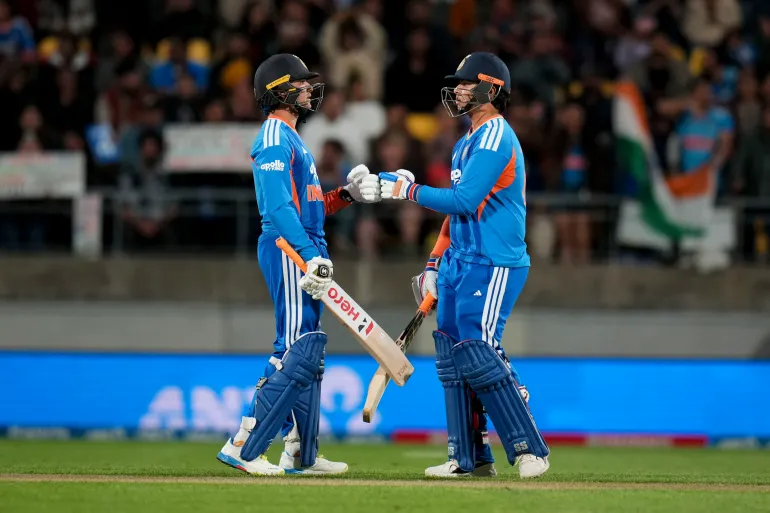
India have a treble of firsts before them in T20 World Cup final vs New Zealand, and the expectations of 1.4 billion fans behind them.
Published On 7 Mar 20267 Mar 2026
Share
The best way to deal with pressure is to embrace it, India captain Suryakumar Yadav reminded his teammates ahead of Sunday’s final of the Twenty20 World Cup at the Narendra Modi Stadium.
India are bidding to become the first team to retain the T20 World Cup title, to win it on home soil and to win the trophy for a record third time.
Recommended Stories
list of 4 itemsend of list
To achieve all that, they will have to deal with not just a strong New Zealand XI but also the weight of expectation from a cricket-mad nation of 1.4 billion people.
Leading the team in the final of a home World Cup was a “special feeling”, and Suryakumar said they were looking forward to the challenge.
“There are nerves, butterflies in the stomach, but as I always say – if there’s no pressure, there’s no fun,” Suryakumar told reporters on Saturday.
“I’m very excited. All the boys and support staff, and I’m sure all of India is excited [for the game].”
More than 100,000 predominantly home fans are expected to fill the world’s largest cricket stadium, where Australia famously beat India in the final of the 50-overs World Cup three years ago.
Expectations are mounting again as India also try to become the first host to win a T20 World Cup.
Suryakumar said they try not to talk about cricket, and the presence of “characters” like Arshdeep Singh and Axar Patel keeps the dressing room atmosphere light.
“It’s very important to have such characters around, because when the situation is tight, you need someone to joke around in the bus and in the dressing room, to calm the dressing room,” said Suryakumar.
“We do not talk about cricket-intense situations because players, like Axar, Arshdeep, [Jasprit] Bumrah – all these people, they know what to do.
“We want to be very relaxed, be in the present, not think about what will happen in the final.”
Suryakumar said as captain, he had also resisted the temptation to be the “big brother” in the dressing room and encouraged individuality.
“I feel a good team culture is very important. A happy team atmosphere is the key,” he added.
“Give them freedom, listen to their ideas as well about what they feel.
“I think it is very important to understand what everyone wants in the team.”
Mumbai, India – For millions of Indians, the ghosts of a home Cricket World Cup defeat to Australia still haunt their memories two years on from the final in Ahmedabad.
It’s a wound that still stings the cricket-mad nation of at least 1.4 billion people, tens of thousands of whom thronged the world’s largest cricket stadium on 19 November 2023, and millions of others who followed the game elsewhere.
Recommended Stories
list of 4 itemsend of list
But just as the heartbreak of the “cursed day” brought them together two years ago, local fans hope that this Sunday will give them a reason to celebrate as India face New Zealand in the T20 World Cup final at the same venue.
A stunned crowd of more than 90,000 watched in silence as Australia crushed India with a six-wicket victory at the Narendra Modi Stadium, turning the undefeated home side’s crowning moment into a day where thousands of seats had emptied before the final ball was bowled.
The sombre atmosphere was akin to a prophecy come true as, on the eve of the 2023 final, Australia’s captain Pat Cummins famously said: “In sport, there’s nothing more satisfying than hearing a big crowd go silent.”
“The 2023 final defeat is still on our minds,” Sounak Biswas, a 29-year-old fan from Mumbai, told Al Jazeera. “Social media posts calling the Ahmedabad stadium a bad omen keep reinforcing that thought.
“On Sunday, I hope I can forget those bad memories and create happier ones.”
The last time Ahmedabad’s Narendra Modi Stadium hosted a World Cup final, India ended on the losing side [File: AFP]
Cautious optimism
The collective mood of the country – from fans to experts and the media – is optimistic.
Oddsmakers have given India a 70 percent chance of defeating New Zealand to become the first host nation to retain its title, local media have thrown their weight behind Suryakumar Yadav’s team to cross the final hurdle and cricket chatter has taken centre stage at workplaces, homes and outdoor gatherings.
Come Sunday, fans will throng pubs, roadside cafes and restaurants from Mumbai to Kolkata and Chennai to Chandigarh to catch the action on large screens or their smartphones. While those without internet access will gather outside electronics stores, a pane of glass separating them from the live broadcast playing on the high-end televisions inside.
Then there are those fans who will undertake journeys from all corners of the country to Ahmedabad in order to watch the action from up close and soak in the atmosphere of a World Cup final.
Mumbai-based fan Biswas and his friend Piyush Nathani will join another 30 or so members of the “North Stand Gang” – a hardcore fan group from the Wankhede Stadium – as they carry their support to the neighbouring state.
For Nathani, Sunday’s final will cap an exhilarating journey of watching the monthlong tournament across stadiums in India and Sri Lanka.
Through the ups and downs of Team India’s campaign, he has held on to one small ritual and he won’t change it for the big match.
“I wear the same jersey and pair of trousers for every game,” the 29-year-old said.
Indians watch the live telecast of the 2023 ICC Men’s Cricket World Cup final match between Australia and India on a television displayed at a TV store in Guwahati, India [File: Anupam Nath/AP]
Squad depth to India’s rescue
India’s route to the final included its fair share of hiccups: the co-hosts didn’t look their strongest against minnows USA in their opening game, fell to South Africa in the next stage and were pushed to the brink by England in the semifinals.
But in their pursuit of victory, a different player stepped up as the team began to falter.
From the ever-reliable pace-bowling star Jasprit Bumrah and versatile all-rounder Hardik Pandya to young wicketkeeper-batter Ishan Kishan and the stunning Sanju Samson, who made a sparkling return to the playing XI, India never fell short of match-winners.
“The Indian team is by far the best in the tournament because of the quality in the squad,” Indian cricketer and TV analyst Aditya Tare told Al Jazeera ahead of the final.
“There were moments when the team was under pressure, but they showed character, picked themselves up from tough situations and finished games off.
“The biggest example of the squad’s depth is Sanju Samson. He didn’t get a spot in the playing XI for a few games, but the moment he got in, he picked up two player of the match awards. That goes to show that India isn’t reliant on just one or two players [to win matches].”
India’s batter Sanju Samson heads into the final on the back of two consecutive man of the match performances [File: Bikas Das/AP]
‘Pressure is privilege’
Suryakumar’s team will undoubtedly carry the hopes of more than 1.4 billion people at home and millions of Indian diaspora watching elsewhere in the world, with Sunday’s result shaping the mood of the nation the next morning – whether Indians wake up brimming with joy or grappling with another heartbreak.
For some fans, however, that pressure is not a burden but a sign of how deeply the team is loved.
“I think pressure is a privilege,” Aritra Mustafi, a fan from Bengaluru, said of the expectations the team carries. “If 90,000 fans turn up again, and it puts the team under pressure, it’s a privilege [for the players] that so many are supporting them.”
After a monthlong tournament, the final hurdle awaits a gritty India side [Prakash Singh/Getty Images]
The venue has been a major part of the discourse in the run-up to the final. The decision to stage another World Cup final at the 132,000-capacity Narendra Modi Stadium instead of the traditional homes of Indian cricket – Mumbai’s Wankhede Stadium or Kolkata’s Eden Gardens – has prompted debate among fans online.
Those who have attended matches there believe the vast stadium gives more supporters a chance to witness India playing for another world title.
“From a fan atmosphere perspective, Gujarat might not be the best place, but stadium-wise it’s pretty good because of the crowd management,” said Mustafi, who attended two matches in Ahmedabad during the 50-over World Cup in 2023. “There are concerns about how such a huge crowd will enter and exit, but during my last visit, I did not face any issues.”
Watching your team lift a trophy on the grandest stage is a dream for many fans, and Hyderabad-based Praketh Reddy is no different.
“I want to experience how it feels to watch India win the World Cup,” he said. “Singing our national song — Vande Mataram — with a 100,000-strong crowd will be incredible. If we win, the post-match celebrations will go on late … I don’t think I’ll make it back to my hotel until about 3am!”
For Biswas, the final also carries a personal significance: it falls a day after his birthday, and a victory would be the sweetest present.
“When the captain of our country lifts the trophy, it will be a dream come true,” he said.
Mumbai’s ‘North Stand Gang’ will be in Ahmedabad doing what they do best: cheer for the team at the top of their voices [Courtesy of Sounak Biswas]
Finn Allen hits fastest century at a T20 World Cup as New Zealand crush South Africa by nine wickets to reach final.
Published On 4 Mar 20264 Mar 2026
Share
New Zealand stormed into the Twenty20 World Cup final with a nine-wicket demolition of South Africa in the first semifinal at the Eden Gardens.
Put into bat, South Africa recovered from a precarious 77-5 to post a competitive 169-8 after Marco Jansen led their recovery with a belligerent 55 not out.
Recommended Stories
list of 4 itemsend of list
Finn Allen smashed an unbeaten 100 off 33 balls, however, and shared a 117-run opening stand with Tim Seifert (58) as New Zealand romped to their target in only 12.5 overs.
Allen’s achievement was the fastest century scored at a T20 World Cup.
“We wanted to start well and put them on the back foot early,” Allen said. “It is easy for me when Tim [Seifert] is going like that. The way he batted got us off to an absolute flyer.
“It is easy in semifinals to stay up for the fight and with Tim [Seifert] we keep each other in it, and we enjoy it out there together.”
Earlier Jansen’s fifty came in response to Kiwis spinners Rachin Ravindra and Cole McConchie took two wickets each before Tristan Stubbs and Jansen put on 73 to rescue the innings at Kolkata’s Eden Gardens.
Stubbs (29) and Jansen, who hit two fours and five sixes in his 30-ball knock, helped set New Zealand a target of 170 to reach the final.
India successfully chased 196 against the West Indies on Sunday on the same ground.
South Africa were the only unbeaten team in the tournament, while New Zealand had edged into the semifinals on net run-rate.
McConchie struck first in the second over with his off-spin to send back Quinton De Kock for 10 and Ryan Rickelton next ball, but Dewald Brevis avoided the hat-trick.
Aiden Markram was reprieved on three when Ravindra dropped him at midwicket off pace bowler Lockie Ferguson.
Left-arm spinner Ravindra made amends when he had the South Africa captain caught in the deep by Daryl Mitchell for 18.
David Miller was dropped on three by Glenn Phillips but fell for six to Ravindra five balls later, with Mitchell again taking the catch at long-on.
South Africa had lost half their side in 10.2 overs when Jimmy Neesham cut short Brevis’s knock on 34.
Ferguson bowled Stubbs but Jansen hit him for six to reach his fifty.
Pace bowler Matt Henry, who arrived back only on Tuesday night after going home for the birth of his child, took 2-34.
The bowling figures for South Africa will be ones to quickly forget, as the figures to focus on – and the moment to remember – belonged to Allen.
“You take the positives from this game, celebrate little moments of success,” Allen added “Then we have a final to play on Sunday and we look forward to that.”
Defending champions India take on twice champions England in the second semi-final in Mumbai on Thursday, ahead of Sunday’s final.
Persistent rain in Colombo forces abandonment of Pakistan’s game with New Zealand, which was to open Super Eights stage.
Published On 21 Feb 202621 Feb 2026
Share
Pakistan and New Zealand’s Super Eights match to open the second phase of the 2026 T20 World Cup was abandoned because of rain without a ball being bowled.
The rain started at Colombo’s R Premadasa Stadium as soon as Pakistan captain Salman Ali Agha won the toss and chose to bat first on Saturday.
Recommended Stories
list of 4 itemsend of list
The post-toss interviews were completed, but with the forecast suggesting the game would be in doubt, there was little surprise when the teams ran for cover.
More than 60 ground staff were on hand to cover the square and the majority of the playing surface.
The persistent rain eventually led to the umpires calling the Group 2 match off at 9:05pm local time (15:35 GMT).
Not even a five-over match was possible by the 10:16 pm (16:46 GMT) cut-off time, giving the two teams one point each.
Tournament co-host India plays South Africa in Ahmedabad in the first Group 1 match on Sunday, when co-host Sri Lanka and England meet in Group 2 in Pallekele.
A BUDGET hotel chain with self-serve bars and private pod rooms is looking to open in the UK.
There’s talk of the brand, LyLo, opening several sites across the country, and it has its sights set on Southwark in London.
Sign up for the Travel newsletter
Thank you!
New bargain pod hotels could open in the UKCredit: LyLo QueenstownThe current locations have spaces for socialising and designated quiet spotsCredit: LyLo Queenstown
Hotels in the city, and across most of the UK can be expensive – but if it opens in the UK LyLo is set to be very affordable.
Its ethos is ‘lower prices and higher comfort at the centre of everything’.
If priced like they are in Australia and New Zealand, a stay in a pod could cost as little as £20.24 (AUD$39).
LyLo promises fuss-free check-in, on-site drinks and eats, WiFi, workspaces, and spaces to play encouraging guests to socialise with various events.
Some of current pod hotels even have rooftop spots where guests are welcome to relax and play games.
LyLo also holds events like welcome drinks, pop-up dinners, local tours, surprise gigs, wellness activities and film screenings.
Some of the LyLo hotels like the ones in New Zealand’s Queenstown and Australia’s Brisbane, even have their own self-pour cocktail and beer wall.
Guests have to show ID to the bar manager, load up their hotel card, then tap and pour – when the balance runs low, just top up and carry on.
Visitors can help themselves to lager, beer, cider and even cocktails like espresso martinis on tap.
For those who need some peace and quiet for work, the hotel also offers a range of ‘quiet spaces’.
Each hotel has a kitchen fully kitted out with ovens, microwaves, fridges, freezers and plenty of cutlery.
At the current sites, guests can either stay in self-contained pods or private rooms.
Visitors can rent out a self-contained pod with a king size mattress, USB charging port and WiFi.
These pods are within a shared room which can sleep up to 10 guests – so each cabin comes with its own privacy screen.
Guests can stay in a pod room – or opt for a private oneCredit: LyLo QueenstownVisitors are welcome to use the kitchen facilities – and have access to a free BBQCredit: LyLo Queenstown
There’s also the option for a female-only space.
Guests can also opt for a private room, or an ensuite room which comes with private bathroom facilities.
If travelling with a number of travellers, there’s also an option to book out a full room of pods for one large group.
LyLo managing director Tim Alpe said: “We are thrilled to introduce LyLo to Europe, with London as the perfect city to launch our first property.
“Our innovative pod hotel concept has already proven successful in New Zealand and Australia, and we are confident that the European market will embrace our unique blend of affordability and community-focused design.
“London’s dynamic and diverse traveller base makes it an ideal location to begin this exciting new chapter, and we look forward to bringing LyLo’s fresh approach to hospitality to the city.”
The brand currently operates 608 pods across New Zealand and Australia.
Here’s another cheap pod hotel that’s already opened in London…
Travel Writer Helen Wright recently spent the night in London’s newest pod hotel – Zedwell – here’s how it went…
“Zedwell is one of the city’s newest hotels to open, right in the middle of Piccadilly Circus. Being so central, you can normally expect hotels to have high prices – the nearby Ritz and the W Hotel can command nightly rates of £500 or more.
“Not Zedwell – the new hotel claims to be the world’s biggest capsule hotel, and with that, comes the small price of just £30 a night. That definitely makes it the cheapest hotel room in the city (unless you want to bunk up in an 18-bed dorm).
“Inside, decked out with a modern concrete and timber design, there are nearly 1,000 individual sleep capsules over five floors. Guests use an iPad to self-check in, before being directed to one of the correct floor and room.
“Each dorm needs a key card to access, too, so you can only enter the dorm you are assigned, which definitely makes it feel secure. It’s a twist on the traditional ‘dorm style’ hostel set up as each guest gets privacy and security of being tucked up in your capsule, with the ability to lock it from the inside.
“Inside, I was surprised to find a cute little space, with mood lighting and welcoming interiors. Each capsule is made from oak and come with a single Hypnos mattress, Egyptian cotton bedding, individual mini aircon or heat, smart climate control, noise reduction, and ambient lighting.
“There is also a plug socket inside, two USB plugs and a mirror. Make sure to bring your own padlock too, so you can lock your pod if you plan on going out (although reception let you buy them on-site as well).
“There are clean common areas, which felt more adult then teen-backpacker, which includes a lounge and co-working space. I was impressed with how clean the communal bathroom and toilet area as well, with light jazz music playing overhead.”
Captain Aiden Markram hits an unbeaten 86 in seven-wicket defeat of New Zealand in Ahmedabad.
Published On 14 Feb 202614 Feb 2026
Share
South Africa are on the brink of reaching the Twenty20 World Cup’s Super Eight stage after captain Aiden Markram’s storming half-century led them to a dominant seven-wicket victory over New Zealand, securing their third straight Group D win.
New Zealand on Saturday suffered their first loss in the campaign after they posted 175-7 as South Africa’s Marco Jansen took four wickets.
Recommended Stories
list of 4 itemsend of list
In response, opener Markram hit four sixes and eight boundaries in his unbeaten knock of 86 off 44 balls, the highest by a South African captain in the tournament’s history, helping his team reach 178-3 with 17 balls to spare.
Last edition’s finalists South Africa chose to bowl first in Ahmedabad, India, and it immediately paid off as player of the match Jansen (4-40) dismissed most of New Zealand’s top order by the seventh over.
Finn Allen (31 off 17 balls) tried to mitigate the damage after Tim Seifert and Rachin Ravindra fell to Jansen. But Jansen got Allen caught at mid-off in the sixth over, leaving New Zealand struggling at 58-3.
Mark Chapman (48) and Daryl Mitchell (32) turned things around with a 74-run partnership for the fifth wicket until Jansen got Chapman caught by Ryan Rickelton at backward point in the 14th.
New Zealand scored only 17 runs in the next four overs until James Neesham’s unbeaten 23 off 15 balls got them to a fighting total.
Markram’s magic seals the deal for South Africa
Chasing 176, South Africa got off to a fast start with Markram hitting three sixes and five boundaries to steer his team to 62-0 in four overs.
Losing fellow opener Quinton de Kock (20) did not affect Markram, who hit Mitchell Santner for a six down long-on to reach his half-century in just 19 balls. By the time Rickelton (21) fell in the eighth over, South Africa had already crossed the 100-run mark.
With the required run rate falling below six per over, Markram did not hit a single boundary in the next seven overs and focused on rotating the strike, getting South Africa within 28 runs of victory with 30 balls left.
“It’s about managing it through the right phases, I guess, but up front, you’ve seen how teams are taking on the powerplay and we’d be silly not to try that. It’s not always going to come off, but when it does, … we can get ahead of the game,” Markram said.
David Miller, who scored an unbeaten 24, cleared the mid-wicket boundary to bring up the winning runs.
South Africa will conclude their group campaign against the United Arab Emirates on Wednesday, a day after New Zealand play Canada.
PM calls for civil debate as government faces backlash over efforts to roll back policies to support Maori community.
Published On 6 Feb 20266 Feb 2026
Share
New Zealand’s Deputy Prime Minister David Seymour has rejected criticism of his claims that colonisation was positive for the country’s Indigenous Maori population.
Dozens of people started booing and shouting when Seymour stood on Friday to offer a prayer during a dawn service at the Waitangi Treaty Grounds, where New Zealand’s founding document was signed in 1840 by representatives of the British Crown and more than 500 Maori Indigenous chiefs, setting out how the two sides would govern the country.
Recommended Stories
list of 3 itemsend of list
Seymour made his controversial comments that colonisation had been an overall positive experience for Indigenous people on Thursday during a speech to mark national Waitangi Day, an annual political gathering that gives Indigenous tribes a chance to air grievances.
“I’m always amazed by the myopic drone that colonisation and everything that’s happened in our country was all bad,” said Seymour, who is leader of the right-wing ACT Party and a member of the Maori community.
“The truth is that very few things are completely bad,” Seymour had said, according to local online news site Stuff.
Describing his hecklers on Friday as “a couple of muppets shouting in the dark”, Seymour said the “silent majority up and down this country are getting a little tired of some of these antics”.
Following Seymour’s prayer on Friday, left-wing Labour Party leader Chris Hipkins was also loudly jeered by those in attendance.
On Thursday, Indigenous leader Eru Kapa-Kingi told parliamentarians “this government has stabbed us in the front,” and the previous Labour government had “stabbed us in the back”.
Seymour’s government has been accused of seeking to wind back special rights given to the country’s 900,000-strong Maori population, who were dispossessed of their land during British colonisation and remain far more likely to die early, live in poverty or be imprisoned compared with the country’s non- Indigenous population.
Controversial legislation that was tabled last year seeking to reinterpret the treaty’s principles and roll back policies designed to address inequalities experienced by Indigenous people led to protests and failed after two of the three governing parties did not vote for it.
Speaking on Friday, New Zealand Prime Minister Christopher Luxon called for national unity and for steps to address challenges faced by the Maori community.
Luxon also said the national debate over the legacy of British colonisation should remain civil.
“We don’t settle our differences through violence. We do not turn on each other; we turn towards the conversation. We work through our differences,” Luxon said in a social media post.
Denial about the destructive legacy of colonialism and its connection to contemporary challenges faced by Indigenous communities remains a frequent subject of contentious debate in former colonies around the world, including Australia and New Zealand.
The Treaty made New Zealand a part of the British Empire, guaranteed Māori rights to their land and gave Māori the rights of British citizens.
The treaty was signed in Waitangi, a town in the Bay of Islands, by a group of Maori chiefs and the British Government, as represented by Lieutenant-Governor Hobson.
In February 1840, it was at Te Tii marae where Ngāpuhi (the largest Māori iwi – tribe) hosted around 10,000 Māori to debate the agreement for several days. On February 6th, Te Tiriti o Waitangi was signed by around 40 Māori rangatira (chiefs) and representatives of the British Crown outside British Government Representative James Busby’s house (now known as Treaty House) on the Waitangi grounds.
The treaty (‘te Tiriti’) was subsequently signed by another 500 Māori chiefs in various locations throughout the country.
The Māori are the Indigenous Polynesian people of New Zealand, which they called Aotearoa (“land of the long white cloud”). They arrived from Polynesian islands sometime before 1300 AD. They are the first known inhabitants before the Europeans arrived in the early 1800s.