New York

‘My Undesirable Friends’ review: Crackdown on Russian media, told in real time

p]:text-cms-story-body-color-text clearfix”>

Great documentaries are sometimes lucky accidents, the product of being at the right place at the right time and then having the wherewithal to produce something extraordinary out of those unlikely circumstances. When director Julia Loktev traveled to Russia in October 2021, all she wanted was to chronicle a handful of smart, dogged journalists trying to tell the truth who, for their trouble, had been branded foreign agents by Vladimir Putin’s vindictive government. She didn’t know she would be arriving mere months before Russia’s full-scale invasion of Ukraine. But thanks to a quirk of coincidence, she ended up having a front-row seat to history.

She made the most of it: Running five-and-a-half hours without a minute wasted, “My Undesirable Friends: Part I — Last Air in Moscow” takes us inside TV Rain, one of Russia’s last independent television channels. Divided into five chapters, the documentary begins as Loktev, who was born in the former Soviet Union before leaving when she was 9, returns to her homeland armed with an iPhone to shadow veteran TV Rain reporter and host Anna Nemzer. Over the next four months, a period that ended shortly after the invasion began, Loktev embedded herself not just with Nemzer (who is credited as the film’s co-director) but several other journalists as they fear being arrested for their reporting.

Loktev hasn’t completed a film since 2011’s “The Loneliest Planet,” which starred Gael García Bernal and Hani Furstenberg as soon-to-be-wed lovers backpacking through the Georgian countryside, their seemingly close bond shattered after a harrowing encounter. In that movie and her previous feature, 2006’s “Day Night Day Night,” a spare procedural about a nameless suicide bomber in New York, Loktev explored the mysteries of human behavior under pressure. But with “My Undesirable Friends,” she takes that fascination to a new level, introducing viewers to a group of compelling subjects, many of them women in their 20s, who open up in front of her camera while hanging out at TV Rain, their apartments or in cafes, candidly processing their country’s terrifying descent into authoritarianism in real time.

These intrepid journalists couldn’t foresee the invasion that was coming, nor the brutal local crackdown on free speech in its wake, but Loktev makes those dire certainties clear from the start, solemnly intoning in voice-over, “The world you’re about to see no longer exists.” Since its premiere at last year’s New York Film Festival, “My Undesirable Friends” has been compared to a horror movie and a political thriller but perhaps more accurately, it’s a disaster film — one in which you know the characters so intimately that, when the awful event finally occurs, you care deeply about the outcome. (“My Undesirable Friends” bears the subtitle “Part I” because Loktev has nearly finished a second installment, which catches up with the women after they fled Russia.)

In its avoidance of interviews with experts or historians, the documentary offers a kind of personal scrapbook of Loktev’s subjects, showing what everyday life is like in an oppressive society: strikingly banal with a constant background hum of paranoia. Each woman comes into empathetic focus. Nemzer, who is a little older than her colleagues, balances her demanding job with marriage and motherhood. Meanwhile, her younger co-worker Ksenia Mironova keeps diligently filing stories despite her fiancé, journalist Ivan Safronov, being imprisoned for more than a year. (He would subsequently be sentenced to 22 years.) Investigative reporter Alesya Marokhovskaya has a girlfriend, whose face we never see, and eventually details grim memories of a violent childhood. And then there’s Marokhovskaya’s best friend and partner Irina Dolinina, who combats anxiety while her politically unconscious mother harangues her about not being able to find a man now that she’s been labeled a foreign agent.

The stress and uncertainty of these conversations is palpable but, remarkably, so is a spiky sense of humor. When a co-worker is temporarily locked up, Mironova cracks jokes outside his prison while awaiting his release. The journalists wear their foreign-agent designation as a badge of honor, mocking the comically lengthy disclaimer text they’re forced to run with their broadcasts, a pitch-black coping mechanism to make sense of their tense, surreal moment.

“My Undesirable Friends” captures dark times with some of the funniest people you’d ever hope to have as sisters-in-arms. Defiant, emotional and life-affirming, the film presents us with endearing patriots who love their country but hate its leaders, sucking us into a riveting tale with a powerful undertow.

The audience anticipates the frightening future that awaits these journalists, which makes their relentless advocacy all the more moving. If our 20s are a period of unbridled optimism — a hopefulness that slowly gets beaten out of us as we grow older — “My Undesirable Friends” stands as a touching display of the resilience of youth. There is nothing naive about these women who came of age during Putin’s cruel regime, but they nonetheless believe they can change things. While Loktev rarely inserts herself into this epic, we feel her admiration from behind the camera. The film inspires while it challenges: What were any of us doing at that age that was comparably heroic or meaningful? What are we doing now?

Those questions should stick in the craw of Americans who watch this masterwork. Loktev has made a movie about Russia but its themes spread far beyond that country’s borders. During a year in which the worst-case scenarios of a second Trump presidency have come to fruition, “My Undesirable Friends” contains plenty of echoes with our national news. The canceling of comedy shows, the baseless imprisonment of innocent people, the rampant transphobia: The Putin playbook is now this country’s day-to-day. Some may wish to avoid Loktev’s film because of those despairing parallels. But that’s only more reason to embrace “My Undesirable Friends.” Loktev didn’t set out to be a witness to history, but what she’s emerged with is an indispensable record and a rallying cry.

‘My Undesirable Friends: Part I — Last Air in Moscow’

In Russian, with subtitles

Not rated

Running time: 5 hours, 24 minutes

Playing: Opens Friday, Nov. 28 at Laemmle Royal

Source link

In ‘A Sexual History of the Internet’ Mindy Seu reveals the unexpected

The technologist and professor Mindy Seu was having drinks when her friend casually referred to the phone as a sex toy. Think about it, her friend, Melanie Hoff, explained: We send nudes or watch porn, it’s vibrating and touch-sensitive — it’s practically an appendage.

“What exactly is sex, and what exactly is technology?” Seu wondered. “Neither can be cleanly defined.”

Around the same time, in 2023, Seu had just published “Cyberfeminism Index,” a viral Google Sheet-turned-Brat-green-doorstopper from Inventory Press. Critics and digital subcultures embraced the niche volume like a manifesto — and a marker of Seu’s arrival as a public intellectual whose archiving was itself a form of activism. The cool design didn’t hurt. “If you’re a woman who owns a pair of Tabis or Miistas, you are going to have this tome,” joked comedian Brian Park on his culture podcast “Middlebrow.”

Still, the knot between sexuality and technology tugged at her. “Recently, my practice has evolved toward technology-driven performance and publication,” she said. “It’s not exactly traditional performance art, but I believe that spaces like lectures and readings can be made performative.” Though she wasn’t yet finished exploring this theme, she wasn’t sure how to approach it next — until an experiment by Julio Correa, a former Yale graduate student, sparked an idea. Correa had devised an Instagram Stories-based lecture format, and she immediately saw its potential. She reached out to ask if she could “manipulate” his idea into a performance piece, and would he like to collaborate?

  • Share via

Thus, “A Sexual History of the Internet” was born. The work is two things at once: a participatory lecture-performance conducted through the audience’s phones, and an accompanying, palm-sized, 700-plus-page “script” examining how our devices serve as bodily extensions.

The book isn’t exhaustive but instead a curated miscellany of non-sequiturs and the kind of dinner-party lore Seu delights in. Did you know that the anatomical structure of the clitoris wasn’t fully mapped until a decade after the invention of the World Wide Web? Or that the first JPEG — introduced in 1992 at USC — cribbed a Playboy centerfold nicknamed “Lenna,” which journalist and the author of the 2018 “Brotopia” Emily Chang called “tech’s original sin.”

The metaverse, web3 and AI — none of this is new, Seu said in her loft this past Saturday, hours before her West Coast debut at the Geffen Contemporary at MOCA. “But understanding the arc is helpful, especially how it’s tied to militaristic origins rooted in power, and how those same people were also confronted with sexuality.”

She’s just returned from a whirlwind tour — Antwerp, New York, Oslo, Madrid — with Tokyo next month. She splits her time between L.A. and Berlin, where her boyfriend lives, but for now, she’s staying put in what she calls her “bachelor pad on the set of a ‘90s erotic thriller,” inherited from a friend, the artist Isabelle Albuquerque.

The floor-to-ceiling windows high in a historic Brutalist artists’ complex overlook MacArthur Park and the downtown skyline. She’s offset the building’s cement with a childhood baby grand piano and her grandmother’s lacquer vanity with pearl inlay. That Seu marries the feminine and the spartan in her space feels intentional — a reflection of the dualities that animate her life and work.

"A Sexual History of the Internet" by Mindy Seu

“A Sexual History of the Internet” by Mindy Seu

(Photography by Tim Schutsky | Art direction by Laura Coombs)

Though she moved from New York three years ago, she resists calling herself an Angeleno — partly, she admits, because she never learned to drive despite growing up in Orange County. Her parents ran a flower shop after immigrating from South Korea. The household was conservative, Presbyterian and promoted abstinence. Like with many millennials, her sexual awakening unfolded online.

“I asked Jeeves how to have an orgasm,” she writes. “I sexted with classmates on AOL Instant Messenger. Any curiosities were saved until I could sneak onto my family’s shared ice blue iMac G3 in the living room.”

At 34, the very-online academic holds a master’s from Harvard’s Graduate School of Design and has taught at Rutgers and Yale before joining her alma mater, UCLA, as one of the youngest tenured professors (and perhaps the only one who has modeled for JW Anderson and Helmut Lang). Her first three years at UCLA have each had their crises — encampments, fires, ICE raids — yet her Gen Z students give her hope. “They’re so principled and motivated, even if it’s in a nihilistic way,” she said.

Online, fans declare their “brain crushes” on Seu, whose ultra-detailed spreadsheets have become unlikely catnip for TikTok. Vanity Fair dubbed her the rare cybernaut who “lands soft-focus photoshoots in niche lifestyle publications.” Her unusual power is the ability to move through different fields, Trojan-horsing her theories across academia, the art world, the lit scene, tech, fashion, et al. Seu’s notoriety continued to swell after appearing on the popular internet talk show “Subway Takes” with the standout zinger: “Gossip is socially useful, especially to women and the marginalized.”

“Mindy’s really good at bridging different audiences who might not read an academic text about the history of the internet but are interested in Mindy’s practice,” said Correa, Seu’s student-turned-collaborator. When the two workshopped their performance last year on their finsta (a.k.a. fake Instagram), they encountered one major hurdle: censorship. They had to get creative with their algospeak (like changing “sex” to “s*x”) to keep from getting banned.

Mindy Seu in her MacArthur Park loft.

Mindy Seu in her MacArthur Park loft.

(Carlin Stiehl / For The Times)

“A Sexual History of the Internet,” designed by Laura Coombs, carries that collaborative ethos into its financial structure. Seu’s first book went through traditional publishing, where authors often receive about 10% and contributors receive fixed fees. This time, she wanted a citation model that compensated the 46 thinkers who shaped her understanding of the subject.

She approached Yancey Strickler, director of Metalabel, “an indie record label for all forms of culture,” and co-founder of Kickstarter. Seu’s original proposal waived all profits to collaborators. “Everyone got paid but her,” Strickler said. If she wanted the model to be replicated, he told her, it needed a capitalist backbone.

They landed on Citational Splits, where everyone who was cited joined a 30% profits pool, in perpetuity, across future printings (27 opted in). The remaining 60% goes to Seu and five core collaborators. Strickler likened it to music royalties or company shares: “Your presence increases the project’s value, and some of that value should flow back to you.”

Neither can name a publishing precedent. “It shows a profound, practical morality that underlies her work,” he said.

At MOCA, about 300 Angelenos braved an atmospheric river to sit in the darkened former police car warehouse bathed in red light. No projector, no spotlight. A pair of Tabis winks at her all-black-clad friend; a couple holds hands as Seu moves through the room. (“I intentionally wear very noisy shoes,” she said earlier.)

With the calm cadence of a flight attendant, Sue instructs everyone to put their phones on Do Not Disturb, sound and brightness to max and open Instagram to find @asexualhistoryoftheinternet.

The audience reads in unison when their designated color appears. What follows is a chorus of anecdotes, artworks and historical fragments tracing the pervasive — and sometimes perverted — roots of our everyday technologies. Hearing men and women say “click and clitoris” together is its own spectacle.

“From personal websites to online communities, cryptocurrencies to AI, the internet has been built on the backs of unattributed sex workers,” one slide notes. Sex work has long been an early adopter of emerging technology — from VHS to the internet — and the present is no exception. Two years ago, OnlyFans creators made more money than the total NBA salary combined; today, the company now generates more revenue per employee than Apple or Nvidia.

Seu ends with the widely known dominatrix Mistress Harley’s concept of data domination, a subset of BDSM in which her “subs” (a.k.a. submissives) grant her remote access to their machines. Seu tells the crowd that she has essentially done the same, “viewing the voyeurs” and taking photos of us throughout the performance, which are already posted to Instagram.

We walk out into the dark rain, wondering what exactly we witnessed — and realizing, perhaps, we’ve been witnessing it all along.


Source link

Tatiana Schlossberg reveals terminal cancer diagnosis, another Kennedy family tragedy

Tatiana Schlossberg, granddaughter of slain President John F. Kennedy, is battling a rare form of leukemia and may have less than a year to live.

In an essay published Saturday in the New Yorker, the 35-year-old environmental journalist wrote her illness was discovered in May 2024 after she gave birth to her daughter. She was diagnosed with acute myeloid leukemia with a rare mutation known as Inversion 3 and has undergone several treatments, including chemotherapy and bone marrow transplants.

Schlossberg is a daughter of former U.S. Ambassador Caroline Kennedy, the former president’s daughter, and Edwin Schlossberg. They live in New York.

In her essay, Schlossberg acknowledged that her terminal illness adds to a string of tragedies that has befallen the famous political family. Her grandfather was assassinated in Dallas in 1963. Nearly five years later, his brother, Sen. Robert F. Kennedy, was fatally shot in Los Angeles after giving a victory speech at the Ambassador Hotel following his California presidential primary win. Her uncle, John F. Kennedy Jr., died in 1999 when his small plane crashed.

“For my whole life, I have tried to be good, to be a good student and a good sister and a good daughter, and to protect my mother and never make her upset or angry,” Schlossberg wrote.

“Now I have added a new tragedy to her life, to our family’s life, and there’s nothing I can do to stop it.”

She wrote her diagnosis was stunning. She had just turned 34, didn’t feel sick and was physically active, including swimming a mile one day before she gave birth to her second child at Columbia-Presbyterian hospital in New York.

After the delivery, her doctor became alarmed by her high white blood cell count.

At first, medical professionals figured the test result might be tied to her pregnancy. However, doctors soon concluded she had myeloid leukemia, a condition mostly observed in older patients. She ended up spending weeks in the hospital.

“Every doctor I saw asked me if I had spent a lot of time at Ground Zero, given how common blood cancers are among first responders,” Schlossberg wrote. “I was in New York on 9/11, in the sixth grade, but I didn’t visit the site until years later.”

She has endured various treatments. Her older sister, Rose, was one of her bone marrow donors.

In the article, Schlossberg mentioned the Kennedy family’s dilemma over controversial positions taken by Robert F. Kennedy Jr., her mother’s cousin. Schlossberg wrote that while she was in the hospital in mid-2024, Kennedy suspended his long-shot campaign for president to throw his weight behind then-Republican candidate President Trump.

Trump went on to name Kennedy to his Cabinet as secretary of the U.S. Dept. of Health and Human Services, which oversees the Food and Drug Administration, National Institutes of Health and the Centers for Disease Control and Prevention.

In one of his early moves, Trump demanded a cut in government money to Columbia University, which employs her husband, George Moran.

“Doctors and scientists at Columbia, including George, didn’t know if they would be able to continue their research, or even have jobs,” she wrote. “Suddenly, the health-care system on which I relied felt strained, shaky.”

On Saturday, her brother Jack Schlossberg, who recently announced his bid for Congress in a New York district, shared on Instagram a link to her New Yorker essay, “A Battle with My Blood.”

He added: “Life is short — let it rip.”


Source link

Liev Schreiber rushed to hospital in New York after Ray Donovan star ‘suffered massive headache’

RAY Donovan star Liev Schreiber has been rushed to a New York hospital after suffering a massive headache.

The Tony award-winning actor is reported to be going through a series of tests since he was hospitalised, according to TMZ.

Planet Hollywood Times Square Grand Opening
Schreiber’s early film roles include Mixed Nuts, Party Girl, The Daytrippers, and Big NightCredit: Getty
"The Perfect Couple" UK Premiere - Arrivals
He has been nominated for nine Primetime Emmy Awards and five Golden Globe AwardsCredit: Getty

Isaac Liev Schreiber, 58, experienced the massive headache on Sunday and called his doctor.

He was then directed to go to hospital immediately.

Doctors have been unable to determine the exact cause of the pain.

However, Schreiber is said to be able to speak and walk without any issues – having full use of his arms and legs.

Read More Entertainment News

TRAGIC END

Diane Ladd’s cause of death revealed after Oscar-nominated actress died aged 89


DIDDY SHOCK

Disgraced Diddy facing fresh sexual assault allegation as cops launch new probe

In the past, the Emmy-nominated actor has experienced a sudden episode of memory loss triggered by a migraine.

This occurred once when he was starring in a Broadway production of Doubt: A Parable.

He spoke about the episode on an appearance with Late Night host Seth Meyers last, describing it as “the worst nightmare that an actor could possibly ever experience”.

Schreiber added: “I was in my dressing room and I had a terrible headache. I thought it was maybe a fast food headache, but it felt a little stronger than that. I’m walking down the stairs and I’m thinking – this is not normal.

“I don’t feel okay.”

He recalled knowing “something was really wrong” when he could not remember his co-star Amy Ryan’s name backstage before having to perform.

An MRI led to the father-of-three being diagnosed with transient global amnesia.

He shares his 18-year-old son, Sasha, and 16-year-old daughter, Kai, with ex-partner Naomi Watts.

The two actors ended their relationship of 11 years in 2016, and both remarried.

Schreiber is now married to former beauty queen Taylor Neisen who was crowned Miss South Dakota in 2012.

They welcomed their first child together in August 2023 after marrying in July.

Schreiber list of acting credits includes Scream, X-Men Origins: Wolverine, Mixed Nuts, Party Girl, and The Daytrippers.

He has in the past been nominated for nine Primetime Emmy Awards and five Golden Globe Awards.

Source link

Former CEO of firm that produces ‘Love Island’ sues ad agency for $100 million

The former chief executive of WPP’s Motion Content Group — the producer behind “Love Is Blind” and other reality TV shows — is suing the ad agency, saying he was fired after he flagged alleged improper billing practices.

In the lawsuit, filed in U.S. District Court for the Southern District of New York on Tuesday, Richard Foster said he was ousted after he repeatedly warned senior managers about alleged “kickback practices” involving the company’s “rebate-driven deals” that he said “were unsustainable, unlawful, and a significant threat to the Company.”

Foster, a 17-year veteran, led WPP’s media division that is the producer and co-financier of “Love Island” and some 2,500 other television shows around the world. The division was rebranded in 2023 as GroupM Motion Entertainment in the North America.

Foster alleged in his lawsuit that GroupM leveraged “client budgets to secure inventory deals” from media companies that included cash rebates, inventory discounts and other financial incentives, and that these transactions were not always transparent or disclosed to clients.

Over the last five years, the lawsuit states, the company “generated rebate-driven deals valued between $3 [billion] and $4 billion, of which it improperly retained approximately $1.5 [billion] to $2 billion.”

But rather than confront the issues, Foster claims executives “marginalized him, and ultimately terminated him and his team to cover up their own improper practices.”

WPP disputed the claims.

“The Company is aware of a lawsuit in the New York State Court filed by a former employee who was let go in a recent organizational restructuring,” a WPP spokesperson said in a statement. “The court has not yet made any findings in relation to the allegations and we will defend them vigorously.”

In December, Foster submitted a 35-page internal report emphasizing that there were opportunities to establish a new entertainment division, but warned that its use of rebates could pose “possible legal and reputational” risks to the company.

At one point, Foster alleged that he told one executive, that “WPP and GroupM have ‘been sleepwalking to the edge of a cliff and people don’t want to hear it.’”

In January, Foster said he was asked to discuss the report with Brian Lesser, global CEO of GroupM, who “expressed concern about the legal risks tied to GroupM Trading and said he would investigate this further.” Days later Foster claimed that he received a text from Lesser asking him to send a “sanitized version of the report” and “to exclude any overt criticism of [GroupM Trading] as that is not in the spirit of working together.”

Eventually, Foster said he was terminated on July 10. He is seeking $100 million in damages.

“Richard Foster devoted nearly two decades to helping build one of the world’s most successful media and entertainment creation operations,” his attorney, William A. Brewer III, partner at Brewer, Attorneys & Counselors, said in a statement. “When he stood up for transparency and accountability at WPP, he was let go. This case will shine a light on systemic misconduct and the retaliation faced by an executive who refused to go along to get along.”

Source link

JFK’s grandson Jack Schlossberg is running for a U.S. House seat in New York

John F. Kennedy’s grandson Jack Schlossberg is running for the U.S. House next year, announcing Tuesday that he’s seeking a congressional seat in New York City that will be vacated by longtime Democratic Rep. Jerry Nadler.

Schlossberg, 32, is a sardonic social media personality with a large following and storied political roots. In a video, he said the district covering a core chunk of Manhattan “should have a representative who can harness the creativity, energy and drive of this district and translate that into political power in Washington.”

Nadler, who is serving his 17th term in Congress, announced in September that he will not run for reelection next year after decades in office, suggesting to The New York Times that a younger Democratic lawmaker in his seat “can maybe do better, can maybe help us more.”

Several possible successors have emerged for the solidly Democratic district, including Micah Lasher, a former aide to Nadler and current New York state lawmaker with deep experience in government. The district stretches from Union Square to the top of Central Park, including the wealthy Upper East Side and Upper West Side neighborhoods.

In his campaign video, Schlossberg took aim at President Trump and Republican governance in Washington, saying “It’s a crisis at every level.”

“We deserve better, and we can do better, and it starts with the Democratic Party winning back control of the House of Representatives,” he said.

Schlossberg has cultivated his online presence with frequent posts weighing in on national political issues, including taking aim at his cousin Robert F. Kennedy Jr., the Trump administration’s health and human services secretary who’s been a vocal vaccine skeptic.

Last month, Schlossberg posted on Instagram an image of a Halloween costume for “MAHA Man,” in reference to Kennedy’s Make America Healthy Again message and described it as including such things as measles.

Source link

Supreme Court justices lean to expanding right to carry gun

The Supreme Court’s justices, citing the right to bear arms in the 2nd Amendment, sounded ready Wednesday to strike down laws in New York and California that deny most gun owners permits to carry concealed guns in public.

Most of the justices said people who live in “high-crime areas” and fear for their safety should be allowed to carry a gun for self-defense. And they said this applies equally to people who live in cities as well as in rural areas.

“Think about people who work late at night in Manhattan,” said Justice Samuel A. Alito Jr. “It might be somebody who cleans offices. It might be a doorman at an apartment. It might be a nurse or an orderly [or] somebody who washes dishes” who is “scared to death” to head home. “How is it consistent with the core right to self-defense” to deny that person the right to have a gun with them? he asked.

In defense of New York’s law, state Solicitor General Barbara Underwood argued for limiting the number of guns in densely populated areas. Too many guns in too many hands would increase the danger of gun violence, she said.

But Chief Justice John G. Roberts Jr. and Justice Brett M. Kavanaugh disputed that view and said people there may have a greater need to protect themselves with a gun.

“How many muggings take place in the forest?” Roberts asked her.

Kavanaugh said the 2nd Amendment protects a right to have a gun for self-defense, which suggests the decision to be armed should rest with the gun owner, not a state or local licensing official.

“Why isn’t it good enough to say I live in a violent area and I want to be able to defend myself?” he asked.

During their comments and questions, the court’s six conservative justices made clear they are highly skeptical of laws that authorize state or local officials to deny gun permits to law-abiding residents.

Only the court’s three liberal justices spoke in defense of these laws and said there has been a long history of regulating guns in public.

Still, a gun rights ruling in the New York case could be limited. The justices, both conservative and liberal, said cities and local governments would not be prevented from enforcing bans on guns in “sensitive places,” and that could include subways, football stadiums and university campuses.

“Can’t we just say Times Square on New Year’s Eve is a sensitive place?” said Justice Amy Coney Barrett.

Washington attorney Paul Clement, who was representing the gun owners, avoided a clear answer on where guns could be excluded, but he agreed the city would retain that authority to restrict guns in certain places.

At issue on Wednesday in the case of New York State Rifle & Pistol Assn. vs. Bruen were the laws in New York as well as similar measures in California and six other states that limit who may obtain a license to carry a concealed handgun in public.

Typically gun owners are required to show they have a “special need” or “good cause” to be armed, not simply a general fear for their safety. In New York City and Los Angeles, these permits are rarely granted.

UCLA law professor Adam Winkler, who has written widely on the 2nd Amendment, said the outcome could force local officials to shift their focus to declaring certain places off-limits to guns.

“New York may be forced to allow more people to carry but can still broadly define sensitive places to make it hard practically to carry in New York City,” he said.

The ruling will also have a direct effect in California as well. “If New York’s law is struck down, the precedent will lead to overturning California’s carry laws too,” he said.

Gun control advocates heard little to cheer from the argument.

“We are on high alert about the dangerous consequences of a potential ruling in favor of gun extremists,” said Hannah Shearer, litigation director for the Giffords Law Center. “But the court still has an opportunity to reject the unprecedented and historically inaccurate view that the 2nd Amendment precludes meaningful gun safety regulations in public.”

But Eric Tirschwell, executive director of Everytown Law, pointed to the justices’ comments about restricting guns in sensitive places.

“Even the court’s most conservative justices have hesitations about granting the gun lobby its ultimate goal in this case — the unrestricted right to carry guns in all public places,” he said.

The case heard Wednesday and the likely outcome highlight the change in the makeup of the court.

In the last decade, the justices had turned down several challenges to the gun-permitting laws, including in California. But with the arrival of Justices Kavanaugh and Barrett, the court appears to have a new majority to bolster individual rights under the 2nd Amendment.

The case began when Robert Nash and Brandon Koch, who live near Albany, N.Y., applied for general concealed-carry permits but were turned down by a county judge because they did not “face any special or unique danger.” They were, however, licensed to carry guns for hunting or target shooting.

They sued along with the New York State Rifle & Pistol Assn., alleging the restrictions violated their rights under the 2nd Amendment to bear arms for self-defense.

Source link

Schumer is pressured to step aside as Senate Democratic leader after shutdown vote

Sen. Chuck Schumer of New York is facing mounting pressure to step aside as leader of the Senate Democratic caucus after eight members voted against his wishes Sunday, joining Republicans in a bid to end the longest government shutdown in history.

The vote was just the latest development in a troubling week for the 74-year-old Schumer, who, after eight years as the top Senate Democrat, has faced growing calls from within the party to make way for a new generation of leadership.

Elections last week revealed the emergence of a growing progressive movement in Schumer’s hometown, where the longtime senator declined to endorse Zohran Mamdani in his successful bid for New York City mayor.

National progressive organizations on Monday urged him to step down and have encouraged a popular congresswoman in the state, Rep. Alexandria Ocasio-Cortez, to run for his Senate seat in 2029. Polls show Schumer faces the lowest approval numbers of any national leader in Washington.

His leadership troubles come on the heels of Rep. Nancy Pelosi (D-San Francisco), the first female speaker of the House, announcing her retirement, a decision that generated praise across the political aisle last week reflecting on her shrewd ability to control a sprawling House Democratic caucus during high-stakes votes.

“Schumer is no longer effective and should be replaced,” Rep. Ro Khanna (D-Fremont) wrote on X after the Sunday night vote. “If you can’t lead the fight to stop healthcare premiums from skyrocketing for Americans, what will you fight for?”

Hakeem Jeffries of New York, the top Democrat in the House, told reporters Monday that he strongly disapproved of the emerging deal in the Senate, where seven Democrats and one independent who caucuses with the party voted to proceed with government funding.

For seven weeks, House and Senate Democrats said they would not vote for legislation to reopen the government unless they were able to secure an extension of health insurance subsidies. But the deal reached in the Senate indicated how some Democrats gave in on that bottom-line negotiation.

Schumer reiterated his disapproval of the spending deal in a speech from the floor Monday. He criticized the compromise as a “Republican bill” even though members of his party helped broker the deal.

“Republicans now own this healthcare crisis,” Schumer said. “They knew it was coming. We wanted to fix it and they said no, and now it is on them.”

As Schumer delivered his speech, Jeffries spoke to reporters at a news conference on the other side of the Capitol.

Asked whether he thought Schumer remained an effective leader and should remain in his position, Jeffries replied, “yes and yes.”

When pressed to elaborate, Jeffries said “the overwhelming majority of Senate Democrats led by Chuck Schumer waged a valiant fight,” and turned his disapproval to the Democrats who voted with Republicans on the bill.

“I am not going to explain what a handful of Senate Democrats have decided to do,” Jeffries said. “That’s their explanation to offer to the American people.”

Now that the effort turns to the House, Jeffries said Democrats in the chamber will try to block a deal that does not address healthcare costs.

California Gov. Gavin Newsom offered harsh criticism of Senate Democrats on Monday, who he said had “rolled over.”

After speaking at the Milken Institute’s Global Investors’ Symposium in São Paulo, Newsom told The Times that the move blunted the momentum his party was experiencing following a string of victories last week.

“You don’t start something unless you’re going to finish,” said Newsom, who next heads to the climate summit known as COP30 in Belém, Brazil. “Why the hell did we do this in the first place? We could have gotten this deal in 20 minutes. … Honestly, I don’t know what’s going on with my party.”

Zach Wahls, a Democratic candidate for Senate in Iowa, said Schumer had “failed to lead this party in one of its most critical moments,” calling for him to step down. And Rep. Seth Moulton, a Democrat from Massachusetts, wrote that an effective leader would have been able to keep party members in line.

“Tonight is another example of why we need new leadership,” Moulton wrote on X.

The eight members who voted to reopen the government — 15% of the Senate Democratic caucus — voted directly against Schumer, who voted against the measure.

Wahls speculated that the moderate members who voted with Republicans were privately given Schumer’s blessing to do so.

“The fact that he voted against this deal, while he clearly gave it his blessing in private, is a perfect illustration of why people no longer trust the Democratic Party,” Wahls said, “and as long as he stays in a leadership role, it is going to be impossible for anybody — whether it’s in Iowa or any other swing state — to win a majority.”

Times staff writers Wilner and Ceballos reported from Washington, and Gutierrez contributed from São Paulo.

Source link

Taking inspiration from Mamdani, democratic socialists look to expand their power in L.A.

The revelers who packed Tuesday’s election night party in L.A.’s Highland Park neighborhood were roughly 2,500 miles from the concert hall where New York City Mayor-elect Zohran Mamdani celebrated his historic win.

Yet despite that sprawling distance, the crowd, heavily populated with members of the L.A. chapter of Democratic Socialists of America, had no trouble finishing the applause lines delivered by Mamdani, himself a DSA member, during his victory speech.

“New York!” Mamdani bellowed on the oversized television screens hung throughout the Greyhound Bar & Grill. “We’re going to make buses fast and — “

“Free!” the crowd inside the bar yelled back in response.

In Los Angeles, activists with the Democratic Socialists of America have already fired up their campaigns for the June election, sending out canvassing teams and scheduling postcard-writing events for their chosen candidates. But they’re also taking fresh inspiration from Mamdani’s win, pointing to his inclusive, unapologetic campaign and his relentless focus on pocketbook issues, particularly among working-class voters.

The message that propelled Mamdani to victory resonates just as much in L.A., said City Councilmember Eunisses Hernandez, who won her seat in 2022 with logistical support from the DSA.

“What New York City is saying is that the rent is too damn high, that affordability is a huge issue not just on housing, but when it comes to grocery shopping, when it comes to daycare,” she said. “These are the things that we’re also experiencing here in Los Angeles.”

City Councilmember Eunisses Hernandez, appearing at a rally in Lincoln Heights last year.

City Councilmember Eunisses Hernandez, appearing at a rally in Lincoln Heights last year, said New York City Mayor-elect Zohran Mamdani’s message will resonate in L.A.

(Jason Armond / Los Angeles Times)

DSA-LA, which is a membership organization and not a political party, has elected four of its endorsed candidates to the council since 2020, ousting incumbents in each of the last three election cycles. They’ve done so in large part by knocking on doors and working to increase turnout among renters and lower-income households.

The chapter hopes to win two additional seats in June. Organizers have begun contemplating a full-on socialist City Council — possibly by the end of 2028 — with DSA members holding eight of the council’s 15 seats.

“We would like a socialist City Council majority,” said Benina Stern, co-chair of DSA’s Los Angeles chapter. “Because clearly that is the logical progression, to keep growing the bloc.”

Despite those lofty ambitions, it could take at least five years before the L.A. chapter matches this week’s breakthrough in New York City.

Mayor Karen Bass, a high-profile leader within the Democratic Party with few ties to the DSA, is now running for a second term. Her only major opponent is former schools superintendent Austin Beutner, who occupies the center of the political spectrum in L.A. Real estate developer Rick Caruso, a longtime Republican who is now a Democrat, has not disclosed his intentions but has long been at odds with DSA‘s progressive policies.

In L.A., DSA organizers have put their emphasis on identifying and campaigning for candidates in down-ballot races, not citywide contests. Part of that is due to the fact that L.A. has a weak-mayor system, particularly when compared with New York City, where the mayor has responsibility not just for city services but also public schools and even judicial appointments.

L.A. council members propose and approve legislation, rework the budgets submitted by the mayor and represent districts with more than a quarter of a million people. As a result, DSA organizers have chosen the council as their path to power at City Hall, Stern said.

“The conditions in Los Angeles and New York I think are very different,” she said.

Since 2020, DSA-LA has been highly selective about its endorsement choices. The all-volunteer organization sends applicants a lengthy questionnaire with dozens of litmus test questions: Do they support diverting funds away from law enforcement? Do they oppose L.A.’s decision to host the Olympics? Do they support a repeal of L.A.’s ban on homeless encampments near schools?

Once a candidate secures an endorsement, DSA-LA turns to its formidable pool of volunteers, sending them out to help candidates knock on doors, staff phone banks and stage fundraising events.

During Tuesday’s party, DSA-LA organizers recruited new members to assist with the reelection campaigns of Hernandez and Councilmember Hugo Soto-Martínez, a former labor organizer. They distributed postcard-sized fliers with the message, “Hate Capitalism? So do we.”

Standing nearby was Estuardo Mazariegos, a tenant rights advocate now running to replace Councilmember Curren Price in a South L.A. district. Mazariegos, 40, said he first became interested in the DSA in the seventh grade, when his middle school civics teacher displayed a DSA flag in her classroom.

The crowd at the Greyhound in Highland Park reacts to results on Tuesday.

The crowd at the Greyhound in Highland Park reacts to results on Tuesday.

(Eric Thayer / Los Angeles Times)

Mazariegos hailed the results from New York and California, saying voters are “taking back America for the working people of America.” He sounded somewhat less excited about Bass, a former community organizer who has pursued some middle-of-the-road positions, such as hiring more police officers.

Asked if he supports Bass’ bid for a second term, Mazariegos responded: “If she’s up against a billionaire, yes.”

“If she’s up against another comrade, maybe not,” he added, laughing.

When Bass ran in November 2022, DSA-LA grudgingly recommended a vote for her in its popular voter guide, describing her as a “status quo politician.”

Councilmember Nithya Raman, who represents a Hollywood Hills district, is far more enthusiastic. Raman has worked closely with Bass on efforts to move homeless Angelenos indoors, while also seeking fixes to the larger systems that serve L.A.’s unhoused population.

“Karen Bass is the most progressive mayor we’ve ever had in L.A,” said Raman, who co-hosted the election night party with the other three DSA-aligned council members, DSA-LA and others.

Raman was the first of the DSA-backed candidates to win a council seat in L.A., running in 2020 as a reformer who would bring stronger renter protections and a network of community access centers to assist homeless residents.

Two years later, voters elected labor organizer Soto-Martínez and Hernandez. Tenant rights attorney Ysabel Jurado became the fourth last year, ousting Councilmember Kevin de León.

Stern, the DSA-LA co-chair, said she believes the four council members have brought a “sea change” to City Hall, working with their progressive colleagues to expand the city’s teams of unarmed responders, who are viewed as an alternative to gun-carrying police officers.

The DSA voting bloc also shaped this year’s city budget, voting to reduce the number of new recruits at the Los Angeles Police Department and preserve other city jobs, Stern said.

To be clear, the four-member bloc has pursued those efforts by working with other progressives on the council who are not affiliated with the DSA but more moderate on other issues. Beyond that, the group has plenty of detractors.

Stuart Waldman, president of the Valley Industry and Commerce Assn., said DSA-backed council members are making the city worse, by pushing for a $30 per hour hotel minimum wage and a $32.35 minimum wage for construction workers.

“No one is ever going to build a hotel in this city again, and DSA were a part of that,” he said. “Pretty soon no one will build housing, and the DSA is a part of that too.”

The union that represents LAPD officers vowed to fight the DSA’s effort to expand its reach, saying it would work to ensure that “Angelenos are not bamboozled by the socialist bait and switch.”

“Socialists want to bait Angelenos into talking about affordability, oppression and fairness, get their candidates elected, and then switch to enact their platform that states ‘Defund the police by rejecting any expansion to police budgets … while cutting [police] budgets annually towards zero,’” the union’s board of directors said in a statement.

In New York City, Mamdani has proposed a series of measures to make the city more affordable, including free bus fares, city-run grocery stores and a four-year freeze on rent increases inside rent stabilized apartment units.

Some of those ideas have already been tried in L.A.

In 2020, weeks into the COVID-19 shutdown, Mayor Eric Garcetti placed a moratorium on rent hikes for more than 600,000 rent-stabilized apartments. The council kept that measure in place for four years.

Around the same time, L.A. County’s transit agency suspended mandatory collection of bus fares. The agency started charging bus passengers again in 2022.

City Councilmembers Nithya Raman and Eunisses Hernandez celebrate at an election party.

City Councilmembers Nithya Raman and Eunisses Hernandez celebrate at the election night party they co-hosted with Democratic Socialists of America’s L.A. chapter and two other council members.

(Eric Thayer / Los Angeles Times)

In recent months, the DSA-LA has pushed for new limits on rent increases inside L.A.’s rent-stabilized apartments. Raman, who chairs the council’s housing committee, is backing a yearly cap of 3% in those buildings, most of which were built before October 1978.

Hernandez, whose district stretches from working-class Westlake to rapidly gentrifying Highland Park, is a believer in shifting the Overton Window at City Hall — moving the political debate left and “putting people over profits.”

Like others at the election party, Hernandez is hoping the council will eventually have eight DSA-aligned members in the coming years, saying such a shift would be a “game changer.” With a clear majority, she said, the council would not face a huge battle to approve new tenant protections, expand the network of unarmed response teams and place “accountability measures” on corporations that are “making money off our city.”

“There’s so many things … that we could do easier for the people of the city of Los Angeles if we had a majority,” she said.

Source link

Republican U.S. Rep. Elise Stefanik is running for governor of New York

U.S. Rep. Elise Stefanik, a close Republican ally of President Trump, announced Friday that she’s running for governor of New York, a place she depicted in a campaign launch video as being “in ashes” because of lawlessness and a high cost of living.

In her video, a narrator declares “The Empire State has fallen” as it paints a grim picture of urban, liberal leadership and life in New York City, though the message appeared to be aimed at audiences in other, more conservative parts of the state.

Her candidacy sets up a potential battle with Gov. Kathy Hochul, a centrist Democrat, though both candidates would have to first clear the field of any intraparty rivals before next November’s election.

Stefanik, 41, has teased a run for months, often castigating Hochul, 67, as the “worst governor in America.” She’s also assailed Hochul for endorsing the ascendent, democratic socialist Zohran Mamdani, now the mayor-elect of New York City.

In a written statement, Stefanik said she is running to make “New York affordable and safe for families all across our great state.”

“Our campaign will unify Republicans, Democrats, and Independents to Fire Kathy Hochul once and for all to Save New York,” she said.

Hochul’s campaign released its own attack ad Friday against the Republican, dubbing her “Sellout Stefanik,” and blamed her for enabling Trump’s tariffs and federal funding cuts to education and health care.

“Apparently, screwing over New Yorkers in Congress wasn’t enough — now she’s trying to bring Trump’s chaos and skyrocketing costs to our state,” said Hochul campaign spokesperson Sarafina Chitika.

Representing a conservative congressional district in northern New York, Stefanik had once been a pragmatic and moderate Republican who would avoid uttering Trump’s name, simply calling him “my party’s presidential nominee.”

But in recent years she has reshaped herself into a brash disciple and ardent defender of Trump’s MAGA movement, rising through the ranks of the Republican Party’s congressional hierarchy as it molded to Trump’s political style.

Last year, Stefanik was tapped to become the president’s ambassador to the United Nations, though her nomination was later pulled over concerns about her party’s tight margins in the House. She then began to angle toward a run for governor, and very quickly got a public nod of support from Trump.

Her announcement video, which was titled “From the Ashes,” casts New York as a dangerous place plagued by “migrant crime” and economic crisis, placing the blame on “Kathy Hochul’s failed policies,” as urgent, ominous music plays in the background.

New York City police officials have long touted drops in crime and this week said the city is in its eighth consecutive quarter of major crime decline.

The Republican primary field remains unclear ahead of the 2026 race.

On Long Island, Republican Nassau County Executive Bruce Blakeman has said he’s weighing a run for governor. In a statement Friday, he said he has “tremendous respect” for Stefanik but that the GOP needs to nominate a candidate who has “broad based appeal with independents and common sense Democrats.”

“The party must nominate the candidate with the best chance to defeat Kathy Hochul and I have been urged by business, community and political leaders across the state to make the run and I am seriously considering it,” said Blakeman, who handily won reelection to another four-year term on Tuesday.

U.S. Rep. Mike Lawler had been contemplating a run but instead decided to seek reelection in his battleground House district in the Hudson Valley.

Hochul faces a contested primary, with her own lieutenant governor, Antonio Delgado, running against her.

Democrats have a major voter registration edge in New York. The state’s last Republican governor was former Gov. George Pataki, who left office about two decades ago.

Still, Republican Lee Zeldin, a former Long Island congressman and current head of the Environmental Protection Agency, made a serious run for the office in 2022, coming within striking distance of upsetting Hochul.

Izaguirre writes for the Associated Press. AP writer Philip Marcelo contributed to this report.

Source link

‘Peter Hujar’s Day’ review: An artist’s Wednesday proves oddly compelling

p]:text-cms-story-body-color-text clearfix”>

If our waking hours are a canvas, the art is how one fills it: tightly packed, loosely, a little of both. At a time when they were both 40 and the art scene in ’70s New York was in thrall to street-centered youth of all stripes, real-life writer Linda Rosenkrantz asked her close friend, photographer Peter Hujar, to make a record of his activities on one day — Dec. 18, 1974 — and then narrate those details into her tape recorder the following day at her apartment.

The goal was a book about the great mundane, the stuff of life as experienced by her talented confidants. In Hujar’s case, an uncannily observant queer artist and key gay liberation figure planning his first book, what emerged was a wry narrative of phone calls (Susan Sontag), freelancing woes (is this gig going to pay?), celebrity encounters (he does an Allen Ginsberg shoot for the New York Times) and chance meetings (some guy waiting for food at the Chinese restaurant). The Hujar transcript, recovered in 2019 sans the tape, was ultimately published as “Peter Hujar’s Day.”

Now director Ira Sachs, who came across the text while filming his previous movie “Passages,” has given this quietly mesmerizing, diaristic conversation cinematic life as a filmed performance of sorts, with “Passages” star Ben Whishaw perfectly cast as Hujar and Rebecca Hall filling out the room tone as Rosenkrantz. (They also go to the roof a couple of times, which offers enough of an exterior visual to remind us that New York is the third character getting the time-capsule treatment.)

From the whistle of a tea kettle in the daylight as Hujar amusingly feels out from Rosenkrantz what’s required of him, to twilight’s more honest self-assessments and a supine cuddle between friends who’ve spent many hours together, “Peter Hujar’s Day” captures something beautifully distilled about human experience and the comfort of others. For each of us, any given day — maybe especially a day devoid of the extraordinary — is the culmination of all we’ve been and whatever we might hope to be. That makes for a stealthy significance considering that Hujar would only live another 13 years, succumbing to AIDS-related complications in 1987. It was a loss of mentorship, aesthetic brilliance and camaraderie felt throughout the art world.

Apart from not explaining Hujar for us (nor explaining his many name drops), Sachs also doesn’t hide the meta-ness of his concept, occasionally offering glimpses of a clapperboard or the crew, or letting us hear sound blips as it appears a reel is ending. There are jump cuts too, and interludes of his actors in close-up that could be color screen tests or just a nod to Hujar’s aptitude for portraits. It’s playful but never too obtrusive, approaching an idea of how art and movies play with time and can conjure their own reality.

The simple, sparsely elegant split-level apartment creates the right authenticity for Alex Ashe’s textured 16mm cinematography. The interior play of light from day to night across Whishaw and Hall’s faces is its own dramatic arc as Hujar’s details become an intimate testimony of humor, rigor and reflection. It’s not meant to be entirely Whishaw’s show, either: As justly compelling as he is, Hall makes the act of listening (and occasionally commenting or teasing) a steady, enveloping warmth. The result is a window into the pleasures of friendship and those days when the minutiae of your loved ones seems like the stuff that true connection is built on.

‘Peter Hujar’s Day’

Not rated

Running time: 1 hour, 16 minutes

Playing: Opens Friday, Nov. 7 at Laemmle Royal

Source link

Most major U.S. airports are among 40 targeted by shutdown-related flight cuts

Airports in Los Angeles, New York and Chicago along with hubs across the U.S. are among the 40 that will see flights cut starting Friday due to the government shutdown, according to a list distributed to the airlines and obtained by The Associated Press.

The Federal Aviation Administration announced Wednesday that it would reduce air traffic by 10% across 40 “high-volume” markets to maintain travel safety as air traffic controllers exhibit signs of strain during the ongoing government shutdown.

The airports impacted cover the busiest across the U.S. — including Atlanta, Denver, Dallas, Orlando, Miami, and San Francisco. In some of the biggest cities — such as New York, Houston and Chicago — multiple airports will be affected.

The FAA is imposing the flight reductions to relieve pressure on air traffic controllers who are working without pay during the government shutdown and have been increasingly calling off work.

Controllers already have missed one paycheck and are scheduled to again receive nothing next week as as the shutdown drags on and the financial pressure on them mounts.

The FAA has already been delaying flights at times when airports or its other facilities are short on controllers.

Airlines said they would try to minimize the impact on travelers. United Airlines said it would focus the cuts on smaller regional routes that use smaller planes like 737s.

Passengers should start to be notified about cancellations Thursday. The AAA recommended that travelers download their airline’s app and turn on notifications. United Airlines and Delta Air Lines both said they will offer refunds to passengers who opt not to fly — even if they purchased tickets that aren’t normally refundable.

Experts predict hundreds if not thousands of flights could be canceled. The cuts could represent as many as 1,800 flights and upwards of 268,000 seats combined, according to an estimate by aviation analytics firm Cirium.

“I’m not aware in my 35-year history in the aviation market where we’ve had a situation where we’re taking these kinds of measures,” Bedford said Wednesday. “We’re in new territory in terms of government shutdowns.”

Air traffic controllers have been working unpaid since the shutdown began Oct. 1. Most work mandatory overtime six days a week, leaving little time for side jobs to help cover bills and other expenses unless they call out.

Mounting staffing pressures are forcing the agency to act, Bedford said.

“We can’t ignore it,” he said, adding that even if the shutdown ends before Friday, the FAA wouldn’t automatically resume normal operations until staffing improves and stabilizes.

Bedford and Transportation Secretary Sean Duffy said Wednesday that they would meet with airline executives to figure out how to safely implement the reductions.

Major airlines, aviation unions and the broader travel industry have been urging Congress to end the shutdown, which on Wednesday became the longest on record.

The shutdown is putting unnecessary strain on the system and “forcing difficult operational decisions that disrupt travel and damage confidence in the U.S. air travel experience,” said U.S. Travel Association President and CEO Geoff Freeman in a statement.

Duffy warned on Tuesday that there could be chaos in the skies if the shutdown drags on long enough for air traffic controllers to miss their second full paycheck next week.

Duffy said some controllers can get by missing one paycheck, but not two or more. And he has said some controllers are even struggling to pay for transportation to work.

Staffing can run short both in regional control centers that manage multiple airports and in individual airport towers, but they don’t always lead to flight disruptions. Throughout October, flight delays caused by staffing problems had been largely isolated and temporary.

But the past weekend brought some of the worst staffing issues since the start of the shutdown.

From Friday to Sunday evening, at least 39 air traffic control facilities reported potential staffing limits, according to an Associated Press analysis of operations plans shared through the Air Traffic Control System Command Center system. The figure, which is likely an undercount, is well above the average for weekends before the shutdown.

During weekends from Jan. 1 to Sept. 30, the average number of airport towers, regional control centers and facilities monitoring traffic at higher altitudes that announced potential staffing issues was 8.3, according to the AP analysis. But during the five weekend periods since the shutdown began, the average more than tripled to 26.2 facilities.

Funk and Yamat write for the Associated Press. AP journalist Christopher L. Keller in Albuquerque, N.M., contributed to this report.

Source link

‘Death by Lightning’: Who were President Garfield and Charles Guiteau?

This article contains some spoilers for the Netflix miniseries “Death by Lightning.”

If politics today make your head spin, wait until you see Netflix’s “Death by Lightning.” The four-part miniseries, premiering Thursday, chronicles one of the more jaw-dropping stretches of post-Civil War American history, when corruption ran rampant, a presidential nominee was drafted at the 11th hour, only to be assassinated early in his term by one of his biggest fans — becoming perhaps the greatest head of state we never really got to have.

And the show answers the burning expletive-laced question posed by its first line: Who is Charles Guiteau?

“I’ve been in a James Garfield rabbit hole for seven years of my life at this point,” says showrunner Mike Makowsky, who adapted Candice Millard’s 2011 chronicle of Garfield and Guiteau, “Destiny of the Republic.” Those who paid attention in history class probably remember that Garfield served briefly as our 20th president in 1881 before being shot and killed. Those who remember more than that are few and far between.

“My own agent half the time refers to him as Andrew Garfield,” says Makowsky. “And I have to confess, I knew very little about Garfield, like most Americans, until I picked up Candice Millard’s remarkable book.”

Realizing he knew little about one of the four American presidents to be assassinated, Makowsky thought, “Since I would desperately like to be on ‘Jeopardy!’ someday, I was like, ‘Let me educate myself.’ I wound up reading the entire book in one sitting.”

“Death by Lightning,” directed by “Captain Fantastic” auteur Matt Ross, boasts a remarkable cast: Betty Gilpin as First Lady Lucretia Garfield; Nick Offerman as Garfield’s successor, a hard-drinking, hard-partying Chester A. Arthur; Michael Shannon as James Garfield, the polymath president, crusader against corruption and noble to a fault; and Matthew Macfadyen as Charles Guiteau, the frustrated office-seeker who shot him.

“I wanted to cast people who were somewhat counterintuitive,” says Ross. “If you read the cast list for this, you might assume Michael Shannon was playing Guiteau because he has played a lot of complicated, for lack of a better word, villains — tough guys, bad guys. And Matthew Macfadyen has played more heroic characters.”

Guiteau is definitely no Darcy from “Pride and Prejudice,” or Tom Wambsgans from “Succession,” for that matter. In the series’ conception of him, he shares more DNA with Martin Scorsese’s unhinged protagonists than he does with Darcy — or, certainly, with Garfield.

The proto-incel with a gun

As portrayed in “Death by Lightning,” Guiteau is a rotten-toothed, scheming, big-dreaming, delusional charlatan and possible sociopath. He’s the proto-incel, and the diametrical opposite to Garfield, whom Makowsky defines as “lawful good,” to borrow the Dungeons & Dragons classification.

“I think the most reductive view of Guiteau is ‘chaotic evil,’ right? But that’s the least interesting rendering of this person,” he says. “What are the societal factors that alienate a man like Guiteau from his fellow human beings? The show is meant to probe into his psyche.”

He was a member of the Oneida community, a religious sect based in New York that practiced communalism, free love and mutual criticism, which is depicted in the series (and yes, they founded the flatware company). But Guiteau couldn’t partake in what Makowsky delicately called the “benefits” of such a society, largely because his delusions of grandeur alienated him from others there. The women reportedly nicknamed him “Charles Gitout.”

“Everyone who encountered him described him as being disagreeable, odd, rude, selfish,” Ross says, explaining the need for an actor who had the opposite qualities. “He’s an extreme example of someone who had no work to be seen for, but was so desperately looking for affirmation and love.”

A man in a straw hat and dirty jacket stands in front of a chair surrounded by people.

Charles Guiteau (Matthew Macfadyen) was part of the Oneida community, which practiced communalism and free love, but he wasn’t accepted by its members.

(Larry Horricks/Netflix)

Ross describes Macfadyen as someone who’s empathetic, warm and funny. “I wanted that humanity because the real Guiteau was a deeply disturbed man who was psychologically brutalized by his father to the point he was a non-functioning person.”

Makowsky says as he was reading Millard’s book, he thought of Rupert Pupkin, Robert De Niro’s deranged-fan protagonist in Scorsese’s “King of Comedy.” “This guy showing up, day in and day out, hoping for an audience with his hero [Garfield], being continually rebuffed to the point where something in his brain breaks,” he says of Guiteau. “He felt like a direct historical antecedent to the Rupert Pupkins and Travis Bickles of the world. He fell through the cracks and we lost potentially one of our greatest presidents because of it.”

Makowsky recalls shooting the only dialogue scene between Garfield and Guiteau, when the “greatest fan” finally gets to meet his idol. To Makowsky’s surprise, Macfadyen’s Guiteau “just burst into tears. That wasn’t scripted. It was so overwhelming to him. I think in that moment, more than any other in the series, you feel something for this man.”

Party (hearty) over country

Garfield was succeeded in office by Chester A. Arthur, whom Makowsky calls one of the least likely persons to ever become president. “The man had never held elected office,” he says. “His one political appointment prior to his nomination for vice president was as chief crony of the spoils system of [New York Sen.] Roscoe Conkling’s political machine. The level of corruption was so audacious and insane.”

He’s played with oft-drunken brio by Nick Offerman, whose voice Makowsky says he heard in his head as soon as he started writing the role: “I was like, it has to be Nick Offerman.” He took some liberties with the character and events, including a memorable sequence where Arthur and Guiteau go on a bender. Makowsky says they “probably never had a wild night out in New York, but it was an indelible proposition and I couldn’t resist.”

A man in a top hat and vest holding a cane walks next to stagecoach with a man leaning out the window.

Nick Offerman plays eventual President Chester A. Arthur, who was closely aligned with New York Sen. Roscoe Conkling (Shea Whigham).

A woman in a blue dress and hair styled in an updo stands in a wooded area.

Betty Gilpin portrays First Lady Lucretia Garfield as her husband’s intellectual equal. (Larry Horricks / Netflix)

As to the first lady, “Lucretia Garfield was every bit her husband’s intellectual equal. But she couldn’t vote. There was a ceiling to what a woman in her day could accomplish,” Makowsky says, wistfully musing on what she might have achieved, given the chance. “And Betty [Gilpin] radiates that strength and that acute intelligence.”

Having recently given birth, Gilpin took her family along to Budapest for filming, voraciously researching Lucretia and reading her entire correspondence with her husband. The role gets meatier as the series progresses until she initiates an unforgettable, blistering encounter with Guiteau to button the story.

“Betty jokingly said to me, ‘If you cut that scene, I will kill you.’ I was like, ‘There’s no way that scene is being cut. It’s one of my favorite scenes in the entire show,’” Ross recalls. “Everyone who read it was like, ‘Oh my God, this scene.’ And Betty just knocked it out of the park, take after take after take.”

The forgotten president

Ross says when he first read Makowsky’s scripts, he thought they were “fantastically relevant” and offered a fresh look at American history. “As an American, I’m always trying to figure out what it means to be American,” he says. “The story of Garfield, you couldn’t make it up. He was a hero of working people and the promise of American democracy — having a representational democracy where those in power and the wealthy are not controlling the laws of the land, which could not be more relevant today.”

Makowsky calls Garfield “a poster boy for the American dream,” rising from poverty to the nation’s top office.

“He was a war hero and a Renaissance man that did math theorems while he was in Congress and who could recite Homer from memory,” he says. “This remarkable individual, fiercely intelligent and a brilliant, powerful orator, was far ahead of his time on certain political questions of the day. He was an outspoken proponent for civil rights and universal education and civil service reform.”

In real life, and as depicted in the series, Garfield worked with notable Black leaders like Frederick Douglass and Blanche Bruce, the first Black register of the Treasury, whom he appointed.

“The great tragedy is we were robbed of a potentially generational leader in Garfield,” Makowsky says.

A man leans back in a chair behind a desk with a lamp, paper and other knickknacks.

“Death by Lightning” showrunner Mike Makowsky says Americans were robbed of a “potentially generational leader” in James Garfield.

(Larry Horricks / Netflix)

Garfield wasn’t even seeking the nomination when he spoke on behalf of another candidate at the Republican National Convention of 1880, but his speech so moved the delegates that they eventually persuaded him to accept the nomination after more than 30 votes failed to produce another winner. It reminded Makowsky of then-Sen. Barack Obama’s 2004 speech at the Democratic National Convention, where he presented “a strong and confident, optimistic vision for the future of our country.”

Nowadays, such a rise seems less likely. “I don’t know if that would happen today, obviously because of money in politics; no one can run if they don’t have phenomenal backing,” Ross says.

Ross emphasizes the show is “not a history lesson,” drawing a distinction between drama and documentary. At times, “Death by Lightning” plays like a black comedy. Makowsky’s dialogue, while usually honoring what we think of as the formality and vocabulary of the 1880s’ idiom, occasionally veers into hilariously cathartic invective that bracingly reminds us these were living, breathing people with fire in their bellies.

“Ken Burns could make a 10-hour documentary to encapsulate all the nuances of this incredible story,” says Ross. What Makowsky did, Ross says, was contextualize the history through the prism of two very different people, Garfield and Guiteau.

“One is this incredibly admirable American figure I think everyone should know about, the greatest president we never really had. And then the other is a charlatan, a deeply broken, deeply mentally ill man who just kind of wanted to be Instagram-famous, just wanted to be known. You see this moment in history through their eyes, and I thought that was delicious.”

Source link

‘Death by Lightning’ review: A surprising story about President Garfield

“Death By Lightning,” premiering Thursday on Netflix, introduces itself as “a story about two men the world forgot,” and while it is undoubtedly true that few in 2025 will recognize the name Charles Guiteau, many will know James A. Garfield, given that he was one of only four assassinated American presidents. There are less well remembered presidents, for sure — does the name John Tyler ring a bell? — and assassins better known than Guiteau, but if you’re going to make a docudrama, it does help to choose a story that might be more surprising to viewers and comes with a murder built in. It is also, I would guess intentionally, a tale made for our times, with its themes of civil rights, income inequality, cronyism and corruption.

Indeed, most everything about the Garfield story is dramatic — a tragedy, not merely for the family, but for the nation. For the sense one gets from “Death by Lightning” and from the historical record it fairly represents, is that Garfield, killed after only 200 days in office, might have made a very good chief executive. (The stated source for the series is Candice Millard’s 2011 book “Destiny of the Republic: A Tale of Madness, Medicine and the Murder of a President”; Millard is also a voice in the more briefly titled, illuminating “American Experience” documentary “Murder of a President.”)

That the longtime Ohio congressman did not seek but was drafted for the job — a compromise chosen, against his protests, on the 36th ballot at the 1880 Republican National Convention, where he’d given a stirring speech to nominate a fellow Ohioan, Treasury Secretary John Sherman — made him, one might say, especially qualified for the job; unlike some politicians one might name, he was self-effacing and humble and not out for personal gain. But he saw, finally, that he had a chance to “fix all the things that terrify me about this republic,” most especially the ongoing oppression of Black citizens, a major theme of his inauguration speech (with remarks transferred here to a campaign address delivered to a crowd of 50,000 from a balcony overlooking New York’s Madison Square Park). “I would rather be with you and defeated than against you and victorious,” he tells a group of Black veterans gathered on his front porch, from which he conducted his campaign. (Some 20,000 people were said to have visited there during its course.)

Political machinations and complications aside, the narrative, which stretches two years across four episodes, is really fairly simple, even schematic, cutting back and forth between Garfield (Michael Shannon, between tours covering early R.E.M. albums) and Guiteau (Matthew Macfadyen), a drifter with delusions of grandeur, as they approach their historically sealed date with destiny. Garfield is goodness personified; we meet him on his farm, cooking breakfast for the family, planing wood to make a picnic table. (A table we will meet again.) Guiteau goes from one failed project to another, living it up on money stolen from his sister, running out on restaurant checks and rooming house bills, telling lies about himself he might well have thought were true, until he decides that politics is the place to make his mark. Under the impression that he was responsible for Garfield’s election, he believed the new president owed him a job — ambassador to France would be nice — and when none was coming, turned sour. A message from God, and the belief that he would save the republic, set him on a path to murder.

A bearded man in a tan bowler hat standing in a crowd mid-applause.

Matthew Macfadyen plays Garfield’s assassin, Charles Guiteau, in the miniseries.

(Larry Horricks / Netflix)

The series largely belongs to them — both actors are terrific, Shannon imbuing Garfield with a gravity leavened with kindness and humor, Macfadyen’s Guiteau, optimistically dedicated to his delusions yet always about to pop. But it’s a loaded cast. The ever-invaluable Betty Gilpin, in her fourth big series this year after “American Primeval,” “The Terminal List: Dark Wolf” and “Hal & Harper,” plays Garfield’s wife, Crete, fully up on the political scene and free with her opinions. Shea Whigham is New York senator and power broker Roscoe Conkling, Garfield’s moral opposite, and the series’ villain, if you excuse Guiteau as mentally ill. (The jury didn’t.). As wise Maine Sen. James Blaine, Bradley Whitford exudes a convincing, quiet authority, honed over those years working in the pretend White House on “The West Wing.” All the men have been whiskered to resemble their historical models.

Where most of them, even Guiteau, remain consistent from beginning to end, it’s Nick Offerman’s Chester A. Arthur who goes on a journey. Conkling’s right hand, in charge of the New York Customs House — which generated a third of the country’s revenues through import fees — he’s offered the position of vice president to appease Conkling, New York being key to winning the election. Arthur begins as a thuggish, cigar-smoking, sausage-eating, drunken clown, until he’s forced, by events, and the possibility of inheriting the presidency, to reckon with himself.

When First Lady Crete Garfield wonders whether there should be a little extra security (or, really, any security at all) around her husband, he responds, “Assassination can no more be guarded against than death by lightning — it’s best not to worry too much about either one,” giving the series its title and clearing up any confusion you may have had about its meaning. Indeed, Guiteau moves in and out of what today would be well guarded rooms with surprising ease, managing encounters (some certainly invented) with Crete, Blaine, a drunken Arthur and Garfield, whom he implores, “Tell me how I can be great, too.”

Created by Mike Makowsky, it isn’t free from theatrical effects, dramatic overreach or obvious statements, but as period pieces go, it’s unusually persuasive, in big and little ways. Only occasionally does one feel taken out of a 19th century reality into a 21st century television series. The effects budget has been spent where it matters, with some detailed evocations of late 19th century Chicago and Washington that don’t scream CGI. The first episode, which recreates the 1880 convention, held at the Interstate Exposition Building in Chicago, aligns perfectly with engravings of the scene and brings it to life, supporting the wheeling and dealing and speechifying in a way that one imagines is close to being there.

Because we know what’s coming, the series can be emotionally taxing, especially as a wounded Garfield lingers through much of the final episode, while being mistreated by his doctor, Willard Bliss (Zeljko Ivanek), who ignores the advice of the younger, better informed Dr. Charles Purvis (Shaun Parkes), the first Black physician to attend to a sitting president; many, including Millard, believe it was the doctor who killed him through a lack of sanitary precautions, and that Garfield might have recovered if he’d just been left alone, an idea the series supports.

But you can’t change history, as much as “Death By Lightning” makes you wish you could.

Source link

Democratic wins nationwide, a major rebuke of Trump, offer the left hope for 2026

At the top of his victory speech at a Brooklyn theater late Tuesday, Zohran Mamdani — the 34-year-old democratic socialist just elected New York’s next mayor — spoke of power being gripped by the bruised and calloused hands of working Americans, away from the wealthy elite.

“Tonight, against all odds, we have grasped it,” he said. “The future is in our hands.”

The imagery was apropos of the night more broadly — when a beaten-down Democratic Party, still nursing its wounds from a wipeout by President Trump a year ago, forcefully took back what some had worried was lost to them for good: momentum.

From coast to coast Tuesday night, American voters delivered a sharp rebuke to Trump and his MAGA movement, electing Democrats in important state and local races in New York, New Jersey and Virginia and passing a major California ballot measure designed to put more Democrats in Congress in 2026.

The results — a reversal of the party’s fortunes in last year’s presidential election, when Trump swept the nation’s swing states — arrived amid deep political division and entrenched Republican power in Washington. Many voters cited Trump’s agenda, and related economic woes, as motivating their choices at the ballot box.

The wins hardly reflected a unified Democratic Party nationally, or even a shared left-wing vision for a future beyond Trump. If anything, Mamdani’s win was a challenge to the Democratic Party establishment as much as a rejection of Trump.

His vision for the future is decidedly different than that of other, more moderate Democrats who won elsewhere in the country, such as Abigail Spanberger, the 46-year-old former CIA officer whom Virginians elected as their first female governor, or Mikie Sherrill, the 53-year-old former Navy helicopter pilot and federal prosecutor who won the race for New Jersey governor.

Still, the cascade of victories did evoke for many Democrats and progressives a political hope that they hadn’t felt in a while: a sense of optimism that Trump and his MAGA movement aren’t unstoppable after all, and that their own party’s ability to resist isn’t just alive and well but gaining speed.

“Let me underscore, it’s been a good evening — for everybody, not just the Democratic Party. But what a night for the Democratic Party,” Gov. Gavin Newsom said during his own remarks on the national wins. “A party that is in its ascendancy, a party that’s on its toes, no longer on its heels.”

“I hope it’s the first of many dominoes that are going to happen across this country,” Noah Gotlib, 29, of Bushwick said late Tuesday at a victory party for Mamdani. “I hope there’s a hundred more Zohrans at a local, state, federal level.”

On a night of big wins, Mamdani’s nonetheless stood out as a thunderbolt from the progressive left — a full-throated rejection not just of Trump but of Mamdani’s mainstream Democratic opponent in the race: former Gov. Andrew Cuomo.

Mamdani — a Muslim, Ugandan-born state assemblyman of Indian descent — beat Cuomo first in the Democratic ranked-choice primary in June. Cuomo, bolstered by many of New York’s moneyed interests afraid of Mamdani’s ideas for taxing the rich and spending for the poor, reentered the race as an independent.

Trump attacked Mamdani time and again as a threat. He said Monday that he would cut off federal funding to New York if Mamdani won. He even took the dramatic step of endorsing Cuomo over Curtis Sliwa, the Republican in the race, in a last-ditch effort to block Mamdani’s stunning political ascent.

Instead, city voters surged to the polls and delivered Mamdani a resounding win.

“To see him rise above all of these odds to actually deliver a vision of something that could be better, that was what really attracted me to the [Democratic Socialists of America] in the first place,” said Aminata Hughes, 31, of Harlem, who was dancing at an election-night party when Mamdani was announced the winner.

“A better world is possible,” the native New Yorker said, “and we’re not used to hearing that from our politicians.”

In trademark Trump fashion, the president dismissed the wins by his rival party, suggesting they were a result of two factors: the ongoing federal shutdown, which he has blamed on Democrats, and the fact that he wasn’t personally on people’s ballots.

Stephen Miller, one of Trump’s chief advisors, posted a paragraph to social media outlining the high number of mixed-status immigrant families in New York being impacted by the Trump administration’s immigration crackdown and mass deportation campaign, which Miller has helped lead.

Democrats in some ways agreed. They pointed to the shutdown and other disruptions to Americans’ safety and financial security as motivating the vote. They pointed to Trump’s immigration tactics as being an affront to hard-working families. And they pointed to Trump himself — not on the ballot but definitely a factor for voters, especially after he threatened to cut off funds to New York if the city voted for Mamdani again.

“President Trump has threatened New York City if we dare stand up to him. The people of New York came together and we said, ‘You don’t threaten New York,’” said Rep. Alexandria Ocasio-Cortez (D-N.Y.). “We’re going to stand up to bullies and thugs in the White House.”

“Today we said ‘no’ to Donald Trump and ‘yes’ to democracy,” New Jersey Democratic Chair LeRoy J. Jones Jr. told a happy crowd at Sherrill’s watch party.

“Congratulations to all the Democratic candidates who won tonight. It’s a reminder that when we come together around strong, forward-looking leaders who care about the issues that matter, we can win,” former President Obama wrote on social media. “We’ve still got plenty of work to do, but the future looks a little bit brighter.”

In addition to winning the New York mayoral and New Jersey and Virginia gubernatorial races, Democrats outperformed Republicans in races across the country. They held several seats on the Pennsylvania Supreme Court, and won the Virginia attorney general’s race. In California, voters passed Proposition 50, a ballot measure giving state Democrats the power to redraw congressional districts in their favor ahead of next year’s midterms.

Newsom and other Democrats had made Proposition 50 all about Trump from the beginning, framing it as a direct response to Trump trying to steal power by convincing red states such as Texas to redraw their own congressional lines in favor of Republicans.

Trump has been direct about trying to shore up Republicans’ slim majority in the House, to help ensure they retain power and are able to block Democrats from thwarting his agenda. And yet, he has suggested California’s own redistricting effort was illegal and a “GIANT SCAM” under “very serious legal and criminal review.”

Trump had also gone after several of the Democrats who won on Tuesday directly. In addition to Mamdani, Trump tried to paint Spanberger and Sherrill as out-of-touch liberals too, attacking them over some of his favorite wedge issues such as transgender rights, crime and energy costs. Similar messaging was deployed by the candidates’ Republican opponents.

In some ways, Trump was going out on a political limb, trying to sway elections in blue states where his grip on the electorate is smaller and his influence is often a major motivator for people to get out and vote against him and his allies.

His weighing in on the races only added to the sense that the Democrats’ wins marked something bigger — a broader repudiation of Trump, and a good sign for Democrats heading into next year’s midterms.

Marcus LaCroix, 42, who voted for Proposition 50 at a polling site in Lomita on Tuesday evening, described it as “a counterpunch” to what he sees as the excesses and overreach of the Trump administration, and Trump’s pressure on red states to redraw their lines.

“A lot of people are very concerned about the redistricting in Texas,” he said. “But we can actually fight back.”

Ed Razine, 27, a student who lives in the Bed-Stuy neighborhood of Brooklyn, was in class when he heard Mamdani won. Soon, he was celebrating with friends at Nowadays, a Bushwick dance club hosting an election watch party.

Razine said Mamdani’s win represented a “new dawn” in American politics that he hopes will spread to other cities and states across the country.

“For me, he does represent the future of the Democratic Party — the fact that billionaires can’t just buy our election, that if someone really cares to truly represent the everyday person, people will rise up and that money will not talk,” Razine said. “At the end of the day, people talk.”

The Associated Press and Times staff writer Connor Sheets contributed to this report.
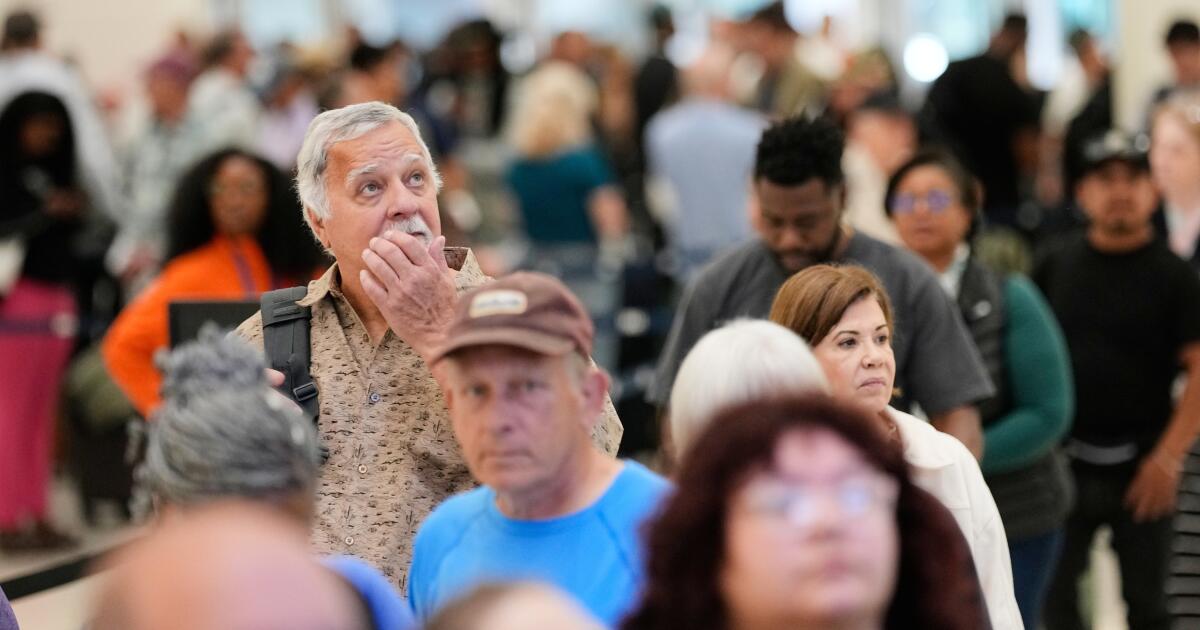
Source link

Races to watch: N.Y. mayor, N.J. and Virginia governor

Voters were casting ballots in high-stakes elections on both coasts Tuesday, including for mayor of New York, new congressional maps in California and governor in both New Jersey and Virginia, states whose shifting electorates could show the direction of the nation’s political winds.

For voters and political watchers alike, the races have taken on huge importance at a time of tense political division, when Democrats and Republicans are sharply divided over the direction of the nation. Despite President Trump not appearing on any ballots, some viewed Tuesday’s races as a referendum on him and his volatile second term in the White House.

In New York, self-described democratic socialist Zohran Mamdani, 34, was favored to win the mayoral race after winning the Democratic ranked-choice mayoral primary in June. Such a result would shake up the Democratic establishment and rile Republicans in near equal measure, serving as a rejection of both former Gov. Andrew Cuomo, a more establishment Democrat and Mamdani’s leading opponent, and Trump, who has warned that a Mamdani win would destroy the city.

On the eve of voting Monday, Trump threatened that a Mamdani win would disrupt the flow of federal dollars to the city, and took the dramatic step of endorsing Cuomo over Curtis Sliwa, the Republican in the race.

“If Communist Candidate Zohran Mamdani wins the Election for Mayor of New York City, it is highly unlikely that I will be contributing Federal Funds, other than the very minimum as required, to my beloved first home, because of the fact that, as a Communist, this once great City has ZERO chance of success, or even survival!” Trump wrote on his Truth Social platform Monday.

A vote for Sliwa “is a vote for Mamdani,” he added. “Whether you personally like Andrew Cuomo or not, you really have no choice. You must vote for him, and hope he does a fantastic job. He is capable of it, Mamdani is not!”

Mamdani, a Ugandan-born naturalized U.S. citizen and New York state assemblyman who already defeated Cuomo once in the primary, has promised a brighter day for New Yorkers with better public transportation, more affordable housing and high-quality childcare if he wins. He has slammed billionaires and some of the city’s monied interests, which have lined up against him, and rejected the “grave political darkness” that he said is threatening the country under Trump.

He also mocked Trump’s endorsement of Cuomo — calling Cuomo Trump’s “puppet” and “parrot.”

Samantha Marrero, a 35-year-old lifelong New Yorker, lined up with more than a dozen people Tuesday morning at her polling site in the Greenpoint neighborhood of Brooklyn to cast her vote for Mamdani, whom she praised for embracing people of color, queer people and other communities marginalized by mainstream politicians.

Marrero said she cares deeply about housing insecurity and affordability in the city, but that it was also “really meaningful to have someone who is brown and who looks like us and who eats like us and who lives more like us than anyone we’ve ever seen before” on the ballot. “That representation is really important.”

Andrew Cuomo stands next to a ballot box.

New York mayoral candidate Andrew Cuomo speaks to reporters as he marks his ballot in New York on Tuesday.

(Richard Drew / Associated Press)

And she said that’s a big part of why people across the country are watching the New York race.

“We’re definitely a beacon in this kind of fascist takeover that is very clearly happening across the country,” she said. “People in other states and other cities and other countries have their eyes on what’s happening here. Obviously Mamdani is doing something right. And together we can do something right. But it has to be together.”

Elsewhere on the East Coast, voters were electing governors in both Virginia and New Jersey, races that have also drawn the president’s attention.

In the New Jersey race, Trump has backed the Republican candidate, former state Rep. Jack Ciattarelli, over the Democratic candidate, Rep. Mikie Sherrill, whom former President Obama recently stumped for. Long a blue state, New Jersey has been shifting to the right, and polls have shown a tight race.

In the Virginia race, Trump has not endorsed Republican candidate Lt. Gov. Winsome Earle-Sears by name, but has called on voters to “vote Republican” and to reject the Democratic candidate, former Rep. Abigail Spanberger, a 46-year-old former CIA officer whom Obama has also supported.

“Why would anyone vote for New Jersey and Virginia Gubernatorial Candidates, Mikie Sherrill and Abigail Spanberger, when they want transgender for everybody, men playing in women’s sports, High Crime, and the most expensive Energy prices almost anywhere in the World?” Trump recently wrote on Truth Social, repeating some of his favorite partisan attacks on Democrats from the presidential campaign trail last year.

At a rally for Spanberger in Norfolk, Va., over the weekend, Obama put the race in equally stark terms — as part of a battle for American democracy.

“We don’t need to speculate about the dangers to our democracy. We don’t need to wonder about whether vulnerable people are going to be hurt, or ask ourselves how much more coarse and mean our culture can become. We’ve witnessed it. Elections do matter,” Obama said. “We all have more power than we think. We just have to use it.”

Voting was underway in the states, but with some disruptions. Bomb threats disrupted voting in some parts of New Jersey early Tuesday, temporarily shutting down a string of polling locations across the state before law enforcement determined the threats were hoaxes.

In California, voters were being asked to change the state Constitution to allow Democrats to redraw congressional maps in their favor through 2030, in order to counter similar moves by Republicans in red states such as Texas.

Leading Democrats, including Obama and Gov. Gavin Newsom, have described the measure as an effort to safeguard American democracy against a power grab by Trump, who had encouraged the red states to act, while opponents of the measure have derided it as an anti-democratic power grab by state Democrats.

Trump has urged California voters not to cast ballots by mail or to vote early, arguing such practices are somehow “dishonest,” and on Tuesday morning suggested on Truth Social that Proposition 50 itself was unconstitutional.

“The Unconstitutional Redistricting Vote in California is a GIANT SCAM in that the entire process, in particular the Voting itself, is RIGGED,” Trump wrote, without providing evidence of problems. “All ‘Mail-In’ Ballots, where the Republicans in that State are ‘Shut Out,’ is under very serious legal and criminal review. STAY TUNED!”

Both individually and collectively, the races are being closely watched as potential indicators of political sentiment and enthusiasm going into next year’s midterm elections, and of Democrats’ ability to get voters back to the polls after Trump’s decisive win over former Vice President Kamala Harris last year.

Voters, too, saw the races as having particularly large stakes at a pivotal moment for the country.

Michelle Kim, 32, who has lived in the Greenpoint neighborhood of Brooklyn for three years, stood in line at a polling site early Tuesday morning — waiting to cast her vote for Mamdani.

Kim said she cares about transportation, land use and the rising cost of living in New York, and appreciated Mamdani’s broader message that solutions are possible, even if not guaranteed.

“My hope is not, like, ‘Oh, he’s gonna solve, like, all of our issues,’” she said. “But I think for him to be able to represent people and give hope, that’s also part of it.”

Lin reported from New York, Rector from San Francisco. Times staff writer Jenny Jarvie in Atlanta contributed to this report.

Source link

As Californians decide fate of Prop. 50, GOP states push their own redistricting plans

The hurried push to revise California’s congressional districts has drawn national attention, large sums of money, and renewed hope among Democrats that the effort may help counter a wave of Republican redistricting initiatives instigated by President Trump.

But if Democrats succeed in California, the question remains: Will it be enough to shift the balance of power in Congress?

To regain control of the House, Democrats need to flip three Republican seats in the midterm elections next year. That slim margin prompted the White House to push Republicans this summer to redraw maps in GOP states in an effort to keep Democrats in the minority.

Texas was the first to signal it would follow Trump’s edict and set off a rare mid-decade redistricting arms race that quickly roped in California, where Gov. Gavin Newsom devised Proposition 50 to tap into his state’s massive inventory of congressional seats.

Californians appear poised to approve the measure Tuesday. If they do, Democrats potentially could gain five seats in the House — an outcome that mainly would offset the Republican effort in Texas that already passed.

While Democrats and Republicans in other states also have moved to redraw their maps, it is too soon to say which party will see a net gain, or predict voter sentiment a year from now, when a lopsided election in either direction could render the remapping irrelevant.

GOP leaders in North Carolina and Missouri approved new maps that likely will yield one new GOP seat in each, Ohio Republicans could pick up two more seats in a newly redrawn map approved Friday, and GOP leaders in Indiana, Louisiana, Kansas and Florida are considering or taking steps to redraw their maps. In all, those moves could lead to at least 10 new Republican seats, according to experts tracking the redistricting efforts.

To counter that, Democrats in Virginia passed a constitutional amendment that, if approved by voters, would give lawmakers the power and option to redraw a new map ahead of next year’s election. Illinois leaders are weighing their redistricting options and New York has filed a lawsuit that seeks to redraw a GOP-held district. But concerns over legal challenges already tanked the party’s efforts in Maryland and the potential dilution of the Black vote has slowed moves in Illinois.

So far, the partisan maneuvers appear to favor Republicans.

“Democrats cannot gerrymander their way out of their gerrymandering problem. The math simply doesn’t add up,” said David Daly, a senior fellow at the nonprofit FairVote. “They don’t have enough opportunities or enough targets.”

Complex factors for Democrats

Democrats have more than just political calculus to weigh. In many states they are hampered by a mix of constitutional restrictions, legal deadlines and the reality that many of their state maps no longer can be easily redrawn for partisan gain. In California, Prop. 50 marks a departure from the state’s commitment to independent redistricting.

The hesitancy from Democrats in states such as Maryland and Illinois also underscores the tensions brewing within the party as it tries to maximize its partisan advantage and establish a House majority that could thwart Trump in his last two years in office.

“Despite deeply shared frustrations about the state of our country, mid-cycle redistricting for Maryland presents a reality where the legal risks are too high, the timeline for action is dangerous, the downside risk to Democrats is catastrophic, and the certainty of our existing map would be undermined,” Bill Ferguson, the Maryland Senate president, wrote in a letter to state lawmakers last week.

In Illinois, Black Democrats are raising concerns over the plans and pledging to oppose maps that would reduce the share of Black voters in congressional districts where they have historically prevailed.

“I can’t just think about this as a short-term fight. I have to think about the long-term consequences of doing such a thing,” said state Sen. Willie Preston, chair of the Illinois Senate Black Caucus.

Adding to those concerns is the possibility that the Supreme Court’s conservative majority could weaken a key provision of the landmark Voting Rights Act and limit lawmakers’ ability to consider race when redrawing maps. The outcome — and its effect on the 2026 midterms — will depend heavily on the timing and scope of the court’s decision.

The court has been asked to rule on the case by January, but a decision may come later. Timing is key as many states have filing deadlines for 2026 congressional races or hold their primary election during the spring and summer.

If the court strikes down the provision, known as Section 2, advocacy groups estimate Republicans could pick up at least a dozen House seats across southern states.

“I think all of these things are going to contribute to what legislatures decide to do,” said Kareem Crayton, vice president of the Brennan Center for Justice. The looming court ruling, he added, is “an extra layer of uncertainty in an already uncertain moment.”

Republican-led states press ahead

Support for Prop. 50 has brought in more than $114 million, the backing of some of the party’s biggest luminaries, including former President Obama, and momentum for national Democrats who want to regain control of Congress after the midterms.

In an email to supporters Monday, Newsom said fundraising goals had been met and asked proponents of the effort to get involved in other states.

“I will be asking for you to help others — states like Indiana, North Carolina, South Carolina and more are all trying to stop Republican mid-decade redistricting efforts. More on that soon,” Newsom wrote.

Indiana Republican Gov. Mike Braun called a special session set to begin Monday, to “protect Hoosiers from efforts in other states that seek to diminish their voice in Washington and ensure their representation in Congress is fair.”

In Kansas, the GOP president of the state Senate said last week that there were enough signatures from Republicans in the chamber to call a special session to redraw the state’s maps. Republicans in the state House would need to match the effort to move forward.

In Louisiana, Republicans in control of the Legislature voted last week to delay the state’s 2026 primary elections. The move is meant to give lawmakers more time to redraw maps in the case that the Supreme Court rules in the federal voting case.

If the justices strike down the practice of drawing districts based on race, Florida Gov. Ron DeSantis, a Republican, has indicated the state likely would jump into the mid-decade redistricting race.

Shaniqua McClendon, head of Vote Save America, said the GOP’s broad redistricting push underscores why Democrats should follow California’s lead — even if they dislike the tactic.

“Democrats have to be serious about what’s at stake. I know they don’t like the means, but we have to think about the end,” McClendon said. “We have to be able to take back the House — it’s the only way we’ll be able to hold Trump accountable.”

In New York, a lawsuit filed last week charging that a congressional district disenfranchises Black and Latino voters would be a “Hail Mary” for Democrats hoping to improve their chances in the 2026 midterms there, said Daly, of FairVote.

Utah also could give Democrats an outside opportunity to pick up a seat, said Dave Wasserman, a congressional forecaster for the nonpartisan Cook Political Report. A court ruling this summer required Utah Republican leaders to redraw the state’s congressional map, resulting in two districts that Democrats potentially could flip.

Wasserman described the various redistricting efforts as an “arms race … Democrats are using what Republicans have done in Texas as a justification for California, and Republicans are using California as justification for their actions in other states.”

‘Political tribalism’

Some political observers said the outcome of California’s election could inspire still more political maneuvering in other states.

“I think passage of Proposition 50 in California could show other states that voters might support mid-decade redistricting when necessary, when they are under attack,” said Jeffrey Wice, a professor at New York Law School where he directs the New York Elections, Census & Redistricting Institute. “I think it would certainly provide impetus in places like New York to move forward.”

Similar to California, New York would need to ask voters to approve a constitutional amendment, but that could not take place in time for the midterms.

“It might also embolden Republican states that have been hesitant to redistrict to say, ‘Well if the voters in California support mid-decade redistricting, maybe they’ll support it here too,’” Wice said.

To Erik Nisbet, the director of the Center for Communications & Public Policy at Northwestern University, the idea that the mid-decade redistricting trend is gaining traction is part of a broader problem.

“It is a symptom of this 20-year trend in increasing polarization and political tribalism,” he said. “And, unfortunately, our tribalism is now breaking out, not only between each other, but it’s breaking out between states.”

He argued that both parties are sacrificing democratic norms and the ideas of procedural fairness as well as a representative democracy for political gain.

“I am worried about what the end result of this will be,” he said.

Ceballos reported from Washington, Mehta from Los Angeles.

Source link