new tax

Why California’s billionaire tax failed to get the support many had anticipated

Despite a nationwide blue wave in the midterm election, California’s much-debated billionaire tax didn’t get the support many expected in one of the country’s most liberal states.

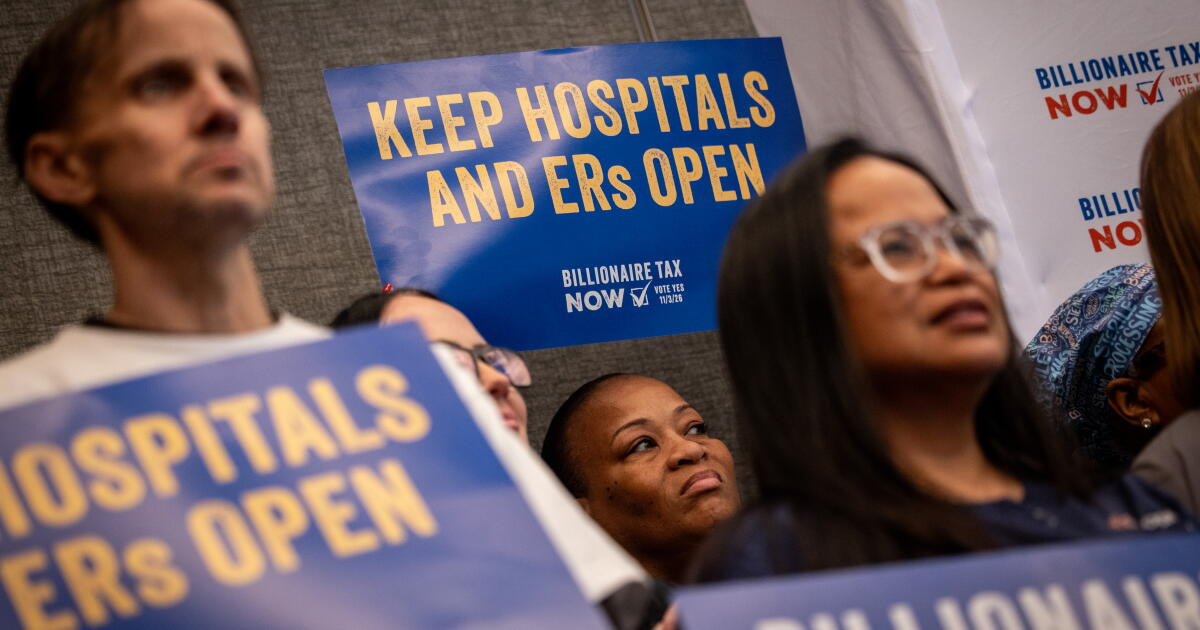
Since the Golden State’s powerful healthcare union proposed the new tax, supporters of Proposition 40 have faced a fierce, expensive battle against the world’s richest people.

In what has been described as a David-versus-Goliath fight, the underdog appears to have lost. The proposition, which would have imposed a one-time 5% tax on the assets of California billionaires to mostly fund healthcare, seemed headed toward defeat as votes were tallied Wednesday.

“In a deep blue state like California, most voters are going to support additional funding for healthcare, especially to replace Trump funding cuts. But in retrospect, the sponsors may wish they’ve been a little bit less ambitious,” said Dan Schnur, a politics and communications professor at USC, UC Berkeley and Pepperdine.

Nearly 56% of California voters rejected the proposal while 44% voted for Proposition 40. However, with roughly 6 million votes still needed to be counted, the results are still too close to call.

The battle over the billionaire tax has been one of the most expensive ballot-measure fights in California’s history, sparking a debate over wealth inequality and taxing the ultrawealthy. It also highlighted how billionaires have wielded more influence in politics.

Well-known politicians such as U.S. Sen. Bernie Sanders (I-Vt.), the California Democratic Party, healthcare workers and Hollywood celebrities including actor Mark Ruffalo, backed the wealth tax. But the idea drew opposition from California Gov. Gavin Newsom, the teachers union, Planned Parenthood, business groups and others who expressed fears that billionaires could flee the state.

The state’s next governor, Xavier Becerra, who just won, also opposed the tax.

Though California’s $4.25-trillion economy remains a global powerhouse, and a major draw for investments in AI and aerospace, thousands of businesses have moved to Texas and other states in recent years due to lower costs.

Opponents of the wealth tax heavily outspent Proposition 40 supporters, flooding televisions, radio, social media and smartphones with ads. Their message: the wealth tax is a reckless experiment and a tax on everyone, not just billionaires.

UC Berkeley law professor Brian Galle, who helped write the wealth tax proposal, said it’s tough to “fix a broken system” and get the facts to people when they were up against the ultrawealthy. Billionaires also own media outlets and social media companies, megaphones that help spread political messaging.

“When billionaires have half a dozen different strategies for buying this election, it shows that they already have too much money and pay too little back,” he said.

Support for the billionaire-bashing proposition had already begun to wane in recent months.

A poll by UC Berkeley’s Institute of Governmental Studies, co-sponsored by the Los Angeles Times and released last week, showed that voter support for Proposition 40 had fallen to 42% of voters surveyed last month from 48% in August.

The measure also may have lost fans because taxing assets rather than income can be a complicated and confusing process and sparks concerns among even non-billionaires on whether they want to allow the state to start demanding a slice of the value of the things that they own.

No matter the result, Proposition 40 also fueled a conversation about taxing billionaires that will continue, Galle said.

As of Wednesday afternoon, roughly $489 million has been raised to support and oppose Proposition 40 along with two ballot measures — Propositions 41 and 42 — that could block the wealth tax, data from the California secretary of state show.

The vast majority of that funding, more than $380 million, went toward killing the billionaire tax. Supporters of the wealth tax, including the Service Employees International Union-United Healthcare Workers West, trailed far behind, contributing roughly $100 million, according to filings with the California secretary of state.

Billionaires such as Google co-founder Sergey Brin contributed millions to a group called Building a Better California that funded ads against the wealth tax and propositions that could block it.

Money doesn’t always win an election, but a big funding imbalance is tough to overcome, Schnur said.

“As important as the money was to beat Prop. 40, the coalition against it may have been just as important. You didn’t see Sergey. You didn’t see tech billionaires in the ads. You saw teachers and nurses and firefighters,” he said.

The four richest Californians — Brin, Nvidia Chief Executive Jensen Huang; Google co-founder Larry Page and Meta Chief Executive Mark Zuckerberg — would owe 40% of the estimated taxes to be collected from the billionaire tax, according to an L.A. Times analysis.

Ahead of the election, billionaires made moves to prepare for the potential tax. Zuckerberg expressed concerns that if he had to sell his stock to pay the tax that could reduce his control over the company, but Meta’s board struck a deal to address that fear.

The billionaire tax proposal also faced other big hurdles. Proposition 42, which could have blocked the billionaire tax, was on track to pass. It would prohibit new taxes on “retirement holdings, individually-owned assets, and other forms of personal savings” and bar retroactive taxes.

“They didn’t just reject a single bad tax idea — millions of Californians backed the strongest protections available to protect their hard earned life savings from double taxation. They joined firefighters, law enforcement officers, building trades workers, seniors, veterans and small businesses in doing so,” said Nathan Click, a spokesman for Proposition 42.

On the other hand, Proposition 41 — a proposal that would have required audits for new state special taxes, and also could have blocked the billionaire tax — was headed for defeat.

Supporters of Proposition 40 tried to convince voters that taxing roughly 200 billionaires was the solution to raise $100 billion needed to offset federal healthcare cuts.

This week, the wealth tax’s supporters emphasized the high stakes. People won’t be able to afford healthcare coverage, children will die and hospitals will shutter, they said, if California lawmakers don’t find a way to get more funding.

“If Sacramento fails to protect patients and deliver a real solution that makes billionaires pay their fair share, healthcare workers will pursue every available avenue, up to and including returning to the ballot in 2028 with a billionaire tax,” said Suzanne Jimenez, chief of staff for the SEIU-UHW.
Source link

Billionaire tax ballot measure trails; California voters reject voter ID

The fate of a controversial ballot measure to impose a new tax on California billionaires, proposed as a lifeline for the needy and castigated as a threat to the state’s fragile economy, appeared headed for defeat in early election results Tuesday night.

California voters also rejected another hotly contested measure, Proposition 39, which would have required voters to show identification when they cast ballots and elections officials to verify that all registered voters were U.S. citizens.

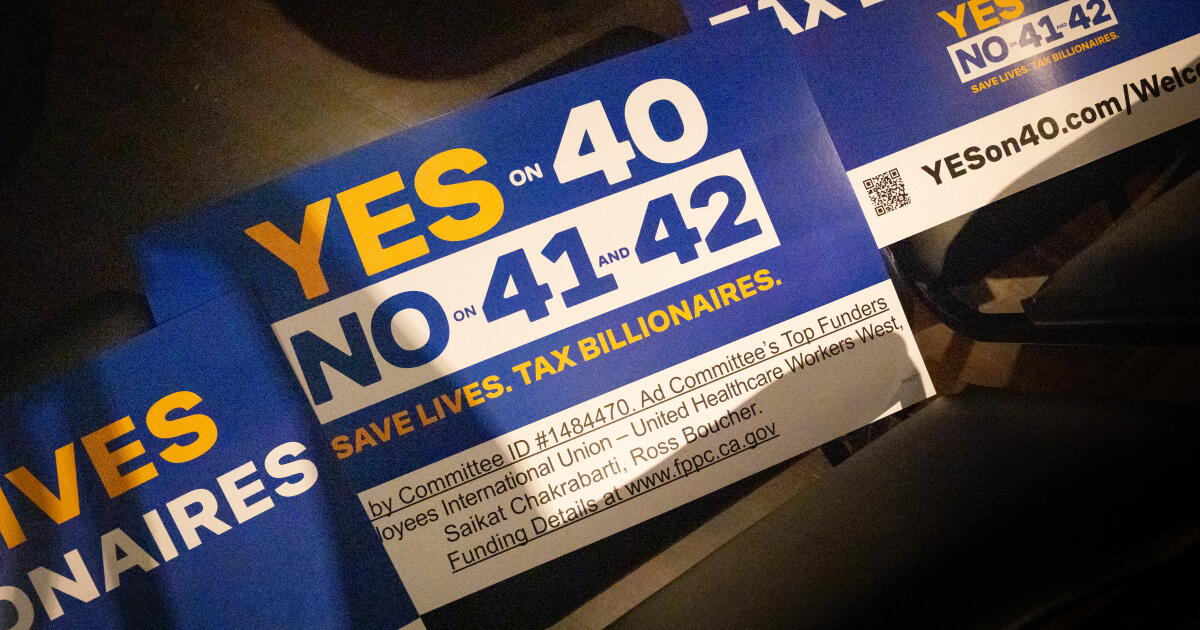
The billionaire tax, Proposition 40, would impose a one-time 5% tax on the assets of billionaires to raise an estimated $100 billion to assist millions of Californians destined to lose healthcare coverage under federal funding cuts. Two separate ballot measures, Propositions 41 and 42, were crafted to nullify the wealth tax and remained too close to call Tuesday evening.

While supporters of the billionaire tax did not concede Tuesday evening, they acknowledged facing tough odds in the race because of the avalanche of spending against them and warned that people will die if the measure fails.

“In the event that we don’t succeed with Prop. 40 tonight, if Sacramento fails to deliver a real solution to the healthcare crisis instigated by the [federal government], one that actually makes billionaires pay their fair share, then California’s healthcare workers intend to be back on the ballot in 2028 to correct the damage, and to overcome all of the lies and deception, and just completely outrageous campaigning that we’ve seen,” said Dave Regan, president of SEIU-United Healthcare Workers West, which crafted the proposal.

Voters rejected the Republican-led Proposition 39 at a time of growing distrust in the integrity of the electoral process nationwide, a wariness intensified by President Trump’s baseless claims that the 2020 election was stolen from him and false assertions that droves of undocumented immigrants, notably in California, are swaying elections.

On Monday, the Supreme Court rejected an emergency appeal by Trump’s attorneys to set aside 20,000 ballots in the state that the White House argued could be cast by people who are not citizens.

The proposals were among the 14 state ballot measures that California’s 23.3 million registered voters were asked to decide Tuesday in addition to congressional, statewide and local elections.

The billionaire tax was proposed in response to legislation signed by Trump last year that could result in millions of Californians losing Medi-Cal coverage, rural hospitals shuttering and other healthcare services being slashed unless a new funding source is found. The proposal would retroactively apply to billionaires who lived in California as of Jan. 1, prompting some to preemptively move out of the state. Ninety percent of the revenue would fund healthcare programs, and the remaining funds would be spent on education programs and food assistance.

Proposition 40 divided Democratic leaders because of concerns about its impact on the state’s volatile budget that is highly dependent on the wealthy. Gov. Gavin Newsom opposed the measure, while the state Democratic party endorsed it.

The effort supporting and opposing the tax and two ballot measures designed to nullify it came close to breaking a state campaign finance record. About $425 million had been donated to the three commingled ballot measures as of Tuesday.

The vast majority of that money was provided by California billionaires, including some of the state’s most powerful tech barons, opposing the wealth tax. The campaign was centered on three interwoven ballot initiatives: Proposition 40 and Propositions 41 and 42, both of which would undercut Proposition 40 through a series of strategic changes to state tax laws and new spending restrictions.

Neither explicitly stated that it would nullify the billionaire tax if Proposition 40 passed and either of the counter measures received more votes.

Proposition 41, which trailed slightly Tuesday evening, is framed as an effort to cut wasteful government spending and require audits of new special taxes. But it also would bar new taxes that are exempt from state spending limits. Proposition 42, which was slightly ahead, is presented as protection from state lawmakers taxing everyday Californians’ retirement funds, personal savings and home equity.

In polling leading up to election day, voters appeared to differentiate between the billionaire tax proposal and Proposition 3, which was approved by voters on Tuesday. . It would make permanent a temporary tax increase on wealthy Californians that largely funds education. The tax adds 1% to 3% to the state income tax of single filers who earn more than $360,000, joint filers who make more than $721,000 and heads of household who earn more than $490,000. Voters passed the tax in 2012 and extended it in 2016, but it is set to expire in 2031.

Voters cast ballots on several other proposals about local taxes, public financing of political campaigns, a landmark environmental law, housing, the state’s recall process, state lawmakers’ ability to redirect taxpayer money to the state’s “rainy day” fund, immunology and immunotherapy funding, and restrictions on how community healthcare clinics spend money:

Several ballot measures were decided Tuesday evening:

  • Proposition 1, which proposed a $11.25-billion bond to boost the construction of affordable housing, was approved by voters.
  • Proposition 2, which would gave state lawmakers more flexibility over state spending by exempting certain tax revenue from a state spending limit, allowing them to place it into a “rainy day” fund, was approved by voters.
  • Proposition 37, which would create a down-payment assistance program to help middle-class Californians buy a home, was approved by voters.
  • Proposition 44, which would require certain health centers to spend 90% of their revenue on patient care rather than overhead and executive compensation, failed.

Among those that remained too close to call:

  • Proposition 4, which would allow state and local candidates to receive public campaign financing if they demonstrated broad support and agreed to expenditure limits.
  • Proposition 5, a constitutional amendment that would alter the state’s recall process by limiting it to the question of whether to remove an elected official from office, and no longer including the cadre of candidates hoping to replace the politician.
  • Proposition 38, which would create an $8.4-billion bond to support the immunology and immunotherapy fields.
  • Proposition 43, which would bar local governments from imposing special taxes unless two-third of voters support the effort. Current law requires a simple majority vote.
  • Proposition 45, which would amend the California Environmental Quality Act to speed up certain housing, water, energy, transportation and other projects deemed essential.

Source link