
new novel

L.A.’s 15 best summer literary happenings, readings and book events

At the beginning of Mary H.K. Choi’s wildly entertaining presentation for her new novel “Pool House’” at Skylight Books, she reveals she won’t be reading.

“Readings are boring,” she says, tapping her Prada loafers. “It’s like you’re watching someone else play video games.”

Instead, she and Yasi Salek, host of the hit podcast “Bandsplain,” spend the evening riffing on literature, coolness, autism diagnoses and a literary perennial: unrelenting pain.

“How is your mother wound?” Salek asks in her signature vocal fry most often heard ad-libbing about the band Weezer. Salek reveals she is in Jungian therapy, adding, “What Carl says, goes.”

Throughout the discussion, Choi describes her novel as a challenging read — calling it a “gross, decaying meat soup.” She jokes that her career as an author feels like a “Make-A-Wish Foundation wish,” bewildered by any attention her work has garnered. Yet dozens of eager readers have packed into the independent bookstore, spilling into the aisles with copies of the novel balanced on their laps.

“Publishing is so slow, it’s like giving birth to a lawn chair,” Choi remarks. Later, she professes tedium with the resurgence of an alt-lit scene.

“Don’t you find that everyone has to be cool right now? Why is everyone so cool?” Choi asks Salek.

Let’s be clear: Salek and Choi are very cool. Salek sits cross-legged, dressed in all black, with a heart tattoo on her forearm that reads “books.” Before “Pool House,” Choi authored three New York Times bestselling novels. Salek recounts dropping out of her MFA program at Bennington College in 2020 to start what would become a cult-classic podcast.

Book-themed sugar cookies sold at a past Little Literary Fair at Hauser & Wirth.

Book-themed sugar cookies sold at a past Little Literary Fair at Hauser & Wirth.

(Francine Orr / Los Angeles Times)

“I love that you started a podcast instead of getting an MFA,” Choi replies.

Like Skylight Books, independent bookstores across Los Angeles have become gathering places for readers and writers alike. Authors ranging from household names to debut novelists regularly draw enthusiastic crowds. Increasingly, bookstores are functioning not only as retail spaces but as community hubs.

A few blocks from Echo Park Lake, local favorite A Good Used Book has transformed Sunday mornings into one of the neighborhood’s liveliest recurring gatherings. Visitors browse used books while enjoying charcoal portraits, handmade jewelry and Hawaiian shaved ice. Buy a book and you might even end up on the store’s coveted Instagram Story — the hottest plug in town.

“It feels like in a city as big as Los Angeles, books are still underrepresented. So there’s a lot of room to grow, and that’s exciting,” says Chris Capizzi, who founded the bookstore in 2017.

Earlier this month, the Los Angeles Review of Books hosted its annual Little Literary Fair at SCI-Arc, drawing hundreds to literary panels and workshops on zine-making, publishing and finding an agent. Vendors from across California filled the space, representing independent presses, bookstores and literary magazines.

“I find writers based [in the L.A. area] to be socially incisive in equal measure as being experimental, innovative and just fun,” says Emily VanKoughnett, the events director at the Los Angeles Review of Books. “I love the L.A. lit scene because it invites people to explore pockets of the city and connect over writing.”

This summer, literary events across Los Angeles are continuing to draw readers into bookstores, community spaces and alternative venues alike. The city’s literary scene remains as weird, profane and sentimental as ever.


Source link

Rasheed Newson’s new novel resurrects a forgotten Black queer Hollywood

On the Shelf

There’s Only One Sin in Hollywood

Flatiron Books: 300 pages, $29

If you buy books linked on our site, The Times may earn a commission from Bookshop.org, whose fees support independent bookstores.

Twenty pages into “There’s Only One Sin in Hollywood” by bestselling Pasadena author Rasheed Newson, I had to stop reading. Not because the story and characters were anything less than gripping —I was utterly transfixed. Not because I was unmoved by the setting, the 1950s version of the iconic landmarks where today’s Angelenos, myself included, work, play, eat and drink: Griffith Park, the L.A. Central Library, the Paramount Pictures lot, the Roosevelt Hotel, the Tam O’Shanter in Atwater Village and the Black Cat in Silver Lake, site of America’s first queer riot, also depicted in the book.

No, it was writerly admiration — OK, envy — that stopped me. As I turned the pages, I kept scribbling the same question in the margins. “How did Newson do this?”

How did Newson, author of the 2022 bestseller “My Government Means to Kill Me” and a producer/writer on such popular TV series as “The Chi” and “Bel-Air,” craft a novel populated with a seamless mix of real and invented characters, each with their own true or fictional backstory, personality, career vicissitudes, sartorial style and sexual proclivities, adhering simultaneously to both his novelistic timeline and historically accurate events?

How did Newson seat his fictional protagonist — Aaron Touissant, a Black, closeted gay Hollywood “fixer” employed by Skyline Studios to keep queer actors’ secrets secret — at the same Beverly Hilton ballroom table with Sidney Poitier, Diahann Carroll, Harry Belafonte, Sammy Davis Jr., Lena Horne, Ruby Dee, Ossie Davis, James Edwards, Eartha Kitt and Xavier Barlow, Newson’s invented Black gay movie star who is Skyline’s greatest hope and Touissant’s principal client?

I couldn’t read another page without knowing, and those unread pages were calling to me. So I called Rasheed Newson, whom I’d seen around the L.A. lit scene but had never met, and asked how he’d made the magic of his novel happen.

“I wanted to do a deep dive into Black queer history during the Golden Age of cinema,” Newson said. “The first thing that came to me was Xavier’s character. I decided to make him the 10-years-younger, queer rival of Sidney Poitier, to highlight the acceptable versus unacceptable — meaning, straight versus gay — 1950s Black movie star.

“I read a lot of books on Hollywood’s golden era,” Newson said. “But I was trying to get closer to what people were thinking at the moment, rather than what they reflected back on later. Only newspapers give you that. So I spent hours and hours in the downtown L.A. public library, poring over microfiche, reading the newspapers of the time.”

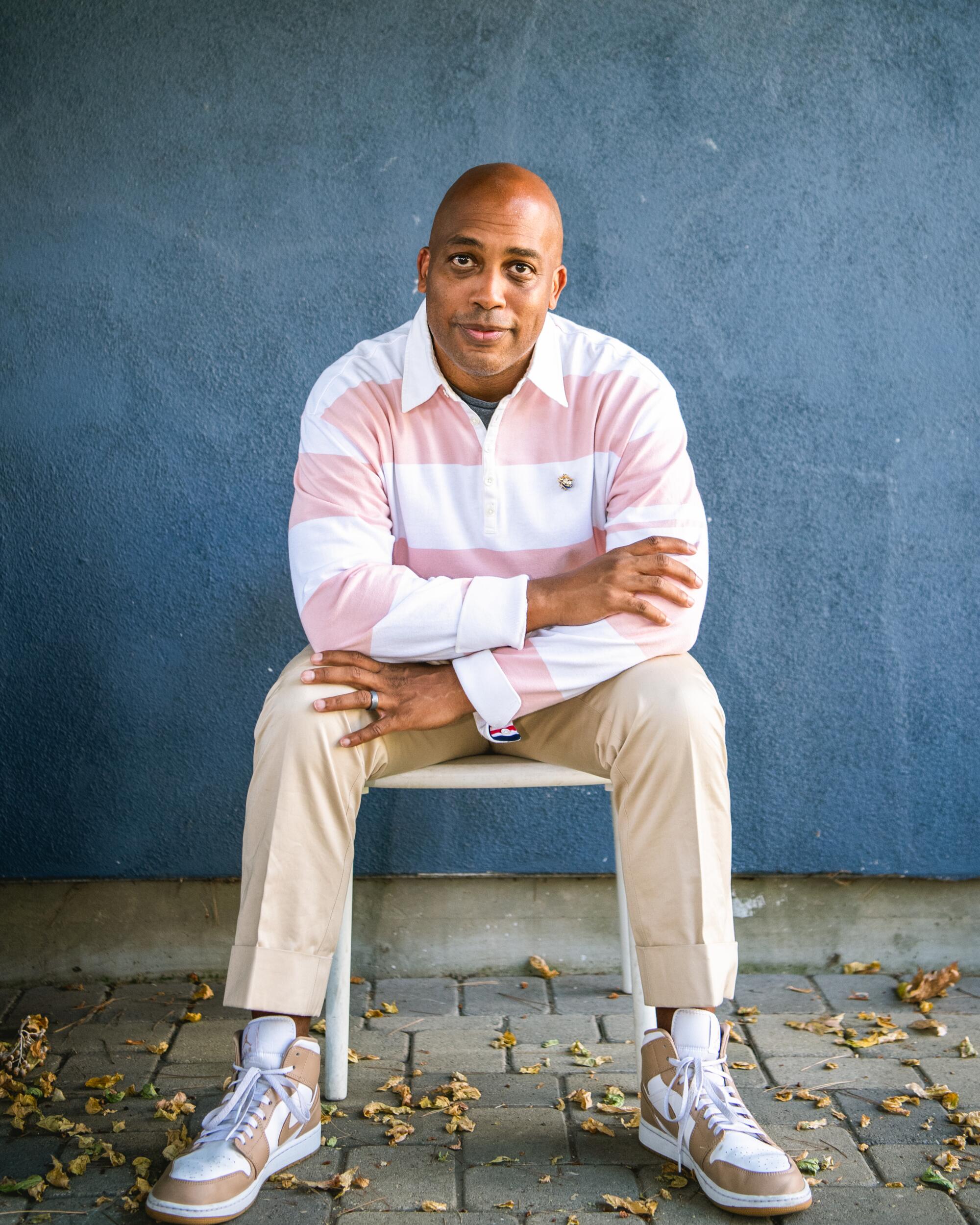
Author Rasheed Newsom.

Author Rasheed Newsom.

(Mariah Tauger / Los Angeles Times)

I asked Newson about the titular “one sin in Hollywood.”

“That sin is disobedience,” he said. “Particularly when your disobedience threatens to upend how the business makes money. In Hollywood you can be an addict, be a philanderer, be outspoken. But don’t disrupt the cash flow.”

Newson’s plot and characters serve the novel’s thesis well. We meet Aaron Touissaint as a brutally bullied “sissy” in a small, small-minded Ohio town. Aaron escapes his torturers, first by rooting himself in the town’s only movie theater open to Black people, and then by lying about his age and enlisting in the Navy at 16. On the Korean battle front, Aaron becomes the aide and the lover of superstar fighter pilot and “model Negro” Horace Dixon. When the war ends and Skyline Studios buys the screen rights to Horace’s life story, Aaron follows Horace to Hollywood.

The movie is canceled. Horace leaves Hollywood and a heartbroken but determined Aaron behind. Hired as a Skyline security guard, Aaron is promoted to fixer, keeping himself and Skyline’s A-listers closeted by any means necessary. To that end, Aaron marries Kimberly, who becomes his poised, self-contained “beard.”

At the top of Aaron’s client roster is Xavier Barlow, Skyline’s new, hot rising star and Aaron’s new, hot crush. “The bond between us was never conventional,” narrator Aaron tells us. “Off and on for nearly a decade, it was my duty to keep [Xavier’s] nose clean. … He challenged me to admit who and what I am. And I fell in love with him.”

As secret same-sex love stories all too often do, Aaron’s love for Xavier, and Xavier’s one-man campaign to mitigate Hollywood’s homophobia, come to a tragic and suspicious end. Soon after Xavier publicly protests the studio’s homophobic rewrite of a movie script he intended to serve as his coming-out announcement, a truck crashes into his car on Wilshire.

“This was no accident,” Aaron realizes. “Xavier was hunted down.” With his best friend, Diahann Carroll, and a sizable contribution from Sidney Poitier, Aaron organizes the funeral, attempting to redeem the reputation he was hired to protect. “The news reports following Xavier’s death impeached his character,” Aaron says. “The implication was that gay men naturally had messy lives and untimely deaths. … Confidential magazine went as far as to print that “the driver of the truck [that killed Xavier] could well have been one of Xavier’s spurned male lovers.”

“Furious at the coverage,” Aaron narrates the story, “Diahann asked me, ‘Why don’t they print the lovely things I have to say about Xavier?’ ”

“I said, “They never will. Xavier fought the studio, and everything you’re reading is part of his punishment.”

The erasure of gay Black Hollywood is really the point of this imaginatively crafted, stunningly tense, historically significant sophomore novel. Newson’s impressive gifts for story, for writing the erotic and the noir, and for rooting himself in his adopted city are on magnificent display here. By smoothly merging the true and the invented stories and characters of 1950s Hollywood, Newson alerts us to the increase in racism and homophobia evident in the entertainment business, and in the U.S., today.

Rasheed Newson will talk with novelist Laura Warrell at Octavia’s Bookshelf at 6 p.m. Monday, and with writer Manuel Betancourt at Skylight Books. at 7 p.m. June 24.

Maran, a Silver Lake-based author, has written “The New Old Me” and other books.


Source link