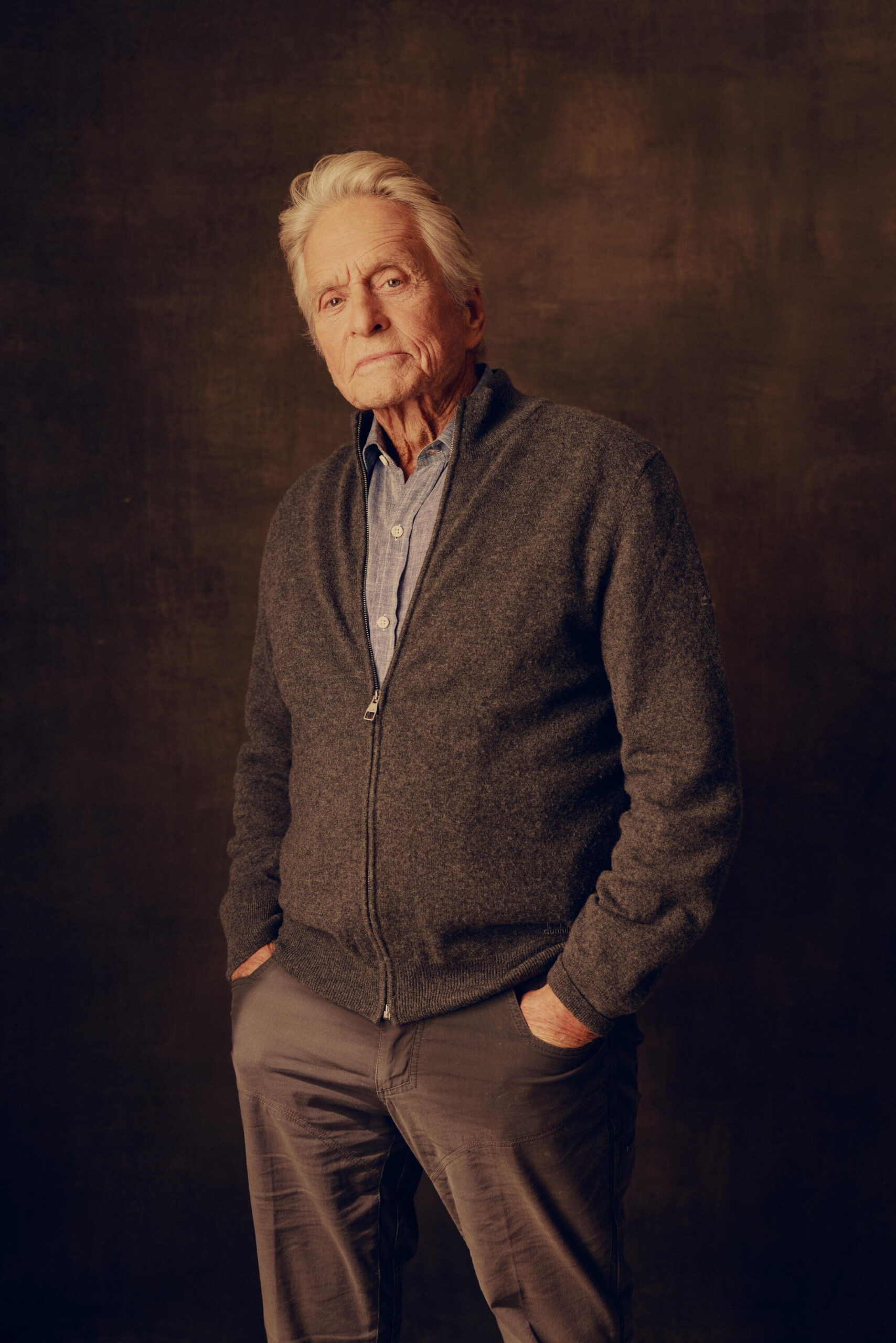
Inside Michael Douglas’s new memoir: Secret affairs, on-set battles and family secrets
Movie stars are an endangered species. They still exist, sure. Their beautiful faces still fill 50-foot screens, beaming down on us. Yet, there is a shortage of, say, Michael Douglas. A man who, over the span of decades, played an American president, a troubled detective, and a Wall Street tycoon so convincingly that the FBI recruited the actor to do a PSA for investment bankers about the perils of financial fraud.
On the Shelf
One Helluva Ride
By Michael Douglas
Grand Central Publishing: 496 pages, $35
If you buy books linked on our site, The Times may earn a commission from Bookshop.org, whose fees support independent bookstores.
The night before I meet Michael Douglas on Zoom, I have a hard time sleeping. I want to be well-rested before I meet the leading man — perhaps one of the last leading men from an era in Hollywood that felt limitless. What do I mean by that? He’ll tell you. His new memoir details his movie-making career as a prolific producer and actor, along with his affair with his “Romancing the Stone” co-star Kathleen Turner, mudslides in Mexico, snorting cocaine with O.J. Simpson, encounters with Princess Diana and screaming matches with Paul Verhoeven that end in blood. In short: the life of a movie star.

“People say to me: Michael Douglas. When I see your name, I don’t know what I’m going to get, but I know it’s going to be good,” Michael Douglas says.
(David Urbanke / For The Times)
Halfway through our conversation, something unanticipated happens: Douglas reveals that he doesn’t quite see himself as a movie star. After gentle pushback, he elaborates. Instead, Douglas sees himself as a chameleon.
“People say to me: Michael Douglas. When I see your name, I don’t know what I’m going to get, but I know it’s going to be good,” he says.
He’s speaking from his home in New York. Behind him is a moody 18th-century Orientalist painting, its scene too indistinct for me to make out. His smiling face — which, like most American moviegoers, I had watched 50 feet tall in the dark — glows with warmth even on my laptop screen. It seems abnormal even to witness him in miniature.
To be clear: Michael Douglas is a movie star, whether or not he wants to cop to it over Zoom. It’s in his blood. His father, Kirk Douglas — born Issur Danielovitch to Russian Jewish immigrant parents — was a legendary actor whose shadow Douglas struggled to escape, as he details in the early chapters of his memoir. He spent his childhood on movie sets, watching his father spar with iconic directors like Stanley Kubrick. Michael Douglas was subject to violent and angry outbursts as well. “Dad’s volatility kept us on edge,” he writes. He felt suffocated by his father’s legacy, often hoping to shake the title of “Kirk Douglas’ son.”
Early in his career, Douglas left his starring role on TV’s “The Streets of San Francisco” after producing his first film, “One Flew Over the Cuckoo’s Nest,” which became a breakout success. On that film, he had to deliver the shattering news to his father that he was too old to play the lead — essentially, firing his father from his dream role. It was a betrayal. Instead, the role went to Jack Nicholson, who would later win an Academy Award for his humanizing portrayal of Randle McMurphy. The film won multiple Academy Awards, launching Douglas’ career as a heavyweight producer and later an actor. Escaping the shadow of being Kirk Douglas’ son has been a lifelong battle for the actor.

(Grand Central Publishing)
Occasionally, inheritance can be a burden. In his own life, Douglas details how he was a distracted father and husband who lost sight of his son, Cameron Douglas. During Cameron’s childhood, Douglas was elsewhere — on location in the Mexican jungle in “Romancing the Stone,” then a disastrous film production in Morocco for “Jewel of the Nile” that included a fatal plane crash that resulted in three crew members’ deaths. To cope with the breakneck pace of show business, Douglas sought refuge in women, cocaine and work.
Cameron’s troubled youth reached a crescendo when he was sentenced to five years in federal prison for drug smuggling, with an additional sentence for drug possession in prison — serving seven years in the end. It was enormously painful for Douglas, who also struggled with addiction, and had sought out treatment to provide an example to his son.
In a late chapter, he recalls confiding in Rob Reiner, who also had a son who struggled with addiction issues. In the memoir, Douglas addresses the killing of Rob and Michelle Reiner in December 2025; their son Nick has been charged with murder. “We both had sons with serious drug issues and we both, at times, had been at the end of our rope,” Douglas writes. “It was a heartbreaking confessional for us, but I know we gave each other some measure of comfort during the hard times.”
Why trudge through movie history, turning over every stone and every wound, in a nearly 500-page memoir? Because, according to Douglas, it’s time.
“Your 80s may be a good time to share,” the actor says, who recently turned 82. “People interested in movies, we give them a certain insight into the process, and maybe they could learn something. For others, it’s just gossip.” His battle with Stage 4 oral cancer brought the contours of his life into stark relief, sharpened by seven weeks of radiation and chemotherapy. His official diagnosis was tongue cancer, but he told the public he had throat cancer, hoping to stall speculation in the press about the possibility of disfigurement — and, more specifically, the prospect of losing his tongue. It was isolating, and Shane Salerno — the memoir’s co-author — stayed by Douglas’ side.

Michael Douglas.
(David Urbanke / For The Times)
As much as Douglas’ memoir, “One Helluva Ride,” is a revealing and delightful account of a life in show business, it is also a love letter to California — a place where Douglas spent much of his adult life, beginning at UC Santa Barbara. The college travel brochure read: campus by the sea. “I remember the cover of it was a guy walking down the beach with a surfboard, two girls in two-piece bathing suits. In 1963, I never saw a two-piece bathing suit back east.” He was sold.
The California years made an impression. Douglas is still, at heart, a hippie. Raised in stiff East Coast prep culture, he was reborn in the California sunshine. “I transferred into becoming a hippie, influenced by the Maharishi Mahesh Yogi, hallucinatory drugs, and the world that existed in the early ‘60s in San Francisco.”
Strangely, Douglas argued that some of the utopic sentiments of the 1960s are returning. “People are beginning to look back at that time, and realize how important family is — cooperation, sharing,” he says. “Socialism is not a four-letter word or something that’s terrible. There are other things to pursue in life other than just making money.”

“Your 80s may be a good time to share,” Michael Douglas says.
(David Urbanke / For The Times)
Like the characters he portrayed, Douglas is far from perfect. He admits that he struggled — in his first marriage, and later as a father. After marrying Diandra Luker, Douglas was unfaithful, having relationships with co-stars, most notably Turner on the set of “Romancing the Stone” in the Mexican jungle. The two denied the relationship for years. Now, with Turner’s blessing, Douglas writes about their involvement in his memoir.
Before Turner, there was Diane Thomas, the film’s waitress-turned-screenwriter, with whom Douglas had an affair. Thomas’ life was tragically cut short in a car accident involving a Porsche that Douglas had gifted her.
Then there were the rumors. On the set of “Basic Instinct,” some speculated that Douglas and Sharon Stone were having an affair. They weren’t, he explains. Douglas was instead locked in a power struggle with director Verhoeven, who, during one particularly heated argument with the actor, suffered a burst artery in his nose, turning the confrontation into a bloody scene. Douglas, meanwhile, was involved with another co-star, Jeanne Tripplehorn. “They were so focused on a possible relationship between Sharon and me, they missed the real relationship happening between me and Jeanne,” he writes.
When he and his current wife, actor Catherine Zeta-Jones, made it official, Douglas went to the other room to make breakup calls to five other women. (By this point in the memoir, Douglas has enough goodwill to pass this off as charming.) “From the moment I met Catherine, and we formed our family, I was a new man,” he writes.
The memoir enshrines Douglas’ petty show-business grievances too: a repaired grudge against David Letterman, a TV co-star who stole his longtime girlfriend, and a bouquet sent to Julia Roberts to apologize for his drunken buffoonery. In Douglas’ words: “There’s two or three people that I share my hostilities with.” He clashed with Brian De Palma, who was originally attached to direct “Fatal Attraction” and tried to have Douglas fired. De Palma underestimated Douglas and was replaced by Adrian Lyne. Years later, De Palma apologized, but Douglas rejected it.
It is impossible to tell the story of Douglas’ career without the women he encountered. The films he championed helped establish a new type of female lead — in all their powerful, morally ambiguous and deranged glory. “An actress was not allowed to play a villain,” he says. In “One Flew Over the Cuckoo’s Nest,” the actor struggled to cast Nurse Ratched. “A whole number of leading actresses turned that part down until we found Louise Fletcher, who went on to win an Oscar.”
For Glenn Close, Sharon Stone and Kathleen Turner, acting opposite Michael Douglas was transformative. After her role as a murderous, sex-crazed bisexual in “Basic Instinct,” Stone became one of the biggest stars of the 1990s and earned an Oscar nomination for Martin Scorsese’s “Casino.” Close‘s portrayal of the mistress-turned-lovesick psychopath in “Fatal Attraction” earned the actor her first lead Oscar nomination after three supporting nods. Turner went from being primarily known as the sexy femme fatale of “Body Heat” to a Golden Globe-winning star with box-office clout after her collaboration with Douglas. Sure, she sued him, too, but their friendship survived.
However, it wasn’t until his role as Gordon Gekko, the fast-talking, impulsive tycoon in 1987’s “Wall Street,” that Douglas was in full force, winning an Academy Award for lead actor. Directed by Vietnam veteran Oliver Stone, Douglas delivered an unforgettable performance about the dangers of unchecked capitalism and greed. At an early New York screening, Douglas recalls Wall Street traders being stunned by the film’s stinging accuracy. “A lot of the Wall Street characters were there, very cocky at the time; they all were shocked because we caught them.”
To his surprise, Wall Street financiers approached him on the street to praise Gekko — anointing him as their hero. “I said, ‘I was the villain.’ ‘No, no, no,’” he said. “So it showed me a lot.”
It speaks to Douglas’ gifts as an actor that he could transcend the caricature of white male entitlement he portrayed with such precision. In “Falling Down,” filmed during the 1992 uprising triggered by the Rodney King verdict, Douglas plays an unemployed defense worker, a man so consumed by disillusionment and blinded by his own sense of victimhood that he cannot recognize the harm he inflicts on others. The character would prove eerily prescient, anticipating an archetype that would take shape in the decades to come. An entire generation mistaking the actor’s brilliance as an invitation.
Perhaps that is the strange thing about being a movie star: Audiences decide who you are, and what you mean to them. For a chameleon, an actor who spent a lifetime resisting other people’s definitions of him, that might be the ultimate paradox.
As our conversation winds down, I remind him of his immense contributions to filmmaking, through producing and acting. It seems redundant, but I say it anyway. His response is polite.
“Quirky,” he said. “‘Falling Down,’ ‘The War of the Roses’ — I love those quirky films.”
“I’m proud of my movies,” he says. “I’m very proud of my movies.”
Connors is a culture journalist in L.A. She covers books, food, entertainment and offbeat Los Angeles. She’s currently at work on a book of essays about tourism in all its forms.