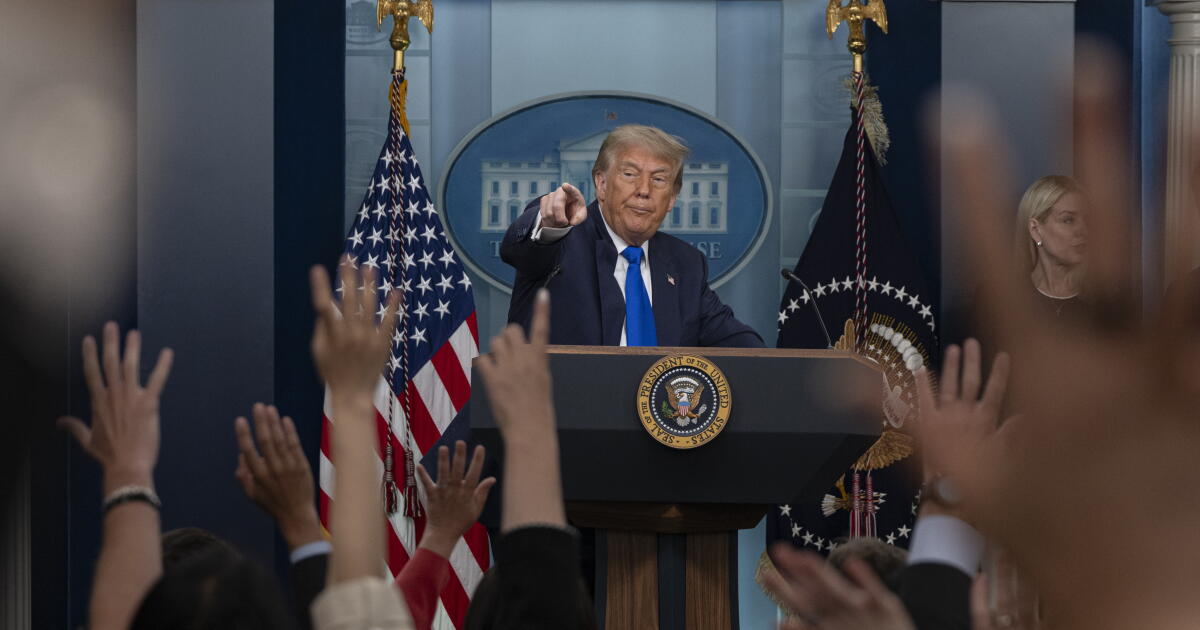
CBS hasn’t given up on producing an original late-night show — despite easing Stephen Colbert out the door.
“The Late Show With Stephen Colbert” ends next month after CBS canceled the popular program, citing financial pressures. The network’s top two executives told reporters during a press briefing in Hollywood on Wednesday that the network still wants to be a player in the 11:35 p.m. hour.
CBS struck a one-year deal with media mogul Byron Allen to bring his “Comics Unleashed” syndicated show to the prominent time slot once occupied by David Letterman until Colbert took the mantle a decade ago. President Trump, in social media posts, has taken credit for getting Colbert, whom he dislikes, tossed off the air.
Colbert’s final broadcast will be May 21.
Beyond the stop-gap arrangement with Allen, network executives acknowledged they don’t have a long-term plan for the late-night hours — but development executives are working on it.
“We are still going to develop other ideas, other concepts,” said George Cheeks, whose role as chair of TV Media at Paramount includes running CBS. He added that Allen’s programs, including “Funny You Should Ask” at 12:35 a.m., will allow the company to immediately turn a small profit — an increasingly critical mandate as CBS prepares to absorb the high cost of keeping NFL football on its schedule.
“If we are going to go back into that space, we have to go back into that space with a different financial model,” Cheeks said, in contrast to a show set in a theater with a band, live audience and large group of writers and support staff to stage a nightly show with numerous guests.
“I grew up in late night — I believe in late night,” Cheeks said. “The reality is that the reach is still there, but the reach is primarily on YouTube.”
It’s become increasingly difficult for CBS or other major networks to make money on a topical show when the majority of the audience, particularly younger viewers, watch snippets on YouTube.
CBS Entertainment President Amy Reisenbach acknowledged the network wasn’t actively developing a replacement late-night show; instead the effort was in the brainstorming stage. “They’re just conversations at this point,” she said.
CBS can make money on “Comics Unleashed” because Allen pays CBS for the hours and covers production costs. In return, Allen’s company receives most of the commercial spots in the programs, which his company can sell to advertisers to defray its costs.
Cheeks dismissed concerns that Allen’s programs, which have been in syndication for years, would not be viewed as “CBS-level quality.” He called Allen “a great partner.”
“Comics Unleashed” has run at 12:35 a.m., but CBS is moving it one hour earlier on the schedule, where it will have more exposure and benefit from running immediately after TV stations’ local late news. “Funny You Should Ask” will air in the 12:35 a.m. time slot.
“I actually think the shows are strong. … They have a point of view,” Cheeks said of Allen’s programs. “It’s a change in format … a change from what people are used to.”
It’s been a rough year for CBS.
The last 12 months have included a nasty spat with Trump over a “60 Minutes” segment with Kamala Harris, which Paramount ended by paying the president $16 million. Then came the tempest over Colbert’s cancellation just days after he called the Trump settlement “a big fat bribe.”
The network got new owners — David Ellison and Skydance Media — in August and Ellison promptly installed a new boss at CBS News, Bari Weiss, who has made talent moves to shake up the division.
Because of last year’s Paramount change in ownership, the NFL has the ability to reopen the network’s TV license deal, which is expected to increase the cost of retaining the NFL by as much as $1 billion a year, potentially cutting into CBS’ programming budget.
“Capital allocation is always a major consideration,” Cheeks said. “But I would harken back to something that David Ellison said recently, which was content investment was mission critical to the future of this company.”
CBS unveiled its new fall schedule Wednesday, announcing that fan-favorite LL Cool J was returning to star in a new show, “NCIS: New York,” with Scott Caan, and the introduction of a new legal drama, “Cupertino,” from hit-making executive producers Robert and Michelle King. CBS will serve up two other new shows, including a comedic drama, “Einstein,” and a half-hour vampire family comedy, “Eternally Yours.”
Cheeks also acknowledged that, for the first time in 18 years, CBS would not end the television season in first place in viewers. This year, that honor goes to NBC, which broadcast a blockbuster February with the Super Bowl and the Winter Olympics.
Nexstar Media Group will host a California gubernatorial candidate debate next week that will air across the company’s TV stations in the state.
“Debate Night in California: The Race for Governor,” will air April 22 starting at 7 p.m. Pacific, the company announced Monday. The event will originate from TV station KRON in San Francisco and be carried on KTLA in Los Angeles, KSWB in San Diego, KTXL in Sacramento, KGET in Bakersfield and KSEE in Fresno.
The debate will be moderated by Nikki Laurenzo, news anchor at KTXL and host of its public affairs program “Inside California Politics,” and Frank Buckley, veteran morning news anchor at KTLA.
The debate will include candidates who reached a minimum of 5% support in Nexstar’s March statewide poll conducted in March. Those candidates — Sheriff Chad Bianco, former Fox News host Steve Hilton, former U.S. Rep. Katie Porter and philanthropist Tom Steyer — have all agreed to participate in the event.
The debate will also air nationally on Nexstar’s cable news outlet NewsNation and be livestreamed over its political website The Hill. The network will also provide coverage leading up to the event with anchors Chris Cuomo and Leland Vittert, whose show will air live from San Francisco. Katie Pavlich will host post-debate coverage.
WASHINGTON — U.S. intelligence agencies are “urgently warning” private sector companies throughout the nation that Iranian actors “are conducting exploitation activity” that has resulted in “disruptions across several U.S. critical infrastructure,” according to a government notice reviewed by The Times.
The Iranian cyberactivity comes as President Trump is threatening to target Iran’s critical infrastructure in the coming hours, particularly its bridges and power plants.
Iran’s attack targeted products by Rockwell Automation’s Allen-Bradley, one of the most widely used industrial automation brands, according to the notice, which said that cyber actors affiliated with Iran were exploiting “programmable logic controllers across U.S. critical infrastructure.”
Tehran’s targeting campaigns against U.S. organizations “have recently escalated, likely in response to hostilities between Iran,” the notice warned.
“Iran-affiliated advanced persistent threat (APT) actors are conducting exploitation activity targeting internet-facing operational technology (OT) devices, including programmable logic controllers (PLCs) manufactured by Rockwell Automation/Allen-Bradley,” the notice reads.
“U.S. organizations should urgently review the tactics, techniques, and procedures (TTPs) and indicators of compromise (IOCs) in this advisory for indications of current or historical activity on their networks,” it continues.
The advisory was issued Tuesday jointly by the FBI, the Cybersecurity and Infrastructure Security Agency, the National Security Agency, the Environmental Protection Agency, the Department of Energy, and Cyber Command.
Top executives from companies at the core of the nation’s ability to function — those leading America’s largest energy, water, transportation, and communications corporations — had already been taking it upon themselves to increase their vigilence over potential attacks, concerned that Trump’s willingness to target Iran’s critical infrastructure inadvertently put a mark on their backs.
Some fear Iran’s ability to conduct cyber operations that could take down transformers or power inverters, if not a wide-scale power system. Others are concerned by threats to brick and mortar sites from proxies of Tehran — physical attacks against facilities such as nuclear plants, or power management systems, the crown jewels of the sector.
Larger, even more capable actors, particularly Russia and China, may also take advantage of the fog of war to launch strikes themselves.
“There remains concern about Iranian cyber capabilities and retaliation if the U.S. carries through on threats to attack their infrastructure,” said Ernest Moniz, former U.S. secretary of energy under President Obama who helped negotiate the 2015 nuclear deal with Iran. “There may already be backdoors, Trojan horses and malware hidden in our infrastructure.”
“I have to believe that the government cyber experts — or what’s left of them — are working closely and indeed overtime with the power companies and other infrastructure operators on cyber defense and intrusion detection and warning,” Moniz added.
Iran has demonstrated an ability to penetrate networks tied to critical U.S. infrastructure before.
In 2015, Iran-backed hackers accessed data associated with Calpine Corp., one of California’s largest power producers, obtaining detailed engineering diagrams and credentials related to power plant systems. Some were labeled “mission critical.” U.S. officials feared at the time that the breach would allow Tehran to initiate blackouts nationwide.
Since that time, companies at the center of the U.S. energy and telecommunications sectors have markedly improved their defenses. But Iran’s offensive capabilities have improved, as well.
Large players in the energy sector are operating with “a watchful eye and an elevated posture right now,” said Pedro J. Pizarro, president and chief executive officer of Edison International, the parent company of Southern California Edison, one of the nation’s largest electric utilities.
Companies like Edison have been operating under persistent threat for over a decade. In 2024, a pair of devastating cyberespionage attacks targeting U.S. critical infrastructure attributed to Chinese hackers, Volt Typhoon and Salt Typhoon, were discovered after avoiding detection for at least three years.
The threat of a similarly latent attack — where malware lies dormant in critical infrastructure systems, waiting for a signal to activate — is a real cause for concern in the sector, despite its best efforts and technological advances, experts and insiders said.
“The threat of cyber and physical attacks targeting critical infrastructure is not new,” said Jennifer DeCesaro, senior vice president of industry operations at the Edison Electric Institute, “which is why we partner with the government through the Electricity Subsector Coordinating Council to share actionable intelligence and prepare to respond to incidents that could affect our ability to provide electricity safely and reliably.”
The ESCC works closely with the National Security Council and its intelligence arms, particularly the intelligence agencies and CISA, to coordinate regular briefings on safety standards, best practices and intelligence tips.
The CIA declined to comment. A spokesperson with CISA, listed as out of office due to the ongoing federal funding hiatus for the Department of Homeland Security, could not be reached for comment.
Last summer, announcing a 40% cut to the workforce of her office, Director of National Intelligence Tulsi Gabbard eliminated the Cyber Threat Intelligence Integration Center, previously seen as a critical fusion hub of information by private sector partners.
Asked to respond to the potential of retaliatory attacks against U.S. infrastructure, Karoline Leavitt, the White House press secretary, repeated the president’s threats.
“The Iranian regime has until 8PM Eastern Time to meet the moment and make a deal with the United States,” she said. “Only the president knows where things stand and what he will do.”
Trump has threatened to destroy every bridge and power plant in Tehran if they fail to come to an agreement that ends its control over the Strait of Hormuz.
Ultimately, corporate executives shoulder much of the burden as the first line of defense for the country’s critical infrastructure, roughly 85% of which is owned by private sector companies.
Tom Fanning, former CEO of Southern Co. and now executive committee chairman at the Alliance for Critical Infrastructure, said the threat from Iran is “credible.”
“I have not seen what I would describe as the existential threat, to take down a wide-ranging power system,” Fanning said. “Could those things be turned on? Sure. Is the United States critical infrastructure prepared to act? I think so.”
Last month, early on in the war, the Los Angeles Metro transit system was forced to shut down a portion of its network due to a hack. Authorities say it is still unclear who was behind the breach, but a source told The Times that Iran-backed hackers are being investigated as the potential culprit.
The transportation agency said its security team had “discovered unauthorized activity,” and were making sure its roughly 1,400 servers were secure before bringing them back online. The agency has emphasized the hack did not impact passengers’ commute time.
The FBI said it was aware of the hack. DHS is working with local partners “to address cyber threats to critical infrastructure,” an official said.
“The reality is that the threats are here and now,” Fanning added. “The truth is, the bad guys are already here.”
Times staff writers Kevin Rector, Richard Winton and Rebecca Ellis, in Los Angeles, contributed to this report.
Bilivan consumers have felt the impact of contaminated gasoline. More than 10,000 vehicle owners, including long-distance transport operators and private drivers, have reported severe engine damage. File Photo by Luis Gandarilas/EPA
April 1 (UPI) — Bolivia’s government, led by President Rodrigo Paz, said it has uncovered an international criminal network responsible for sabotaging and adulterating imported fuel shipments that entered the country over the past five months.
Interior Minister Marco Antonio Oviedo told a news conference Tuesday that at least 150 million liters of gasoline and diesel were tampered with, citing an official investigation that identified a scheme involving fuel theft and contamination with water and oil in Chilean territory.
Authorities said the operation targeted tanker trucks transporting fuel to Bolivia, particularly in northern Chilean cities. In those locations, part of the fuel was allegedly siphoned off and replaced with a mixture of water and oil, according to local broadcaster Unitel.
President Paz said the adulteration began around October.
Investigators believe the network operated mainly in Chile, with additional links and operational hubs in Paraguay and Argentina. The direct economic loss to the Bolivian state is estimated at $150 million, excluding indirect costs linked to transport disruptions.
Consumers also have felt the impact. More than 10,000 vehicle owners, including long-distance transport operators and private drivers, have reported severe engine damage.
“We are facing an attack against the assets of Bolivian families,” Paz said, adding that the government will pursue legal mechanisms to compensate those affected, according to local newspaper El Deber.
Bolivia’s landlocked status makes transporting fuel from Chile critical to its energy supply chain. The country relies on Chilean ports such as Arica, Iquique and Mejillones to receive international shipments of crude oil and refined products.
After a virtual meeting Tuesday, Paz and Chilean President José Antonio Kast agreed on a joint roadmap to dismantle the transnational organized crime network behind the fuel adulteration, according to Bolivia’s state-run broadcaster BTV.
As an immediate response, Bolivia announced tighter controls at facilities operated by state energy company Yacimientos Petrolíferos Fiscales Bolivianos, known as YPFB, and the National Hydrocarbons Agency. Authorities will implement mandatory laboratory testing at production sites and border checkpoints.
Civil society groups have called for accountability as the investigation continues, urging authorities to prosecute those responsible abroad and to address potential internal failures that allowed the sabotage to go undetected for months.
The crisis comes as Bolivia faces a severe fuel supply shortage. After a structural decline in domestic hydrocarbon production, which fell about 44% between 2014 and 2024, the country shifted from a net exporter to a heavily import-dependent market. Bolivia now imports about 90% of the diesel and 50% of the gasoline it consumes.
The situation has worsened since 2023 due to a shortage of foreign currency, particularly U.S. dollars, complicating payments to international suppliers and contributing to intermittent shortages and partial disruptions in transport and productive sectors.
A U.S. District Court judge dismissed a wrongful termination suit filed by a Fox News producer who claimed he was fired in retaliation for calling out the network’s reporting on President Trump’s erroneous charges of 2020 election fraud and the riot at the U.S. Capitol on Jan. 6, 2021.
Jason Donner, who worked at the network’s Washington bureau as a reporter and producer was fired on Sept. 28, 2022, two days after calling in sick. He was told he had been terminated for his absence.
In 2023, Donner filed a lawsuit in a Washington, D.C., court that contended his dismissal was linked to several instances in which he challenged the veracity of the network’s coverage.
But U.S. District Judge Amir Ali determined in his ruling issued Monday that Donner failed to meet the company rules and that his conduct was not protected by the District of Columbia’s sick leave law.
Donner’s attorney did not immediately respond to a request for comment.
The lawsuit noted that Fox News bosses criticized the network’s journalists for not considering the feelings of its pro-Trump audience following the election that sent Joe Biden to the White House.
But Ali also said Donner was an at-will employee and that his case failed to identify “a public policy that precluded Fox from firing him over his ardent objections to the network’s programming, no matter their validity.”
The same point was raised when U.S. District Judge Christopher Cooper dismissed that portion of Donner’s claim in 2024.
“As we have maintained, this lawsuit was entirely without merit, and we are pleased with the court’s ruling on the matter,” a Fox News representative said in a statement.
Peter Alexander, who covered Washington for NBC News for more than a decade, is leaving the network to join MS NOW, according to people familiar with his plans.
Alexander, 49, will serve as an anchor and chief national reporter for MS NOW. He will have a weekday program and also handle breaking news coverage throughout the day.
A 22-year veteran of NBC News, Alexander served as chief White House correspondent and co-host of the Saturday edition of “Today” with Laura Jarrett. He is among the most familiar faces in the White House briefing room.
Alexander told viewers at the end of his Saturday broadcast that he is departing NBC News but did not mention his new job. A representative for MS NOW declined comment.
MS NOW is the progressive-leaning cable channel formerly known as MSNBC. The network changed its name after it was spun off from Comcast into a new company called Versant.
After the split, MS NOW ended its relationship with NBC News. Journalists who worked on both MSNBC and NBC News had to chose which entity they would work for going forward.
Correspondents Jacob Soboroff and Ken Dilanian switched from NBC News to MS NOW. Data guru Steve Kornacki decided to stick with NBC News as he also has assignments at NBC Sports. Willie Geist, a co-host on MS NOW’s “Morning Joe,” is an exception as he continues to anchor NBC’s “Sunday Today.”
Alexander is the first NBC journalist to cross over to MS NOW since the split. His deal with Versant also gives him the opportunity to contribute to sports coverage on the company’s other cable properties, USA Network and the Golf Channel.
Alexander will anchor the 11 a.m. Eastern hour on MS NOW, succeeding Ana Cabrera, who is leaving the network when its daytime programming changes take effect in June.
Alexander joined NBC News after serving as an anchor on the network’s Washington station WRC.
He was White House correspondent from 2012 to 2014 during President Obama’s second term and returned to the assignment in 2018 to cover President Trump.
An aggressive questioner, Alexander has been chastised by Trump publicly over news conference questions that made him unhappy.
Behind a network of fake YouTube newscasts spreading propaganda in favor of Venezuela’s acting president, Delcy Rodríguez, lies a hidden digital structure made up of dozens of websites and social media accounts. It is a much larger and still-active operation than initially believed, designed to distribute content as if it came from independent regional outlets.
In two previous reports, Cazadores de Fake News named this influence operation “Hispan Online.” The first revealed part of the network of YouTube channels whose videos appeared as ads on Venezuelan screens, pushing narratives favorable to the Rodríguez administration. The second report confirmed that the “anchors” were not journalists, but more than 20 actors living in Argentina who were hired through an intermediary agency. The videos racked up millions of views.
The channels mimic Spanish-language news outlets, presenting their content as if it were multiple spontaneous local coverages. So far, Cazadores has identified: Hispan Online (the most prolific producer and the network’s central amplification node), Nación Argentina, Colombia Actual, Panorama Colombiano, La Perspectiva Global, México en Datos, Informe Mexicano, United Data News, Continental Report, Nación Digital MX, Chile en Datos, Argentina en Perspectiva, EC En Análisis, and El Informe Europeo. All of them are part of the network identified so far as the YouTube arm of the operation.
Logos of 12 of the “Hispan Online” network’s YouTube channels.
But Venezuelans exposed to those videos are largely unaware that the operation extends far beyond YouTube. At least 30 websites were created as part of it, publishing more than 11,000 articles in just one month. Each site links to Instagram, Facebook, and YouTube accounts bearing the same names as the fake newscasts.
Domain records for some of these websites identify QSocial, an Argentine political communications firm, as the registrant of several of them. A separate investigation by La Nación points in the same direction.
YouTube channels as the tip of the iceberg
The propaganda videos promoted through YouTube ads amassed millions of views, but the 14 channels that initially hosted them hardly resembled real news outlets. Most displayed little more than a logo, and their videos were often not publicly listed.
Some channels, however, included short descriptions and, in some cases, a website address—such as colombiaactual.co for “Colombia Actual” and nacionargentina.info for “Nación Argentina.”
Ongoing monitoring of F. G. Medios S.A. (the company that paid for the YouTube ads) through Google’s Ads Transparency Center led to the identification of 30 distinct YouTube channels. Together, they published at least 90 videos and amassed more than 47.5 million views. Following the pattern of the web addresses, additional associated sites were expected: Manual searches confirmed 30 corresponding websites.
At least five of these sites embedded YouTube playlists or windows featuring the same fake “journalists” seen in the ads.
Screenshots of four websites from the “Hispan Online” network.
All 30 domains with known registration dates were created within just nine days, between February 17 and 25, 2026. Fourteen were registered on February 20 alone. This pattern mirrors the creation of the YouTube channels, which appeared between February 18 and early March. The clustering of dates is one of several technical indicators of coordination in this influence operation.
The sites also share a common technical architecture. All run on WordPress, use Cloudflare servers, were registered via Dattatec or DonWeb, use themes developed by Ansar, and have the same Jetpack plugin installed. Articles across all sites are published by the same three WordPress users: “administrador,” “periodista 1,” and “periodista 2.”
This is not a network of independently built websites. It is a single model replicated 30 times and operated by the same group. In total, the network includes more than 90 social media accounts: 30 YouTube channels, 32 Instagram accounts, and 29 Facebook pages. As of publication, most have minimal activity and almost no followers—but the infrastructure is in place and regularly updated.
Venezuela content stands out
With 30 active websites identified, the next step was to analyze their content. Reviewing each article manually was not feasible at that scale.
To do so, Cazadores de Fake News developed a tool—with assistance from generative AI—capable of automatically downloading all articles published across the 30 sites, including full text and images. The result was a database of 11,391 articles produced in just one month.
While most articles are not about Venezuela, it is the most frequently referenced country. With 1,912 pieces, Venezuela accounts for 16.79% of all content, ahead of Brazil (14.30%), Colombia (8.83%), Mexico (8.79%), and Argentina (8.12%). The rest covers other countries, helping each site appear as a regional outlet with its own editorial agenda.
Much of the Venezuela-related content mirrors the narratives promoted in the YouTube ads: favorable coverage of Delcy Rodríguez and her brother Jorge Rodríguez (who presides the Venezuelan parliament), reporting on the new amnesty and hydrocarbons laws, and stories highlighting positive economic projections and the oil sector.
Screenshots of related articles published across “Hispan Online” websites.
The analysis also revealed another pattern: the same article often appeared across multiple sites with different headlines and slight rewrites tailored to each country, but with nearly identical core narratives. It is a form of serial production, where one base story is rewritten and redistributed to simulate independent local coverage.
One example is coverage of joint ventures between PDVSA and US oil companies. Articles published on March 16–17 across republicahoy.do, pulsonacional.mx, and panoramabrasil.info repeat identical figures (250,000 barrels per day, 22% of national output) while adapting their framing. The Dominican version adds references to Caribbean fuel prices. The Mexican version mentions the Dos Bocas refinery and the Energy Ministry. The Brazilian version refers to the Palácio do Planalto and investment opportunities for Brazil.
The texts share repeated transitional phrases—“in this context,” “on the other hand,” “diante deste cenário”—and identical section structures. The Brazilian version also contains errors suggesting automated translation, such as “empresas americana” instead of “americanas” and leaving “barriles” untranslated.
Although headlines and wording vary, these articles share one constant: they use exactly the same featured images. By comparing images across all 11,391 articles, the tool identified hundreds of such clusters. Contents largely consist of one base story, adapted and republished across multiple sites with the same photo.
Articles published across multiple websites show minor variations tailored to different national audiences.
This is the first time Cazadores de Fake News has documented evidence suggesting the use of automation or generative AI to sustain an influence operation of this scale targeting Venezuelan audiences. Producing more than 11,000 articles in one month, localized by country and language, would have been unfeasible for a small team of human writers.
The websites have so far attracted little traffic. But the infrastructure is active, content continues to be published, and the material already looks credible enough to be mistaken for real journalism.
The trail leads to QSocial
Despite the scale of the operation (30 websites, three social media platforms, and thousands of articles) those who registered the domains left traces. At least five domains lacked privacy protection, exposing registrant names and emails.
Two Dominican domains—diariocaribedigital.do and republicahoy.do—were registered on February 20 at the exact same second. Their records list “QSocial” as the registrant. These are different names pointing to the same corporate ecosystem.
Multiple websites in the network list QSocial or QSN Big Data—names tied to the same Argentine political communications firm—as their registrant.
QSN Big Data and QSocial are names used by the same Argentine political communications firm, which has also operated as QSocialNow. According to a March 23 investigation by La Nación, the company—led by former Chubut governor Martín Buzzi—produced the fake newscast videos. The outlet reported that the videos were recorded at the company’s offices in Buenos Aires, where actors were recruited through a casting process.
The firm also has a documented history within Venezuela’s propaganda ecosystem. After the July 2024 presidential election, it produced a poll under the name QSocialNow backing a decision from Venezuela’s Supreme Tribunal to declare Nicolás Maduro the winner, despite widespread independent evidence of electoral fraud.
All domains in the network were registered through the same Argentine provider, within the same time frame, and using the same servers. However, this investigation could not determine whether QSocial itself entered the domain registration data or whether it was done by a third party.
Cazadores de Fake News and Argentine fact-checking outlet Chequeado contacted QSocial for comment. The company had not responded at the time of publication (March 24).
An unprecedented operation in Venezuela
Although QSocial director Martín Buzzi denied involvement to La Nación, the technical records documented in this investigation and the newspaper’s sources point to the same company. Who commissioned the operation and how it was financed remain unanswered questions.
It is also unclear whether the thousands of articles about Argentina, Mexico, Brazil, and other countries are merely camouflage for the pro-Rodríguez campaign or part of parallel influence operations using the same infrastructure.
There is no recent precedent in Venezuela for an influence operation of this scale deployed in such a short period.
Before Google, Meta, or the operators themselves took down most of the YouTube channels and 15 Instagram accounts, the propaganda videos had already surpassed 47.5 million views. At the time of publication, all Facebook accounts and the 30 websites remain active.
MS NOW is making sweeping changes to its daytime programming, moving hosts Stephanie Ruhle and Alicia Menendez to new time slots.
The changes include the departure of Ana Cabrera, who told viewers about her plans Wednesday. Carbera joined MS NOW — formerly MSNBC — from CNN in 2023. Chris Jansing, the current 11 a.m. Eastern host, will become chief political correspondent.
Stephanie Ruhle is the new anchor for MSNBC’s “The 11th Hour.”
(MSNBC)
The moves announced by MS NOW President Rebecca Kutler are aimed at improving daytime ratings on the network, which changed its name from MSNBC after being spun off from Comcast into a new company called Versant.
MS NOW has seen improved ratings in prime time with opinion programming since the network was re-branded in November. The politically progressive-leaning network will have hosts with a point-of-view in the daytime hours as well once the programming changes take effect in June.
In a memo to staff obtained by The Times, Kutler said the daytime programming will “still be rooted in hard news.”
Ana Cabrera speaks at The Common Good Forum & American Spirit Awards 2018 at The Common Good Forum on May 21, 2018 in New York City.
(Sylvain Gaboury / Patrick McMullan via Getty Images)
Ruhle will move from her 11 p.m. Eastern program “The 11th Hour” to a daytime shift from 9 a.m. to 11 a.m. Eastern. Her program will focus on money and politics.
Menendez will host two hours in the afternoon starting at noon Eastern.
The schedule changes will take effect in June.
Alicia Menendez, Michael Steele and Symone Sanders Townsend of MSNBC’s “The Weekend.”
(MSNBC/Virginia Sherwood/MSNBC)
Once Ruhle’s new program debuts, “Morning Joe” will return to a three-hour format. The program co-hosted by Joe Scarborough and Mika Brzezinski expanded to four hours in 2022. Although the expansion improved ratings, the hosts have asked to scale back so they can pursue other projects at the network.
Menendez has been part of the trio on “The Weeknight,” with Michael Steele and Simone Sanders-Townsend. Luke Russert will take her seat on the program as he returns to an on-air role. Russert had been part of the daytime MSNBC show “The Cycle,” and recently served as creative director for MS NOW’s live event series.
Ruhle will be replaced on “The 11th Hour” by Ali Velshi, who recently served as a weekend anchor. Jacob Soboroff, the network’s national correspondent, will take over Velshi’s anchor duties from 10 a.m. to 1 p.m. Eastern.
Kutler said there will be no job reductions related to the schedule changes, saying she expects to have “more people working at MS NOW by the end of 2026 than we do today.”
MS NOW is the second most-watched cable news network behind Fox News while leading CNN.
Federal Communications Commission Chairman Brendan Carr is using his bully pulpit to push back against coverage of the U.S. military action in Iran that his boss President Trump doesn’t like, marking an extraordinary escalation in his clashes with the media.
On Saturday, Carr posted a message on X suggesting TV stations could lose their government licenses to use the public airwaves if they “don’t operate in the public interest.”
Underneath his statement, Carr shared a social media post from Trump, who complained about the New York Times and Wall Street Journal stories on the five refueling tankers were hit during an Iranian missile strike on the Prince Sultan Air Base in Saudi Arabia.
Carr seized on Trump’s missive to issue a warning to TV outlets, which are frequently threatened by the president when he is angry at their coverage.
It’s the latest attempt by the FCC chair to apply pressure on media companies that irritate Trump with critical coverage of his administration.
Since becoming FCC chairman last year, Carr has repeatedly threatened to use the levers of power he has to punish TV and radio stations when they get in Trump’s crosshairs. His behavior has alarmed free speech advocates.
“Broadcasters that are running hoaxes and news distortions — also known as the fake news — have a chance now to correct course before their license renewals come up,” Carr wrote, without providing evidence to back up his claims. “The law is clear. Broadcasters must operate in the public interest, and they will lose their licenses if they do not.”
Carr’s threats are based on his assertions that said he wants to enforce the FCC’s public interest obligation for broadcasters that use the airwaves. He made similar remarks in the fall, which prompted two major TV station groups to keep ABC’s “Jimmy Kimmel Live!” off the air for a week due to remarks the host made regarding slain right-wing activist Charlie Kirk.
Trump and Defense Secretary Pete Hegseth have repeatedly attacked news organizations for any reporting that doesn’t say the war in Iran is anything but a rousing success.
Ellison, the chief executive of Paramount who, along with his father, has forged strong ties to the White House, will have control over CNN in addition to CBS if the company’s deal to acquire the news outlet’s parent Warner Bros. Discovery is completed.
Carr made the appointment of an ombudsman for CBS News a condition to approve Ellison’s Skydance Partners deal to acquire Paramount last year. Paramount also drew scrutiny over its controversial decision to pay $16 million to settle Trump’s legal salvo against “60 Minutes” over the editing of an interview with his 2024 opponent, then-Vice President Kamala Harris. Most legal analysts viewed the case as frivolous.
The FCC has no jurisdiction over CNN, which is why most of Carr’s barbs are aimed at ABC, CBS and NBC, which air on local TV stations. He once wrote on X, “More Americans trust gas station sushi than the legacy national media.”
Trump said in a social media post Sunday that he was “thrilled” with Carr’s remarks and would support his efforts to go after what he called “Highly Unpatriotic ‘News’ Organizations.”
“They get Billions of Dollars of FREE American Airwaves, and use it to perpetuate LIES, both in News and almost all of their Shows, including the Late Night Morons, who get gigantic Salaries for horrible ratings,” Trump wrote.
Andrew Jay Schwartzman, a Washington-based public interest communications attorney, believes Carr’s conduct and threats violate the 1st Amendment, adding that any serious attempt to revoke licenses would be tied up in legal challenges.
“Even if he started to try to deny a license renewal as quickly as he could, Brendan Carr would be long gone before that case would be over,” Schwartzman said. “The law intentionally sets out a very steep burden for the FCC to deny a license renewal; the process takes many years, during which time the licensee continues to operate normally under ‘continuing operating authority.’”
Carr’s remarks Saturday drew immediate blowback from Democrats and 1st Amendment advocates, noting the FCC’s role does not include policing the free press.
“Once again, this FCC pretends it has the power to control news coverage,” FCC Commissioner Anna Gomez said Monday in a statement. “In reality, the FCC has vanishingly little power over national news networks. It licenses local broadcast stations, not networks, and no licenses are up for renewal until 2028.”
Calif. Gov. Gavin Newsom weighed in as well, posting, “If Trump doesn’t like your coverage of the war, his FCC will pull your broadcast license. That is flagrantly unconstitutional.”
Sen. Ron Johnson (R-Wis.), usually a reliable voice of support for the Trump administration, expressed his concerns over Carr’s remarks.
“I’m a big supporter of the 1st Amendment,” Johnson told Fox News on Sunday. “I do not like the heavy hand of government no matter who’s wielding it. I’d rather the federal government stay out of the private sector as much as possible.”
Gomez added that while attempts to pull licenses border on folly, Carr’s threats and attacks on the media can create a chilling effect and erode the public’s confidence in the press.
“Over the past year, this FCC has attacked the media as part of a years-long campaign by this Administration and its allies to discredit factual, independent coverage while blaming the press for growing public distrust,” Gomez said. “Meanwhile, it is the FCC’s own credibility and public trust that are rapidly eroding.”
Trump is not the first president to target TV station licenses in response to negative news coverage. At the height of the Watergate scandal in the 1970s, Richard Nixon’s allies attempted to challenge the TV licenses for three stations owned at the time by the Washington Post.
The effort didn’t get far.
The last Los Angeles outlet to lose its broadcast license was KHJ in 1987, when the station was part of RKO General, a media company owned by the General Tire and Rubber Co. The case was related to corporate malfeasance and not broadcast content on the stations.
The process to revoke the RKO licenses took seven years from the moment the FCC voted in favor of the move.
“Since then, only small mom-and-pop radio stations have been litigated,” Schwartzman said. “The cases nearly always involve lying to the government, felony convictions or failure to pay regulatory fees. In one recent case, a small owner convicted of tax evasion still kept his license.”
There would be other logistical hurdles to the FCC making good on Carr’s threats.
As Gomez noted, Carr’s FCC only has regulatory control over the TV stations that carry the network signals. If stations were drop network programming for any reason, they could violate their affiliation contracts and lose the right to carry NFL football and other content that delivers big ratings and revenue.
Sinclair Broadcast Group wanted Kimmel to apologize to Kirk‘s family and contribute to his organization Turning Point USA before putting the host’s late night show on the air.
That did not happen and “Jimmy Kimmel Live!” returned to Sinclair’s stations anyway.
NBCUniversal is cutting “Access Hollywood” and several other of its daytime talk shows, effectively ending its first-run syndication business as daytime television atrophies.
The company confirmed that “Access Hollywood,” and its counterpart “Access Live,” will be coming to an end in September. The shows, produced in Los Angeles, are currently hosted by Mario Lopez, Kit Hoover, Scott Evans and Zuri Hall.
Talk shows “Karamo” and “The Steve Wilkos Show,” produced out of NBC’s facility in Stamford, Conn., are also shutting down. The programs have already completed their production for the season and will run through the summer.
NBC previously announced that “The Kelly Clarkson Show” is also ending later this year after seven seasons.
“The Steve Wilkos Show” ran for 19 seasons. The host is a former bouncer for “The Jerry Springer Show.”
Francis Berwick, chairman of Bravo and Peacock unscripted, said in a statement that the company will continue to distribute library episodes of its talk programs and network shows such as “Law & Order.” But NBCU’s days of launching series for daytime and the hour before prime time are over.
“NBCUniversal is making changes to our first-run syndication division to better align with the programming preferences of local stations,” Berwick said. “The company will remain active in the distribution of our existing program library and other off-network titles, while winding down production of our first-run shows.”
“Access Hollywood” was first launched by NBC in 1996 as a competitor to CBS Media Ventures’ “Entertainment Tonight.”
First-run syndication allows producers to sell TV shows to stations on a market-by-market basis, instead of distributing them through a single network. This model was a major success for talk show staples such as Oprah Winfrey and Ellen DeGeneres.
But streaming has pulled viewers away from traditional television, as viewers can watch their favorite shows and movies anytime on demand. The audience levels needed to generate enough ad revenue to support first-run programming in daytime no longer exists.
Many TV stations are filling their hours with more local news as daytime talk goes away.