THE top cities in the WORLD have been announced from far-flung Asia to the ‘city of love’ that has cheap UK flights.
Readers of Conde Nast Traveller voted for their “favourite urban sprawls across the planet” to decide which ones are the best and it might be time to book that bucket list trip to Thailand.
The best city in the world is Bangkok – you can pick up street food for as little as £1Credit: AlamyThe second best city in the world is Paris – which has £13 flights from the UKCredit: Alamy
Taking the number one spot on the list is Bangkok which was praised for its “buzzy markets, glittering palaces and captivating religious sites unite – street food sellers dishing up tasty food between them all, of course.”
When Assistant Travel Editor Sophie Swietochowski visited Bangkok she picked up tasty dishes for the equivalent of £1 – you can also pick up beer for as little as £1.14 according to Wise.
Sign up for the Travel newsletter
Thank you!
She said: “Within an hour of being in Thai capital Bangkok’s Chinatown we have sampled street food including noodle soup splashed with vinegar, fish sauce and sugar; crunchy corn parcels.
“A bowl of salty critters, displayed next to a row of scorpions on sticks; purple mashed potatoes shaped into doughy, salty balls; and traditional sweet luk chup, made with mung beans.”
She also visited Lebua Hotel’s Sky Bar, which was the filming location from 2011 buddy comedyfilm The Hangover 2 and it’s home to the “world’s highest open-air whisky bar”, Alfresco 64.
The city coming second on the list is much closer for Brits to visit, it’s Paris.
The French capital is said to have “topped bucket lists of international travellers for centuries thanks to an unrivalled food culture, grand monuments, world-class museums and subtly seductive atmosphere.”
From the UK it’s easy to reach the French capital either on the Eurostar or plane with one-way flights as little as £13.
There’s so much to do in Paris from sight-seeing landmarks like the Eiffel Tower or wandering around the Louvre.
When Travel Reporter Alice Penwill ventured to Paris for an extreme daytrip on the Eurostar she had some suggestions on how to spend time there.
Valletta in Malta came in fifth – and it gets 300 days of sunshine each yearCredit: Alamy
She said: “To start the morning off right, it would be a crime not to pop into one of Paris’ many bakeries, or boulangeries, for a croissant and a coffee.
“Take one to go and stroll along the Seine before heading into the Musée d’Orsay where you can see work by artists like Monet, Renoir and Van Gogh.
“Afterwards, head back along the Seine to see the beautiful Notre Dame which has now reopened to visitors. And if you’re a fan of books, pop across to the famous bookshop, Shakespeare And Company.”
Turkey’s capital, Istanbul was named the third best city in the world which was called “chaotic in all the best ways.”
The publication said: “Centuries of history sit alongside a vibrant contemporary culture, with new waves of artisans luring travellers into chic boutiques after tours of places like Topkapı Palace, the Blue Mosque and the sweet-scented Grand Bazaar.”
She described it as a “trendy pocket of an otherwise busy, but beautiful city.”
If you wander into Karaköy’s backstreets and climb towards neighbouring Galata, you’ll find that cobbled lanes and historic buildings lead to the landmark Galata Tower.
Istanbul came in third spot and is divided by the Bosphorus straitCredit: AlamySouth Africa’s Cape Town is a popular winter sun spots for Brits with no jet lagCredit: Getty
Head up for spectacular views across the Golden Horn, Bosphorus and historic peninsula – it’s especially beautiful in the late afternoon.
Valletta in Malta comes in at number five and it’s a popular spot for Brits thanks to its 300 days of annual sunshine.
Even in November it can see highs of 18C – and it’s reachable from the UK in just over three hours and flights are as little as £15.
It was voted last year’s top city thanks to its mix of ancient but also modern feel and architecture.
Other popular winter sun destinations that made the list include Cape Town in South Africa which in January and February has highs of 25C – while the UK shivers in highs of 8C.
There’s also no jet lag because Cape Town is either one or two hours in front of the UK – depending on the time of year.
When Head of Travel (Digital) Caroline McGuire visited, she saw Table Mountain, lots of wildlife, vineyards and was impressed with an area called Kalk Bay.
She said: “At the town’s upmarket Harbour House restaurant, we dined on seafood and good wine for the price of a Pizza Hut meal in the UK — all while watching seals swimming in the harbour.
“Our accommodation was the charming Chartfield Guesthouse, staying in a huge two-bedroom apartment. It was bigger than my house back home, and cost only £94 a night.
“Kalk Bay is a prime spot for visiting the endangered African penguins of neighbouring Simonstown – there must have been around 100 on the town’s shoreline.”
These are the top 20 cities according to Conde Nast Traveller…
In-depth study also says the royal house made huge profits from the Dutch colonial policies in past centuries.
Published On 2 Oct 20262 Oct 2026
A historical study has found that the Dutch royal house benefited from the country’s colonial policies in past centuries and helped the slave trade to survive.
The in-depth study, commissioned by King Willem-Alexander and conducted by Leiden University, showed the House of Orange-Nassau “actively supported Dutch colonialism for centuries, but only rarely determined colonial policy”, according to the university’s statement, published on Friday.
Recommended Stories
list of 3 itemsend of list
“The involvement of the House of Orange-Nassau was wholehearted and without any real reservations,” Dutch historians and human rights experts concluded after a three-year study looking at the period from 1600 to the present.
“The research leaves us in no doubt that the House of Orange shares responsibility for the survival over the centuries of the Dutch slave trade and slavery,” the study said, noting that most of the rulers showed no objections to slavery.
King Willem-Alexander said on Friday he was personally affected by the “explicit” conclusions of the study.
“It is a painful and confronting conclusion. A conclusion that affects me, even though I am three generations removed,” Willem-Alexander said in a speech at the presentation of the research.
“We know the effects of colonialism and slavery are still being felt today. Discrimination and economic exploitation unfortunately happen every day,” he added.
The study also showed that the royal family at times profited substantially from the colonial system, mostly from trade in the Dutch East Indies, modern-day Indonesia.
In the 19th century, for instance, profits accumulated to about $650m in modern terms, the researchers said.
On the other hand, the royal family earned “almost nothing” from the slave trade, the research showed.
Apologies without reparations
The Dutch monarch, who in 2023 apologised for his ancestors’ lack of action against slavery, highlighted their lack of “counter-current leadership” in the face of colonialism.
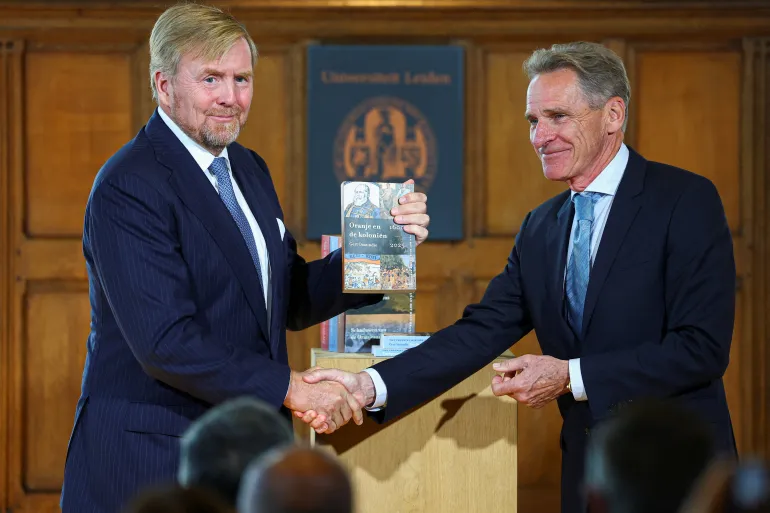
Dutch historian Gert Oostindie, right, presents a volume of an independent study into the role of the House of Orange-Nassau in Dutch colonial history to King Willem-Alexander in Leiden, the Netherlands, on October 2, 2026 [Piroschka van de Wouw/Reuters]
The House of Orange has ruled the Netherlands since the late 16th century, first as “stadtholders” who presided over the republic, and later as the royal house when the Netherlands became a monarchy.
For most of this time, the Dutch ruled over vast colonies in Southeast Asia and the Caribbean, including what is now Indonesia and Suriname.
The findings could stir up the debate around reparations in the Netherlands. The Dutch government apologised in 2022 after acknowledging the Dutch state bore responsibility for transatlantic slavery. King Willem-Alexander apologised the following year.
The government at the time ruled out reparations, instead creating a 200 million euro ($238m) fund for social initiatives, which anti-racism campaigners have dismissed as insufficient.
The National Institute for the Dutch Slavery Past and Heritage (NiNsee) lauded the king for commissioning the study but said it should lead to a next phase.
“Research impacts society when the new insights into the past contribute to awareness, dialogue, corrections and additions to our national history in the school curriculum and the conversation about responsibility and reparatory justice,” NiNsee director Bianca Groen Gallant said.
The Dutch played a major role in the global slave trade from the 17th century until the Netherlands abolished slavery in the second half of the 19th century.
Justice minister condemns ‘Hitler salutes, antisemitic slogans, violence’ at the anti-immigration rally.
Published On 19 Sep 202619 Sep 2026
Dutch riot police have intervened at a protest against immigration and asylum policies after about 500 far-right demonstrators pelted them with projectiles and fireworks .
Police used baton charges and dogs to break up the demonstration in The Hague on Saturday, reported the AFP news agency.
Recommended Stories
list of 4 itemsend of list
Local authorities said the demonstration was ended because of continued violence, and protesters were escorted away from Malieveld park in the city centre.
Police said they arrested 24 people and deployed water cannon to disperse the rioters. Further investigations were underway, they added.
Prime Minister Rob Jetten said on X that the demonstrators deliberately sought confrontation with the police and chanted “abhorrent” far-right and antisemitic slogans
Justice Minister David van Weel condemned the violent scenes and slogans.
“Identical images from the Malieveld. Hitler salutes, antisemitic slogans, violence against the police and throwing fireworks at the riot squad,” he posted on X. “It is important that hardline action is taken against this.”
He also thanked police officers for helping to maintain the democratic rule of law.
The “Wij zijn het volk” rally, which translates to “We are the people”, was organised to protest against government policies in the Netherlands’, specifically on immigration.
The protesters had planned to march through The Hague, but local authorities banned it when violence began and ordered the demonstration to be broken up.
The Prince’s flag with the symbol of the Dutch East India Company during the far-right demonstration in The Hague on Saturday [Nicolas Economou/Reuters]
Someone at the rally was seen giving a Hitler salute, while a truck serving as a stage displayed a screen reading “The Netherlands is for the Dutch,” according to the country’s largest national news agency, Algemeen Nederlands Persbureau (ANP).
Protester Thijs Jansen, a 31-year-old mechanic, told AFP: “We’re losing our country. We’re literally losing our country to mass migration”.
A police car was then set on fire in clashes between black-clad protesters and police, as the headquarters of the centrist D66 party were attacked. Its leader, Rob Jetten, is now prime minister.
Public broadcaster RTE says the country’s participation cannot be justified amid ‘appalling and ongoing loss of lives in Gaza’.
Published On 17 Sep 202617 Sep 2026
Ireland has become the second country, after the Netherlands, to announce a boycott of next year’s Eurovision Song Contest over Israel’s participation.
Irish public broadcaster RTE said in a statement on Thursday that the country’s participation could not be justified “given the appalling and ongoing loss of lives in Gaza” and that the humanitarian crisis in the enclave “continues to put the lives of so many civilians at risk”.
Recommended Stories
list of 3 itemsend of list
RTE, which manages Ireland’s selection and participation in Eurovision, added that it remained “deeply concerned by the continued denial of independent access [for] international journalists to the territory”.
The decision marks the second consecutive year that Ireland will neither participate in nor broadcast the competition, which is the world’s most popular television music show.
Earlier this month, Eurovision organisers said they were excluding any country involved in an armed conflict from hosting the competition.
However, the Dutch public broadcaster Avrotros said the exclusion of countries in conflict was not “sufficient”.
Avrotros announced last month that it was withdrawing from the 2027 competition.
It said Eurovision could “no longer be considered neutral” given Israel’s participation in “a large-scale military conflict” in Gaza.
Both Ireland and the Netherlands were among five countries that withdrew from Eurovision 2026 in Vienna earlier this year. Spain, Slovenia and Iceland also decided not to participate.
Eurovision Director Martin Green said on Thurday that organisers “fully respect” Ireland’s decision and that they “will be missed”.
“The Eurovision Song Contest is at its best when broadcasters and their artists from different countries come together to share music, celebrate creativity and create connections between audiences,” Green said.
“That power to bring people together is at the heart of what makes the Contest so special, and is even more important now in an increasingly difficult and divided world.”
The 2026 show, which Bulgaria won, attracted 132 million viewers, 34 million fewer than its 2025 edition.
Thousands of protesters gathered outside the venue in the Austrian capital during the final in mid-May to oppose Israel’s participation.
The European Broadcasting Union organises the annual music competition. It has faced accusations of applying a double standard for refusing to exclude Israel, despite banning Russia following its invasion of Ukraine in 2022.
Prosecutors have requested a 45-year jail sentence for Thaci and three wartime commanders accused of war crimes.
Published On 16 Sep 202616 Sep 2026
The Kosovo war crimes tribunal will on Wednesday deliver its verdicts in the case of former President Hashim Thaci and several wartime commanders accused of murder and torture during the self-declared republic’s break from Serbia.
Thaci, 58, is facing several counts of war crimes and crimes against humanity, including murder, torture and persecution, along with three former commanders from the ethnic Albanian Kosovo Liberation Army (KLA), a separatist militia that fought Serbian troops.
Recommended Stories
list of 3 itemsend of list
Thaci and the other former high-ranking commanders, Jakup Krasniqi, Rexhep Selimi and Kadri Veseli, deny the charges.
Prosecutors have requested 45-year prison sentences for each of the men.
The case is extremely contentious within Kosovo, where Thaci remains a revered figure for many Kosovan Albanians due to his role in the 1998-99 independence war.
On Saturday, tens of thousands gathered in the capital, Pristina, to call for their acquittal in the latest of several rallies since the trial began. Portraits of the four former KLA fighters have been plastered across the city along with a huge digital clock counting down to the verdicts.
“In the name of the people, declare them innocent,” one banner read.
According to prosecutors, the men targeted political opponents and civilians perceived as collaborators and traitors during their time in the KLA.
Thaci’s lawyers argued in February there is no evidence that directly links him to any of the crimes.
“There are no orders in the record from Thaci to perpetrators of crimes. There are no reports from perpetrators of crimes to Thaci,” lawyer Luka Misetic told judges at the Kosovo tribunal in February.
Most of the 13,000 people who died in the war in Kosovo were ethnic Albanians. A 78-day campaign of NATO air attacks against Serbian forces ended the fighting. About one million ethnic Albanian Kosovars were driven from their homes.
In 2008, Kosovo declared its independence from Serbia, a move that Belgrade refuses to recognise. Ties between Kosovo and Serbia remain tense, despite years of negotiations mediated by the European Union.
EES delays update over 9 UK tourist destinations – key details – The Mirror
Need to know
The EES entry/exit system has been widely criticised for causing long EU border delays at airports in popular UK tourist travel destinations
Crowds of passengers gathered at passport control areas at Amsterdam Airport Schiphol following the introduction of a new European digital border control system(Image: Anadolu, Anadolu via Getty Images)
Need to know on EU delays: Latest over the controversial EES system
British holidaymakers could finally get relief from airport chaos as the EU has reportedly postponed its controversial Entry/Exit System across nine major countries.
Portugal, Italy, France, Belgium, the Netherlands, Germany, Malta, Greece and Switzerland have all been granted permission to postpone the EES system indefinitely, reports say. The scheme has caused delays of up to four hours at European airports this summer, but the Times reports the 9 nations have been allowed to delay implementing the scheme, with no timescale on when to actually bring it in.
The automated system forces non-EU residents to queue at special machines before entering 29 Schengen area countries. It was designed to track whether people have exceeded their permitted 90-day stays in Europe.
Despite the EU previously insisting there would be no extensions after September 6, countries have informally been allowed to drop the checks until the technology works properly. The system has faced fierce criticism from airlines including Ryanair.
Nadia from Greater Manchester described her Frankfurt airport experience as “pretty shambolic” after facing ridiculously long queues. “People missing their flights because of it is just not acceptable,” she said.
The controversial system has sparked widespread debate on social media, with one traveller saying: “They made a mess of it.”
The European Union entry-exit system (EES) has caused repeated delays for Brits at major EU airports this year
14:40, 13 Sep 2026Updated 14:50, 13 Sep 2026
(Image: Anadolu, Anadolu via Getty Images)
British holidaymakers heading abroad may finally be able to breathe a sigh of relief over the widely-criticised EES system. The scheme forces non-EU residents to queue at special machines in airports before gaining entry to 29 nations within the so-called Schengen area – essentially the majority of the European Union.
However, there have been persistent reports of lengthy delays – some stretching to as long as four hours. A new report in the Sunday Times now reveals that the European Union has shelved the controversial entry-exit system (EES) across at least nine countries.
Portugal, Italy, France, Belgium, the Netherlands, Germany, Malta, Greece and Switzerland are all understood to have been granted permission to postpone full implementation of EES. The newspaper reports that there appears to be no deadline by which these countries must adopt the scheme, which has already sparked widespread reports of enormous queues at European airports this summer in destinations such as Mallorca, Faro, the Canary Islands and Milan.
The scheme has faced fierce criticism from Ryanair and others. The European Union describes the Entry/Exit System (EES) as an automated IT system designed to register non-EU nationals travelling on short stays each time they cross the external borders of participating European countries.
Following years of postponements, the system was rolled out from October 2025, with full implementation originally anticipated by the following April. However, faced with the prospect of significant border queues due to software failures, officials granted countries a 150-day grace period during which they could drop the checks to avoid travel chaos.
That rule ended on September 6. The EU previously insisted there would be no extension.
Yet the Sunday Times reports that at least nine Schengen countries are understood to have told the European Commission, which is responsible for overseeing the EES, that they would not enforce the new controls in full until the technology and systems were working correctly.
They have informally been allowed to do so with no time limits apparently in place to adopt the system, it is being reported. One of the main purposes of the system is to track whether non-EU citizens have spent more than their permitted 90 days in the bloc in a rolling 180-day period.
Social media has been awash with debate about the scheme. One post on Reddit saw a traveller say: “They made a mess of it. Seems many basic things like it is hit and miss on the document scanning but also things like people walk up with hats and headphones and the machine doesn’t tell them to remove them, and organisational things like if the machine errors the traveller has to back out and has no where to go.
“The right way to do this would have been progressive: start by getting some people eg 5% going through the machine lane, everyone else through normal.
“The vendor observes problems, fixes them, once machine working well, increase to 10%, then 20% and so on.” Another person said: “The general lack of functionality of so many IT systems across the EU is kind of astonishing.”
A third added: “It’s worse than that. There isn’t even consistent protocol/IT support within a single EU airport.”
Another put it more simply, saying: “I just miss having stamps.”
‘People are missing their flights’
Nadia, from Greater Manchester, told the Guardian in August she had made two trips to Schengen areas this summer. A trip to Tenerife in June was “quite straightforward”, but her experience in July at Frankfurt airport where she was picking up a connecting flight home, was much less so.
“The queue there was ridiculously long, and there was very limited information,” she says. “People were wandering around trying to work out where they needed to go.
“I’m very well travelled and pretty confident, but even I was slightly unsure and was thinking, is there some other queue I should be joining? There was no one nearby to check with without losing your place.”
Eventually, her passport was checked. “He didn’t actually take fingerprints then,” says Nadia, who is a solicitor. “I think the queue was so long they decided to dispense with that.
“It’s the efficiency of the system I question and the fact that individual member states’ systems do not talk to one another. They shouldn’t need to get information again if you have already gone through. It’s pretty shambolic, and I think people missing their flights because of it is just not acceptable, especially when there’s no recourse; it’s not your fault.”
Ryanair chief executive Michael O’Leary has repeatedly complained about EES. Speaking earlier this year, he said: “There’s a bit of Brexit in this too. Here, you voted for Brexit – f***ing join the queue.”
European CFOs must adjust as the region’s biggest pension buyer of long-dated debt cuts back.
This article appears in the September 2026 issue of Global Finance Magazine.
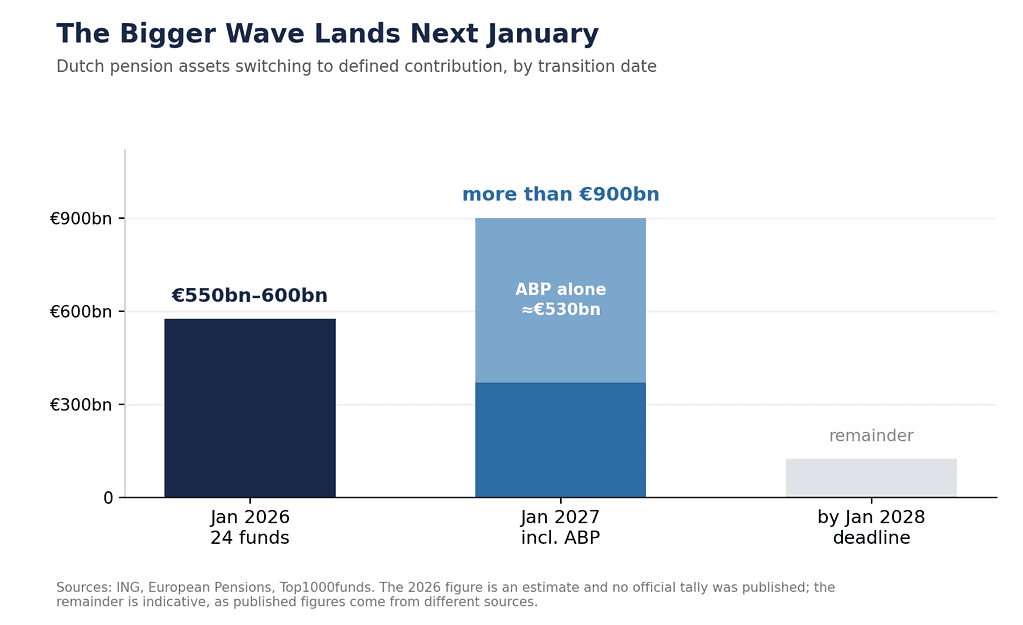
The Netherlands pension system is beginning to reduce one of Europe’s most reliable sources of demand for long-dated debt as a broad regulatory shift changes how Dutch pension funds manage their assets and liabilities. ING Groep NV estimates that nearly €600 billion ($699 billion) of assets have already been affected by the change, with more than €900 billion expected to follow early next year.
Under the old defined-benefit pension system, Dutch funds were required to hedge the interest-rate sensitivity of long-term pension liabilities by using long-dated bonds and swaps to match assets with payments extending decades into the future. Under the new defined-contribution model, which became law in 2023, that liability matching requirement has been significantly reduced, allowing funds to carry less duration and scale back their long-term hedges, resulting in less structural demand for the longest-dated debt and swaps.
For European CFOs, this could mean a higher premium for 20-, 30- and 50-year borrowing as companies and governments compete for a smaller pool of long-duration investors.
The change “should reduce structural demand for long-end duration assets and support curve steepeners over the long-term horizon,” wrote Sara Adjir, senior vice president and portfolio manager, and Jeroen van Bezooijen, account manager, at Pacific Investment Management Co., in a research note. They expect the impact will be mostly concentrated in 50-year swaps, but will also be felt in the demand for 20- and 30-year euro swaps and government bonds, including German and Dutch debt.
Deadlines
The Netherlands runs Europe’s largest pension system, with roughly €1.6 trillion in assets, and every fund must complete the switch by January 2028. Dutch pensions have long dominated the market for European long-dated debt, holding around €88 billion of interest-rate swaps maturing beyond 25 years at the end of last year, roughly a quarter of the total.
The first major wave of the transition came on Jan. 1, when 24 funds converted, among them the healthcare scheme PFZW and the metals scheme PMT, with an estimated €550 billion to €600 billion of pension assets between them. Analysis by the Netherlands central bank shows that Dutch pensions bought almost €34 billion net of swaps maturing inside 25 years while selling more than €12 billion of longer-dated ones.
The bigger test, however, comes when more than €900 billion of pension assets is scheduled to convert on Jan. 1, with the Dutch civil service scheme ABP accounting for about €530 billion of that.
The shift does not mean long-dated Dutch debt is suddenly becoming illiquid or even hard to sell: “Overall, we still see strong demand for our 30-year bond. Remember, we are AAA,” said Saskia van Dun, director of the Dutch State Treasury Agency.
Sovereign Issuers Adjust
Data indicates that sovereign borrowers are already adjusting to the change.
The share of Netherlands government bonds sold at maturities beyond 10 years fell from 42% at the start of 2025 to 31% by the third quarter, according to the Organization for Economic Co-operation and Development (OECD), which calls the constraint on long tenors structural. The OECD expects eurozone debt agencies to sell a record €1.35 trillion of medium- and long-term bonds this year into that thinner pool of demand.
For European finance chiefs, however, times are changing. For two decades, long-dated bond demand was unusually deep and predictable. As it recedes, the shifting cost of locking in 20 or 30 years of funding could become a live question.
Thomas Monteiro is a contributing writer based in Spain.