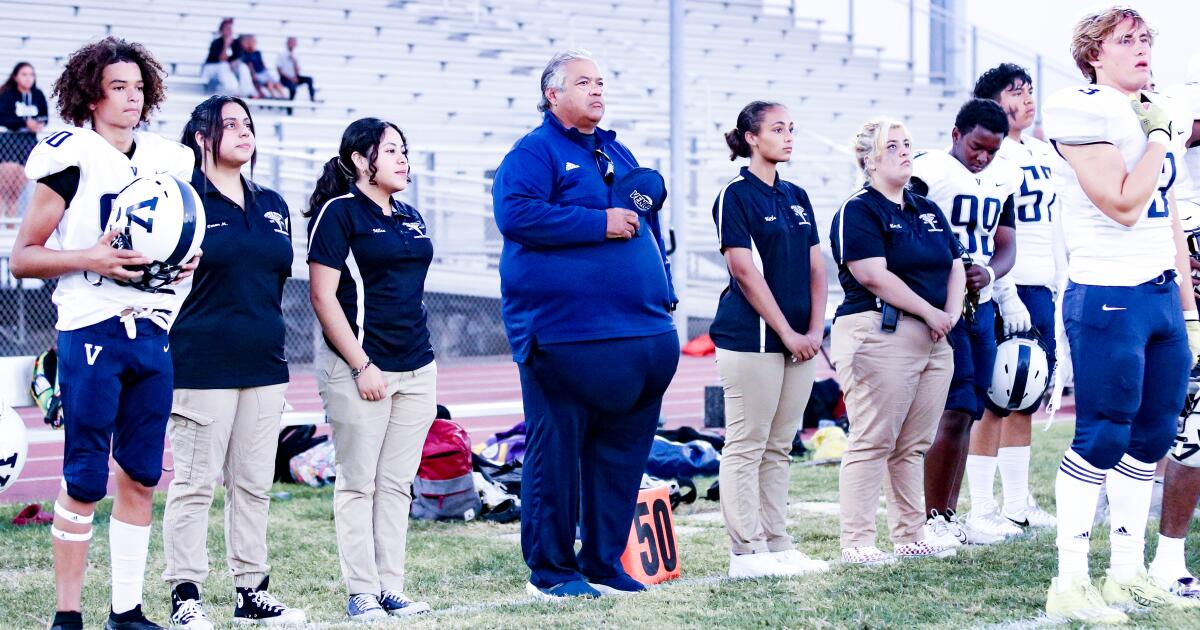
Angelo Gasca, a one-of-a-kind high school football coach who grew up using football to escape from gangs and became a beloved special education teacher, mentor and coach for 36 years at Venice High, died Monday night while watching a Lakers game on television, according to longtime friend, Steve Clarkson. He was 65.
The 1978 Venice graduate never left his neighborhood. Gasca won his first and only City Section Division I championship in 2021. He was known for his innovative passing schemes and producing numerous top City Section quarterbacks, led by former NFL player JP Losman. He was such a fixture at Venice that coaching sons of former players became the norm. He loved the concept of “neighborhood team.”
Perhaps his most important contribution was training, supporting and preparing players to become teachers and coaches. Most of his staff at Venice has been made up of former players. He’d help them stick with the difficult task of earning a teaching credential and find jobs for them.
He was most proud of former running back Byron Ellis, who became an orthopedic surgeon, and receiver Brycen Tremayne, who walked on at Stanford, went undrafted and made the Carolina Panthers.
Last month, Gasca was asked if he ever learned anything from a player and he told the story of having a coaches meeting and one of his ex-players reminded him how he wanted to quit football but Gasca wouldn’t let him.
“I’m not accepting your resignation today,” Gasca told him. “You need to go home and think about it.”
Said Gasca: “He went home and thought about it and stayed on the team and was the starting center. He taught me the best thing we can teach kids is come to school and you never know what connections you’ll make at the school you grew up at. He taught me there’s more to coaching than winning games and scoring touchdowns. In our lives as teachers and coaches, we do learn from players. When we stop learning, it’s time to stop coaching.”
Even though there were rumors last season of Gasca retiring, he insisted he was coming back because he loved teaching and coaching and believed that sports competition can change someone’s life for the better.
“My parents didn’t attend high school,” he said. “When you play, you get a little taste of success and want to play harder and people come into your life and help you. It’s just as easy to do well as it is to do bad. Sometimes when your friends zig right, you have to zig left. The life lessons we learn together is what it’s about.”
By day, you’d be forgiven for walking past the newest theater in downtown L.A.
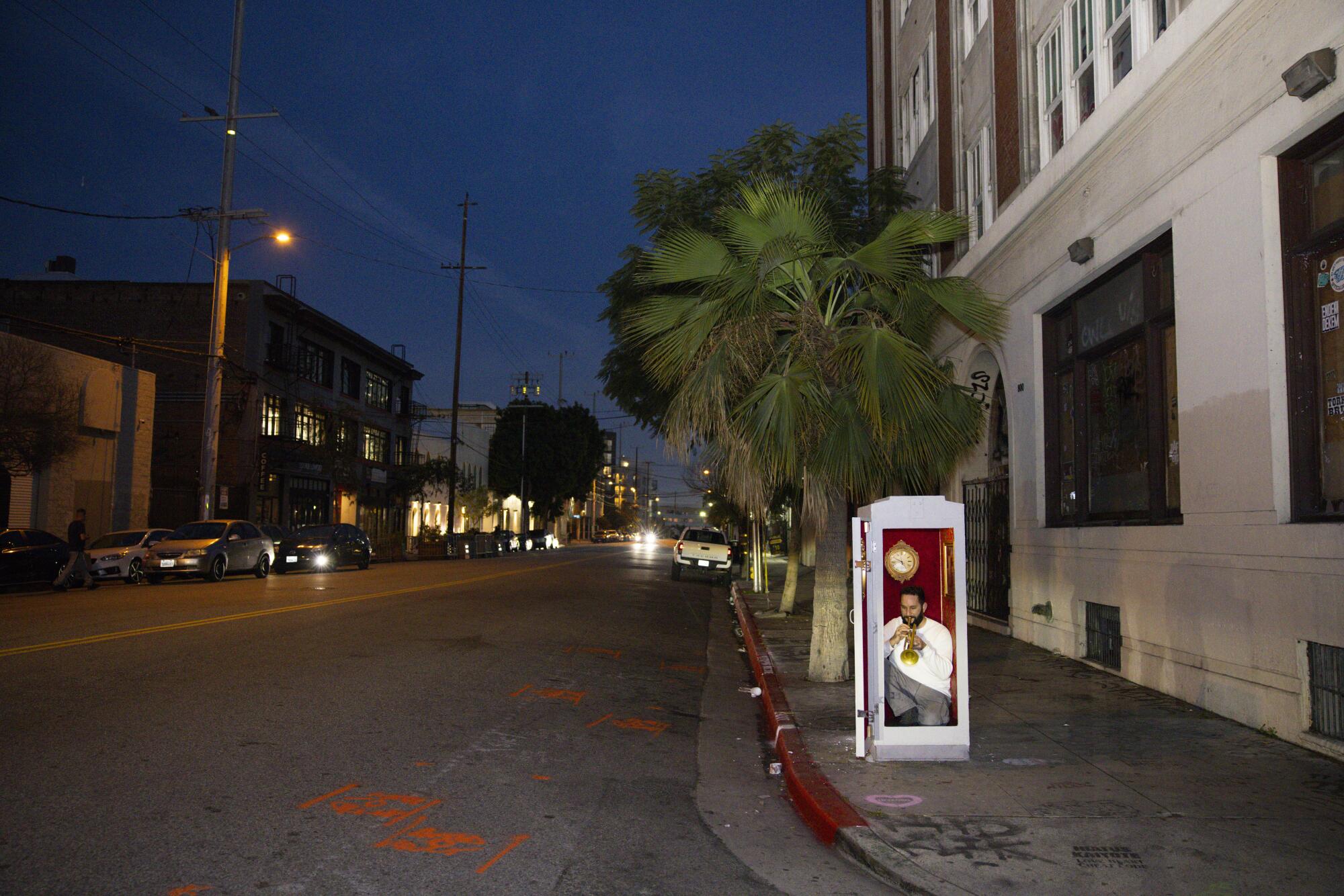
It isn’t hidden in an alley or obscured via a nameless door. No, this performance space is essentially a theater in disguise, as it’s designed to look like an electrical box — a fabrication so real that when artist S.C. Mero was installing it in the Arts District, police stopped her, concerned she was ripping out its copper wire. (There is no copper wire inside this wooden nook.)
Open the door to the theater, and discover a place of urban enchantment, where a red velvet door and crimson wallpaper beckon guests to come closer and sit inside. That is, if they can fit.
With a mirror on its side and a clock in its back, Mero’s creation, about 6 feet tall and 3 feet deep yet smaller on its interior, looks something akin to an intimate, private boudoir — the sort of dressing room that wouldn’t be out of place in one of Broadway’s historic downtown theaters. That’s by design, says Mero, who cites the ornately romanticized vibe and color palette of the Los Angeles Theatre as prime inspiration. Mero, a longtime street artist whose guerrilla art regularly dots the downtown landscape, likes to inject whimsy into her work: a drainage pipe that gives birth, a ball pit for rats or the transformation of a dilapidated building into a “castle.” But there’s just as often some hidden social commentary.
With her Electrical Box Theatre, situated across from the historic American Hotel and sausage restaurant and bar Wurstküche, Mero set out to create an impromptu performance space for the sort of experimental artists who no longer have an outlet in downtown’s galleries or more refined stages. The American Hotel, for instance, subject of 2018 documentary “Tales of the American” and once home to the anything-goes punk rock ethos of Al’s Bar, still stands, but it isn’t lost on Mero that most of the neighborhood’s artist platforms today are softer around the edges.
Ethan Marks inside S.C. Mero’s theater inside a fake electrical box. The guerrilla art piece is near the American Hotel.
“A lot of galleries are for what can sell,” Mero says. “Usually that’s paintings and wall art.”
She dreamed, however, of an anti-establishment place that could feel inviting and erase boundaries between audience and perfomer. “People may be intimidated to get up on a stage or at a coffee shop, but here it’s right on street level.”
It’s already working as intended, says Mero. I visited the box early last week when Mero invited a pair of experimental musicians to perform. Shortly after trumpeter Ethan Marks took to the sidewalk, one of the American Hotel’s current residents leaned out his window and began vocally and jovially mimicking the fragmented and angular notes coming from the instrument. In this moment, “the box,” as Mero casually refers to it, became a true communal stage, a participatory call-and-response pulpit for the neighborhood.
Clown Lars Adams, 38, peers out of S.C. Mero’s theater inside a fake electrical box. Mero modeled the space off of Broadway’s historic theaters.
A few days prior, a rideshare driver noticed a crowd and pulled over to read his poetry. He told Mero it was his first time. The unscripted occurrence, she says, was “one of the best moments I’ve ever experienced in making art.”
“That’s literally what this space is,” Mero says. “It’s for people to try something new or to experiment.”
Marks jumped at the chance to perform for free inside the theater, his brassy freewheeling equally complementing and contrasting the sounds of the intersection. “I was delighted,” he says, when Mero told him about the stage. “There’s so much unexpectedness to it that as an improviser, it really keeps you in the moment.”
A downtown resident for more than a decade, Mero has become something of an advocate for the neighborhood. The area arguably hasn’t returned to its pre-pandemic heights, as many office floors sit empty and a string of high-profile restaurant closures struck the community. Mero’s own gallery at the corner of Spring and Seventh streets shuttered in 2024. Downtown also saw its perception take a hit last year when ICE descended on the city center and national media incorrectly portrayed the hood as a hub of chaos.
Artist S.C. Mero looks into her latest project, a fake electrical box in the Arts District. Mero has long been associated with street art in the neighborhood.
“A lot has changed in the 13 years when I first got down here,” Mero says. “Everybody felt like it was magic, like we were going to be part of this renaissance and L.A. was going to have this epicenter again. Then it descended. A lot of my friends left. But I still see the same beauty in it. The architecture. The history. Downtown is the most populous neighborhood in all of L.A. because it belongs to everybody. It’s everybody’s downtown, whether they love it or not. And I feel we are part of history.”
Art today in downtown ranges from high-end galleries such as Hauser & Wirth to the graffiti-covered towers of Oceanwide Plaza. Gritty spaces, such as Superchief Gallery, have been vocal about struggles to stay afloat. Mero’s art, meanwhile, remains a source of optimism throughout downtown’s streets.
At Pershing Square, for instance, sits her “Spike Cafe,” a mini tropical hideaway atop a parking garage sign where umbrellas and finger food props have become a prettier nesting spot for pigeons. Seen potentially as a vision for beautification, a contrast, for instance, from the nature intrusive barbs that aim to deter wildlife, “Spike Cafe” has become a statement of harmony.
Elsewhere, on the corner of Broadway and Fourth streets, Mero has commandeered a once historic building that’s been burned and left to rot. Mero, in collaboration with fellow street artist Wild Life, has turned the blighted space into a fantastical haven with a knight, a dragon and more — a decaying castle from a bygone era.
“A lot of times people are like, ‘I can’t believe you get away with that!’ But most people haven’t tried to do it, you know?” Mero says. “It can be moved easily. It’s not impeding on anyone. I don’t feel I do anything bad. Not having a permit is just a technicality. I believe what I’m doing is right.”
Musician Jeonghyeon Joo, 31, plays the haegeum outside of S.C. Mero’s latest art project, a theater in a faux electrical box.
After initially posting her electrical box on her social media, Mero says she almost instantly received more than 20 requests to perform at the venue. Two combination locks keep it closed, and Mero will give out the code to those she trusts. “Some people want to come and play their accordion. Another is a tour guide,” Mero says.
Ultimately, it’s an idea, she says, that she’s had for about a decade. “Everything has to come together, right? You have to have enough funds to buy the supplies, and then the skills to to have it come together.”
And while it isn’t designed to be forever, it is bolted to the sidewalk. As for why now was the right time to unleash it, Mero is direct: “I needed the space,” she says.
There are concerns. Perhaps, Mero speculates, someone will change the lock combination, knocking her out of her own creation. And the more attention brought to the box via media interviews means more scrutiny may be placed on it, risking its confiscation by city authorities.
As a street artist, however, Mero has had to embrace impermanence, although she acknowledges it can be a bummer when a piece disappears in a day or two. And unlike a gallerist, she feels an obligation to tweak her work once it’s out in the world. Though her “Spike Cafe” is about a year old, she says she has to “continue to babysit it,” as pigeons aren’t exactly known for their tidiness.
But Mero hopes the box has a life of its own, and considers it a conversation between her, local artists and downtown itself. “I still think we’re part of something special,” Mero says of living and working downtown.
And, at least for now, it’s the neighborhood with arguably the city’s most unique performance venue.
The San Fernando Valley is back in the spotlight, thanks in part to Bravo’s reality franchise “The Valley,” where viewers may recognize a slew of Ventura Boulevard staples (we see you, Rocco’s Tavern).
Much of the show is filmed in and around Studio City, a neighborhood just west of the Cahuenga Pass, about 10 miles from downtown L.A. and within the city of Los Angeles.
That last fact is what usually throws people off guard.
“Isn’t Studio City a separate city from L.A.?” they ask.
Get to know Los Angeles through the places that bring it to life. From restaurants to shops to outdoor spaces, here’s what to discover now.
This is when I must reply no and launch into an explanation on the expansiveness of the 818, the identity crisis it never asked for and how its lore has endured for decades on the silver screen, from “Fast Times at Ridgemont High” to “The Karate Kid” and “Licorice Pizza,” to name a few.
See, long before Kendall Jenner bottled our area code with her tequila brand or “The Valley’s” Golnesa “GG” Gharachedaghi created her Valley Girl jewelry line (a response to a castmate’s constant gripe that the area had no vibe), Studio City was already a vibrant L.A. hub. It claimed a roster of power players — “The Brady Bunch” soundstage, Laurel Canyon News and the iconic Studio City Hand Car Wash — all of which still transcend ratings or storyline.
The neighborhood was originally formed around film producer Mack Sennett’s studio, which later became Republic Studios and then CBS Studio Center. With the studio as the focal point, the U.S. Postal Service designated its branch in that area as the Studio City Post Office, formalizing the name Studio City. Not exactly poetic, but it stuck. By the 1940s, Studio City developed into a “just over the hill” refuge for Hollywood’s working families, with new restaurants and bars abuzz.
My first memories of Studio City were hanging out with a childhood friend whose parents worked at CBS, and back then, it felt like the ultimate suburban dream. Fast forward to the mid-aughts and I got to live it myself, renting an apartment a few blocks from Tujunga Village, the neighborhood’s own “small-town U.S.A.” I spent countless weekends perusing food stands and trendy coffeehouses, the flaky bread and baked goods reviving me after hours of line dancing at Oil Can Harry’s or a booze-soaked late night at Page 71.
As one of the Valley’s most social enclaves, where nature is within reach, strip mall sushi is world-class and shaded residential streets feel worlds away from the Sunset Strip, Studio City still feels like the perfect remedy. Sure, finding parking after 6 p.m. can feel like something out of “The Hunger Games,” but on any given weekend you’ll still find me channeling my inner Katniss, circling blocks and deciphering cryptic signage all to revisit one of the L.A. neighborhoods that raised me.
Studio City must be the place. Then again, it always was.
What’s included in this guide
Anyone who’s lived in a major metropolis can tell you that neighborhoods are a tricky thing. They’re eternally malleable and evoke sociological questions around how we place our homes, our neighbors and our communities within a wider tapestry. In the name of neighborly generosity, we may include gems that linger outside of technical parameters. Instead of leaning into stark definitions, we hope to celebrate all of the places that make us love where we live.
Our journalists independently visited every spot recommended in this guide. We do not accept free meals or experiences. What L.A. neighborhood should we check out next? Send ideas to guides@latimes.com.