Naver

OpenAI’s Altman to visit Naver after Nvidia CEO’s trip

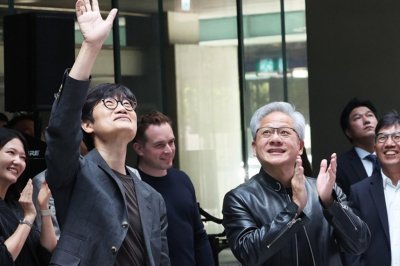
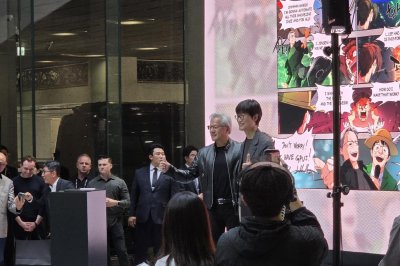
Nvidia chief executive officer Jensen Huang, left, and Naver Chairman Lee Hae-jin appear at Naver’s Vision Studio at its 1784 headquarters in Seongnam, south of Seoul, on Monday. Photo courtesy of Naver

June 12 (Asia Today) — OpenAI chief executive officer Sam Altman is expected to visit Naver on Monday, a week after Nvidia chief executive officer Jensen Huang met with the South Korean technology company’s leadership.

Industry sources said Altman plans to visit South Korea during a two-day trip beginning Sunday and meet officials from major Korean companies, including Naver, Kakao and Samsung Electronics, to discuss artificial intelligence cooperation.

The expected Naver visit comes shortly after Huang visited Naver’s 1784 headquarters in Seongnam, south of Seoul, on Monday and met with Lee Hae-jin, Naver’s founder and chairman.

The back-to-back visits by two of the most influential figures in the global AI industry are drawing renewed attention to Naver’s role in the sector. Industry officials said OpenAI may be interested in Naver’s data, service ecosystem and experience operating consumer platforms at scale.

Naver has built large user data assets through search, shopping, content, community, mapping and reservation services. As competition in generative AI increasingly depends on access to high-quality data, those assets are viewed as one of Naver’s main strengths.

Naver recently outlined what it calls a “product-native LLM” strategy, saying it will optimize AI for specific services such as search, shopping, maps and reservations rather than rely only on a single general-purpose model.

The company develops its own AI models and also operates a creator ecosystem of about 20 million people, with more than 630 million pieces of content produced annually. It also owns large-scale data center infrastructure and runs the services where AI can be applied directly to users.

A Naver official said competition in AI is changing quickly.

“In the past, the key was developing a better model,” the official said. “Now, the ability to secure high-quality data, service experience and the infrastructure to support them is emerging as a decisive factor.”

Naver is also seeking to expand AI search into agentic AI services, in which AI does not simply answer a user’s question but can help complete tasks such as reservations and purchases.

Global interest in Naver also grew after Huang’s visit this week. During his meeting with Lee, the Nvidia chief described Naver as a “world-class AI company.”

Huang cited possible cooperation with Naver in several areas, including participation in Nvidia’s Nemotron Alliance, the development of AI factories and robotics. He said Naver was selected because it has world-class cloud technology and AI talent.

Industry officials said Nvidia appears to view Naver as an AI infrastructure partner, while OpenAI may see potential in Naver’s data and service ecosystem.

“Naver’s combined strength in AI models, data, services and infrastructure is attracting attention from global AI companies,” one industry official said.

— Reported by Asia Today; translated by UPI

© Asia Today. Unauthorized reproduction or redistribution prohibited.

Original Korean report: https://www.asiatoday.co.kr/kn/view.php?key=20260612010004347

Source link

Naver, Nvidia launch gigawatt-scale AI factory plan

Nvidia Chief Executive Jensen Huang, left, and Naver founder and board Chairman Lee Hae-jin greet attendees at Naver’s 1784 headquarters in Seongnam, south of Seoul, on Monday. Photo by Asia Today

June 8 (Asia Today) — Naver said Monday it will work with Nvidia to build a gigawatt-scale artificial intelligence factory, starting from its hyperscale data center in Sejong.

Naver founder and board Chairman Lee Hae-jin and Chief Executive Choi Soo-yeon met Nvidia Chief Executive Jensen Huang at Naver’s 1784 headquarters in Seongnam, south of Seoul, to discuss a joint business road map and global expansion strategy.

Huang greeted employees and visitors at the building, saying, “I love Naver.” He also joined a Naver Webtoon event and wrote, “Don’t worry! I have GPUs!” in a blank space on a display.

Naver and Nvidia said they agreed to pursue a joint project to build a large-scale global AI factory. The partnership goes beyond technology cooperation, covering demand development, investment and infrastructure construction across the value chain.

Naver will participate as a core partner sharing business results and risks.

The project will be based at Gak Sejong, Naver’s hyperscale data center. Naver plans to begin operating 55 megawatts of infrastructure in the first half of 2027, expand to 100 megawatts later that year and reach 200 megawatts in 2028. The company ultimately aims to build gigawatt-scale AI infrastructure.

Naver plans to use Gak Sejong to serve AI demand not only in South Korea but also in Asia, the Middle East and Europe.

The cooperation centers on combining Naver’s data-center and GPU cluster operation capabilities with Nvidia’s DSX platform. Nvidia DSX integrates chips, servers, software and data-center operating technologies for AI factories. The platform is designed to lower AI model training and inference costs and speed up infrastructure deployment.

Naver plans to use the technology to expand AI infrastructure services for companies, governments and industrial clients.

The companies also plan to broaden technical cooperation. Naver has been improving its HyperCLOVA X AI model by using Nvidia’s open large language model Nemotron. It is also working to develop a “Seoul world model” by combining Nvidia’s Cosmos world foundation model with Naver’s street-view and spatial modeling technologies.

The cooperation is expected to expand into physical AI, robotics and digital twins.

The meeting marked another step in the companies’ existing partnership. Lee and Huang met last year during the Asia-Pacific Economic Cooperation summit in Gyeongju to discuss cooperation on physical AI platforms.

Naver 1784 is considered a showcase for robotics, digital twins and cloud technologies. Huang was expected to review areas for expanded cooperation during his visit.

Naver is seeking to move beyond its role as an internet services company and become a global AI infrastructure provider. Huang recently introduced Naver Cloud as a key partner in the global AI ecosystem during Nvidia GTC Taipei 2026. Naver said it plans to accelerate its sovereign AI and AI data-center businesses through cooperation with Nvidia.

Naver shares also rose Monday. The stock closed at 279,000 won, or about $181, up 9.20% from the previous trading session, according to the Korea Exchange. Market analysts attributed the gain to investor expectations for the large-scale AI factory project and Naver’s global AI infrastructure expansion.

— Reported by Asia Today; translated by UPI

© Asia Today. Unauthorized reproduction or redistribution prohibited.

Original Korean report: https://www.asiatoday.co.kr/kn/view.php?key=20260608010002635

Source link

Naver Cloud, Nvidia form AI factory alliance

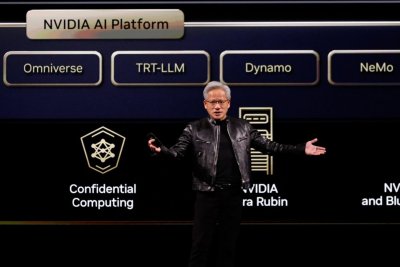
NVIDIA CEO Jensen Huang delivers his keynote speech as part of the COMPUTEX 2026 AI exhibition in Taipei, Taiwan, 01 June 2026. Jensan Huang officially announced NVIDIA’s new products and various AI integration. Photo by RITCHIE B. TONGO / EPA

June 2 (Asia Today) — Naver Cloud is moving to expand its presence in the global artificial intelligence infrastructure market through a deeper partnership with Nvidia.

The company aims to combine its HyperCLOVA X large-scale AI model and sovereign AI capabilities with Nvidia’s AI infrastructure platform to become a key player in the era of AI factories.

Industry officials said Tuesday that Naver Cloud CEO Kim Yu-won attended the Nvidia Cloud Partner Summit in Taiwan and outlined the company’s strategic cooperation with Nvidia.

The partnership is drawing attention because it goes beyond a simple graphics processing unit supply arrangement and extends across infrastructure, AI models and services.

Nvidia CEO Jensen Huang introduced Naver Cloud as a major AI-native cloud partner in the global AI ecosystem during his keynote speech at GTC Taipei 2026 on Monday.

The two companies also plan to expand cooperation in large language models. Naver Cloud plans to use Nvidia’s open large language model technology, Nemotron 3 Ultra, to advance HyperCLOVA X. The companies also plan to jointly study model optimization and core technologies.

Cooperation will also continue in physical AI. In March, Naver Cloud unveiled the Seoul World Model, a digital recreation of Seoul built with Nvidia’s Cosmos physical AI platform.

The Seoul World Model was trained on South Korean map data and 1.2 million panoramic images collected across Seoul, allowing it to reproduce real road environments and spatial structures.

Naver Cloud plans to target the global AI market by emphasizing its full-stack capabilities, which combine its own AI models and cloud infrastructure. The company also plans to expand sovereign AI projects that protect national data sovereignty by working with governments and local companies.

Naver board chair Lee Hae-jin and Huang are expected to meet soon in South Korea and disclose specific plans for the AI factory project.

“The AI industry paradigm is shifting from models to inference-focused AI factories that can operate large-scale infrastructure reliably,” Kim said. “Our cooperation with Nvidia is not a simple supply relationship but a strategic decision to expand the global AI ecosystem together.”

— Reported by Asia Today; translated by UPI

© Asia Today. Unauthorized reproduction or redistribution prohibited.

Original Korean report: https://www.asiatoday.co.kr/kn/view.php?key=20260602010000541

Source link

Naver showcases AI robots across ‘lab-like’ headquarters

1 of 2 | Service robots operate inside Naver’s headquarters in Seongnam, South Korea. Photo by Asia Today

April 16 (Asia Today) — South Korean tech company Naver is expanding its artificial intelligence capabilities with robots operating throughout its headquarters, as the firm ramps up investment in next-generation technologies.

At the company’s second headquarters in Seongnam, south of Seoul, robots are deployed across the building, which spans from a basement level to 28 above-ground floors. The facility has been described by the company as functioning like a “living laboratory” for AI and robotics.

About 100 service robots, known internally as “Rookie,” assist employees by delivering food, beverages and packages, as well as transporting documents. Workers can summon the robots through a mobile application and verify their identity upon arrival.

The robots are designed to move autonomously throughout the entire building. They can pass through security gates, use elevators and navigate between floors without human assistance, a capability that sets them apart from robots typically confined to a single floor or designated area.

“The ability for robots to use elevators and travel across the entire building is a distinctive feature,” a company official said, adding that the machines are positioned for easy access and operate based on time-specific tasks.

The robotics technology is being developed by Naver Labs, a research subsidiary focused on advancing automation systems. Inside the facility, various robots – including wheeled service units and bipedal machines – are being tested as part of efforts to build a broader robotics ecosystem.

A key component of the system is “ARC Brain,” a cloud-based platform that allows centralized control and coordination of multiple robots. The system is designed to improve efficiency by enabling simultaneous management of a fleet of machines.

“Improving productivity by having robots perform tasks traditionally done by humans is essential,” the official said. “That requires an integrated system capable of managing multiple robots at once.”

Beyond robotics, the company is also strengthening AI features in its core search business. It plans to introduce an “AI tab” following the rollout of its AI briefing service last year.

Naver reported record results in 2025, with revenue reaching 12.35 trillion won ($8.2 billion) and operating profit of 2.21 trillion won ($1.47 billion). Market forecasts suggest the company will post another record this year, with revenue projected at 13.41 trillion won ($8.9 billion) and operating profit at 2.45 trillion won ($1.63 billion).

— Reported by Asia Today; translated by UPI

© Asia Today. Unauthorized reproduction or redistribution prohibited.

Original Korean report: https://www.asiatoday.co.kr/kn/view.php?key=20260416010005223

Source link