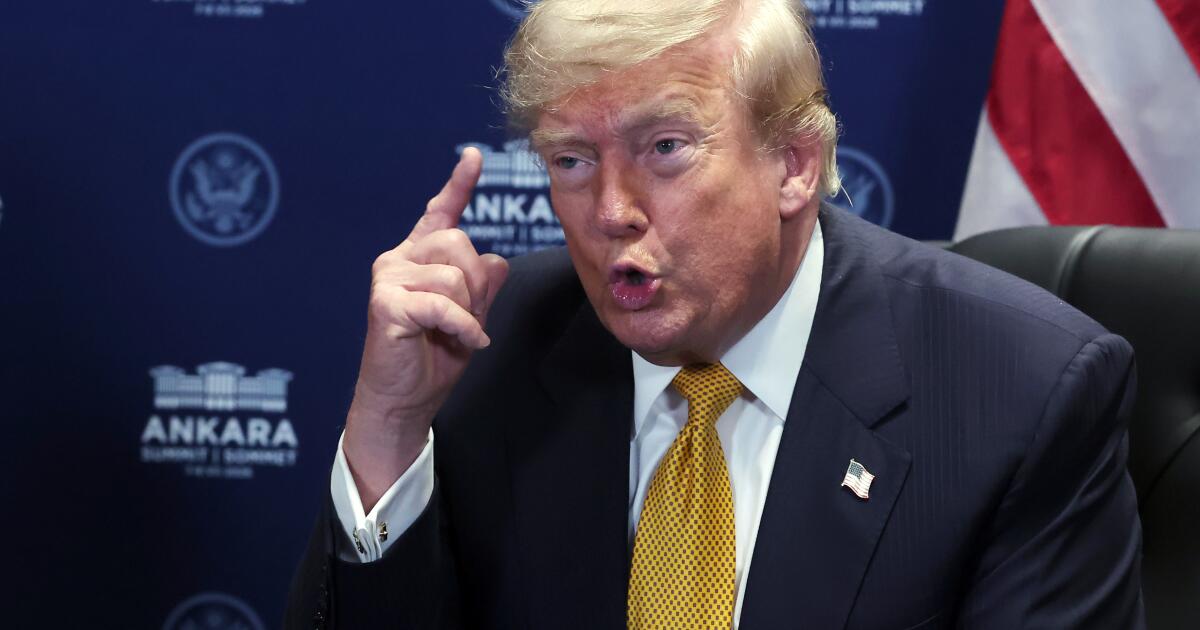
nato summit

Trump says the U.S. will give license to Ukraine to produce Patriot defense systems

President Trump said Wednesday that the U.S. will give a license to Ukraine to manufacture Patriot air defense systems to help counter Russian missile attacks, a huge coup for Ukraine which has badly needed the technology for the war now in its fifth year.

“We’ll give them the right to make Patriots. We’ll show them how to do it,” Trump said as he met with Ukrainian President Volodymyr Zelensky at a NATO summit in Turkey. “I think they can produce them pretty quickly.”

Patriots are expensive, in high demand and take a long time to produce. Zelensky has for years been asking for more of them, and more recently for a license so that Ukraine can manufacture its own.

The tone of Trump’s meeting with the Ukrainian leader was a break from earlier encounters which ended in acrimony, and Trump praised Zelensky’s willingness to reach a deal on ending the fighting in Ukraine.

He said the Ukrainian president has “done an amazing job” and “been very effective” in the war.

“We’ve actually developed a good relationship. It’s hard to believe,” Trump said, adding he believed a deal on ending the war was on the horizon and that the U.S. would “work on some kind of security package” to provide to Ukraine.

Trump takes aim at NATO partners

Trump wasn’t as friendly, however, with some his NATO partners, saying he was unhappy with the alliance for pushing back against his efforts to take control of Greenland and for not supporting his war in Iran.

NATO’s European members plus Canada have scrambled to meet the increased defense spending targets Trump has demanded, as the U.S. draws down the number of troops it has in Europe and insists that the continent take more responsibility for its own security.

But Trump reopened old wounds as he arrived at the meeting of 32 NATO leaders by insisting again that the United States should control Greenland, a semiautonomous Danish territory. He blasted some European countries for refusing to participate in the Iran campaign, singling out Spain as “a terrible partner in NATO” and renewing his threats to cut off trade.

Ahead of the summit, Trump said Greenland “is very important” for the U.S. but not for Denmark, declaring, “We need it for protection of the world, not just the United States.”

But Denmark’s Prime Minister Mette Frederiksen said her country is “ready to defend every inch of NATO including our own territory” in the event of an attack, and would rely on NATO allies to honor their commitment to defend each other.

Trump’s criticisms have in the past drawn European countries closer together as they confront wars in Ukraine and Iran, a ballooning trade deficit with China, and threats from Russia.

The president’s renewed interest in Greenland could put at risk the entire future of NATO, which was founded in 1949 to counter the threat to European security posed by the Soviet Union during the Cold War.

NATO Secretary-General Mark Rutte sought to tamp down the president’s ire by giving him credit for recent increases in defense spending from NATO allies.

“Grab the win. It’s there,” Rutte told Trump on Wednesday.

NATO chief backs latest U.S. strikes on Iran

Ahead of the summit, Rutte praised Trump for the series of U.S. strikes on Iran overnight, after Tehran struck three merchant ships in the Strait of Hormuz.

“I think what you did last night was absolutely necessary,” Rutte said to Trump. “It was a very strong response, and I’m with you on this.”

The U.S. strikes, as well as the revoking of a license allowing Iran to sell its oil on global markets, underscored the fragility of an interim deal to end months of fighting.

Trump said of the interim agreement with Iran: “For me, I think it’s over” — but added he will allow talks to continue.

“It’s just a waste of time dealing with them,” he said.

NATO leaders sought to show Trump they were boosting defense

Rutte has dedicated a huge amount of energy to keeping Trump’s support for NATO and to holding the summit together.

The NATO chief pointed to countries including Estonia, Latvia, Poland and Denmark that are investing more in defense, but noted the Trump administration expects “the Europeans and Canadians will equalize their spending with the United States.”

Last month Rutte went to Washington to hail the “Trump Trillion” — the $1.2 trillion that European allies and Canada have added to defense spending since Trump came to power in 2017.

As leaders converged on Ankara, Rutte hosted a “big reveal” event to showcase the many deals planned for the increased spending — much of it to be spent on U.S. companies, creating thousands of jobs for Americans.

At last year’s summit, the allies agreed to invest 5% of their gross domestic product on defense — 3.5% on their defense budgets and 1.5% on infrastructure so troops and equipment can move faster in times of conflict.

Yet figures released by NATO on Tuesday showed that Slovenia, Belgium, Spain and the Czech Republic have struggled to meet the alliance’s old spending target of 2% of GDP.

The Trump administration wants to see a leaner “NATO 3.0,” with Europe taking responsibility for its own security, including Ukraine, with conventional weapons while America would continue to provide its nuclear umbrella.

The Pentagon has launched a six-month review of U.S. military presence in Europe, leaving allies to seek clarity on just how deeply Trump intends to cut U.S. force numbers.

Ukraine’s Zelensky pushes for NATO entry

Zelensky made a fresh appeal Tuesday for Ukraine to be allowed to join the alliance, saying Ukrainian armed forces are highly experienced and would only boost NATO’s defense capabilities.

He’s highlighted Ukraine’s adaptability and its ability to strike deep inside Russia. He said Ukraine’s armed forces are “eliminating” on average 30,000 Russian troops every month.

Concern has been mounting among some countries with borders near Russia that Moscow might be preparing a hybrid attack — a combination of conventional warfare with tactics like cyberattacks — on the continent as President Vladimir Putin struggles to secure victory in Ukraine.

Trump will also meet with Syrian President Ahmad al-Sharaa, a former insurgent who led the offensive that unseated autocrat Bashar Assad in December 2024. Despite having once been an al-Qaida fighter, al-Sharaa has won Trump’s backing as he seeks to rebuild Syria and restore its shattered ties with the West.

Cook, Kim and Fraser write for the Associated Press. AP journalists Collin Binkley and Michelle L. Price in Washington contributed to this report.
Source link

NATO unveils billions in arms deals to prove its firepower as Trump arrives in Ankara

President Trump said on Tuesday that the U.S. will lift sanctions on Turkey that were issued after Ankara purchased a Russian missile defense system that led to the country being kicked out of the F-35 fighter jet program.

There are still a number of legal hurdles before Turkey could be fully admitted back to the U.S. program, but the removal of the sanctions — issued under the Countering America’s Adversaries Through Sanctions Act — would help ease the process for Ankara to regain access to the F-35s, a top goal of Turkish President Recep Tayyip Erdogan and one that Trump has predicted for some time would occur.

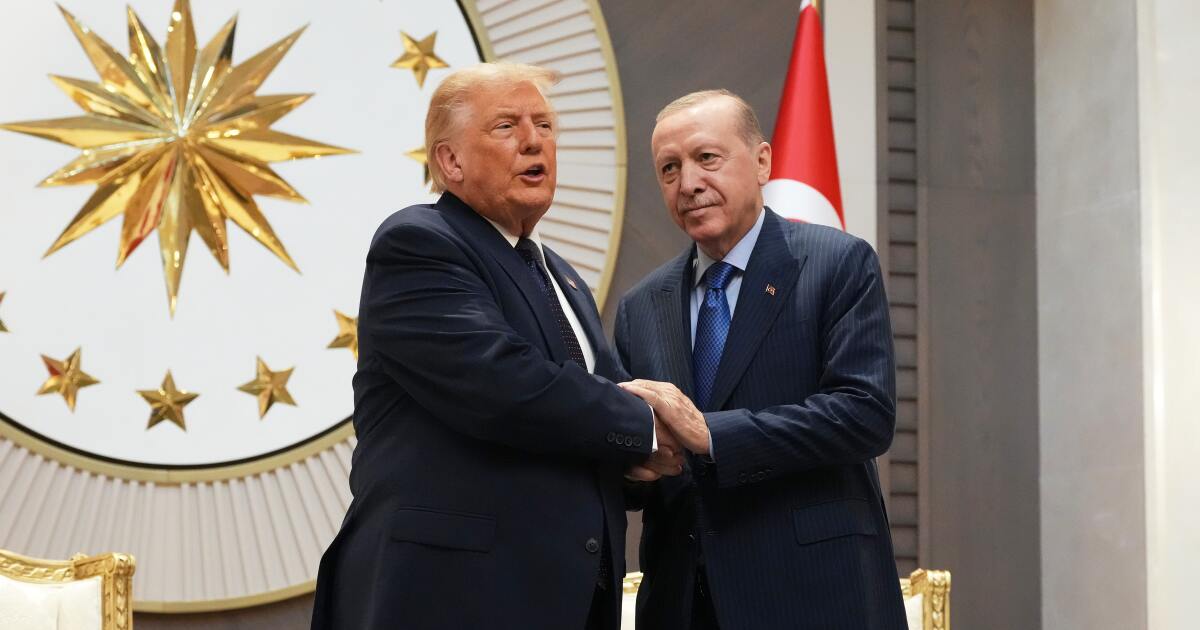
“We’re going to be taking the sanctions off, OK?” Trump said in response to a question during a meeting with Erdogan at the presidential palace in Ankara. He said Cabinet officials were working on the matter. Earlier in the meeting, he said the possibility of selling the F-35s to Turkey is “certainly something we will consider.”

Trump and Erdogan repeatedly underscored their warm relationship as they met soon after the U.S. president arrived in Ankara for the NATO summit. Erdogan greeted the U.S. president with an elaborate welcome ceremony involving cannons, military officials on horseback and jets flying overhead emitting red, white and blue smoke.

“Sometimes you get along with the toughest people, like him,” Trump said, gesturing to Erdogan. The U.S. president repeatedly praised Turkey for its loyalty to the U.S., particularly during the war in Iran.

Trump, who has often upended NATO gatherings with complaints that European allies did not spend enough on defense, had said he would not have attended this year’s summit had it not been for his close ties with Erdogan.

‘Moment of great pride’

Earlier in the day, NATO showcased a series of military projects worth billions of dollars — an investment that the alliance’s secretary-general, Mark Rutte, called “money well spent.”

An energized Rutte was speaking to government ministers and defense industry officials at a forum billed as NATO’s “big reveal,” to the thrum of techno music and a slick video display.

NATO as an organization does not own any weapons — these are the property of the 32 member countries — but it does have a fleet of 14 AWACS early warning radar surveillance planes that are about 50 years old, along with some newer surveillance drones.

A deal to replace the aging planes was announced Tuesday. Swedish manufacturer Saab will be supplying up to 10 new GlobalEye surveillance aircraft for a 10-nation consortium, Swedish Prime Minister Ulf Kristersson announced.

“It’s a moment of great pride,” he said, noting that the twin-engine aircraft would be “made within the alliance for all the alliance.”

Some of the projects will be paid for with funds from a system of cheap loans for defense purposes set up by the European Union, comprising up to $170 billion raised on capital markets.

“We need to ensure that we are translating our economic might into military capabilities, putting the cash to work from defense plans to drones, from money to missiles and interceptors,” Rutte said.

Trump has branded NATO a “paper tiger” that would cease to function without American arms and leadership. At the forum on Tuesday, Michael Duffy, a U.S. undersecretary of defense, said “the reality is that we need production increases across the board.”

“We will be looking to increase our exports to those who are looking to buy our equipment, and we’ll also be looking to partner with the expansion of production capacity here in Europe,” he said.

Defense sales announced

Representatives from 15 nations shook hands and patted shoulders on a vast podium under the NATO logo as they announced a multinational effort to buy air-to-air refueling and transport planes from Airbus.

Then Rutte announced a four-country effort to purchase as many as five new Triton surveillance drones to add to NATO’s small fleet.

“It is genuinely made in NATO, and creating jobs on both sides of the Atlantic,” he said.

Rutte told reporters on the eve of the military alliance’s two-day summit in Turkey that “we will announce tens of billions in new contracts that will provide the crucial kit we need to deter and defend.”

However, at Tuesday’s event, no dollar figures were given and the display included some projects long since agreed.

The defense industry splash comes a few weeks after Rutte tried to ease U.S. concerns about military spending at NATO with a new pitch using a chart labeled “The Trump Trillion” — showing $1.2 trillion in spending by European allies and Canada since 2017.

Trump appeared unmoved, saying he was still disappointed at some NATO allies’ refusal to join the Iran war, which he had launched alongside Israel without consulting them.

“We don’t need their money — we don’t need anything,” Trump said. “I just want loyalty.”

Debate over jet sales to Turkey

The summit is being held in Erdogan’s sprawling palace compound in Ankara, and Trump has suggested he would come bearing gifts for the Turkish leader.

Turkey was barred from the F-35 fighter jet program in 2019 after it purchased Russian-made S-400 missile defense systems. When asked about the fate of Turkey’s return to the F-35 system, Trump said as he sat next to Erdogan that “it’s certainly something we will consider.

Speaking Monday on the morning show “Fox & Friends,” Israeli Prime Minister Benjamin Netanyahu urged the U.S. not to sell F-35 fighter jets to Turkey, saying that Erdogan “calls openly for the annihilation of Israel.”

Turkey and Israel have acrimonious relations. Erdogan frequently accuses Israel of committing genocide in its war in Gaza, triggered by the deadly Oct. 7, 2023, Hamas-led attack on southern Israel.

Netanyahu said selling Turkey F-35s would “upset the power balance in the Middle East, which is ultimately guaranteed by Israeli air superiority and also, I think, by America’s posture in the Middle East.”

Turkey beefed up security and banned protests in Ankara during the summit, but a small group of demonstrators gathered on Tuesday in the capital. They were quickly surrounded by police, and a legal association said 22 students affiliated with the leftist Turkish Workers Party and three lawyers had been detained.

Seeking a stronger Europe for a stronger NATO

The Pentagon wants a reboot and is promoting what it calls “NATO 3.0,” a vision of the alliance in which Europe assumes greater responsibility for its own defense, freeing the U.S. to concentrate on other priorities.

But hiking defense spending means increasing taxes or diverting resources from other priorities. U.K. Defense Secretary John Healey unexpectedly quit last month, saying the British government was not willing to spend at a time of rising threats.

Separately on Tuesday, Ukrainian President Volodymyr Zelensky made a fresh appeal for his country to be allowed to join the alliance, saying its armed forces are highly experienced and resilient would only boost the alliance’s defense capabilities.

He highlighted Ukraine’s adaptability and its ability to strike deep inside Russia, hit oil refineries and other energy targets. He said that Ukraine’s armed forces are “eliminating” on average 30,000 Russian troops every month.

“Frankly we take no pride in this,” Zelensky said, noting that the war with Russia — now in its fifth year — is “a war we did not seek but one we are forced to fight.”

Concern is mounting among some northern and central eastern countries that Russia might be preparing a hybrid attack — a combination of conventional warfare with tactics like cyberattacks — on the continent as Russian President Vladimir Putin struggles to secure victory in Ukraine.

Cook, Fraser, Sewell and Kim write for the Associated Press. AP writers Jill Lawless in London and Andy Wilks in Istanbul contributed to this report.

Source link

Macron once had a knack for managing Trump. The G7 may test it

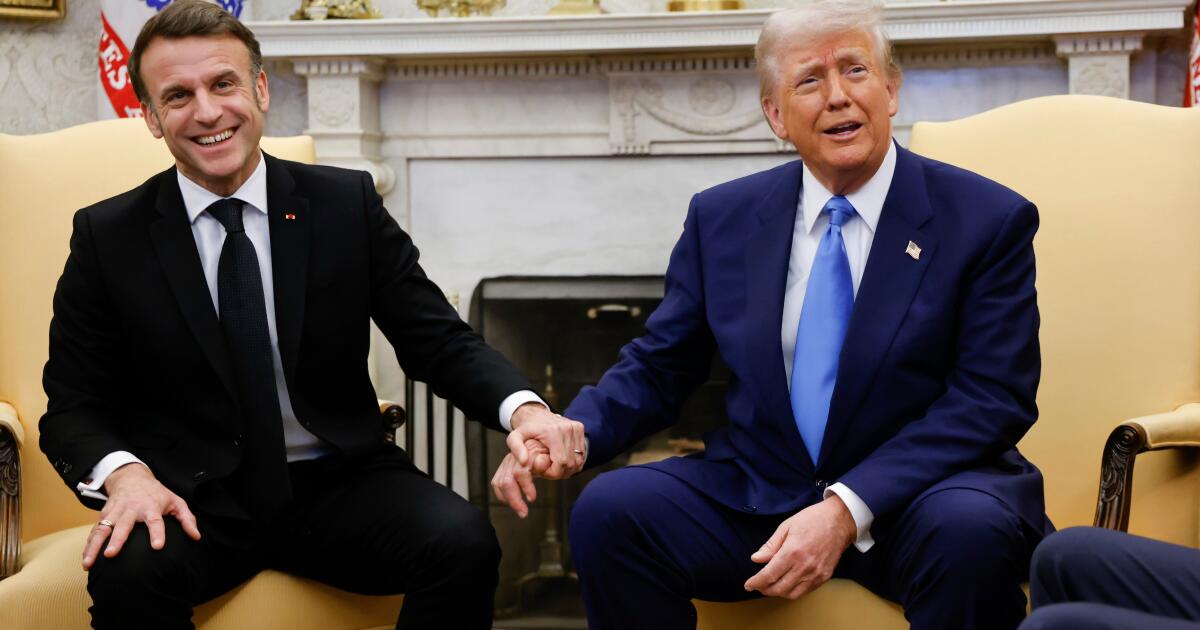
The relationship between President Trump and French President Emmanuel Macron started simply enough, with a handshake, nearly a decade ago.

But even then, there were signs of strain in their relationship — tensions that could be on full display during next week’s G7 summit in France.

Back in 2017, Trump was a brash businessman just elected to America’s most powerful office, and Macron was an upstart politician who had won his race in a landslide. At a NATO summit in Brussels, they clinched hands far longer than most people do when they meet for the first time. Neither seemed to want to be the first to break a grip so tight that it exposed white knuckles.

Nevertheless, a friendship was born. And early on, Macron seemed to be the one European leader with a knack for managing his mercurial, three-decades-older counterpart.

Macron invited the Republican president to join him for Bastille Day celebrations in July 2017, including an Eiffel Tower dinner date with their wives. Trump reciprocated by making Macron the guest of honor the following year at his first White House state dinner, the highest diplomatic honor the United States can extend to an ally.

But by the end of Trump’s first term, the bromance had faded. And in his second term, the leaders now openly trade barbs, disagreeing over tariffs, Ukraine and the Iran war. That dynamic will be scrutinized next week when Trump and the leaders of Britain, Canada, Germany, Italy and Japan join Macron in the French lakeside resort of Evian-les-Bains for the G7 summit.

Trump’s long-simmering frustrations with US allies could be on display

There could be awkward moments between Trump and Macron, as well as among Trump and the other G7 leaders he’s criticized for not joining him in Iran.

“But I also think European leaders are quite professionals when it comes to politics, and in some ways diplomacy at this point, and will maybe see it as an opportunity as well,” Max Bergmann, director of the Europe, Russia, and Eurasia Program at the Center for Strategic and International Studies, said in an interview.

Kurt Volker, a former U.S. ambassador to NATO, said the Trump-Macron relationship has been further complicated by the Iran war and Trump’s complaints “that Europeans weren’t helping, when they hadn’t been consulted, and their interests are very much affected by this.”

“I think that was a negative for Macron,” Volker said.

Trump joined Israel in a war against Iran over its nuclear program back in February without consulting other U.S. allies. He then complained publicly when European countries spurned his requests for their help.

Waning support for Ukraine in its war against Russia from the Trump administration “has really irritated the French,” Volker said. “They feel this is important and we’re not paying attention to it.” Macron invited Ukrainian President Volodymyr Zelenskyy to join the leaders’ discussions on Tuesday.

Macron is the G7 member who has dealt with Trump the longest

In Trump’s first term, Macron appeared confident that he could persuade and influence the U.S. leader, but the relationship increasingly has come to be defined by their disagreements.

Macron now says he is “careful” about Trump’s statements, suggesting he no longer takes them at face value. Their relationship remains cordial as each calls the other “my friend.” But the relationship has also experienced some ups and downs.

As president-elect, Trump attended the reopening of Notre Dame Cathedral in Paris in late 2024 at Macron’s invitation. After Trump began his second term in 2025, Macron was an early Oval Office visitor. The president wrote on social media that he was “delighted” to welcome Macron back to the White House and said the relationship with France has been “very special.”

But at one point during the meeting, the French president publicly corrected Trump after he wrongly suggested that Europe would recover the money it had provided to support Ukraine. With a smile, Macron touched Trump’s forearm and replied, “We provided real money.”

Macron also condemned as “brutal and unfounded” new tariffs that Trump slapped on steel, aluminum and a broader range of European imports in early 2025.

But there have also been some lighter moments mixed with the tensions.

A documentary aired last year on French television showed Macron telling Trump during a phone call that Zelenskyy had agreed to a U.S.-backed ceasefire proposal. Trump replied, “You’re the greatest.”

Macron has often said he can reach Trump directly whenever he needs to — and proved his point during last year’s U.N. General Assembly session in New York. After police officers blocked the French leader from crossing a street because traffic had been halted for Trump’s motorcade, Macron whipped out his cellphone and dialed the U.S. president.

“How are you?” Macron said. “Guess what? I’m waiting in the street because everything is frozen for you!”

‘This is not a show,’ Macron has said about Trump’s NATO ambiguity

Macron has argued that Trump’s “America first” policies bolstered his case for a stronger European defense capability that would lessen reliance on the United States.

In April of this year, as Trump sent mixed signals about Washington’s commitment to NATO after the start of the war in Iran, Macron delivered some of his sharpest criticism of the U.S. president.

“There is too much talk, and it’s going in all directions,” Macron said. “We all need stability, calm and a return to peace. This is not a show.”

“You have to be serious, and when you want to be serious, you don’t say the opposite every day of what you said the day before,” he said.

Trump, while mimicking a French accent, recently has taken to reenacting a conversation he says he had with Macron over drug prices and tariffs. Trump also poked Macron by telling a private luncheon in April that his wife, Brigitte Macron, treats her husband badly. The comments were in a video the White House had posted on its YouTube channel before blocking access.

Macron didn’t see any humor in Trump’s comments. “The remarks I heard were neither elegant nor appropriate,” he said. “They do not deserve a response.”

Still, Macron has tried to accommodate Trump’s schedule to ensure his presence at the summit in Evian-les-Bains, knowing that he has a record of leaving such gatherings early.

Macron originally had set Sunday, which is Trump’s 80th birthday, as the opening day of the summit, but he pushed the start back a day because Trump is celebrating the occasion with a UFC show staged on the White House grounds.

Superville and Corbet write for the Associated Press. Corbet reported from Paris.

Source link