Protesters urged the Venezuelan government to bring rice imports under control. (Archive)
Caracas, June 22, 2026 (venezuelanalysis.com) – Hundreds of rice producers took to the streets on Sunday in Calabozo, Guárico state, to urge the Venezuelan government to take action against agribusiness imports and price fixing.
The “tractorazo” saw local campesinos block one of the state’s major highways with tractors, trucks, and other heavy machinery carrying Venezuelan flags and signs with some of the main demands. Local sources estimated turnout at over 300.
“We are here on behalf of the producing states in Venezuela with a struggle that is just and urgent,” local spokesman José de la Cueva stated. “We urge the Venezuelan government to review its public policies so that national production is not destroyed.”
De la Cueva and other speakers emphasized the need for authorities to control imports, establish fair prices, and implement subsidies for the production of rice and other crops. Protesters contended that they have no conditions to compete with imports from countries where rice is subsidized, including Brazil and the US.
Rice growers, particularly in agricultural states Barinas, Cojedes, Guárico, and Portuguesa, have warned for months that agroindustry conglomerates have been importing massively since February.
According to agribusiness lobby FEDEAGRO, Venezuela has received more than 300,000 tons of imported rice in recent months. The amount is nearly half the 683,000 reportedly produced in the Caribbean country in 2025.
FEDEAGRO has complained that the exoneration of tariffs and import taxes is benefiting imported rice against national competitors. Imports of other crops such as corn have also skyrocketed, with purchases from the US more than tripling in the first five months of 2026 when compared to the previous year.
Meanwhile, campesinos have repeatedly denounced that local agribusiness corporations outright refuse to receive rice crops or attempt to impose prices as low as US $0.30 per kilo. Venezuela’s Agriculture Ministry established $0.40 per kilo following meetings with agroindustry and campesino representatives. Producers complained that the price did not take into account rising production costs and risked driving them bankrupt.
Alongside the latest street mobilization, rural organizations have likewise called for a boycott of Venezuela’s main agrifood conglomerates, including Polar and Iancarina.
The Small Farmers Movement (MPA), one of the organizations that took part in Sunday’s protest, issued a statement stressing that the defense of Venezuelan production and food sovereignty should become a “national unity cause.”
“This protest is about the survival of thousands of campesino families,” the text read. “It denounces the cruelty of agroindustry bosses whose voracious appetite for profit is fueling imports during harvest seasons to drive prices down.”
The MPA added that the growth of agricultural output in recent years has been based on “the exploitation of the work of thousands of campesinos” and urged social movements not to stay silent when it comes to the reality of small-scale producers in the countryside.
The campesino organization urged the government to adopt a series of measures, including implementing fair prices for rice and corn, reviewing import policies during harvest seasons, and investigating the “cartelization of prices” by agroindustry oligopolies. The MPA also called attention to the lack of credit for small-scale producers, which leaves them vulnerable to predatory lending agreements, including ones where they are offered seeds and inputs in exchange for a significant percentage of the harvest.
In a recent meeting with campesinos in Guárico state, National Assembly President Jorge Rodríguez vowed to investigate the issue of rice imports, claiming he was not previously aware of it. He urged agribusinesses to respect the previously agreed $0.40 price and called on public banks to reactivate credit for rural producers.
In recent years, with the economy heavily constrained by US sanctions, the Nicolás Maduro government moved to liberalize agricultural policies, transferring state competencies to the private sector, including provisioning of seed and fertilizer inputs and access to tractors. Fuel subsidies have also been phased out, with small-scale producers highlighting it as a major factor driving up production costs.
A single-line diagram shows the GIST 2217-Bus Test System, an open simulation model of South Korea’s national power grid. Courtesy of Gwangju Institute of Science and Technology
June 19 (Asia Today) — South Korean researchers have developed an open simulation model that digitally reproduces the structure of the country’s power grid, allowing researchers to study the domestic electricity system without using classified infrastructure data.
The Gwangju Institute of Science and Technology said Friday that its Power Grid Research Center developed the GIST 2217-Bus Test System using only publicly available maps and electricity statistics.
A bus is a connection point within a power system where electricity is generated, transmitted or distributed.
The institute said the model could improve South Korea’s power grid research environment, which has largely depended on foreign test systems developed around electricity networks with different geographical and operational characteristics.
The project is part of an effort by the research center, which opened in September, to establish the foundation for a next-generation South Korean power grid research platform.
Computer simulations are needed to analyze how electricity moves through transmission networks and to ensure that power generated at plants can be delivered reliably to homes and industrial facilities.
Detailed information about South Korea’s actual power grid is not publicly available because it is considered sensitive national infrastructure data. Domestic researchers have therefore relied on foreign test systems, including models provided by the Institute of Electrical and Electronics Engineers.
Researchers said those models have limitations when applied to South Korea.
Many of the country’s power plants are concentrated along coastal areas, while a large share of electricity demand is centered in the Seoul metropolitan area. That structure differs significantly from the foreign grids represented in existing research models.
The GIST team constructed its model without using confidential grid data. Researchers instead combined publicly available geographical information with national electricity statistics.
The completed system contains 2,217 buses and about 3,700 transmission circuits. It represents connections among major power plants and substations across South Korea, including links between the mainland and Jeju Island.
GIST said the model produced stable calculations under conditions simulating peak electricity demand during the summer, demonstrating sufficient reliability for power system research.
The institute released the grid dataset, map and construction and analysis tools for public use. Researchers and companies can download and use the materials without obtaining separate permission.
The model could be used to study how much additional solar and wind power can be connected to the grid, responses to blackouts, grid operations during the transition to carbon neutrality and artificial intelligence-based electricity management systems.
Kim Yoon-soo, director of the Power Grid Research Center, said he hopes the model will serve as both a starting point and a shared platform for research on South Korea’s electricity system.
“We will continue updating the model as the power grid changes and incorporate the actual operating characteristics of generators and renewable energy facilities,” Kim said.
He said the center intends to develop it into a South Korean power grid platform that can be used jointly by domestic researchers and companies.
The national park’s a hotspot for tourism, but this particular walk felt like, at points, I could have been hiking in a tropical destination, with its bright green rugged cliffs
You don’t need to leave the UK to experience unreal views(Image: Emily Malia)
The more I travel around the UK, the more I am in awe of its natural beauty which seems to be overlooked by a lot of keen travellers, and this particular spot feels like a real slice of paradise.
You don’t need to hop on a plane to experience a sense of the tropics; it turns out you can immerse yourself in the brightest hues of green and walk along waterfalls in the north of Wales. While, of course, Snowdonia National Park is no secret, especially to avid hikers, cyclists and explorers, it was my first time visiting, and this specific route is one that blew me away.
It’s often cited as one of the best hikes in Snowdonia (Eryri). Cadair Idris is an 893-metre mountain in the southern part of the park and is renowned for its wild and rugged scenery. To me, it looked like its surroundings could belong in the likes of Peru or Southeast Asia, with its tropical plants, waterfalls and vibrancy of its green grass.
But of course, like any beautiful place in Wales, it reminded me exactly where I was when I spotted sheep dotted around its cliffs, even on the steepest parts. It looked as though the sheep could fall off the edge of the world, taking me with them, as I fought for hours against the growing pain in my shins, with each step up and up to the peak.
The route
I was taken up the Minffordd Path route, which is described as the shortest yet steepest route to the mountain’s summit, tackling a demanding 10 km walk. Overall it’s set to take up to four to five hours to complete, and in turn you are rewarded with dramatic and captivating views of the national park’s landscape.
The route begins at Dôl Idris car park and takes you past the Cadair Idris visitor centre, which quickly fills up. We were recommended to get there early in the morning to beat the pile-up and were thankful that we did; setting off on our walk at around 8am meant we got to experience the quietness of the route in all of its natural wonder. Albeit, the lie-in would have also been appreciated.
Running parallel along the stream which runs parallel to the stream which leads to Llyn Cau, the lake at the heart of the base of the mountain. It was immediately, when taking on these steep steps along the river, that I felt like I could be abroad.
Not only was the sun shining down on us, but the water was trickling down, with tropical plants growing around us, and it felt as wild and wonderful as the experiences I had in Thailand or the pictures I’ve seen of hikes in Vietnam or Peru.
This continued as we made our way out of the forest area and into the open air, with nothing but pure greenery around us, and the mountain stood proudly ahead. The second phase levels lightly as you enter a rocky amphitheatre, with up-close and personal views of the lake.
Pushing past slate and rocks, many of which are loose and therefore can be difficult to navigate, this section and throughout the walk, requires concentration and care with each step. A quick trip or fall could have you stumbling, and that’s why lots of hikers opt to go armed with sticks to help gain their balance and push them through.
By the time I made it to the top of the mountain, the weather dramatically changed, from sunny to high winds which were extremely cold. It’s this that can catch a lot of amateur hikers out, and I think it’s always best to go armed with windproof and waterproof layers, as they say ‘don’t dress for the car park’.
The real treat after that consistently steep hike upwards is this – the flat walk along the edge of the entire mountain before reaching its penultimate peak. Seeing it all from a circular angle gave you a real treat at each point whenever I decided to stop and take a breath.
Wales is the gift that keeps on giving when it comes to my explorations, and Cadair Idris was no exception to that. If you’re willing to take on the circular route and the real challenge of its steep and unsteady ground, then you will be rewarded with a touch of paradise and views you’ll continue to daydream about.
Passengers wait to drop their luggage while traveling during the holiday season at Ronald Reagan National Airport in Washington, D.C., on December 22. The airport is scheduled to close for most of July 4 to accommodate events celebrating Independence Day in the capital. File Photo by Bonnie Cash/UPI | License Photo
June 17 (UPI) — Officials at Ronald Reagan Washington National Airport announced Tuesday that the airport is scheduled to be closed for much of July 4 amid a predicted record-breaking week of travel for the holiday.
There are no scheduled flights to or from the airport after noon on July 4, the Metropolitan Washington Airports Authority announced in a release. The day before will also have no flights for several hours in the early afternoon.
The MWAA said the schedule disruption is to accommodate Independence Day celebrations coinciding with the country’s 250th birthday.
“Many events will include downtown flyovers or other aerial displays such as fireworks or parachute jumps, which will affect flights periodically at Reagan National,” the agency said.
Airport officials expected flight operations to return to normal July 5.
AAA projected Tuesday that a record-breaking 72.2 million Americans will travel at least 50 miles away from home to mark Independence Day between June 27 and July 5. That’s up from 71.8 million in 2025.
Stacey Barber, vice president of AAA Travel, said traveling for the July 4th holiday “is tradition.”
“The 9-day travel forecast includes travelers who are vacationing all week and people just getting away for the long holiday weekend,” Barber said. “While the overall number of Independence Day travelers appears to be plateauing, we’re still expecting record volumes this year.”
Among those traveling for the holiday, AAA projected the vast majority — 61.4 million — will do so by car, 5.85 million by air and 4.93 million by other modes of transportation such as bus, train or cruise.
The Top 10 domestic destinations for the holiday week are Seattle; Orlando, Fla.; Anchorage, Alaska; Miami; New York City; Chicago; Fort Lauderdale, Fla.; Fairbanks, Alaska; Denver; and Boston. The Top 10 international destinations are Vancouver, Canada; Rome; Dublin; Paris; London; Calgary, Canada; Reykjavik, Iceland; Amsterdam; Athens; and Barcelona, Spain.
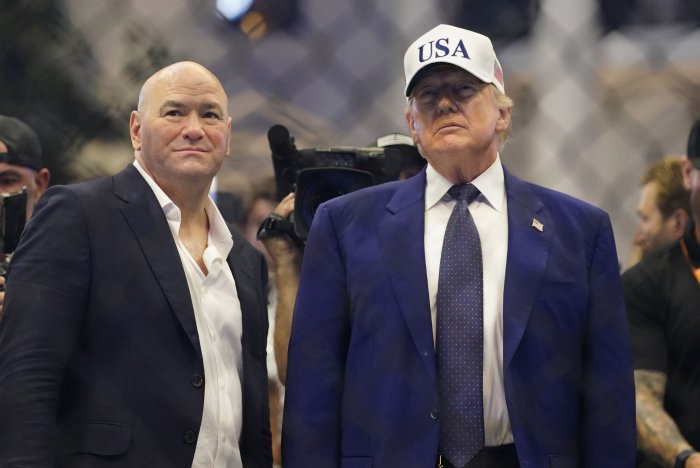
President Donald Trump and UFC CEO Dana White stand in the octagon after the UFC Freedom 250 event on the South Lawn of the White House in Washington, on June 14, 2026. Photo by Bonnie Cash/UPI | License Photo
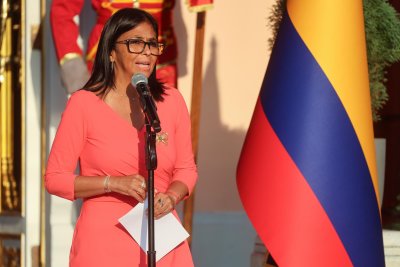
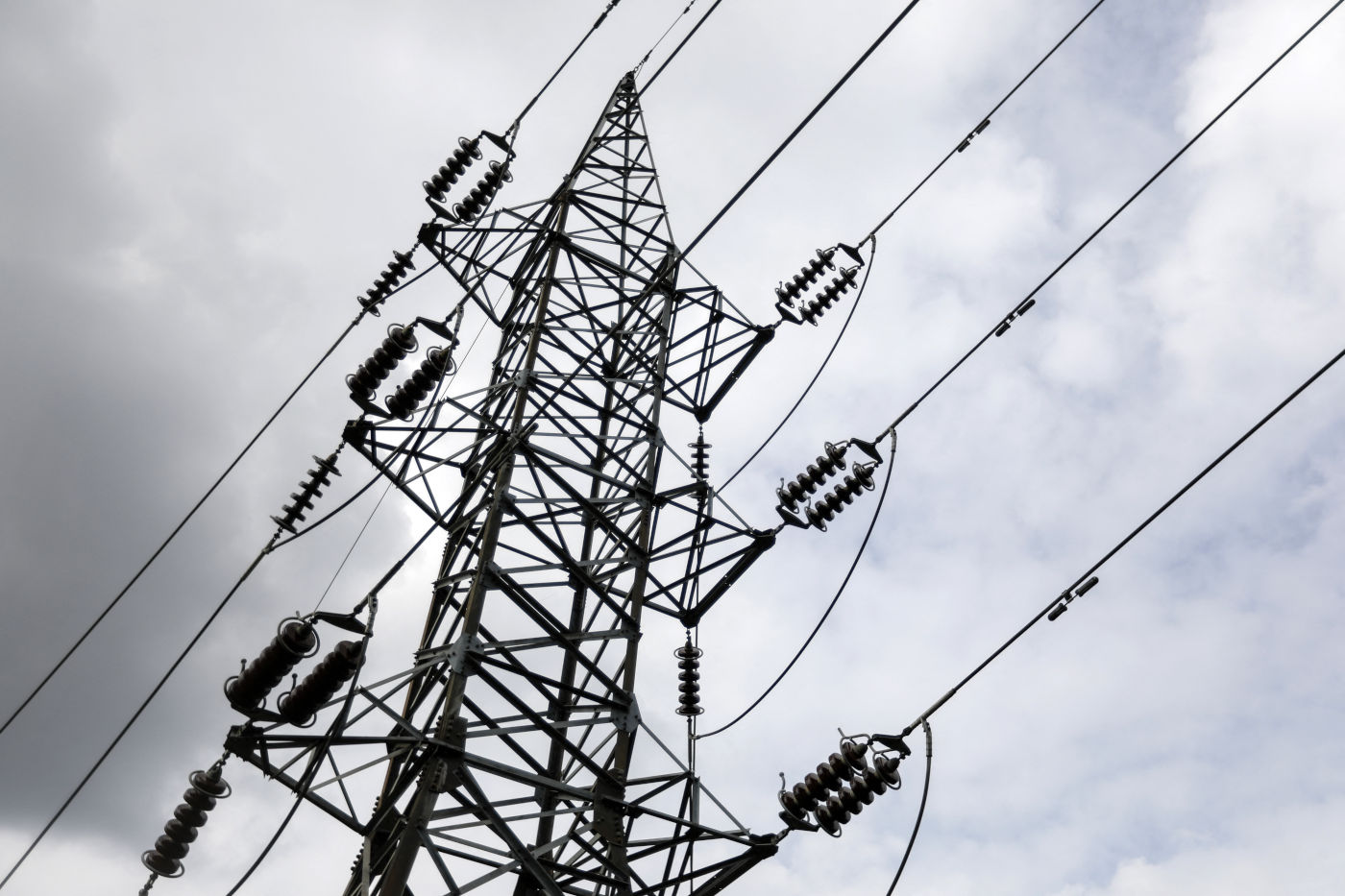
Venezuela’s interim President Delcy Rodriguez signed a memorandum of understanding with U.S.-based GE Vernova, General Electric’s energy division, and state-owned utility Corpoelec to repair, modernize and stabilize the country’s struggling national power grid. File Photo by Miguel Gutierrez/EPA
June 16 (UPI) — Venezuela’s government signed a memorandum of understanding with U.S.-based GE Vernova, General Electric’s energy division, and state-owned utility Corpoelec to repair, modernize and stabilize the country’s struggling national power grid.
The plan aims to restore 1,000 megawatts of generating capacity over the next 24 months and more than 5,000 MW within four to five years.
The agreement, signed Monday by Venezuela’s interim President Delcy Rodriguez, comes shortly after the National Assembly approved reforms to the country’s electricity law. The changes create a new framework that allows foreign investment in the sector after 15 years of an exclusive state monopoly.
During the signing ceremony, attended by Venezuelan government officials, company representatives and U.S. Charge d’Affaires in Caracas John Barrett, Rodriguez said the project will address both hydroelectric and thermoelectric infrastructure.
“We want to move forward steadily in the recovery of the national electricity system, for the benefit of the entire country but also to facilitate conditions for all the international investments arriving in the country,” Rodriguez said during the ceremony, which was broadcast on state television.
#EnVideo| Presidenta (E) Delcy Rodríguez, destacó que la firma del acuerdo con General Electric Vernova constituye un paso histórico para la recuperación del servicio eléctrico, esencial para la vida nacional.
Informó que ha solicitado convertir de inmediato este acuerdo en… pic.twitter.com/O0Wwrs0cYn— Ministerio de Comunicación e Información (@mippci_ven) June 15, 2026
GE Vernova technical teams spent six weeks conducting an audit of Venezuela’s electrical system. The assessment confirmed the deteriorated condition of Corpoelec’s facilities, which have contributed to electricity rationing and widespread blackouts, particularly in western states such as Zulia, the center of Venezuela’s oil industry and a major agricultural region.
“We want to move quickly so the system works as well as possible within a few months, and I believe we can do that together,” GE Vernova Chief Sustainability Officer Roger Martella said. “We already have an agreement on the technical aspects and how we can move forward rapidly. Over the next 12 months and beyond, we will strengthen the national electric system.”
According to local media reports, the Guri Hydroelectric Plant, which supplies about 70% of the country’s electricity, has suffered significant wear because of a lack of original replacement parts. New equipment will be used to stabilize and rehabilitate generating facilities at hydroelectric dams in southern Venezuela.
GE Vernova’s equipment also is expected to help restore local thermoelectric generation capacity, reducing pressure on the Guri complex and improving energy independence for central and western regions.
Transmission lines that cross the country face constant overloads and aging substations. The plan includes energy management software and upgrades to substations to improve reliability and reduce recurring power fluctuations.
The legal reforms approved this month allow concessions of up to 25 years in power generation, transmission and distribution, providing legal certainty for companies such as GE Vernova to deploy technology and services in the sector.
The legislation also establishes stricter accountability requirements for operators and creates a formal framework for renewable energy development.
In addition to increasing generating capacity and modernizing grid operations, the agreement includes a specialized training program for Venezuela’s technical workforce.
A federal judge has ordered the Trump administration to restore signs related to topics such as climate change, slavery and Indigenous and LGBTQ+ history that were removed under an executive order to purge language at national parks that allegedly cast America in a negative light.
The order has prompted the removal of mentions of President Washington’s slaves at Independence National Historical Park in Philadelphia, signs regarding climate threats at Fort Sumter in South Carolina and a pride flag at the Stonewall National Monument in New York City, according to the lawsuit challenging the action.
A preliminary injunction was issued Friday by U.S. District Judge Angel Kelley in Boston, who sided with a coalition of conservation and historical groups and ordered all language removed under the order to be reinstated before the Fourth of July. Earlier this year, another federal judge ordered the signage related to Washington’s slaves restored.
In Friday’s injunction, Kelley accused the Trump administration of seeking “to rewrite the Nation’s history with a white-out pen,” and said that national parks play an important role in telling the multifaceted history of America, including “the good, the bad, and the ugly.”
“Because Defendants deemed it important to strip the parks of these undeniable truths in anticipation of the 250th Anniversary of our great Nation,” she wrote, “it is equally important that our shared history be honestly told and fully restored by the 250th Anniversary to properly honor the remarkable achievements of the United States.”
A spokesperson for the U.S. Department of the Interior dismissed the ruling as the work of a “liberal activist judge.”
“The Department will look at our appeal options while we celebrate UFC Freedom 250 on the South Lawn of the White House this weekend in honor of our nation’s 250th with the greatest president in the history of our country — President Donald J. Trump,” the spokesperson said in a statement.
Trump initially signed the executive order in March 2025, arguing that a revisionist movement is seeking to undermine American history by replacing objective fact with a distorted, ideologically driven narrative.
“Under this historical revision, our Nation’s unparalleled legacy of advancing liberty, individual rights, and human happiness is reconstructed as inherently racist, sexist, oppressive, or otherwise irredeemably flawed,” the order stated.
Under the order, more than 430 sites under the purview of the National Park Service were told to review language on monuments, memorials, statues and markers to ensure they didn’t disparage Americans past or present, with a close eye on language added during former President Biden’s administration. QR codes were also added at sites encouraging visitors to report any signs they believed violated the order.
In February, a coalition including the National Parks Conservation Assn., American Assn. for State and Local History, Assn. of National Park Rangers and Union of Concerned Scientists filed a lawsuit in federal court in Boston alleging that the order was erasing American history and science.
“National parks serve as living classrooms for our country, where science and history come to life for visitors,” Alan Spears, senior director of cultural resources at the parks conservation association, said in a February statement. “As Americans, we deserve national parks that tell stories of our country’s triumphs and heartbreaks alike. We can handle the truth.”
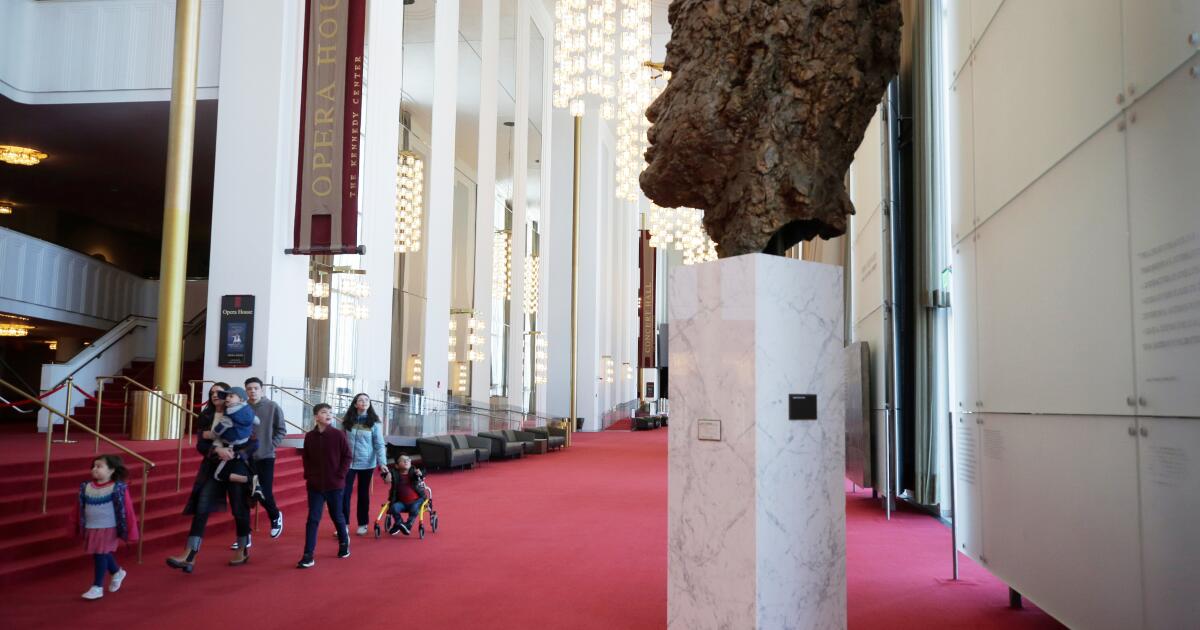
The Washington National Opera filed a lawsuit on Thursday that demands more than $17 million from the John F. Kennedy Center for the Performing Arts. The opera company claims it is owed millions in donations that have been withheld.
The lawsuit claims that after the opera company and the Kennedy Center parted ways in January, center officials have not returned more than $17 million in gifts and donations that belong to the opera company. The lawsuit lists the federal government as a defendant because the Kennedy Center was established by Congress.
According to the suit, the opera company and the Kennedy Center had a longstanding contract in which WNO produced its operas at the Kennedy Center, which in return, provided a number of services and other support for the opera company including managing its donations.
In late 2025, after approximately 15 years of affiliation, the suit claims that the Kennedy Center stopped performing the obligations of their agreement, which included marketing, fundraising and administrative support, as well as timely reporting on the growth of the opera company’s funds. When the opera company requested the Kennedy Center remedy the issue, center officials asked to sever ties.
“Five months have now passed since the termination of the affiliation, and the Kennedy Center still has not returned the funds to WNO,” reads the suit. “To the contrary, according to the Kennedy Center’s Chief Financial Officer, the Kennedy Center has put a significant portion of WNO’s money at risk by using it to collateralize the Kennedy Center’s line of credit.”
In an emailed statement responding to the lawsuit, Roma Daravi, a spokeswoman for the Kennedy Center, told The Times that the contract between the opera house and the center financially burdened the center for more than a decade. The statement claimed that taking into account the company’s endowment, an external accounting firm calculated that the opera company had “accumulated a $72 million deficit to the center” between 2011 and 2026.
“The Center has acted transparently and in the best interests of the public throughout this process,” the statement reads. “This lawsuit is meritless, and we plan to pursue a countersuit to defend the institution.”
In December, President Trump’s name was installed on the exterior of the center the day after his handpicked board of trustees voted to change the institution’s name to the “Trump-Kennedy Center.” Last month, a federal judge ordered President Trump’s name to be removed from the exterior of the building within two weeks and a halt to the Trump administration’s planned two-year closure of the venue.
On Friday, the court-ordered deadline for removing his name sparked widespread interest and crowds gathered outside the center. A live cam was also placed near the structure.
The Times arts editor Jessica Gelt contributed to this report.
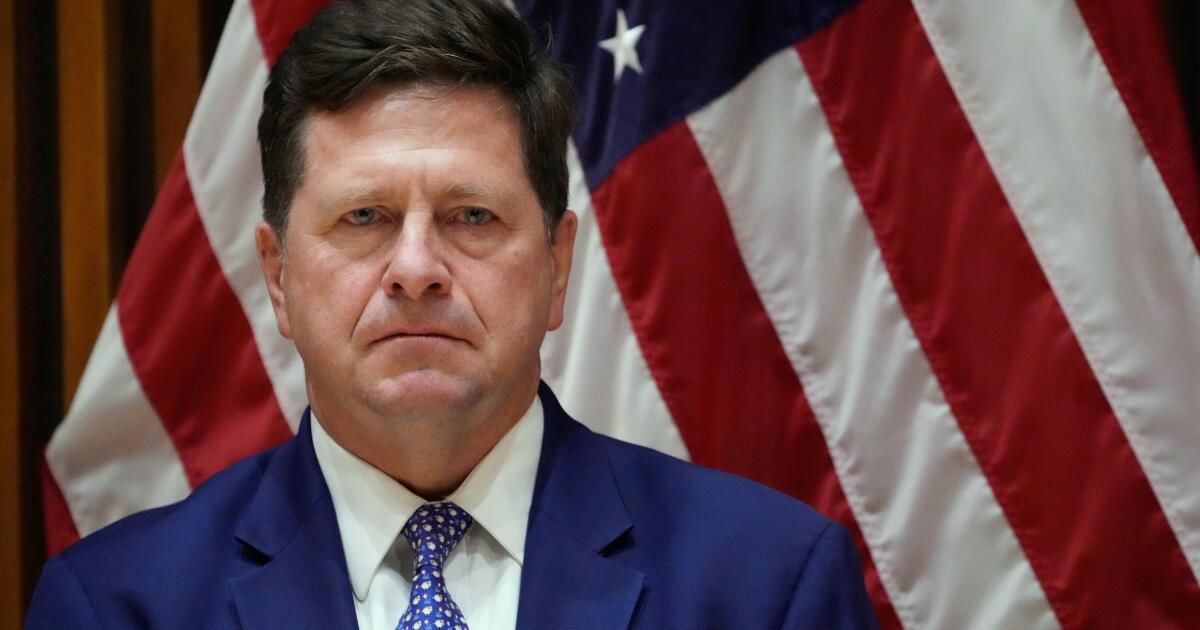
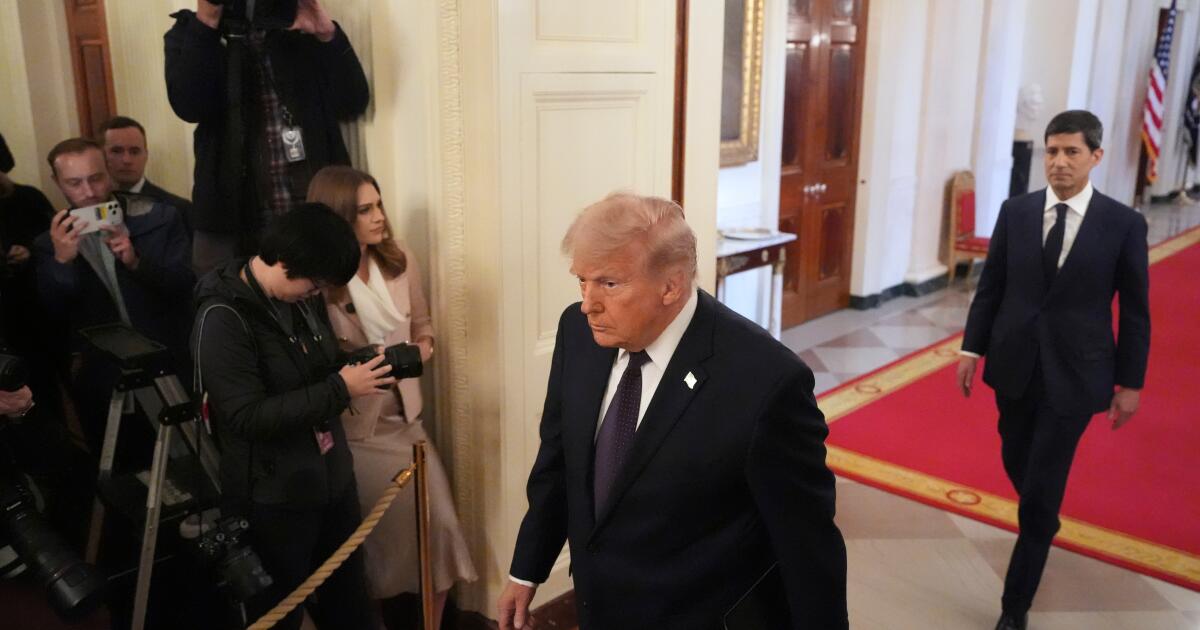
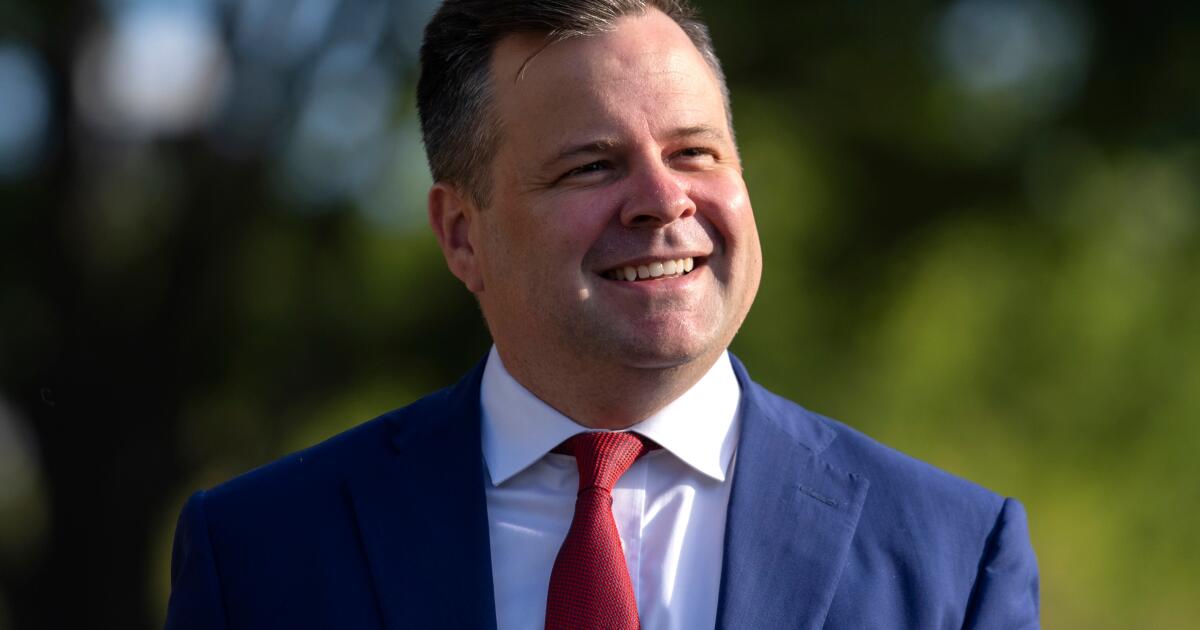
WASHINGTON — President Trump said Thursday that he plans to nominate Jay Clayton, the U.S. attorney for the Southern District of New York and a former Securities and Exchange Commission chairman, as director of national intelligence.
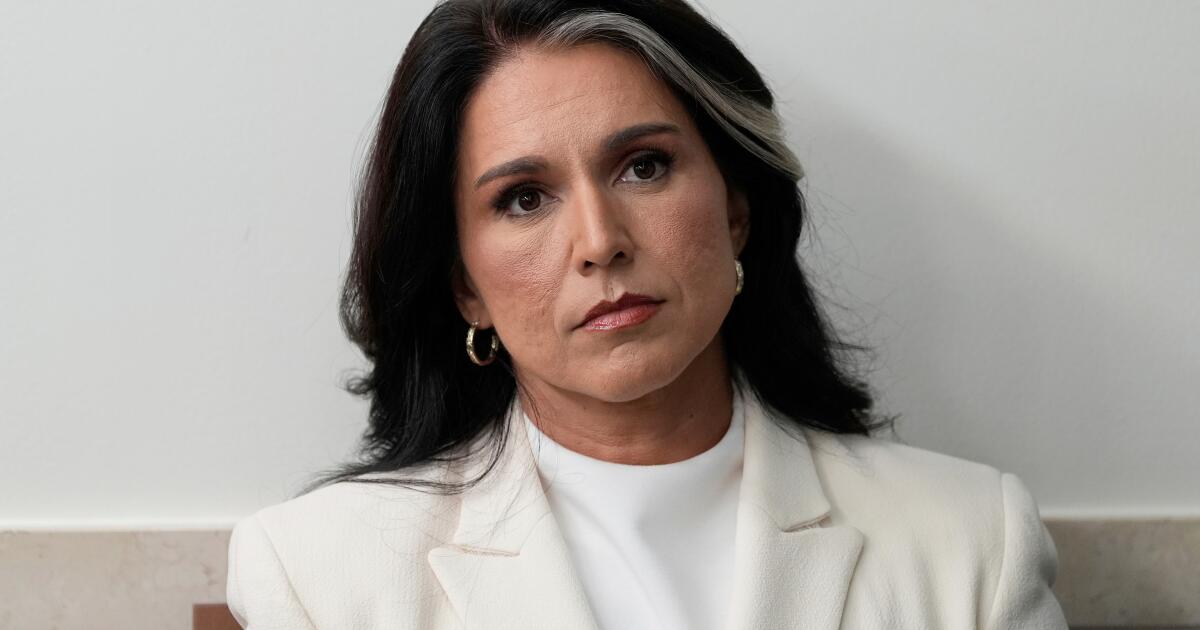
Trump announced the nomination on social media amid pressure from Congress to name a permanent replacement for Tulsi Gabbard, who resigned last month. Trump faced intense pushback over his decision to name Bill Pulte, head of the Federal Housing Finance Agency, as acting director.
The situation has led to a standoff in Congress as Democrats said they would refuse to renew foreign intelligence powers unless Trump pulled Pulte’s nomination and named a permanent nominee.
“Few people anywhere in the Legal Community are respected at the level of Jay,” Trump wrote. “I encourage the United States Senate to confirm Jay as soon as possible.”
The 52 clubs involved have outlined in the letter an agenda they hope to discuss at the meeting with the FA.
Among the issues they raise are:
Whether the process adopted by the board “complies” with the constitutional rights of the member clubs
The use of “anonymous” surveys instead of a formal voting procedure
The “incentive of financial distributions” to press for an agreement
“Concerns” regarding the independence of decision-making on the board
A need for “transparency and accountability”
The letter asks that the FA is bound by a notice period to agree the meeting and confirm an agenda, which is believed to be between seven and 14 working days.
Anthony Shaw, operations manager at Hashtag United FC, pulled the 52 clubs together and signed the letter on their behalf.
All clubs were listed. Among them were Middlesbrough, Derby County, Halifax, Doncaster Belles and Hull City.
Former Women’s National League chair Carol West has strongly opposed the proposals, writing on social media: “The damage being done here should not be underestimated. I can’t quite believe it’s being allowed to happen.
“The overriding issue with all of this is that the vast majority of clubs do not want PGA (Professional Game Academy) teams in their league but have repeatedly been denied their democratic right to vote to formalise this once and for all.
“Instead, they’ve been told it’s happening regardless which isn’t right.”
ABOARD AIR FORCE ONE — President Trump said Friday that he wants Bill Pulte, his new acting director of national intelligence, to cut the office, which has already been significantly scaled back during his second term.
Trump noted that the size of the office has been “way too high for way too long” and that “if he cut, I wouldn’t mind.”
“Bill Pulte is very good, he’s very talented,” Trump told reporters on Air Force One as he traveled to Wisconsin. The Republican president said in an earlier interview with the Wall Street Journal that he has asked Pulte to start the process of firing employees.
In the interview with the Journal, the president says he has already conveyed his view to Pulte, the incoming acting director of national intelligence, who has served as head of the Federal Housing Finance Agency but apparently has no national security expertise.
“I’d like to see it smaller. I think there are a lot of people in there that shouldn’t be there,” Trump said, which the Journal said was in reference to intelligence community officials who had served in the Democratic administrations of Presidents Biden and Obama.
Trump told the Journal that he wants Pulte to “start the process” of firing personnel and that the eventual permanent director of national intelligence should continue it. The president has indicated that he would not formally nominate Pulte for the position.
“Frankly, it might be good for him to shake it up before people come,” Trump said. “Because, if he [Pulte] reduced the size, in conjunction with me … and in conjunction with possibly the person coming in … he can do a lot of the hard work and we wouldn’t have to saddle somebody that goes in.”
Pulte was tapped by the president earlier this week in a surprising move that has been met with bipartisan resistance in the Senate, which confirms presidential nominations. The temporary appointment has now snarled the renewal of a critical national security surveillance program on Capitol Hill, with Democrats key to the vote pointing out that they did not trust Pulte — whose office oversees 18 intelligence agencies — to help administer the surveillance program.
Under Pulte’s successor, Tulsi Gabbard, the director of national intelligence’s office had already taken steps to scale back its size. In August, the Trump administration said that the office’s budget would be cut by more than $700 million per year, while slashing the size of its workforce.
At the time, Gabbard said the office had become “bloated and inefficient” while she announced the roughly 40% workforce reduction.
Gabbard resigned last month after revealing her husband’s cancer diagnosis.
Price and Kim write for the Associated Press. Kim reported from Washington.
Private and mixed companies will be allowed to participate in electricity generation, transmission, distribution, and commercialization. (AFP)
Caracas, June 4, 2026 (venezuelanalysis.com) – The Venezuelan National Assembly preliminarily approved on Tuesday a reform to the country’s Organic Law of the National Electricity System and Service, proposing a structural overhaul of the National Electricity System (SEN).
One of the most significant changes is the incorporation of the private sector in electricity generation, transmission, distribution, and commercialization activities, breaking with two decades of state monopoly through the National Electric Corporation (Corpoelec).
According to the draft text seen by Venezuelanalysis, private corporations and joint ventures will be able to operate in the electric grid in what is termed a “diversification of actors in the service chain.” The mixed ventures, where the state can hold majority or minority stakes, will be approved directly by the government and not by the National Assembly.
“In recent decades, the electric system has showcased structural and financial limitations […] as a result of the productive reality and the negative impact of unilateral coercive measures,” the proposed law reads. “Faced with this reality, the Venezuelan state must assume an institutional and judicial reengineering.”
The bill establishes concessions with a maximum duration of 25 years, renewable for a further 15 years under specific conditions. Once a concession expires, all infrastructure, assets, substations, and data will automatically revert to the state in good condition and without compensation.
The proposed legislation announces the creation of a new tariff scheme “based on real costs and a reasonable return for investors.” Electricity, like most public services, has been heavily subsidized in recent decades in the Caribbean nation. The bill additionally introduces obligations for electricity distributors to compensate users for damages caused by blackouts or other failures.
The reform likewise establishes the possibility for the executive branch to grant tax exemptions to projects linked to renewable energy, rural electrification, or strategic investments in the electricity sector.
The 42-article legislation will now be subject to discussions and amendments before a second and decisive vote.
If approved, it would repeal the Organic Law for the Reorganization of the Electricity Sector, enacted by former President Hugo Chávez on July 31, 2007, which merged the country’s seven existing electricity companies through the creation of the National Electric Corporation. The legislation also defined all stages of electricity generation and distribution as “strategic for the nation.”
During Tuesday’s parliamentary session, United Socialist Party (PSUV) lawmaker Orlando Miranda argued that the electricity reform represented a “mixed and private capital strategy under a rigorous regime of concessions and public supervision.”
He noted that government plans to reinforce the grid with thermoelectric plants in the past 15 years were hampered by US economic sanctions. Miranda went on to add that increased tariffs are being studied to reflect the “real costs” of the system.
For his part, opposition legislator Ezio Angelini (Un Nuevo Tiempo) demanded that the reform address corruption, which he identified as a key factor behind Venezuela’s recurring power outages.
Angelini stated that in 2019 Venezuela generated around 20,000 megawatts (MW) while consuming approximately 12,000. Today, he claimed, the country produces close to 12,000 MW, roughly 40 percent of installed capacity, while demand has risen to 14,000. On May 11, Interior Minister Diosdado Cabello stated that electricity demand had surpassed 15,500 MW due to increased oil production.
Zulia state, considered the cradle of Venezuela’s oil industry, and other western regions have experienced daily blackouts lasting between eight and twelve hours in recent weeks. Supply instability also affects other services such as water pumping and cooking gas distribution.
Frequent power outages have also gripped oil fields in the Orinoco Belt, as crude extraction relies on electric motors that are vulnerable to tension fluctuations. According to Bloomberg, the Venezuelan government is urging international energy companies to generate their own electricity for oil and natural gas projects in an effort to shield the grid from the additional load.
Delegations from Siemens and General Electric visited the country in April and held talks with the Venezuelan government headed by Acting President Delcy Rodríguez. However, the two corporate giants are reportedly “hesitant” to take part in major projects due to doubts over Caracas’ financial capabilities.
Additionally, in mid-May, US Chargé d’Affaires in Venezuela John Barrett held a meeting with Electricity Minister Rolando Alcalá to discuss plans to “restore a reliable energy supply through US investment and collaboration.”
Electricity generation in Venezuela depends heavily on the 10 MW-capacity Guri hydroelectric complex in Bolívar state, making the system particularly vulnerable to climatic factors such as the high temperatures affecting the country. Venezuela suffered nationwide blackouts in 2019, with authorities blaming US-led cyberattacks.
The electricity reform follows legislative overhauls to the hydrocarbon and mining sectors that likewise curtailed the state’s role and responsibilities while granting private corporations expanded control over operations and sales, slashed royalties and taxes, and the ability to bring disputes to international arbitration bodies.
June 4 (UPI) — Acting Director of National Intelligence Bill Pulte, whose new assignment has drawn bipartisan criticism, won’t be the “permanent” choice for the job, President Donald Trump said Thursday.
Trump, speaking to reporters Thursday the White House, said Pulte’s role as acting director of DNI to replace Tulsi Gabbard, which began Tuesday, would not be “permanent.”
Rather, the president said Pulte will be “very good” as he takes the job on for a “little while,” while also asserting he will be able to “figure it out quickly.”
Gabbard announced her resignation in May, saying she will step down June 30, and Trump’s pick of Pulte to replace her two days ago ignited a backlash among lawmakers of both parties.
A former housing developer and currently director of the Federal Housing Finance Agency, Pulte — a staunch Trump loyalist — has no experience in foreign intelligence work, a fact that has sparked criticism from both sides of the political aisle.
Sen. Thom Tillis., R-N.C., on Wednesday blasted Pulte as an “incendiary attack dog” for Trump who likely wouldn’t pass Senate muster for confirmation.
“I don’t think he has a prayer” of becoming the permanent DNI, Tillis told CNBC, adding that Pulte’s presence could hurt the GOP congressional majority’s efforts to reauthorize the part of the Foreign Intelligence Surveillance Act governing warrantless surveillance.
Similarly, Sen. Ron Wyden, D-Ore., a long-serving member of the Senate Intelligence Committee, decried the choice of Pulte for DNI director, saying Trump is “appointing his top political henchman to one of the most important positions for protecting the safety of Americans and preventing terrorist attacks like September 11th.”
Pulte, he said, “appears to be unscathed by intelligence or any semblance of ethics,” noting he has already used his post at a housing agency “to persecute Trump’s political opponents, including Senator Adam Schiff, New York Attorney General Leticia James and Federal Reserve Board member Lisa Cook.”
Pulte has alleged fraud against several of Trump’s foes in their mortgage applications, including Cook for claiming two different homes as her primary residence. She has appealed her firing by Trump to the U.S. Supreme Court.
President Donald Trump presents the Commander in Chief’s Trophy to the Navy Midshipmen football team during a ceremony in the East Room of the White House on Friday. The award is presented annually to the winner of the football competition between the Navy, Air Force and Army. Navy has won the trophy back to back years and 13 times over the last 23 years. Photo by Bonnie Cash/UPI | License Photo
WASHINGTON — President Trump said Thursday that federal housing finance regulator Bill Pulte, his pick for acting director of national intelligence, would not be his “permanent” choice for the critical security post.
The Republican president’s disclosure that he was ruling out installing Pulte in the position full time came after bipartisan pushback on Capitol Hill in recent days over Pulte’s lack of national security experience. The position requires Senate confirmation, something that lawmakers indicated was unlikely if Pulte were the nominee.
“He’s not going to be permanent because, you know, I don’t think he’d want to be permanent,” Trump said while taking questions in the Oval Office after an event on coal. He called Pulte a “very smart guy” and said he may look at past elections that Trump claims, without credible evidence, were “rigged” against him.
Trump said other candidates were under consideration for nomination to the post. “We’re interviewing people right now,” he said.
Pulte, a grandson of the founder of PulteGroup, has been a source of controversy within the administration for his work as director of the Federal Housing Finance Agency and his oversight of the mortgage companies Fannie Mae and Freddie Mac.
Pulte has used his position to pursue Trump’s perceived political rivals for alleged mortgage fraud and has verbally attacked Jerome H. Powell, whose term as the Federal Reserve chairman recently ended after months of Trump and Pulte attacking him for not slashing the central bank’s benchmark rates. The federal housing finance regulator has also pitched a 50-year mortgage, an idea that backfired as it meant that the process of building wealth through homeownership would be slowed.
Both Republican and Democratic senators expressed concerns about Pulte and his lack of national security credentials in occupying a role coordinating 18 federal agencies involved in domestic and foreign security issues. Trump’s initial director of national intelligence, Tulsi Gabbard, resigned last month, citing her husband’s recent cancer diagnosis.
Senate Majority Leader John Thune, a Republican from South Dakota, said the national intelligence director job shouldn’t be “weaponized” and should be led by “professionals.”
Republican Sens. Thom Tillis of North Carolina, Bill Cassidy of Louisiana and John Cornyn of Texas, who are each leaving the chamber after this year’s elections, also expressed concerns about Pulte.
Democratic senators view Pulte as a risk even if he is serving only temporarily as the director of national intelligence while keeping his position at the FHFA.
Sen. Elizabeth Warren (D-Mass.) sent Trump a letter on Thursday calling on him to rescind Pulte’s national security appointment.
“Americans cannot trust him to protect our nation and refrain from misusing the sensitive information he will have access to,” Warren wrote, saying that giving Pulte the job on an acting basis was a risk because Trump’s own words suggested the federal agency could be used “to promote election denial theories.”
At a hearing on Wednesday, Treasury Secretary Scott Bessent confirmed reports that he had threatened to fight Pulte in September, a sign of the friction that the federal housing finance director had generated inside the administration.
But as a frequent traveler on Air Force One, Pulte has a close relationship with Trump.
“He’s a person who’s got high integrity,” Trump said Thursday about Pulte.
President Trump signed an executive order on artificial intelligence Tuesday, less than two weeks after postponing a White House ceremony over his concerns that a similar policy could dull America’s edge on AI technology.
The order establishes a framework for the federal government to vet the national security risks of the most advanced AI systems for up to a month before their public release. The government will be able to work with trusted partners “that will have early access to covered frontier models to promote secure innovation and strengthen the cybersecurity of critical infrastructure,” the order says.
It was not immediately clear to what extent the order differed from the one he declined to sign on May 21.
Trump canceled an Oval Office event with tech industry executives last month because he did not like what he saw in the earlier version of the order’s text. “We’re leading China, we’re leading everybody, and I don’t want to do anything that’s going to get in the way of that lead,” Trump told reporters at the time.
That directive was characterized as a voluntary collaboration with participating U.S.-based tech companies, including Anthropic, OpenAI and Google.
WASHINGTON — President Trump has tapped Bill Pulte, head of the Federal Housing Finance Agency, to be the acting director of national intelligence — putting a real estate scion and fierce Trump loyalist in a key national security post as the U.S. remains at war with Iran.
Trump made the surprise announcement Tuesday on social media that Pulte would be replacing Tulsi Gabbard, the former Hawaii congresswoman who served as the director of national intelligence.
The Republican president cited Pulte’s work at the FHFA and his role as chair of the mortgage giants Fannie Mae and Freddie Mac, saying that the 38 year-old “has deep experience managing the most sensitive matters in America, the safety and soundness of the Markets, and over 10 Trillion Dollars at Fannie Mae/Freddie Mac, a substantial increase from where it was just 12 months ago.”
Pulte’s sudden elevation to a role coordinating sensitive national security matters is a sign of how Trump is putting a priority on loyalty over a traditional resume full of previous military and intelligence assignments. It’s unclear what national security expertise Pulte has, but he has been a frequent guest on Air Force One as Trump has traveled to Mar-a-Lago, his home and club in Palm Beach, Florida.
As the grandson of the founder of PulteGroup, one of the country’s largest homebuilders, Pulte has cut a combative streak on social media and used his post at the FHFA to attack perceived opponents of the Trump administration.
His time overseeing mortgage finance has been linked with criminal referrals for mortgage fraud by public officials Trump sought to punish, including New York Attorney General Letitia James, a Democrat; Sen. Adam Schiff, D-Calif.; and Lisa Cook, a member of the Federal Reserve, who was nominated by a Democratic president, Joe Biden.
Pulte has famously gone after then-Federal Reserve Chair Jerome Powell for not cutting the central bank’s benchmark interest rates as aggressively as the president wanted. He has also been linked to ideas such as the 50-year mortgage and efforts to lower mortgage rates through the purchase of home loan debt that have not paid off as promised.
Trump said Pulte will keep his other positions even as he fills in for Gabbard, who resigned last month after revealing her husband’s cancer diagnosis.
If formally nominated, Pulte would need to be confirmed by the Senate to hold the position full time.
Saint Mary’s has achieved the seemingly unthinkable — the Gaels have eliminated UCLA, the nation’s top-ranked team, from the NCAA tournament.
With two outs in the 10th inning, Makoa Sniffen drove in Cody Kashimoto on a walk-off single off UCLA reliever Easton Hawk to lift Saint Mary’s to a 6-5 comeback win Sunday in a Los Angeles Regional elimination game at Jackie Robinson Stadium.
The Gaels (36-26), who also stunned the Bruins (52-8) in the regional opener on Friday, made the Big Ten champions just the second NCAA No. 1 overall seed — after Vanderbilt in 2025 — to be eliminated from the regional round since the current format was established in 1999.
“Obviously, this weekend, we just did not play up to our standards,” UCLA coach John Savage said. “I really felt it was a struggle, for whatever reason — all three games, really. But it’s nothing to take away from this team. You win 52 games [and are] preseason [No.1], and you never leave that spot; it’s really remarkable and a lot of credit to our captains, to our seniors, to the entire program … I just can’t say enough about the people that I’m around and that I’ve coached.”
Against all odds, Saint Mary’s is still alive and playing Cal Poly in the regional final on Sunday night.
“Felt like 12 rounds with the heavyweight champ,” Saint Mary’s coach Eric Valenzuela said of the Gaels’ wins over UCLA. “So proud of our group, the fight.”
Favored to win their first national title since 2013, the Bruins led the Gaels 5-4 entering the ninth and needed just three outs to continue what had been the program’s best season ever.
But Tanner Griffith led with a base hit off UCLA reliever Cal Randall and — after being moved to second following a sacrifice bunt from Diego Castellanos — catcher Ian Armstrong brought Griffith home with an RBI single to right field off Hawk.
Saint Mary’s reliever David Roberts retired the Bruins in order in the 10th. Hawk then struck out Brayden Gutierrez before Kashimoto hit an infield single. Griffith advanced Kashimoto to second on a groundout to first. Two batters later, Sniffen’s hit to left field gave Kashimoto just enough time to beat a throw to the plate, sealing the Gaels’ win.
Randall and Hawk pitched in all three of UCLA’s regional games. Savage saluted the entire pitching staff — highlighting Angel Cervantes’ development as a freshman — but added that Logan Reddemann’s absence had a “major effect” on the staff. The ace right-hander hadn’t pitched since April 17 because of arm soreness.
“It had a ripple effect on the starters, had a ripple effect on the bullpen,” Savage said of Reddemann’s absence. “The effect it had on roles, the effect it had on usage [was a] major deal. No excuses, because [we] still won. But at the same time, it looked a little different and it felt a little different, and at the end, I think it really hurt losing a potential first-rounder the last six weeks.”
The Big Ten coach of the year took the time to acknowledge the Bruins’ junior class for sticking with the program throughout its ascent, admiring the “all kinds of players” he expects to be selected in July’s MLB draft.
Savage, though, was particularly emotional when discussing the eventual departure of shortstop and back-to-back Big Ten player of the year Roch Cholowsky, who is widely expected to be a first-round pick.
“Cholowsky just meant so much to the program,” Savage said. “He just had such an impact on the program. He had such an impact on people. Had impact on a fan base. Had impact on the community. Just such a winning, winning player. It’s hard to watch a guy like that leave … but it’s what he’s all about. He’s all about the right things.
“He’s a Bruin through and through. And at the end of the day, you couldn’t ask for a better player or a better person than Roch.”
Led by Cholowsky and eight other All-Big Ten selections, with the best team ERA (3.27) throughout the regular season, the Bruins had lost merely six times before the regional and had won every series.
But after losing two games to Saint Mary’s, as regional hosts for a second consecutive year, UCLA has no choice but to go back to the drawing board in preparation for 2027.
“I feel for them,” Savage said of his clubhouse. “It’s the college game … anything can happen. We didn’t play well enough this weekend.”
President Trump plans to celebrate the nation’s 250th anniversary — and his own 80th birthday — next month by watching bare-chested and bloody UFC fighters kick, punch and choke each other on the storied South Lawn of the White House.
Later, during the administration’s summer-long festival to commemorate the signing of the Declaration of Independence, IndyCars will race in a fossil fuel-burning extravaganza around and around the National Mall — home to the U.S. Capitol and the Washington and Lincoln monuments.
Both venues are National Park Service land and are administered by the agency.
The planned spectacles — UFC Freedom 250 and the Freedom 250 Grand Prix — stray so far from the park service’s traditional mission and ethos that advocates and career employees are crying foul.
“These events are inappropriate and disrespectful to the history and importance of the White House and the National Mall,” said Jonathan Jarvis, who began his career as a park ranger on the Mall in 1976 and was named director of the National Park Service by President Obama in 2009.
White House officials insist that IndyCar and the UFC are extremely popular with everyday Americans: the race and the fights will be exuberant celebrations of patriotism and pride, they say.
The UFC event, in particular, “will be one of the greatest and most historic sports events in history, and President Trump hosting it at the White House is a testament to his vision to celebrate America’s monumental 250th anniversary,” said White House spokesperson Davis Ingle.
President Trump is hosting a UFC match on the White House grounds in honor of the 250th anniversary of the United States.
(Alex Wong / Getty Images)
To organize this summer’s events, the Trump administration asked the National Park Foundation — a congressionally chartered nonprofit that works closely with the park service and collects private donations to help maintain hiking trails and fund programs to get kids outdoors — to lend a hand.
Because of the scale of the planned celebrations, the foundation created a limited liability company, “Freedom 250,” to “execute events, activities, and celebrations in or around national parks,” according to the Freedom 250 website.
Freedom 250 has its own employees, but the foundation provides funds and the park service approves the events and reviews their budgets, according to the website.
Which is why advocates are appalled.
“Essentially, this is a hijacking of one of America’s oldest and most well-respected conservation organizations,” said Aaron Weiss, director of the Center for Western Priorities, an environmental nonprofit based in Denver. “There are so many very good people at the foundation, with so many years doing real work on behalf of America’s national parks, it’s heartbreaking to watch.”
When Jarvis was director of the park service — and therefore an ex-officio board member of the foundation — the two organizations worked hand in hand to ensure that the foundation’s work complemented that of the park service. They organized the annual Easter Egg Roll on the White House South Lawn and lit the Christmas tree on the Ellipse, Jarvis said.
Workers continue to paint the bottom of the Lincoln Memorial Reflecting Pool on the National Mall.
(Alex Wong / Getty Images)
Occasionally, the president made special requests, which were reviewed carefully to ensure they were consistent with park service principles. Michelle Obama’s famous “Kitchen Garden” passed the test, Jarvis said with a chuckle, providing fruits and vegetables for family meals — and the occasional state dinner — for years.
It’s hard to imagine any career parks employee, or the foundation board members he served with, coming up with the current agenda, Jarvis said.
In addition to the IndyCar race and cage fights, the National Park Foundation is sponsoring“Freedom Trucks” — six red, white and blue tractor trailers traveling the country as rolling museums — andRededicate 250, a large Christian revival meeting held on the Mall earlier this month that raised objections about the mixing of church and state.
“I think the foundation is being told what to do,” Jarvis said. “And I think it’s hard to say no to the White House these days.”
Josh deBerge, a spokesperson for the National Park Foundation, insisted that no money from Freedom 250 is being spent on the IndyCar race or the UFC fights.
But the IndyCar race is listed as a “signature” event on the Freedom 250 website, and both IndyCar and the UFC are listed as Freedom 250 sponsors.
Danielle Alvarez, a former Trump campaign senior advisor, is a spokesperson for Freedom 250. She acknowledged that the race and the cage fights are happening on national park land and under the banner of Freedom 250, but said neither is receiving funds or logistical support from her organization.
“Many groups have adopted ‘Freedom 250’ branding as part of their festivities, even though it does not mean it is backed by Freedom 250 funding,” Alvarez said in a text message. “The shared terminology is a natural expression of collective pride in 250 years of American independence.”
Neither IndyCar nor the UFC responded to requests for comment.
All of this comes as the Trump administration has taken an ax to the National Park Service, cutting its staff by 25% through buyouts and layoffs since 2025, and proposing another 25% staff reduction this year.
A worker applies hot wax during the restoration process of the Gen. Nathanael Greene statue in Stanton Park on Capitol Hill.
(Tom Williams / CQ-Roll Call / Getty Images)
Trump has also proposed slashing nearly $800 million from the park system’s roughly $3-billion operating budget — potentially diminishing the ability to keep facilities clean and control crowds. Already this year, Yosemite National Park has ditched a reservation system, leading to enormous crowds in the valley and on nearby trails.
Parks advocates fear it’s part of a broader and deliberate strategy to marginalize an agency that has long been a sanctuary for environmentalists and progressives — most of whom presumably did not vote for Trump.
In addition to the staff and budget cuts, Trump last year instructed the National Park Service toscrub any language he would deem negative, unpatriotic or smacking of “improper partisan ideology” from signs and presentations visitors encounter at parks and historic sites.
Instead, he ordered the agency to ensure that its signs remind Americans of our “extraordinary heritage, consistent progress toward becoming a more perfect Union, and unmatched record of advancing liberty, prosperity and human flourishing.”
Those marching orders left opponents and free speech advocates in disbelief, wondering how park employees were supposed to put a sunny spin on monuments acknowledging slavery, Jim Crow laws and the incarceration of Japanese Americans during World War II.
Trump opponents also question the political wisdom of picking on an agency that’s routinely ranked among the most admired branches of the large and sprawling federal government. Even Americans who pay little attention to politics will probably never forget standing in Yosemite Valley and admiring a towering waterfall.
There were more than 323 million visits to America’s national parks in 2025, dwarfing attendance — 135 million — at professional football, baseball, basketball and hockey games combined.
That has not stopped the assault by the current administration.
Black granite was installed last month as the new walkway for the West Wing Colonnade at the White House.
(Andrew Harnik / Getty Images)
“The ideologues in power now take a very dim view of the federal government in general, and the last thing they want is a highly popular and successful federal agency,” Jarvis said. “So if they can kill it, or diminish it through neglect, they win. They don’t really care about the public’s opinion.”
Chuck Sams, the last director of the National Park Service, stepped down the day Trump was inaugurated. Since then, the agency has not had a Senate-confirmed director.
Sams agreed that the Trump administration seems to have it in for the Park Service and worried that the guardrails that used to prevent the executive branch from doing whatever it wants with park land are disappearing.
Destroying the East Wing of the White House for Trump’s proposed ballroom and paving over portions of the White House Rose Garden lawn are prime examples, Sams said.
During his tenure, any proposed change to the White House or its grounds was approached in a “very concerted and deliberate manner with a lot of educated professionals weighing in,” Sams said. “Was it slow? Absolutely, but that was because everyone understood these places belong to the people.”
Asked what he thought of the IndyCar race and the cage fights, Sams said, “We are in uncharted territory, on uncharted ground.”
WASHINGTON — Shrey Parikh felt the pressure of arriving at the Scripps National Spelling Bee as a favorite, but his confidence showed every time he got a word he knew. And when the bee came down to a lightning-round tiebreaker against Ishaan Gupta, Shrey left no doubt.
Shrey turned a tense, high-quality final into a blowout Thursday night, racing through the 90-second “spell-off” and getting 32 words right to be crowned the best young speller in the English language. Ishaan spelled 25 words correctly in the tiebreaker.
A 14-year-old from Rancho Cucamonga, Shrey finished third in 2024 but lost his school bee last year when he was battling a fever. He has dominated the bee circuit since, winning several highly competitive online competitions against many of the same kids he outlasted this week in the nation’s capital.
Ishaan, a 12-year-old seventh-grader from Jersey City, N.J., was a semifinalist this year, outperformed some veteran spellers in the finals, and has another year of eligibility left.
Sarv Dharavane, a 12-year-old sixth-grader from Dunwoody, Ga., finished third for the second consecutive year and has two more years to improve that placement.
For the first time in the bee’s history, second- and third-place finishers from the same year have gone on to win. Faizan Zaki won last year, and two years ago he was the runner-up, just ahead of Shrey.
Sporting a business-casual look with a dark, long-sleeve collared shirt, khakis and sneakers, the lanky Shrey strode to the microphone with a dour, apprehensive expression that instantly vanished when he heard his word from pronouncer Jacques Bailly and nodded vigorously — his tell that, yes, he knew it.
Upon hearing the announcement confirming his victory in the spell-off, Shrey turned and shook his competitor’s hand.
He can credit his victory to intense preparation. Shrey’s coaching team included Sam Evans, who has tutored each of the past three champions, and Sohum Sukhatankar, a co-champion himself in 2019. He competed nonstop against other top spellers, pored through advanced study guides and tried to eliminate the variables that had led to the few unexpected exits of his long spelling career.
Former spellers, coaches and other observers described this group of finalists as unusually strong, and they showed off their skills early by going 18 for 18 to start, breezing through the first spelling and vocabulary rounds. Aiden Meng of Orinda, Calif., ended that streak when he was tripped up by “catometope” to start the second spelling round.
Then the crowd gasped when the bell rung on two thought to be capable of winning it all: Oliver Halkett for “Faesulae” and Zwe Spacetime for “vaesite,” words with tricky combinations of origins and vowel sounds.
The bee’s move to Constitution Hall, a point of contention for spellers and their families because of the inconveniences it caused, helped imbue the event with a lively atmosphere, with more intimate seating and better sight lines bringing the crowd closer to the action.
New television host Mina Kimes of ESPN narrated the action smoothly alongside longtime bee analyst Paul Loeffler.
Holidaymakers heading to Italy have been warned to brace for major disruption as a nationwide transport strike threatens chaos across the country. The 24-hour walkout is expected to hit rail services, airports, metro systems, buses and regional transport networks from 9pm on Thursday, May 28, until 9pm on Friday, May 29.
Several unions have confirmed industrial action involving major rail operators including Trenitalia, Trenord and Italo, sparking fears of cancellations and delays on some of Italy’s busiest routes. Long-distance rail services connecting major cities including Rome, Milan, Venice, Florence, Bologna and Naples are expected to be among the worst affected outside protected operating periods.
Italy’s Ministry of Transport has published lists of “guaranteed” services that must continue operating during protected commuter windows between 6am and 9am, and again between 6pm and 9pm. Italy’s Civil Aviation Authority, ENAC, confirmed flights are legally protected during guaranteed operating periods between 7am and 10am and 6pm and 9pm.
The aviation authority has urged passengers to contact airlines directly for the latest updates regarding individual flights. Travel experts have also warned the strike could trigger wider disruption across European airline networks due to aircraft scheduling changes and increased rebooking demand.
Major travel hubs including Rome Fiumicino Airport, Milan Malpensa Airport, Venice Marco Polo Airport and Naples International Airport are expected to face delays, congestion and possible schedule changes during the strike.
Airport transfers, metro systems, buses and regional rail services may also run at reduced capacity or face temporary suspensions depending on local participation levels. Tourists visiting major attractions including the Colosseum, Vatican City, Venice’s canals and Florence’s historic centre could also experience delays due to disruption on local transport networks.
Travel experts are advising passengers to closely monitor airline notifications and rail updates as schedules may change rapidly throughout the strike period. easyJet said it currently plans to operate flights as normal but warned customers to allow extra time when travelling through airports.
A spokesperson for easyJet said: “We would like to reassure customers that we are doing all we can to minimise any disruption caused by national industrial action in Italy tomorrow. We are currently planning on operating our schedule as planned but would advise customers travelling to allow additional time to make their way to and through the airport.
“Should any flights be impacted, we will contact customers directly with their options to help rearrange their plans. We would like to apologise for any inconvenience caused.”
Italy remains one of Britain’s most popular tourist destinations, with millions of UK travellers visiting every year during the spring and summer seasons.
Murrell admitted the offences at the High Court in Edinburgh after an investigation into the party’s finances.
By Al Jazeera Staff and AFP
Published On 25 May 202625 May 2026
The former chief executive of the ruling Scottish National Party (SNP), and ex-husband of former First Minister Nicola Sturgeon, has pleaded guilty to embezzling more than 400,000 British pounds ($540,000) from the party’s funds.
Sixty-one-year-old Peter Murrell admitted the offences at the High Court in Edinburgh on Monday, following a years-long investigation into the SNP’s finances and the alleged diversion of donations intended to support the Scottish independence campaign.
Recommended Stories
list of 4 itemsend of list
Murrell, who was the SNP’s chief executive from 2001 to 2023, was remanded in custody by the judge before a sentencing hearing scheduled for June 23.
Judge James Young said Murrell was responsible for a “gross breach of trust” for embezzling offences between August 2010 and October 2022.
Scotland’s First Minister John Swinney addresses a press conference after Peter Murrell’s embezzlement hearing at the Edinburgh Marriott Hotel Holyrood on May 25, 2026, in Edinburgh, Scotland [Jeff J Mitchell/Getty]
Murrell’s arrest came after a lengthy investigation into the diversion of 600,000 British pounds ($810,400) in SNP donations intended to support the party’s campaign for Scottish independence.
Although part of the United Kingdom, Scotland has a devolved government with powers over areas such as health and education. But the country has so far rejected calls for full independence.
Sturgeon, the former head of Scotland’s administration, quit as SNP leader and first minister in February 2023.
Murrell was arrested in April that year after officers searched the home he shared with Sturgeon near Glasgow, as part of an investigation into the SNP’s finances.
Sturgeon was herself arrested in June 2023 and questioned for seven hours before being released without charge.
Current First Minister John Swinney, who was re-elected to his post following the SNP’s victory in local elections in May, said he felt “betrayed” by Murrell’s actions.
“By embezzling from the SNP, Peter Murrell was stealing the hopes, the dreams and the aspirations of thousands of people all over Scotland,” said Swinney.
Nicola Sturgeon and Peter Murrell attend a rugby game in Edinburgh, Scotland [File: Russell Cheyne/Reuters]
‘I am betrayed’
Sturgeon, who was cleared in the probe last year, announced in January 2025 that she and Murrell had separated.
In an Instagram post, she said she was “utterly appalled” by her former partner’s admission and that she had “no knowledge or suspicion whatsoever”.
“To be deceived and let down by a husband I loved and trusted has caused me acute pain,” she added.
Sturgeon stepped down as a lawmaker earlier this year, ending a nearly 30-year career as one of the independence movement’s main figureheads.
WASHINGTON — Tulsi Gabbard resigned as President Trump’s director of national intelligence on Friday, saying she needed to step away as her husband battles cancer. She is the fourth Cabinet official to depart during Trump’s second term.
“Unfortunately, I must submit my resignation, effective June 30, 2026,” Gabbard wrote in her resignation letter, which she posted on X. “My husband, Abraham, has recently been diagnosed with an extremely rare form of bone cancer.”
There had been rumblings that Gabbard would split with Trump after the president’s decision to strike Iran, which caused some division within his administration. Joe Kent, the director of the National Counterterrorism Center, announced his resignation in March, saying he “cannot in good conscience” back the war.
Gabbard, a veteran and former Democratic congresswoman from Hawaii, built her political name on her opposition to foreign wars. This put her in an awkward position when the U.S. joined Israel in launching attacks on Iran on Feb. 28.
During a congressional hearing in March, her measured comments were notable for their careful non-endorsement of Trump’s decision to strike Iran. She repeatedly dodged questions about whether the White House had been warned of potential fallout from the conflict, including Iran’s effective closure of the Strait of Hormuz.
Gabbard said in written remarks to the Senate Intelligence Committee that there had been no effort by Iran to rebuild its nuclear capability after U.S. attacks last year “obliterated” its nuclear program. That statement contradicted Trump, who has repeatedly asserted that the war was necessary to head off an imminent threat from the Islamic Republic.
This created several awkward exchanges with lawmakers who asked Gabbard for her opinion on the threat posed by Iran as the nation’s top intelligence official. She repeatedly said it was Trump’s decision to strike, not hers.
“It is not the intelligence community’s responsibility to determine what is and is not an imminent threat,” she said.
Gabbard’s departure follows Trump having ousted Homeland Security Secretary Kristi Noem in late March, in the midst of mounting criticism over her leadership of the department — including the handling of the administration’s immigration crackdown and disaster response.
The second Cabinet member to leave was Attorney General Pam Bondi, in response to growing frustration over the Justice Department’s handling of files related to Jeffrey Epstein. And Labor Secretary Lori Chavez-DeRemer resigned in April, after being the target of various misconduct investigations.
A surprising choice for the job
A veteran but without any intelligence experience, Gabbard was a surprising choice to head the Office of the Director of National Intelligence, which oversees the nation’s 18 intelligence agencies. She ran for president in 2020 on a progressive platform and her opposition to U.S. involvement in foreign military conflicts.
Citing her military experience, she argued that U.S. wars in the Middle East had destabilized the region, made the U.S. less safe and cost thousands of American lives. Gabbard later dropped out of the race and endorsed the ultimate winner, President Joe Biden.
Two years later she left the Democratic Party to become an independent, saying her old party was dominated by an “elitist cabal of warmongers” and “woke” ideologues. She subsequently campaigned for several high-profile Republicans and became a contributor to Fox News.
She later endorsed Trump, who also was a strong critic of past U.S. wars in the Middle East and campaigned on a pledge to avoid unnecessary wars and nation-building overseas.
Iran caused early tensions
But friction with the president started soon after he began his second term and tapped Gabbard to lead ODNI, which was set up after the Sept. 11, 2001, attacks to improve coordination between the nation’s intelligence agencies.
Shortly after taking on the job, Gabbard testified before lawmakers that there was no intelligence suggesting Iran was seeking to develop nuclear weapons. After Trump launched attacks on Iranian nuclear sites in June he said Gabbard was wrong and that he didn’t care what she said.
She appeared to be back in Trump’s good graces when she took a lead role in Trump’s effort to relitigate his 2020 election loss to Biden, whom Gabbard had endorsed. She appeared at an FBI search of election offices in Fulton County, Georgia, even though her office was created to focus on foreign espionage, not state elections.
Earlier this week, however, she testified to lawmakers during an annual threats hearing that last year’s strikes on Iran’s nuclear sites had “obliterated” their nuclear program and that there had been no subsequent effort to rebuild.
The statement seemed to complicate Trump’s repeated assertions that Iran posed an imminent threat and created several awkward exchanges with lawmakers who asked Gabbard for her opinion on Iran’s threat as the nation’s top intelligence official. She repeatedly said that it was Trump’s decision to strike, not hers.
“It is not the intelligence community’s responsibility to determine what is and is not an imminent threat,” she said at one of this week’s hearings.
Gabbard wrought big changes in one year
Gabbard vowed to eliminate what she said was the politicization of intelligence by government insiders. But she quickly used her office to support some of Trump’s most partisan of arguments — that he won the 2020 election.
She also worked to undermine the results of earlier investigations into Trump’s ties to Russia.
In her year on the job, Gabbard oversaw a sharp reduction in the intelligence workforce, as well as the creation of a new task force that she charged with considering big changes to the intelligence service.
Earlier this year an intelligence sector whistleblower filed a complaint that Gabbard was withholding intelligence for political reasons, a complaint that prompted calls from Democrats for Gabbard’s resignation.
Gabbard, 44, was born in the U.S. territory of American Samoa, raised in Hawaii and spent a year of her childhood in the Philippines. She was first elected as a 21-year-old to Hawaii’s House of Representatives but had to leave after one term when her National Guard unit deployed to Iraq.
As the first Hindu member of the House, Gabbard was sworn into office with her hand on the Bhagavad Gita, the Hindu devotional work. She was also the first American Samoan elected to Congress.
During her four House terms she became known for speaking out against her party’s leadership. Her early support for Sen. Bernie Sanders ’ 2016 Democratic presidential primary run made her a popular figure in progressive politics nationally.
Kinnard, Weissert and Klepper write for the Associated Press.