As crowds build at Yosemite, visitors worry the high season will be a disaster
From California Rock, 1,100 feet above Yosemite Valley, the crown jewel of America’s beloved national parks spreads out beneath you.
The jaw-dropping north face of 8,800-foot Half Dome towers to the east. The silky green ribbon of the Merced River meanders through the valley floor below, astonishingly lush during the spring snow melt. Even cars in the parking lots look fabulous, their roofs and windshields sparkling in the golden sunshine like so many tiny gems.
And then you realize those gems are everywhere — as far as the eye can see — because every single parking space in the valley is full.
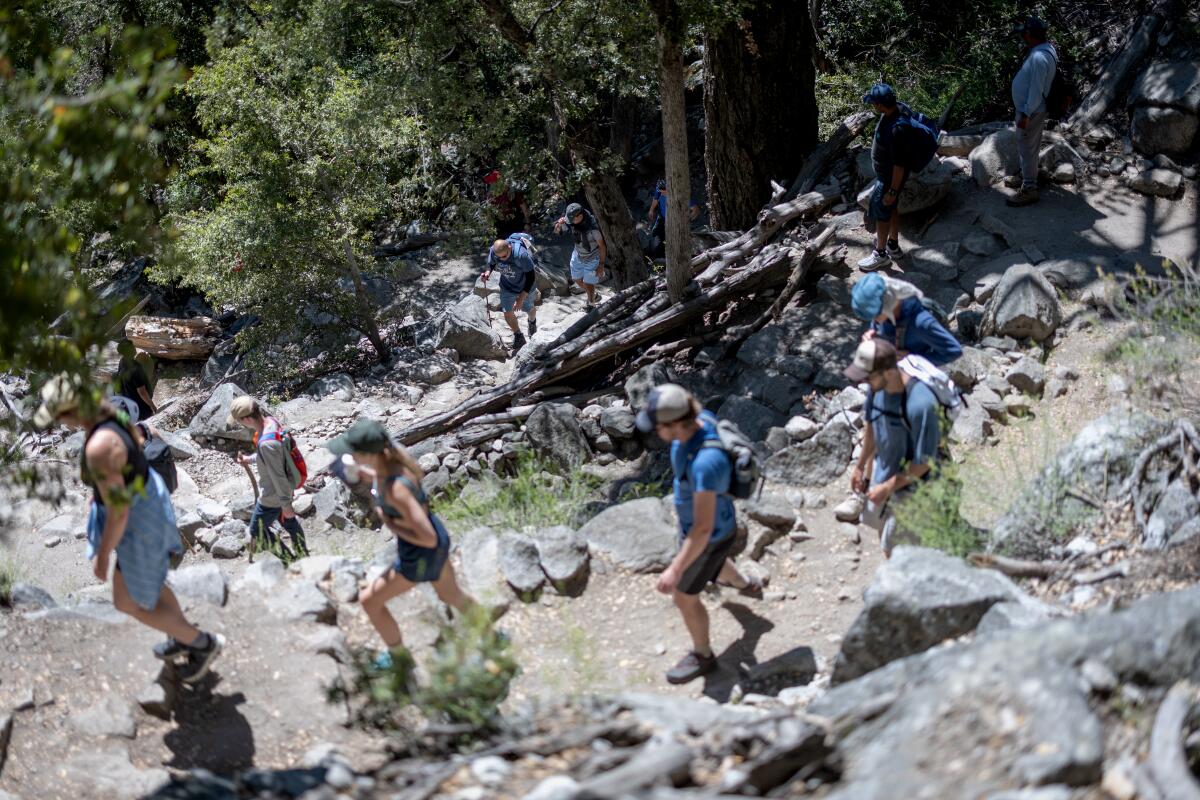
On the way down from that vantage point, Upper Yosemite Falls Trail, which was practically empty at 9 a.m., had turned into a human conveyor belt by 11 a.m. Hundreds of people trudged up the steep switchbacks in single file.

People hike the Upper Yosemite Falls trail in Yosemite National Park on Saturday.
(Eric Thayer/Los Angeles Times)
That’s what’s giving parks enthusiasts heartburn this spring.
Even before the summer rush, which begins in earnest in a few days with Memorial Day weekend, California’s most visited national park is seeing enormous crowds. There have been more than 836,000 visits so far in 2026, according to National Park System data — about 100,000 more than this time last year.
The reason, according to parks advocates, is the Trump administration’s decision to abandon a reservation system implemented in 2020 to limit crowds during the COVID-19 pandemic. The system has been used on and off since then to help control the number of visitors and preserve a sense of natural tranquility.
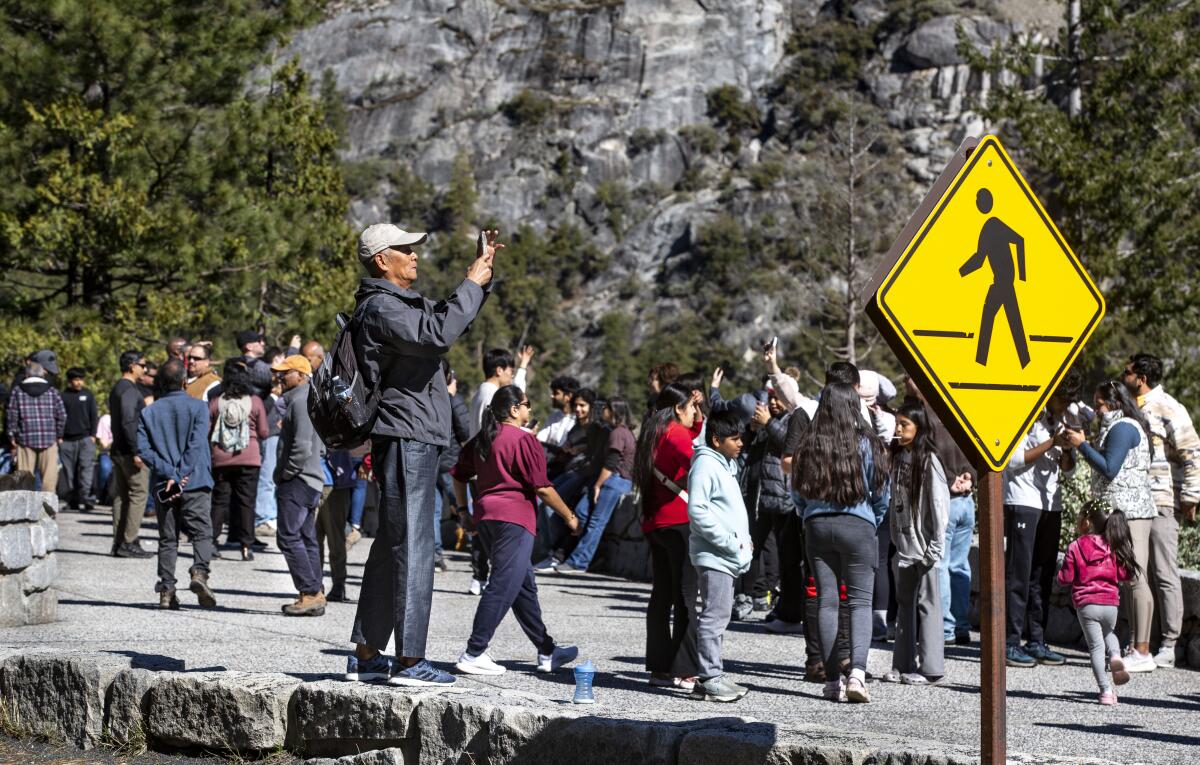
On Saturday, there seemed to be an uneasy balance: The crowds were large but well-managed, with some visitors worried about the months ahead.
On the valley floor, as hundreds of people pressed together to gaze in awe at Lower Yosemite Falls, Jeff Wilson of Folsom said he was having flashbacks to 2023, the last time the park allowed entry without permits.
“It was just absolute bumper-to-bumper traffic all the way around the loop. Zero places to park, cars just circling all day, and people pulling off into just random spots,” Wilson said. “It was an absolute mess.”

People walk to the bottom of Yosemite Falls in Yosemite National Park on Saturday.
(Eric Thayer/Los Angeles Times)
There were echoes of that everywhere on Saturday. Parking lots filled up fast — the lot at Curry Village was full by 8 a.m. — and cars were stashed in every unmarked flat spot their owners thought they could get away with.
Once people found somewhere to leave their cars, they didn’t dare move them. Most relied on the free shuttle that circles the valley floor. The big white buses were jammed to capacity by midday, as were the bus stops, where people often had to wait for several shuttles to pass before one arrived with room.
Still, the lines were reasonable to enter the park and pay the fee — $35 per car for U.S. residents and President Trump’s new $100 per person extra charge for foreigners. That means a family of four from abroad would have to pay $435.
People who arrived very early breezed through the toll booths, and even those who showed up after 9 a.m. said they waited only about 15 to 30 minutes. That was a dramatic improvement over recent weekends, when social media lit up with complaints of hour-and-a-half ordeals.
Traffic flowed slowly but smoothly on the main paved roads around the valley floor. There was the occasional outburst as angry drivers leaned heavily on their horns, filling the peaceful meadow with a sudden blast of urban agita, but in general, things remained calm.
“We thought it would be more crowded,” said Laura Yuen, from the Bay Area. “But it’s actually manageable. We’re on bikes, and people are making room and are courteous.”
Arriving early and stashing the car was key for Yuen and her companion.
“A couple of sights have been crowded — those were the really touristy spots. But other than that, it has been beautiful,” she said. “This is a great time of year to come.”
Whether the good times will last once the high season begins is the question.

People board a shuttle in Yosemite National Park on Saturday.
(Eric Thayer/Los Angeles Times)
Since Trump returned to office in 2025 and unleashed Elon Musk’s Department of Government Efficiency on the federal work force, the National Park System has lost nearly a quarter of its employees to layoffs and buyouts, according to the nonprofit National Parks Conservation Assn.
And the Trump administration has proposed about 3,000 more job cuts — roughly another 25% — in the coming year. Trump has also proposed slashing nearly $800 million from the park system’s roughly $3-billion operating budget.
All of which risks tipping the delicate balance into chaos and gridlock, critics warn.
By 2 p.m., a flashing sign at the entrance to Curry Village advised that the parking lot was full and directed people to try their luck elsewhere.
Still, dozens of drivers crept around the lot, hoping to pounce if someone pulled out. It looked like an especially depressing way to spend an afternoon surrounded by some of the most celebrated natural wonders on Earth.
Kunal Khandwala of San José was among those searching for a spot until he gave up and pulled over, blocking a few cars but ready to move if their owners returned and needed to leave.
His friends had hopped out and joined the line at the Curry Village Pizza Deck, waiting to grab some food and go find a quiet spot for a picnic — far from the village.
The situation was “testing,” Khandwala said, but not intolerable if you relaxed and remained patient.
And anything was better than subjecting yourself to the shuttle, he joked.

People raft down the Merced River with Yosemite Falls in the background in Yosemite National Park on Saturday.
(Eric Thayer/Los Angeles Times)
“The waits are insane,” he said, pitying people who had only a day in the park and were hoping to hit all of the highlights by bus. “There’s no way. You’re not going to see everything you want if you rely on the shuttle.”
Parks officials were unable to provide the number of visitors who arrived on Saturday, or compare that to the crowds on recent weekends.
But with Memorial Day looming, this weekend felt like the calm before the storm.
Which is why Wilson, the frequent visitor from Folsom, said he is “very, very much pro-reservation. It is a hassle — you have to plan ahead — but it just makes it a better experience for everybody.”
He had also brought his bike, which seemed to be the best way to elude the masses.
“This is my favorite place in the world, no matter what the crowds are like,” he said before pedaling off. “As long as you can get in, come, have a good time, you’ll love it.”