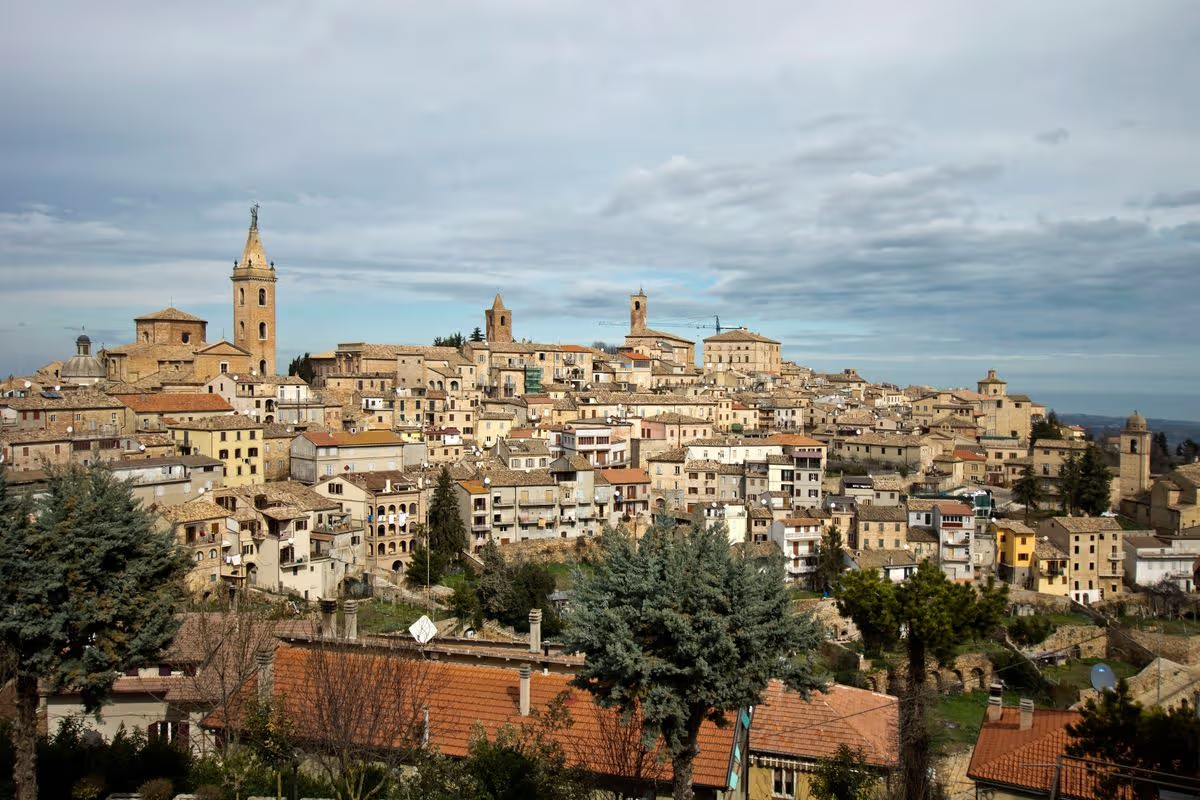
A small hilltop town in Italy is home to stunning panoramic views and a wealth of history – but many tourists are flocking to it for something quite different

(Image: Universal Images Group via Getty Images)
For those who want a challenge, there’s an alleyway is a gorgeous town in Italy that stands at just 43 centimetres wide – but amazingly that’s not the world’s narrowest.
The incredibly slender street is in Ripatransone, a small village in the province of Ascoli Piceno in the Marche region in central Italy, known for its breathtaking views and medieval, renaissance and baroque style buildings.
And, of course, famous for the incredibly narrow alleyway at Via Francesco Lunerti, 14 which has gained significant notoriety as a result of social media and has people flock from far and wide to see it. The narrowest part is only 38 centimetres wide before it widens, funnel-like, to 43 centimetres.
The alleyway received official certification from the local Tourism Office and has a dedicated tourism sign so visitors can find it easily, near Piazza XX Settembre and Via Margherita.
READ MORE: Quintessential English town is like stepping back in timeREAD MORE: New passport rules come into force for Brits today – 5 key things you need to know
Originally a service passage between two medieval houses, over time planning modernisation meant the space between the properties was reduced as a result of building expansion – paving the way for it to become Ripatransone’s main attraction.
However, the beautiful village is more than just a small walkway. A hilltop village situated between the valleys of the Menocchia torrent and the Tesino rover, Ripatransone has a stunning panoramic view of its surrounding landscape and boasts a rich historical and artistic heritage.
As one of the oldest and most important centres in the province of Ascoli Piceno, the historic centre is medieval in its layout with buildings from 19th Century and noble palaces which run lengthwise from north to south for about one kilometre.
READ MORE: Spain holiday island warning as threat of plague grows worse
The neighbourhoods sport a myriad of narrow streets and alleys which open out onto small squares with characteristic nooks and crannies.
Of course, none of the alleys are quite as narrow as the 43 centimetres-wide space which actually took the title as Italy’s narrowest from Via Baciadonne in Citta della Pieve in the province of Perugia in central Italy which stands at 53 centimetres. It was given the title in 1968 which Professor Antonion Giannetti surveyed all the alleyways in the historic centre.
However, despite its incredibly slight size, the alley in Ripatransone does not hold the world record for the narrowest. That belongs to an alleyway in the hilltop town of Gassin in the heart of the Saint-Tropez peninsula in southeastern France.
At its narrowest point, that alleyway is only 29 centimetres wide and National Geographic has dubbed it the narrowest alley in the world. As for streets officially registered in the land registry, the narrowest in the world is Spreuerhofstraße in Germany which sits at 31 centimetres wide.
Ensure our latest stories always appear at the top of your Google Search by making us a Preferred Source. Click here to activate or add us as your Preferred Source in your Google search settings.