Muslim

After San Diego shooting, Muslim Americans aim to turn grief into action | Islamophobia News

Baltimore, United States – Muslim Americans are grieving after two gunmen last week opened fire at the Islamic Center of San Diego, killing three people.

But at the annual conference for the Islamic Circle of North America (ICNA) in Baltimore, community leaders stressed the urgency of turning the sorrow into action.

Recommended Stories

list of 3 itemsend of list

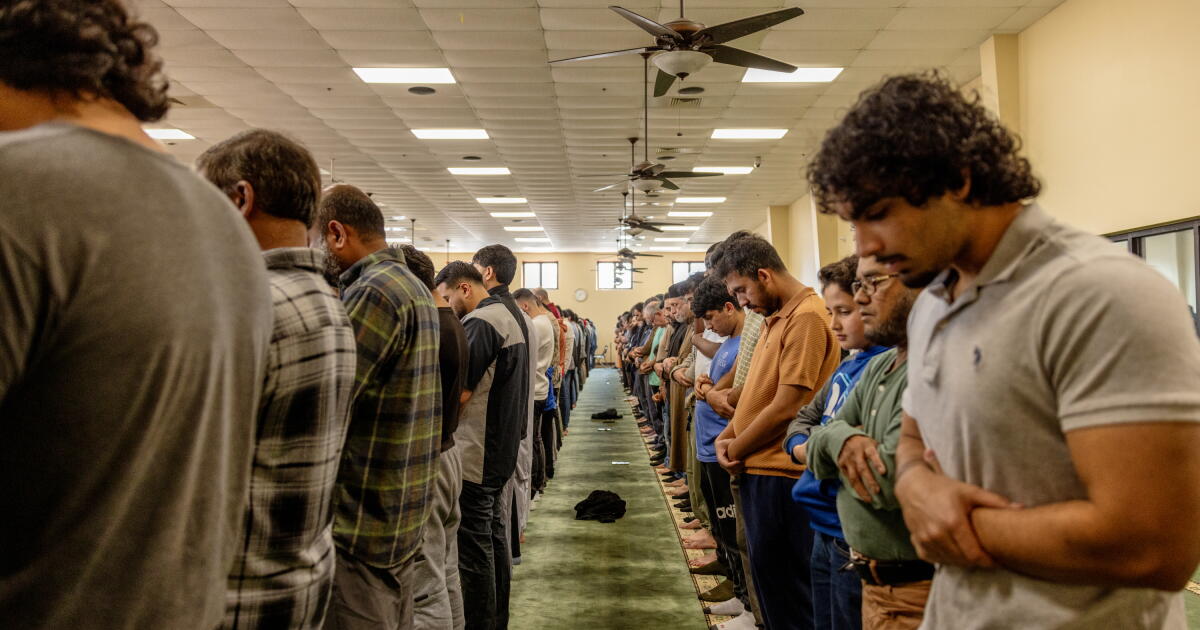
Nearly 25,000 people turned out for the annual event, held on Saturday and Sunday. Speakers addressed the recent shooting, pointing to the courage of the three victims as examples for the broader community in a time of heightened Islamophobia.

“We owe them more than condolences. We owe them resolve,” said Lena Masri, a lawyer at the Council of American-Islamic Relations (CAIR).

She explained how the victims — a security officer, a caretaker and a neighbour — sacrificed their lives to save others. The security officer, Amin Abdullah, exchanged fire with the shooters, while the other two victims, Mansour Kaziha and Nadir Awad, rushed to help and called for emergency services.

“They protected the physical space of our community: the masjid [mosque], the school, the children, the teachers, the worshippers,” Masri explained.

“Our responsibility is to protect the civic space of our community: the right to worship, the right to speak, the right to organise, the right to defend Palestine, the right to build institutions.”

That was the recurring theme of the conference: that the Muslim American community cannot afford to be passive and must draw on its strength to push back against bigotry and hate.

Speakers emphasised voting, organising and donating to community institutions and candidates who align with Muslim Americans. They also underscored the need to hold officials accountable and push for an end to Israel’s atrocities in Palestine.

“We owe Gaza more than grief. We owe Gaza advocacy that cannot be intimidated into silence,” Masri said.

Islamophobia and Palestinians’ dehumanisation

Symbols of Palestine could be seen everywhere at the conference, from bags emblazoned with watermelons and flags to keffiyeh-patterned scarves, shirts and water bottles.

At a bazaar featuring dozens of vendors, conference-goers left messages of solidarity on a tent that will be sent to Gaza by the charity Life for Relief and Development (LIFE).

In speeches and on panels, advocates drew a link between anti-Muslim bigotry in the United States and Israel’s abuses in Gaza, the occupied West Bank and Lebanon.

Some of the loudest promoters of Islamophobia in the US are also staunch Israel supporters, among them right-wing commentator Laura Loomer and Congressman Randy Fine.

Both Loomer and Fine are allies of US President Donald Trump, whose administration has unleashed a crackdown to deport critics of Israel who live in the US but are not citizens.

Altaf Husain, a professor at the Howard University School of Social Work, said anti-Palestinian voices are trying to “scare” Muslims as a means of silencing criticism of Israel.

“They want to shut this down, so it’s a direct connection,” Husain told Al Jazeera.

He said the large turnout at the ICNA conference shows that the community is not intimidated and will not back down.

In the response to the shooting in San Diego, Husain pointed out that the community raised more than $3.5m for the victims’ families and moved to bolster security around Muslim institutions.

People sign tent
ICNA conference attendees on May 24 write messages of solidarity on a tent to be sent to Gaza [Ali Harb/Al Jazeera]

Layers of security

Saad Kazmi, the president of ICNA, said the organisation relied on three layers of protection to secure this weekend’s event: its own security guards, an outside firm and local law enforcement agencies in Baltimore.

While there is anxiety in the community over the rise of Islamophobia and Trump’s immigration crackdown, he said Muslim Americans must take matters into their own hands and work with “sensible” people across the political spectrum to defeat hate.

“We are very thankful that we live in a country that is ruled by the Constitution and law,” Kazmi told Al Jazeera.

Kazmi added that the shooting in San Diego only added to the community’s determination to assert and protect its rights. The Islamic centre in the city, he noted, did not shut down after the attack.

“If anything came out of this, it is that there are more attendees to the masjid, more people who believe that the way forward is to strengthen ourselves, strengthen our community and march on,” Kazmi said.

After the shooting, Loomer doubled down on her anti-Muslim rhetoric, calling on immigration authorities to target the Islamic Center of San Diego.

She also called for the deportation of all Muslims from the US, describing them as an “invasive species”. But few Republicans disavowed Loomer, who maintains close ties to the White House.

Rather, more than 60 Congress members have joined the Sharia-Free America Caucus since it was established in December. CAIR has designated the caucus a hate group.

At the state level, governors and local legislators have disparaged Islam while also pushing to penalise Palestinian rights activism.

Texas and Florida, for example, have labelled CAIR a “terrorist” group, while implementing measures against “Sharia law” that critics consider anti-Muslim dog whistles.

Rights under attack

In March, after CAIR sued Florida Governor Ron DeSantis over its “terrorist” designation, a federal court blocked the label from being imposed.

In his ruling, Judge Mark Walker wrote that DeSantis’s executive order (EO) targets the Muslim community as a whole.

“It should be lost on no one that Defendant’s EO targets one of America’s largest Muslim civil rights organizations for indirect suppression of speech. But, as we all know, it is easy for those in power to target minority groups with little pushback,” Walker wrote.

“Sadly, history teaches that it is often minority religious groups who find themselves in the crosshairs.”

On Saturday, several panels praised the US legal system and the laws that protect freedom of religion and speech. But the panellists argued that human rights do not defend themselves; people must step up to protect them.

“You’ve got to imagine rights are a territory, and you have to occupy that territory. If you do not actively occupy that territory, that territory will be taken from you. And that is exactly what has been happening,” Tom Facchine, an imam from New Jersey, said.

Last year, Palestinian immigrant Leqaa Kordia found her rights in jeopardy when immigration agents knocked on her door and detained her over her activism against Israel’s genocidal war in Gaza.

Kordia spent more than a year in Immigration and Customs Enforcement (ICE) detention before an immigration judge ordered her to be released in March.

But Kordia — who is still fighting deportation — told ICNA conference attendees on Saturday that she has no regrets, encouraging them to remain politically active and engaged.

“Speaking up, it comes with a cost … It cost me my health, my life, literally my freedom, and I’m living in uncertainty that tomorrow I’m going to be here, or I’m going to be deported,” she said.

“It comes with a cost, but it’s worth it. It’s worth it because silence, it costs even way more than speaking.”

Source link

When are Hajj and Eid al-Adha 2026? A visual guide to the Muslim pilgrimage | Religion News

Nearly 2 million Muslims are preparing to embark on the annual Hajj pilgrimage to Mecca, which begins on May 25, following the sighting of the crescent moon in Saudi Arabia.

The Hajj is the largest annual gathering of Muslims from all over the world and a once-in-a-lifetime journey for many. It is also the fifth pillar of Islam.

Recommended Stories

list of 4 itemsend of list

In this visual explainer, we look at how Muslims perform the Hajj, including the key steps, rituals and preparations.

What is Hajj?

The Hajj is the annual pilgrimage to Mecca, Saudi Arabia. It is the fifth and final pillar of Islam, along with the declaration of faith (shahada), five daily prayers, obligatory charity (zakat), and fasting during the month of Ramadan.

The word comes from the Arabic root “h-j-j”, which means “intending a journey” or “to set out for a definitive purpose”.

It is obligatory once in a lifetime for all adult Muslims who are physically and financially able to undertake the journey.

Interactive_Hajj_2026_Five_Pillars

When is the Hajj performed?

The Hajj is performed between the 8th and 12th (or 13th) of Dhul-Hijjah, the 12th and final month of the Islamic calendar.

The timing falls roughly 70 days after the end of Ramadan, though this can vary slightly depending on the lunar cycle.

In 2026, the Hajj will take place from May 25 to May 27, but many pilgrims arrive in Saudi Arabia weeks before to prepare for the journey.

Because the Islamic calendar follows a lunar cycle, with months lasting 29 or 30 days, the Hajj shifts 10 to 12 days earlier each year in the Gregorian calendar.

Interactive_Hajj_2026_3-02-1779033341

Why do Muslims perform the Hajj?

Muslims believe that the Hajj is a direct commandment from God, as outlined in the Quran.

Prophet Muhammad’s “farewell pilgrimage” in 632 AD affirmed the steps in the 10th year of the Islamic calendar, and it is mentioned in the Quran nearly a dozen times.

The Hajj begins before pilgrims even enter Mecca.

The journey is a spiritual one, and it is considered to allow Muslims to seek forgiveness, purify their souls and demonstrate their submission to God.

How is the Hajj performed?

Muslims perform many rites and rituals during the five days of Hajj, which can be explained in the following steps.

Interactive_Hajj_2026_Rituals of Hajj

Day 1

Ihram: Entering the pilgrimage

Before entering Mecca, pilgrims enter a sacred state known as ihram. After making the intention to perform the Hajj, men change into two white garments and women wear modest attire. The basic clothing symbolises equality, humility, and unity before God, where differences of nationality, wealth, and status disappear.


Husin bin Nisan, center, with other worshippers, prepares to wear a special garb called "ihram," typically worn during hajj pilgrimage, prior to a hajj rehearsal in Tangerang, Indonesia, Monday, May 15, 2023. After spending more than three decades picking tips from motorists, the 85-year-old volunteer traffic attendant is finally realizing his dream to go to the Islamic holy cities of Mecca and Medina for hajj pilgrimage. (AP Photo/Achmad Ibrahim)
Husin bin Nisan, centre, with other worshippers, prepares to wear a special garb called ihram, typically worn during the Hajj pilgrimage, prior to a Hajj rehearsal in Tangerang, Indonesia [File: Achmad Ibrahim/AP Photo]


2. Tawaf: Circling the Kaaba

After entering Mecca, pilgrims circle the Kaaba – a cubic building at the Masjid al-Haram (Grand Mosque) that serves as the qibla, the direction Muslims face during prayer – seven times in a counterclockwise direction. This shared rhythm symbolises unity in the worship of the One God.

AP24163687893997-1779025568
Muslim pilgrims circle the Kaaba, the cubic building at the Grand Mosque, during the annual Hajj pilgrimage in Mecca, Saudi Arabia, on June 11, 2024 [Rafiq Maqbool/AP Photo]

Interactive_Hajj_2026_Kaaba

3. Sa’i: Walking between Safa and Marwah

Pilgrims can then perform the sa’i, a ritual of walking seven times between the hills of Safa and Marwa.

The ritual retraces the search for water in the desert valley of Mecca by Prophet Abraham’s (Ibrahim) wife, Hagar (Hajar), for their son, Ishmael (Ismail), before the Zamzam well emerged.

In Islamic tradition, this well has supplied pristine water in the arid desert for more than 4,000 years and continues to nourish pilgrims to this day.

SAUDI-RELIGION-ISLAM-RAMADAN
Muslim worshippers walk between the Marwa and Safa hills at the Grand Mosque in Saudi Arabia’s holy city of Mecca [File: Abdel Ghani Bashir/AFP]

Interactive_Hajj_2026_Zamzam

4. Mina: The tent city

Pilgrims then proceed to Mina, about 8km (5 miles) east of the Kaaba, where they will spend the night in prayer and reflection.

Mina is famously known as the “city of tents” due to the vast expanse of 100,000 white tents to house the millions of pilgrims.

AP22191439966011-1779026116
Tents for Muslim pilgrims fill the Mina tent camp during the Hajj, in Mecca, Saudi Arabia, on July 10, 2022 [Amr Nabil/AP Photo]

Day 2

5. Arafat: The central day of Hajj

On the second day of the Hajj, pilgrims arrive early at the plains of Mount Arafat, about 15km (9 miles) from Mina. They spend the afternoon in wuquf (standing) from midday to sunset, praying, and repenting.

Arafah is the most important ritual of the Hajj and symbolises a preview of the Day of Judgement. Muslims worldwide are encouraged to fast on this day and engage in prayer and reflection.

AP25156596193976-1779026190
Muslim pilgrims gather on top of the rocky hill known as the Mountain of Mercy, on the Plain of Arafat, during the annual Hajj pilgrimage near the holy city of Mecca, Saudi Arabia, on June 5, 2025 [Amr Nabil/AP Photo]

6. Muzdalifah: Sleeping under the open sky

After sunset, pilgrims travel to Muzdalifah, 9km (5.5 miles) away. There, they perform maghrib and isha prayers before collecting pebbles for the next day’s ritual.

SAUDI-RELIGION-ISLAM-HAJJ
Muslim pilgrims rest after arriving at Muzdalifah, before heading to Mina during the annual Hajj pilgrimage, on June 27, 2023 [Sajjad Hussain/AFP]

Day 3

On this day, Muslims from around the world celebrate the first day of Eid al-Adha, or the celebration of the sacrifice.

From the early hours of the morning, pilgrims perform a series of rituals, starting with walking back to Mina.

Muslim pilgrims walk on their way to cast stones at pillars in the symbolic stoning of the devil, the last rite of the annual Hajj, in Mina near the holy city of Mecca, Saudi Arabia, Friday, June 6, 2025. (AP Photo/Amr Nabil)
Muslim pilgrims walk on their way to cast stones at pillars in the symbolic stoning of the devil, the last rite of the annual Hajj, in Mina, near the holy city of Mecca, Saudi Arabia, on June 6, 2025 [Amr Nabil/AP Photo]

7. Stoning of the pillars

Pilgrims enter Mina, where they throw seven pebbles at the largest of three stone pillars. This ritual represents the stoning of the devil, which symbolises the rejection of Satan’s temptations.

Muslim pilgrims cast stones at pillars in the symbolic stoning of the devil, the last rite of the annual Hajj, in Mina near the holy city of Mecca, Saudi Arabia, Friday, June 6, 2025. (AP Photo/Amr Nabil)
Muslim pilgrims cast stones at pillars in the symbolic stoning of the devil, the last rite of the annual Hajj, in Mina near the holy city of Mecca, Saudi Arabia, on June 6, 2025 [Amr Nabil/AP Photo]

8. Sacrifice during Eid al-Adha

Pilgrims, or agents on their behalf, offer an animal sacrifice in remembrance of Abraham’s willingness to sacrifice his son in obedience to God.

9. Cutting or shaving hair

Men shave or trim their heads, and women cut a small portion of their hair. This symbolises spiritual renewal.

Muslim pilgrims have their heads shaven by barbers upon leaving Muzdalifah after throwing pebbles as part on the symbolic al-Aqabah (stoning of the devil ritual) at the Jamarat Bridge during the Hajj pilgrimage in Mina, near Saudi Arabia's holy city of Mecca on August 11, 2019. (Photo by FETHI BELAID / AFP)
Muslim pilgrims have their heads shaved by barbers upon leaving Muzdalifah, after throwing pebbles as part of the symbolic al-Aqabah (stoning of the devil ritual) at the Jamarat Bridge during the Hajj pilgrimage in Mina, near Saudi Arabia’s holy city of Mecca on August 11, 2019 [Fethi Belaid/AFP]

10. Main tawaf

Pilgrims return to Mecca to perform tawaf, circling the Kaaba, followed by sa’i, walking seven times between the hills of Safa and Marwa.

Muslim pilgrims walk around the Kaaba, the cubic building at the Grand Mosque, during the annual Hajj pilgrimage, in the Muslim holy city of Mecca, Saudi Arabia, Wednesday, June 4, 2025. (AP Photo/Amr Nabil)
Muslim pilgrims walk around the Kaaba, the cubic building at the Grand Mosque, during the annual Hajj pilgrimage, in the Muslim holy city of Mecca, Saudi Arabia, on June 4, 2025 [Amr Nabil/AP Photo]

Days 4 and 5

Pilgrims return to Mina and perform rami (stoning) of all three stone pillars on each day. Pilgrims who remain for an extra day repeat the stoning ritual at all three pillars once more.

Before leaving Mecca, pilgrims perform a final tawaf around the Kaaba, known as the tawaf al-wada or a “farewell tawaf”, signifying a spiritual farewell to the holy sanctuary.

How do Muslims mark the end of Hajj?

Muslims mark the end of the Hajj with Eid al-Adha, celebrated on the 10th of Dhul-Hijjah and lasting up to three days in many countries.

The day begins with a special prayer shortly after sunrise, as Muslims gather in mosques or open areas, wearing their finest clothes. The rest of the day is spent sharing meals, exchanging gifts, and visiting family and friends. The greeting “Eid Mubarak”, meaning “Blessed Eid,” is commonly exchanged.

Eid al-Adha also involves the ritual of animal sacrifice, known as Qurbani. Muslims who are able to do so sacrifice a sheep, goat, cow or camel, and the meat is divided into three parts: one for the family, one for relatives and friends, and one for those in need.

Interactive_Hajj_2026_WHEN_IS_EID

Source link