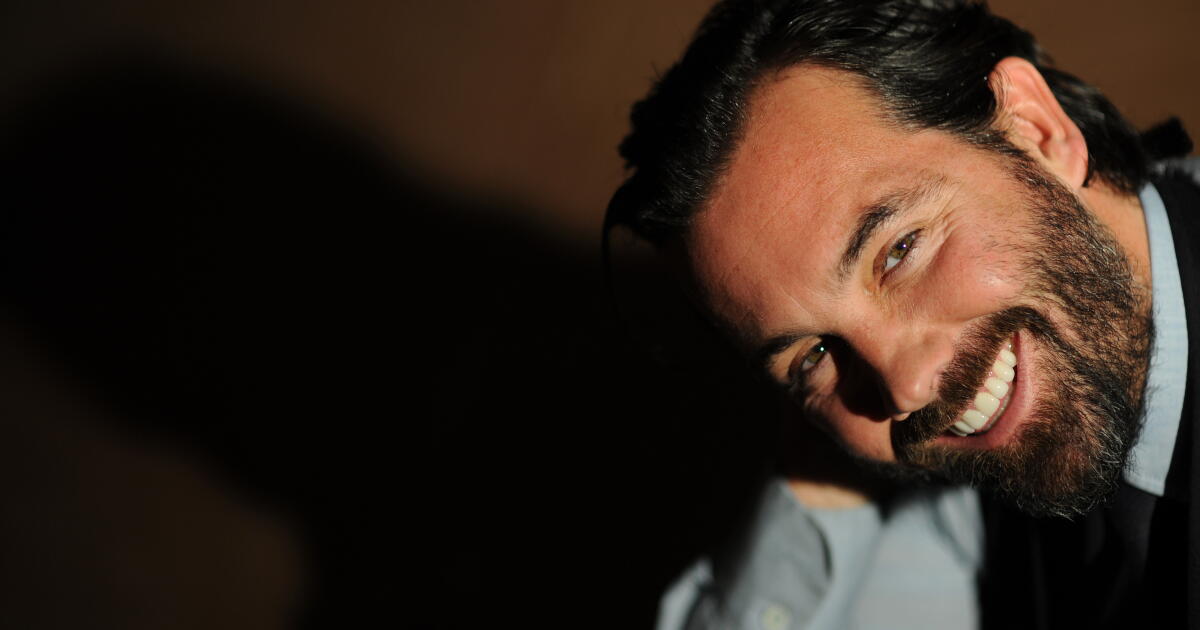
Macklemore says ‘being apolitical during a genocide doesn’t work’, promises to donate proceeds to Palestinian causes.
Grammy Award-winning rapper Macklemore has announced a string of shows in support of Palestine after he was controversially dropped from Ed Sheeran’s United States tour after speaking out against Israel’s genocidal war on Gaza.
The 43-year-old American rapper, who has almost 40 million monthly listeners on Spotify, announced his Free Palestine Tour on Thursday, with shows set to take place in Dublin, Paris and London in late October.
Recommended Stories
list of 3 itemsend of list
Macklemore said he will be joined by other musicians and will announce their names soon. He added that US shows are currently being organised.
He said all proceeds raised from the tour will be donated to causes supporting the Palestinian people and the wider movement.
“If these last couple of weeks have shown us anything, it’s that something has shifted over the last three years,” Macklemore said in a statement.
“There has been a collective awakening around Palestinian liberation, the power of billionaires that try to censor that call, and what we expect from artists right now. It’s 2026. Being apolitical during a genocide doesn’t work anymore,” he continued.
“People are asking artists to show up, educate themselves and be in community. To use the stage for more than entertainment. To push back when the call for a Free Palestine is met with attempts to silence it.”
English punk rap duo Bob Vylan have expressed their support for the tour, responding to Macklemore’s Instagram post with a heart emoji. The British YouTuber and influencer known as Chunkz, who has more than four million followers on Instagram, also praised Macklemore.
Attempts to silence Macklemore
On September 4 at New Jersey’s MetLife Stadium, Macklemore, who was one of Sheeran’s opening acts, expressed support for Palestine.
“A big part of the reason why I wanted to do this tour in the first place is so I could stand up in stadiums like this and say two words that are very near and dear to my heart: ‘Free Palestine’ … My message is for peace; love for all human beings to be treated with dignity, respect, and equality,” Macklemore told the audience at the time.
Soon after, the rapper announced that he had been dropped from the Sheeran tour.
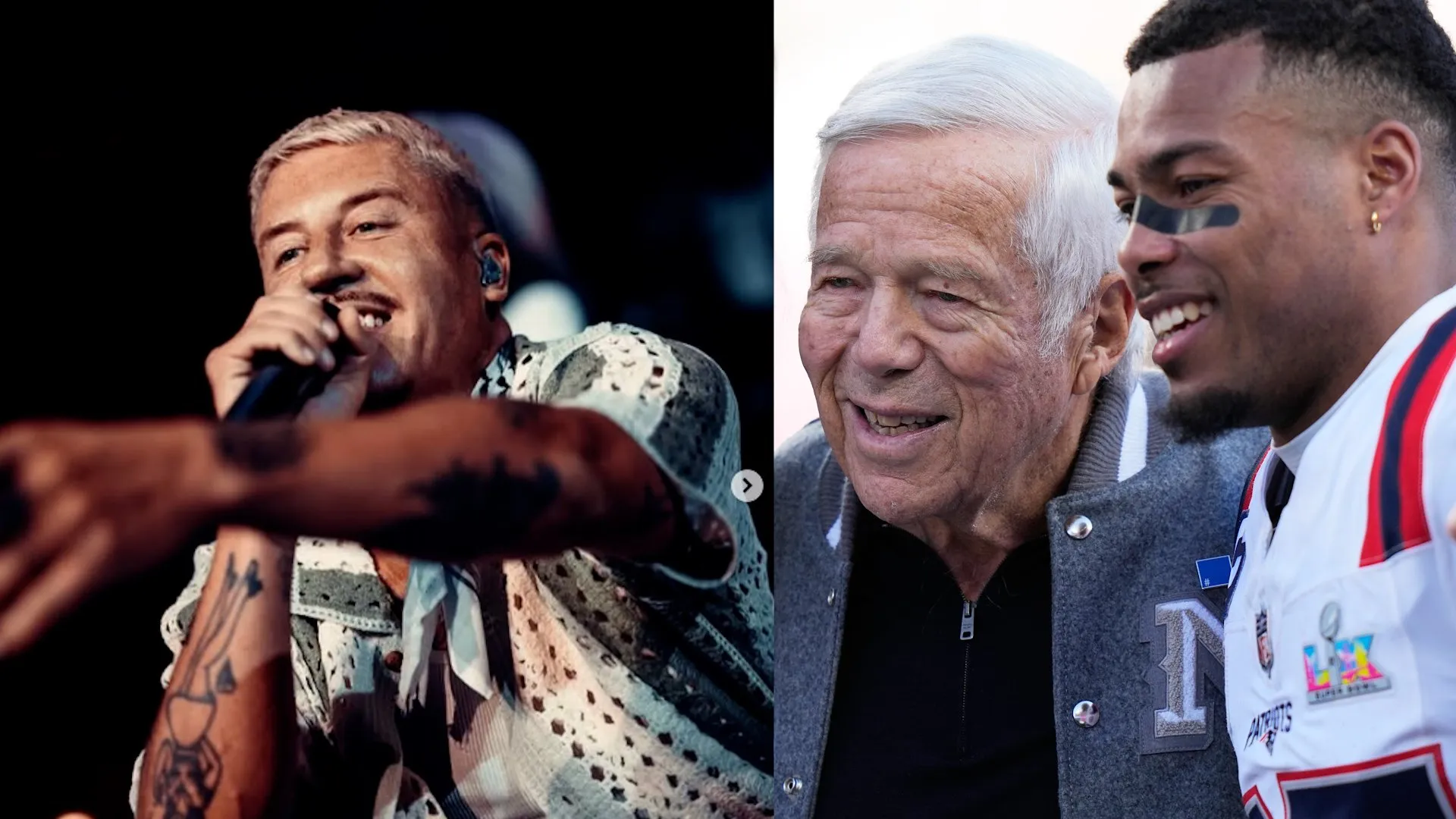
Venue owner Robert Kraft later confirmed that Macklemore was barred from performing at his Gillette Stadium in Foxborough, Massachusetts. Kraft denounced what he described as the rapper’s “broader history of antisemitic rhetoric and imagery” and argued that such actions led him to decide that allowing Macklemore to perform at his venue “would cross that line”.
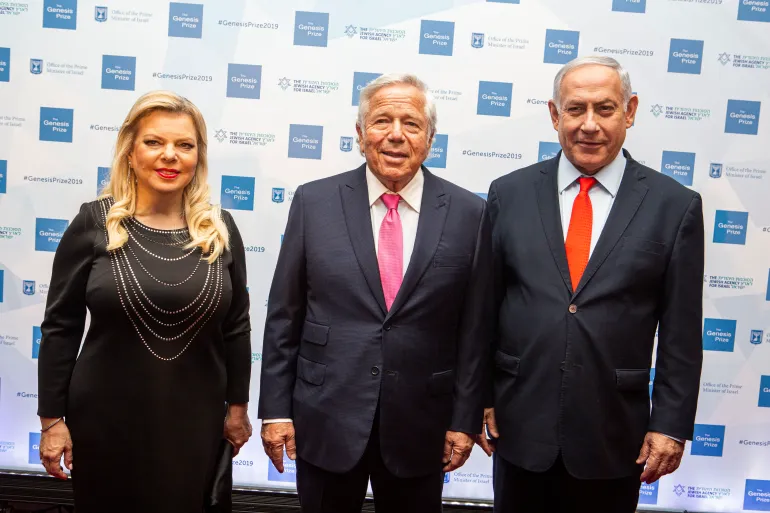
Kraft is a Jewish-American billionaire and has donated to several Israeli causes. Israeli Prime Minister Benjamin Netanyahu, who is the subject of an arrest warrant issued by the International Criminal Court (ICC) for war crimes and crimes against humanity, said in 2019 that Israel did not have a “more loyal friend” than Kraft.
From left, Sara Netanyahu, Robert Kraft and Israeli Prime Minister Benjamin Netanyahu at the Genesis Prize at The Jerusalem Theater on June 20, 2019 [File: Getty]
Macklemore claimed Sheeran and his team removed him from the tour following pressure from Kraft.
He alleged that Kraft rallied the owners of the remaining stadiums that the tour would include and persuaded them not to allow him to perform. The rapper said that Kraft then told Sheeran the tour would not go ahead unless he was dropped.
Neither Kraft nor Sheeran have commented on Macklemore’s allegations that stadium owners were contacted by Kraft.
Two years ago, the biggest record labels took artificial intelligence music generators to court for copyright infringement. Now several of them are licensing their catalogs to those same companies, and the deals are starting to turn into products.
The latest example came earlier this month, when Suno, an AI music company valued at $5.4 billion, released its first models built with licensed music from Warner Music Group, BMG and Believe. Rival Udio has licensing deals with Universal Music Group and Warner.
The companies are pitching AI as a new revenue stream for artists. But so far, none of them have disclosed what artists will be paid, how many artists have opted in, or how much input individual musicians have over whether their work is used. And some musicians and songwriters are fearful of how these AI deals might affect livelihoods.
“It’s sort of a creepy and ominous cloud,” said Matt Evans, a 35-year-old Pasadena resident who’s played brass instruments on shows like “The Late Late Show With James Corden” and Netflix’s “Dr. Seuss’s Red Fish, Blue Fish.” “The fact that I could do something once and then it could be reused, and if that’s not negotiated in a contract, then I never got to make a choice to receive additional compensation. It all comes down to the loss of money.”
The American Federation of Musicians sued Universal and Warner in June, alleging the labels licensed recordings its members played on to Suno and Udio without paying those musicians or telling the union which recordings were involved. The labels have moved to dismiss the case.
In 2024, Universal, Sony Music Entertainment and Warner sued Suno and Udio for copyright infringement, alleging the AI companies trained their models on copyrighted songs spanning many artists, genres and time periods. The settlements began the following year. Universal settled with Udio in October and became its partner, and Warner settled with both Udio and Suno in November, signing licensing deals with each.
“The reason why they would settle this is they think they’re going to profit more from licensing music to them rather than from the outcome of a lawsuit,” said Jane Davidson, an entertainment attorney at Nolan Heimann who specializes in copyright and trademark infringement.
More deals followed. Udio signed with Merlin, which licenses music on behalf of independent labels, and with independent publisher Kobalt. Suno signed with BMG in August and with Believe, owner of the DIY distribution platform TuneCore, this month. Spotify, which wasn’t part of the lawsuits, struck deals with Universal and Merlin.
Not everyone is settling. Sony filed a second lawsuit against Udio over more than 30,000 recordings, and it is still suing Suno alongside Universal, which is licensing its music to Udio and Spotify at the same time. Sony and Universal also filed a new lawsuit last week alleging that Suno’s latest model still infringes on their copyrighted works. In July, a Munich court ruled against Suno in a case brought by GEMA, which collects royalties for German songwriters and publishers.
The deals between labels and AI music platforms — on which consumers can create full songs from text prompts — share a basic promise. Artists signed to the participating labels can opt in and will be credited and paid.
But each company is building something different. Udio operates under a “walled garden” model favored by Universal, in which songs made on the platform can’t be downloaded or distributed elsewhere. Spotify’s tool, a planned paid add-on for Premium subscribers, has no launch date. Suno lets users download what they make and release it elsewhere, with download caps and watermarks meant to curb abuse; songs made with its new models can be distributed through Believe and TuneCore.
Whether an artist opts out depends on who owns the rights. Songs typically carry two copyrights — one for the composition, usually held by songwriters and their publishers, and one for the sound recording, usually owned by the label. Every contract is different, so it’s unclear how AI products will handle music where those rights are split.
Waveforms of audio files from various instruments are displayed on a computer screen during the making of an AI musical piece at Suno.
(Robert F. Bukaty / Associated Press)
“These companies are able to make deals on behalf of their artists, and their control over their music is pretty significant based on what major label contracts typically say,” Davidson said. “But I expect that we will have some artists that push back against this and say that they didn’t authorize the use of their music for this purpose.”
Warner’s agreement with Suno, for example, lets artists opt in to having their names, likenesses, voices and compositions used in AI-generated music. But Jack Brody, Suno’s chief product officer, acknowledged that labels “ultimately have their contracts in place that will have some say in what an artist can and can’t do.” It’s also not always clear whether opting out keeps an artist’s recordings out of AI training, or only out of fan-facing features.
Michelle Lewis, a songwriter and the co-founder and chief executive of the nonprofit Songwriters of North America, said the composition side of that copyright split is often the harder one to defend.
“With AI, it’s so much easier to tell if you’ve infringed on the sound recording. You know what Beyoncé and Drake’s voices sound like,” said Lewis, who wrote Cher’s “A Different Kind of Love Song,” Little Mix’s “Wings” and the music for the Disney Jr. show “Doc McStuffins.” “But songwriting is so much more nebulous, so much harder to sue.”
“From the creator side, nobody asked for this. We like our job,” added Lewis. “The job is the process and what makes it special, interesting and artful.”
Some musicians argue the deals can’t cover rights the labels don’t control. A proposed class action filed last month by Jason Isbell and other musicians alleges Suno lets users generate songs that evoke specific artists’ identities without their consent, a right-of-publicity claim the plaintiffs say belongs to performers no matter who owns their recordings. Suno disputes the claims.
Session musicians like Evans are pushing back through their union.
“By licensing our members’ performances to AI platforms like Suno and Udio without consent, credit, or compensation, companies like Universal, Warner Records, and Atlantic are bypassing the very human creators who made their catalogs valuable in the first place,” AFM International President Tino Gagliardi said in a statement.
The labels have disputed the claims and argue that these deals advance the interests of artists and songwriters.
Jonathan Wyner, head of artistic technology initiatives at Berklee College of Music’s Emerging Artistic Technology Lab, compared the AI deals to the arrival of streaming services. Wyner has advised Suno.
“It’s a good step, and I think it was an inevitable step, especially if you want to stay engaged with musicians and the creative community,” he said.
That comparison cuts both ways. Streaming grew the industry while fueling years of complaints about artist pay.
Damon Krukowski, a musician and the legislative director at United Musicians & Allied Workers, said the deals so far don’t seem to benefit working-class musicians and could be used to cut them out entirely.
“It’s a new technology, but it’s not a new corporate story,” Krukowski said. “But the tools are even more powerful. It seems within their possible reach to destroy the labor market. The major labels are just seeing dollar signs without any regard to the long-term health or sustainability of this industry, because they’re envisioning an industry without artists who can push back.”
Brody disputed that, saying Suno is building ways for independent and unsigned artists to benefit, such as its deal with Believe and TuneCore.
With terms under wraps, it’s too early to know whether any of this will pay off for artists. The tests are still ahead — whether Sony and Universal win or settle, and what the first payouts actually look like.
“A label making a deal and an individual artist having a choice are not necessarily the same thing,” said Drew Silverstein, the senior advisor for AI at music tech company BandLab Technologies. “Our music industry has a long history of new revenue streams coming into existence that benefit certain folks, and create great financial opportunities for rights holders.”
Duncan Sheik, who earned a Grammy nomination for his ubiquitous 1990s hit “Barely Breathing” and won a Tony Award for composing the music for “Spring Awakening,” died Thursday. He was 56.
“It is with profound sadness that we confirm the passing of Duncan Sheik,” a statement posted Friday on Sheik’s Instagram account read. “The world has a lost a singular talent, and deeply influential voice in music and theater…. Duncan’s artistry touched many and leaves an indelible mark on the cultural landscape.
“Duncan was a father, husband, son, brother, and friend. He will be remembered for his sensitivity, wit, inteligence, and depth of spirit he brought to those who knew and loved him.”
The statement added that “Duncan passed away last night surrounded by love.”
His mother, Suzanne Sheik, told the New York Times that her son died of organ failure. A statement posted to his Instagram account Thursday said that Sheik was “receiving medical care and remains in critical but stable condition.”
Sheik, a New Jersey native, went to Brown University, where he played in an early band with singer-songwriter Lisa Loeb. His 1996 self-titled debut LP was a hit on the strength of “Barely Breathing,” an exemplar of the upbeat coffeeshop rock that emerged in the wake of grunge on the pop charts. The single stayed on the Hot 100 for over a year, and the album went gold, earning earned him a Grammy nomination for male pop vocal performance.
Sheik’s followup, 1998’s “Humming,” featured rich orchestration, but he already had an eye on Broadway (his sister Kacie Sheik is a stage actor who has appeared in “Hair,” “American Idiot” and “Because of Winn-Dixie,” for which Duncan wrote the score).
He wrote his 2001 album “Phantom Moon” with poet and playwright Steven Sater, whom he’d again collaborate with on the score for the musical “Spring Awakening” — based on the play by German Expressionist Frank Wedekind, which won him a Tony Award — and “Alice by Heart.” His 2009 album “Whisper House” yielded a companion musical of the same name. He also composed the score for the 2004 film “A Home at the End of the World.”
While Sheik sought treatment for alcohol addiction after canceling a tour in 2011, his stage and studio career never slowed. Other major stage credits include hit productions of “American Psycho,” “Bob & Carol & Ted & Alice,” the thriller “Noir” and “The Secret Life of Bees,” along with Shakespeare’s “Twelfth Night” and “The Taming of the Shrew.” His last album, “Claptrap,” came out in 2022.
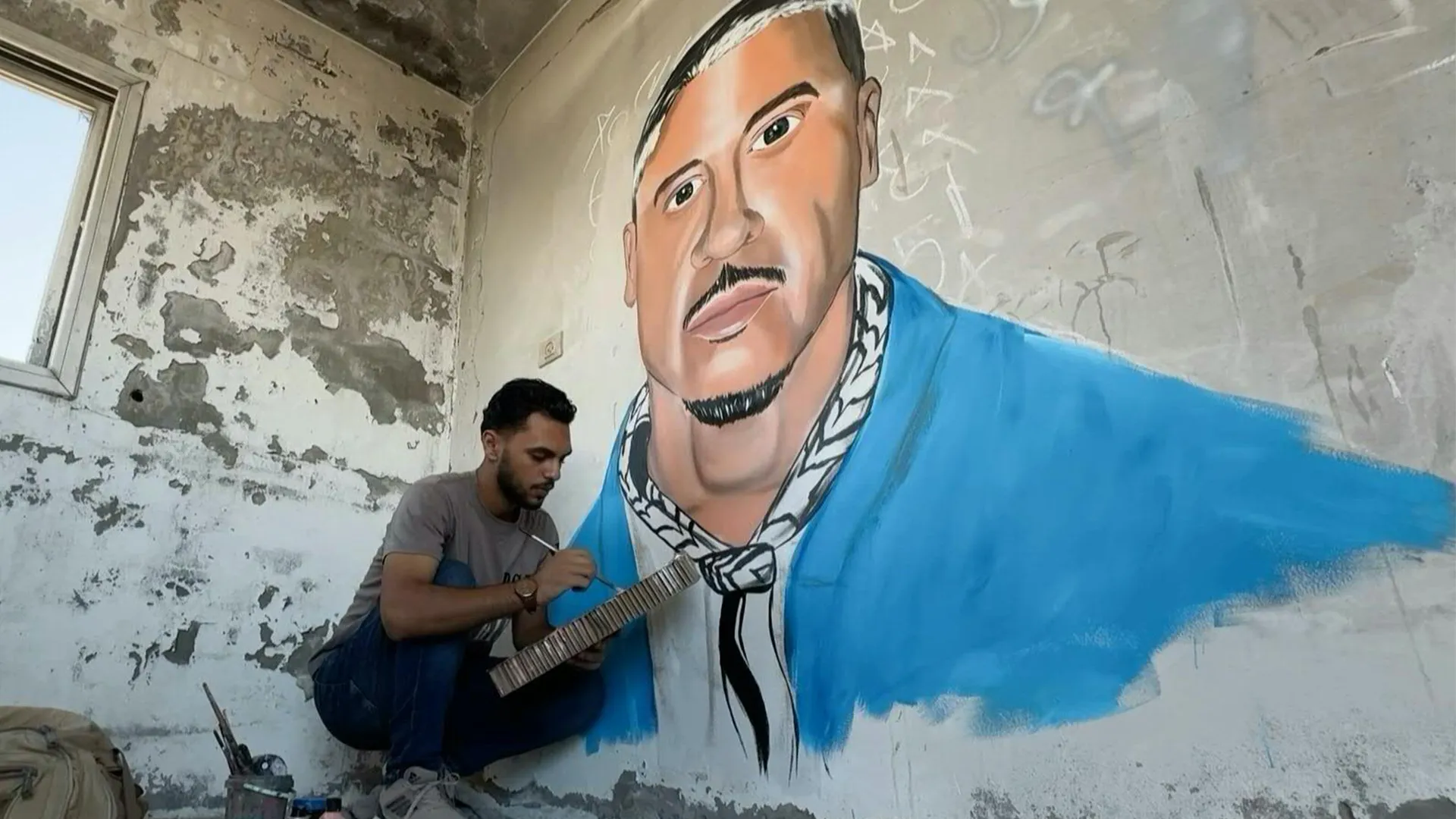
Artists in Gaza are painting murals on destroyed walls, honouring US rapper Macklemore for his support for Palestine. Despite a ceasefire agreement, Israel continues to kill Palestinians in frequent strikes across Gaza.
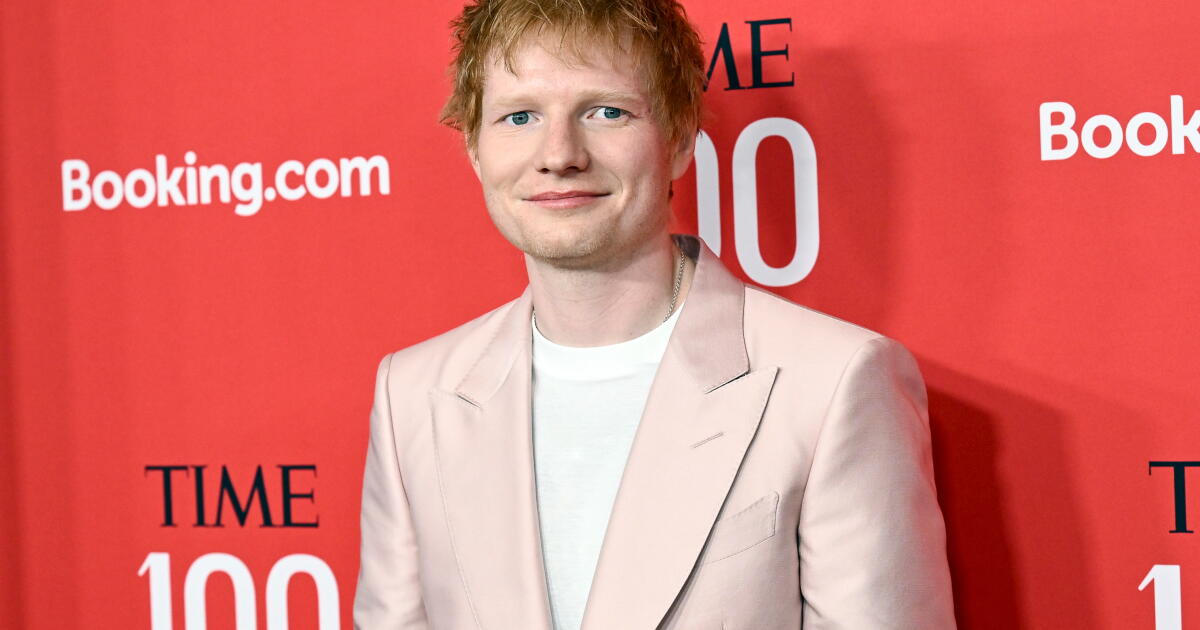
PHILADELPHIA — Ed Sheeran opened a solo concert in Philadelphia on Saturday with comments about Gaza, saying what’s happening is “catastrophic and unjustifiable.”
“My heart has been broken by the scale of devastation and loss of civilians’ lives, of children’s lives,” Sheeran said at his nighttime performance at Lincoln Financial Field.
Sheeran also said he wants his music and shows to be about unity and humanity, not politics.
He then addressed the controversy that unfolded since his supporting acts withdrew in solidarity with opener Macklemore, who was dropped from the tour after making pro-Palestinian comments onstage.
Sheeran has performed much of his Loop Tour concerts solo, but he had been joined for several songs at each stop by the Irish folk band Beoga. Macklemore, Sheeran’s original U.S. opener, had been replaced by Danish band Lukas Graham and Irish singer Aaron Rowe before they backed out.
Finneas, Billie Eilish’s brother and musical collaborator, was due to tour with Sheeran in South America later this year before he too dropped out earlier this week.
As of Saturday afternoon, tickets were still available for the show, and Sheeran’s website did not list any replacement acts.
Earlier a group of about 50 pro-Palestinian demonstrators congregated outside the stadium before the show. Hillary Steinberg, 34, of Philadelphia, said she got tickets a year ago but wound up getting a refund and attending the demonstration instead, disappointed that Sheeran had not taken a stand.
“I was, until this week, a big Ed Sheeran fan,” Steinberg said. “I think all art is political, and all music is political, and so this choice — even though he was saying that he wasn’t complicit — is a political choice.”
The show comes after a tumultuous week that opened with Macklemore being dropped in response to exclaiming “Free Palestine!” during a Sept. 5 show in New Jersey. Sheeran has said he was not responsible for the decision, which came at the urging of New England Patriots owner Robert Kraft. His company owns a stadium where Sheeran’s tour was scheduled to play Friday.
Within hours of Sheeran’s statement Tuesday, his supporting acts withdrew.
Diane Savitz, a 53-year-old concertgoer from Stroudsburg, Pa., got her tickets to the show months ago and is a big Sheeran fan. She said she does not think that he did anything wrong or that a concert is the place for politics.
“A concert should be for people enjoying the music. Music should bring people together,” Savitz said. “Everyone has their right to freedom of speech, but not every platform is the place for it.”
Macklemore said Wednesday he is donating $1 million to support Palestinian relief efforts and called on Kraft to match the gift; a spokesperson for Kraft has said the billionaire and Sheeran have each agreed to donate $2 million but have not specified where the money will be directed. Sheeran’s representatives have not responded to multiple requests for comment.
Sheeran’s Loop Tour was the highest-grossing in the world, with an average box office gross of over $7 million per city, Pollstar said in May. Through the end of 2025, Sheeran was the No. 3 top-earning concert act since 2021.
Sheeran has said the tour promoter was ultimately responsible for the decision to drop Macklemore.
The Grammy winner was adamant in his Tuesday statement that he wouldn’t be drawn into discussion of the war in Gaza, arguing that his fans don’t come to his shows to hear about these issues.
He also said he “spoke with the venues at length all week to try to build a bridge” before Macklemore was dropped. He insisted he would never willingly let down his fans or abandon the touring crew and others who rely on him to make a living.
While promoters and venues wield great power over concert tours, experts say an artist of Sheeran’s magnitude generally has the final say about what happens concerning the shows.
Sheeran told the crowd in Philadelphia that everyone is welcome at his concerts, and they can have opposing points of view while still singing his songs, which are about “love, hope, and unity.”
Vejpongsa writes for the Associated Press. AP journalist Jessica Hill in Las Vegas contributed to this report.
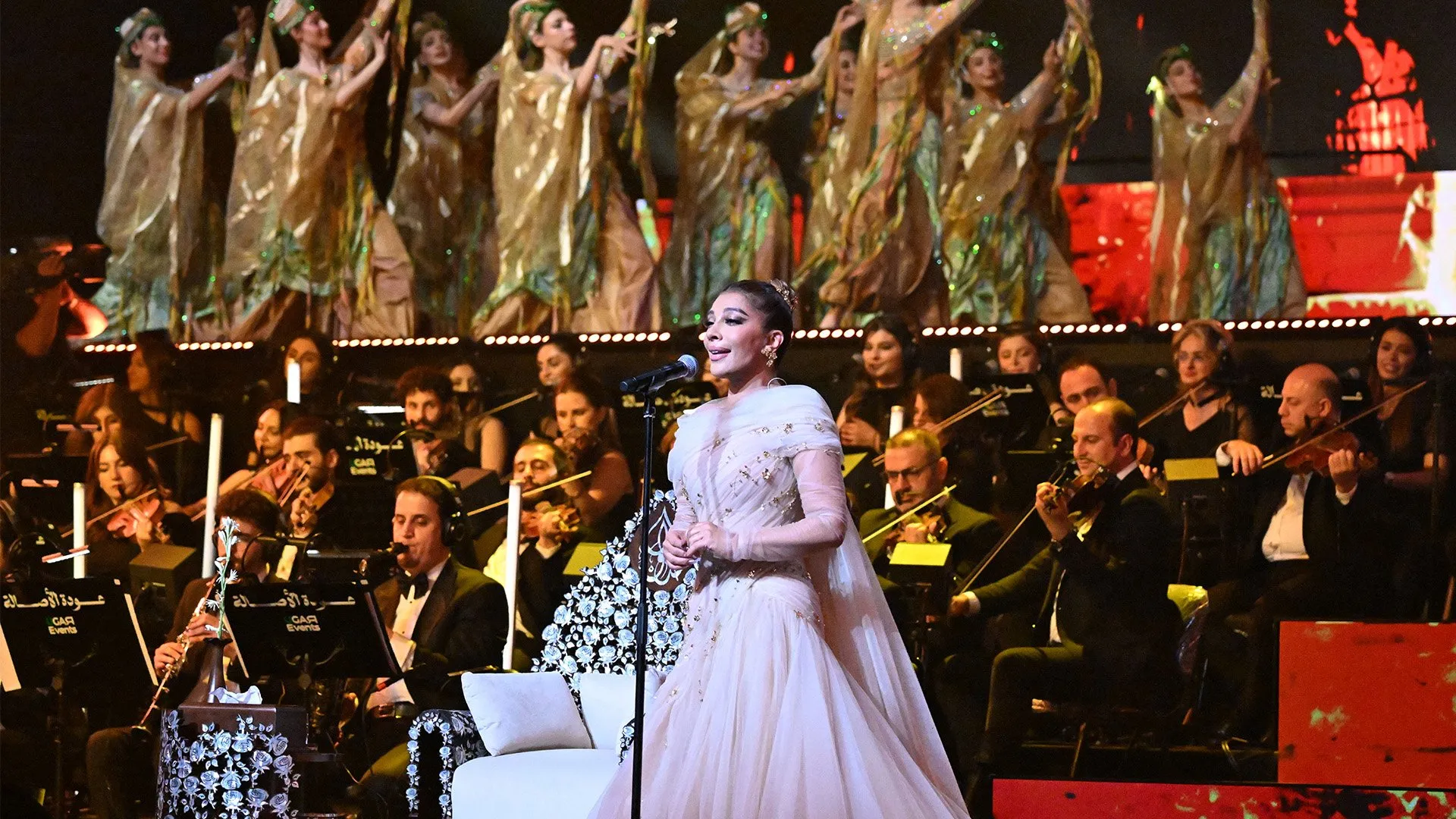
Thousands of people cheered as they welcomed Syrian icon Assala Nasri back at a sold-out concert in Damascus. She spent more than 15 years in exile after publicly supporting the 2011 uprising against the government of Bashar al-Assad.
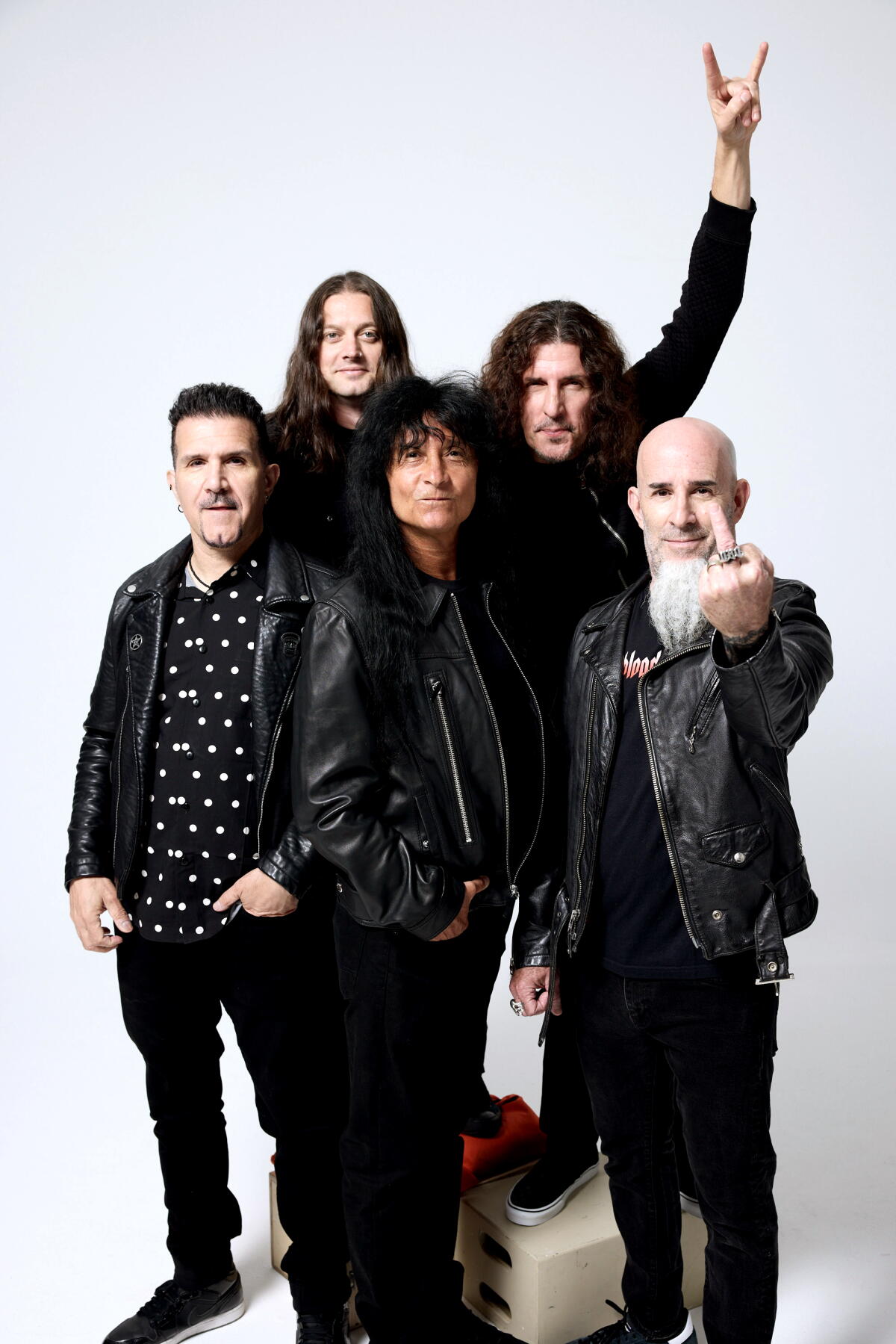
Moments after the final rapid-fire rhythm of Anthrax’s opening number “Caught in a Mosh” fades from the open air of the Sports Illustrated Stadium in Harrison, N.J., shaggy-headed vocalist Joey Belladonna addresses the audience. “I gotta ask everybody out there right now. Who’s never seen Anthrax before?” Around half of the 6,000-or-so crowd members who showed up by 6 p.m. for the three-band bill, headlined by heavy metal legends Iron Maiden, raise their hands. “Ah, yeah! We got a lot of new friends here today. Thank you for being here.”
Some bands with a four-decade career would be disappointed by the turnout, or by the realization that many fans not wearing Maiden shirts are dressed in Megadeth merch. But for Anthrax, preaching to the unconverted is an opportunity to expand their fan base beyond the somewhat insular community of thrash metal, a style of music that took the aggression of bands like Iron Maiden and turbocharged it with the speed and fury of hardcore punk. As much as Anthrax cherish being one of the “Big Four” — Metallica, Megadeth, Slayer and Anthrax — playing a 35-minute set well before dark is a great way to reach new listeners.
“We have a strong base of fans that are deeply into this band, but we know there are also people that have never listened to this type of music before,” says bald-headed, gray-bearded rhythm guitarist and lyricist Scott Ian from his home office outside of L.A. a week before the show. “They’ve heard band names, but maybe they haven’t dipped their toe in the water. So, it would be great to reach them and give them something they didn’t even know they wanted and then they’ll fall in love with it.”
A full 10 years have passed since Anthrax released their last studio album, “For All Kings,” which helps explain why they’re not as well-known as some metal veterans. Instead of rushing out an album after the pandemic, Anthrax took their time writing and fine-tuning new songs before entering Dave Grohl’s Studio 606 in L.A. in 2022. Then, they wrote more songs and massaged those for another two years before finishing the recording and sending the album to be mixed in 2025.
“I nitpicked over every detail of these songs before I even sent the demos to the other guys to put their two cents in,” says drummer and main songwriter Charlie Benante, clad in a black T-shirt and blue jean shorts, and sporting cropped black hair and a slanted mustache. “I wanted them to be as good as they could possibly be. Being good enough wasn’t OK.”
The 11 tracks on “Cursum Perficio” (Latin for “I complete my journey”) encapsulate the finessed brutality, incisive melodies and experimental flourishes from Anthrax’s years with Belladonna (from 1984-1992 and 2005 to the present), during which the band wrote its fastest, most aggressive songs. As much as Anthrax were driven this time by the desire to attract new fans, they were also motivated by many popular new metal albums — and not in a good way.
Anthrax’s meticulously crafted album was recorded at Studio 606, using Iron Maiden support slots to court new listeners beyond the thrash faithful.
(Travis Shinn)
“I hear bands with new records out, and they’re horrible,” Benante says, squinting his eyes and grimacing. “The genre has gotten stagnant to the point where you see a social media post by some band mentioning they have new music coming out, and you can tell exactly how it’s going to sound just by the way they look.”
While “Cursum Perficio” may be a bit heavy for some metal fans, it’s neither dull nor predictable. The album is loaded with Anthrax trademarks — serrated, crunchy riffs, soaring lead vocals, bludgeoning beats, and scorching guitar — but there are also galactic noise effects, angular song structures and atypical chord configurations. The most striking number, “The Edge of Perfection,” starts with chiming ethereal guitars and gently tapped cymbals, then detonates in a conflagration of feral blast beats, minor-key tremolo guitar picking (redolent of black metal), and chanted tribal vocals before climaxing in a slithering riff and ebullient chorus.
“After 30 years as a band, I can honestly say that’s the best song we’ve ever done,” says Ian, the most voluble member. “I feel like it’s genre-defying and can appeal to fans of atmospheric stuff and extreme metal, and anyone who likes aggressive music or even just guitar rock.”
For such a bruising cut, the lyrics of “The Edge of Perfection” are surprisingly optimistic. “It’s about striving for perfection, which, of course, is impossible. But that doesn’t mean you can’t reach for it,” says Ian. “To me, true perfection is happiness and health, and that comes from love, and it isn’t a given. I work hard at being an empathetic person and I only do things out of love and wanting to make everybody around me feel good as well.”
Lest Ian’s Zen-like proclamation color him a romantic, the guitarist stresses that much of the energy and anger of “Cursum Perficio” stems from the political, social and economic turmoil of the last decade. The problems, he stresses, are cutthroat capitalism, rampant partisanship and mankind’s seemingly innate instinct to destroy.
“Humans are really good at one thing and that’s murder, and we’ve excelled at it over the centuries,” Ian says, shattering the good vibes that flowed like a clean mountain spring just a minute ago. “Every year, we get better at treating each other terribly, which I can’t understand. I mean, there are people on this planet who, if they wanted to, could end world hunger. But I guess there’s no money in that. They would rather make the world a s— place by draining the resources. I swear to God, it’s just like [the 1971 Dr. Seuss book] ‘The Lorax.’”
While Ian purposely scrapped any early lyrics he wrote about politics in the age of Trump (“that would have been boring”), on “Everyone’s Got a Plan” he addresses the partisan strategy of “divide and conquer,” and in the first single, “It’s for the Kids,” he writes about the ubiquity of school shootings. Neither song has stopped naysayers from characterizing Anthrax as left-wing.
“I’m not a liberal,” he plainly states. “I’m a centrist. I like skeet shooting and I enjoy going to a range and shooting at targets. But I believe in common sense. And no matter what your political leanings, I think everybody can agree that nobody wants to see an 8-year-old shot in the face, which happens all too often.”
“I love this country,” interjects Benante. “But that doesn’t mean I don’t have some problems with it…. The way we go about things in this country is just wrong, and it makes me frustrated to the point where I’m like, ‘F— it. I’ll just put my head down and write a song.’”
“Cursum Perficio” delivers classic Anthrax crunch with experimental flourishes, anchored by genre-defying centerpiece “The Edge of Perfection.”
(Travis Shinn)
Much of “Cursum Perficio” caters to neither the left nor the right. “NYC 93” is about the celebratory chaos of band life in the early ’90s, “The Long Goodbye” addresses the horrors of dementia, and the title track is about closure, whether positive or problematic. The Latin translation of the phrase, along with Benante’s past comments that he can’t imagine writing another full Anthrax album anytime soon, have led to speculation that the band is nearing the end of the line; the theory is seemingly supported by lines like, “The journey’s over/ The threads that hold it all together.” But while there are no plans now to write any new songs, and four of the members are in their 60s (lead guitarist Jonathan Donais is the baby at 47), growing too old to headbang isn’t even a notion.
“I truly believe that going out and playing shows keeps us young,” concludes Benante. “We get in a zone, and the music takes over and the energy going through our bodies is the same as it was when we were 20. Why would we ever want to give that up?”
Wiederhorn is the co-author of Scott Ian’s 2014 autobiography, “I’m the Man: The Story of That Guy From Anthrax.”
Public broadcaster RTE says the country’s participation cannot be justified amid ‘appalling and ongoing loss of lives in Gaza’.
Published On 17 Sep 202617 Sep 2026
Ireland has become the second country, after the Netherlands, to announce a boycott of next year’s Eurovision Song Contest over Israel’s participation.
Irish public broadcaster RTE said in a statement on Thursday that the country’s participation could not be justified “given the appalling and ongoing loss of lives in Gaza” and that the humanitarian crisis in the enclave “continues to put the lives of so many civilians at risk”.
Recommended Stories
list of 3 itemsend of list
RTE, which manages Ireland’s selection and participation in Eurovision, added that it remained “deeply concerned by the continued denial of independent access [for] international journalists to the territory”.
The decision marks the second consecutive year that Ireland will neither participate in nor broadcast the competition, which is the world’s most popular television music show.
Earlier this month, Eurovision organisers said they were excluding any country involved in an armed conflict from hosting the competition.
However, the Dutch public broadcaster Avrotros said the exclusion of countries in conflict was not “sufficient”.
Avrotros announced last month that it was withdrawing from the 2027 competition.
It said Eurovision could “no longer be considered neutral” given Israel’s participation in “a large-scale military conflict” in Gaza.
Both Ireland and the Netherlands were among five countries that withdrew from Eurovision 2026 in Vienna earlier this year. Spain, Slovenia and Iceland also decided not to participate.
Eurovision Director Martin Green said on Thurday that organisers “fully respect” Ireland’s decision and that they “will be missed”.
“The Eurovision Song Contest is at its best when broadcasters and their artists from different countries come together to share music, celebrate creativity and create connections between audiences,” Green said.
“That power to bring people together is at the heart of what makes the Contest so special, and is even more important now in an increasingly difficult and divided world.”
The 2026 show, which Bulgaria won, attracted 132 million viewers, 34 million fewer than its 2025 edition.
Thousands of protesters gathered outside the venue in the Austrian capital during the final in mid-May to oppose Israel’s participation.
The European Broadcasting Union organises the annual music competition. It has faced accusations of applying a double standard for refusing to exclude Israel, despite banning Russia following its invasion of Ukraine in 2022.
In the evening, Nike has flown in a custom-made outdoor volleyball court so Sherman Oaks Notre Dame can host Harvard-Westlake in a 7 p.m. girls’ volleyball match played on the Notre Dame baseball field. There will be food trucks, music and other surprises.
Girls Volleyball: Pools Are Set For “The Classic” 39th Annual Venice Invitational Tournament. 20 @CIFLACS Teams Will Compete Across 3-Sites… Venice, Le Lycée & University. Action Begins Friday At 3:00PM With Several Intriguing Opening-Day Matchups. #RepTheCitypic.twitter.com/2zgrqTKrmK
There’s also the Venice girls volleyball tournament taking place at Venice High and the Woodbridge Classic cross-country meet at the Great Park in Irvine.
This is a daily look at the positive happenings in high school sports. To submit any news, please email eric.sondheimer@latimes.com.
THEY were the cool Brit pop duo that broke onto the music scene in 2007 with a number one album and chart-topping smash hit.
And almost two decades later, the husband-and-wife pair are still releasing new music – though their look is worlds away from their noughties heydey.
The husband and wife band rose to fame in the early 2000s – but are rocking a very different look these daysCredit: InstagramThe female star – one half of the pop duo – has ditched her rock chic era and instead appears to be channeling Dolly PartonCredit: Instagram
The Ting Tings, comprised of married couple Katie White and Jules De Martino have taken to TikTok to share a clip of them singing their brand new song Home.
In the video, rock chick turned boho babe Katie can be seen showing off her impressive vocals, while hubby Jules plays guitar.
Sign up for the Showbiz newsletter
Thank you!
They look world’s away from their earlier rock and roll vibe with Katie in particular then known for her heavy eye make-up and platinum blonde Debbie Harry-esque locks.
They wrote over their new video: “Hey, we’re Katie & Jules from a band called The Ting Tings and you might remember us from our song That’s Not My Name.
The duo were all the rage in the noughtiesCredit: HandoutThey scored a number one hit with That’s Not My Name back in the dayCredit: GettyBut their style has changed a lot from their noughties heydeyCredit: thetingtingsofficial/TiktokKatie belted out vocals for new single Home while cradling the couple’s daughter in her lapCredit: thetingtingsofficial/Tiktok
“This is us, 18 years on singing Home from our latest album with our daughter. A lot has changed since 2008.”
The caption read: “18 years & 5 albums later… we are back in the studio, song writing and working on our 6th record.”
The iconic band made a shock comeback to the music industry back in January 2024.
In a cute video posted to Instagram, they added the caption: “Where have we been? Here, making the record of our lives. Get ready. J K x”
The scenes showed a blonde-haired toddler strolling around, leading one fan to quiz: “Is that a baby Ting Ting?”
During a chat with the BBC in 2022, they confirmed their happy news – with the tot dubbed “mini Ting” aged one at the time.
Katie admitted: “We never particularly spoke about it.
“We always wanted to keep it quite separate from the music, but it’s quite hard when you have literally a mini person.
“We’ve been together a long time now.”
The Salford-based duo formed in 2007, with their debut album We Started Nothing topping the UK charts just a year later.
Their iconic track That’s Not My Name became a huge success and has been streamed more than 1.1million times.
The group then fine-tuned their material in New York, yet a tour scheduled for three years later was scrapped after Katie suffered a hand injury.
Following their comeback, they went on to release their fifth album Home and are now gearing up for their sixth offering.
One could say that I’ve been waiting my whole life for this moment.
It’s a musical event some might have thought unlikely or impossible — but to me, it wasn’t a matter of if Beyoncé would ever release a collaboration with Selena but when. And on Thursday night, with the release of the special anniversary edition of Beyoncé’s sophomore album, “B’Day,” it finally happened.
Alongside an expanded track list that includes remastered versions of the 2006 album’s original songs, plus new remixes and collaborations, there’s “Irreemplazable (Como La Flor),” a mashup of Beyoncé’s first Spanish-language release and one of Selena’s most beloved hits.
In her tragic absence, Selena’s estate gave a rare blessing to Beyoncé for the collaboration. A press release for the album noted that this “resounding approval” from the Quintanilla family “made it possible for this timely and meaningful duet.”
“Two women from Texas. Two unmistakable and irreplaceable voices that broke down and continue to break down barriers,” read the statement.
But not everyone was happy about the remix. Some fans viewed the collaboration cynically, criticizing it as a way for Beyoncé to capitalize on Selena’s legacy, or to court more Latino fans. Some voiced their dissatisfaction under a post from Selena’s husband, Chris Pérez, on Instagram — but he was quick to shut them down.
“Shout out to Beyoncé for showing respect to an ICON,” wrote Perez on Instagram. “In my opinion, nobody will ever, CAN ever, top Selena’s performance. But, dammit … can’t you just appreciate that another iconic/amazing artist chose to highlight Selena in this way?”
For those who need reminding: This isn’t Beyoncé’s first foray into Spanish-language music — and it’s not even her first tribute to Selena.
Long before Beyoncé reached superstardom, she was a girl from Houston who grew up listening to Selena on the radio. In 2007, she credited the “Queen of Tejano” with inspiring her to release “Irreemplazable,” a Spanish-language companion album to “B’Day.”
Working alongside Cuban American composer Rudy Pérez, the songs on that record were workshopped to retain the spirit of their English lyrics without being word-for-word translations: the catchy “To the left, to the left” refrain in “Irreplaceable” became “Ya lo ves, ya lo ves / Te olvidé, te olvidé” (“Now you see, now you see/I forgot you).”
Like Selena, Beyoncé learned to sing in Spanish phonetically, and in a 2007 MTV Tr3s documentary on the making of the album, you can see her angling toward perfection as Pérez and a friend corrected her pronunciation. Some of the lyrics she was tasked with delivering were tongue-twisters, even for native Spanish speakers. Try saying “Tú creías que eras imprescindible” five times fast and in key.
“I spent a lot of time on it making sure it was perfect because I didn’t want to disrespect the language, because it’s so beautiful,” Beyoncé told People en Español that year.
At the time, Beyoncé wasn’t the only major American artist making waves in Latin music. The pop landscape was undergoing a massive shift, thanks to the work of such crossover sensations as Daddy Yankee, Don Omar, and Shakira — and artists in the States were eager to tap into the burgeoning Latino market.
And while that was certainly a part of Beyoncé’s calculus when plotting “Irreemplazable,” she has a personal attachment to Spanish music. “A lot of my family, a lot of my friends who I grew up with speak Spanish, I grew up in Texas,” she said in the MTV doc. “I just have so much respect for the culture, and I really relate to it.”
“The heart and rhythm of the music and the drums and the spiciness,” she added, in her People interview, “it all reminds me of Creole, which is my heritage, and where I come from.”
While Beyoncé’s early solo releases were built on R&B, she demonstrated a curiosity for global sounds like reggae, Latin and Arabic music. Selena’s background was in Tejano, yet she was heavily influenced by heavy-hitters in pop, disco and R&B — namely Jody Watley, Janet Jackson and Donna Summer.
The two share a similar cultural background, one forged by migration, changing borders and centuries of history. And, as second- and third-generation Texans, Beyoncé and Selena were both able to take their heritage and interpret it, while also melding it with the melting pot of influences they were surrounded by.
Twenty years after the release of “B’Day,” Beyoncé has had the luxury of growing and maturing as an artist. She’s delivered masterful musical dissertations that challenge rigid ideas of “genre” and reemphasized the Black origins of traditions like country, rock and Americana.
Selena didn’t have the benefit of time; but in the years since her death, her music has been kept alive, replayed, reinterpreted, and remixed, so that new generations continue to celebrate her Tejano roots. With “Irremplazable (Como La Flor),” Selena and Beyoncé’s artistry gets to coexist.
It’s a blending of their worlds and voices — the merging of two songs empowering women to move on from their heartbreak, as well as a union of two artists who are so different, but so very much alike.
Since its monumental debut in March, “sister dreamer lauren halsey’s architectural ode to tha surge n splurge of south central los angeles” has been active.
In Sunday Funday, L.A. people give us a play-by-play of their ideal Sunday around town. Find ideas and inspiration on where to go, what to eat and how to enjoy life on the weekends.
That’s the official name of Lauren Halsey’s public sculptural park nestled at the corner of 76th and Western in South-Central. In its first few months, the park has hosted intimate jazz shows, Kemetic yoga classes, art workshops and album listening parties where artists like Childish Gambino and Vince Staples have performed. For Halsey, a contemporary visual artist who began dreaming up the space 17 years ago, it’s all been part of the plan.
“At a museum or a gallery, I can program in a context that makes sense there, but at the park, it becomes a venue that is limitless,” she says. “So I can have a music series. People can roller skate. It can be a classroom. It can be a dance floor. It can be a theater, so I’m getting to know it every day, which is just so cool.”
She adds, “It’s just very alive so I love it.”
Now, Halsey is plotting on her next project: “emajendat,” a music festival that merges fine art, music and community activation all in one night. Featuring live performances from Erykah Badu, the Alchemist, Flea (of Red Hot Chili Peppers), DJ Pee .Wee (a.k.a Anderson .Paak) and the Charles Gaines Collective (with Black Nile and Devin Daniels), the immersive event will take place on Sept. 29 at the Hollywood Bowl.
Ahead of the big night, the South-Central native shared her itinerary for a magical day in L.A. It involves listening to rare ‘70s funk and soul music at her favorite brunch spot, supporting all of her favorite vendors (including a henna artist) in Venice Beach and bowling at Lucky Strike.
6:30: Coffee and produce at the Westchester Farmers’ Market
I wake up early no matter what. I’m out of my door between 6 to 6:30 a.m. I’d do my walk around my neighborhood and wait until my partner gets up then we’re off to the Westchester Farmers’ Market, which we go to sometimes. There’s this really amazing vendor called Gus’ Coffee. He makes coffee with his daughter. I’d get a black coffee with a tiny bit of milk or a horchata-based coffee and we’ll just shop for produce. We’d get some yellow watermelons, which are in season right now.
11 a.m: Brunch and ‘70s funk music at RVR
I’m going to my favorite restaurant RVR in Venice for brunch. I’m talking to the chefs, Travis and Ian. I’m listening to amazing music because they have this wonderful vinyl program led by Carlos Niño. So I’m listening to this rare B-side of the B-side ‘70s soul and funk while eating amazing plates. They change their menu quite often because it’s a call and response to what produce is available seasonally. No matter what, I start with the pickled vegetables then I get one of the hamachi rolls. Right now, I’m getting the melon salad, egg plate and the spotted prawn. Depending on the day, they’ll have six or 21 of the prawns, so sometimes they’ll hold me one when they know I’m coming in. Then I’m getting the dessert. Right now it’s banana ice cream with blueberries and it’s heaven.
2 p.m.: Get blasted with henna tattoos in Venice Beach
Then we’re racing to Venice Beach, which has been my favorite since I was a kid. It’s just so wild and grungy and weird and fun yet family friendly and safe. My girlfriend’s best friend lives on the boardwalk so we’ll go see him. I’ve always loved the vendors there so I have my favorites. Right now I’m really into Martha who is a henna tattoo artist, so I just get blasted with henna tattoos. She has a fat notebook of [inspiration], so I’ll pick some and then I’ll remix them with her. It’s this really cool collaboration. I do it every few weeks. I’ll sit with her for like two hours while life is happening, watching the roller skaters, the families, the cool outfits, the riffraff. Sometimes I’ll go to a lady to get the back of my hair wrapped in thread, which I used to do as a kid. It’s just another way I can adorn myself with color. Also, I love a hat, so I’ll go to everyone who’s selling a hat and maybe we’ll buy some fruit.
5 p.m.: Bowl and live my WNBA dreams at Lucky Strike
We’re going bowling at Lucky Strike, which used to Bowlero. We have the summer season passes and we just go ham. We go to the arcade first and I just live my WNBA dreams. Then we’ll go bowl two or three games. My partner usually orders the chicken wings. I don’t eat meat, so I’ll do a beer, French fries with “truffle,” shrimp tacos and maybe some candy.
8:30 p.m.: Head home to prepare for the week
Next, we’re going home. I’d look at my calendar for the week and answer emails. Then I’d take a shower and watch something with my partner. I’m into heist films and basketball. She’s into the psychological thrillers and those sort of crime investigation shows, so we meet in the middle. It’s going to sound so silly and I don’t care, but the last good show I watched was Tyler Perry’s “Beauty in Black.” His imagination is wild, so we just can’t wait until Season 3. It’s ridiculous that it’s so good. We’d watch something until I fall asleep usually by 10 p.m.
August Wilson’s “Ma Rainey’s Black Bottom,” the first of his plays to reach Broadway, catapulted the author’s playwriting career.
It’s the only drama in Wilson’s 10-play American Century Cycle not set in Pittsburgh’s Hill District. But the series might never have come to fruition were it not for the way “Ma Rainey’s Black Bottom” heralded the emergence of a major new American dramatist.
Although it’s still one of his most produced works, “Ma Rainey’s Black Bottom” has the hallmarks of an early piece. Wilson discovers his playwriting voice in this play, but he’s still working out his approach to dramatic structure.
I wasn’t champing at the bit to see another production of “Ma Rainey’s,” but I’m glad I didn’t miss this latest Wilson revival at A Noise Within, directed by Gregg T. Daniel. Acted with breathtaking ensemble naturalness, the play seems lived in rather than performed.
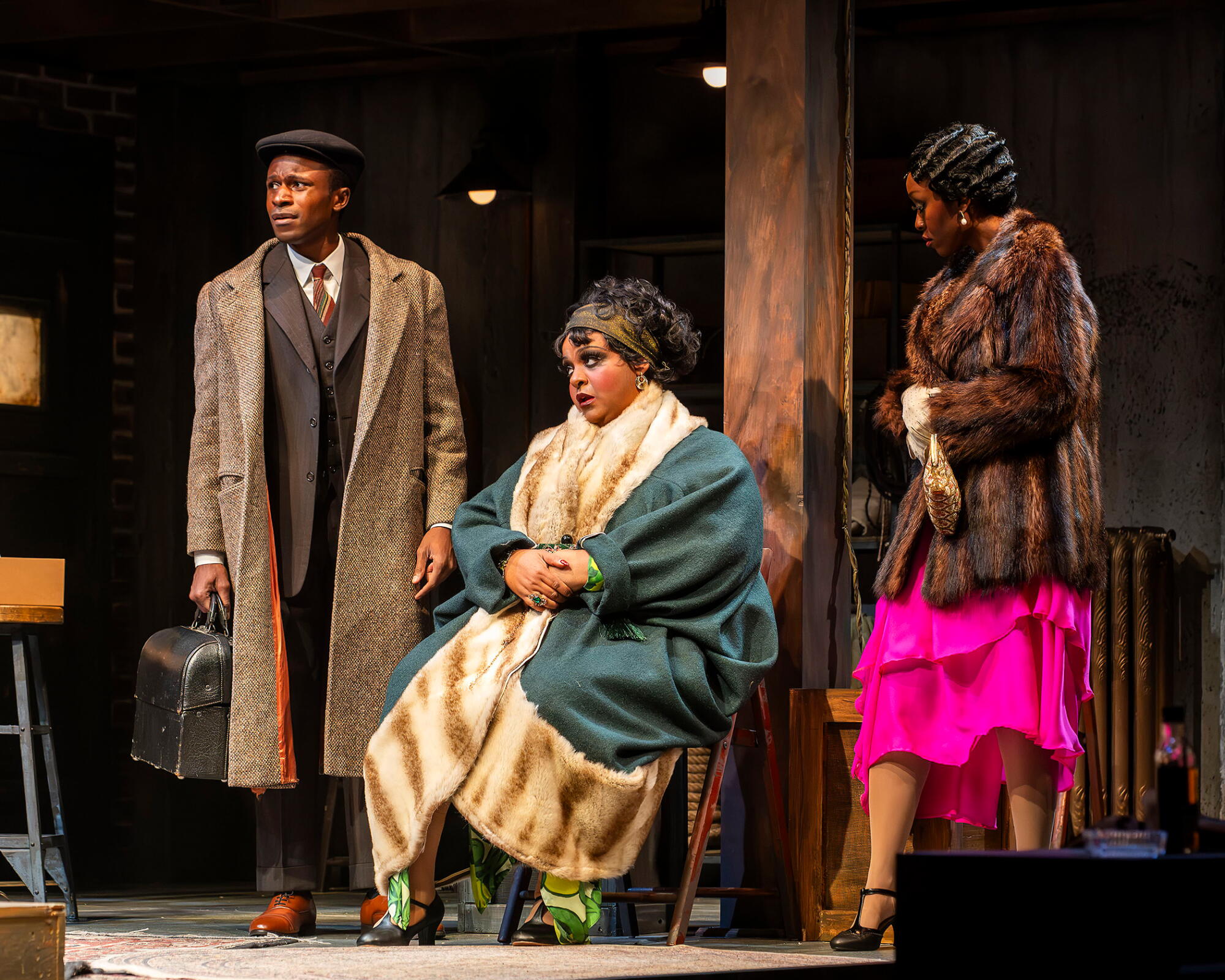
Francis C. Edemobi, from left, Amber Liekhus and CJ Obilom in August Wilson’s “Ma Rainey’s Black Bottom” at A Noise Within.
(Craig Schwartz)
The voices of the characters come through as though we’re eavesdropping from a discreet distance on their banter and squabbles. There’s nothing more riveting on stage than the truth, and here we have human beings in all their flagrant, unadorned and seemingly irreconcilable complications.
Set in a Chicago recording studio in 1927, the play splits its focus between the title character, a fictitious re-creation of the great blues singer Ma Rainey engaged in a power struggle with her white industry overlords, and the exchanges of her sidemen, a quartet of Black men with markedly different ambitions and sensibilities.
Levee, the role magnificently played by Chadwick Boseman in George C. Wolfe‘s 2020 film adaptation, may have more of a claim on the protagonist role than even Ma Rainey, who’s the play’s thematic center. As she throws her diva weight around in defense of a talent born out of Black suffering, she crystallizes the racial politics that Wilson powerfully illuminates.
But Levee’s role is the most dynamic in the play. A trumpeter who wants to move the band in a more musically sophisticated direction, he’s written his own arrangement of the song “Ma Rainey’s Black Bottom” that they’ve come to the studio to record. But Ma Rainey insists on doing it her way, even if Levee’s version is more interesting from a jazz perspective.
Overcome with anger from a traumatic childhood in which he witnessed his mother being raped by a mob of white men, he can’t tolerate slights, big or small. And his fiery temper, igniting at every possible moment with his older and more accommodating bandmates, turns this snapshot of history into genuine tragedy.
Kai A. Ealy, from left, Alex Morris, Gerald C. Rivers and Jamar Gilbert in August Wilson’s “Ma Rainey’s Black Bottom” at A Noise Within.
(Craig Schwartz)
The bedraggled studio has been visually renovated with the wood-slatted elegance of Tesshi Nakagawa’s scenic design. Daniel’s production demands that we experience the play in a fresh light. The period is respected but never allowed to become stiff or artificial. This isn’t a waxwork staging.
Standing microphones, placed on different tiers of the set, never let us forget that Wilson was first and foremost a conductor of voices. He bestows on his characters arias, and Daniel’s cast delivers them as though the words were expressly made for these particular actors.
Jamar Gilbert’s Levee moves through the world as if it’s a battle zone, which of course for him it has been. Conflict has dogged him his entire life, and injustice is what he’s come to expect. His focus is on himself, his music, his sensual pleasures and his determination not to be anyone’s victim. He takes as much pride in the shine of his new shoes as he does in the flirtatious giggle of a pretty woman.
Toledo (Gerald C. Rivers), the philosopher and historian of the group, tries to broaden Levee’s perspective, but the two men have a knack for getting under each other’s skin. Their antagonism is fueled in part by Levee’s immaturity, but there’s also a divide in their worldview: Levee wants society to change in time for him to make good while Toledo is more concerned with the collective spirit of his people.
Meanwhile, Slow Drag (Alex Morris) mostly wants to get on with the session, collect his money and enjoy life as it was meant to be enjoyed, with whiskey, a little reefer and good-looking women. Cutler (Kai A. Ealy) tries to be a moderating influence, but he winds up as exasperated by Levee as Toledo.
Alex Morris, from left, Amber Liekhus and Jamar Gilbert in August Wilson’s “Ma Rainey’s Black Bottom” at A Noise Within.
(Craig Schwartz)
The authenticity of the production encompasses the music. These actors don’t mime making music, as is often the case in revivals. They jam together, modestly but effectively enough to make their recording session real to us.
There’s nothing at all modest about Amber Liekhus’ musical talent. Indeed, Liekhus is the first actor who was able to convince me that the character of Ma Rainey really is a professional, jobbing singer. She doesn’t imitate being the mother of the blues, as her character is known. She earns the distinction through the wondrous depths of her soulful singing.
She refuses to be bulldozed by either Irvin (Bert Emmett), her manager, or Sturdyvant (Matt Foyer), the owner of the recording studio, knowing full well that they depend on her gift for their pile of money. Her insistence that Sylvester (Francis C. Edemobi), her nephew with a pronounced stutter, speaks the intro to her new record, is her way of asserting human control over corporate greed.
Liekhus’ Ma Rainey isn’t merely being temperamental, as Sturdyvant and Irvin assume. She’s using her limited leverage in whatever ways she can. There’s something touching about her imperiousness, a regal vulnerability that shines through even in her romantic interaction with Dussie Mae (CJ Obilom), whom Levee has his predatory eye on.
The honesty of the acting is so enlivening that I’m tempted to rank this production among the very best Wilson revivals I’ve seen. If there’s one slight misstep, it happens at the play’s violent climax. The moment makes perfect psychological and dramatic sense, but the confrontation needs a few more beats than Daniel allows.
But this encounter with “Ma Rainey” reveals that even early Wilson can, in the right hands, offer unadulterated playwriting greatness.
‘Ma Rainey’s Black Bottom’
Where: A Noise Within, 3352 E. Foothill Blvd., Pasadena
EVER wanted to head to a music festival abroad? Well, how about heading to the world’s biggest where most concerts are free?
Found in the capital of Morocco – Rabat – Mawazine isn’t your usual festival.
Mawazine Festival is the largest in the worldCredit: AP:Associated PressIt takes place each year in Rabat, MoroccoCredit: Getty
Instead of lasting the normal three-days, Mawazine goes on for nine days in total.
The festival takes place each June and its attendance always breaks records with 3.75million people visiting in 2025 – making it the largest music festival in the world by attendance.
Sign up for the Travel newsletter
Thank you!
As for whats on at the festival, around 90 per cent of the concerts are free to attend.
You can expect Moroccan and Arab artists as well as global headliners.
There are a seven stages in total including OLM Souissi, which is the main stage where international stars such as Rihanna, Beyoncé, Shakira, Elton John, Stevie Wonder, Justin Timberlake and Maroon 5 have all performed.
You could then go to the Nahda Stage, which is dedicated to Arabic and Oriental music.
And over at Chellah, you’ll find a historic Roman site used for calm with acoustic music.
The festival isn’t just music either – you can expect art exhibitions, workshops and film screenings.
The festival spans nine days with most of the concerts being freeCredit: Getty
If you want to head to the festival, make sure to book your hotel well ahead.
The city of Rabat is transformed for the nine days as well, with cafes and shops open later.
The city is also a UNESCO World Heritage Site meaning there is plenty to explore including a huge medina, Hassan Tower and Kasbah of the Oudayas – a historic fortress with sea views.
Return flights from the UK to Rabat cost as little as £125 in June.
Long gone are the days of Mexican Americans’ alienation from Mexico — at least, if the Mexican government can help it.
On Sunday, hundreds of spectators gathered inside the Orpheum Theatre in downtown Los Angeles to watch the United States semifinals for “México Canta,” a binational music competition for rising artists from the U.S. and Mexico, organized by the latter’s Ministry of Culture.
Seven participants of Mexican descent from across the U.S. braved the stage with original songs, in what can only be described as a heartfelt singing contest, without the scorn of nitpicky judges or behind-the-scenes melodrama, but rather a zealous crowd made up of all age groups.
Voting was handed over to the public, as the segment broadcast live on public television across the United States and Mexico. Over 300,000 individuals tuned in to cast a vote to advance the top three contestants: Tiffany Galaviz, Joshua Soto and Rosalba Valdez. They will go on to compete in the grand finale of México Canta on Sept. 13 at the Auditorio Nacional in Mexico City for a chance at a record deal.
“There’s always that saying that if you’re Mexican American, you’re not Mexican enough, but I think that’s wrong,” said 18-year-old Soto, a Bronx native whose musical theater background and deep R&B groove gave depth to the bilingual country-corrido “Terco Callejero.”
“Ever since I was little, my parents always showed me my culture, my roots. It’s in my blood. It’s in the traditions that I follow and the music that I listen to every day,” added Soto, who is enrolled in New York University’s vocal performance program in music theater.
For 27-year-old semifinalist Valdez — a Chicagoan whose signature red hair and bedazzled fringe fit distinguished her onstage, as she sang her merengue-infused tune “Por Bonita” — being Mexican American is both a huge privilege and responsibility.
“When I was younger, I used to think the opposite, because of what our community went through,” said Valdez. “Now I see it as a superpower. [Being Mexican American is] something that I want more people to understand has power. We can create a lot of change when we realize the power that we have.”
Over 300,000 individuals tuned in live to cast a vote for the top three contestants: Joshua Soto, Tiffany Galaviz and Rosalba Valdez
(Ronaldo Bolanos / Los Angeles Times)
Speaking to The Times, Mexico Secretary of Culture Claudia Curiel de Icaza, stressed the importance of binational programming — adding that she believed that the singing contest can unite young people across the U.S.-Mexico border.
“We cannot think that we are merely divided by territory. Culture transcends borders, music transcends borders,” she said. “We are separated, but ultimately there is an extremely intimate and rich cultural development because culture has been the space of resistance, of resilience.”
As host and singer, Majo Aguilar — granddaughter of Mexican film and music legends Antonio Aguilar and Flor Silvestre — ushered vocalists on and off the stage. Large screens lit up with educational stories of the legacy of Mexican nationals, such as Pedro J. González, one of the first Spanish radio broadcasters in the U.S.
The show also paid homage to American-born individuals who have elevated Mexican music: including Texas-born Gloria Ríos, who helped pioneer rock ’n’ roll in Mexico in 1956 and Arizona-born Linda Ronstadt, whose 1987 album “Canciones de Mi Padre” became the bestselling non-English language record in U.S. history.
This year, the contest placed an emphasis on música mexicana. According to Spotify, global streams of the genre have grown by 295% since 2021; in the U.S. alone, its popularity has grown by 162% since 2021.
In large part, its popularity has been driven by corrido tumbados, or songs which blend traditional Mexican folk with trap, often underscoring street life, “the hustle” and the riches that can follow.
Its most prominent acts include Junior H, Fuerza Regida and Peso Pluma. These were the biggest streaming Latin musicians in the U.S. in 2024, just below reggaeton superstar Bad Bunny — yet none of these popular música mexicana artists were recognized during the competition.
“Mexican music is among the most consumed worldwide and it’s a matter of choosing a genre where young people feel identified and music that transcends borders,” said Curiel de Icaza. “And no, we are not censoring it.”
México Canta began in 2025 as state-sponsored programming to promote musical narratives beyond themes of violence and drug-trafficking.
Besides banning the use of artificial intelligence and other audio alterations, the contest did not permit “songs that glorify violence or drug use.” Failure to comply with the rules would result in disqualification for contestants.
“More than banning, it’s about educating, guiding, and getting young people to stop listening to that music,” President Claudia Sheinbaum said in a news conference last year when the program was first introduced.
President of Mexico Claudia Sheinbaum speaks during the daily morning briefing at Palacio Nacional on Aug. 6, 2025, in Mexico City.
(Manuel Velasquez / Getty Images)
The singing competition comes at a time when 10 out of 32 Mexican states have implemented bans or limitations on corridos in public spaces; namely narcocorridos, or ballads that recount or glamorize elements of drug culture or organized crime.
Some lawmakers assert that the lyrics in these songs promote violence, including Mexico City lawmakers who, in May, passed a law barring the songs from being played at public events.
“The bans, which come amid President Trump’s hyper-focus on drug trafficking in Mexico, have sparked debates here about freedom of expression and state censorship and have raised provocative questions: Do narcocorridos merely reflect reality in a nation gripped by powerful drug gangs? Or do they somehow shape it?” wrote Times correspondent Kate Linthicum in a May 2025 article.
In May, the second edition of México Canta was announced during Sheinbaum’s daily news conference, generating online buzz when famed corrido tumbado singer Junior H vocalized support for the contest — while also lamenting his past musical choices.
“In my initial [career], some of the stories that I shared in my music didn’t add to the positive message that reflect my current compositions,” said Junior H, whose real name is Antonio Herrera Pérez, in the news conference. “I kept growing and I learned that music, besides being a form of expression, also implies a responsibility when millions of people hear you worldwide.”
The 25-year-old rose to fame through popular narcocorridos such as 2023’s “El Azul,” which is believed to be about Sinaloan drug lord Juan Jose Esparragoza Moreno; as well as his 2022 banda-fused track, “El Hijo Mayor,” which some speculate to be about the son of Joaquín “El Chapo” Guzmán.
“When you grow up, you have a career path and you see that you have an impact on young people, you start to mature and evolve your career,” Curiel de Icaza said of Junior H. “And you realize you want to go in a different direction, that’s when he understood and decided that it was better to focus on something else.”
During the news conference, Sheinbaum denounced the idea that the music contest was a form of censorship. Curiel de Icaza also refuted those claims: “We’re not prohibiting anything. Music will continue to exist, different voices exist and we’re not prohibiting or censoring songs.”
To help amplify the values of México Canta, organizers enlisted the help of Los Tigres del Norte, one of the most successful regional Mexican acts in the U.S. The night before the semifinals in L.A., Los Tigres performed with Gustavo Dudamel at the Hollywood Bowl.
The band closed Sunday’s competition with a performance of “México Sigue De Pie,” a new song that underscores the grit of the Mexican community. “They’re legendary,” Curiel de Icaza said of the band.
Coincidentally, the esteemed guests were early pioneers of narcocorridos: including their 1974 song “Contrabando y Traición,” which details a fictional drug trade tale of Emilio Varela and Camelia la Texana, as well as their 1978 track “La Banda del Carro Rojo,” which describes cocaine trafficking across the state lines.
But over the last decade, the band, too, has been advised by concert organizers in Mexico to avoid playing these types of songs when performing in certain venues, leading them to voice concern over the criticism of corridos — which they argue provide listeners with details over real-life truths, in the same way journalists engage in storytelling.
“We’re narrators of people’s lives,” bandleader Jorge Hernández told El País last year.
KYLIE Minogue shares some unseen throwback snaps to celebrate Can’t Get You Out Of My Head becoming her first billion-streaming hit.
The pop icon, 58, also told of her pride as the hit surpassed the Spotify milestone 25 years after its release on September 8, 2001.
Kylie Minogue shares some unseen throwback snaps to celebrate Can’t Get You Out Of My Head becoming her first billion-streaming hitCredit: InstagramThe singer also told of her pride as the hit surpassed the Spotify milestone 25 years after its release on September 8, 2001Credit: Instagram
The video, showing her in outfits including a deeply-plunging white number slashed to both thighs, was a fan favourite.
She wrote: “Thank you to everyone all around the world who has streamed and sang and danced and loved!
Sign up for the Showbiz newsletter
Thank you!
“Way before streaming, here I am doing wardrobe and glam tests in preparation for the video.
The song is currently streamed around 850,000 times per day.
It was the lead single from her acclaimed album, Fever.
The single topped the charts in more than 40 countries with over five million sales globally.
The Aussie may be popping champagne corks but, in an interview with Vogue Australia this week, she said she had reigned in her drinking since her wildest days.
Minogue said in an interview with Vogue Australia she had reigned in her drinking since her wildest daysCredit: InstagramThe beauty’s interview is in this week’s Vogue AustraliaCredit: Lachlan Bailey for Vogue Australia
She joins the billion stream club alongside stars including The Weeknd, who tops the chart with 5.5billion streams for hit Blinding Lights.
Ed Sheeran comes a close second with Shape Of You, with 5.1billion.
Earlier this month she said: “I do believe that it has its place in that realm..
“Sonically and visually and at that point in my life, I think, what was I? What, 32? I was settling into myself.”’
Kylie performing Can’t Get You Out Of My HeadShe wrote: ‘Thank you to everyone all around the world who has streamed and sang and danced and loved!’Credit: Instagram
It was part of her 21st century comeback after establishing herself with early hits from Stock, Aitken and Waterman and then dance label Deconstruction.
But Can’t Get You . . . was, says Kylie: “Like riding a spaceship.”
Rivera sang about rural life in times of fast neocolonial expansion. (Venezuelanalysis)
Venezuelan popular artist Luis Mariano Rivera was born on August 19, 1906. His music is a tribute to life and a commitment to his community’s identity and cultural sovereignty. Rivera’s works remind us that when a people sow their land and tell their stories, they become resistant to oppression and invincible against foreign domination.
Canchunchó Florido is a tribute to Luis Mariano Rivera’s home village. Peformed by Gualberto Barreto.
A brief and affectionate profile
In the fertile and sunny lands of eastern Venezuela, specifically in the lush village of Canchunchú in Bermúdez Municipality, Sucre State, Luis Mariano Rivera was born on August 19, 1906, 120 years ago. His life was shaped by the rural realities of this area, which combined the abundance of nature with the profound inequalities of a latifundista-dominated agrarian economy.
His childhood was marked by early orphanhood and farm labor. Far from leading to resentment or resignation, this experience shaped in Rivera a loving and vital sensibility that allowed him to dismantle traditional notions of property and patriarchal-landowner hierarchy, enabling him to identify with the land, plants, and animals that surrounded him. This connection to the land enriched his imagination, and his extended family ultimately came to encompass the entire territory.
Rivera’s creative work blossomed after he turned 48. A self-taught musician, poet, and playwright, he composed his first verses using the Venezuelan four-stringed cuatro guitar as his primary instrument. His artistic output became an act of defiance that placed elements dismissed by the dominant culture at the center of Venezuelan poetry: local biodiversity, manual labor, trees, fruits, and wildlife.
Through his popular theater plays and musical compositions, Rivera portrayed a cosmogony in which nature is not merely a resource to be exploited, but a subject with rights to be loved and respected.
Although he never joined any political party nor sought public office, his approach to life and art constitutes a profound political statement. In a Caribbean and Venezuelan context where the neocolonial oil rentier model displaced agricultural production and fueled the exodus from the countryside to the city, Rivera’s insistence on staying in Canchunchú and singing about rural life was a clear act of resistance.
His politics were rooted in pacifism, fraternity, and love for the land. In the face of the metastasizing commodification of life, he prioritized the ethics of care, respect for natural cycles, and community solidarity. Various artists of national and international renown, including Alí Primera, Lilia Vera, Cecilia Todd, Soledad Bravo, Gualberto Ibarreto, and Morella Muñoz, performed his songs, transforming his local message into a banner of continental identity. Alí Primera, in particular, saw Rivera as a beacon of popular dignity, celebrating his ability to transform everyday rural life into revolutionary and loving poetry.
Luis Mariano Rivera passed away on March 15, 2002, in Carúpano, Sucre State, at the age of 95, after nearly a century devoted to cultivating the poetry of life, simplicity, and affection. His legacy is recognized as a symbol of the musical identity that flows directly from the harmonious relationship with the land and the wisdom of the people.
La Guácara [The Snail] is a tribute to nature and the delicate nature of life. Interpreted by Gualberto Ibarreto.
Sound, memory, and collective identity
In many of the ancestral cultures of Abya Yala, sound is part of the creation myth of the women and men who originally inhabited these territories. For all of humanity, sounds have played an important role in the formation of identities. Languages and music stem from this very relationship and our need to connect, to name ourselves, and to determine our own destinies.
Every landscape has its own sonority. In other words, a set of sounds that form its geohistory. This includes our ways of speaking and our music, but also the sounds of the wind, the rain, the sea, the river, birds, insects. In short, all the sounds of life expressing itself, as well as the sounds of human inventions that are now part of our daily lives.
Within this spectrum, there are human beings who manage to connect the sounds of past, present, and future memories to bequeath a sonic identity that transcends the purely artistic realm, becoming the very landscape narrated in their poetry. Luis Mariano Rivera is an example of this transcendental audacity to place oneself beyond time with a unique music.
At the age of 48, driven by the desire to express himself without relying on others to write his letters and thoughts, he taught himself to read and write. Already in his mature years, he began composing verses, parrandas, merengues, and eastern joropos through which he paid tribute to the flora, fauna, and everyday life of his village.
Rivera’s remarkable sensitivity stems from his direct observation of the countryside. His lyrics preserve idioms, sayings, and oral expressions from eastern Venezuela that would otherwise have been lost. Long before the rise of globalized environmental movements, his songs already championed the balance between humans, wildlife, and flora from a local, community-based, and decolonizing perspective. Rivera’s legacy transcends mere musical composition; he represents a defense of communal life and a living example of how it is possible to reclaim one’s own history to create sounds that cement collective identity.
For him, Canchunchú was not merely a geographical reference point, but the center of the world. By singing about his village and embracing rural daily life as a symbol of belonging with a claim to universality, he created an affective geohistory that recognized the dignity of life as equivalent to that of the cherry, the guácara [snail], and the mango. He showed to his community that their own reality is worthy of being celebrated and sung about. As such, his work did not stem from ego. It was born out of the village’s celebrations and gatherings, and like collective knowledge, it has no other purpose than enjoyment and the strengthening of collective unity.
Singing honestly about one’s own village, honoring the vernacular of one’s community without resorting to artificial language, taught us a sense of pride in our ways of feeling, understanding, and reasoning.
Rivera’s music, paraphrasing Alí Primera, grounds us in our own land, with the profound simplicity of one who surrenders to the magnitude of the surrounding beauty. His deep connection to his native Canchunchú never served as chauvinistic isolation or picturesque folklorism. Rather, it was a gateway to the human condition prior to the violent irruption of Western capitalist modernity, with its imposition of individuality, the commodification of nature, and linear progress, at the expense of communal memory. Rivera’s work operates in the opposite direction: it reconnects with an organic body of knowledge that does not require academia to be legitimate, because it is engraved in the lived collective experience.
It is no secret to anyone that traditional community music, as well as rural poetry, serves as a means of transmitting memory. It is not mere entertainment. Rhythmic patterns, melodic turns, and poetic meter interact with the biological, agricultural, and communal cycles that humankind has cultivated for millennia.
Rivera did not theorize about nature: he embodied it. His philosophy sprang from working the land, from sweat, and from the sounds of the countryside. It is the knowledge transmitted through the body and emotion, that “communal way of life” that predates modernity and remains a reservoir from which to conceive alternatives to capitalism, fascism, imperialism, and Zionism.
True universality does not consist in erasing differences under a single mold with domineering hegemonic pretensions, but rather in reaching our very roots. When we reaffirm the dignity of our communities, we validate the “peripheries” as the center of our own worldviews without the need for external recognition.
Rivera demonstrates that the periphery is a center in and of itself by stripping away the pretensions of colonial modernity. His music taps into the common core of humanity: the wonder of being alive, communal solidarity, and respect for the sacred meaning of life. And this is not a nostalgic gaze toward the past, but rather a reservoir of meaning and hope for the present. It reminds us that beneath the veneer of modernity, the human species remains hardwired to come together, celebrate, and sustain communities.
Finally, Rivera’s production is above all an expression of love. Love toward the full life experience. But when a poet sings about love, it is usually limited to romantic love, or heartbreak in the absence of corresponding feelings. Nevertheless, Rivera did count on a “spiritual companion,” to use his own words: Maximina Marsella, known as La Negra Marsella and whom he affectionately called “la negra,” in what is a very common expression in Venezuela. She was presented as the only woman capable of understanding his silences and his late passion for words. He dedicated many love verses to her, expressing how they shared feelings and devotion for the small things in life and the land.
El Mango is a song dedicated to Venezuela’s ubiquitous tropical fruit as a symbol of shared sovereignty and food sovereignty. Interpreted by Andrea Paola.
Writing our own history and cultural sovereignty
The act by which a dispossessed individual reclaims control over the written word is, in essence, an act of sociopolitical liberation. For Luis Mariano Rivera, the decision to learn to read and write on his own as an adult was not merely a matter of functional education or an attempt to conform to bourgeois standards. It represented taking control of his own narrative and a fundamental reaffirmation of his personal and communal sovereignty. In a system dominated by the colonialism of knowledge, where official writing has historically functioned as a mechanism of subordination and administrative control, mastering the alphabet from the campesino perspective means dismantling the monopoly on truth. Rivera lucidly understood that mastering the written code granted him the historical ability to cease being a passive subject, an object of study in folklorism, and become the chronicler and philosopher of his own time. He ceased to be narrated by others and assumed authorship of his territorial memory.
This literacy and poetic endeavor took place against a profoundly adverse historical backdrop. Throughout the twentieth century, Venezuela underwent a traumatic transformation driven by the emergence of the neocolonial oil enclave. Urban modernization advanced aggressively through its ideological and economic strategy of marginalizing the countryside, dismantling traditional community structures, and promoting rural depopulation in favor of slums in the major cities.
The extraction of hydrocarbons by transnational corporations tied to the geopolitical interests of US and European imperialism came alongside an overwhelming wave of cultural propaganda. This ideological penetration sought to impose the American consumerist lifestyle, eroding peasant identity and dismissing local agriculture as synonymous with backwardness and savagery. Venezuela, which was barely emerging from the devastating aftermath of the war of independence and successive nineteenth-century insurrections, revolutions, and civil wars stoked by local elites and foreign capital, saw its food sovereignty and historical memory shaken.
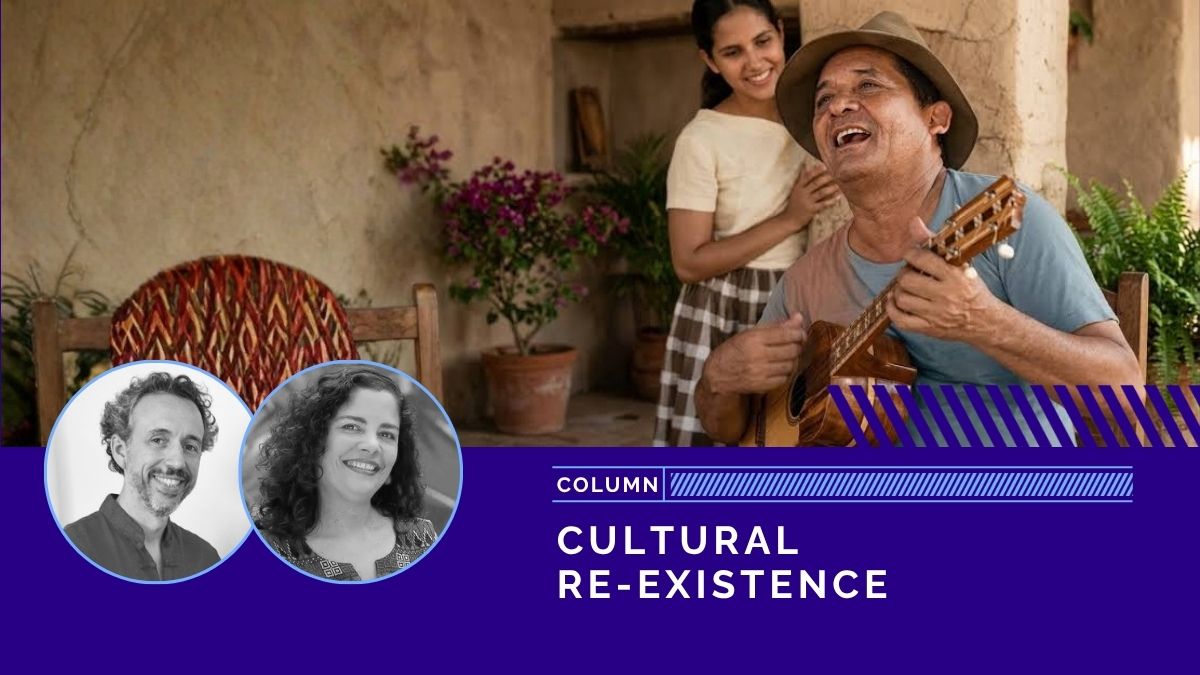
Amid this landscape of alienation, where the country was rapidly transforming into a consumerist, import-dependent enclave, Rivera’s insistence on remaining in his Canchunchú valley and singing about the communal way of life was not a nostalgic or folkloric retreat, but rather a deeply political and assertive affirmation of cultural re-existence.
He sang with such transparent and loving clarity that his powerful message took root in the national collective imagination, ethically reframing the traditions, sufferings, joys, and experiences of campesinos in eastern Venezuela. Against the aesthetics of waste and the logic of neocolonial dispossession, he countered with the ethics of care and the sacredness of everyday life. His compositions served as a mechanism for preserving historical memory: he warned against the collective amnesia regarding the communal way of life driven by the discourse of developmental modernity; he championed food sovereignty in the face of dependence on the globalizing market; he dignified rural labor in the face of urban prejudice, revealing the profound ecological philosophy inherent in popular knowledge. But, moreover, his profound poetic work demonstrates that true national sovereignty is more than just the defense of natural resources or borders. It requires the preservation of the collective soul, the dignity of the living word, and the self-determination of the people’s power.
Luis Mariano Rivera’s life journey teaches us that decolonization is not achieved solely through theoretical confrontation or bellicose rhetoric, but above all through an organic connection to the land and the community. By recognizing himself through his own voice, he prevented imperialist corporations and the oil industry’s maelstrom from erasing the humanity of his surroundings. His music endures as an indestructible testament to cultural sovereignty: living proof that a people who remember their roots, cultivate their land, and tell their own stories become resilient in the face of modern oppressions and invincible against any attempt at external domination.
Cerecita [Little Cherry] is a song about the miracle of life and a subtle critique of the urban disdain for the simple beauty of rural life. Interpreted by Maria José Delgado and Fabiola José.
Fabiola José is a Venezuelan singer. She has performed in countries across South America, Africa, Europe, and Asia. Her singles and albums are available on all digital platforms. She hosted and produced “Cantante y Sonante” for Radio Nacional de Venezuela. In 2018–2019, she created a series of videos for social media, published on her YouTube channel #HechoEnCasa. She holds a bachelor’s degree in Music from IUDEM, Caracas (2005); specialized under Maestro Tom Krause in Spain (2007); and an M.A. in Arts and Cultures of the South from UNEARTE, Venezuela (2020).
Fidel Barbarito is a Venezuelan musician and researcher, with a bachelor’s and master’s degrees in music and history, respectively. He teaches in the undergraduate and graduate programs at the National Experimental University of the Arts (UNEARTE). Together with Fabiola José, he promotes several musical projects aimed at disseminating traditional repertoires, integrating them with contemporary compositions inspired by these sounds. Joropo llanero. Parranda de reexistencia is one of his published essays.
The views expressed in this article are the authors’ own and do not necessarily reflect those of the Venezuelanalysis editorial staff.
DOLLY Parton’s late husband’s will has revealed clues into how the music icon will divide up her massive $650 million fortune in the months after her death.
In Carl Dean’s last will and testament obtained by The U.S. Sun, he set out his wishes for his property, including what should happen to Dolly’s estate.
Dolly Parton’s husband Carl Dean’s will, gives insight into how the icon’s massive estate may be dividedCredit: DollyParton.comDolly’s husband allocated property to their 19 nieces and nephewsCredit: AFP
Carl’s will claimed Dolly would have trusted him with her estate should she have died first, so his will appears to have been done in coordination with the music legend.
Sign up for the Showbiz newsletter
Thank you!
In his 2013 will, Carl set out a directive specifically about Dolly’s personal effects relating to her “music and entertainment career.”
Carl said that if Dolly does not survive him, all of her career artifacts “including…pictures, costumes, jewelry, musical instruments and equipment and souvenirs” are to be distributed according to the terms of the Carl Thomas Dean Trust.
The actual terms of that trust, however, are not public.
Carl then directed that for the rest of his belongings, in the event that Dolly died before him, should be distributed among their nieces and nephews.
At the time of his will, which was updated in 2013, Carl acknowledged five of his own nieces and nephews, and then another 14 on Dolly’s side, who are named to be beneficiaries of the estate.
Dolly and Carl had no children together.
Most read in Entertainment
Dolly transferred ownership of her main Tennessee properties into a consolidated trust just four months before she died, The U.S. Sun previously exclusively revealedCredit: Google MapsOne of Dolly’s largest assets is her 50% stake in her theme park, DollywoodCredit: Getty
The philanthropist’s husband also set out a specific clause for the allocation of money to charity.
Under a section titled Payment of Debts and Administration Expenses, Carl authorized his executor to make decisions to pay out any “unpaid charitable pledges” at their sole discretion.
Carl essentially was leaving the door open for his executor to pay any charity that may have had an outstanding donation promise from his and Dolly’s estate.
As The U.S. Sun exclusively reported, Dolly was quietly getting her affairs squared away during her final months.
Public records show that her expansive Willow Lake Plantation property was transferred to the DP Dean Trust on April 21 of this year for $0.
A county clerk noted that the estate was previously held under the DP Spousal Trust before being shifted into the DP Dean Trust.
Since Dolly served as the trustee for the spousal trust, it seems clear she was actively rearranging her real estate holdings just four months before her passing.
Recent 2025 tax records assessed her main home in Brentwood, Tennessee, at $10,700,400, while her neighboring property was appraised at $1,282,800.
Dolly was the sole beneficiary of the Carl Thomas Dean Trust.
Forbes estimated her net worth at roughly $450 million in 2025.
Much of that fortune stemmed from her 50 percent ownership of the Dollywood theme park, alongside a prized music catalog featuring over 3,000 songs—including massive hits like 9 to 5 and I Will Always Love You —which was valued at around $120 million.
Beyond her music and business ventures, she also founded Dolly Parton’s Imagination Library, a beloved charity that mails free books to young children across five countries.
Singer Dolly Parton died Tuesday at the age of 80.
In death as in life, Parton left us one of the few spaces where Americans can still unite under a single banner. The banner of Dolly.
Flags are flying at half-mast to honor singer Dolly Parton, who died Tuesday at the age of 80.
There are few artists, let alone individuals of any stripe, whose loss compels a national day of mourning. Especially now, when it can appear there is little to agree upon and everything to debate.
But in death as in life, Parton left us one of the few spaces where Americans can still unite under a single banner: The banner of Dolly.
Her music was borderless, disarming and genuine. Simply put, it was a reflection of the woman who wrote and performed the songs. Her outsized personality, warmth, compassion and charm made her more than a country music star. Parton was an icon whose music, philanthropy and authenticity superseded genre, class, sexuality, color and politics.
She ingratiated herself to the public in bigger-than-big wigs, “trashy” outfits (her words) and with an unfailing sense of humor about herself. When I interviewed Parton in 2001 upon release of her album “Little Sparrow,” she expounded on her fashion sense.
“Just ‘cause I’m singing about a farmer doesn’t mean I have to come out in overalls,” she said. “Or just ‘cause I’m singing about a woman having a baby doesn’t mean I have to wear a maternity smock. But if I did, I’d put rhinestones on it.”
Parton’s self-effacing jokes made her immense talent less threatening in an entertainment industry that often reserved the title of “genius songwriter” for men. And women’s contributions were often minimized by putting the focus elsewhere.
In 1977, when she appeared on “The Tonight Show Starring Johnny Carson,” the most powerful man on television asked what her ample bustline would have been called back home. “Healthy,” he joked? She laughed it off. He then said he would give a year’s pay to “peek under there.” She was quick with a comeback, “I paid good money for these.”
Parton was a master at meeting wisecracks about her shapely figure with her own one-liners. When Carson’s successor Jay Leno asked if her breasts were real, Parton replied, “They’re real big!”
The boob jokes were predictable during her frequent appearances on talk and variety shows. But the of-its-time sexism was neutralized when she’d pull out her acoustic guitar and perform a song as comfortably as if she were sitting on the porch of her childhood home in Appalachia. The audience was then reminded that it was her indelible songs like “Coat of Many Colors” or “Jolene,” and the home-spun beauty of Parton’s voice, that made her a star.
The fourth of 12 children born to a poor sharecropper in a one-room cabin on the banks of the Little Pigeon River in Pittman Center, Tenn., Parton over six decades sold more than 100 million records to become one of the bestselling music artists of all time. She expanded her audience when in 1980 she played an overworked, underappreciated secretary alongside Jane Fonda and Lily Tomlin in “9 to 5.” The title track she wrote and performed for the film is an enduring work anthem, no matter the generation.
Despite Parton’s huge pop successes, which also included “Here You Come Again” and “Islands in the Stream,” she always came back to her roots. “When I came out of the Smoky Mountains, I tried to make a living doing [mountain music], but I couldn’t,” she said back in 2001. “I had to prostitute myself in certain ways musically in order to make a living. It’s almost like I had to get rich in order to sing like I was poor again.”
But it was largely what Parton did and said outside the recording studio and film set that made her such an inspiring and beloved figure, especially in communities that had been overlooked, marginalized or demonized.
She spent her lifetime giving back to Appalachia and other regions of her home state, sponsoring literacy programs and building the Dollywood theme park to attract tourism and create jobs. She covered tuition and related college expenses should Dollywood employees enroll in higher education. It was also reported that Parton had anonymously paid for the band uniforms for a number of Tennessee high schools for years.
When Whitney Houston popularized the country singer’s song “I Will Always Love You,” Parton used her songwriting royalties to buy property in a historically Black Nashville neighborhood, and moved her own business offices into the complex rather than in the city’s corporate or music-row districts. Functioning as a local commercial building and office space, it allowed her to invest directly in the surrounding community. Parton referred to the property as “the house that Whitney built.”
Parton was also known for her long history of openly supporting the gay community. She raised money for HIV-related charities, and her production company, Sandollar Productions, co-produced the Oscar-winning documentary “Common Threads: Stories From the Quilt,” which honored people lost to AIDS. She also publicly came out in support of same-sex marriage in 2009 and voiced her support for the trans community after several anti-trans measures came into law in Tennessee in 2023.
Dolly Parton had reportedly been battling cancer before her death.
A spokesperson for Parton’s estate confirmed the cause of death to the New York Times.
In a statement, also shared with People, a representative for the country music icon said: “After bravely facing a brief battle with cancer, Dolly departed her Earthly life today at the Vanderbilt-Ingram Cancer Center surrounded by loved ones.”
The type of cancer was not specified. TMZ had previously reported that Parton had been hospitalized early Friday for kidney and autoimmune issues.
Parton’s death at age 80 was announced earlier Tuesday by her nephew Bryan Seaver in a news release and in a video shared to the singer’s Instagram page. Tributes from entertainment luminaries, politicians and others immediately followed.
An entertainer and philanthropist, Parton had previously had a series of health issues that led her to postpone several public appearances and performances. She missed the announcement of a Dollywood attraction to recover from a kidney stone in September 2025. Later that month, she delayed her residency at Caesars Palace in Las Vegas for unspecified “health challenges.”
“Our beloved Dolly Parton spent her life and career bringing joy, laughter, hope and integrity into everything she touched,” the statement from her representatives read. “Her unmatched generosity reached the lives of countless people whom she would never meet, yet she was always there to offer a helping hand.
“Whether it be the hundreds of millions of books donated through her invaluable Imagination Library or funding research that helped create a lifesaving vaccine used around the world, Dolly’s unconditional love for all people was the guiding force for her lasting impact.”
DOLLY Parton’s cause of death has been revealed as the country music superstar died following a “brief battle with cancer”, aged 80.
The Queen of Country passed away on Tuesday after suffering from a number of health issues in recent months.
Dolly Parton’s cause of death has been revealed after the country superstar died on TuesdayCredit: RexThe Queen of Country passed away following a ‘brief battle’ with cancerCredit: Refer to source
It has now been revealed that Dolly died “surrounded by loved ones” in Nashville after a “brief battle” with cancer, reports People.
Representatives revealed the news in a statement to the outlet which did not reveal the type of cancer Dolly had been battling.
Sign up for the Showbiz newsletter
Thank you!
The statement read: “Our beloved Dolly Parton spent her life and career bringing joy, laughter, hope and integrity into everything she touched.
“Her unmatched generosity reached the lives of countless people whom she would never meet, yet she was always there to offer a helping hand.
News of the superstar’s death was announced on Tuesday, shocking fans around the worldCredit: GettyThe legendary singer spent over 65 years in the music industryCredit: Getty Images – Getty
It comes as:
“Whether it be the hundreds of millions of books donated through her invaluable Imagination Library or funding research that helped create a lifesaving vaccine used around the world, Dolly’s unconditional love for all people was the guiding force for her lasting impact.
“After bravely facing a brief battle with cancer, Dolly departed her Earthly life today at the Vanderbilt-Ingram Cancer Center surrounded by loved ones.”
Dolly had been struggling with her health for some time before her passing and was forced to bow out of numerous gigs.
She told PEOPLE on Friday: “I am dealing with some health issues that I just didn’t pay attention to when I was watching over Carl.”
Her beloved husband of 60 years, Carl Thomas Dean, died last March after being diagnosed with Alzheimer’s disease in 2019. He was 82 years old.
After cancelling a slew of shows in December, the Tennessee native admitted she needed to go through “a few procedures”.
Last October, Dolly’s sister Frieda had pleaded with her fans to pray for her sibling due to fears around her health.
Dolly released 50 studio albums over her legendary 65-year careerCredit: GettyShe recently had to cancel numerous appearances due to her health problemsCredit: Youtube/Khloe Kardashian
It was only earlier this month that she shared an update with fans on social media saying she had a “few little health issues”.
She added that “sometimes I get a little dizzy and I get dehydrated”, saying her doctors had banned her from traveling to the opening of Dollywood’s latest ride.
But during her last public appearance, Dolly appeared upbeat at the unveiling of her new Nashville truck stop.
And just one week before her death, she shared about her excitement to open a new museum in her very last post.
Dolly has no children but leaves behind her legacy in music.
Across her illustrious career, Dolly became one of the most-honored female country performers of all time.
Dolly Parton’s Career Highlights
Dolly Parton is one of the most well-known country stars in the business, and her career has continued to flourish. Here’s a look at the highlights of the music legend’s decades-long career.
Dolly wrote and released her first single, Puppy Love, including the B-track Girl Left Alone, on Goldband Records when she was 11 years old.
Although her single wasn’t a big hit, she ended up performing at Nashville, Tennessee’s Grand Ole Opry for the first time at 13 years old and was introduced by Johnny Cash.
Dolly made the Billboard country charts in January 1967 with two singles from Monument Records: Dumb Blonde and Something Fishy.
The singer earned her first number-one hit in 1971 with her single Joshua.
In 1974, Dolly’s arguably most well-known song, Jolene, reached number one on the country charts.
Her music continued to succeed, and she was awarded the Female Vocalist of the Year award at the CMAs in 1975.
Dolly’s track, Here You Come Again, achieved platinum status in 1978, and the album earned her a Grammy award for Best Female Country Vocal Performance.
In 1980, Dolly starred in her first film, 9 to 5, alongside Lily Tomlin and Jane Fonda and released her hit song of the same name.
The star opened her famed amusement park, Dollywood, in Pigeon Forge, Tennessee, in 1986.
Later that year, she was inducted into the Nashville Songwriters Hall of Fame.
At 75 years old, Dolly recreated her 1978 Playboy Cover for her husband Carl Dean’s birthday.
In May 2022, it was announced that Dolly would officially be inducted into the Rock & Roll Hall of Fame, alongside Eminem, Lionel Richie, Carly Simon, Eurythmics, Duran Duran, and Pat Benatar.
A total of 25 of her singles or albums became Gold, Platinum or Multi-Platinum records.
She had 26 songs reach number one on the Billboard country charts – a record for a female artist – and 42 career top 10 country albums.
As of 2012, she had written more than 3,000 songs and sold more than 100 million records.
She also boasts a whole host of awards including 11 Grammy Awards alongside 55 nominations.
Dolly is also in several halls of fame across the US including the Hollywood Walk of Fame, Country Music Hall of Fame and the Nashville Songwriters Hall of Fame.
In 2023, she was even ranked at number 27 on Rolling Stone‘s 2023 list of the 200 Greatest Singers of All Time.