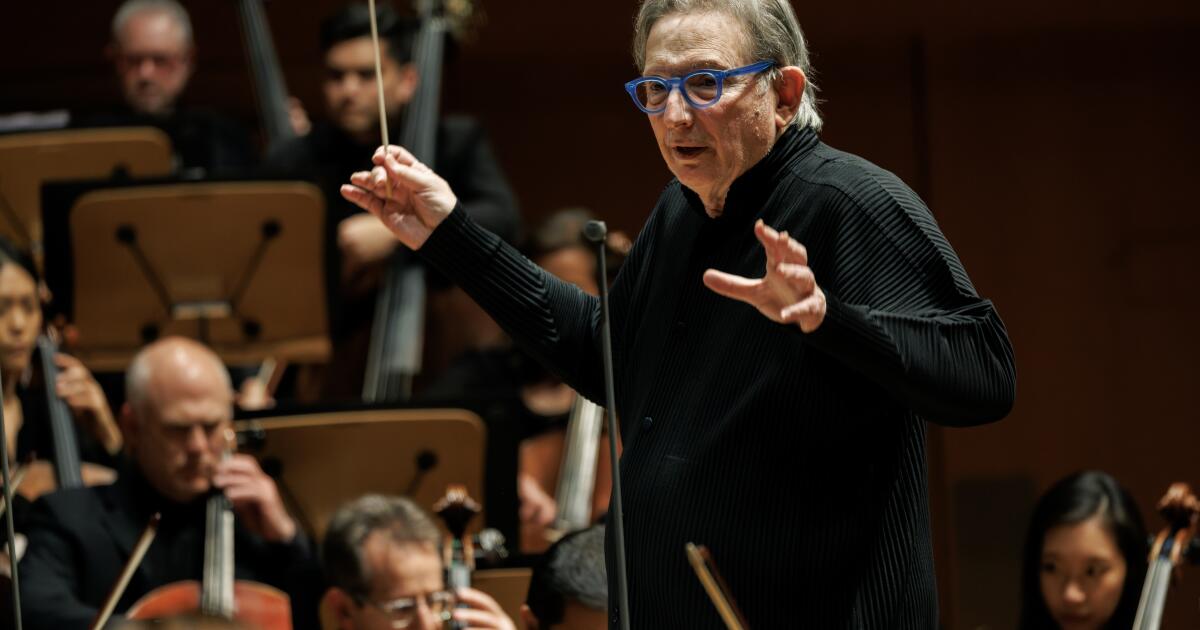
Michael Tilson Thomas embodied L.A.’s musical essence
Michael Tilson Thomas came onto the scene as a great hope for classical music, American music, Los Angeles music, modern music, multifaceted pop music, maverick music, Russian music, Broadway music and just plain music, whatever it might be and from wherever it might be found. He lived his 81 years as conductor, pianist, composer, educator and media personality promoting that hope, and died Wednesday having shown how hope is done. He looked ahead. He looked back. Yet he lived for the now.
It wasn’t always easy. He wasn’t, to say the least, always easy. But MTT made music matter by making hope matter. He was, moreover, one of us. He achieved greatness though an epic amplification of a uniquely L.A. positivity in which grumpy became wistful.
I first encountered MTT as a kid clarinetist and he, Michael Thomas back then, a student conductor at USC and already, at 19, music director of the Young Musicians Foundation Debut Orchestra. He was soon everywhere. A piano prodigy, he regularly performed (and hobnobbed) with the likes of Stravinsky, Copland, Boulez and Cage at Monday Evening Concerts programs when the Los Angeles County Museum of Art opened in 1965. That summer, he appeared at the Ojai Music Festival, which he would go on to lead as music director seven times.
MTT liked to describe his L.A. youth as driving from Jascha Heifetz’s house in the Hollywood Hills (where he accompanied the famed Russian violinist in classes) to LACMA to rehearse Ives and Renaissance music, to composition and conducting classes at USC. Then it was home to the San Fernando Valley to practice Beethoven.
All the while, he listened to the hip L.A. 1960s pop music stations on his car radio. He was particularly keen on, and became friends with, Chuck Berry. Home was where he would also encounter screen legends. Tilson Thomas’ father worked in films and television as a screenwriter, producer and dialogue coach. Theodor Thomas was, as well, a painter with a visionary sensibility and a pianist, self-taught other than a handful of lessons from Gershwin.
But it was Tilson Thomas’ mother and grandmother who may have had the biggest influence. His mother was a public school teacher. She instilled what became a key trait in her only child, who treated conducting as an exercise in learning both for the musicians and the audience (if not for him, because he basically knew it all). His grandmother, Bessie Thomashefsky and her husband, Boris, were stars of Yiddish theater on New York’s Lower East Side.
Boris died in 1939, five years before MTT was born. But Bessie and young Michael were close. She recognized that, like her, he was born for the stage, and regaled him with stage lore that put the stardust in his eyes. As a young kid, MTT played Beethoven piano sonatas so impressively that he wowed his babysitter, an architecture student at USC named Frank Owen Goldberg, who needed extra cash.
Frank Gehry, as he became, told me that MTT was already an entrancing showman. The two remained lifelong friends.
While MTT did not actually reside in L.A. for most of his life, he never really left it. It prepared him for all that was to follow. In high school, he met Joshua Robison, who became his lifelong partner and ultimately husband. Whether in New York, Miami, London or San Francisco, wherever they lived, they always talked about L.A. His father’s paintings were on the walls, as were Boris’ Yiddish theater posters, one proclaiming “King Lear,” translated and improved.
The Tilson Thomas package that emerged from L.A. was unlike any conductor the world had seen. He doted on the music of Rachmaninoff when Rachmaninoff was unfashionable and on Steve Reich when Reich was found unfathomable. He adopted classical music’s neglected outsiders and especially such key West Coast “mavericks” as Lou Harrison and Henry Cowell. He convinced Meredith Monk to write for orchestra and enticed everyone from Sarah Vaughan to the Mahavishnu Orchestra onto the symphony stage.
Studying at Tanglewood, the Boston Symphony’s summer home, MTT won the Koussevitzky Prize in 1969 and, with the encouragement of Leonard Bernstein, was appointed assistant conductor to music director William Steinberg. Before long, MTT became principal guest conductor, filling in frequently for Steinberg, who was in poor health.
MTT in his early 20s was vibrant, arrogant, fearless, full of ideas, a chance taker. Ever the Angeleno, he tooled around town in a Porsche. He talked to staid symphony musicians and audiences who didn’t want to be talked to and often played music they didn’t want to play or hear. And he dazzled them. He got a contract with the distinguished German record label Deutsche Grammophon and made exciting records with the orchestra of Tchaikovsky, Stravinsky, Ives and modern Americans. They remain a thrill to hear.
By 1974, it was Tchaikovsky one moment and a wonderfully crazy avant-garde opera the next. Stanley Silverman’s “Elephant Steps,” which MTT recorded in 1974, was for pop singers, opera singers, orchestra, rock band, electronic tape, raga group, gypsy ensemble and, of course, elephants. Richard Foreman wrote the libretto. There had been nothing like it then or since. A revival could prove a sensation. The Olympic arts festival, anyone?
At the same time, Tilson Thomas, who proved a born educator, succeeded Bernstein in delivering the New York Philharmonic’s Young People’s Concerts. When Steinberg left, the Boston Symphony Orchestra passed over MTT as too young (24) and not ready (he wasn’t, nor was Boston). He was just right, though, for the Buffalo Philharmonic, which he led from 1971 to 1979. It was a wild ride, with lots of exciting new music and no small amount of controversy — arresting performances of arresting new works (Morton Feldman in particular) and an actual arrest at Kennedy International Airport when small quantities of cocaine, marijuana and amphetamines were found in his luggage.
He may have seemed ready for a homecoming in 1981, but MTT’s appointment as principal guest conductor of the Los Angeles Philharmonic did not prove to be the return of the prodigal son. These were the years of Carlo Maria Giulini’s music directorship, and MTT brought currency — new music, Gershwin, flashy showstoppers. Much of it was a breath of freshest air, but he was also remembered for his brash youth, which was now a brash 30s. He ran afoul of some in the orchestra and of its imperious head, Ernest Fleischmann.
Having been branded the next Bernstein, MTT floundered. What he needed was not L.A., but a far distant remove to find himself. That happened in two parts.
In 1987, the educator in him led to his greatest project, the creation of the New World Symphony in Miami Beach, Florida. The training orchestra guides young musicians with conservatory backgrounds into the world of professional orchestras.
Around the same time, Bernstein talked the London Symphony Orchestra into hiring Tilson Thomas as music director. Far from L.A., Boston and New York, a newly mature MTT found his bearings, no longer the next Leonard Bernstein but the first and only Michael Tilson Thomas.
Miami gave MTT meaning, and he commissioned Frank Gehry to design a revolutionary concert hall and teaching facility. In London, his conducting took on depth without losing its surface glamour. What MTT still lacked, however, was a creative outlook. He had always thought himself a composer and could, at a party, make up a clever song at the piano on the spot. He had drawers full of sketches but little finished work.
It took a return to the West Coast for MTT, having turned 50, to put all of his musical, emotional, personal and spiritual parts together and achieve greatness. For 25 years as music director of the San Francisco Symphony, MTT conducted Mahler and Tchaikovsky with a depth of soul that integrated his Russian roots and Bernsteinian character. He advocated for mavericks in summer festivals. He found his voice as a composer. He and Robison were embraced as a beloved San Francisco couple. He alchemized the San Francisco Symphony into a Bay Area beacon.
In the challenging last chapter of his life, MTT turned tragedy into triumph to became a universal inspiration. The lockdown in June 2020 meant cancellation of his farewell concerts as music director, including a production of Wagner’s “The Flying Dutchman” with a set by Gehry. The following summer, MTT fell on stage while conducting the London Symphony in Santa Barbara. He was diagnosed with late-stage glioblastoma. He likely had less than a year to live.
Remarkably, MTT continued to conduct until last April. His appearances with the L.A. Phil and the San Francisco Symphony were transformative. He guest conducted in New York, London, Prague and elsewhere. In L.A., a dying MTT led a profound performance of Mahler’s death-obsessed Ninth Symphony, not as a farewell but as a shamanistic savoring of every moment of life. He asked not for sympathy but for joy.
For MTT, the music never stopped. In his later years, he advanced the theory that what you took away from hearing a performance mattered as much, if not more, than what you experienced. That may explain why this creature of the theater who was so graceful leading an orchestra and so enjoyed talking to the audience turned stiff and awkward when bowing to acknowledged applause. Was it his reluctance to leave? Insecurity? Attempt to remove his ego from the experience, as if he was now handing the music over to you?
It was probably all of those things. During his illness, when his movement became more difficult, he let go. He was simply happy to be there, happy to share music, happy to be alive, very happy to be loved. His final bows were a celebration of life.
Sadly, Robison died Feb. 22, exactly two months before MTT, who died four days short of a year since his final concert with the San Francisco Symphony. But he lives on through about 150 recordings and his website.
He and Robison worked as tirelessly throughout his illness to archive his life. His website provides a treasure trove of compelling radio and television programs, his copious Thomashefsky Yiddish theater archive, a vast legacy of searching and believing. And hope.