What comes after ‘Viva Mexico’? On the limits of Mexican nationalism
This summer, I cheered — and at times, secretly sneered — in crowds of Angelenos cheering for the Mexican national team during the World Cup.
Friends, colleagues, strangers who had grown up in Southern California arrived at watch parties prepared with the players’ names, stats and even deep lore on what the World Cup meant to each country. Such was the beauty of shared diaspora with other countries in my city of Los Angeles.
Then, it occurred to me: As a Mexican-born immigrant, I should know the players’ names too, right? Should I know the national anthem and maybe even shed a tear as it plays? Maybe I’ve grown cold, maybe bitter, annoyed even, at the fervor, I thought.
But it wasn’t until Mexico was eliminated in its match against England (curse you, Jude Bellingham) that I, on the drive home, sobbed into the steering wheel.
I realized many questions then, which led me to investigate this piece: Why did I finally feel what everyone had been feeling? Why did the World Cup piss me off? Was it only the corruption? Or was there something stranger inside me? There’s no simple answer, but I will start with one word: nationalism.
Suited up in the cardigan of excess privilege, which is my UCLA education, I can easily be trapped in my own musings to identify, assess and even profess what I think should be the truth about what “country” is to me. My “undocumented-ness,” too, however, is not a golden ticket to absolute genius in my country, nationalism, or cross-border identities. For the Chicano Studies-initiated, there are libraries full of books to help answer this question; but here, I posit a few things to chew on.

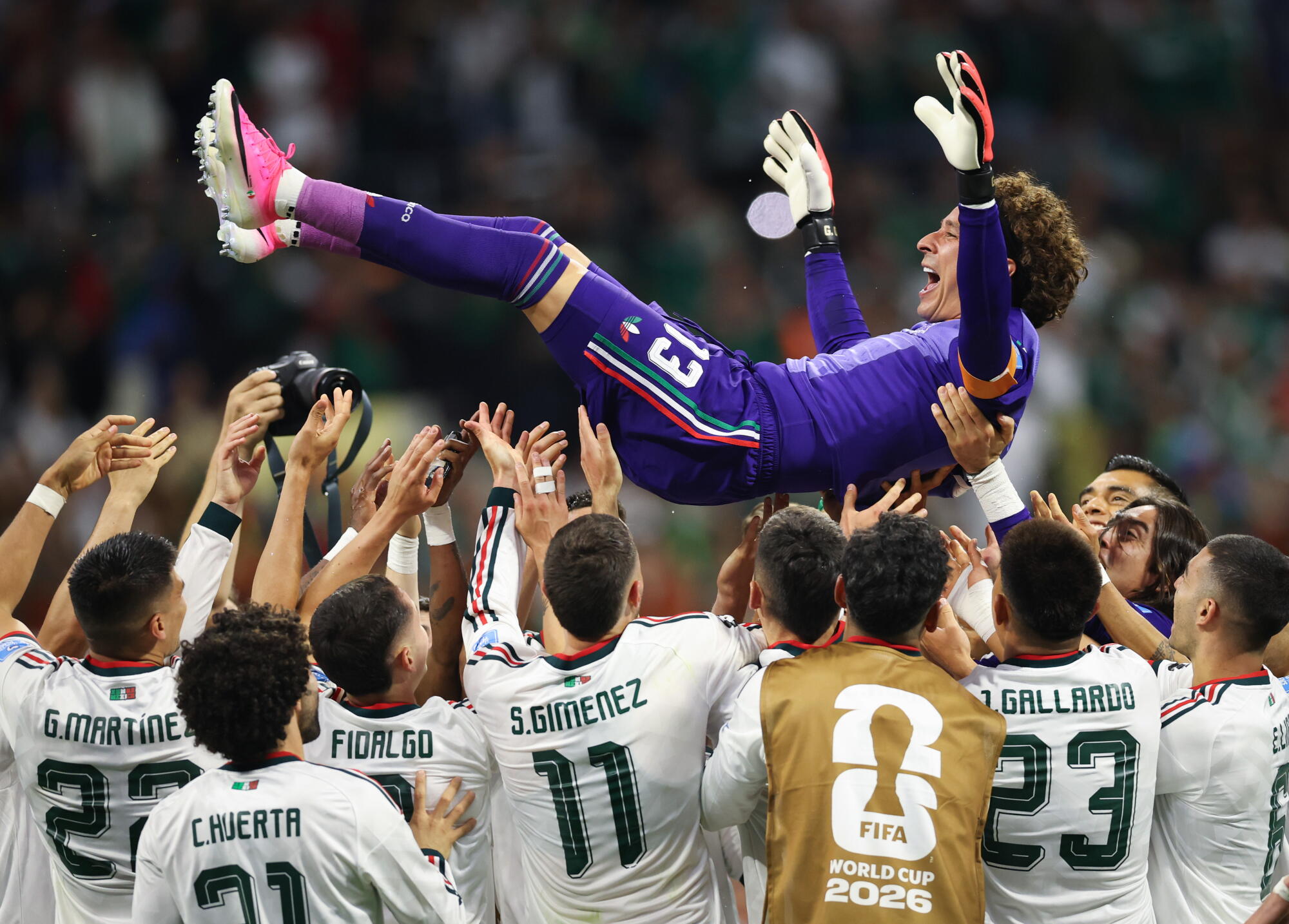
Mexican teammates toss goalkeeper Guillermo Ochoa into the air after their 3-0 victory over Czechia in Group A.
(Molly Darlington / Getty Images)
After the deluge of 2026 World Cup tequila brand activations, and the more recent midterm elections in the U.S. — which, with the help of Latino voters, resulted in a “blue tsunami” of Democratic wins — we’re reaching the end of two very rousing years for Latinas/os. As the summer of 2025 was hallmarked by Immigration and Customs Enforcement raids that have continued to wreak havoc, especially in California, this time has called for a reckoning with our own conservatism, as well as the need for stronger leadership.
When I look back on the times I felt angry in gatherings to celebrate Latinidad — or even my own Mexican identity — I realize that I just want more from us and for us.
The answer to my questions, then, must not come from just ruminating; I must talk to people who know more than I do.
Over the years, I’ve known Rudy Mondragón as a key expert in the intersection of boxing, race and culture, particularly in the ways fighters use the ring to perform identity, belonging and resistance. As an assistant professor at Loyola Marymount University, he asks us to take seriously the few minutes before the bell goes off in the boxing ring: Notice what flags are draped over the athletes’ shoulders, what kind of music booms through the arenas, the colors stitched into their trunks. These were all the things I had been trying to understand as merely symbolic.

Mexico national soccer team fan Hector Chavez, also known as Caramelo, poses with a replica of the World Cup trophy in Iztapalapa, a Mexico City neighborhood, in 2022.
(Kevin C. Cox / Getty Images)
For many Mexicans, both here and in our home country, boxing is one of the main sports we grow up watching — whether we wanted to or not. When I arrived here, I became a huge fan of the L.A. Lakers and Dodgers, but the only times my family would gather around a TV or have carne asadas would be for the big boxing matches. As I grew older, I began to cheer for key fighters, many of whom are working class; and I can profoundly appreciate the greater legacy that the sport carries in our communities.
One of the key things I wanted to deeply understand, however, was why this impact was so huge for our community. Cynically, I’ve asked: Why do so many fighters say “Viva Mexico,” but don’t give back to Mexico? What do they stand for?
“You’re not saying that you support the federal government, the nation-state,” explains Mondragón over a Zoom call, with a framed Muhammad Ali photograph behind him. “It’s their way of expressing their version, their definition, which is infinite in terms of how we can express and socially construct being Latino, being Mexican.”
When Canelo wins and says “Viva Mexico,” it becomes our victory. Many of his high-profile fights have been with non-Mexicans too, thus creating a sense of cultural representation among other Latinos who may be forced to see his fights, but can appreciate the intense passion and joy when he wins.
But the same people who create that sense of belonging can also police its boundaries. Mondragón points to Canelo distinguishing Ryan Garcia as Mexican American, rather than Mexican. That matters, because someone with Canelo’s cultural power can help define who the public understands as authentically Mexican.
Mondragón warns, however, against expecting athletes to communicate politics in exactly the vocabulary that activists or academics might prefer. Public gestures can carry political meaning, even when they don’t resemble conventional activism. Their contributions are still impactful and meaningful, but we don’t need to look far to also see how others are expanding what belonging can be.

A portrait of professional fighter and actor Kali Reis.
(Justin J Wee / For The Times)
Kali Reis, a former world champion boxer and actor who identifies with the Seaconke Wampanoag Tribe, offers a different kind of entrance.
Mondragón told me that when Reis fights, she reaches out to Native communities whose lands she is fighting on and invites them to help create her walk to the ring. Rather than simply arriving with her own symbols and asking an audience to recognize them, she has invited members of those communities to walk alongside her — even allowing them to choose music culturally specific to their nation.
In Reis’ telling, Mondragón says, the entrance borrows from the opening of a powwow: The people walking with her are not for decoration; they are helping bless the space before she enters it.
I keep coming back to that distinction: Reis is still performing belonging. She is still using music, clothing and ceremony to tell thousands of people who she is. But she is not necessarily drawing a circle around herself and declaring who belongs inside it — she is asking the people whose land she enters to help draw the circle with her.
In a sport so often expensively sold through flags, borders, and at times racist and xenophobic rivalries, her entrance offers another possibility: What if pride did not require making the borders of belonging smaller but invited more people into its making? What if nationalism alone isn’t what creates community?

Bad Bunny at the Super Bowl LX halftime show in February. His powerful performance illustrated the complexity of the Latino community.
(Eric Thayer / Los Angeles Times)
Vanessa J. Díaz, who recently appeared on the De Los podcast, pushes the argument further: Art, music, dance and cultural expression are not necessarily separate from material resistance, but they help us imagine what community can truly look like for Latinos.
Also a professor at LMU, Díaz has become the leading chronicler of Bad Bunny’s relationship to Puerto Rican identity and resistance. She is the co-author, with Petra Rivera-Rideau, of “P FKN R: How Bad Bunny Became the Global Voice of Puerto Rican Resistance,” a book that places his music and political expression within a much longer history of Puerto Rican cultural resistance.
“If we are talking about resistance in comprehensive terms, then we make room for lots of different kinds of resistance,” Díaz tells me in a series of phone calls.
For her, the symbolism is the material; it is the powerful arm to meet the ends of empowerment and healing for our community. Beyond all the anthems Bad Bunny played during his halftime show — songs that carried me from my 20s into my 30s — it was him literally painting a picture of how complex our Latino community is at the Super Bowl, which in my opinion, remains the most powerful Latino cultural moment in recent times. (And, yes, this means I count Gaga as an honorary Latina now. Deal with it.)
Bad Bunny, to some, has campaigned for candidates, funded political billboards and unequivocally impacted his Puerto Rico — extending the idea of what nationalism is. He also shows how expanding it can be a more impactful form of pride, rather than just touting your country’s name.
“[But] can one person do everything?” asks Díaz. “Is one person responsible for all of the different components of a movement? I don’t think so.”
However, she adds: “Every movement has [to have] a soundtrack.”
In Puerto Rico, she argues, music has never simply accompanied resistance; it has been one of the ways people practice it. From bomba carrying messages of revolt and abolition to reggaetón emerging from poor Afro-Puerto Rican communities and narrating experiences of racism, poverty, and policing, culture has long been one of the places Puerto Ricans make politics.
And perhaps that is what I had been missing when I first started asking what comes after “¡Viva México!” — the song, the dance, the flag, the entrance, even the cry itself do not have to be the thing that comes before political action. Sometimes they, the universal one, are already doing something: preserving memory, teaching history, finding one another, or simply giving people enough joy to imagine themselves as a people worth fighting for.
Puerto Rico, to some, is a modern colony, a settler colonial state to the U.S. But though its political context is different from that of Mexico, it can offer a deeper imagination of what is possible. Benito did not need to include Chicanos, or any other Latin American flag at the Super Bowl — but choosing to display those visuals alone are what truly got our community together in ways a simple gesture just can’t.
The anger I felt during the World Cup, I know now, was just a yearning for more. In an ideal timeline, Mexico would have made it to the finals and won. Los Angeles would have erupted into a parade — and I would have marched across the border to reunite with my family. In this world, there are no ICE agents; there is only music; there are only long hugs.
Maybe that is why I still feel angry, but that is also why I will keep returning to music and gatherings — because what I long for is not the validation of the nation-state. What I really long for is community.