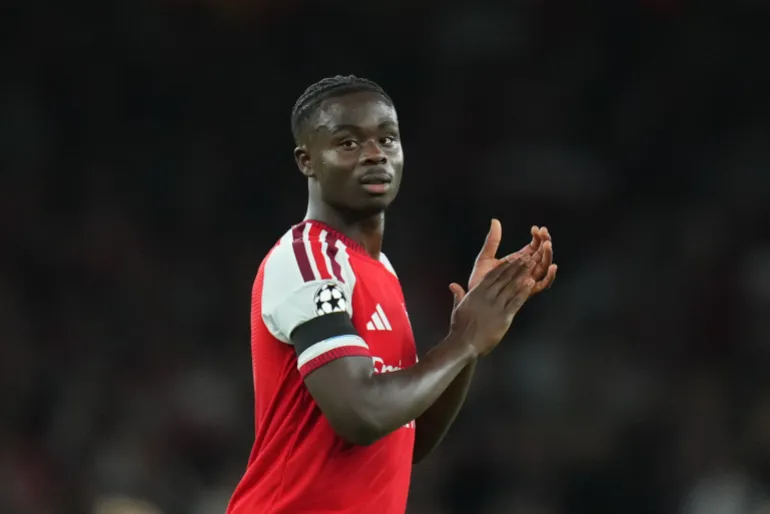
Champions League analysts Nedum Onuoha, Guillem Balague and Stephen Warnock look at two contentious handball decisions that weren’t awarded against Paris St-Germain, including a potential red card for Nuno Mendes and a possible penalty for Bayern Munich.
Bayern Munich players, coaching staff and fans at the Allianz Arena were in disbelief after they were denied a penalty for a handball by Joao Neves in their Champions League semi-final second leg against Paris St-Germain.
Trailing the holders 1-0 on the night and 6-4 on aggregate, the German side’s players surrounded referee Joao Pedro Silva Pinheiro at the half-hour mark when Vitinha rifled a clearance against his own team-mate Neves’ arm inside the box.
But Pinheiro waved away the Bayern protests with the video assistant referee (VAR) also not intervening, leaving social media wondering why a spot-kick was not given.
According to BBC Sport’s football issues correspondent Dale Johnson, it was because of a little-known exemption within the handball law.
According to the laws of the game, it is not a handball if “hit on the hand/arm by the ball which has been played by a team-mate (unless the ball goes directly into the opponents’ goal or the player scores immediately afterwards, in which case a direct free-kick is awarded to the other team)”.
“It covers when the ball is unexpectedly hit at you by a team-mate, even if your arm is away from your body – the law says you should not give away a penalty,” said Johnson.
“When Vitinha blasts the ball clear, could Joao Neves think the ball would be hit straight at him?
“Of course, this could be overridden by deliberate handball, but in the context of this situation, a penalty would not be expected to be awarded.”
In the south-west of Munich, Schlachthofviertel is an area in flux; a jarring district that is home to a theatre, a techno club and a controversial active slaughterhouse.
In the 1870s, after the final cholera epidemic in Munich, a municipal slaughterhouse (Schlachthof) was built on what was then the outskirts of the city as part of a wider effort to improve hygiene standards. Although it is still in use today, the site has dramatically decreased in capacity, and creative entrepreneurs have been quick to see the potential of unused spaces.
In 2021, the Münchner Volkstheater (People’s Theatre) moved to the area, bringing a new cultural status and sparking fears of accelerated gentrification. For me, it’s a part of town I go to for a change of scene or just a loaf of double-baked rye bread. In summer, the open-air spaces come out of hibernation and show a much edgier side to Munich.
Where to eat and drink
Today, butcher’s shops and cult dive bars sit side by side. There has been a flurry of openings; my favourite recent addition is the female-run Mari on Adlzreiterstraße, the street Albert Einstein lived on for much of his childhood. The airy cafe serves a late breakfast, including a Korean option of marinated tofu and miso mayonnaise.
The Brotatelier bakery operates from a shipping container, and bakers use equipment on wheels to maximise the limited space. From the cinnamon buns to the French fougasse bread, all products are prepared with sourdough. “Everybody has time here; we haven’t had a single customer who was stressed or anything like that,” says co-founder Christof Teriete, whose bigger concern is the impact of the fluctuating container temperatures on the sourdough starters.
For drinks, start at Frisches Bier, run by craft brewer Tilman Ludwig. He has his own beers on tap, along with a small selection of other independent labels, such as Bierol from Tirol and Hoppebräu from southern Bavaria.
‘It’s not about comfort, it’s about maximum inspiration.’ Photograph: Fabian Christ
Cultural experiences
On one side of Zenettistraße is the decommissioned cattle market (Viehhof). The red brick walls are now home to the Volkstheater. Launched with a production of Christopher Marlowe’s Edward II, the diverse programme includes the Radikal jung festival, focused on emerging directors, and the U20 Poetry Slam, which invites young writers to present their work.
Next door is Bahnwärter Thiel, the heart of Munich’s underground scene, were graffitied shipping containers and the occasional caravan provide studios for DJs, artists, potters, goldsmiths, bakers (see above) and non-profits. “There’s no central heating or running water in the containers,” says Kati Legge from female creative office High Five, “but it’s not about comfort, it’s about maximum inspiration and the fascinating people around you.”
Raised garden beds add touches of green and upcycled materials are used for sculptures and makeshift walkways. There’s also a bar in an old tram, a restaurant in a train carriage and a techno club open till 6am weekends.
The Viehhof, the city’s decommissioned cattle market, is now home to the Volkstheater. Photograph: Sport Press Photo/Alamy
Where to shop
Rindchen’s Weinkontor has a huge selection of wine stored in a roomy, listed building. At Moss Concept Store on Thalkirchner Straße you’ll find ceramics, glassware and other home accessories.
Don’t miss
Actually quite hard to miss is Alte Utting, a former passenger ship that’s now a bar and event space that fills the length of a bridge over Lagerhausstraße. Destined for the scrapyard after years of service on Ammersee, it was rescued and relocated in 2017 by Wannda, the people behind Bahnwärter Thiel.
Where to stay
There’s little tourist accommodation in Schlachthofviertel, but there are hotels close to the nearby Oktoberfest site. Cocoon Theresienwiese has doubles from around €80 room-only.
Three-man forward lines have been a staple tactic throughout the history of football.
But they have arguably never been as popular as they have over the last 15 or so years.
It is a resurgence that is largely down to Barcelona’s success under Pep Guardiola between 2008 and 2012.
Guardiola helped Barcelona win two Champions Leagues and three La Liga titles with a dominant possession-based style.
It was a revolutionary system that relied on both the midfield and front line – operating with a recognised number nine – to be fluid in and out of possession.
Nine‑time Ballon d’Or winner Lionel Messi was usually the most central attacker, though he often dropped deep to either drag defenders out of position and create space for his team-mates, or to create a numerical advantage in midfield.
Either way, the end result was a fluid style of football that was practically impossible to stop and resulted in Barcelona claiming 14 trophies during Guardiola’s time at the helm.
Since then, three-man forward lines have become fairly prominent in Europe, with the likes of Real Madrid and PSG deploying similar tactics in the years that followed.
In the Premier League, however, the forward line that resembled Guardiola’s side most closely was Liverpool’s Champions League and Premier League-winning trio of Sadio Mane, Roberto Firmino and Mohamed Salah.
During their five seasons together at Anfield, Firmino was deployed as the Reds’ central attacker and, similar to Messi, was responsible for dropping between the lines, linking play with the midfielders and ultimately creating space for Mane and Salah to run in behind.
The trio is widely regarded as one of the greatest forward lines in the history of English football, having helped Jurgen Klopp’s side win a haul of major trophies.
The tone was set for a dazzling European encounter when both sets of fans unfurled giant tifos before kick-off – PSG’s was emblazoned with the words ‘the conquest of Europe’, while the visitors’ banner urged their side to ‘give everything’.
In a chaotic opening 45 minutes at the Parc des Princes, both sides did just that.
It was fitting the two top-scoring sides in the Champions League this season put five goals on the scoreboard in a mesmerising, end-to-end opening period.
Harry Kane’s penalty was cancelled out by Khvicha Kvaratskhelia’s clinical finish, before Joao Neves’ glancing header and Michael Olise’s moment of individual brilliance left the sides level.
Many will suggest the PSG penalty, awarded after Bayern defender Alphonso Davies was deemed to have handled an Ousmane Dembele cross in the box, was harsh. Dembele calmly converted to give PSG a 3-2 lead at the break.
But the controversial incident was ultimately overshadowed by what pundits called one of the greatest halves of football they had ever witnessed.
Former England captain Alan Shearer said on Amazon Prime: “I can’t stop smiling at how open and bonkers this game is.
“It’s one of the greatest games I’ve ever been to. Two teams that believe in their own ability to outscore their opponent.”
The chaos continued after the break with PSG building a three-goal cushion, again through Kvaratskhelia and Dembele, leaving some to wonder if the outcome had been settled.
But Bayern were unwilling to let the chance of a first Champions League title since 2020 get away from them as they fought back in fearsome fashion.
Goals from Dayot Upamecano and Diaz were met with stunned silence from the home fans and no further response from the PSG players as the hosts finished with a slim advantage.
“I have been managing for more than 15 years, and I have to say it was the most exciting [match],” added Luis Enrique.
“It is important to show that that is the way to try to play football. OK, we are not happy as a coach when you concede four goals, but I’m happy because we won.”
It was the first time in any major European semi-final that both sides had scored at least four goals, and just the second time in a Champions League knockout match after Chelsea and Liverpool drew 4-4 in the 2008-09 quarter-final.
With PSG netting 43 goals and Bayern 42, it was also the first time two teams have each scored more than 40 times in a Champions League campaign.
It was always going to be difficult for the second period to match the high-octane tempo of the first, and instead the decisive moments, both mad and magnificent, were compacted into the final few minutes.
With extra time looming, substitute Camavinga was dismissed for two yellow cards within 24 minutes of coming on. The first was for a foul on Jamal Musiala in the 78th minute and the second for taking the ball and delaying a Bayern free-kick following a foul on Kane.
The red card was to prove costly for him, and his team as the hosts made the most of their advantage.
Luis Diaz struck in the 89th minute to make it 5-4 to Bayern on aggregate, before Michael Olise put the icing on the cake in stoppage time.
With Guler also sent off in the aftermath, Real boss Alvaro Arbeloa admitted: “With the red card everything was over.
“It’s unbelievable to send off a player for this action. It’s not possible in a player like that, match like that. We feel all of this is a bit unfair.”
For Bayern, a semi-final against holders Paris St-Germain will follow and boss Kompany said: “The boys were mentally strong to recover from setbacks.
“The fans helped us as well. We stayed calm and always felt that our moment would come. The boys deserved this win.
“We showed absolute belief and will to fight our way back into the game.”
Gerrard, a 2005 Champions League winner with Liverpool, described it as “an incredible game of football, end-to-end, fascinating tactical approaches”.
“Extra time was looking likely, but one moment of madness, indiscipline and silliness has cost Real the chance of getting to the last four,” he added.
Former Liverpool defender Stephen Warnock told Match of the Day: “Both teams were brilliant going forward, but defensively both have been poor.
“If you want to win the Champions League, can you play like that? It is going to be fascinating to see how that pans out when Bayern face Paris St-Germain.”