MQ25

USS Theodore Roosevelt Is The First Carrier With A Drone Control Center Ready For MQ-25 Stingray Ops

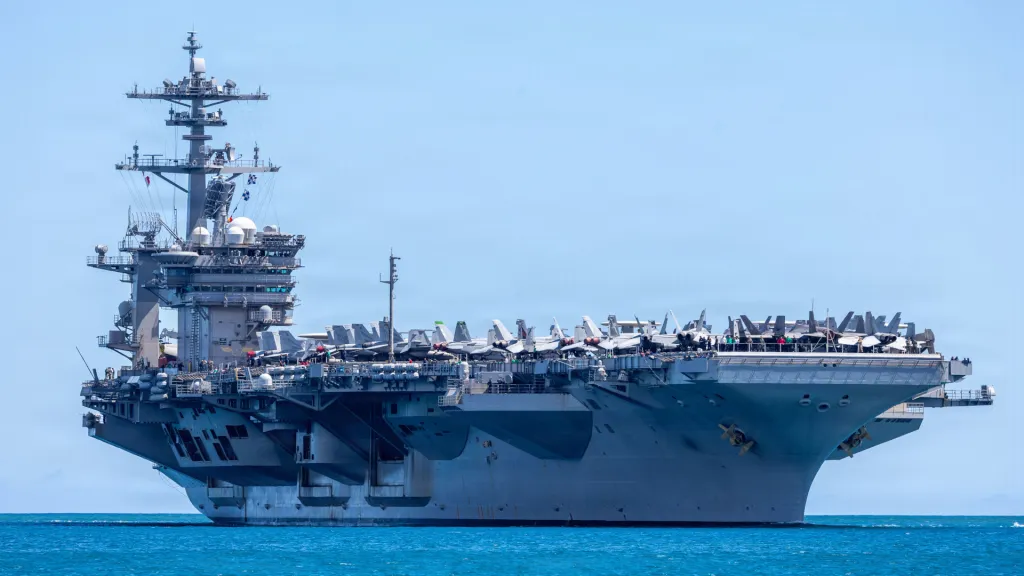
The Nimitz class USS Theodore Roosevelt has become the first U.S. Navy supercarrier with an Unmanned Air Warfare Center (UAWC) fully capable of supporting the forthcoming MQ-25 Stingray tanker drone. This marks another step toward the Navy finally reaching initial operational capability with the MQ-25, now set to come in 2029 after years of delays. There is still a lot of work to be done before the Stingray can be fully woven into routine carrier flight operations.

The new details about the Theodore Roosevelt‘s UAWC and other information about the MQ-25 are contained in a Modernized Selected Acquisition Report (MSAR) that the Pentagon recently released. The report itself is dated April 21, 2026, and it was produced as part of work on the U.S. military’s proposed Fiscal Year 2027 budget.

“In March 2026, the USS Theodore Roosevelt (CVN 71) UAWC became the first fully operational/deployable MQ-25 capable aircraft carrier,” according to the report. “The USS Ronald Reagan (CVN 76) UAWC is planned to be operational/deployable at the end of Aug 2026.”

A stock picture of the USS Theodore Roosevelt, seen here returning to Pearl Harbor in Hawaii during Exercise Rim of the Pacific 2026 (RIMPAC 2026) in July 2026. USN

“In August 2024, the first test Unmanned Air Warfare Center (UAWC), where Air Vehicle Pilots will control future MQ-25 airborne operations, was installed and tested aboard the USS George H.W. Bush (CVN 77),” the report also notes.

The USS Ronald Reagan and USS George H.W. Bush are also Nimitz class aircraft carriers. The Navy publicly announced the integration of the UAWC on the George H.W. Bush, a first-of-its-kind development, back in 2024. It is unclear why Theodore Roosevelt‘s UAWC has now become the first to be fully certified to support MQ-25 operations. It has been previously reported that the Navy’s plan is to deploy Stingrays first on the Theodore Roosevelt.

As mentioned, the MQ-25 program, overall, has been beset by delays, as well as cost growth, for years now. The Navy originally hoped to see the Stingray reach initial operational capability (IOC) in 2024. The IOC timeline subsequently slipped to July 2027 and has now been pushed even further to the right to February 2029. The first production representative example only made its maiden flight this past April. An earlier MQ-25 demonstrator, also known as the T1, has been flying since 2019.

The first production-representative MQ-25 Stingray drone seen during its maiden flight in April 2026. Boeing

The Navy currently plans to acquire a total fleet of 76 Stingrays, which will offer critical range extension for current and future aircraft in its carrier air wings. The aim, in turn, is also to eliminate the need for crewed F/A-18E/F Super Hornets to fly in the tanker role, which accounts for a significant portion of their sorties while deployed. This will free up those aircraft up for other missions and reduce overall wear and tear on the airframes. The new drones will also have a secondary intelligence, surveillance, and reconnaissance (ISR) capability from the start.

“The MQ-25 Air System is integrating a Ground Control Station (GCS) managed by the Unmanned Carrier Aviation Mission Control System (UMCS) program within UCA [the Navy’s Unmanned Carrier Aviation program]. The UMCS program is a separate ACAT II [Acquisition Category II] program that integrates with multiple networks and systems both afloat and ashore,” the recently released MSAR also notes. “The MQ-25 and UMCS programs are synchronized to provide complete capability to the aircraft carrier.”

While Boeing is the prime contractor for the MQ-25 drone, Lockheed Martin has been leading work on the UMCS, and has described it previously as a “system of systems.” The central element is the MD-5E GCS, which consists of operator stations with arrays of monitors, tablet-like devices, and other computer hardware. What has been seen of the MD-5 system to date in terms of the physical hardware is fully in line with other known GCS designs, including ones the U.S. Air Force has used over the years to operate MQ-1 Predators and MQ-9 Reapers.

A picture the Navy previously released of the inside of the UAWC on the Nimitz class carrier USS George H.W. Bush. USN
An example of a GCS used to operate the MQ-9 Reaper. GA-ASI

The UMCS also includes the Multi Domain Combat System (MDCX), an “autonomy platform” developed by Lockheed Martin’s famed Skunk Works advanced projects division. The company has told TWZ directly in the past that MDCX “provides uncrewed vehicle autonomy, mission planning, and command and control (C2) capability.”

“In October 2025, MQ-25A and the UMCS connected for the first time during air vehicle and Ground Control Station (GCS) Integration Checkout testing, allowing the Lockheed Martin GCS to establish command and control of the aircraft, which was critical to achieving First Flight,” per the recently released MSAR.

“The first Command, Control, Communications, Computers, and Intelligence (C4I) Operational Network Evaluation test event was also conducted in collaboration with the USS Abraham Lincoln (CVN72),” the report also highlights. “This test event transmitted representative-network traffic between an at sea-configured aircraft carrier and a remote MQ-25 surrogate through operational C4I paths that include satellite communications links and the Navy’s primary tactical wide area network.”

The Navy has previously disclosed testing of the UMCS in conjunction with General Atomics MQ-20 Avenger drone to demonstrate the control system’s ability to support other uncrewed platforms beyond the MQ-25. The Navy does envision its future carrier air wings eventually incorporating multiple types of drones, including ones capable of attacking enemy forces at least 1,000 nautical miles away, as you can read more about here. A year ago, the service awarded contracts to Anduril, Boeing, General Atomics, and Northrop Grumman for work on concepts for future carrier-based Collaborative Combat Aircraft (CCA) type designs. Navy officials have said in the past that the composition of the service’s carrier air wings could eventually become 60 percent or more uncrewed.

A US Navy briefing slide from August 2025 discussing CCA contracts and other uncrewed carrier-based aviation plans. USN

Beyond the important additional capabilities the MQ-25 will bring to the Navy’s carrier air wings, the Navy has long described the Stingray as a foundational “pathfinder” for its broader uncrewed aviation plans, something the new MSAR reiterates. As TWZ has explored in detail in the past, the MQ-25’s design and baseline performance, especially its extreme endurance and low-signature design, open the door to the Stingray itself being adapted to strike, advanced ISR, and other missions in the future.

There is more work still to be done before the MQ-25 can enter operational service, including demonstrating the ability of Navy carriers to launch and recover the drones. The service has laid at least some of the groundwork for that years ago with extensive testing involving a pair of X-47B stealthy demonstrator drones, which achieved many firsts for carrier-based uncrewed aviation. That very promising work was done under the Unmanned Carrier-Launched Airborne Surveillance and Strike (UCLASS) program, which subsequently morphed into the radically different Carrier-Based Aerial-Refueling System (CBARS) effort in the mid-2010s. The reasons for that shift are still not entirely clear, as you can read more about in detail here. CBARS ultimately led to the MQ-25.

Northrop Grumman's X47-B Completes 1st Carrier Catapult Launch thumbnail

Northrop Grumman’s X47-B Completes 1st Carrier Catapult Launch


The Stingrays will have to be further integrated into routine flight deck operations, including just making sure they can be safely moved around with everything else going on. As we have previously written:

“Carrier decks are very constrained environments physically, and present very different conditions to operate in compared to bases on land. This is true even for crewed aircraft operations, where individuals onboard can provide additional situational awareness. A wearable glove-like system that personnel could use for deck handling was notably used during testing of the X-47B. A different kind of portable control device has been used in testing of the T1 MQ-25 demonstrator in the past, as well. The video released today does not appear to offer any major new insights into how the Navy plans to maneuver the Stingray around on carrier decks.”

It is still unclear what the Navy will be using to manage operational MQ-25s on carrier flight decks when the drones enter service.

The glove-like system used during testing of the X-47Bs. USN

The Navy has already been working to establish new units and training pipelines to support the future MQ-25 fleet. The Stingray force structure is set to be deeply intertwined with that of the Navy’s E-2 Hawkeye airborne early warning and control aircraft.

With the USS Theodore Roosevelt‘s UAWC now deemed fully able to support MQ-25 operations, the Navy has moved at least one more step closer toward finally fielding the Stingray.

Contact the author: joe@twz.com
Joseph is TWZ’s Deputy Editor, helping to oversee the site’s highly experienced and dedicated team, while also writing informative and impactful defense and national security content. He lives right in the thick of it in the Washington, D.C. area.


Source link

MQ-25 Stingray Demonstrator Goes Aboard USS Nimitz For 250th U.S. Anniversary Celebrations

The U.S. Navy has confirmed to TWZ that the MQ-25 Stingray demonstrator drone, also known as T-1, is embarked on the supercarrier USS Nimitz. Pictures of Nimitz with the uncrewed aircraft on its deck had prompted questions about whether the initial production representative MQ-25, which made its maiden flight in April, had now gone aboard a carrier for the first time. We now know that is not the case. Regardless, the images of T-1 aboard Nimitz still underscore just how big the Navy’s first advanced carrier-based drone actually is, especially when placed next to other aircraft in the air wings. Production MQ-25s will be an important and imposing presence when they enter operational service, something the service hopes will finally start next year.

“We do indeed have a Boeing-owned T-1 prototype currently onboard,” a Navy spokesperson told TWZ today when asked about the drone seen on Nimitz‘s deck.

A view of T-1 and other aircraft on the deck of USS Nimitz. USN/Seaman Johnathan McCune

The spokesperson directed us to contact Naval Air Systems Command (NAVAIR) for more information about the current status of the MQ-25 program. T-1 has been flying since 2019 and has taken part in a slew of testing in support of the development of the Stingray in the air and on the ground. This also includes deck handling testing aboard the Nimitz class carrier USS George H.W. Bush in December 2021, something we will come back to later on. T-1 has never taken off from or landed aboard a Navy carrier, and would have had to be transported aboard Nimitz.

Another view of Nimitz, with the T-1 MQ-25 demonstrator and other aircraft on its deck, taking part in a group sail photo op as part of Fleet Exercise 250 on June 25, 2026. USN

“To honor the United States’ 250th anniversary, the MQ-25A T1 prototype is aboard the USS Nimitz, offering a glimpse of the Navy’s carrier air wing of the future,” Boeing has now also written in a post on X. “The special ‘Boeing Backs America’ mark highlights our support for U.S. aviation.”

The USS Nimitz has been sailing in the Atlantic Ocean as part of Fleet Exercise 250 (FLEETEX 250). This is a large, multi-national event that is running concurrently with several celebrations marking the 250th anniversary of the United States. In addition to the United States, Belgium, Brazil, Canada, Cameroon, Côte d’Ivoire, Cyprus, Denmark, France, Germany, Mexico, Morocco, the Netherlands, Norway, Peru, Senegal, Spain, Turkey, and the United Kingdom are also taking part, according to the Navy. As part of FLEETEX 250 activities last week, Nimitz had taken the lead in a group sail photo exercise that included 25 other naval vessels from 13 of the participating countries.

A full view of the ships participating in the FLEETEX 250 group sail photo op on June 25, 2026. USN

“USS Nimitz is underway taking part in Fleet Exercise (FLEETEX) 250 alongside 25 other warships, multi-national aircraft, and their crews, conducting a series of structured training events at-sea,” a Navy spokesperson had also told TWZ last week in response to queries about that ship after it was spotted leaving Mayport, Florida, on June 25. “Following FLEETEX, we are scheduled to take part in another major event celebrating our nation’s 250th birthday.”

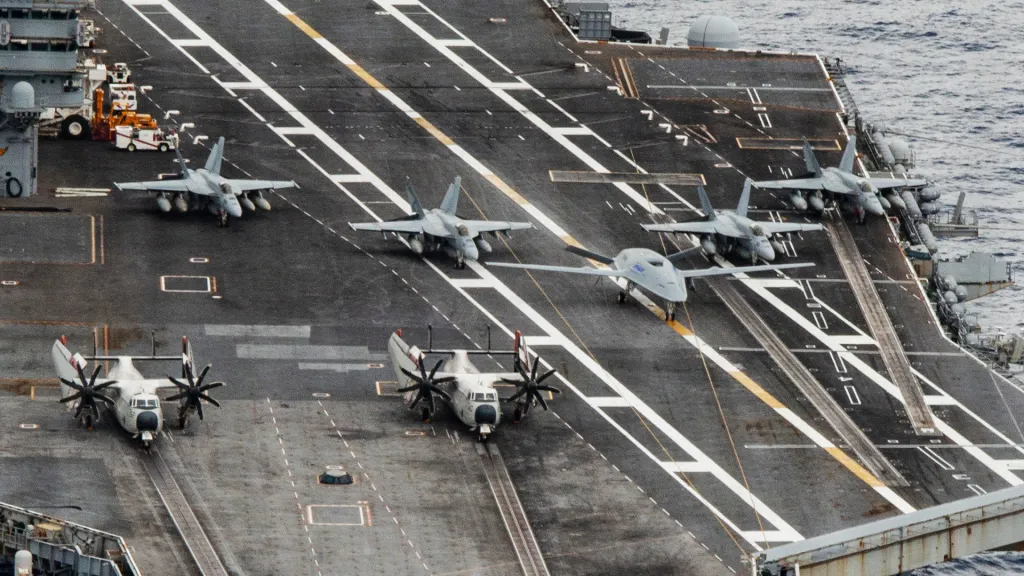
The T-1 demonstrator was lashed to the carrier’s deck for the pictures, along with four F/A-18E Super Hornet fighters and two C-2A Greyhound carrier onboard delivery aircraft. The drone notably has new “250” markings written in blue on both sides of the fuselage.

A picture offering a look at the current markings on T-1. US Navy via Boeing
Another view of T-1’s new markings. USN

As noted, T-1’s size stands out when parked next to the F/A-18Es, which are themselves not small aircraft. The production MQ-25 has a wingspan of 75 feet, according to Boeing. With its wings folded, the drone is still 31.3 feet across, as well as 51 feet long. For comparison, the Super Hornet’s wingspan is nearly 45 feet and it is just over 60 feet long, per the Navy.

T-1 looks large even when contrasted with the C-2As, at least with their wings folded. With its wings extended, the Greyhound is 80 feet, seven inches from tip to tip, according to the Navy. It is also 56 feet, 10 inches in length.

A close-up view of T-1 on Nimitz’s deck offering more of a visual comparison to the F/A-18Es parked alongside, as well as the C-2A at bottom left. USN

All of this underscores the amount of work the Navy will have to do to get production MQ-25s ready for routine operational use. As we wrote roughly a year ago, when the start of ground testing of the production representative Stingray was announced:

The Stingrays will also have to be woven into the existing cadence of flight deck operations, including just figuring out how to move them around amid the hustle and bustle of other activity. Carrier decks are very constrained environments physically, and present very different conditions to operate in compared to bases on land. This is true even for crewed aircraft operations, where individuals onboard can provide additional situational awareness. A wearable glove-like system that personnel could use for deck handling was notably used during testing of the X-47B. A different kind of portable control device has been used in testing of the T-1 MQ-25 demonstrator in the past, as well. The video released today does not appear to offer any major new insights into how the Navy plans to maneuver the Stingray around on carrier decks.

T-1 seen during deck handling testing aboard the USS George H.W. Bush. USN

This is on top of more general flight testing, including demonstrating that the drones can safely take off from and land on Navy carriers, as well as integration with the control systems on those ships. The MQ-25 will bring new tactics, techniques, and procedures to the service’s carrier air wings, as well as open the door to further operational developments.

Right now, the MQ-25’s principal mission will be extending the reach of other aircraft in the carrier air wing. This is a critical capability for the Navy as adversary anti-access and area denial bubbles, especially ones that China’s People’s Liberation Army (PLA) has established and continues to expand, threaten to push carriers out of reach of target areas.

By extension, the Stingray will also eliminate the need to use crewed F/A-18F Super Hornets in the tanker role, freeing them up for other missions and reducing wear and tear on those airframes.

The drones will also come with a built-in secondary intelligence, surveillance, and reconnaissance (ISR) capability, thanks primarily to a sensor turret under the nose. The size of the MQ-25, its extreme range potential, and other attributes of the design could well lead it to be adapted to other roles in the future, such as a long-range strike platform, as TWZ has previously explored in detail.

A look at T-1 in flight from below. Boeing

Showcasing the T-1 during FLEETEX 250 does highlight the Stingray program and its importance to the Navy. The effort has faced significant delays and cost growth in recent years, with the original goal being for the MQ-25 to have reached initial operational capability (IOC) in 2024. As noted, the first production representative example only flew in April, despite a major push by the Navy and Boeing to hit that milestone before the end of 2025. When that drone might make its first appearance on a carrier deck remains to be seen, but the Navy is now aiming to reach IOC sometime next year.

As an aside, carrying T-1 for display during FLEETEX 250 and associated events may be the extent to which Nimitz ever embarks any MQ-25s. The Navy has extended the carrier’s service life due to a number of factors, but only into March of next year. The USS George H.W. Bush received a first-of-its-kind drone control center in 2024. The Navy subsequently moved to install that equipment on the USS Carl Vinson, USS Theodore Roosevelt, and USS Ronald Reagan, creating an initial group of Nimitz class carriers that will be able to operate the Stingrays.

USN

The Navy also sees the MQ-25 as a ‘pathfinder’ to future uncrewed additions to its carrier air wings. This is set to include carrier-based Collaborative Combat Aircraft (CCA) drones, an effort that is still very much in its infancy. Navy officials have talked in the past about a goal to see the makeup of future carrier air wings be 60 percent or more uncrewed.

In the meantime, T-1’s latest appearance on the deck of the USS Nimitz has already underscored the big changes coming to Navy carrier air wings, both figuratively and literally.

Contact the author: joe@twz.com

Joseph is TWZ’s Deputy Editor, helping to oversee the site’s highly experienced and dedicated team, while also writing informative and impactful defense and national security content. He lives right in the thick of it in the Washington, D.C. area.


Source link